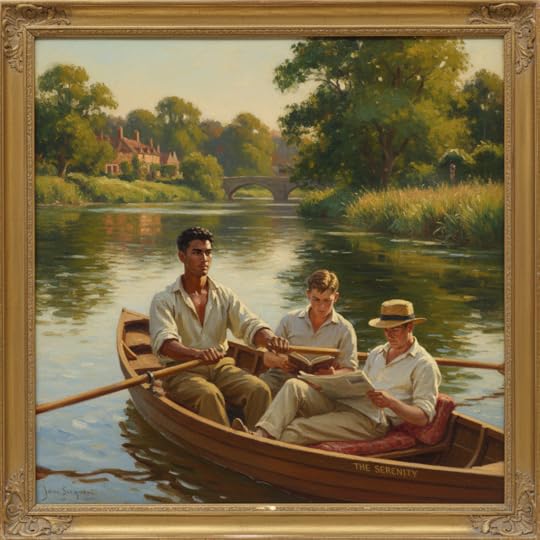
Dave Win ist dreizehn, als er zum ersten Mal zu den Hadlows kommt, denen er ein Stipendium für das örtliche Internat verdankt. Das Wochenende bei der einflussreichen Familie eröffnet dem Jungen Möglichkeiten, die zuvor undenkbar schienen. Dave hat seinen birmanischen Vater nie kennengelernt und ist bei seiner Mutter aufgewachsen, einer englischen Schneiderin. Bei den Hadlows eröffnet sich ihm eine bislang ungekannte Welt des Wohlstands. Er ist aber auch den neidvollen Attacken von Giles Hadlow ausgesetzt, dem gleichaltrigen Sohn des Hauses. So verschieden die beiden Jungen sind, so unterschiedlich verlaufen ihre Lebenswege. Während Dave als Schauspieler Erfolge feiert, aber auch mit Vorurteilen und Diskriminierung konfrontiert ist, macht Giles als konservativer Politiker Karriere und kämpft für den Brexit. "Unsere Abende" ist Dave Wins Lebensbericht. Der Roman verfolgt seine Entwicklung durch ein halbes Jahrhundert – von den frühen Jahren als Schüler und Student über erste Beziehungen und den Umzug nach London bis hin zum turbulenten Alltag als Tournee-Schauspieler und einem späten Liebesglück in seinen Sechzigern. Gleichzeitig wird die Geschichte von Daves Mutter Avril erzählt, die nach dem Auszug ihres Sohnes überraschend eine Beziehung mit einer Frau eingeht. Mitreißend und bewegend, geistreich und feinsinnig schreibt Alan Hollinghurst über die Höhen und Tiefen des menschlichen Daseins. "Unsere Abende" ist eine epische Parabel über Kunst und Sex, Rassismus und Klasse, Liebe und Gewalt – ein Meisterwerk von einem der größten Schriftsteller unserer Zeit.
Alan Hollinghurst is an English novelist, and winner of the 2004 Booker Prize for The Line of Beauty.
He read English at Magdalen College, Oxford graduating in 1975; and subsequently took the further degree of Master of Literature (1979). While at Oxford he shared a house with Andrew Motion, and was awarded the Newdigate Prize for poetry in 1974, the year before Motion.
In the late 1970s he became a lecturer at Magdalen, and then at Somerville College and Corpus Christi College, Oxford. In 1981 he moved on to lecture at University College London. In 1997, he went on an Asia book tour in Singapore.
In 1981 he joined The Times Literary Supplement and was the paper's deputy editor from 1982 to 1995.
An instant classic!!! The kind of book you want to write an essay about.
Our Evenings is so expertly crafted -- the writing was just silky smooth, like velvet on the page. Once I started, I couldn't stop reading, and now blame my complete uselessness over the past few days on how distractingly brilliant it was.
We follow a queer Burmese actor from childhood to adulthood, as he comes of age and comes out. It’s also a story about his childhood patron, Giles, who becomes a radicalised pro-Brexit politician (a Boris Johnson-esque figure) in later life. Despite identical education backgrounds, the two men's lives diverge significantly, which is fascinating to watch unfold and Hollinghurst traverses this with expert subtlety.
Perhaps most interesting is the way that "microaggressions" throughout the book towards our central protagonist end up punctuating the entire novel and, indeed, the character's life. Small moments end up having dire consequences, and it's devastating to realise how many of these occurrences would be dismissed in casual conversation in our own world outside of the novel. It's a powerful statement about being aware of one's own use of language, and the way that silly quips or invasive questions can escalate rapidly into deep-rooted prejudices and an atmosphere of hostility.
Our Evenings is also about how love can manifest in myriad forms, and ultimately persevere. It's about the desire to know and be known.
Sometimes I wished for one extra layer of introspection from the character, and some crucial moments were glossed over that I would've liked to have seen unpacked in more depth. Honestly I could’ve read an extra 200 pages of this and spent many more evenings poring over Alan Hollinghurst’s masterful style, so I just wish there was more of it.
The final chapter (the coda) floored me, and I burst into tears. Wow.
at one point when i was reading this book, my fiancé asked me what it was about, and i just kind of sat there for a second before venturing "nothing?"
after another second of thought, i added that thus far it was kind of a coming of age story of a boy in britain, trying to determine what his gay and half-burmese identity means to him after a lifetime of learning what it means to others.
in truth, this is a very slow, very character-driven book. it was never very eventful, and i never felt particularly driven to pick it up, but i enjoyed it whenever i did.
eventually that changed a bit, as i realized i had spent weeks in the occasional company of david win and i was soon going to never do that again. that's something i love about long books: even if you don't notice, they grow on you, a sort of fondness built on extended company. i drew the last 50 pages out over a day.
good timing, too, as i tuned in fully just in time for the book to stick the landing on the growing moral failings of society lurking in the background. i think this is among the best inclusions of the pandemic i've seen in lit fic.
Now Longlisted for the Dublin Literary Award 2026 Listen, I'm usually all into experimental literature and unusual aesthetic decisions, but this, this is traditional storytelling at its very best, an absorbing, sweeping epic about race, class, and sex spanning the last ca. 75 years in the UK, and I just could not put it down. Hollinghurst tells the life story of David Win, born in 1948, whom we first meet as a fourteen-year-old boarder at Bampton school where he is on a scholarship sponsored by the wealthy Hadlow family, known to be avid supporters of the arts. David, who never met his father, is half Burmese and gay, growing up with a single mother who works as a seamstress and causes even more scandal by sharing her life with a woman. He goes on to attend Oxford and then becomes an actor, all through his life having to fight not only racism, but, as a gay man, also homophobia. While David is making his way in the arts, Giles Hadlow, the son of the Hadlow family who is just three months younger than him, makes it big as a Tory MP, a Minister and then a Brexiteer: While David pushes forward, he is the force that pushes backwards.
It is masterful how Hollinghurst manages to convey how David is shaped by the people he meets and his experiences throughout his life, not only his own family and the Hadlows, but also his friends and colleagues. People and instances re-appear thoughout the text, showing David's growth and changing political circumstances - in the background, this is also a story about British politics, especially British racism, from colonialism (David's mother worked for Major General Hubert Rance in Burma, which became independent the year of our protagonist's birth) to social movements and experimental theater (where David is involved) that aimed to overcome everyday racism and professional limitations of non-white artists up to xenophobia-driven Brexit and, finally, the rise of anti-Asian hate crime during COVID. It's of course also a story about a young man growing into his sexuality and experiencing changing societal attitudes towards queer people.
All these themes are carried by the life-like, touching rendering of David, a flawed, deeply human individual chasing happiness. Throughout the text, Hollinghurst adds theater references to numerous plays and the roles David plays, and these references go way beyond pointing towards the struggles of an actor who can't pass as white in the world of British theater: They are interwoven with the story, and good luck to the people writing theses about the complex net of meaning behind this composition (there are also circular references, like the fact that Hollinghurst himself translated Racine's "Bajazet", in which David performs). Additionally, there are hints to other artworks, most notably Burmese fashion, paintings like "The Messenger, a Tragic Gesture", music like "On an Overgrown Path" (which contains the movement "Our Evenings") and poetry like "Spelt from Sibyl’s Leaves" (which contains the lines "Óur évening is over us; óur night ' whélms, whélms, ánd will end us.").
The title also points to actual evenings in the novel, time David spends with people that are important to him. The whole story is told in such a psychologically plausible and nuanced way (the dependency of the arts on the people they criticize! the brutality of love! complex family dynamics! etc.), plus there is a turn at the end that I can't give away which is rather brilliant. I am in awe of this achievement and am now eagerly waiting for Hollinghurst to extend his collection of literary prizes.
Is that why Americans have been reluctant to embrace the novels of Alan Hollinghurst, Britain’s finest prose stylist? Given the extraordinary quality of his writing, he should be snapped up on this side of the Atlantic by refined book clubs that adore Zadie Smith, Ian McEwan and Julian Barnes. Instead, he seems stuck in the U.S. customs queue trying to prove his bona fides.
The sex scenes — the gay sex scenes — are a tempting explanation for Americans’ squeamishness. After all, Hollinghurst’s earliest novels, starting with “The Swimming-Pool Library” in 1988, could still send a whole Moms for Liberty convention into orgiastic paroxysms of rage. And 20 years ago, when “The Line of Beauty” won the Booker Prize, even the most laudatory reviewers — myself among them — felt compelled to pass out smelling salts lest the novel’s explicit content overwhelm virginal readers.
But surely, despite the recent revival of Anthony Comstock, we’ve grown more experienced and worldly, right? Ocean Vuong, Garth Greenwell and Justin Torres are all thriving in the freedom that Hollinghurst helped create. Miranda July’s feminist sexcapade, “All Fours,” has been on the bestseller list for months, and it’s a finalist for a National Book Award. If there were ever a moment for American readers of literary fiction to pick up Hollinghurst, it’s now.
Particularly since, at age 70, this seminal writer has grown coy when it comes to erotic adventures. His gorgeous new novel, “Our Evenings,” is a story of growing up, coming out and making one’s way in the world, but the libidinous elements are almost entirely buried in the satiny folds of his prose. That’s not to suggest any attenuation of his potency, just the natural reckoning of a complicated life lived well, which is the theme of this ruminative story.
“Our Evenings” is presented as the memoir of an actor named Dave Win, one of those performers just famous enough for people to know they should recognize even if they don’t. But at the opening, his origins are so....
It's been seven long years since Hollinghurst's last novel, The Sparsholt Affair - but it's been worth the wait. In only his seventh novel in 36 years, the author once again redefines the English novel, incorporating all he has seen, felt and learnt in his 70 years (we are roughly the same age; I'm 6 weeks older than he).
In telling the story of biracial gay actor David Win, beginning in 1961 when he is 13 and on holiday at Woolpeck, the stately home of his benefactors, the Hadleys, and tracing his ups and down right up through the pandemic year of 2020, Hollinghurst gives us perhaps the finest 'state-of-the nation' novel since his own Booker-winning The Line of Beauty twenty years ago.
Roughly the first half details David's travails as an 'Exhibitioner', a charity student at Bampton, his boarding school, and his relationship with Giles, the wealthy and sadistic scion of the Hadley family, who, naturally, eventually becomes a Brexit-promoting Tory MP. This section not only (consciously?) echoes Hollinghurst's Booker-winner, but every OTHER boarding school novel, somewhat of a Brideshead Revisited Revisited, but with Hollinghurst's exquisite prose and unerring characterizations.
Then the second half covers the rest of David's life, from his early days as a struggling actor in an experimental theatre troupe to a seasoned performer and author, and also delineates through his gay relationships - and that of his own mother with the estimable Esme - the trajectory of the gay rights movement from the time such affairs were illegal, right up to marriage equality.
Even though it took me an inordinate time to read the first half (my fault, NOT the novel's), I breezed through the second section in two days - riveting stuff here, and as theatre is my field, I enjoyed all the references to dramatic works known and imagined.
Many of the 34 chapters could easily be read as standalone short stories, but the throughline makes them even more impactful. I wouldn't be at all surprised to find this on the 2025 Booker longlist, and perhaps Hollinghurst will join that rare pantheon of double Booker winners.
My sincere and grateful thanks to Netgalley and Random House for the ARC in advance of publication, in exchange for this honest and enthusiastic review.
Hollinghurst is one of those writers who disappears off the radar for about a decade and then comes out with such a brilliant book everyone wonders why he is not more prolific. ‘The Folding Star’ was one of the first gay novels I ever read, along with Edmund White’s ‘A Boy’s Own Story’.
These two writers have bookended my gay reading life ever since; not a bad place to start. And now there is a new crop of bright young things crowding through the doors that these two writers flung open so forcefully in their own ascendancy.
I read ‘The Line of Beauty’ before it won the Booker – I was surprised that such an unapologetically gay (and anti-conservative; liberal is not the correct word) novel won such a prestigious award. Maybe Hollinghurst was, too.
One reviewer – I think it was from The Washington Post, which makes sense as American audiences are notoriously prudish – remarked archly that Hollinghurst’s books should be sold with smelling salts, given the graphic (gay) sexual content.
Reading ‘Our Evenings’ – Hollinghurst’s best book to date, in my opinion – and reflecting on his oeuvre, not even ten books, if I recall, it is remarkable how much his preoccupations have changed, and stayed the same, over the decades.
Female characters take the centre stage for a large chunk, the beautiful story of Dave’s mother and her lesbian lover who defy the prejudice of the time and carve out a magnificent life together. Yes, the gay son and his mother is an unfortunate trope of the genre, but Hollinghurst adds such grace and melancholy to this defining relationship of Dave’s life.
You do get a sense of Hollinghurst ticking off the boxes: female characters, check. Race and politics, check. And acting! I can’t recall if Hollinghurst has ever written about theatre life before, but he evokes this bohemian idyll with wit and wonder.
Of course, our protagonist segues from (barely) working actor to threadbare writer, and Hollinghurst has great fun in comparing the deficiencies and pecking orders of both, an experience he has no doubt been subjected every time a new book pops out and he is trundled out by his publisher like a main exhibit in a courtroom drama.
It is also Hollinghurst’s most overtly political book to date. No spoilers, but I was a bit taken aback by the coda. Is it necessary? Then again, a main theme here is memory, and who lives on to remember, and recount, our own stories and those of our friends and loved ones, against the inexorable tide of history, which has a nasty habit of regressing to our base natures. A comment on Brexit: “In a few weeks history went backwards by a century.”
A stickler for detail, I thought Hollinghurst had forgotten about the bloody birdbath in the garden and its cryptic legend of SENSIM SINE SENSU. But it pops up again at exactly the right moment, and we learn the phrase means: “slowly, without sensing it, we grow old.” And that is the best way to enjoy this extraordinarily rich paean to memory and loss: slowly, savoured in the gloaming of our evenings.
A moving and beautifully written story which begins with Dave, a half-British / half-Burmese teen, who has just started boarding school on a funded scholarship. Up until then, he lived with his widowed working-class white mother. He’s never known his father, and doesn’t seem to want to know more about him.
This is the first of this author’s books that I’ve read, and I found this to be such a moving story, which also, unfortunately, felt all too real. The attitude of the majority of his classmates toward him, the fact that he is there on a funded scholarship, seems to make him ‘less than’ in their eyes. While he does make friends with some, he seems to feel a need to prove that he is more than they seem to see him.
An often heartbreaking story, as the years pass Dave shares the barriers he has had to come to terms with, along with the success he’s had in the theater over the years, as well as sharing the friendships over the years, those he has loved, his commitment to family, and to finding someone to share his life with, someone to love.
Pub Date: 08 Oct 2024
Many thanks for the ARC provided by Random House Publishing Group - Random House / Random House
3.9 "elegant, erudite, nostalgic, but occasionally off key" stars !!
A ribbon of Excellence read for 2025
Thank you to Netgalley, the author and Penguin Random House Canada for an ecopy. This was released October 2024. I am providing an honest review.
In 2013 I had the great pleasure of reading The Stranger's Child and I felt that I may have met the gay male version of A.S. Byatt. Byatt is an empress and so that is a very high compliment to this author. I somehow did not read any more of his work until this book was granted to me to read.
The prose is lush, descriptive, evocative and gorgeous. I would even call it sublime and perfect about eighty percent of the time (yes perfect !) Mr. Hollinghurst is able to elicit mixed and complex emotions through the sheer beauty of his descriptions, dialogue and character relationships. We are invited to witness and experience the life of a mixed race (Burmese/British) gay man as he explores his art, loves and place in the world where his semi-otherness acts as both a hindrance and privilege to living a full and good life in a changing Britain from the 1950s to 2020s. The narrative is rich and although the characters are fully fleshed out we are not always privy to the intrapsychic complexities. The interpersonal aspects were however, flawless and pristine. All of the above is 4.5 star worthy and at times five stars.
I did however have minor but significant concerns. These are very subjective in nature but detracted for this reader a uniformly high enjoyment factor (mostly five star but then pulled to three star territory for stretches at a time). I found small portions of the book politically preachy and there were some moments of preciousness that took me out abruptly of what could have been a minor masterpiece of contemporary British litereature.
A very high three star pushed to four stars on the sheer gorgeousness of prose and the evocation of complex and tender emotions.
A colleague of Alan Hollinghurst, Ian McEwan, had a huge hit, back in 2022, with Lessons, the life story of the rather average Roland Baines. For me too, this was an absolute success, partly because Roland's life more or less paralleled mine chronologically, and the time period was so well depicted. I suspect Alan Hollinghurst didn't intend to pull off a similar feat with "Our Evenings." But there are quite a few similarities: it's the life story of an Englishman, in this case Dave Win, from his youth to his death; and the time period is also touched upon to some extent (Thatcher, and especially Brexit).
Yet, this novel resonated less with me; at least, I felt less of a connection. This may be because Win's life takes place primarily in the theater world, and conversations about playwrights, plays, and specific performances occur regularly. But perhaps it's also because Win is explicitly portrayed as gay and also engages in all sorts of relationships in that sense. In a sense, you could even call this a Great Gay Novel, with a gay protagonist (and rather explicit sex scenes) and his lesbian mother. Hollinghurst subtly highlights the taboo atmosphere that surrounded most of Dave Win's life, and the poignant hypocrisy of English society. So much so that the racial discrimination Dave experiences because of his background (he has a Burmese father, and this is also reflected in his appearance) is given slightly less attention.
From the outset, this novel is dominated by the much later Brexit, through the figure of Giles Hadlow, his school bully who, through considerable opportunism and populist politics, manages to rise to become the minister who forces Brexit. But Hollinghurst doesn't develop this theme consistently: sometimes it takes hundreds of pages for Giles to reappear. Through the Hadlows, the British upper class also comes into focus, making this novel, especially at the beginning, a kind of Brideshead Revisited: The Sacred and Profane Memories of Captain Charles Ryder. But Dave, despite his foreign origins and his lower-class upbringing, later manages to build a successful professional career.
So, Hollinghurst's cocktail contains many ingredients, but they aren't all mixed equally successfully, making it a bit of a tough read at times. Nevertheless, this is a refined novel, into which the author has clearly also infused some of his own nostalgic feelings and – I guess – a lot of his own experiences.
This has all the typical elements of a Hollinghurst novel—a gay protagonist who is a student at a prestigious school, an interloper in upperclass households mixing with powerful families. The story is presented as the memoirs of a David Win, the son of a British woman and an unknown Burmese father. He's a scholarship boy at an elite boarding school who spends time at the estates of his wealthy benefactors, attends Oxford and eventually becomes a relatively successful stage and television actor. All the while, his once bullying classmate, the son of his scholarship funders, becomes an increasingly prominent, far-right, pro-Brexit politician and, at the zenith of Dave's career, by an ironic turn of fortune, he is appointed as the Minister for the Arts, and Dave will depend on him once again for his beneficence. One might think of The Line of Beauty in which Nick Guest (an appropriate name) moves into the house of the distinguished family of his Oxford buddy and, while discreetly cruising men in the neighbouring park, lives with the father of the house, an ardent backbencher in the Thatcher government. One might also think of The Sparsholt Affair in which a gay scandal brings disrepute on burnished political careers. Hollinghust's novels constellate gay stigma, class privilege and political power.
There's a lot less sex in Our Evenings. For much of the novel, Dave Win's desires are muted and unrequited. As a teenager on vacation, he becomes obsessed with one of the waiters and follows him around the wharf, a place which seems to be a cruising site—but unlike The Swimming-Pool Library, where sex is gratuitous and inevitable and bodies of color are exoticized and prized, Dave struggles to name and act on his desires, and the worldlier men around him knowingly humor him rather than want him. It's not until Oxford at a party when he has his first kiss, and it's an unfulfilled moment: Dave crawls into the man's bed hopelessly enamored, not rejected but not embraced either, and they fall asleep chastely. Hollinghurt's novel captures something perhaps so much more central to the queer experience: a longing that is more than libido, and a casual intimacy more empty and more frustrating than casual sex. When Dave finally does have his first relationship, it is, surprisingly and unsurprisingly, with a boring municipal civil servant. Hollingurst's characters tend to be bold, sexually confident, but Dave is more often uncertain and passive. His first affair and the older man says as Dave unbuckles his pants, "Let me do it". A chapter later when Dave has another affair, the man says to him in almost identical words, "Let me do that". While Dave may be a compelling actor on stage, he is reserved and demure in his romantic life. Even when at his most reckless, he is still docile.
As it happens, Dave has no qualms about his sexuality (in fact, early on in his life, his mother moves in with a woman and Dave grows up in a same-sex family). It's more of a memoir, a Bildungsroman, about a boy learning to step outside himself. All his life, he is asked about Burma and his Burmese parentage—but Dave knows nothing. His mother rarely discusses the subject; his father is unknown; and he has taught himself to avoid asking questions. When he sits down for his finals at Oxford, the exam question is about colonial Burma, and he walks out, unable to engage with the topic, a topic that feels personally forbidden. It's not until in his older age that he feels he can ask questions and write: to find out about his father, to plan a trip to Burma, to discuss his past relationships with frankness. Unlike Nick Guest of The Line of Beauty, for most of his life, Dave lacked the swagger and the sprezzatura to move in these elite spaces and still comfortably fit in—except on stage when he can play a role. He is corseted, guarded, about anything personal.
Overall, I enjoyed it but it had the tedious feel of a disjointed and over-populated memoir, as if Dave were jumping through his life desultorily, from one period to another, from one set of friends to another. The opening chapters suggested the focus would be on Dave and his lifelong connection with his classmate and one-day Brexiteer, Giles, but we lose sight of him. I think it needed more narrative tidiness.
It’s almost impressive how an almost 500-page novel, proposing itself as a Bildungsroman of sorts, manages to revolve so completely around a single character while failing to develop him in any meaningful way. In hindsight, I should have stopped reading early on, since I never felt intrigued, amused, or invested in what was happening on the page—but I persevered, determined to finally read something by Alan Hollinghurst. I’ve seen his books in almost every charity shop I’ve visited, and, being the superficial bibliophile that I am, I found their titles and covers aesthetically pleasing. Since the premise of Our Evenings sounded right up my alley, I thought I could finally give Hollinghurst a shot.
The novel follows Dave Win from his teenage years into old age, using his life as a lens to comment on Britain—particularly in relation to class. Raised by a hardworking mother, Dave receives a scholarship to a boarding school attended by the crème de la crème, privileged boys who take pleasure in replicating the rigid social hierarchies of the outside world. While he makes it through relatively unscathed, he is subjected to the torment of Giles, the bullish and dullard son of the Hadlow family, who also happen to be his scholarship sponsors. At the same time, Dave navigates his awareness of his own sexuality while enduring speculation about his "suspect" un-Britishness (dave’s father was burmese).
He later finds his calling as a theatre actor, and much of the novel details his career and romantic entanglements. I wanted to be moved—or at the very least, for the social commentary to have more bite—but the novel is frustratingly milquetoast. The characters are painfully one-dimensional, their interactions as dry and formulaic as a bad BBC period drama. Dave himself is dull beyond words, and none of his so-called insights struck me as particularly sharp or witty. The novel’s treatment of class, race, sexuality, and politics is uninspired and shallow, either on the nose or not committed enough to truly delve into uncomfortable realities and truths (i guess, in this way it did feel very british).
And then there’s the ending—na boiata. In many ways, this reads like the book equivalent of an Oscar-bait film, one of those sweeping, real(ish) stories that follow a character through the decades as they make a name for themselves. After hundreds of pages of lifeless storytelling, I was left wondering what, if anything, Our Evenings actually had to say. Sure, Hollinghurst’s writing isn’t atrocious, but writing good or even decent sentences does not automatically make for a good or memorable book.
I'm sure plenty of readers will connect with this novel in ways I couldn't. If you're unsure whether to add it to your TBR, I recommend checking out other reviews, as the above opinions are entirely subjective—and I tend to be a moody, contrarian reader.
I put down Hollinghurst's previous novel, and at first I put this one down, too. The historical coming-of-age novel of a gay, British man felt like something I'd already seen Hollinghurst do before. But I picked this one back up on audio and was happy I did. Because we are lucky to get these novels, even if they do tend to fall into the same category in many ways. It's always good to have a good novel and this one is good in the kind of way that it's hard to find any fault with it at all. It manages to cover more than 50 years of British life, how one becomes an artist, the clash of the political and the personal, and show us multiple versions of gay life.
While the book is framed by David's interactions with Giles Hadlow, a bully from wealthy, liberal parents who grows up to become a Brexiteering imbecile, Giles is much more background than foreground. A way for us to mark time and see how the world changes. (We mostly skip the Thatcher years.) What I found much more absorbing was David's relationship with his mother, not only a single white woman raising a biracial child, but a queer woman who manages to build a life of her own. David is aware of his own sexual identity even while he remains oblivious to his mother's, and the book lets us see and imagine her while also keeping us limited to David's perspective.
Just a Very Good novel, one I listened to on audio (Very Good reader as well) and was always happy to come back to. Which certainly isn't always the case with a 500-ish page story that isn't heavy on traditional plot. Was a real joy to finish the year with it and a reminder to come back to books that require a little patience.
Cheating and putting this on my Best of 2024 list since I mostly listened to it that year.
I do love Alan Hollinghurst. His novels all have some similarities but they are all so lovely.
This follows Dave Win from the 1960s to present day. Dave is the son of a single mother British dressmaker and a Burmese man he’s never met (which means he’s not white, which didn’t always make his life easy.). He is awarded a scholarship to Bampton, a top boarding school where he comes into contact with the monied class, particularly Giles Hadlow, as his parents, Cara and Mark; the Hadlow family sponsors his scholarship and he is invited to spend time at their country home during his first year at school. This short visit impacts his life and he keeps up with Cara and Mark for decades.
Throughout his life Giles becomes estranged from his parents as he becomes a conservative politician. The stay closer to Dave, an actor. The two men circle round each other over the years.
Ignore some of the jacket information as it isn’t really what the book is about; it’s more about Dave’s life as he navigates the world as a lower class, gay man pursuing acting in London, as the author examines issues of race, class and sexual orientation in the 1960s-1980s. I enjoyed it very much, the pacing is nice and it’s not flashy, but completely nice.
Our Evenings spans over seventy years and is the story, as told by himself, of Dave Win a gay Anglo-Burmese actor and scholarship boy from a working-class background. It tells you a lot about English society - about race and class and prejudice - but only in the way that your own experience tells you about society. All the larger points arise ineluctably from the events of a single life.
I can’t do justice to the depth and subtlety of this novel, its multi-layered themes and skilful blending of the personal and political, but I was deeply moved by it. Progressing at a leisurely pace, particularly in the long first section which deals with Dave’s time at boarding school and Oxford, it immerses you in his experience through a series of painterly tableaux which seem to suspend time.
A central theme is the lifelong loving bond between Dave and his single parent mother, Avril. On holiday in Devon the adolescent Dave is too infatuated with the hotel waiter Marco to notice that his mum has formed a relationship with her friend Esme. In a touching and nicely underplayed scene Dave finally comes out to Avril and she and Esme come out as a couple to him. And then there’s Giles, awful offspring of Dave’s leftist benefactors the Hadlows. Giles bullies Dave at school and grows up to be a prominent Conservative MP and Brexiteer. The blurb on the jacket rather suggests that the book is about the conflict between Dave and Giles. It really isn’t. In fact he’s absent for much of its length though he does have a habit of reappearing in Dave’s life at inopportune moments. Giles is the personification of an insular, brutish, and philistine attitude that is the opposite of Dave’s own.
Dave’s memoir, like life itself, is about many things: intimacy between lovers, and mothers and sons, absent fathers and father figures, quietly unorthodox lives in quotidian places, and fleeting moments which reverberate in memory down the decades. Hollinghurst writes delectable prose; elegant and elegiac, poetical without ever descending into prose poetry. Lyrical but tightly controlled prose which radiates with intelligence and sensitivity. He can convey a complexity of emotion and thought in a single sentence; a world in a grain of sand. The unique power and distinction of this novel lies less in its epic sweep - a film can do that - as in the precise rendering of micro-moments of tenderness or aggression. There are certain things that can only be done on the page with words, words, words. Our Evenings does them with subtle brilliance.
Alan Hollinghurst is the consummate storyteller; for over a quarter of a century he has written some of the most beautifully powerful and moving novels- Our Evenings is another classic.
This should have made the 2025 Booker long list !
Our Evenings- those special times at the end of a day when we spend times with those we love
This is the story of Dave Win- his life, his loves, his successes and challenges- covering the period from his teens up until his seventies. The story takes us through key moments in his life and his encounters with key individuals who figured briefly in his world or over many years.
From life in public school through a scholarship, his formative years at Oxford and through his career on stage and screen, Dave Win bares his soul and observations about society - subtly referencing the racism across 'class divides' and the English landscape over the decades, connecting us intimately with his mother and her partner ( the unspoken relationship of two women in a small community) and the ever present bond with Mark and Cara , the wealthy couple, who supported his steps into education and remained friends through his career.
Alan Hollinghurst has created a very poignant and at times heart-rending tale of survival in a world where Dave Win never fully is accepted or fits in. With a nod to right wing politics and the pretension of a wealthy elite, he cuts certain characters down to size especially the odious Giles( son of Mark and Cara) who is an ever present figure through his rise in national politics.
The first chapter or so felt as though this was to be novel about the rivalry between the class divide and the violence and abuse of life in a public school but the story panned more widely and broadened into a truly exquisite read about the wider obstacles and triumphs encountered by Dave Win. The chapters exploring the love between Dave and his mother, Avril, are charmingly tender; the recollections of life in the theatre and daily life are wonderful.
This is a brilliant novel -the creation of Dave Win is a literary gem- a story that will be savoured for a long time.
There’s a beautiful gravitas woven through all of Hollinghurst’s work, although ‘Our Evenings’ also has a sense of closure. I hope that this won’t be his last work.
Deeply absorbing and magically written, with a wonderful erudite charm, this is a singular piece of fiction that feels so real that I’m tempted to head online to find out more about them!
It’s definitely time to revisit his earlier works.
This stunningly beautiful and moving novel focuses on the life of a richly drawn lead, David. We move with David from boyhood in the 1960s through Covid lockdown, and the personal journey is compelling. David's life though, serves as a vehicle for exploring issues of class, race, sexual and romantic identification, and the ways in which beauty and intellect are ground down more and more under the boot heel of acquisitiveness and hatred.
Time for a (slightly) more detailed review!
I am not sure if a story can be called an epic while also being quiet and intimate, but to me at least this book was simultaneously epic in scope and intimate in its moments. (If I had to compare the style to any other writer I would point to Henry James, but more British.) We meet our hero, David, as a young scholarship student, dark-skinned and half-Burmese at a lily-white elite prep school. David's life becomes moderately entangled with that of Giles, a boy who bullies him and whose kind and unfailingly decent father is Dave's benefactor. Giles and his family continue to have an outsize impact on David's life for the roughly 50 years covered in the book, though Glies and David barely see one another one-on-one after leaving school. As in any life, there are people we brush up against who leave a lasting mark and others who are constants but who don't much change our trajectories. In this book we meet lots of people who fall into both of these camps, and in the places in between, and all of them are interesting and intricately drawn. The focus though never shifts from David, an actor and later a writer struggling in a world not built to embrace him as a person of color, a Gay man, or as an artist. I don't want to tell any of the story; letting it unfold in its time is one of the things that make this gorgeously crafted story a joy to read. I will mention that though this is very much about David, it is equally about England and the limitations placed on people, even the best and the brightest who have been given some but not all keys to the castle, as David certainly is. These limitations are many, but primarily those based on race, class, gender, and sexual identity, all of which define Dave's life and those of the people around him.
Coincidentally, my first read completed in 2024, The House of Doors, was about many of the same things as this novel, and both have turned out to be grand ways to start my reading year.
I was hooked from the very first page by the elegant writing and the way this story immediately pulls you in. The author has such a gift for creating characters who feel completely real — layered, flawed, and deeply human. Their emotions and relationships are written with such honesty and depth that you can’t help but care about what happens to them.
It reminded me a little of The Bee Sting by Paul Murray in the way it balances big emotional themes with such intimate, character-driven storytelling.
Impressive writing applied to a story that was less excellent. The vast majority of the novel is told from within the protagonist's private thoughts and observations, or unfolds through his serial interactions with individuals. Even during the many scenes of parties, rehearsal spaces, school dormitories, homes, weddings, funerals, and family dinners, David Win is generally focused on - and in conversation with - one other character. It makes for a slow pace, and creates the impression that his life is less dynamic than Hollinghurst clearly intended it to be.
As always, you're drawn into a world where manners are perfect, drama is polite, and the characters so multi layered you can't help but need to know every single detail about them.
I loved the journey of this book, its flow through time, and as David gets older, his interactions become more complex and interesting.
A lovely quiet chronicle of a biracial gay actor growing up through the 2nd half of the 20 Century and into our own. Along the way, Hollinghurst conveys, as he often does so well, the changing political and social landscape of England from the post-war years to the present morning. The book is episodic but its emotional intensity is accretive, and as always Hollinghurst's prose is exquisite.
Our Evenings is beautifully written, with elegant prose and vivid character portrayals. Hollinghurst thoughtfully explores themes of race, class, and sexuality, weaving them into the narrative with subtlety. However, while the treatment of these themes is insightful, the overall narrative lacked the momentum to fully engage me. I found it a book to appreciate for its style and thematic depth, but occasionally wondered what it all added up to.
In any case, Alan Hollinghurst continues to demonstrate that he is a writer of great skill and beauty. Whatever my own quibbles with the narrative, Our Evenings is not to be missed.
I love the word “evening.” It conjures up home, dimly lit by the setting sun, and settling into a comfy chair to review your day with someone you love as you reorient into the life that is the reason you put up with it all.
Our Evenings had that feel to me. It’s a first-person narrative that becomes a sort of review of a life. The life is Dave Win’s, a gay, mixed-race Englishman who grew up within the strange juxtaposition of coming from a modest single-parent home but at the same time thrown into school with boys from often wealthy and very different social backgrounds, including one prominent family he becomes particularly close with. And all this in the 1960’s.
The story takes us from this childhood through his academic ups and downs, sexual awareness, and life as an actor. There is a through line of the racism and homophobia he encounters throughout his life, and always there is the undercurrent of the impacts of his childhood--true with most of us, I suppose.
“I tried to explain the presence of the place in my mind, its function, so habitual as to seem instinctive, visited innumerable times, little mental occasions, glimpse more than word, though particular words bring it back: chickenwire, Clytemnestra, plutocracy … The house itself is where any novel I’m reading is instantly set …”
Another thing I love is nostalgia, and this is a very nostalgic story. It travels from the 1960’s through Brexit to the pandemic of 2020, examining how attitudes have changed and not changed. But it also explores how we grow and adapt as we go through the various milestones of life.
Dave is an actor, a shape-shifter, and that can make for an unusual protagonist. He’s a bit slippery, and since the story is revealed in his point-of-view, it feels like he’s withholding, an unreliable narrator, or maybe just weak. We don’t quite know who he is.
By the end, however, I knew enough of him to like him, to be glad I’d seen life through his eyes for a time. Hollinghurst expanded more than I wanted him to in some sections, but his writing was often breathtaking, and some of the captured moments will stay with me for a long time.
Sensim Sine Sensu Oh, well it’s Cicero, isn’t it…De Senectute. I suppose, sort of… “slowly, without sensing it, we grow old.” from Our Evenings by Alan Hollinghurst
Our Evenings was a lovely read that reminded me of Brideshead Revisited by Evelyn Waugh with its bittersweet nostalgia of remembering one’s youth and those one loved, and the importance of place in one’s emotional life.
The novel begins with the death of the man who changed David Win’s life. Mark Hadlow had inherited wealth and set up a scholarship to a private school which was awarded to David, a biracial son to unmarried mother who ran a dressmaking business. David never knew much about his Burmese father.
Fourteen-year-old David vacationed with the Hadlow’s at their country house. Giles Hadlow, the son, was a bully. An aunt was an actress and noted David’s nascent acting talent.
A great deal of the novel follows David’s time at school, then moves on to his career and the men he fell in love with. His race and color limits the roles he can play, although he is described as a beautiful man. All through his life, people ask him ‘where are you from’ and are perplexed when with David’s answer, an undercurrent of racism ever present.
He used to call me a brown faced bastard…Which I am, strictly speaking. from Our Evenings by Alan Hollinghurst
David suffered Giles’ mistreatment at school and while he spent summers with the Hadlows. Giles’ political career brings prominence as an anti-immigrant leader. “He was an absolute shit,” David says years later, “He was a cheat and a bully, and very good at being both.” Giles becomes Minister for the Arts solely based on his family’s support of the arts, so he is ironically present when, late in life, David was Speaker in Vaughan Williams’ “An Oxford Elegy”.
Society’s attitude toward homosexuality is also ever present. When a schoolboy, David reads a poll stating that 93% thought that homosexuality required medical or psychiatric treatment. Past middle age, he found a life partner and they married. David’s mother became involved with a divorcee’ as a business and life partner.
The book’s title came from a piece of music David’s teacher at school had played for him, Janacek’s “Our Evenings”. “Our evenings are rarely our own,” David says, referring to the life of an actor.
After his mother’s death, and then Mark Hadlow’s passing, David realizes the brevity of days ahead of him. He writes his memoir of his life, which is this novel.
The lyricism and emotional attachment to David enchanted me as I read the novel. And at the end, I felt profound loss. Loss of this character, but also from the awareness of the limited evenings personally left to me, how quickly life passes by, how the world alters around us, for the better and the worse. The sundial at the Hadlow’s summer house warned David when he was fourteen, but he did not understand the message until late in life.
Dear reader, perhaps this story can be a warning to us.
This one wasn’t as boring as The Stranger’s Child, but that alone didn’t offer me much comfort.
I couldn’t have cared less about the insipid main character, and all the side ones were mere names on a page.
The narrative jumped forward in time far too often (usually every time the main character was about to lower his trousers), only for the next section to be even duller than the previous one.
Don’t go into this expecting it to be a love story between two men. It’s not! At its core, and despite some really good writing, this is just another box ticking novel in a world now filled to the brim with patronising and self-indulgent claptrap.
This is old fashioned storytelling at its finest. Reminiscent of the beloved (at least to me) Delderfield sagas of a previous generation, Alan Hollinghurst examines British mores through the lens of a most interestingly flawed and attractive narrator, David Win. Biracial and gay, he is the recipient of kindness on the part of a wealthy family who are patrons of the arts, thus allowing Hollinghurst to do a deep dive into many areas that have shaped Britain's aesthetic and political history. Immersive and informative at the same time.