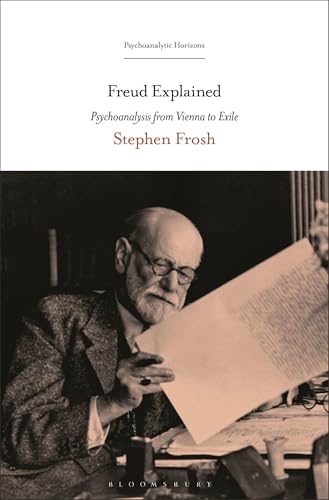
An engaging biographical introduction to Sigmund Freud, contextualizing the evolution of his theories within the vibrant and tumultuous climate of early-20th-century Vienna.Freud Explained presents Freud’s core ideas as they developed over the course of his life, in context with his historical moment. It explains key moments in the progression of Freud’s theories – such as sexual repression, the Oedipus complex, and the interpretation of dreams – weaving these together with discussions of his family history and upbringing. It also highlights important shifts, contradictions, and controversies, particularly relating to seduction theory, hysteria, female sexuality, and homosexual desire. Stephen Frosh describes Freud’s life in Vienna and the patients with whom he worked; looks at the relationships he formed with his teachers and followers; and focuses on how his theories developed in the context of the enormous social and political upheavals of the time – disruptions that eventually prompted Freud to move to England, in order “to die in freedom.” Frosh’s expertise on antisemitism is especially vital to his discussion of the challenges Freud faced, as a Jewish intellectual in Vienna, to the dissemination of his radical ideas. As more people feel comfortable seeking psychotherapy, and as the socio-political world in which we live becomes more emotionally challenging, we all — knowingly or not — draw on Freud’s ideas about unresolved conflicts and traumatic memories as we try to make sense of things. Freud Explained provides a highly researched and very accessible introduction to Freud that speaks to this growing curiosity about what makes us feel and act the way we do.
Stephen Frosh has worked at Birkbeck from 1979, first in the School of Psychology and since 2008 in the Department of Psychosocial Studies, of which he was a founding member and first Head of Department. From 1982 until 2000 he worked part time at Birkbeck and part time as a clinical psychologist in the NHS. Throughout the 1990s he was Consultant Clinical Psychologist and (from 1996) Vice Dean in the Child and Family Department of the Tavistock Clinic, London. His academic interests are in the applications of psychoanalysis to social issues; gender, culture and ‘race’; and psychosocial studies. He was Pro-Vice-Master of Birkbeck from 2003 to 2017, first with responsibility for Learning and Teaching, then for Research and then for Internationalisation