

What do you think?

Meeting New People
From the author of the national bestseller Women’s Hotel, the irresistible and wildly entertaining story of one woman contending with age and friendship—a narrative that reads like an homage to Nora Ephron’s Heartburn.
Sixtysomething, twice-divorced Barbara is at a crossroads. In the midst of her emotional uncertainty, she looks back on the dissolution of the nine best friendships of her life, in hopes of figuring out how to optimize finding her tenth, and hopefully last, best friend. Barbara is acerbic, opinionated, and wrong about many things, but she also doesn't shy away when she's at fault. The turning point of her predicament comes from Barbara’s choice, in friends, between (too-young) Caitlyn and the (unsuitable) Other Barbara. Will she repeat the exciting mistakes of the past, or will she try a new kind of mistake for a change? She feels like an out-of-season Scrooge who is unexpectedly, and all at once, surprised and entirely transformed by the possibility of joy.
For readers who loved Bobby Finger's The Old Place and Elif Bautmann's Either/Or, Meeting New People will feel like a long-lost companion—Lavery at the height of his storytelling powers. It is an unforgettable novel from one of our most inventive and brilliant writers.
Sixtysomething, twice-divorced Barbara is at a crossroads. In the midst of her emotional uncertainty, she looks back on the dissolution of the nine best friendships of her life, in hopes of figuring out how to optimize finding her tenth, and hopefully last, best friend. Barbara is acerbic, opinionated, and wrong about many things, but she also doesn't shy away when she's at fault. The turning point of her predicament comes from Barbara’s choice, in friends, between (too-young) Caitlyn and the (unsuitable) Other Barbara. Will she repeat the exciting mistakes of the past, or will she try a new kind of mistake for a change? She feels like an out-of-season Scrooge who is unexpectedly, and all at once, surprised and entirely transformed by the possibility of joy.
For readers who loved Bobby Finger's The Old Place and Elif Bautmann's Either/Or, Meeting New People will feel like a long-lost companion—Lavery at the height of his storytelling powers. It is an unforgettable novel from one of our most inventive and brilliant writers.
288 pages, Hardcover
First published June 2, 2026
About the author
Daniel M. Lavery
24 books1,042 followersDaniel M. Lavery is the “Dear Prudence” advice columnist at Slate, the cofounder of The Toast, and the New York Times bestselling author of Texts From Jane Eyre and The Merry Spinster.
Ratings & Reviews
Friends & Following
Create a free account to discover what your friends think of this book!
Community Reviews
Displaying 1 - 30 of 241 reviews
June 16, 2026
Literally nothing happens in this entire book and yet it physically pains me to not know what happens after the last page.

July 29, 2026
Let me say right up front that you won't like this book if:
1. You didn't like Olive Kitteredge because Olive was too crotchety and hard to get along with.
2. You don't care for interior dialogue and books where not much happens plot-wise.
I happen to love both those things, and 58 year old Barbara is opinionated, brutally honest, even with herself, and has apparently become increasingly hard to get along with, as her best friend has ended things abruptly and she makes her son mad every time they talk or text. So after some deep diving into herself, she decides to make a few minor changes in her life in order to find a new best friend who will stay around for old age. I felt like Barbara was channeling me, as I agreed with (almost) everything she thought or said. Barbara lived alone in a 6th floor walk up in NYC, liked things a certain way, and managed an upscale market deli. She loved to cook and eat and threw out a few recipes and handy tips along the way. I enjoyed the entire journey with Barbara, and will look for my own copy of this book once it comes out in paperback.
Not that I need a whole of improvement. But you never know.
1. You didn't like Olive Kitteredge because Olive was too crotchety and hard to get along with.
2. You don't care for interior dialogue and books where not much happens plot-wise.
I happen to love both those things, and 58 year old Barbara is opinionated, brutally honest, even with herself, and has apparently become increasingly hard to get along with, as her best friend has ended things abruptly and she makes her son mad every time they talk or text. So after some deep diving into herself, she decides to make a few minor changes in her life in order to find a new best friend who will stay around for old age. I felt like Barbara was channeling me, as I agreed with (almost) everything she thought or said. Barbara lived alone in a 6th floor walk up in NYC, liked things a certain way, and managed an upscale market deli. She loved to cook and eat and threw out a few recipes and handy tips along the way. I enjoyed the entire journey with Barbara, and will look for my own copy of this book once it comes out in paperback.
Not that I need a whole of improvement. But you never know.

August 11, 2026
I started reading this in print and around Chapter 4 or so I made an important decision: I needed to switch to audio. In print I was finding Barbara rather grating, I was hearing something shrill in her in my own head. I suspected if I switched to audio, I would feel differently. So I waited for a few months for the audiobook to come out and gave it a whirl. I have made this print-to-audio switch a few times, but this was definitely the most drastic shift. I went from feeling annoyed by Barbara to feeling much more invested. This book is a monologue, it felt like someone talking, and sure enough audio was a magical format. It helps that they brought in Marcia Gay Harden to read Barbara, she gives her just the right amount of softness to balance out Barbara's many rough edges. The end result is a deeply endearing and poignant novel of a woman who is actually trying her best.
Barbara has just been dumped by her best friend. This has happened to her several times before over the decades of her life. This time, Barbara doesn't just do her usual search for a new bff. Instead she realizes perhaps it's time to consider some changes. Maybe even some changes to herself.
Lavery's style--funny, specific, stuffed with details--gets channeled into Barbara's voice in a great way. Barbara doesn't feel like Lavery from his previous works of memoir/nonfiction, but you can definitely see the shape of the author on the character. Barbara is A Lot and she is going to let you know her opinions on things. For the novel to work you have to be able to take these in stride and see what Barbara is telling you about herself. You also have to be willing to laugh because sometimes Barbara's opinions feel completely correct and sometimes they are baffling. After a while I was always happy to hear one of Barbara's digressions, whether it be about the dishwasher, sauces on soups, or cutting a slice of cake.
I have been a little hostile towards many books about older people and change. So often the message I keep getting is that they will not change and you should not expect them to or that they did change and it was actually so easy. Barbara is in her late 50's, so not as old as the protagonist of The Correspondent, but Barbara is at least becoming aware of her flaws and actually taking steps to do something about them. This is the work of the book, following Barbara as she starts to admit these flaws and then as she sets out to address them. Other books that include this type of character change often skip the hard work of it, but that is the meat here and I really enjoyed it. It's also noteworthy that Barbara and her son have a difficult relationship and this is something that we have reason to hope will improve, but that is not miraculously better by the end of the book.
This book made me think a lot about friendship, about growing older. It mostly made me really happy to spend time with Barbara. She became a friend to me, and I was very sad when it was time for her to go.
Barbara has just been dumped by her best friend. This has happened to her several times before over the decades of her life. This time, Barbara doesn't just do her usual search for a new bff. Instead she realizes perhaps it's time to consider some changes. Maybe even some changes to herself.
Lavery's style--funny, specific, stuffed with details--gets channeled into Barbara's voice in a great way. Barbara doesn't feel like Lavery from his previous works of memoir/nonfiction, but you can definitely see the shape of the author on the character. Barbara is A Lot and she is going to let you know her opinions on things. For the novel to work you have to be able to take these in stride and see what Barbara is telling you about herself. You also have to be willing to laugh because sometimes Barbara's opinions feel completely correct and sometimes they are baffling. After a while I was always happy to hear one of Barbara's digressions, whether it be about the dishwasher, sauces on soups, or cutting a slice of cake.
I have been a little hostile towards many books about older people and change. So often the message I keep getting is that they will not change and you should not expect them to or that they did change and it was actually so easy. Barbara is in her late 50's, so not as old as the protagonist of The Correspondent, but Barbara is at least becoming aware of her flaws and actually taking steps to do something about them. This is the work of the book, following Barbara as she starts to admit these flaws and then as she sets out to address them. Other books that include this type of character change often skip the hard work of it, but that is the meat here and I really enjoyed it. It's also noteworthy that Barbara and her son have a difficult relationship and this is something that we have reason to hope will improve, but that is not miraculously better by the end of the book.
This book made me think a lot about friendship, about growing older. It mostly made me really happy to spend time with Barbara. She became a friend to me, and I was very sad when it was time for her to go.

Review of advance copy received from NetGalley
She Would Rather Feed You Than Tell You She Needs You
Daniel M. Lavery’s “Meeting New People” serves up casseroles, grievances, burnt paprika, and one of the sharpest recent novels about friendship, pride, and the social uses of food.
By Demetris Papadimitropoulos | April 5th, 2026
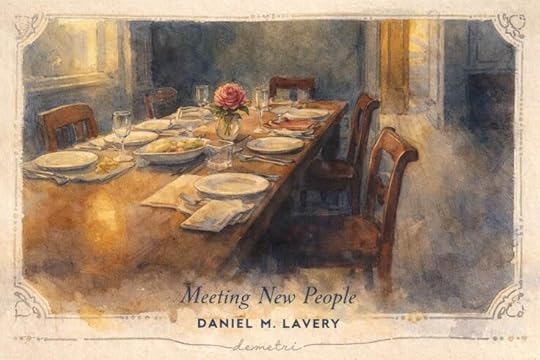
A room made ready for more people than one woman can confidently count on – Daniel M. Lavery’s “Meeting New People” distilled into late light, disciplined beauty, and the risky grace of laying extra places anyway.
Barbara Foerster would rather feed you than tell you she needs you. Daniel M. Lavery’s “Meeting New People” knows how costly that instinct can be. When Barbara’s closest friend Susan comes over for dinner, arrives with a handwritten list of complaints, and ends the friendship instead of eating, the scene lands with the dry sting of social humiliation. Susan refuses the meal, walks out in one of Barbara’s shirts, and leaves the apartment smelling of singed paprika. A friend breakup with notes is bad enough. A friend breakup with notes after you have bloiled the spices for goulash is practically liturgical.
At first the novel pretends to be a hunt for Susan’s replacement. Barbara, pushing sixty and newly unmoored, starts auditing the nine best friendships of her life, all broken or shed along the way, as if a sufficiently exact inventory might reveal how to secure a tenth and final one. Susan’s departure seems to set the terms: either Barbara finds the right woman to stand where Susan once stood, or she submits to social shrinkage. Very quickly, though, “Meeting New People” turns into a harsher, stranger, and much more interesting book than its title advertises. It is less interested in finding Barbara one sufficient person than in asking how she is meant to go on arranging a life once no single person can be trusted to hold it upright.
Lavery refuses Barbara the dignity of a contained crisis. He makes her drag the whole mess into the next room. She quarrels with her grown son Ezra over childcare, hotel rooms, antique furniture, and the ordinary insolence of adult children who think their parents can be redesigned to fit a travel schedule. At the upscale Brooklyn market hall where she works, she spars with younger coworkers over Narcan, self-checkout, bathrooms, and the moral jurisdiction of a deli counter. She starts haunting Saint Stephen’s, an Episcopal church that shares a building with a Zen center. She backs into hospice work. She begins, almost against her own habits, to treat her impossible ground-floor neighbor Lorraine like a person. She calls Marc, the widower of an old best friend who cut her off before dying, and manages – miracle of miracles – not to use the conversation as a crowbar into the past. By the time the novel reaches its final movement, Barbara is planning a dinner party whose guest list keeps expanding just as her hope of finding one perfect replacement grows less convincing.
Lavery knows what fiction still likes to underrate: friendship in adult life is not decorative padding around the real plot. It is one of the structures keeping the day from collapsing inward. Barbara’s devastation after Susan leaves is not framed as softer or more embarrassing than divorce. It hurts with the force many novels still reserve for marriage. More to the point, the novel is shrewd about how little public language exists for this kind of loss. Divorce has paperwork. Bereavement has casseroles. A friendship breakup often leaves one person clutching leftovers and the other in possession of the story. Barbara knows this. She also knows – with a braid of vanity, realism, and panic – that getting older makes new intimacy harder to come by and harder to seek without looking as though one is trying to come by it.
Barbara is such a good narrator because Lavery never launders her. She is exacting, class-tuned, funny, often cruel, often right, and almost pathologically alert to bad form. She has theories about dessert personalities, old women in cap sleeves, the vulgarity of self-checkout, the moral weather of athleisure, and the slow death of usable social rituals. She can be monstrous in miniature. She can also be ruthlessly exact. She would curdle into a recital of good lines if Lavery did not understand that style is the shell she keeps polishing while the injury is fresh. Barbara explains because explanation gives her leverage over pain. She categorizes because categories keep abandonment from feeling infinite. She turns to recipes at moments of distress not because cooking distracts her from feeling, but because food is the language in which she can think most fluently.
Everything here depends on the sentence knowing when Barbara is clarifying and when she is armoring. Lavery writes long, tensile, beautifully managed sentences that let her move from anecdote to refinement to analogy to verdict without sounding merely busy. The syntax does not ramble so much as open another drawer. A remark about tablecloths becomes an account of class aspiration. A note on potatoes becomes a theory of temperament. A complaint about texting becomes a small anatomy of modern intimacy. The diction lives among spice tins, sideboards, hems, church handbills, bad countertops, old coats, and better shoes. Barbara is forever telling one thing from another. That habit is both her charm and her trouble.
Food is not décor here. It is Barbara’s domestic logic. She cooks to welcome, to court, to comfort, to remember, to tidy the mind after injury, to put shape around loneliness, to make an evening mean something. If Susan’s refusal bites so hard, it is because she rejects not just dinner but the thing Barbara speaks best. Later, when Barbara sends a green lasagna to Marc and Holly, or brings clafoutis and Dutch baby downstairs to Lorraine, the book shows her trying to reroute that same language away from private grievance and toward social tact. Food in this novel is not atmosphere. It is thought with butter in it.

The room after Susan’s exit – red velvet, cooling dinner, and the peculiar humiliation of having your best language refused.
The structure only looks loose if you mistake drift for design. What begins as a single problem – Susan is gone, therefore someone else must be found – slowly becomes a series of awkward social experiments. Church strips some authority from Barbara’s old scripts. Hospice strips a little more. Lorraine does more than either. Caitlyn, a younger coworker Barbara first imagines as a possible successor to Susan, matters less as a destined friend than as evidence of Barbara’s habitual mistake: she keeps wanting intimacy on terms so precise that ordinary attachment can scarcely survive them. Lavery’s smartest refusal is simply not to reward that fantasy. Caitlyn does not become the answer. Neither does church. Neither does Ezra, Marc, or the other Barbara. What emerges instead is a messier arrangement of loyalties, obligations, appetites, and half-successful acts of tact.
That larger, makeshift circle is where the novel stops performing its intelligence and starts hurting. It earns its authority in scenes no one would call glamorous. Barbara sits with Deborah, a hospice patient too near death for conversation, and learns that presence can matter even when recognition cannot. She begins visiting Nita, an eighty-one-year-old woman with Alzheimer’s, and discovers the odd relief of being useful inside someone else’s mother-daughter quarrel rather than starring in her own. Most beautifully, she undergoes something very close to conversion in her dealings with Lorraine. Lorraine starts as comic blight: suspicious, nosy, forever complaining, dragging behind her a huge miserable dog. Then one rainy night Barbara sees her barefoot and without her false teeth, peering over a yard strewn with broken garbage, and the relation changes all at once. Barbara drops to her knees in the rain, picking up wet coffee grounds, broken glass, soaked dog bags, and old tampons with a kind of relieved gratitude. She is thankful not only that Lorraine is safe, but that she no longer has to act badly toward her.
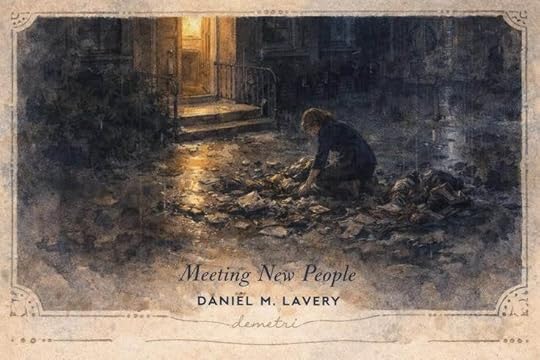
Barbara in the rain among spilled garbage – the novel’s hinge, where contempt gives way to service and neighborliness arrives looking nothing like virtue.
That is the hinge of the novel. Barbara does not need to become nicer in the vague, cosmetic sense. She needs to become less impossible. Lavery is too intelligent to pretend this happens through insight alone. It happens through repeated, slightly humiliating acts of service: answering Ezra briefly instead of expansively, calling Marc without prying, reading to the dying, walking Lorraine’s dog though she does not even like the creature very much. The book’s boldest idea is that service can outlast perfect mutual understanding. That is not a diminished vision of companionship. It is a sterner one, and a more persuasive one.
The cost of letting Barbara dominate so completely is that other people can sometimes feel overexposed to her weather. Susan remains, by design, partly caught inside Barbara’s account of her. Caitlyn never entirely escapes the pressure of functioning as Barbara’s hoped-for next thing. Even Ezra, whose position is fundamentally legible, reaches us mostly through Barbara’s mix of tenderness, irritation, and hurt pride. The novel thins everyone else a little in order to keep Barbara this fully oxygenated. That is a real cost. There are moments, especially in the middle, when Barbara’s theories arrive faster than new pressure does, and the book risks worrying the same seam – age, standards, grievance, bad manners – before it has quite earned another pass.
Even that circling tells on Barbara. Lonely people repeat themselves. Grieving people do. People trying to control the terms on which they are loved certainly do. What saves the novel from cleverness is that it never mistakes Barbara’s eloquence for immunity. She can explain almost anything except the one thing she most wants explained: why other people tire of her while she is still busy refining the terms of their attachment. In that sense the book has a distant kinship with Sigrid Nunez’s “The Friend,” which also treats companionship as serious business, though Lavery’s world is more upholstered, more exasperated, and much more interested in sauce.
The novel presses on a very contemporary bruise without mistaking itself for a dispatch. Adult friendship now has to do work once distributed across marriage, family, neighborhood, parish, and habit, yet it still has almost none of the rituals that help us survive its failure. It also knows something less discussable: friendliness is not the same as wanted company. Barbara is surrounded by people who are decent, welcoming, and available. That is not enough. What she lacks, and what Lavery keeps anatomizing, is belief in the irreducible value of this person’s attention. That distinction is snobbish, painful, true to experience, and one of the reasons the book keeps humming after it ends.
I’d put “Meeting New People” at 91/100 – 5/5: a genuinely excellent novel, often exhilarating at the sentence level, occasionally a little too enamored of its own best flourishes, and wiser by the end than its title first lets on. Lavery’s best move is not to hand Barbara one dazzling new best friend and call that growth. He gives her something messier, lonelier, and truer: a son she must speak to more carefully, dying strangers who require her presence, an old friend she can reenter tactfully, a neighbor she can no longer afford to despise, and a dinner table that keeps acquiring names, obligations, and plates. The book opens on a woman undone that one person no longer wants the thing she makes best. It leaves her setting more places than she can confidently fill. That turns out to be not defeat but form – a life no longer organized around one crowned intimacy, but around the risk of laying extra places anyway.
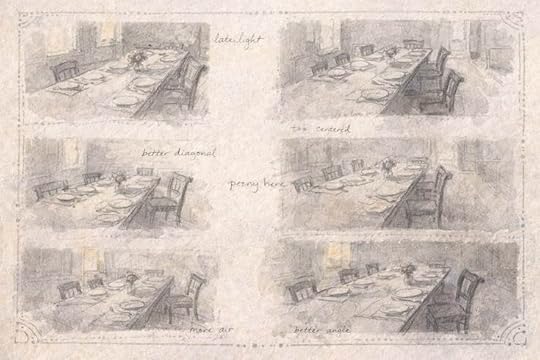
Early thumbnail studies testing the table’s angle, the window’s pull, and the burden of empty space – the first search for a composition that could hold hospitality, solitude, and expectation in the same breath.
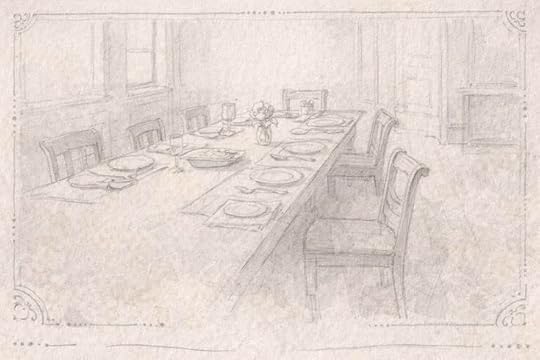
The faint pencil scaffold beneath the looseness – measured lines establishing the table, chairs, border, and negative space before emotion was allowed to enter by way of paint.
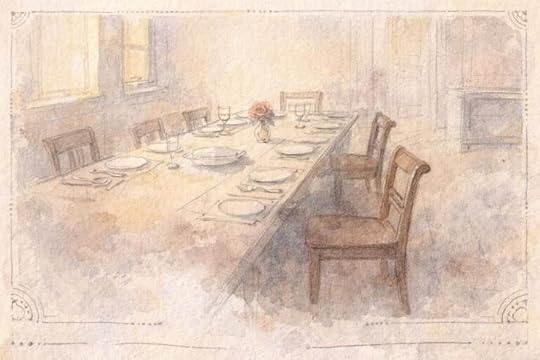
The first wash laying in the novel’s true weather – late light, cool interior shadow, and the first suggestion that this prepared room might be poised between anticipation and aftermath.

Palette studies drawn from the cover’s muted logic – testing wood, linen, peony, shadow, and evening light until the painting’s loneliness could feel composed rather than decorative.
[image error]
Border studies searching for a frame equal to the novel’s rituals of taste and hospitality – plate echoes, molding rhythms, and domestic order pared down until they could hold without fussing.
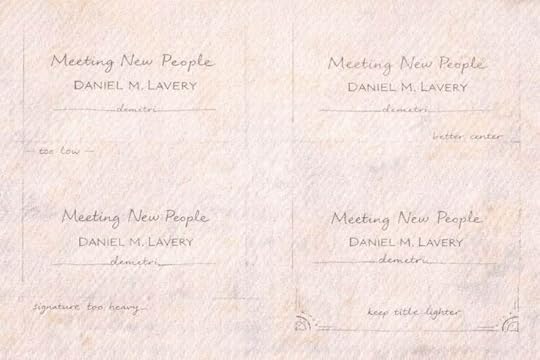
Handwritten placement studies for title, author, and signature – testing how the lower text could settle into the painting like part of the room rather than an addition laid on top of it.
All watercolor illustrations by Demetris Papadimitropoulos.
Daniel M. Lavery’s “Meeting New People” serves up casseroles, grievances, burnt paprika, and one of the sharpest recent novels about friendship, pride, and the social uses of food.
By Demetris Papadimitropoulos | April 5th, 2026
A room made ready for more people than one woman can confidently count on – Daniel M. Lavery’s “Meeting New People” distilled into late light, disciplined beauty, and the risky grace of laying extra places anyway.
Barbara Foerster would rather feed you than tell you she needs you. Daniel M. Lavery’s “Meeting New People” knows how costly that instinct can be. When Barbara’s closest friend Susan comes over for dinner, arrives with a handwritten list of complaints, and ends the friendship instead of eating, the scene lands with the dry sting of social humiliation. Susan refuses the meal, walks out in one of Barbara’s shirts, and leaves the apartment smelling of singed paprika. A friend breakup with notes is bad enough. A friend breakup with notes after you have bloiled the spices for goulash is practically liturgical.
At first the novel pretends to be a hunt for Susan’s replacement. Barbara, pushing sixty and newly unmoored, starts auditing the nine best friendships of her life, all broken or shed along the way, as if a sufficiently exact inventory might reveal how to secure a tenth and final one. Susan’s departure seems to set the terms: either Barbara finds the right woman to stand where Susan once stood, or she submits to social shrinkage. Very quickly, though, “Meeting New People” turns into a harsher, stranger, and much more interesting book than its title advertises. It is less interested in finding Barbara one sufficient person than in asking how she is meant to go on arranging a life once no single person can be trusted to hold it upright.
Lavery refuses Barbara the dignity of a contained crisis. He makes her drag the whole mess into the next room. She quarrels with her grown son Ezra over childcare, hotel rooms, antique furniture, and the ordinary insolence of adult children who think their parents can be redesigned to fit a travel schedule. At the upscale Brooklyn market hall where she works, she spars with younger coworkers over Narcan, self-checkout, bathrooms, and the moral jurisdiction of a deli counter. She starts haunting Saint Stephen’s, an Episcopal church that shares a building with a Zen center. She backs into hospice work. She begins, almost against her own habits, to treat her impossible ground-floor neighbor Lorraine like a person. She calls Marc, the widower of an old best friend who cut her off before dying, and manages – miracle of miracles – not to use the conversation as a crowbar into the past. By the time the novel reaches its final movement, Barbara is planning a dinner party whose guest list keeps expanding just as her hope of finding one perfect replacement grows less convincing.
Lavery knows what fiction still likes to underrate: friendship in adult life is not decorative padding around the real plot. It is one of the structures keeping the day from collapsing inward. Barbara’s devastation after Susan leaves is not framed as softer or more embarrassing than divorce. It hurts with the force many novels still reserve for marriage. More to the point, the novel is shrewd about how little public language exists for this kind of loss. Divorce has paperwork. Bereavement has casseroles. A friendship breakup often leaves one person clutching leftovers and the other in possession of the story. Barbara knows this. She also knows – with a braid of vanity, realism, and panic – that getting older makes new intimacy harder to come by and harder to seek without looking as though one is trying to come by it.
Barbara is such a good narrator because Lavery never launders her. She is exacting, class-tuned, funny, often cruel, often right, and almost pathologically alert to bad form. She has theories about dessert personalities, old women in cap sleeves, the vulgarity of self-checkout, the moral weather of athleisure, and the slow death of usable social rituals. She can be monstrous in miniature. She can also be ruthlessly exact. She would curdle into a recital of good lines if Lavery did not understand that style is the shell she keeps polishing while the injury is fresh. Barbara explains because explanation gives her leverage over pain. She categorizes because categories keep abandonment from feeling infinite. She turns to recipes at moments of distress not because cooking distracts her from feeling, but because food is the language in which she can think most fluently.
Everything here depends on the sentence knowing when Barbara is clarifying and when she is armoring. Lavery writes long, tensile, beautifully managed sentences that let her move from anecdote to refinement to analogy to verdict without sounding merely busy. The syntax does not ramble so much as open another drawer. A remark about tablecloths becomes an account of class aspiration. A note on potatoes becomes a theory of temperament. A complaint about texting becomes a small anatomy of modern intimacy. The diction lives among spice tins, sideboards, hems, church handbills, bad countertops, old coats, and better shoes. Barbara is forever telling one thing from another. That habit is both her charm and her trouble.
Food is not décor here. It is Barbara’s domestic logic. She cooks to welcome, to court, to comfort, to remember, to tidy the mind after injury, to put shape around loneliness, to make an evening mean something. If Susan’s refusal bites so hard, it is because she rejects not just dinner but the thing Barbara speaks best. Later, when Barbara sends a green lasagna to Marc and Holly, or brings clafoutis and Dutch baby downstairs to Lorraine, the book shows her trying to reroute that same language away from private grievance and toward social tact. Food in this novel is not atmosphere. It is thought with butter in it.
The room after Susan’s exit – red velvet, cooling dinner, and the peculiar humiliation of having your best language refused.
The structure only looks loose if you mistake drift for design. What begins as a single problem – Susan is gone, therefore someone else must be found – slowly becomes a series of awkward social experiments. Church strips some authority from Barbara’s old scripts. Hospice strips a little more. Lorraine does more than either. Caitlyn, a younger coworker Barbara first imagines as a possible successor to Susan, matters less as a destined friend than as evidence of Barbara’s habitual mistake: she keeps wanting intimacy on terms so precise that ordinary attachment can scarcely survive them. Lavery’s smartest refusal is simply not to reward that fantasy. Caitlyn does not become the answer. Neither does church. Neither does Ezra, Marc, or the other Barbara. What emerges instead is a messier arrangement of loyalties, obligations, appetites, and half-successful acts of tact.
That larger, makeshift circle is where the novel stops performing its intelligence and starts hurting. It earns its authority in scenes no one would call glamorous. Barbara sits with Deborah, a hospice patient too near death for conversation, and learns that presence can matter even when recognition cannot. She begins visiting Nita, an eighty-one-year-old woman with Alzheimer’s, and discovers the odd relief of being useful inside someone else’s mother-daughter quarrel rather than starring in her own. Most beautifully, she undergoes something very close to conversion in her dealings with Lorraine. Lorraine starts as comic blight: suspicious, nosy, forever complaining, dragging behind her a huge miserable dog. Then one rainy night Barbara sees her barefoot and without her false teeth, peering over a yard strewn with broken garbage, and the relation changes all at once. Barbara drops to her knees in the rain, picking up wet coffee grounds, broken glass, soaked dog bags, and old tampons with a kind of relieved gratitude. She is thankful not only that Lorraine is safe, but that she no longer has to act badly toward her.
Barbara in the rain among spilled garbage – the novel’s hinge, where contempt gives way to service and neighborliness arrives looking nothing like virtue.
That is the hinge of the novel. Barbara does not need to become nicer in the vague, cosmetic sense. She needs to become less impossible. Lavery is too intelligent to pretend this happens through insight alone. It happens through repeated, slightly humiliating acts of service: answering Ezra briefly instead of expansively, calling Marc without prying, reading to the dying, walking Lorraine’s dog though she does not even like the creature very much. The book’s boldest idea is that service can outlast perfect mutual understanding. That is not a diminished vision of companionship. It is a sterner one, and a more persuasive one.
The cost of letting Barbara dominate so completely is that other people can sometimes feel overexposed to her weather. Susan remains, by design, partly caught inside Barbara’s account of her. Caitlyn never entirely escapes the pressure of functioning as Barbara’s hoped-for next thing. Even Ezra, whose position is fundamentally legible, reaches us mostly through Barbara’s mix of tenderness, irritation, and hurt pride. The novel thins everyone else a little in order to keep Barbara this fully oxygenated. That is a real cost. There are moments, especially in the middle, when Barbara’s theories arrive faster than new pressure does, and the book risks worrying the same seam – age, standards, grievance, bad manners – before it has quite earned another pass.
Even that circling tells on Barbara. Lonely people repeat themselves. Grieving people do. People trying to control the terms on which they are loved certainly do. What saves the novel from cleverness is that it never mistakes Barbara’s eloquence for immunity. She can explain almost anything except the one thing she most wants explained: why other people tire of her while she is still busy refining the terms of their attachment. In that sense the book has a distant kinship with Sigrid Nunez’s “The Friend,” which also treats companionship as serious business, though Lavery’s world is more upholstered, more exasperated, and much more interested in sauce.
The novel presses on a very contemporary bruise without mistaking itself for a dispatch. Adult friendship now has to do work once distributed across marriage, family, neighborhood, parish, and habit, yet it still has almost none of the rituals that help us survive its failure. It also knows something less discussable: friendliness is not the same as wanted company. Barbara is surrounded by people who are decent, welcoming, and available. That is not enough. What she lacks, and what Lavery keeps anatomizing, is belief in the irreducible value of this person’s attention. That distinction is snobbish, painful, true to experience, and one of the reasons the book keeps humming after it ends.
I’d put “Meeting New People” at 91/100 – 5/5: a genuinely excellent novel, often exhilarating at the sentence level, occasionally a little too enamored of its own best flourishes, and wiser by the end than its title first lets on. Lavery’s best move is not to hand Barbara one dazzling new best friend and call that growth. He gives her something messier, lonelier, and truer: a son she must speak to more carefully, dying strangers who require her presence, an old friend she can reenter tactfully, a neighbor she can no longer afford to despise, and a dinner table that keeps acquiring names, obligations, and plates. The book opens on a woman undone that one person no longer wants the thing she makes best. It leaves her setting more places than she can confidently fill. That turns out to be not defeat but form – a life no longer organized around one crowned intimacy, but around the risk of laying extra places anyway.
Early thumbnail studies testing the table’s angle, the window’s pull, and the burden of empty space – the first search for a composition that could hold hospitality, solitude, and expectation in the same breath.
The faint pencil scaffold beneath the looseness – measured lines establishing the table, chairs, border, and negative space before emotion was allowed to enter by way of paint.
The first wash laying in the novel’s true weather – late light, cool interior shadow, and the first suggestion that this prepared room might be poised between anticipation and aftermath.
Palette studies drawn from the cover’s muted logic – testing wood, linen, peony, shadow, and evening light until the painting’s loneliness could feel composed rather than decorative.
[image error]
Border studies searching for a frame equal to the novel’s rituals of taste and hospitality – plate echoes, molding rhythms, and domestic order pared down until they could hold without fussing.
Handwritten placement studies for title, author, and signature – testing how the lower text could settle into the painting like part of the room rather than an addition laid on top of it.
All watercolor illustrations by Demetris Papadimitropoulos.

Read
February 18, 2026ARC for review. To be published June 2, 2026.
DNF at 35%.
This was a well-written, good book about the failure of the main character’s female friendships, or at least what I read of it was. I just found it unbearably sad, and perhaps parts of it hit a little too close to home. I wasn’t in the right headspace to finish it at the moment. Definitely no knock on the book.
DNF at 35%.
This was a well-written, good book about the failure of the main character’s female friendships, or at least what I read of it was. I just found it unbearably sad, and perhaps parts of it hit a little too close to home. I wasn’t in the right headspace to finish it at the moment. Definitely no knock on the book.

June 15, 2026
Daniel M. Lavery’s Meeting New People follows Barbara, a woman who seems perpetually baffled by her inability to maintain friendships, despite leaving a trail of strained relationships behind her. Through Barbara’s observations, complaints, explanations, and endless justifications, the novel invites readers into her worldview as she navigates social interactions and attempts to understand why meaningful connections never seem to last. The premise is deceptively simple, but Lavery uses it to explore the gap between how we see ourselves and how others experience us.
What makes the book interesting is that Barbara is not especially easy to spend time with. She is crabby, long-winded, rigid in her opinions, and often exhausting. As the story progresses, I found myself increasingly understanding why her friendships struggle. Lavery writes her with enough self-awareness to make her funny and enough blindness to make her frustrating. The humor often feels deeply sarcastic, as though the author is quietly inviting readers to recognize the disconnect between Barbara’s perception of herself and the reality unfolding around her.
In fact, I began to suspect that this discomfort is the entire point of the novel. We, the readers, become Barbara’s newest friend. We are the ones listening to her stories, enduring her tangents, and trying to stay patient as she talks herself in circles. And, just as so many people seem to do in Barbara’s life, I eventually found myself wanting to step away. Oddly enough, that reaction made me appreciate the book more. Whether I enjoyed the experience is another question entirely, but I suspect Lavery accomplished exactly what he set out to do.
What makes the book interesting is that Barbara is not especially easy to spend time with. She is crabby, long-winded, rigid in her opinions, and often exhausting. As the story progresses, I found myself increasingly understanding why her friendships struggle. Lavery writes her with enough self-awareness to make her funny and enough blindness to make her frustrating. The humor often feels deeply sarcastic, as though the author is quietly inviting readers to recognize the disconnect between Barbara’s perception of herself and the reality unfolding around her.
In fact, I began to suspect that this discomfort is the entire point of the novel. We, the readers, become Barbara’s newest friend. We are the ones listening to her stories, enduring her tangents, and trying to stay patient as she talks herself in circles. And, just as so many people seem to do in Barbara’s life, I eventually found myself wanting to step away. Oddly enough, that reaction made me appreciate the book more. Whether I enjoyed the experience is another question entirely, but I suspect Lavery accomplished exactly what he set out to do.

June 8, 2026
The way it was written made it to be a an audiobook I was very invested it eventough I did not like the main characters. Its a good book but it was not what I had wanted to but could really be that I didn't read the blurb closely enough. The book is really about the main character rather toxic behaviour and unableness to keep friends where I wanted more a story of someone struggles with friendships, the ups and down and not always being because of their behaviour.

June 25, 2026
Entertaining read.
It could go either way for a reader so practice caution.
Barbara's opinion might set you off, but it also gives you a glimpse into the central issue of this book : Why does Barabara keep losing friends?
She has some very strong opinions on almost everything which makes her pretty exhausting and a taxing companion to be with but Barbara is determined to find a new best friend and transform herself into a kinder person.
I absolutely enjoyed peeking into her life and I want to know what happened after the last page. 😭
It could go either way for a reader so practice caution.
Barbara's opinion might set you off, but it also gives you a glimpse into the central issue of this book : Why does Barabara keep losing friends?
She has some very strong opinions on almost everything which makes her pretty exhausting and a taxing companion to be with but Barbara is determined to find a new best friend and transform herself into a kinder person.
I absolutely enjoyed peeking into her life and I want to know what happened after the last page. 😭

Did Not Finish
June 25, 2026Got almost half way through, but it was torture. I’d rather get a root canal.

June 6, 2026
A witty novel about a woman in her sixties reflecting on the friendships that shaped her life as she searches for connection, joy, and a sense of belonging.
I eventually grew to find Barbara endearing, but she is a fickle, neurotic woman who can be harsh and frustrating at times. Some of her views felt outdated and lacking in inclusivity, which occasionally made her difficult to root for. However, I did appreciate that she was willing to learn and grow. At its core, this is a thoughtful exploration of friendship, aging, loneliness and the idea that it’s never too late to start over.
I eventually grew to find Barbara endearing, but she is a fickle, neurotic woman who can be harsh and frustrating at times. Some of her views felt outdated and lacking in inclusivity, which occasionally made her difficult to root for. However, I did appreciate that she was willing to learn and grow. At its core, this is a thoughtful exploration of friendship, aging, loneliness and the idea that it’s never too late to start over.

June 28, 2026
this is my favorite read this year. gave me similar vibes to olive by elizabeth strout. wow

June 9, 2026
3.75⭐️ This story follows Barbara Foerster, a twice-divorced woman in her late 50s whose best friend abruptly ends their friendship. Determined to understand what went wrong, Barbara looks back on the nine most important relationships of her life while searching for a new best friend.
The reader is taken along with Barbara as she revisits old relationships, misunderstandings, and patterns of behaviour. Romantic relationship break ups are written about often, but the loss of close friendships can be just as, if not more devastating and this story is touching and thought-provoking. Lavery does a good job of weaving humour and emotional insight together. I enjoyed the interiority of this book, told in first person. I felt like I really started to understand Barbara by the end of the story. Her thoughts, recollections, and observations felt relatable and reminiscent of some of Elizabeth Strout’s characters.
I enjoyed my time in Barbara’s world, enhanced by Marcia Gay Harden’s fabulous narration!
The book might be for you if:
💜 You enjoy deep character exploration at a slower pace
💜 You are a fan of writers like Elizabeth Strout
💜 You enjoy a New York setting
Thank you to NetGalley and HarperAudio Adult for an advance listener’s copy in exchange for my honest review.
The reader is taken along with Barbara as she revisits old relationships, misunderstandings, and patterns of behaviour. Romantic relationship break ups are written about often, but the loss of close friendships can be just as, if not more devastating and this story is touching and thought-provoking. Lavery does a good job of weaving humour and emotional insight together. I enjoyed the interiority of this book, told in first person. I felt like I really started to understand Barbara by the end of the story. Her thoughts, recollections, and observations felt relatable and reminiscent of some of Elizabeth Strout’s characters.
I enjoyed my time in Barbara’s world, enhanced by Marcia Gay Harden’s fabulous narration!
The book might be for you if:
💜 You enjoy deep character exploration at a slower pace
💜 You are a fan of writers like Elizabeth Strout
💜 You enjoy a New York setting
Thank you to NetGalley and HarperAudio Adult for an advance listener’s copy in exchange for my honest review.

June 12, 2026
Like hearing gossip and hot takes from a favorite co-worker.

June 28, 2026
A book about a woman who has an opinion on every single thing, and her struggles with maintaining friendships throughout her life and now in her older years. I really enjoyed this mostly because I read it as an audiobook because I know I'd have been annoyed less than 50 pages in if not lol. Lavery is an incredible writer and that's very evident in how well this flows and comes together from start to finish.
ps. I have no idea why this is tagged as queer when the main character isn't queer and neither is the story being told. I found out the author is queer but if that's why it's tagged as such, that's a very stupid reason
ps. I have no idea why this is tagged as queer when the main character isn't queer and neither is the story being told. I found out the author is queer but if that's why it's tagged as such, that's a very stupid reason

July 16, 2026
SO the first, 40% or so, I'm like, this better pick up, because this is just the ramblings of a older-middle aged woman, and then sure enough, you get just enough crumbs about her past to be like OH! ok....and then it absolutely took off for me from there. And by the end of it I thought it to be a really interesting look at what it means to have community, to engage with community, and the value of different relationships, as well as how your past experiences with people are reflected in your behavior with others. A lot to chew on and I'm really glad I didn't DNF.
July 14, 2026
I liked, but didn't love, this book. Laugh out loud funny at times, but also a bit repetitive and I couldn't decide if I liked the main character or not. But, maybe that's the point? Entertaining, quick read.

July 5, 2026
This book surprised me in the best way, but of course because it’s a Daniel M. Lavery joint. Barbara is such a messy, opinionated, and funny main character that I couldn't stop reading, even when she was driving me crazy. After her best friend Susan suddenly ends their friendship with a list of complaints, Barbara starts looking back on all the friendships she's lost while trying to figure out how to make one lasting connection. Her observations are hilarious, and I loved how the book explored friendship, loneliness, motherhood, and getting older in such an honest way.
What I liked most was that Barbara doesn't magically become a different person. Instead, she slowly grows through her relationships with coworkers, exes, and even the strangers she meets through hospice volunteering. The ending felt hopeful without being unrealistic, and Lavery balanced humor and emotion perfectly. He writes older women so well! This was smart, funny, and surprisingly moving, an easy five stars for me.
What I liked most was that Barbara doesn't magically become a different person. Instead, she slowly grows through her relationships with coworkers, exes, and even the strangers she meets through hospice volunteering. The ending felt hopeful without being unrealistic, and Lavery balanced humor and emotion perfectly. He writes older women so well! This was smart, funny, and surprisingly moving, an easy five stars for me.

July 26, 2026
I loved this book. it was funny, heartfelt, and compelling. I could have kept reading Barbara's thoughts forever.

July 14, 2026
Sedarisian incisive wit paired with Ephronian descriptions of food and cooking both done expertly, loved
August 25, 2026
You’ve gotta love a woman who puts herself out there! Barbara is at a crossroads - she knows she’s not everybody’s cup of tea and she can be quite picky about who she likes, but she doesn’t think that should preclude her from having a best friend. Not a friend, mind you, a best friend! She’s had a number of them in her life and has had almost the same number of falling outs (plus one death) leaving her in her late 50s with no best friend. With the dissolution of her latest friendship, she’s reflecting and realizing that she needs a big transformation in order to attract and hold on to the people she wants in her life and shore up her relationships for the long haul as she heads into old age.
The book is entirely inner monologue - that of a woman who generally likes who she is but still wants to transform deeply; who realizes she can grow in a positive direction and sets out to do it. It’s an incredibly satisfying character study. Barbara is complex in ways that leap off the page. She constructs meals that are works of art and sees enjoying meals together as the best part of friendship. She’s fashionable. She’s direct. She turns to church to re-center herself after the friend breakup, but enumerates her misgivings about certain types of church. She admits she loved her mother, now dead, more than she loved her son, but she also admits that she wants to work on her relationship with her son. I did not tire at all of listening to Barbara‘s thoughts, nor for that matter her recipes, although they are entirely way too complex for me to try to recreate and her food standards might be a little too high for most. For example:
“Stovetop rice pudding should taste simple and severe. The rice pudding should be immaculate and profound. The rice should be unimpeachable. The butter should be above reproach.”
Marcia Gay Harden is note perfect as the narrator. Now I’m gonna have to go find more books that she’s narrated.
The book is entirely inner monologue - that of a woman who generally likes who she is but still wants to transform deeply; who realizes she can grow in a positive direction and sets out to do it. It’s an incredibly satisfying character study. Barbara is complex in ways that leap off the page. She constructs meals that are works of art and sees enjoying meals together as the best part of friendship. She’s fashionable. She’s direct. She turns to church to re-center herself after the friend breakup, but enumerates her misgivings about certain types of church. She admits she loved her mother, now dead, more than she loved her son, but she also admits that she wants to work on her relationship with her son. I did not tire at all of listening to Barbara‘s thoughts, nor for that matter her recipes, although they are entirely way too complex for me to try to recreate and her food standards might be a little too high for most. For example:
“Stovetop rice pudding should taste simple and severe. The rice pudding should be immaculate and profound. The rice should be unimpeachable. The butter should be above reproach.”
Marcia Gay Harden is note perfect as the narrator. Now I’m gonna have to go find more books that she’s narrated.

Read
June 24, 2026This is a tricky one for me to review, and I think, perhaps, since I had wildly incorrect expectations about it, the best use I can make of this space is to help others set their expectations, hoping this book finds the readers who are most likely to love it. I went into it expecting a relatable, complex story about a woman in her 60s struggling to understand the evolution of past friendships and form new friendships in the face of her increasing loneliness. A book that said to readers: you’re not alone in this. It’s hard. It’s complicated. But -maybe- there’s a way out of the loneliness. Instead, this read to me as a critique of those feelings, and it’s in the same family as Yellowface or Yesteryear, not in tone, humour, or genre, but in that all 3 are character studies used for social critique, and all 3 present us with an increasingly alienating heroine whose behaviour becomes more reprehensible the longer the reader spends time with the narrative. In this one, the heroine’s reasons for not keeping or forming new friendships become glaringly obvious to the reader early on in the story, as her complaints, criticisms, judgments, and narrow-minded opinions mount. She has something negative to say about everyone and everything, including lesbians, the homeless, Jesus, how women age, how women talk about age, how women date, vegetarianism, meditation, acceptable hair lengths, email etiquette, and dog ownership, with her comments growing more biting, self-aggrandizing, and hypocritical throughout the novel while she outsources her character growth to god and approaches every social interaction--even the most outwardly charitable ones--with an eye for what she can gain. She talks about wanting to change, but has a million reasons not to. The only things she seems to genuinely care about are her food and furniture, certainly not her own son, and even more certainly, anyone she wants to befriend. So to me, this read as a critique of older women who complain about being lonely while relentlessly considering themselves superior to everyone else and yet somehow not understanding why people don’t like them, making this best suited for readers who want to engage with that social critique, and who enjoy the inner monologue of a self-important woman who has something politely demeaning to say about everything and everyone but her sofa and her souffle.

September 2, 2026
Absolutely loved this book. Barbara was such a hilarious and passionate character. I loved her stubbornness, her thoughts about how to “do things properly,” and her slow growth throughout the novel. It was so sweet and funny to see how much she avoids the things that are good for her. This is an impeccably done character study - like one reviewer said “literally nothing happens in this book, but it physically pains me to not know what happens after the last page.”
I also LOVED her recipes - I wish I had the paperback version of this book so that I could save all the recipes, or that Lavery put out an article with every recipe. Really wanting to try that stuffed tomato one. Like I am obsessed with how the food in this book was written such care and detail. I think I craved literally every single dish.
I think this will definitely be a book I’d reread, even just little sections here and there. So well done, one of my favorites of the year so far.
I also LOVED her recipes - I wish I had the paperback version of this book so that I could save all the recipes, or that Lavery put out an article with every recipe. Really wanting to try that stuffed tomato one. Like I am obsessed with how the food in this book was written such care and detail. I think I craved literally every single dish.
I think this will definitely be a book I’d reread, even just little sections here and there. So well done, one of my favorites of the year so far.

August 15, 2026
3.5. I liked this one. I appreciated all its astute musings on friendships and its complexities. Could relate to all of the sentiments. Made me laugh out loud at times too. Not a lot happens and def felt a lull in the middle.

July 19, 2026
Apparently I relate way too much to Barbara … I didn’t find her unlikable at all (like many other readers djd). I wonder what that says about me.
Loved this novel. Charming, funny, sad and sweet.
Loved this novel. Charming, funny, sad and sweet.

June 24, 2026
One of my favorite genres of books is the complainy older lady, and this may be the definitive complainy older lady book (although Barbara is not actually as old as she comes across).
Barbara's most recent best friend has just dumped her, and it sets her on a longwinded reflection as she searches for a replacement. She is bitchy and mostly right (I think my enjoyment stems from agreeing with many of her observations and judgments) and has thoughts about everything and everyone. She's vicious and ruthless but funny. Hilarious even. She's the type of friend I am and the type of friend I like.
The thing is, the entire novel is mostly just her going on tangents about things. The plot and action are super thin. I wish there had been more of her interacting with old friends or potential friends or foes to create some tension and break to the onslaught... but as a representation of the unfettered tirades of a complainy older lady's mind presented as a sort of cockamamie self-help guide, I can't actually complain. Very funny, highly recommended.
I listened to the audiobook which was narrated by Marcia Gay Harden and her delivery was delightful. I'm pretty sure this added to my enjoyment of the book.
Barbara's most recent best friend has just dumped her, and it sets her on a longwinded reflection as she searches for a replacement. She is bitchy and mostly right (I think my enjoyment stems from agreeing with many of her observations and judgments) and has thoughts about everything and everyone. She's vicious and ruthless but funny. Hilarious even. She's the type of friend I am and the type of friend I like.
The thing is, the entire novel is mostly just her going on tangents about things. The plot and action are super thin. I wish there had been more of her interacting with old friends or potential friends or foes to create some tension and break to the onslaught... but as a representation of the unfettered tirades of a complainy older lady's mind presented as a sort of cockamamie self-help guide, I can't actually complain. Very funny, highly recommended.
I listened to the audiobook which was narrated by Marcia Gay Harden and her delivery was delightful. I'm pretty sure this added to my enjoyment of the book.

June 24, 2026
If you love a character study of a quirky New York woman of a certain age-stop right here because this is perfection. Read by Marcia Gay Hardin-it was literally a plum of a novel! Chef’s kiss.
April 22, 2026
Genre: Contemporary Adult Fiction
For fans of:
Female friendships
Food-centered storytelling
Easy, short read
I won this in a Goodreads giveaway—thank you to the publisher for the ARC.
This was definitely out of my comfort zone (trying new genres this year), and while it didn’t work for me, I can see the appeal for others.
The story follows Barbara after her best friend “breaks up” with her, and it’s mostly about her navigating loneliness and reflecting on her past relationships. I liked the idea, but I struggled with Barbara as a character—she came off very negative and hard to connect with.
There were also a few comments about the queer community that didn’t sit right with me, especially the idea that women can’t be friends with lesbians. That really threw me off.
Overall, I wanted more character growth and development, but it felt pretty minimal.
I’m a little sad this one didn’t land for me, but I’m still glad I tried something different.
For fans of:
Female friendships
Food-centered storytelling
Easy, short read
I won this in a Goodreads giveaway—thank you to the publisher for the ARC.
This was definitely out of my comfort zone (trying new genres this year), and while it didn’t work for me, I can see the appeal for others.
The story follows Barbara after her best friend “breaks up” with her, and it’s mostly about her navigating loneliness and reflecting on her past relationships. I liked the idea, but I struggled with Barbara as a character—she came off very negative and hard to connect with.
There were also a few comments about the queer community that didn’t sit right with me, especially the idea that women can’t be friends with lesbians. That really threw me off.
Overall, I wanted more character growth and development, but it felt pretty minimal.
I’m a little sad this one didn’t land for me, but I’m still glad I tried something different.

June 24, 2026
Meeting New People by Daniel M. Lavery.
HarperVia, thank you for the gifted copy.
This book surprised me.
I went in expecting a story about making friends later in life. Instead, I found myself spending a few days inside the head of Barbara, a fifty-eight-year-old woman whose best friend has just broken up with her. Not drifted away. Not gotten busy. Actually broken up with her.
And honestly? That hit harder than I expected.
Barbara is not the kind of character you’re supposed to instantly love. She’s stubborn, judgmental, occasionally cranky, and has an opinion about absolutely everything. More than once I found myself thinking, “Oh Barbara, please stop talking.” Then a few pages later she’d say something so honest that I’d have to admit she had a point.
What stayed with me most was how real the loneliness felt. Not dramatic, movie-style loneliness. The quieter kind. The kind that sneaks up on you when life looks different than you thought it would and the people who once felt permanent aren’t there anymore.
A lot of this book is Barbara reflecting on the friendships that shaped her life and trying to understand why so many of them ended. It’s thoughtful, funny in a dry sort of way, and surprisingly emotional. There isn’t a ton of action here. The story lives almost entirely inside Barbara’s thoughts, which I know won’t work for every reader, but I found myself settling into her voice and enjoying the ride.
⭐️⭐️⭐️⭐️
“Women are really incredible. I don’t mean that it’s fun to lose a man’s affection, because of course it isn’t. But there’s nothing in the world as immovable as a woman who’s finished with you.”
That line practically jumped off the page.
I also loved that this book treats friendship as something important enough to grieve. We spend so much time talking about romantic heartbreak, but losing a close friend can leave a hole that feels just as big. This story gives that kind of loss the space it deserves.
If you enjoy character-driven literary fiction, complicated women, sharp observations about getting older, and stories that feel a little like sitting across the table from someone telling you the truth about themselves, flaws and all, I think this one is worth picking up.
And now I’m curious: what’s harder to get over—a breakup with a partner or a breakup with a friend?
HarperVia, thank you for the gifted copy.
This book surprised me.
I went in expecting a story about making friends later in life. Instead, I found myself spending a few days inside the head of Barbara, a fifty-eight-year-old woman whose best friend has just broken up with her. Not drifted away. Not gotten busy. Actually broken up with her.
And honestly? That hit harder than I expected.
Barbara is not the kind of character you’re supposed to instantly love. She’s stubborn, judgmental, occasionally cranky, and has an opinion about absolutely everything. More than once I found myself thinking, “Oh Barbara, please stop talking.” Then a few pages later she’d say something so honest that I’d have to admit she had a point.
What stayed with me most was how real the loneliness felt. Not dramatic, movie-style loneliness. The quieter kind. The kind that sneaks up on you when life looks different than you thought it would and the people who once felt permanent aren’t there anymore.
A lot of this book is Barbara reflecting on the friendships that shaped her life and trying to understand why so many of them ended. It’s thoughtful, funny in a dry sort of way, and surprisingly emotional. There isn’t a ton of action here. The story lives almost entirely inside Barbara’s thoughts, which I know won’t work for every reader, but I found myself settling into her voice and enjoying the ride.
⭐️⭐️⭐️⭐️
“Women are really incredible. I don’t mean that it’s fun to lose a man’s affection, because of course it isn’t. But there’s nothing in the world as immovable as a woman who’s finished with you.”
That line practically jumped off the page.
I also loved that this book treats friendship as something important enough to grieve. We spend so much time talking about romantic heartbreak, but losing a close friend can leave a hole that feels just as big. This story gives that kind of loss the space it deserves.
If you enjoy character-driven literary fiction, complicated women, sharp observations about getting older, and stories that feel a little like sitting across the table from someone telling you the truth about themselves, flaws and all, I think this one is worth picking up.
And now I’m curious: what’s harder to get over—a breakup with a partner or a breakup with a friend?

July 14, 2026
3.5 ⭐️
I could identify with so many of the emotions in this book. And I could identify with how friendships change with age.
I thought the author did a great job of tapping into that
This book made me laugh and it made me cry.
I could identify with so many of the emotions in this book. And I could identify with how friendships change with age.
I thought the author did a great job of tapping into that
This book made me laugh and it made me cry.

August 14, 2026
I was disappointed by Danny's previous forays into fiction so I'm delighted to report that I thoroughly enjoyed this. Funny, a wonderful narrative voice, and I can tell he's been reading the same Muriel Spark and Barbara Pym books I have.
Displaying 1 - 30 of 241 reviews