

What do you think?

Mastering Connections: Build Stronger Relationships with the Science of Body Language – An FBI Agent's Proven Strategies for Nonverbal Communication and Authentic Connection
From international bestselling author and retired FBI special agent Joe Navarro—a guide to reading other people’s body language and using your own to build and maintain lasting connections in an increasingly lonely and isolated world.
As an FBI special agent focused on counterintelligence and behavioral assessment, Joe Navarro’s ability to connect with people was never optional—it was essential. Victims needed to feel safe enough to open up, and suspects needed to trust him enough to tell the truth. With no time to slowly build rapport, Navarro mastered nonverbal communication: the language beneath words. The slightest gesture, a subtle shift in posture, and even fleeting eye contact became tools for creating trust and uncovering the truth.
Connecting with others in our modern era can feel similarly daunting. In a world dominated by screens, remote work, and algorithm-driven dating, genuine human connection feels harder to come by than ever. Nevertheless, the need to bond, to belong, and to be understood remains as urgent as ever.
In Mastering Connections, Navarro distills decades of field experience and cutting-edge science into practical strategies anyone can use. This book offers clear, actionable advice for how to:
- Make a lasting first impression in interviews, meetings, and on dates
- Earn trust quickly and, most importantly, authentically
- Utilize proven techniques that few have mastered
- Recognize and defuse conflict before it escalates
- Strengthen personal and professional bonds that will endure
- Change the way you connect with others for a happier and longer life
Backed by research and enriched with real-life stories, Mastering Connections is more than a book on body language—it’s a road map to stronger, healthier, and more meaningful relationships. Trusted by millions of readers worldwide, Joe Navarro delivers the ultimate guide to thriving in a world where true connection has never been more valuable.
As an FBI special agent focused on counterintelligence and behavioral assessment, Joe Navarro’s ability to connect with people was never optional—it was essential. Victims needed to feel safe enough to open up, and suspects needed to trust him enough to tell the truth. With no time to slowly build rapport, Navarro mastered nonverbal communication: the language beneath words. The slightest gesture, a subtle shift in posture, and even fleeting eye contact became tools for creating trust and uncovering the truth.
Connecting with others in our modern era can feel similarly daunting. In a world dominated by screens, remote work, and algorithm-driven dating, genuine human connection feels harder to come by than ever. Nevertheless, the need to bond, to belong, and to be understood remains as urgent as ever.
In Mastering Connections, Navarro distills decades of field experience and cutting-edge science into practical strategies anyone can use. This book offers clear, actionable advice for how to:
- Make a lasting first impression in interviews, meetings, and on dates
- Earn trust quickly and, most importantly, authentically
- Utilize proven techniques that few have mastered
- Recognize and defuse conflict before it escalates
- Strengthen personal and professional bonds that will endure
- Change the way you connect with others for a happier and longer life
Backed by research and enriched with real-life stories, Mastering Connections is more than a book on body language—it’s a road map to stronger, healthier, and more meaningful relationships. Trusted by millions of readers worldwide, Joe Navarro delivers the ultimate guide to thriving in a world where true connection has never been more valuable.
256 pages, Hardcover
Published June 2, 2026
About the author
Joe Navarro
98 books988 followersJoe Navarro is an author, public speaker and ex-FBI agent. Navarro specializes in the area of nonverbal communication or body language and has authored numerous books.
Ratings & Reviews
Friends & Following
Create a free account to discover what your friends think of this book!
Community Reviews
Displaying 1 - 8 of 8 reviews

June 5, 2026
A Lowered Voice, an Open Hand, a Room Made Safer
In “Mastering Connections,” Joe Navarro recasts body language as a practical art of attention, courtesy, and repair.
By Demetris Papadimitropoulos | June 4th, 2026
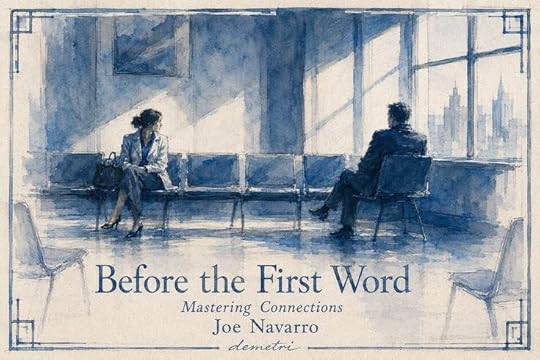
“Before the First Word” — In a blue-toned waiting room shaped by distance, light, and unfinished wash, two figures sit just before speech, where Joe Navarro’s “Mastering Connections” locates its deepest subject: the fragile bodily grammar of attention, safety, and possible trust.
Decoding another person can be a chilly pleasure. Much of the body-language shelf has trained readers to comb for involuntary disclosures, tells, giveaways, and micro-betrayals, as if every lunch meeting were a deposition and every first date a low-budget espionage film. Joe Navarro’s “Mastering Connections: Build Stronger Relationships with the Science of Body Language” is most interesting because it keeps trying to warm that cold genre from within. It is not immune to the temptations of a category addicted to certainty: the confident checklist, the memorable acronym, the brisk little rule that makes human complexity behave itself for a paragraph. But its deeper instinct is generous. Navarro wants to teach readers not merely how to read a room, but how to stop making the room harder to survive.
Even in its opening crime scene, the book resists the obvious mythology. Navarro, newly minted as an FBI agent in 1978, speeds toward a Phoenix bank robbery with the adrenaline of a rookie and the retrospective mercy of a man old enough to recognize the rookie from a safer distance. By the time he arrives, the robber has fled. What remains is aftermath: a rattled branch manager, elderly customers, tellers so frightened they seem almost breakable. Navarro’s real assignment is not pursuit. It is emotional weather management. He gives people paper, separates witnesses so their memories do not contaminate one another, stands at an angle rather than squarely in front of them, opens his palms, lowers his voice, and lets fear settle enough for facts to return.
Much of the book unspools from that first reversal. The drama is not in the raised weapon but in the lowered threat. Again and again, Navarro returns to the same stubborn fact of social life: information, cooperation, testimony, apology, desire, and trust do not simply appear because we demand them. They have to be invited. A person has to feel uncornered enough to remember, speak, stay, soften, or change direction. The body, in Navarro’s telling, is where that permission is granted, withheld, or forfeited before language catches up.
Exile gives the argument its more vulnerable origin. Navarro recalls arriving in Miami from Cuba as an eight-year-old who did not yet speak English and learning to navigate America through eyebrows, squints, mouths, postures, and tones. A raised brow could mean recognition; a furrowed one, suspicion; a face could become weather report, map, warning, or welcome. This childhood origin matters because it keeps the book from being only a credentialed memoir by a former agent. His body-language education begins not with suspects but with loneliness. Before reading bodies becomes an investigative skill, it is a child’s way of asking, without words, whether he belongs.
That autobiographical current gives “Mastering Connections” more tenderness than the body-language aisle usually risks. The book is not merely “What Every BODY Is Saying” repurposed for dating, leadership, and family life, though Navarro’s earlier work stands just offstage. This is a more relational book, less interested in tells than in terms of entry: how to approach, how to listen, how to keep from turning another person’s discomfort into your own advantage. The chapters move through first impressions, hands, feet, faces, scent, proximity, voice, conflict, romance, negotiation, trust, irritating habits, friendship, and the loneliness of an age that keeps substituting contact for presence. The book carries so much that, now and then, one hears the seams complain. Yet most of what Navarro packs earns its place.
Research and recollection run through the book as alternating currents. Navarro cites studies on thin-slice judgment, gesture, social connection, touch, attachment, trust, timing, loneliness, and neurobiology, but he is most persuasive when evidence becomes encounter. His prose sharpens when he is watching someone under pressure: a witness flooding him with details, a young man’s hands tightening before he gives up a criminal friend, a date’s body failing to keep pace with a smile, a colleague’s distrust hiding behind a misunderstanding. The science is translated for ordinary use, sometimes with nuance left standing on the platform. The experiential intelligence is harder to dismiss. Navarro has spent a life watching people become legible despite themselves.
In style, the book is plainspoken, teacherly, and companionable, with a fondness for direct address and the occasional joke landing with its knees slightly bent. Navarro can move from “glabella,” “haptics,” and “proxemics” to warnings about overenthusiastic cologne without apparent embarrassment. Sentence by sentence, the prose is built less for elegance than for use. Yet its best scenes carry the pressure of lived memory. The Puerto Rico knife encounter slows time to a pulse. The bank scene churns with procedural urgency. The overpass scene is almost all restraint: distance, cold, breath, ordinary questions, a young woman’s hand releasing the barrier.
Part of Navarro’s appeal is that he corrects the pop-semiotic folklore that clings to body language like lint. Crossed arms do not automatically mean rejection; they may be self-soothing. Nervousness is not proof of lying. No single gesture reliably convicts a person of deception. A body gives data, not a verdict. This humility is crucial. Without it, the book would become another invitation to amateur prosecution. With it, Navarro’s advice becomes more humane: notice the cue, but do not leap from cue to certainty. A quiver, a glance, a foot angled toward the door, a hand rubbing the neck – all are invitations to attend more carefully, not permission to reduce another person to a diagram.
As a result, ordinary manners regain physiological consequence. Do not point with one finger. Keep your hands visible. Stop interrupting. Give people room. Lower your voice. Do not douse yourself in scent before a meeting, unless your professional goal is to be remembered as a walking department-store counter. These are not revelations, exactly. Many grandmothers, uncredentialed but correct, have offered similar counsel without invoking the parasympathetic nervous system. Navarro’s contribution is to show how such habits register in the body: as ease or threat, openness or pressure, welcome or warning. Courtesy, in this book, is not decoration. It is stress reduction.
Perhaps the most revealing sections are those that move beyond first impressions into repair. In the chapter on de-escalation, Navarro recounts being confronted in Puerto Rico by a young man with a knife. He reads the trembling hand, the shabby clothes, the furtive look, the fear inside the threat. Instead of reaching for his gun, he raises his palms, speaks softly in Spanish, and offers ten dollars if the young man will lower the blade. The episode is not presented as a universal prescription – sensibly, he does not advise readers to improvise their own mugging protocol – but as an extreme version of a common principle. Conflict often worsens when bodies escalate before minds return.
After that comes one of the book’s strongest emotional turns: Navarro’s account of a young woman on an overpass at Brigham Young University, apparently preparing to jump. He does not rush her. He stands at a distance, asks ordinary questions, notices the cold, waits, keeps his movements modest. Eventually she steps away, accepts his jacket, and walks with him toward help. The scene works because it is almost theatrically undramatic. Its power lies in what Navarro does not do. He does not seize, command, perform heroism, or force confession. He becomes, for a few minutes, a nonthreatening presence at the edge of another person’s catastrophe.
Dating, inevitably, receives its chapter, and it is here that Navarro is at his most usefully comic. He understands that the modern first date is a small theater of overmanaged selves and underread bodies. He advises grooming before arrival, sparing use of scent, contextually sane clothing, respect with the eyes, and a greeting calibrated to the relationship rather than to a human-resources seminar. A man who offers a fourth-date handshake, in one anecdote, ends the romance with the clean efficiency of a stamped invoice. The chapter is strongest when it refuses the false glamour of invulnerability. Nervousness, Navarro insists, is not failure; pretending not to be nervous while your body broadcasts panic is the failure.
It is also in the courtship material that the book’s tenderness and limits appear together. Navarro’s discussions of synchrony, touch, gaze, feet, and ventral orientation are vivid and memorable. His reading of Michelangelo’s “Creation of Adam” as a drama of almost-touch is one of the book’s lovelier detours. Yet the dating advice can drift toward the well-worn, and some sections on gendered ways of connecting feel too obedient to pattern. Navarro often acknowledges cultural difference and individual variation, but his appetite for broad human tendencies can flatten the strange, local, power-laden ways bodies are read by others.
Much the same can be said of the book’s relationship to science. The bibliography is broader and more serious than one might expect from a general-market guide to body language, drawing from work on social judgment, gesture, trust, attachment, touch, emotion, and social health. Still, “Mastering Connections” is a trade synthesis, not a cautious academic monograph. Its claims about longevity, scent, timing, touch, sex differences, and evolutionary inheritance are often plausible and sometimes illuminating, but they are made in a brisk style that favors usability over qualification. The reader should accept the invitation to observe, not assume they have been issued a laboratory license.
Intellectually, the most interesting friction is that Navarro’s tools come from interrogation rooms, crime scenes, negotiations, and intelligence work, while his highest ambition is care. Read beside “The Gift of Fear” by Gavin de Becker or “Never Split the Difference” by Chris Voss with Tahl Raz, “Mastering Connections” is less a manual for winning the encounter than a guide to lowering its temperature. Yet the older fieldcraft does not disappear. Turning time into pressure, using silence, mirroring behavior, wearing down resistance, and recruiting trust are complicated tactics. Navarro’s ethical insistence is clear: be trustworthy, do not manipulate, do not fake care. But the book cannot entirely dissolve its own unease: attention can become care, and attention can become leverage.
The structure does more than sort the material into chapters; it changes the moral scale of the advice. Navarro begins with the body as evidence, then reframes it as invitation, then finally enlarges it into a social ethic. The machinery is serviceable, occasionally over-obvious – story, principle, application, takeaway – and sometimes the takeaways have all the charm of a laminated workshop handout. But the larger arc works. The book starts in a bank after violence and ends with the possibility that even people committed to violence can be reached. Between those points, gesture is steadily redefined: first as survival skill, then social tool, then relational discipline, then moral wager.
Repetition is the book’s main tax. Hands must be visible. Space must be respected. The voice should calm rather than command. A sincere apology should not arrive wearing the little fake mustache of “if” or “but.” These lessons recur because Navarro is teaching, and repetition is part of teaching. Still, the middle chapters can feel overstocked with catalogs: behaviors that connect, behaviors that disconnect, signs of stress, signs of contempt, habits that annoy colleagues, ways to build trust, ways to maintain rapport. It is easy to consult, less consistently pleasurable to inhabit. Its excellence is practical, emotional, and ethical more than strictly artistic.
Of all the late chapters, the one on trust is the book’s moral center. Navarro defines trust not as a feeling but as a pattern of demonstrable actions: keep your word, show up early, admit error, apologize plainly, respect the other person’s distance, do not corner them, do not stare them down. The most devastating example comes from an interview with a young mother on a Native American reservation after her baby has disappeared. Sitting across from her fails. Remembering his grandmother, Navarro moves his chair beside her so they face the same direction. That physical rearrangement changes the emotional architecture of the room. She eventually reveals the awful truth: her boyfriend killed the baby. It is a devastating scene, but it demonstrates the book’s argument with terrible clarity. Sometimes the difference between silence and truth is where the chair is placed.
Perhaps that is why the ending, though sunlit and perhaps slightly overlit, feels more earned than it might have. Navarro closes with Raul, an anti-Castro extremist who once attempted to fire an old bazooka at a Czechoslovakian ship in Miami because it had traded with Cuba. The weapon fails; Raul is imprisoned; later, in Puerto Rico, Navarro seeks him out not to corner him but to ask for his help understanding other extremists. Against colleagues’ warnings, he builds a relationship with him. Raul’s intelligence is redirected toward study, then scholarship, then teaching. Late in life, dying of cancer, he writes to thank Navarro for changing his path. The story is almost too neat, except that Navarro does not make Raul innocent. He makes him reachable.
Over this final movement hovers Thomas Merton’s Louisville revelation: the realization, amid ordinary strangers on an ordinary sidewalk, that human beings are not alien to one another. Navarro uses Merton to lift the book from practical guide to humanist plea. Not every reader will welcome the elevation. Some will prefer the bank robbery to the benediction, the handshake to the shining sun. But the turn clarifies what Navarro has been after all along. Nonverbal communication, for him, is not a secret code for social advantage. It is evidence that we are made to affect one another, whether we admit it or not.
Under the pressures of mediated suspicion, that claim has bite. The book speaks naturally to loneliness, online dating, remote work, romance scams, AI-assisted deception, workplace mistrust, and families whose dinner tables have become tiny parliaments with worse snacks. Navarro is not naïve about harm; he knows some connections should be pruned, some people should be avoided, some conflicts cannot be mediated. But he is stubbornly hopeful about ordinary presence. He believes in the old tools: a hand shown empty, a chair moved beside rather than across, a voice lowered, a silence allowed to breathe, a greeting made with the eyes before the mouth enters the room.
Like many useful books, “Mastering Connections” is better than its least graceful sentences and less revolutionary than its boldest claims. It overreaches, repeats itself, and occasionally tidies the body into a clearer instrument than any living body really is. But its central achievement is harder to shrug off. It takes a subject often associated with suspicion and turns it toward responsibility. It argues, persuasively, that the point of noticing another person is not to catch them out, but to help them feel less alone with whatever their body has already begun to confess.
On balance, my rating is 84/100, which corresponds to a Goodreads-compatible 4/5 stars. That feels like the right temperature: admiring, alert, and not dazzled past judgment. This is not an immaculate book, and it is not always an elegant one. It is, however, a generous one, and generosity is not the same as softness. In Navarro’s best pages, connection is demanding. It asks the reader to give up the cheap thrill of certainty and accept the harder work of care.
So the question the book leaves behind is not whether you can decode the person in front of you. That would be too easy, and probably too flattering. The better question is whether, having noticed the tightened hand, the angled foot, the swallowed word, the face trying not to show fear, you can become the kind of presence that lets another person return from the edge of themselves. Navarro’s answer is disarmingly simple: lower your voice, open your hands, make room. The body is already speaking. The art is learning how not to interrupt it.
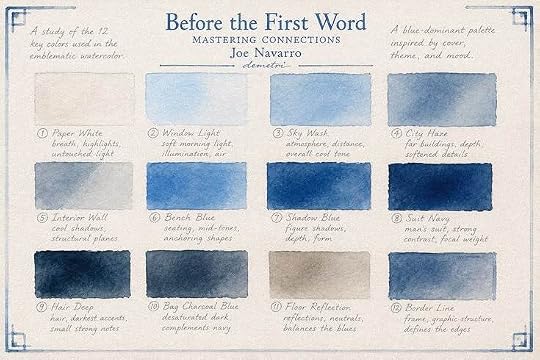
Palette study — A working sheet of cover-derived blues, grays, off-whites, and deep petrol shadows, testing how “Mastering Connections” could become an atmosphere rather than a borrowed design.

Thumbnail sheet — Small compositional trials mapping distance, chair placement, window light, and the charged empty space between two figures before the final image found its restraint.

Watercolor border study — A trial frame of broken blue rules, window-like edges, and unfinished corners, turning the border into a quiet metaphor for observation, distance, and connection.
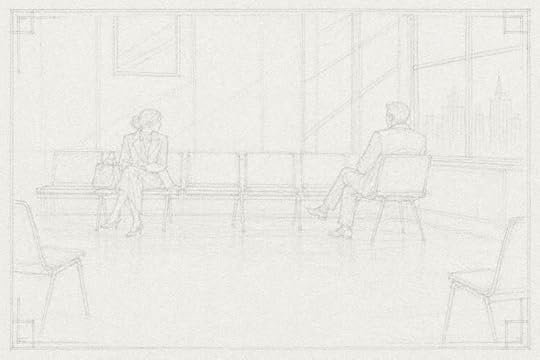
Faint underdrawing — The image at its skeletal stage, with graphite lines holding chairs, windows, figures, and silence in place before the first emotional wash entered the room.

First wash — Pale blue-gray light begins to settle over the room, establishing the watercolor’s temperature: cool, restrained, lonely, but not without invitation.
All watercolor illustrations by Demetris Papadimitropoulos.
Watercolors are done on 140lb vellum and then scanned into the computer using an Epson scanner. From there, they are finalized in Procreate. All art and opinions are my own.
In “Mastering Connections,” Joe Navarro recasts body language as a practical art of attention, courtesy, and repair.
By Demetris Papadimitropoulos | June 4th, 2026
“Before the First Word” — In a blue-toned waiting room shaped by distance, light, and unfinished wash, two figures sit just before speech, where Joe Navarro’s “Mastering Connections” locates its deepest subject: the fragile bodily grammar of attention, safety, and possible trust.
Decoding another person can be a chilly pleasure. Much of the body-language shelf has trained readers to comb for involuntary disclosures, tells, giveaways, and micro-betrayals, as if every lunch meeting were a deposition and every first date a low-budget espionage film. Joe Navarro’s “Mastering Connections: Build Stronger Relationships with the Science of Body Language” is most interesting because it keeps trying to warm that cold genre from within. It is not immune to the temptations of a category addicted to certainty: the confident checklist, the memorable acronym, the brisk little rule that makes human complexity behave itself for a paragraph. But its deeper instinct is generous. Navarro wants to teach readers not merely how to read a room, but how to stop making the room harder to survive.
Even in its opening crime scene, the book resists the obvious mythology. Navarro, newly minted as an FBI agent in 1978, speeds toward a Phoenix bank robbery with the adrenaline of a rookie and the retrospective mercy of a man old enough to recognize the rookie from a safer distance. By the time he arrives, the robber has fled. What remains is aftermath: a rattled branch manager, elderly customers, tellers so frightened they seem almost breakable. Navarro’s real assignment is not pursuit. It is emotional weather management. He gives people paper, separates witnesses so their memories do not contaminate one another, stands at an angle rather than squarely in front of them, opens his palms, lowers his voice, and lets fear settle enough for facts to return.
Much of the book unspools from that first reversal. The drama is not in the raised weapon but in the lowered threat. Again and again, Navarro returns to the same stubborn fact of social life: information, cooperation, testimony, apology, desire, and trust do not simply appear because we demand them. They have to be invited. A person has to feel uncornered enough to remember, speak, stay, soften, or change direction. The body, in Navarro’s telling, is where that permission is granted, withheld, or forfeited before language catches up.
Exile gives the argument its more vulnerable origin. Navarro recalls arriving in Miami from Cuba as an eight-year-old who did not yet speak English and learning to navigate America through eyebrows, squints, mouths, postures, and tones. A raised brow could mean recognition; a furrowed one, suspicion; a face could become weather report, map, warning, or welcome. This childhood origin matters because it keeps the book from being only a credentialed memoir by a former agent. His body-language education begins not with suspects but with loneliness. Before reading bodies becomes an investigative skill, it is a child’s way of asking, without words, whether he belongs.
That autobiographical current gives “Mastering Connections” more tenderness than the body-language aisle usually risks. The book is not merely “What Every BODY Is Saying” repurposed for dating, leadership, and family life, though Navarro’s earlier work stands just offstage. This is a more relational book, less interested in tells than in terms of entry: how to approach, how to listen, how to keep from turning another person’s discomfort into your own advantage. The chapters move through first impressions, hands, feet, faces, scent, proximity, voice, conflict, romance, negotiation, trust, irritating habits, friendship, and the loneliness of an age that keeps substituting contact for presence. The book carries so much that, now and then, one hears the seams complain. Yet most of what Navarro packs earns its place.
Research and recollection run through the book as alternating currents. Navarro cites studies on thin-slice judgment, gesture, social connection, touch, attachment, trust, timing, loneliness, and neurobiology, but he is most persuasive when evidence becomes encounter. His prose sharpens when he is watching someone under pressure: a witness flooding him with details, a young man’s hands tightening before he gives up a criminal friend, a date’s body failing to keep pace with a smile, a colleague’s distrust hiding behind a misunderstanding. The science is translated for ordinary use, sometimes with nuance left standing on the platform. The experiential intelligence is harder to dismiss. Navarro has spent a life watching people become legible despite themselves.
In style, the book is plainspoken, teacherly, and companionable, with a fondness for direct address and the occasional joke landing with its knees slightly bent. Navarro can move from “glabella,” “haptics,” and “proxemics” to warnings about overenthusiastic cologne without apparent embarrassment. Sentence by sentence, the prose is built less for elegance than for use. Yet its best scenes carry the pressure of lived memory. The Puerto Rico knife encounter slows time to a pulse. The bank scene churns with procedural urgency. The overpass scene is almost all restraint: distance, cold, breath, ordinary questions, a young woman’s hand releasing the barrier.
Part of Navarro’s appeal is that he corrects the pop-semiotic folklore that clings to body language like lint. Crossed arms do not automatically mean rejection; they may be self-soothing. Nervousness is not proof of lying. No single gesture reliably convicts a person of deception. A body gives data, not a verdict. This humility is crucial. Without it, the book would become another invitation to amateur prosecution. With it, Navarro’s advice becomes more humane: notice the cue, but do not leap from cue to certainty. A quiver, a glance, a foot angled toward the door, a hand rubbing the neck – all are invitations to attend more carefully, not permission to reduce another person to a diagram.
As a result, ordinary manners regain physiological consequence. Do not point with one finger. Keep your hands visible. Stop interrupting. Give people room. Lower your voice. Do not douse yourself in scent before a meeting, unless your professional goal is to be remembered as a walking department-store counter. These are not revelations, exactly. Many grandmothers, uncredentialed but correct, have offered similar counsel without invoking the parasympathetic nervous system. Navarro’s contribution is to show how such habits register in the body: as ease or threat, openness or pressure, welcome or warning. Courtesy, in this book, is not decoration. It is stress reduction.
Perhaps the most revealing sections are those that move beyond first impressions into repair. In the chapter on de-escalation, Navarro recounts being confronted in Puerto Rico by a young man with a knife. He reads the trembling hand, the shabby clothes, the furtive look, the fear inside the threat. Instead of reaching for his gun, he raises his palms, speaks softly in Spanish, and offers ten dollars if the young man will lower the blade. The episode is not presented as a universal prescription – sensibly, he does not advise readers to improvise their own mugging protocol – but as an extreme version of a common principle. Conflict often worsens when bodies escalate before minds return.
After that comes one of the book’s strongest emotional turns: Navarro’s account of a young woman on an overpass at Brigham Young University, apparently preparing to jump. He does not rush her. He stands at a distance, asks ordinary questions, notices the cold, waits, keeps his movements modest. Eventually she steps away, accepts his jacket, and walks with him toward help. The scene works because it is almost theatrically undramatic. Its power lies in what Navarro does not do. He does not seize, command, perform heroism, or force confession. He becomes, for a few minutes, a nonthreatening presence at the edge of another person’s catastrophe.
Dating, inevitably, receives its chapter, and it is here that Navarro is at his most usefully comic. He understands that the modern first date is a small theater of overmanaged selves and underread bodies. He advises grooming before arrival, sparing use of scent, contextually sane clothing, respect with the eyes, and a greeting calibrated to the relationship rather than to a human-resources seminar. A man who offers a fourth-date handshake, in one anecdote, ends the romance with the clean efficiency of a stamped invoice. The chapter is strongest when it refuses the false glamour of invulnerability. Nervousness, Navarro insists, is not failure; pretending not to be nervous while your body broadcasts panic is the failure.
It is also in the courtship material that the book’s tenderness and limits appear together. Navarro’s discussions of synchrony, touch, gaze, feet, and ventral orientation are vivid and memorable. His reading of Michelangelo’s “Creation of Adam” as a drama of almost-touch is one of the book’s lovelier detours. Yet the dating advice can drift toward the well-worn, and some sections on gendered ways of connecting feel too obedient to pattern. Navarro often acknowledges cultural difference and individual variation, but his appetite for broad human tendencies can flatten the strange, local, power-laden ways bodies are read by others.
Much the same can be said of the book’s relationship to science. The bibliography is broader and more serious than one might expect from a general-market guide to body language, drawing from work on social judgment, gesture, trust, attachment, touch, emotion, and social health. Still, “Mastering Connections” is a trade synthesis, not a cautious academic monograph. Its claims about longevity, scent, timing, touch, sex differences, and evolutionary inheritance are often plausible and sometimes illuminating, but they are made in a brisk style that favors usability over qualification. The reader should accept the invitation to observe, not assume they have been issued a laboratory license.
Intellectually, the most interesting friction is that Navarro’s tools come from interrogation rooms, crime scenes, negotiations, and intelligence work, while his highest ambition is care. Read beside “The Gift of Fear” by Gavin de Becker or “Never Split the Difference” by Chris Voss with Tahl Raz, “Mastering Connections” is less a manual for winning the encounter than a guide to lowering its temperature. Yet the older fieldcraft does not disappear. Turning time into pressure, using silence, mirroring behavior, wearing down resistance, and recruiting trust are complicated tactics. Navarro’s ethical insistence is clear: be trustworthy, do not manipulate, do not fake care. But the book cannot entirely dissolve its own unease: attention can become care, and attention can become leverage.
The structure does more than sort the material into chapters; it changes the moral scale of the advice. Navarro begins with the body as evidence, then reframes it as invitation, then finally enlarges it into a social ethic. The machinery is serviceable, occasionally over-obvious – story, principle, application, takeaway – and sometimes the takeaways have all the charm of a laminated workshop handout. But the larger arc works. The book starts in a bank after violence and ends with the possibility that even people committed to violence can be reached. Between those points, gesture is steadily redefined: first as survival skill, then social tool, then relational discipline, then moral wager.
Repetition is the book’s main tax. Hands must be visible. Space must be respected. The voice should calm rather than command. A sincere apology should not arrive wearing the little fake mustache of “if” or “but.” These lessons recur because Navarro is teaching, and repetition is part of teaching. Still, the middle chapters can feel overstocked with catalogs: behaviors that connect, behaviors that disconnect, signs of stress, signs of contempt, habits that annoy colleagues, ways to build trust, ways to maintain rapport. It is easy to consult, less consistently pleasurable to inhabit. Its excellence is practical, emotional, and ethical more than strictly artistic.
Of all the late chapters, the one on trust is the book’s moral center. Navarro defines trust not as a feeling but as a pattern of demonstrable actions: keep your word, show up early, admit error, apologize plainly, respect the other person’s distance, do not corner them, do not stare them down. The most devastating example comes from an interview with a young mother on a Native American reservation after her baby has disappeared. Sitting across from her fails. Remembering his grandmother, Navarro moves his chair beside her so they face the same direction. That physical rearrangement changes the emotional architecture of the room. She eventually reveals the awful truth: her boyfriend killed the baby. It is a devastating scene, but it demonstrates the book’s argument with terrible clarity. Sometimes the difference between silence and truth is where the chair is placed.
Perhaps that is why the ending, though sunlit and perhaps slightly overlit, feels more earned than it might have. Navarro closes with Raul, an anti-Castro extremist who once attempted to fire an old bazooka at a Czechoslovakian ship in Miami because it had traded with Cuba. The weapon fails; Raul is imprisoned; later, in Puerto Rico, Navarro seeks him out not to corner him but to ask for his help understanding other extremists. Against colleagues’ warnings, he builds a relationship with him. Raul’s intelligence is redirected toward study, then scholarship, then teaching. Late in life, dying of cancer, he writes to thank Navarro for changing his path. The story is almost too neat, except that Navarro does not make Raul innocent. He makes him reachable.
Over this final movement hovers Thomas Merton’s Louisville revelation: the realization, amid ordinary strangers on an ordinary sidewalk, that human beings are not alien to one another. Navarro uses Merton to lift the book from practical guide to humanist plea. Not every reader will welcome the elevation. Some will prefer the bank robbery to the benediction, the handshake to the shining sun. But the turn clarifies what Navarro has been after all along. Nonverbal communication, for him, is not a secret code for social advantage. It is evidence that we are made to affect one another, whether we admit it or not.
Under the pressures of mediated suspicion, that claim has bite. The book speaks naturally to loneliness, online dating, remote work, romance scams, AI-assisted deception, workplace mistrust, and families whose dinner tables have become tiny parliaments with worse snacks. Navarro is not naïve about harm; he knows some connections should be pruned, some people should be avoided, some conflicts cannot be mediated. But he is stubbornly hopeful about ordinary presence. He believes in the old tools: a hand shown empty, a chair moved beside rather than across, a voice lowered, a silence allowed to breathe, a greeting made with the eyes before the mouth enters the room.
Like many useful books, “Mastering Connections” is better than its least graceful sentences and less revolutionary than its boldest claims. It overreaches, repeats itself, and occasionally tidies the body into a clearer instrument than any living body really is. But its central achievement is harder to shrug off. It takes a subject often associated with suspicion and turns it toward responsibility. It argues, persuasively, that the point of noticing another person is not to catch them out, but to help them feel less alone with whatever their body has already begun to confess.
On balance, my rating is 84/100, which corresponds to a Goodreads-compatible 4/5 stars. That feels like the right temperature: admiring, alert, and not dazzled past judgment. This is not an immaculate book, and it is not always an elegant one. It is, however, a generous one, and generosity is not the same as softness. In Navarro’s best pages, connection is demanding. It asks the reader to give up the cheap thrill of certainty and accept the harder work of care.
So the question the book leaves behind is not whether you can decode the person in front of you. That would be too easy, and probably too flattering. The better question is whether, having noticed the tightened hand, the angled foot, the swallowed word, the face trying not to show fear, you can become the kind of presence that lets another person return from the edge of themselves. Navarro’s answer is disarmingly simple: lower your voice, open your hands, make room. The body is already speaking. The art is learning how not to interrupt it.
Palette study — A working sheet of cover-derived blues, grays, off-whites, and deep petrol shadows, testing how “Mastering Connections” could become an atmosphere rather than a borrowed design.
Thumbnail sheet — Small compositional trials mapping distance, chair placement, window light, and the charged empty space between two figures before the final image found its restraint.
Watercolor border study — A trial frame of broken blue rules, window-like edges, and unfinished corners, turning the border into a quiet metaphor for observation, distance, and connection.
Faint underdrawing — The image at its skeletal stage, with graphite lines holding chairs, windows, figures, and silence in place before the first emotional wash entered the room.
First wash — Pale blue-gray light begins to settle over the room, establishing the watercolor’s temperature: cool, restrained, lonely, but not without invitation.
All watercolor illustrations by Demetris Papadimitropoulos.
Watercolors are done on 140lb vellum and then scanned into the computer using an Epson scanner. From there, they are finalized in Procreate. All art and opinions are my own.

Review of advance copy received from Goodreads Giveaways
I received a copy of this book for free in a Goodreads giveaway.
I remember seeing Joe Navarro on various poker shows and YouTube providing some commentary about body language, and I found what he said to be insightful and interesting, presented in his calm but authoritative manner. This book is no different, and he clearly has a lot of experience and insight about body language and nonverbal communication.
The book is very accessible while also being informative. There's nothing really groundbreaking in the book, but it presents a lot of information about a lot of aspects of body language, and specifics about how certain behaviors and gestures reveal things about the person even if they're not saying them. I appreciated that every chapter ends with a "Key Takeaways" summary that condenses the key ideas of the chapter into a few bullet points as a reminder before going onto the next chapter. But reading just the summaries would mean missing out on the details and also the interesting anecdotes the author puts in the book.
With all of his experience as an FBI agent, the author has a lot of practical experience in reading people's body language, which has helped him solve crimes and get out of trouble, as he describes in various stories throughout the book. These are very interesting, and it made me want more of them. The book kind of drags in comparison whenever it just talks about ideas without anecdotes, though. The chapter that lists twenty behaviors that were found to be negative in the workplace is just that, and it felt really dry and lifeless in comparison to other parts of the book, where the author goes into actual cases and narratives.
It's a fairly quick read and quite accessible, while also packing in a lot of information about body language, including how to deescalate conflict based on it and how to form lasting connections with people, both platonic and romantic. The author also draws on his vast experience as an FBI agent to include actual use cases for reading others' body language and conveying things with his own. I just wish that the author had included even more interesting stories from his life and work in places where the book becomes a bit dry.
I remember seeing Joe Navarro on various poker shows and YouTube providing some commentary about body language, and I found what he said to be insightful and interesting, presented in his calm but authoritative manner. This book is no different, and he clearly has a lot of experience and insight about body language and nonverbal communication.
The book is very accessible while also being informative. There's nothing really groundbreaking in the book, but it presents a lot of information about a lot of aspects of body language, and specifics about how certain behaviors and gestures reveal things about the person even if they're not saying them. I appreciated that every chapter ends with a "Key Takeaways" summary that condenses the key ideas of the chapter into a few bullet points as a reminder before going onto the next chapter. But reading just the summaries would mean missing out on the details and also the interesting anecdotes the author puts in the book.
With all of his experience as an FBI agent, the author has a lot of practical experience in reading people's body language, which has helped him solve crimes and get out of trouble, as he describes in various stories throughout the book. These are very interesting, and it made me want more of them. The book kind of drags in comparison whenever it just talks about ideas without anecdotes, though. The chapter that lists twenty behaviors that were found to be negative in the workplace is just that, and it felt really dry and lifeless in comparison to other parts of the book, where the author goes into actual cases and narratives.
It's a fairly quick read and quite accessible, while also packing in a lot of information about body language, including how to deescalate conflict based on it and how to form lasting connections with people, both platonic and romantic. The author also draws on his vast experience as an FBI agent to include actual use cases for reading others' body language and conveying things with his own. I just wish that the author had included even more interesting stories from his life and work in places where the book becomes a bit dry.

June 21, 2026
Mastering Connections: Build Stronger Relationships with the Science of Body Language
I have read several of Joe Navarro’s books and have enjoyed each one. Having followed his work and interacted with him a few times on X, I genuinely like and respect him. He comes across as a warm, empathetic individual with a substantial body of knowledge and experience to share.
In Mastering Connections, Navarro draws on decades of real-world scenarios from his FBI career and beyond. He guides readers on using body language to communicate more effectively and form stronger connections. His overarching philosophy emphasizes our fundamental interconnectedness, captured in this passage:
What I mean to say here—what I mean to say in the entirety of this book, really—is that every beating human heart on this planet is connected. Our differences are infinitesimal next to the enormity of our shared human experience. Across cultures, creeds, and countries, our commonalities unite us in an ineluctable, indestructible, indescribable humanity.
For readers new to observing nonverbal cues, much of the material may feel fresh. Those already familiar with Navarro’s earlier works may find many insights intuitive. Even so, the book reinforces a valuable mindset: cultivate greater observation of those around us, paired with curiosity and empathy. Doing so reliably leads to better connections.
Mastering Connections offers practical, experience-grounded guidance from an author who combines expertise with evident humanity. It earns a strong recommendation for anyone seeking to improve relationships through the science of body language.
I have read several of Joe Navarro’s books and have enjoyed each one. Having followed his work and interacted with him a few times on X, I genuinely like and respect him. He comes across as a warm, empathetic individual with a substantial body of knowledge and experience to share.
In Mastering Connections, Navarro draws on decades of real-world scenarios from his FBI career and beyond. He guides readers on using body language to communicate more effectively and form stronger connections. His overarching philosophy emphasizes our fundamental interconnectedness, captured in this passage:
What I mean to say here—what I mean to say in the entirety of this book, really—is that every beating human heart on this planet is connected. Our differences are infinitesimal next to the enormity of our shared human experience. Across cultures, creeds, and countries, our commonalities unite us in an ineluctable, indestructible, indescribable humanity.
For readers new to observing nonverbal cues, much of the material may feel fresh. Those already familiar with Navarro’s earlier works may find many insights intuitive. Even so, the book reinforces a valuable mindset: cultivate greater observation of those around us, paired with curiosity and empathy. Doing so reliably leads to better connections.
Mastering Connections offers practical, experience-grounded guidance from an author who combines expertise with evident humanity. It earns a strong recommendation for anyone seeking to improve relationships through the science of body language.
July 4, 2026
Communication isn’t just about words, our actions and body language speak just as loudly.
Joe Navarro takes a close, thoughtful look at what we communicate to others and what others communicate to us without saying a single word. This book helps you understand not only how to read the signals people send, but also how to recognize what you may be unintentionally expressing. Becoming aware of the messages you relay, can strengthen relationships, improve interactions, and even help you identify people you may need to distance yourself from. Navarro offers a fascinating and thorough exploration of how our bodies speak.
Navarro also dives into how body language shapes our relationships and what our nonverbal cues reveal about us to others. It’s an eye‑opening look at how much we communicate without ever opening our mouths.
The writing is clear, engaging, and easy to follow. Each chapter flows well and ends with a helpful summary that reinforces the key points. My favorite chapter was Chapter 5, which outlines practical strategies for setting yourself up for success in negotiations and offers clues to watch for when interactions start to go off track.
This was a very enjoyable read. It made me more aware of the body language of those around me, what they might be saying, how I can respond more effectively, and what I should pay attention to. Even more importantly, it made me evaluate my own nonverbal communication and how I might better influence my interactions. The book encouraged me to reflect on what I may be expressing, intentionally or unintentionally, and how small adjustments can make a big difference.
Thank you to the author, NetGalley and William Morrow for the ARC and the opportunity to read and review this book.
Joe Navarro takes a close, thoughtful look at what we communicate to others and what others communicate to us without saying a single word. This book helps you understand not only how to read the signals people send, but also how to recognize what you may be unintentionally expressing. Becoming aware of the messages you relay, can strengthen relationships, improve interactions, and even help you identify people you may need to distance yourself from. Navarro offers a fascinating and thorough exploration of how our bodies speak.
Navarro also dives into how body language shapes our relationships and what our nonverbal cues reveal about us to others. It’s an eye‑opening look at how much we communicate without ever opening our mouths.
The writing is clear, engaging, and easy to follow. Each chapter flows well and ends with a helpful summary that reinforces the key points. My favorite chapter was Chapter 5, which outlines practical strategies for setting yourself up for success in negotiations and offers clues to watch for when interactions start to go off track.
This was a very enjoyable read. It made me more aware of the body language of those around me, what they might be saying, how I can respond more effectively, and what I should pay attention to. Even more importantly, it made me evaluate my own nonverbal communication and how I might better influence my interactions. The book encouraged me to reflect on what I may be expressing, intentionally or unintentionally, and how small adjustments can make a big difference.
Thank you to the author, NetGalley and William Morrow for the ARC and the opportunity to read and review this book.

Review of advance copy received from Netgalley
I really enjoyed "Mastering Connections" - I have always been fascinated by body language and non-verbal communication. I really appreciated how the author weaved in his real life experiences to drive points home. It is very easy for body language books to drift into pseudoscience and speculation, but the author did an excellent job navigating and avoiding that trap by adding in reality and that sometimes body language can mean multiple things depending on the environment (are their arms crossed because they are distancing themselves or are they cold?) The book then goes beyond non-verbal at times and highlights how our words have to mirror or actions/body language for it to feel genuine and true.
While none of the advice and suggestions the author gave are new per se, he did an excellent job collating them into an easy to read, very accessible book.
If you are looking for a book to learn more about body language or if you want to shore up your relationship building techniques, this is a great book to begin your journey!
Thank you to NetGalley and William Morrow for an ARC in exchange for my honest review!
While none of the advice and suggestions the author gave are new per se, he did an excellent job collating them into an easy to read, very accessible book.
If you are looking for a book to learn more about body language or if you want to shore up your relationship building techniques, this is a great book to begin your journey!
Thank you to NetGalley and William Morrow for an ARC in exchange for my honest review!
July 31, 2026
(audio book) pretty interesting but nothing entirely new

August 11, 2026
This is a great book on body language that is road map to stronger, healthier, & more meaningful relationships.
August 20, 2026
Easy to read book and interesting.
Displaying 1 - 8 of 8 reviews