Simultaneously heart-breaking and darkly hilarious, Leaving Home is a portrait of the artist both as a child and as an adult.
Mark Haddon's parents were not really cut out for the job of having children. They were cut out, respectively, for the jobs of designing abattoirs and keeping a pathologically clean and tidy house. At least Mark had the consolations of The Weetabix Solar System Wallchart, walnut whips and the occasional Babycham.
Astringently honest and scalpel sharp, this is a book about being different and seeing the world differently. It’s about being a cartoonist and a care assistant. It’s about family. It’s about how art, in all its varied forms, provides a way of understanding and coming to terms with the mess of human life. And it’s richly illustrated throughout with images from the author’s childhood.
As bracing as it is embracing, Leaving Home is about escaping a place that never felt like home and learning to create somewhere that does.
'Tender, transporting, creative and beautifully written ... Simply glorious, from start to finish' Rachel Clarke, author of Dear Life
'I loved this funny, melancholy and arrestingly original memoir of an artist's coming into being' Sarah Perry, author of Enlightenment
Mark Haddon is an English novelist, best known for The Curious Incident of the Dog in the Night-Time (2003). He won the Whitbread Award, the Dolly Gray Children's Literature Award, the Guardian Prize, and a Commonwealth Writers Prize for his work.
"Sometimes home is a place you have to discover or construct"
As an avid reader, you have an image that successful authors must lead an idyllic existence of countryside retreats musing over your next novel or writings- life is a chain of praise, gatherings and readings. Digging into the lives of authors- especially living writers- isn't something that many do ; the enjoyment of a favourite writer's book is the focus and the anticipation of something new.
Mark Haddon has always been a respected and savoured writer - a man who digs into the underbelly of the human narrative and creates stories that transform and transport.
Leaving Home is an autobiography - it is raw and unflinching as Mark Haddon allows us to be a party to his childhood and the subsequent years of adulthood and literary acclaim. for someone who was a child of the 60s and 70s, the concrete imagery of the time came flooding back. But all is not happiness in the slightest.
" Do objects, in their constancy, provide consolation in a world where adults are unpredictable and distant and loving?
This is a book that rips open a family and reveals the unseen image - parents who were never truly happy, children who were not visibly loved and were isolated in their existence from their parents and a world where praise and understanding was very limited. To share such a childhood and teenage years is not an easy read- especially when you know your own was the opposite. Mark Haddon describes in detail the family home and his life as an insular child who very much felt alone and the negativity his mother placed upon his sister. Ultimately, his life long search for a home beyond that of the his childhood whilst recognising the impacts of the past.
Subsequent mental health challenges and the dynamic within the 'nuclear' family are exposed. When you grow up in certain circumstances, trying to acknowledge or understand alternatives is not easy. The prose in this book is very moving- sometimes it cuts like a knife. But there is also light amidst the dark and the love Mark Haddon feels for his sister, wife and children is palpable. A wonderful array of illustrations, photographs and imagery accompany the text- adding further depth to the read.
It would be easy to add different details from Leaving Home but this is a book that needs to be read with an open mind from the start and to follow the extraordinary personal life that Mark Haddon has shared with us- his need to self heal and find understanding..
This is a book that could be construed as incredibly sad but by sharing the enclosed events will bring recognition for many and of course help to reduce the shielding and self protection that all of us feel after traumatic events.
Powerful, moving and inspiring.
Reviewing such a book is from our own personal experiences and interpretations and we will all react differently. But there are many instances that connected with me- albeit from adult experiences.
Thank you Mark Haddon .
Thank you to Chatto and Windus and Netgalley for the advance copy
Brilliant writer. The way he writes sometimes reading I felt like I found golden coins! But sometimes he went on tangents I had no interest in. At times philosophical and other times quite raw reading of his anxieties and troubled mind. His writing really puts you right inside!
This is completely wonderful. it made me snort with laughter on several occasions, but is also profound and wise and laced with a melancholic sense throughout. Haddon's sister, Fiona, and wife, Sos, are the two heroes of it all, and the warmth with which he writes about them is another lovely element of this. As is the fact that zoos are mentioned on four occasions.
The Quiet Power of “Leaving Home”: A Book About Attention, Rooms, and the Strange Ways We Learn to Breathe Again By Demetris Papadimitropoulos | February 17th, 2026
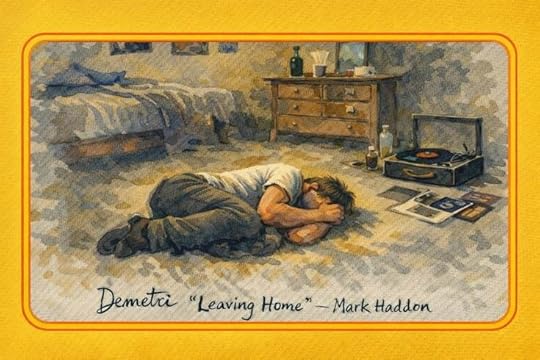
Watercolor Piece by Demetris Papadimitropoulos
Mark Haddon’s “Leaving Home” arrives with the mild audacity of a book that declines to do what memoirs are currently hired to do. It does not audition for your sympathy. It does not build a courtroom case. It does not climb a tidy hill from damage to triumph and plant a flag on the summit labeled HEALING. Instead, it unpacks a box.
Out come the contents: a handful of childhood scenes with the off-kilter clarity of remembered light, a boarding-school education in cruelty and conformity, a body that periodically malfunctions and a mind that sometimes responds to overwhelm by simply leaving the premises. There are hospital corridors and rented rooms and the kind of jobs that feel less like steps on a ladder than like sideways shuffles across a wet pavement. There are, too, artifacts: photographs, diary entries, drawings, prints, diagrams, sculptures, record sleeves, architectural images, the humble evidence of making. Haddon lays these items on the table with a steady, unsentimental hand, as if to say: this is what I have. This is what I can prove. If you want a story, you may assemble one yourself.
The method is not gimmick but temperament. Haddon has always been a writer with an engineer’s suspicion of grand claims, a novelist of perception more than confession. In his fiction, the world is often seen askew, through a consciousness that is both hyperliteral and hyperattentive, and in “Leaving Home” that attentiveness becomes not merely style but ethics. The book’s short numbered sections feel like rooms rather than chapters, each a compartment in which a memory can be placed without being forced to pretend it is part of a smooth continuum. Memoir, here, is not a river but a floor plan. You walk. You open doors. You double back. You stand in the doorway a little longer than you planned because the light on the desk is doing something precise and inexplicable, and it would be rude to look away.
In the current climate, this refusal to perform emotion can read as chill. Some readers will call it cold. They will be wrong, but understandably so. “Leaving Home” is not a book that raises its voice. It is, instead, a book that listens. And because it listens so closely, it sometimes feels as if it is listening around the reader, not at them. That may be its greatest strength and its mildest frustration. Haddon is not, by nature, a sentimentalist. He has a dry, exacting wit and a keen eye for the comic absurdity embedded in bureaucratic life, even at its most solemn. There is a moment in which, asked at an office to describe his relationship to the deceased, he answers “Troubled.” It is funny in the way that truth is funny when spoken too plainly, without the cushioning euphemisms that social life depends upon. The joke is not decoration. It is a pinprick that releases pressure.
“Leaving Home” is full of pressures. The most pervasive is not the dramatic kind you can name and narrate in a satisfying arc, but the ambient kind that saturates a childhood when feelings are never directly discussed. Haddon’s parents are not rendered as melodramatic villains. They are not cartoon neglecters, not monsters in the style of certain confessional memoirs. They are something more ordinary and more painful: emotionally illiterate, inconsistent, often preoccupied, allergic to explanation. Love may be present, but language is not. Silence is the family dialect. The result is that the child becomes fluent in inference, in reading the atmosphere the way sailors read weather. You sense in these pages what it costs to grow up in a house where nothing is named and therefore nothing can be held safely.
If this sounds like the premise of a trauma memoir, it is worth emphasizing how firmly Haddon refuses that template. He does not stage “moments.” Dialogue is scarce. The memoir does not bristle with scenes in which someone finally says the thing and everything changes. Instead, there are objects. There are rooms. There are small recollections delivered with the blunt modesty of someone who distrusts the mind’s dramatizations. Haddon does not offer his past as a narrative of special suffering. He offers it as a set of conditions, a climate.
And climate is what the book is really about. The title suggests a plot point, the day you leave, the door closing behind you, the clean break. But in Haddon’s hands, leaving is less an event than a long habit of seeking a livable interior. “Home” is not only a place. It is a feeling of air. Can you breathe here? Can you think? Can your body relax its vigilance? The memoir repeatedly returns to the idea that space is moral, that rooms make us. Haddon’s father, trained as an architect, haunts these pages through drawings and plans, through a life of practical making that could not quite translate itself into emotional language. In one of the memoir’s most moving reversals, the father we meet through family life, brusque and unreachable, begins to soften when Haddon encounters his private writings. The father becomes a person of flashes: an observer, a note-taker, a man with a secret lyricism. The archive gives him dimension. It also gives the son a new problem. How do you mourn someone you never fully met?
Haddon answers by building a different kind of portrait. He does not invent a reconciliation scene. He does not submit a final verdict. He offers, instead, paper evidence: diary lines, drawings, photographs, the residue of a mind at work. Here “Patrimony” comes to mind, the Philip Roth book that finds a father not through melodrama but through the work of care, the daily, unglamorous attending. Yet Haddon’s care is different in texture. He is less operatic, more oblique. His tenderness arrives in the form of attention rather than declaration. If Roth’s grief is a narrative, Haddon’s is a still life.
Still life is the right mode for much of “Leaving Home.” Consider how often Haddon remembers objects more vividly than people. A record sleeve. A magazine photograph. A particular kind of chair. A room on an LP cover that seems to promise a calm, bright adulthood. The boy looks at these images the way one looks at a door in a burning house. Not to escape the fire in a dramatic sprint, but to find the place where air is cooler. When he hears Benjamin Britten’s “Hymn for St Cecilia” in a chapel, the moment is described with the simplicity of a true aesthetic shock: the sensation of being transported by something you did not know could transport you. He then raids a music library and picks a Michael Tippett symphony largely at random, and is struck by the modernist image on the cover, that quiet, uncluttered room. “I want to be in that room,” he thinks, essentially. I want to live that kind of life. It is not a grand ambition. It is more intimate than ambition. It is a hunger for an interior that does not hurt.
The memoir’s most contemporary resonance lies exactly here. In an era when “home” is a subject of constant anxiety and impossible arithmetic, when housing has become both fetish and crisis, when many adults live in a state of extended temporariness, Haddon’s search for a livable room feels quietly urgent. He does not write about rents or mortgages as news items. He doesn’t have to. He writes about the psychological weight of space, the way certain architectures make a nervous system tense and others release it. That is a current-events tie that doesn’t require headlines. It is embedded in the body.
So is the book’s relationship to attention. The fragmented form, the short sections, the leaps from memory to object to quotation, can feel uncannily aligned with the contemporary mind, trained by feeds to process life in bursts. Yet Haddon’s fragments are not feed fragments. They are the opposite of scroll culture. They require you to linger. This is not a memoir that wants to be “consumed.” It wants to be handled. “Leaving Home” reads better slowly than quickly, and on reread it becomes more generous, as patterns that initially seem like drift reveal themselves as echo. In this sense, it joins books like “The Rings of Saturn” and “The Argonauts,” works that demand a reader willing to collaborate, to carry threads across gaps, to accept that meaning will not be preassembled.
The comp titles that hover around “Leaving Home” are instructive because each reveals something about what Haddon is not doing. “Speak, Memory” is lush, jeweled, built from sentences that sparkle with their own certainty. Haddon is plainer, funnier, more skeptical. “Bluets” turns obsession into a prism and sadness into a philosophy. Haddon is less lyrical, more craftsmanlike, his metaphors embedded in objects rather than announced. “I Remember” by Joe Brainard offers pure fragment as a radical democratic gesture, memory as inventory. Haddon shares the inventory impulse but brings to it a narrative intelligence that keeps the fragments in a subtle conversation. “W, or the Memory of Childhood” is a crucial touchstone because Georges Perec demonstrates how formal constraint can tell a truth that linear confession cannot. Haddon, too, seems to believe that the only honest way to approach certain experiences is indirectly, through structure.
The book’s indirectness is perhaps its defining feature. When something painful appears, Haddon often approaches it by side door: a quote from Plato’s “Symposium,” a reflection on a teacher’s incompetence, an architectural photograph, a piece of music, a drawing. On a superficial read, this can look like evasion. On a deeper one, it looks like fidelity. People raised without emotional language often do not suddenly acquire it in adulthood and begin narrating their feelings with therapeutic clarity. They acquire other languages. Haddon’s languages are visual and structural. He draws. He builds. He organizes. He walks. He makes.
The body’s role in this is striking. Haddon writes about self-harm not as melodrama but as mechanism, a method of relief, a dangerous but comprehensible strategy in a life where the nervous system has few other outlets. He writes about fainting and blackouts with the same matter-of-fact tone, as if the body itself has its own escape hatch. The metaphor is almost too neat: a memoir called “Leaving Home” by a person whose body sometimes leaves him. Yet Haddon refuses to tidy that into a thesis. He merely places the fact on the table and moves on. The restraint is infuriating and admirable. It is infuriating because readers have been trained to expect interpretation. It is admirable because it trusts the reader’s intelligence and refuses to sell pain as content.
This refusal is, in its way, a quiet rebuke to contemporary spectacle. “Leaving Home” is an anti-spectacle book. It contains no twist. It offers no viral hook. It does not behave like a memoir designed for discussion panels. Yet it is deeply of its time precisely because it proposes an alternative to our performance economy: attention, steadiness, maintenance. The book’s emotional center is not transformation but upkeep. Adulthood, in these pages, is not a breakthrough but a set of routines that make living possible: a desk, a walk, a studio, the daily return to making.
Making, indeed, is the memoir’s truest plot. Haddon is a writer who has always carried the illustrator inside him, and here the visual is not garnish but method. The later sections, which become increasingly image-driven, feel less like an ending than like a studio visit. Some readers will be disappointed by this. They want the concluding paragraph that announces what it all meant. Haddon offers a portrait of a desk, a set of tools, a handful of sculptures, an acknowledgement of collaboration. He includes a portrait of Simon Stephens, who adapted “The Curious Incident of the Dog in the Night-Time” for the stage, a reminder that even solitary work enters the world and becomes communal. The gesture is modest, almost radically humble. Instead of a moral, he shows you where the work happens.
If “Leaving Home” has a weakness, it is the one that comes attached to its virtues. The collage method can flatten momentum. The coolness can occasionally feel like a shield. The refusal to dramatize can make certain stretches feel slight, not because nothing is happening but because the book refuses to do the work of conventional propulsion. Haddon does not always arrange his fragments with the ruthless elegance of a Perec. There are moments when the reader may feel the drift of the archive, the slight slackening of tension when an image arrives without enough contextual charge. Yet these are minor imbalances in a work whose overall architecture is remarkably sure.
What remains, after the fragments have been handled, is a portrait of a mind. Not a heroic mind, not a mythologized mind, but a mind shaped by silence and made livable by attention. Haddon’s memoir is, among other things, a book about class without making speeches about class: the provincial English atmosphere, the state schools, the awkward awareness that certain tastes feel like passports to another world. It is a book about masculinity without ideology: a generational inheritance of emotional reticence, softened not by confession but by care, by the quiet competence of making and maintaining. It is a book about memory in an era obsessed with documentation: an argument, implicit rather than stated, that objects sometimes remember better than we do, and that the self might be less a story than a curated collection.
And it is, finally, a book about leaving without annihilating. Many memoirs of childhood hardship end with a symbolic burning of the old house. Haddon does something more difficult and more adult. He keeps the artifacts. He allows the past to remain complicated. He does not fix his parents on the page like insects pinned to felt. He does not exonerate them either. He simply acknowledges the cost of their limitations and the strange ways those limitations shaped his own capacities. The father becomes, in the end, not a villain or a saint but a person you can almost see at a table, pencil in hand, drawing something he can control.
As a reader, you may finish “Leaving Home” with the sensation that you have not been told a story so much as invited into a particular quality of attention. That is not a universal pleasure. It is, however, a distinctive one. In a culture that rewards loudness, this book values quiet. In a moment that wants narratives to be either inspirational or outraged, it offers steadiness. It is not perfect, but its imperfections are the kind you forgive in a work that feels honestly made rather than cleverly engineered. My own response settles, fittingly, in the realm of measured admiration: “Leaving Home” earns an 88/100 by refusing to be more than it is – a memoir built like a workbench, stocked with the tools and scraps from which a livable life was assembled, one careful object at a time.
Mark Haddon’s Leaving Home is a masterful and deeply affecting memoir that captures the complexities of childhood, family, and creative life with extraordinary honesty. Eschewing conventional narrative, Haddon presents his experiences in vivid, fragmentary vignettes, combining humour, reflection, and visual artistry to create a work that is both intimate and expansive.
From the very first pages, the memoir balances wit and tenderness, confronting difficult truths — parental unhappiness, isolation, and the search for belonging — with a refreshing lack of sentimentality. Haddon’s prose is precise yet evocative, and the inclusion of drawings, photographs, and visual fragments transforms the book into a collage-like experience, where text and imagery enhance one another.
Leaving Home is profoundly humane. It illuminates the ways humour, creativity, and connection can sustain us, even in the face of emotional turbulence. The memoir resonates on multiple levels: as a portrait of Haddon’s formative years, a reflection on the creative impulse, and a meditation on memory, family, and self-discovery.
Many thanks to Random House UK, Vintage and NetGalley for providing this advanced copy
The Curious Incident wasn't a wowzer for me, but I loved A Spot of Bother and heard this book being reviewed on R4, I think, and it piqued my interest. There is no coherent narrative here, but recollections from Mark's child and adulthood, with the odd essay / philosophical discourse thrown in. He had a difficult relationship with both of his parents. His mum was very conscious of keeping up appearances and neither Mark nor his sister, Fiona, ever felt loved. His Dad was more gregarious but with no overlap between his job, church and sports clubs. His circles never mixed. I found all of Mark's reminiscences moving, be they happy or sad. They are often sad. The adult Mark is an illustrator as well as a writer and the book is filled with his drawings. He has also worked with people with learning difficulties and is a Samaritan, which has given him much fulfillment.. This book is a fascinating insight into Mark's life, and his mental health. He is so much more than The Curious Incident.