The exhilarating and riotously entertaining science fiction romance blending queer counterculture, joy as resistance, and banging disco hits, perfect for readers of Kaliane Bradley, Vajra Chandraseker and Victor Manibo.
In 1977 – a world in which America launched its space program shortly after WWII – Mitch Ward followed Flynn, the lost love of his youth, into the US Spaceguard. Now, he’s stuck on a backwater moon base with his only friend, Gloria, watching every shuttle in the hope Flynn will be on it.
After an inexplicable encounter with a strange, euphoric being, Mitch and Gloria find themselves dishonourably discharged, and stuck with no plans and no future in a USA rapidly sliding into fascism. There’s nothing for it but to move to Los Angeles to chase their dreams, and find their people in the discos of the city.
But when Flynn crashes back into their lives, claiming to be the host for an emissary of a utopian civilization approaching Earth, he offers Mitch the power to protect himself and friends across the queer community, so they never have to live in the shadows or face oppression again.
With the world on the brink of cataclysm, and Mitch and his friends being squeezed out of every space, it’s down to this community of disco-loving outcasts to stand up for what is beautiful and right.
The Disco at the End of the World by Nathan Tavares sounded like a book that should have worked for me. I received it from NetGalley and thought it would be a strong Pride Month read, especially with its combination of alternate history, disco, queer sci-fi, space travel, and political repression. The concept had so much potential, and I was interested in the way the book uses an alternate 1977, with Reagan as president, to reflect the fears and realities of life in 2026. That allegorical connection was one of the more interesting parts of the novel, especially in how it links authoritarian politics with the repression of queer communities.
The opening section in space was easily the strongest part for me. It was quirky, strange, and genuinely interesting to read. That beginning made me think the book might become something fun, imaginative, and politically meaningful. Once the story returned to Earth, though, the reading experience changed completely. The book became boring, convoluted, and difficult to follow. I kept trying to understand what it was doing, but it felt like a complete mess. It almost felt like two different books: one set in space and one set on Earth, and the Earth section did not hold my interest at all.
I also struggled to connect with the characters. They did not feel real to me, which made it even harder to stay invested in the story. I could see that the book was trying to explore themes of queer survival, political oppression, identity, love, and resistance, but those ideas never landed in a way that felt clear or emotionally satisfying. I appreciate the ambition, and I can see how this might work better for readers who enjoy experimental queer speculative fiction, but it did not work for me. This was a disappointing read, and I would not recommend it.
Thank you to NetGalley, author Nathan Tavares, and rb Media for an ARC in exchange for an honest review. #TheDiscoattheEndoftheWorld #NetGalley
A new science fiction novel, from an author whose previous works I found super interesting. As with his previous work, it´s definitely science fiction, but this time in an alternate version of the 70s where the USA has veered very fascist but space exploration started earlier. The music and cultural references stay the same cross universes, though. And it’s up to a group of queer people, banding together, and feeling the power of music (disco, baby!) to resist and combat fascism. And not just on Earth! There is a lot of fascinating queer history (which feels very well researched) and queer rage here and the parallels to our 2026 are inevitable.
Very voicy point of view character, very colorful. Many many groovy vibes (literally!). The book has an almost magical realism tone, if one can apply that term to an alternate history with moonbases, shuttles, and eventually aliens.
On the downside, it felt a little too long, and maybe a little bit lost in the details which are so good, but there is a lot of historical details and trivia and build-up! The slang is also intensive - not sure what is historical and what is invented, but I often had to carefully parse meaning and it made it slower. The ultimate resolution is grand and epic but not the type of plot that resonates with me, sadly.
Thank you to the publisher and NetGalley for the chance to read an ARC of The Disco at the End of the World by Nathan Tavares. I requested it because I had enjoyed author's previous work, and this is (again) interesting and fresh.
The Disco at the End of the World by Nathan Tavares starts with an incredible opening in space being quirky, strange, and genuinely fascinating. It immediately suggested a novel that would be imaginative, politically meaningful, and unlike anything else. The book's unapologetically queer cast, strong sense of style, and alternative-history setting remained highlights throughout.
Where it lost me was in its speculative elements. I enjoyed the alternate history, but struggled once the aliens and magic powers became central to the story. Tavares is at his strongest when alien contact feels hallucinatory and disorienting, but the longer the cosmic mythology stayed on the page, the more it relied on infodumps and metaphysical jargon that felt disconnected from the rest of the novel.
The biggest issue was the tonal whiplash. The novel balances camp and serious themes remarkably well for much of its runtime, but the climax pushes that balance too far. Absurd dialogue from a disco-ball alien mothership sits alongside genuinely weighty material, including a soldier reckoning with his role in a genocidal machine. For me, those elements never fully coalesced.
The first half had me hooked with the book sitting at five starts but as the second half continue my rating had to go down. Despite its flaws, I'd still recommend The Disco at the End of the World to readers seeking queer historical fantasy/sci-fi and countercultural storytelling.
Thank you Nathan Tavares, RBmedia | Recorded Books, an NetGalley for the audio ARC in exchange for an honest review.
Ah this one was such a great concept, but for me the execution just didn’t work. On paper it’s a very ‘me’ book; sci-fi meets historical, set in the Hollywood studios with a whole cast of queer characters. The beginning in space had me intrigued, but once they got back down to earth the narrative voice completely changed and I lost all interest. I DNF’d at 34%.
I think it was the writing style that really didn’t work for me; there were some really weird turns of phrase that I had to read several times before it made sense (or not). Usually I enjoy a lyrical writing style, but this one just didn’t work for me.
I enjoyed the was the author weaves modern day and historical issues into each other - removing trans folks from the military, puritan culture, forcing the ‘family’ message, moral panic. It was a great concept but the execution was very heavy-handed.
Overall I am genuinely sad that this didn’t work for me, but I’m sure some people will love it.
For a queer space nerd this was a really interesting read! The alternative history that leads to there being a Spaceguard on the moon in the 1970s was an interesting setting. The topics explored feel very relevant today. I loved the joy of characters when they come together. Also the alien first contact was very unique.
Note: I received this book as an ARC through NetGalley.
Thank you to NetGalley and the publisher for the ARC in exchange for an honest review.
The Disco at the End of the World follows Mitch, who has a chance encounter with an alien that ends up changing his life. As the story unfolds, it mixes first contact, queer romance, friendship, and a world dealing with growing political unrest.
I really wanted to love this one because the premise sounded so unique, and it definitely had some interesting ideas. I liked the message about community and hope, and there were moments that really worked for me.
But overall, I had a hard time connecting with the story. There was a lot going on, and I found myself getting confused at times with everything the book was trying to do. The pacing also felt a little slow in the middle, so it was hard to stay fully invested.
The audiobook narrator did a great job and kept me listening, even when the story wasn’t completely clicking for me.
In the end, this just wasn’t the right book for me. I think readers who enjoy character-driven sci-fi with bigger themes and don’t mind a slower, more layered story will probably get a lot more out of it than I did.
Overall the book has a great concept. The plot itself is good and so are the characters. It's very strange, I was confused at times but I think that's part of it's appeal. It's a wild ride from start to finish. Would absolutely recommend to the any weird book lovers.
I've come to accept the fact that I never fully understand what's going on in a Nathan Tavares novel, and The Disco at the End of the World is no exception. However, it bothered me less this time, because it was more important to go with the feelings than tax my brain over the overstuffed, messy, ambitious, and unique story.
The book is set in an alternative 1972, although the dynamics are all too familiar. Ronald Reagan is president of the United States. Free speech, free press, and free expression are all curtailed. Hollywood studios are political pawns, churning out endless propaganda about American exceptionalism, heteronormative behavior, and traditional gender roles. Somehow we've achieved the technological knowledge to have colonies of soldiers living on the moon.
Our first person narrator is Mitchell Ward, known as "Last Mitch Effort" for his wily ability to smuggle and distribute contraband to his fellow starmen on the moon. His queerness is tolerated, due to his usefulness, but he has to act straight to avoid the wrath of the commanding officers. Mitch and his best friend Gloria, aka Lady Moondust, look out for each other, and occasionally Gloria uses her otberwordly voice to entertain the troops. But the new commanding officer is big on loyalty oaths and ratting out your brothers in arms, and it looks like Gloria's drag queen days will soon be over. As the situation rapidly deteriorates, Mitch thinks he sees Flynn, a boy he once liked (and the reason for his inadvisable enlistment). But then the shit hits the fan, and Mitch and Gloria find themselves on a shuttle back to Earth, dishonorably discharged.
It may feel like I'm giving a lot of plot details here, but this all happens in the first 15% of the novel. I haven't even gotten to the titular disco, the queer riots, the aliens, and the cosmic power of Donna Summer's "I Feel Love." The book just keeps getting more weird and mind-blowing. On the one hand you have the ripped-from-today's-headlines fascist MAGA/Project horrors, and on the other you have the Divine Deviants who harness the power of community and music, along with newly acquired superpowers, to save the planet.
Mitch starts out as a horny, queer Han Solo wiseass, a cynical grump with a soft heart, who bears scars from parental abandonment and years of living in an oppressive society. Then he turns out to be so much more. The love story between him and Flynn is filled with unexpected turns. If you're looking for a typical romance novel you might be disappointed, although the ending is happy in a cosmic sort of way.
The Disco at the End of the World is bursting with ideas, some of which work more than others. It could have used some editing to tighten up the plot, but that would have risked its unique feel. It's uplifting and depressing at the same time, and definitely Tavares' best work to date.
This book was really interesting, and I was not expecting it to go in the direction that it ended up being. I made the joke early on that the book feels like "Starship Troopers, if D.A.D.T. was never enacted," but I have to retract that statement. The best part of this book is the unapologetically queer cast of characters. It's sense of style and alternative history was great and knew exactly what it wanted to be. The only reason that I rate this so low is because it takes the book 50% of it's length to finally get to the "End of the World" plot point, and the narrative becomes much harder to follow after that. Up to that mid-point, the writing was impeccable, and I would recommend it to anyone looking for a good Sci-Fi book that it wholeheartedly about queer pride.
Imagine Dungeon Crawler Carl mixed with Rocky Horror Picture Show, and then add a dash of my Little Pony: Friendship is magic. Sounds crazy? Well, yes, but in the BEST way. What a wonderful story of queer joy, found family, and the idea that Disco may save us all.
This book should have been perfect for me because I LOVE a queer space sci-fi and anti-fascism stories. Unfortunately, it is really slow and too much of it takes place on earth for my particular tastes. Whenever the sci-fi elements come into play, it's kind of disorienting, confusing, and difficult to follow.
That being said, I adore the main characters and the way queerness is portrayed in this book. It feels really authentic and the reimagined version of the 1970's was completely fascinating. I just wish that everything developed faster. It felt like the story didn't really start until around 45%. If I was in a different mood, I may have enjoyed it more.
I should have loved this book. The concept was great and I adored the opening in space. But when we crashed back down to earth we hit hard and I just lost all interest. It’s a shame and I really like Gloria, but the story just isn’t enough.
Thanks to Titan Books, Recorded Books Inc, Nathan Tavares (author), Edelweiss, and Libro.fm for the digital review copy and advance audiobook copy of The Disco at The End of the World (narrated by Ruffin Prentiss).
The first 35-40% of this was really good and had my attention. In an alternate US where our space program started right after WWII, a moon base is well established by 1977. Mitch is there on the base after following his crush into the space corp but doesn’t find him until they are both involved in an otherworldly encounter with some spooky fog stuff. Mitch is then kicked out and moves to LA to become involved in the queer scene there. His crush soon shows up as an emissary sent from this hostile other-dimension thing.
I was right there and enjoying the book. Then at the halfway point, it got a little too weird for me. It became absurdist with disco balls and Donna Summer making a portal to another dimension or something. Maybe it was the qualudes or other drugs they consumed? I don’t know. But I definitely knew I didn’t want to continue when some cringy fanfic slang was used during an intimate scene, and later in the same scene the crush was described as having eyebrows like smudges of instant coffee. I can’t unsee those images. I tried. I hope this finds the intended audience because I was liking it until I got a bad case of the ick.
Thanks NetGalley for the review copy! What a wild story! It’s an otherworldly tale that tackles the political struggles of our time. Flynn and Mitchell are star crossed lovers struggling against repressive governments and genocidal beings whose only way to resist is through the power of music and dance. So, can disco Dave the world? Read and find out!
I had such a fun time reading this story. The cast of characters was unique and fun with deep character reflection and growth. It’s a queer story that doesn’t shy aware from its queer identity. The world building and lore was vivid, incredibly vivid. There were points of sliding perspective and slips from the action to inner reflection or memory that were confusing, but Tavares uses dividers to break up the text and bracket off the changes. Overall, I had a great time in this version of our work and was touched by the found family and power of love and disco!
I don't even know how to describe this book...it was so weird, but in the best way.
This was my first Nathan Tavares book, and it definitely won't be my last. I was hooked almost immediately because I genuinely had no idea where this story was going next. Alternate history, space, disco, aliens...sure, why not?
My biggest issue was that it felt like I was reading two completely different books. I was obsessed with everything happening in space, but once the story moved back to Earth, I kind of hit a wall. It wasn't bad, it just felt like all the momentum disappeared for a while. Eventually it found its way back, but that middle section was a struggle for me.
Even with that, I had so much fun reading this. It's one of those books that's a little chaotic, doesn't always stick the landing, but is so unique that I couldn't stop turning the pages. I'd rather read something that's a little messy but takes huge risks than something that's perfectly polished and forgettable.
Definitely not a book for everyone, but if you're looking for something completely different, give it a shot. Thank you to NetGalley and the publisher for an advanced copy!
Ahh, really wanted to love this one! It was going so well, with a futuristic alternative 1970s US. Americans were on the moon and the world building around their moon base, the space army (I forget what they're called now) and the advertising/propaganda was incredible! If it had continued down this vein, I would have been sold.
I liked the main character and his friends, his defiance against the military powers and the celebration of queer joy and love.
Then I got kinda lost in the second half. Aliens and their musical powers I can get behind, but it was confusing to follow and felt like a gear change from the first half. It was ambitious, and the title is spot on. That said, I loved how the setting moved from sci-fi space stations to the epicentre of queer counter-culture. A good homage to all things disco!
I loved the use of music in this and have a newfound appreciation for Donna Summer's 'I Feel Love' 🪩😎
I appreciate the themes this book works with but it completely lost me in the second half due to the flowery utopian style. I know there is a tradition of this in queer writing (see The Faggots and Their Friends Between Revolutions) so it might well be the case of it’s not you it’s me. I liked Tavares’ Fractured Infinity better even though I understood less. Can’t win them all.
I received an ALC through Netgalley and I’m leaving a voluntary review.
... woah you can leave half-stars now. I guess this update was why the reviews page wasn't loading for me last week.
OKAY. So on topic: This book was much better in concept than execution. I loved the characters, the setting, and who doesn't want more Disco and hating Ronald Reagan? But it felt like the writer put all the less important stuff on screen and kept the most crucial scenes off? You know what I mean? Like, we didn't need the details of how Reagan rose to power and made everything shit. Just show us the shit? But I'm glad I read it for the pure amusement factor.
This book was very interesting, and was built around very intriguing concepts. I’m not sure the writing style and narrator was my cup of tea, but I really enjoyed the unique storyline and opinions of the characters. This book was so imaginative and there’s a lot to be seen in the way Travers writes sci-fi.
From the description, I thought I'd really love this book. It started out very strong but lost me pretty quickly once the initial space part was over and it was a bit of struggle to finish. The narration was good and the characters were mostly interesting but the story just fell flat for me. Overall, not a terrible read, just not something I'm going to recommend.
Thank you to NetGalley and RBmedia for the advance review copy. All opinions are my own.
No One Here Should Be Trusted with This Much Glitter, Power, or Theological Responsibility “The Disco at the End of the World” by Nathan Tavares treats apocalypse with camp nerve and real feeling, arriving at the genuinely moving conclusion that the people mocked as excessive may be the ones doing the most necessary work. By Demetris Papadimitropoulos | April 7th, 2026
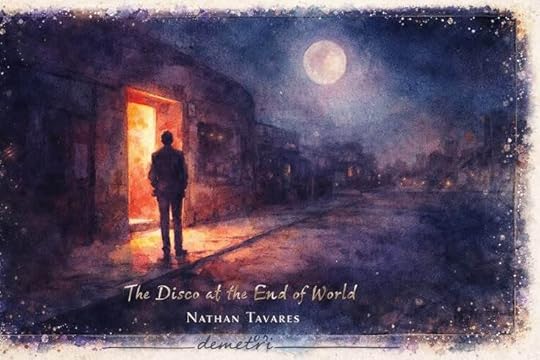
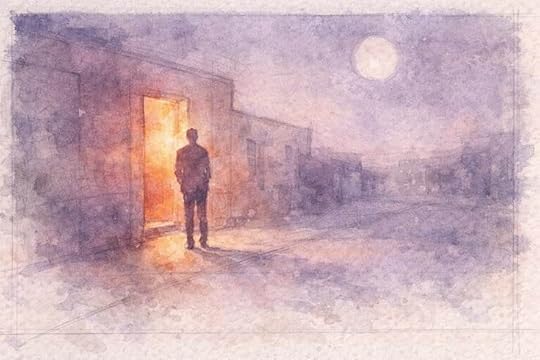
A lone figure held at the threshold of refuge, where nightclub light becomes survival’s invitation and the novel’s private ache turns briefly gold.
Nathan Tavares writes “The Disco at the End of the World” as if the nightclub were the last functioning civic institution in America. That is the novel’s wildest idea, and also its most serious one. The club here is not backdrop, not camp garnish, not a glitter-bombed annex to the “real” action. It is shelter, switchboard, supply depot, choir loft, black market, warning network, flirtation engine, and emergency government. It stores hormones and contraband, passes messages, hides the hunted, stages drag, trains desire, teaches courage, and keeps the music going while official America tries to regulate breathing itself. Tavares gives us moon bases, alien adjudicators, Reaganite moral warfare, Studio Zones that operate like sovereign kingdoms, and disco as both sound and metaphysical technology, but the book’s deepest conviction is almost stubbornly material: people stay alive because other people make room for them.
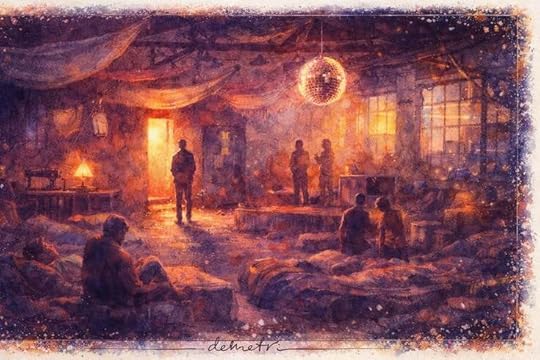
Fort Founding Mothers imagined as a patched-together sanctuary where shelter, nightlife, logistics, and chosen family become the same room.
That conviction is what keeps the novel from becoming merely a fabulous premise in platform heels. On paper, the pitch sounds deliciously unmanageable. In an alternate 1970s America, Mitchell Ward – ex–Space Guard, horny wiseass, emotional evasive specialist, patron saint of bad decisions – lands in Los Angeles after catastrophe on the moon and falls into a city where queerness is policed through Moral Codes, studios function as privatized states, and public culture is being bleached into patriotic mush. Mitch reunites with Gloria, the novel’s incandescent diva-saint, whose nightclub world becomes the center of an underground network of queer survival. Then the scale blows open. Strange disco frequencies, Donna Summer–like star music, crashed alien craft, and a cosmic order called the Metronomes reveal that Earth is under judgment. The question is not only whether the world can be saved. It is who gets to decide what counts as a world worth saving.
That last question gives the novel its real voltage. Tavares is not satisfied by the familiar opposition between grubby earthly fascism and enlightened cosmic order. He wants to know how authority prettifies itself. The U.S. government does it with patriotism, moral hygiene, family rhetoric, curfews, raids, surveillance, and the soft-pedaled violence of “public order.” Hollywood does it with image management, glamour, nostalgia, and private security wrapped in dream-factory varnish. The Metronomes do it with harmony, beauty, transcendence, and the rhetoric of balance. They may speak in celestial shimmer rather than bureaucratic sludge, but they are still deciding who is admissible. They aestheticize hierarchy so elegantly that even they can mistake sentencing for mercy.
That is one of the novel’s sharpest intellectual moves. The Metronomes are not benevolent aliens whose grandeur throws human pettiness into relief. They are imperial harmonizers. Their universalism comes with fuel demands, rules of worthiness, and a chilling confidence that they can hear the right music of civilization better than the people living inside it. Tavares understands, to the novel’s benefit, that domination often arrives dressed as refinement. “The Disco at the End of the World” is full of people insisting they know how to protect the vulnerable while building systems that classify, contain, and erase them. In that sense, the book’s speculative machinery is not a decorative superstructure placed atop queer history. It is the pressure chamber that lets Tavares ask how control moves from the bedroom to the city, from the city to the nation, from the nation to the cosmos.
Mitch’s first-person voice is what makes all this not only legible but alive. He is not a solemn guide through apocalypse. He is lascivious, frightened, loyal, petty, self-mocking, romantic, strategic, and forever cracking a joke half a second before a feeling can catch him in the throat. Tavares is exceptionally good at the kind of comic line that is doing three jobs at once: making us laugh, sketching social texture, and showing a man improvising his own emotional life in real time. Mitch’s jokes are not decorative flair. They are the gearwork of survival. They let him test danger, deflect humiliation, flirt with disaster, and keep his selfhood moving when stasis would mean suffocation. The wisecracks are not garnish but breathing equipment.
That verbal energy shapes the prose at every level. Tavares writes in a register that slides happily between streetwise banter, erotic camp, military bark, gospel uplift, cosmic melodrama, and real grief. He likes a sentence with hips. He likes a phrase that can glitter and sneer in the same breath. He likes the ridiculous word or image that reveals a whole social world rather than merely decorating it. The style is not polished flat. It is shiny in the right places and scuffed in useful ones. Even the book’s excesses belong to its temperament. This is a novel that trusts amplification. It wants more bodies, more lights, more jokes, more noise, more fear, more hunger, more song. When it works, and it often does, that excess becomes method. Tavares is writing about people dismissed as too loud, too sexual, too theatrical, too much, and he gives them a prose that refuses tasteful diminishment.
He is also smart about bodies. The book’s politics do not hover above experience as thesis. They arrive through lungs, sweat, bruises, panic, arousal, exhaustion, outfits, cigarettes, breathlessness, and the choreography of rooms. A curfew is not just a law; it is a rearrangement of desire. A raid is not just a plot point; it is a forced rewrite of what bodies may do in proximity. Even the cosmic plot gets translated into flesh. Music rattles the ribs. Tempo moves through hands, throats, skin, and breath. Healing, corruption, ecstasy, and command all become bodily states before they become ideas. That keeps the novel from floating away on its own speculative exuberance. No matter how wild the cosmology gets, someone still has to pass the sandwich, hide the pills, prop open the safe house, and check whether another person can breathe.
This is where Gloria becomes the book’s secret center. Mitch may narrate and Flynn may carry the grand cosmic reveal, but Gloria is the figure who tells the novel what power ought to look like. She is not merely conscience, sidekick, muse, or drag-divine ornament. She is a competing model of authority. Where Kern commands by narrowing the room, and the Metronomes adjudicate by sorting and scaling, Gloria enlarges. She makes performance useful. She makes charisma infrastructural. She turns style into invitation, invitation into shelter, shelter into collective action. Lady Moondust does not simply entertain the crowd. She reorganizes what the crowd can become. The book eventually knows this, and its ending gets stronger the moment it fully admits it.
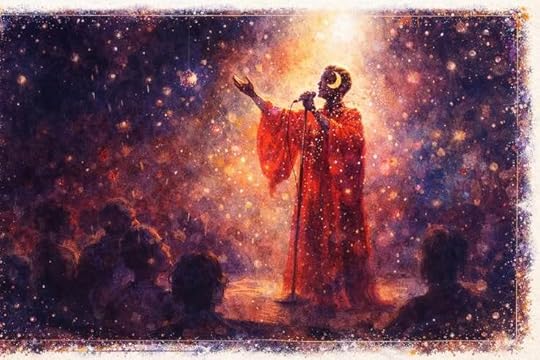
Lady Moondust as performer-saint, where charisma stops being ornament and becomes a form of collective protection.
Formally, “The Disco at the End of the World” is built less like a clock than like a set list. Tracks bleed into one another. Motifs come back louder, stranger, and more charged. Refrains, remixes, reprises, callbacks, costume changes, reveals, and escalations do a great deal of the structural work. That is not cute ornamentation. It is how the novel thinks. Information is delayed not to create puzzle-box cleverness but to make revelation feel like a beat drop – the thing has been there in the mix all along and suddenly the whole room hears it. Tavares is especially good at letting motifs accrue practical, emotional, and metaphysical force at once. The sewing room is a workroom, refuge, theater annex, and political cell. The disco is pleasure palace, mutual-aid hub, alternate state, and cosmological relay station. “I Feel Love” is a song, a code, an engine, a prayer, and eventually an ontology.
Still, the structure does not always deepen meaning as much as hold too much material in motion at once. The novel’s central limitation is the cost of its appetite. Tavares wants queer nightlife novel, alternate-history satire, apocalyptic sci-fi, first-love story, friendship novel, anti-fascist fantasia, metaphysical melodrama, and camp liturgy under one roof. Much of the time that ambition is the source of the book’s singularity. At other moments, it produces drag in the less flattering sense. A motif returns once too often. An opposition that has already been dramatized gets named again in larger letters. A lore passage arrives with a trace of “just to be clear.” A climactic turn occasionally comes after the emotional and intellectual point has already landed. The book’s imagination is ahead of its pruning instinct.
That unevenness matters, but it does not cancel the feat. In fact, a more ruthlessly disciplined version of this novel might have been less alive. Tavares’s messiest impulses are often the same ones that make the book feel inhabited rather than manufactured. He has a gift for turning a room into a system, a gag into a worldview, a crush into a metaphysics, a party into a counterstate. The bars and back rooms do actual work here. So do cots, sewing machines, phone trees, speed pills, makeup, demos, cigarettes, stage lights, and cheap booze. The novel’s queer spaces are not romanticized into perfect havens, but neither are they reduced to nightlife chic. They are labor-intensive places where people keep one another from disappearing.
That, finally, is the novel’s central achievement. It takes forms of life often dismissed as unserious – drag banter, disco excess, sexual adventurousness, gossip networks, flamboyance, chosen family, style itself – and reveals them as practical intelligence. Tavares insists that what official culture calls noise may be knowledge, and what it calls excess may be the only thing flexible enough to answer catastrophe without becoming catastrophe. There are lines of inheritance here from queer nightlife fiction and queer speculative fiction alike – one sometimes thinks of Andrew Holleran’s “Dancer from the Dance” for the ache and the after-hours intelligence, or Samuel R. Delany’s “Stars in My Pocket Like Grains of Sand” for the braiding of erotic life and speculative architecture – but Tavares is less elegiac than Holleran and far grimier, funnier, and more logistic-minded than Delany. His great interest is not just queer feeling but queer operation.
The ending sharpens that interest beautifully. It does not simply resolve the alien plot. It reassigns the book’s center of gravity. What begins as Mitch’s voice, Flynn’s mystery, and a cosmic chosen-two story becomes something more collective and more persuasive. Gloria’s ascendance, and the novel’s final turn toward the Army of Lovers as an actual distributed power, rescues the book from the danger of making salvation the property of exceptional beings alone. “Love multiplies” is a sentimental sentence in lesser hands. Here it becomes an organizational principle. The ending argues that survival will not come from purity, hierarchy, or abstract harmony, but from people who can convert hurt into music, music into force, and force into protection without forgetting mercy. That is a huge claim. Tavares earns more of it than I expected he would.
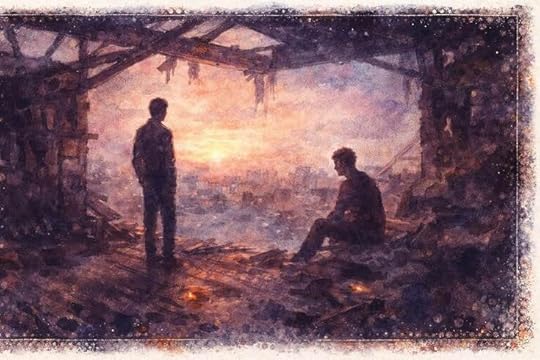
Two figures held in the pause between ruin and dawn, where love, secrecy, and near-forgiveness share the same damaged roofline.
For all its overreach, and there is overreach, I found the novel hard to shake. What lingers is not only the premise, though the premise has a lovely deranged confidence to it. It is the furniture. The cot by the wall. The altar of pop divas. The sewing machine in the corner. The stash of contraband. The spotlight. The joke told in danger because silence would be worse. The room with rules and routes and supplies. The sense that while the nation is busy choreographing obedience, somebody else is still pinning the hem, checking the tank, passing the warning, cueing the next track, and keeping the speakers on.
“The Disco at the End of the World” is not a flawless book. It is a rangy, overclocked, intermittently baggy, fiercely alive one. Its 89/100 rating and corresponding 4-star Goodreads verdict reflect exactly that mix of admiration and reservation: this is not a polished masterpiece, but it is too inventive, too heartfelt, too politically alert, and too gloriously itself to count as anything less than a major success on its own wild terms. Tavares understands that the people most often told they are too loud, too queer, too soft, too much may be the very ones who know how to hold a room together when everything else goes dark. By the end, the novel has made its case. History is not kept alive by the men who speak most piously about order. It is kept alive by the ones still dancing through the wreckage, passing the bottle, lifting the fallen, stealing the mic, and turning the music back on before the dead air wins.
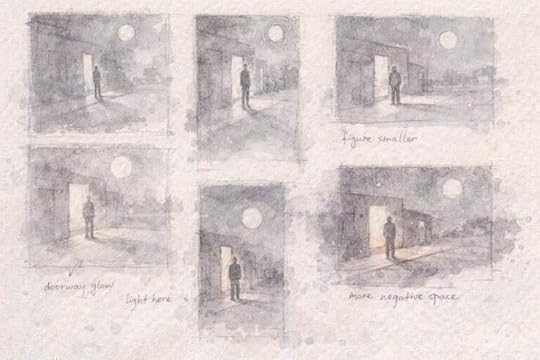
Early compositional searches for the threshold image, testing how solitude, invitation, and negative space could carry the book’s emotional argument.
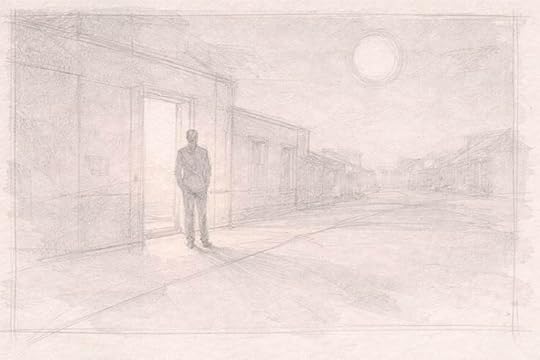
The scene before color – just enough graphite to locate the doorway, the body, and the hush between isolation and belonging.
The first diluted washes laying in dusk, shadow, and doorway heat, when the image begins to choose atmosphere before detail.
The working palette behind the review’s visual world – bruised blues, ember reds, worn ambers, and nightclub shadow translated into hand-painted notation.
All watercolor illustrations by Demetris Papadimitropoulos.
The Disco at the End of the World was such a fun, weird ride. It leans into the chaos with plenty of heart, and while it gets a little over-the-top at times, it never loses the charm that kept me turning the pages.
Nathan Tavares has more or less cemented himself as an instabuy author for me, and Disco at the End of the World continues placing him near the top of my favorite author’s list. The early reviews for Disco had me hesitant: several readers I trust DNFd, and a 3.5 rating on Goodreads typically indicates that a book has some fairly major flaws. Like with most of Tavares work, I think my love for it is going to be higher than most people’s. He speaks to my soul in a way that few authors do. This book has some significant rough patches, but it also filled a void that I’ve been searching for: speculative fiction that seriously engages with historical underground queer spaces in America. If that isn’t something that immediately gets you excited though, there probably isn’t enough here for me to recommend it to the average reader.
Read If You Like: portrayals of underground gay culture, alternate space-race history, queer acid trips, disco ball spaceships
Avoid If You Dislike: characters facing homophobia, long stretches without speculative elements, the power of LOVE, intense tonal shifts
Comparable Media: Welcome to Forever, Exit Stage Left: Snagglepuss Chronicles, Disco Witches of Fire Island
Elevator Pitch: Mitch is a member of the Spaceguard, which has replaced Nasa in this version of the Cold War with more of a military emphasis than exploratory. He works on the moon base, where he’s known as a queer who doesn’t get a hard time only because he also smuggles contraband in for everybody else. He gets reported for morality breaches and is sent back to Earth, where he and his fellow servicewoman Gloria (not that most soldiers used that name for her) helped open an underground Disco outside Hollywood. Strange things are happening to Mitch however, and he ends up being a contact point for Aliens who are threatening to destroy Earth, unless he, Gloria, and his new family can bougie hard enough to change history.
What Worked for Me: The thing that keeps bringing me back to Tavares is how he captures the voices of queer men. Obviously there’s no singular experience of what it means to be a gay man, but Tavares taps into the communal history and experiences of our community in a way that speculative fiction authors are generally reluctant or incapable of doing. His books make me feel seen, like this is a book for me and people like me. He is unafraid to write a book that doesn’t center a version of queerness palatable for the masses. This novel in particular relishes in the underground and countercultural elements. Casual desire, cruising culture, queer magazines; part of his research for this book involved interviewing the owner of the last remaining vintage gay erotica shop in the world. It is impossible to separate queer joy and resistance from the DNA of The Disco at the End of the World. When your identity is criminalized, you either choose to blend in for safety or live in a constant state of reckless abandonment.
While there are absolutely parts of the world where the need for underground queer culture is strong, even the worst parts of America have largely moved on. Ironically, apps have fragmented our community even as they increase our physical safety, breaking down intergenerational mentorship and a tight fabric of communal organizing. As we appear more often in popular media, the intrinsic subversiveness of homosexuality fades away into something that exists more comfortably alongside mainstream sensibilities. I refuse to be a grouchy old man who says this is all bad; life is unambiguously and unarguably better for queer folks now than it was even twenty years ago, especially for kids. However, we can both celebrate progress while mourning and honoring parts of our culture that have faded. This book is an homage to the history of queerness, but queer masculinity in particular. This means it isn’t going to be for everyone, but it’s hard to overstate how much Tavares’ writing makes me feel connected to the history of gay men in America.
This all goes hand in hand with Disco’s place as an Alternate History. Tavares has a lot of fun making sweeping changes. Reagan is even worse than he was in the real world, taking on some Trumpian aspects in a world where Communists were winning the Cold War. Disco imagines America’s response by doubling down on repressive policies to enforce a particular brand of morality and a stronger shift to authoritarianism than we saw in our actual history. Layer onto all of this a stronger space-race craze that becomes a cultural monolith across TV, advertising, and even food branding. Knitted together with a growing hotbed of fascism is the revelry of the Disco scene, banned and censored in the US and thus smuggled in from Europe and Canada. The ease with which Tavares shifted between these two modes, of Mitch getting beaten up by cops only to lose himself in dance the very next day, is an endorsement for revelry when times get hard. I don’t go quite as far thematically as Tavares seems to want to - that this joy is itself the change - but its defiant joy is a necessary component of resistance to fascism. Minnesota had a rough year for that, and it’s challenging to find joy when those who are supposed to keep you safe are constantly pummeling you. The Disco at the End of the World reminds us of the importance of community and losing yourself to the moment.
What Didn’t Work For Me: This was a Tavares book through and through, with all the good and bad that entails. Tavares is a master of characterization and compelling prose. However, I’ve generally found his implementation of speculative elements a bit lacking. While I enjoyed the Alternate History elements of Disco, I struggled once the aliens and magic powers came online. This book leans into ‘love is magic’ in a very literal sense, but mixes it with vocab like Ascended Beings and Tempo. There was lots of infodumping and talking about tapping into the power of the universe often felt stylistically divorced from other parts of the novel, like I had shifted to reading something with light and invisible prose. When magic and alien contact was hallucinatory, I loved it. Tavares is at his strongest when asking readers to disassociate from their bodies a bit. However, the longer this magic and alien contact remained in the story, the more I felt like Tavares’ writing shifted to something I’d see on Royal Road. I do love a good Royal Road story, but that isn’t what I’ve picked up The Disco at the End of the World for.
As we careened towards the climax of the story, the camp that Tavares had balanced with such a light hand spun out of control. I can accept a lot, but it crossed a line when the disco ball alien mothership said Holy fuckcannons. Who knew these cats had antimatter bombs? If you’re going to harsh our vibe, we are going to boot you off the dancefloor. The writing is especially jarring because they're paired with well-developed serious elements, such as a soldier processing that he's actually been part of a genocidal machine for eons. The tonal whiplash was extreme, and it didn’t serve the book in meaningful ways.
The first half of the story was an easy 5 stars for me, but I’d put the back half closer to a 2. I think these issues are significant enough that I can only recommend Disco to folks who are actively seeking out historical American fantasy/sci fi and the countercultural elements that Tavares wove into the book. Objectively, there’s a lot about this book that was a hot mess, and Tavares remains one of four authors on my ‘must buy’ list.
Conclusion: A captivating Alternate History for those interested in queer history in America, but its implementation of other speculative elements was rough.
Thank you to the publisher and NetGalley for the ARC.
There is something wonderfully audacious about The Disco at the End of the World. On paper, it sounds, in the very least, tricky to pull off: an alternate-history 1970s America with an accelerated space race, queer counterculture, disco, first contact, cosmic metaphysics, political repression, romance, and an impending apocalypse. It is precisely the kind of premise that makes you wonder whether its ambition will become its greatest strength or its greatest weakness.
Remarkably, for much of its runtime, Nathan Tavares convinces you that it might actually be both.
The novel's absolute confidence in its own identity is admirable. It never apologises for its queerness, never softens its politics, and never feels compelled to justify its exuberance. The disco of it all is also not just a backdrop or an aesthetic flourish, it becomes sanctuary, community, resistance, and, ultimately, philosophy. There was a danger that its symbolism could have felt unbearably contrived., however, here it feels earned because Tavares seems to understand that joy itself can be a profoundly political act.
The alternate history presented is compelling. Rather than a simple "what if?" scenario, we get to explore how technological progress does not necessarily produce moral progress. Humanity may have reached the Moon decades ahead of schedule, but prejudice, authoritarianism, and moral panic remain stubbornly terrestrial. That juxtaposition gives the novel much of its bite. It asks whether societies can truly call themselves advanced if they continue to deny entire communities the right to exist openly.
Mitch proves to be an engaging narrator precisely because he lacks heroic certainty. He's funny, vulnerable, frequently overwhelmed, and often unsure whether he's chasing love, purpose, or simply somewhere he might finally belong. His friendship with Gloria is the emotional heart of the novel, grounding even its strangest flights of speculative imagination in something recognisably human. Found family is hardly an uncommon theme in science fiction, but Tavares approaches it with remarkable warmth and sincerity.
Stylistically, the novel is equally distinctive, and if you are a fan of works like The City We Became by N K Jemisin, then you’ll be on board. Tavares writes with an infectious energy that shifts effortlessly between humour, melancholy, romance, camp, and cosmic wonder. There are passages that feel almost musical in their rhythm, fitting for a book so deeply invested in dance floors and playlists. Even when individual scenes become surreal, the prose remains emotionally intelligible.
Where the novel falters is in its second half. As the cosmic mythology expands and the mechanics behind its first-contact narrative move increasingly to the foreground, the book begins carrying more conceptual weight than its structure can comfortably support. Although I am partial to no hand holding in my storytelling, The Last Disco at the End of the World continually refuses to balance pacing past its midway point. A true shame because, as exposition becomes denser, metaphysical terminology accumulates much too rapidly, and the ideas that initially felt dreamlike become increasingly literal, but rather than deepening the mystery, the explanations occasionally diminish it.
Tonally, too, the balancing act doesn't always hold. The novel moves confidently between camp exuberance and genuine political horror for much of its length, but there are moments where those registers begin competing rather than complementing one another. Yet I found it difficult to hold those shortcomings against the novel for long. Books this imaginative are surprisingly rare. Tavares isn't interested in refining familiar formulas, that much is clear. He seems to be trying to build something gloriously idiosyncratic, where queer history, speculative fiction, disco culture, and cosmic transcendence all occupy the same emotional landscape. Even when the execution occasionally overreaches, the ambition itself remains invigorating.
Nathan Tavares has written a hallucinogenic ode to love and queer joy and I simply love it. In this alternate history, America launched its space programme immediately after WWII, and the ripples of that divergence run strange and deep through every corner of American culture and politics. Into this world steps Mitch Ward, who follows Flynn, the lost love of his youth, into the US Spaceguard, only to find himself stationed on a backwater moon base with his closest friend Gloria, watching every incoming shuttle for a face that never quite arrives.
What starts as a quiet, aching story about longing, surveillance, and state persecution turns explosive fast. After a dishonourable discharge and an encounter with a mysterious euphoric entity on the moon, Mitch and Gloria land in Los Angeles with nothing: no plans, no future, and an America sliding toward fascism around them. What they find instead is each other and their people. The discos. As the blurb puts it, this is where "the people the mainstream has rejected have always found each other, have always built their joy precisely because it was denied them everywhere else."
That's really the heartbeat of this book: joy as resistance, glitter as armour. Gloria in particular emerges as the novel's emotional anchor; her friendship with Mitch, and the grace and self-knowledge she offers him, gives the book much of its warmth. The novel is deeply interested not only in survival, but in healing, forgiveness, and refusing to become the thing that oppresses you.
When Flynn crashes back into Mitch's life claiming to host an emissary of a utopian civilisation approaching Earth, the novel pivots into full first-contact science fiction without ever losing its grip on the personal and political stakes it built first. It's a book doing three things at once: an intimate queer love story, a political novel about marginalised communities surviving fascism, and a genuine alien-contact narrative, and somehow none of those threads crowd the others out.
The needle-drops are doing real work here too. I particularly love this line: "Throw away your philosophy, don't you worry about heresy, try a little humility and dance 'til we die." It sets the tone for a book where disco isn't backdrop, it's doctrine. Tavares clearly knows his history and his music inside out; the way he warps 70s and early-80s references together into something that feels both specific and slightly unreal is genuinely impressive, the kind of confidence that only comes from someone who's done the research and trusts it.
What surprised me most was how the cosmic and the historical never feel like separate registers. Mitch's relationship with his father, the quiet correspondence with Gloria through letters, the casual cruelty of being asked to inform on twenty fellow servicemen, all of it sits alongside aliens and ascension and dance floors that bend reality, and it works. Tavares embraces the bizarre wholeheartedly: ascension, sentient music, cosmic dance floors and reality-bending discos all unfold with dreamlike conviction. This is psychedelic, politically alive, and completely unlike anything else I've read this year.
I listened to this as an audiobook, narrated by Ruffin Prentiss, and I genuinely don't think I could've experienced this book any other way. His baritone hits something in your chest: sexy, alluring, completely magnetic, and he brings such clarity to both the fear and the elation in this story that I could've listened to him forever. The pacing, the vocal range needed to do justice to a cast this size and this distinct, the way he makes every disco scene feel alive: this is masterclass narration.
Huge thanks to Libro.fm for the ALC. #pudseyrecommends
The Publisher Says: An alternate 1970s science fiction romance blending first contact and queer counterculture in the Los Angeles disco scene, perfect for readers of Vajra Chandraseker and Victor Manibo.
In 1977—a world where America launched its space program shortly after WWII—Mitch Ward is a grunt in the US Spaceguard. Stationed in a backwater base on the Moon, his only friend is Gloria, who performs "Lady Moondust" for fellow soldiers, until he's briefly reunited with Flynn, a love from his youth who has never been far from his heart.
Following a visit from an unseen, terrifying but also maybe euphoric being, Mitch and Gloria find themselves quickly discharged from the Guard, and sent back to Earth. Moving to Los Angeles to chase their dreams, the duo scrape by, dancing between joy and defiance at the discos in a rapidly changing city that's unwelcoming to those who don't fit the Golden Age of Hollywood standard.
But when Flynn crashes back into their lives, he comes with a warning. He claims to be the host for a traveler and emissary of a utopian civilization, who has caught notice of Earth. This civilization is either the source of humanity's salvation—or its destruction. And they're on the way.
With the strange new powers blooming in Mitch and Gloria and Flynn's motives perhaps as hazy as those fog-filled LA dance floors, it's up to this community of disco-loving misfits to stand up for what is beautiful and right. And save those who maybe wouldn't do the same for them.
They're not going down without a fight—and one hell of a party.
I RECEIVED A DRC FROM THE PUBLISHER VIA EDELWEISS+. THANK YOU.
My Review: I'd give it four stars just for the Mothership being a disco ball.
As it was, I gave it four stars because the chilling terribleness of a 1970s Reagan presidency coming as a natural development of Ronnie's disgusting authoritarian conversion in the 1950s, ushering in a repressive crackdown in place of Stonewall...well, it was a seasick feeling of "are we *sure* this didn't happen?"
I spent less time pondering Flynn's freaky-deaky...um, alteration?...than the alternate history elements. In fact the aliens were not particularly convincing to me, in that their role in the story felt less than integral to my sense of what should happen next. I found the ending flowed from their presence, so it wasn't joltingly out of place...just wasn't what I'd've preferred.
The Metronomes substitute for the christian nationalist horrors of our time quite neatly. Substituting one set of soi-disant judges for a different one is a wish-fulfillment move. It's like thinking the grade-school "how would you like it" argument on steroids...unconvincing, flimsy, and ultimately self-defeating. I'm not raving like I would be had we stuck to our alternate history premise, but honestly...I was having fun, so I unpuckered and got the pleasure the story I was reading offered me. I left the pining for something else on the dance floor with the fifth star.
2.5 stars rounded up. Review for: The Disco and the End of the World by Nathan Tavares (As Spoil-Free as I Can Be)
This is such a cool concept! It started off like if Studio 54 meets the Fallout universe (pre-fallout). Which seems very much up my alley. Unfortunately, this just missed too many marks for me. I found myself about 30% speeding through chapters just to get to the end. I still had high hopes when the book took a total tone shift into the surreal. I did make it to the end, and I can appreciate the love letter to disco and queer nerds but it just didn't do it for me.
The Good: The aesthetic of this world is very interesting! It's fantastical, and heavily leans into my favorite vibe, retro futurism. I appreciate an all queer cast, fighting against the powers that be with love, dancing, and ass kicking. Who wouldn't like a disco heavy science fiction!
The Bad: With all that good, imagine my surprise when this book could not get out of its own way. This story felt disjointed. I found it so hard to feel anything while reading. Every character is a cardboard cutout of someone with depth, but never actually presents any. The fantastical events of the second half of the book were hard to follow. It felt like the author wanted it to be a fever dream of an event. I just found it confusing to track the action.
The Ugly: World building! As a huge sci-fi fan and a history nut, I was thoroughly disappointed with the world building. In just the beginning 15% of the book I was screaming "why are they using chits!" What sense does that make. I understand its sort of a smuggling currency for the soldiers on base. But why?! Why chits? Where is the supply of heavy metal coming from? Why is that a form of currency to be used? Is there a shortage on paper? If so, why metal? Are they mining it from the moon? What large quantities of metals are they extracting from the moon? If you are going to go for science fiction, GO FOR SCIENCE FICTION! Build the world. Do not just add historical events and never explain why the other (real-life) events still occurred. Why is there still a Red Scare if we made it to the moon and established a base. Why was Reagan still elected? Why do any of the TV shows of that time still exist in a world where we as the US not only made it to the moon, and a few short years later established a functioning moon base. I understand maybe I am overthinking, but the moon base aspect felt so shoe-horned in the author could have left it out.
Overall, this is an amazing concept for a novel. I love the attempts at campy dialogue, the queer representation, and the overall aesthetic of the story. This story suffers from not going further with its worldbuilding and failing to craft rich characters. I do like where this author's mind goes and I am curious to see what their other works are like.