

What do you think?

Cages
Cages is a sweeping, polyphonic portrait of a man seen through the eyes of those who loved him, feared him, and betrayed him. At its center is Felix—a zookeeper in 1960s Cuba, an exile in London, and finally a dying man in Miami. His story is pieced together like a puzzle that can never fully be solved by one who knew him only as an absence and seeks to know him before it is too late.
In Cuba, during the Missile Crisis, Felix risks everything for an illicit love affair with René, a fellow keeper. In a society where homosexuality is branded “counterrevolutionary,” their tenderness unfolds in the shadow of danger, betrayal, and political oppression. In London, Felix and his wife Anabel navigate exile and reinvention, while an aspiring actress named Claudia finds herself drawn into their orbit, her ambitions and desires colliding with Felix’s own hunger for connection. Years later, Virgilio—Anabel’s devoted brother—recounts the disintegration of Felix’s marriage and the exile that follows, even as he steps in to protect the family Felix abandoned.
From Anabel, long silent about her complicity in the events that forced Felix’s flight from Cuba, to Rita, the daughter who knew him differently, each voice brings a sliver of truth. Together, these testimonies form a mosaic of longing, deception, survival, and reconciliation.
Spanning Havana, London, and Miami, Acevedo’s luminous, formally inventive novel explores exile, forbidden love, fractured families, the nature of truth, and the stories we tell to make sense of the people we cannot forget.
In Cuba, during the Missile Crisis, Felix risks everything for an illicit love affair with René, a fellow keeper. In a society where homosexuality is branded “counterrevolutionary,” their tenderness unfolds in the shadow of danger, betrayal, and political oppression. In London, Felix and his wife Anabel navigate exile and reinvention, while an aspiring actress named Claudia finds herself drawn into their orbit, her ambitions and desires colliding with Felix’s own hunger for connection. Years later, Virgilio—Anabel’s devoted brother—recounts the disintegration of Felix’s marriage and the exile that follows, even as he steps in to protect the family Felix abandoned.
From Anabel, long silent about her complicity in the events that forced Felix’s flight from Cuba, to Rita, the daughter who knew him differently, each voice brings a sliver of truth. Together, these testimonies form a mosaic of longing, deception, survival, and reconciliation.
Spanning Havana, London, and Miami, Acevedo’s luminous, formally inventive novel explores exile, forbidden love, fractured families, the nature of truth, and the stories we tell to make sense of the people we cannot forget.
208 pages, Hardcover
Published June 9, 2026
About the author
Chantel Acevedo
15 books252 followersCalled "a master storyteller" by Kirkus Reviews, Chantel Acevedo is the author of Love and Ghost Letters, A Falling Star, The Distant Marvels, which was a finalist for the 2016 Andrew Carnegie Medal for Excellence in Fiction, and most recently, The Living Infinite, hailed by Booklist as a "vivid and enthralling tale of love and redemption." Her essays have appeared in Vogue and Real Simple, among others. THE MUSE SQUAD: THE CASSANDRA CURSE, is a new middle grade series forthcoming from Balzer + Bray. She is a Professor of English at the University of Miami, where she directs in the MFA program.
Ratings & Reviews
Friends & Following
Create a free account to discover what your friends think of this book!
Community Reviews
Displaying 1 - 20 of 20 reviews

July 31, 2026
The novel, Cages, spans three key locations:
🔹1960s Havana during the early years of Castro’s regime
🔹London during the “swinging sixties”
🔹Miami FL during the AIDS-era of the 1980s.
This is the story of Felix—a very charismatic zookeeper and closeted bisexual who risks being discovered and sent to a labour camp for conscientious objectors (homosexuals and dissidents) at a time when homosexuality is seen as “counterrevolutionary”.
But Felix is a very complicated person, so the author decides to tell his story through the perspectives of the five characters closest to him—his two lovers (René and Claudia), his wife Anabél, his brother-in-law Virgilio, and his second daughter Rita.
I have mixed feelings. On one hand, the historical themes are rich and interesting, but on the other, I found the pacing a bit sluggish at times. My biggest issue was with the London section. Despite what he’d already put his family through, Felix falls back into his hedonistic ways—unable to say "no" to save his life! His affair with Claudia felt like such an enormous betrayal—she was Anabél’s only friend! To me, it was just one affair too many!
IMO, Anabél was the absolute saving grace of the book. She’s so brave and realistic—she knows she cannot “fix” him, so despite having a very young child to care for, she leaves the marriage and travels to Miami to stay with family, leaving Felix to (hopefully) figure things out in his own time. I adored her strength and integrity, but the occasional slow pace and the frustrating relationship drama kept me from loving this one.
3 “Reality–is–a–question–of–perspective” stars ⭐⭐⭐
🔹1960s Havana during the early years of Castro’s regime
🔹London during the “swinging sixties”
🔹Miami FL during the AIDS-era of the 1980s.
This is the story of Felix—a very charismatic zookeeper and closeted bisexual who risks being discovered and sent to a labour camp for conscientious objectors (homosexuals and dissidents) at a time when homosexuality is seen as “counterrevolutionary”.
But Felix is a very complicated person, so the author decides to tell his story through the perspectives of the five characters closest to him—his two lovers (René and Claudia), his wife Anabél, his brother-in-law Virgilio, and his second daughter Rita.
I have mixed feelings. On one hand, the historical themes are rich and interesting, but on the other, I found the pacing a bit sluggish at times. My biggest issue was with the London section. Despite what he’d already put his family through, Felix falls back into his hedonistic ways—unable to say "no" to save his life! His affair with Claudia felt like such an enormous betrayal—she was Anabél’s only friend! To me, it was just one affair too many!
IMO, Anabél was the absolute saving grace of the book. She’s so brave and realistic—she knows she cannot “fix” him, so despite having a very young child to care for, she leaves the marriage and travels to Miami to stay with family, leaving Felix to (hopefully) figure things out in his own time. I adored her strength and integrity, but the occasional slow pace and the frustrating relationship drama kept me from loving this one.
3 “Reality–is–a–question–of–perspective” stars ⭐⭐⭐

June 14, 2026
Chantel Acevedo writes a devastating, deeply personal saga about the literal and symbolic cages keeping us from being our true selves. Told from the perspective of those who knew him, we learn about Felix, a closeted gay man who’s dying of AIDS in Miami. Perhaps is my own bias as a gay man, but I thought Acevedo did a flawless job with the characterization of this complicated man, and his journey made me think of all the individuals who had a similar fate as him. We owe so much as a community to those who came before us, and while we still have a long way to go when it comes to acceptance, we are at a much better place than the Felixes of the world were last century.
I loved learning about this character through the eyes of others. Acevedo does a great job at infusing each part with the narrator’s personality and point of view. It is hard to learn about a character when they are never the ones on the driver’s seat, but the author does a great job at building a three-dimensional character through the eyes of others.
Great Pride Month read especially for those looking for the Latino/LGBTQ intersection. Thank you, Chantel, for telling this story!
I loved learning about this character through the eyes of others. Acevedo does a great job at infusing each part with the narrator’s personality and point of view. It is hard to learn about a character when they are never the ones on the driver’s seat, but the author does a great job at building a three-dimensional character through the eyes of others.
Great Pride Month read especially for those looking for the Latino/LGBTQ intersection. Thank you, Chantel, for telling this story!

June 29, 2026
“We can be curious about the things we don’t know, but knowledge? Knowledge can be a torment to the soul.” Pg 177
I am so glad I randomly came across this incredible book when I was gift shopping at Barnes and Noble. I was drawn to it by its cover and the title, and then I read the synopsis and knew I had to read it. Only after did I realize this was written by a local author and professor and University of Miami! (I’m the new one to Miami, being here just three years, so maybe everyone else already knew this about her!)
Nevertheless, I adored this book. The writing was impeccable. I really appreciated the unique storytelling technique in that the saga of this man’s life, the study of his character, was presented through the narration and perspectives of how these other narrator’s lives intersected with his, as told through their explanations to his daughter. And it was still done chronologically in a way that we follow a fluid story of Felix living as a closeted gay man in 1960’s Cuba, to London, and then to Miami during the AIDS crisis in the 1980’s. Even though he never appeared as the narrator, and even though the other characters were secondary, each and every character was brought to life so fully and with such rich characterization that I felt like I knew them and their motivations; I could feel their pain, their love, and their worries.
I liked how the theme of being caged was consistent throughout the book, as well as the consistent presence and reference to the lions at the zoo. There was also the theme of the parent-child relationship and reconciling the things we don’t know with the person presented to us. In this case, a daughter tries, as her father lays dying, to reconcile her experiences of him as an absent father with what she learns about his past and the motivations for his decisions.
I want to include one more quote that I found so beautiful and deeply resonating.
“That afternoon, I waited a long time, and stood very still, and let the anger make a hole in me, a home with a door that I could lock when I needed to. I waited and turned the key to the lock, securing it, so that I could be the wife that Felix needed.” P 205
This is a short book at 253 pages, but I ended up having to go through it slowly just because of the circumstances of the week or so after I picked up this book which left me little time for reading. But I actually think that taking the time to savor this one slowly is the way to go.
I am so glad I randomly came across this incredible book when I was gift shopping at Barnes and Noble. I was drawn to it by its cover and the title, and then I read the synopsis and knew I had to read it. Only after did I realize this was written by a local author and professor and University of Miami! (I’m the new one to Miami, being here just three years, so maybe everyone else already knew this about her!)
Nevertheless, I adored this book. The writing was impeccable. I really appreciated the unique storytelling technique in that the saga of this man’s life, the study of his character, was presented through the narration and perspectives of how these other narrator’s lives intersected with his, as told through their explanations to his daughter. And it was still done chronologically in a way that we follow a fluid story of Felix living as a closeted gay man in 1960’s Cuba, to London, and then to Miami during the AIDS crisis in the 1980’s. Even though he never appeared as the narrator, and even though the other characters were secondary, each and every character was brought to life so fully and with such rich characterization that I felt like I knew them and their motivations; I could feel their pain, their love, and their worries.
I liked how the theme of being caged was consistent throughout the book, as well as the consistent presence and reference to the lions at the zoo. There was also the theme of the parent-child relationship and reconciling the things we don’t know with the person presented to us. In this case, a daughter tries, as her father lays dying, to reconcile her experiences of him as an absent father with what she learns about his past and the motivations for his decisions.
I want to include one more quote that I found so beautiful and deeply resonating.
“That afternoon, I waited a long time, and stood very still, and let the anger make a hole in me, a home with a door that I could lock when I needed to. I waited and turned the key to the lock, securing it, so that I could be the wife that Felix needed.” P 205
This is a short book at 253 pages, but I ended up having to go through it slowly just because of the circumstances of the week or so after I picked up this book which left me little time for reading. But I actually think that taking the time to savor this one slowly is the way to go.
September 9, 2026
This novel is told serially in five different perspectives by the people who knew Felix best. They were being interviewed by his estranged daughter as she learned about the man who had adored her during the first few years of her life before her mother took her to Miami from London. Cages referred to many constricing aspects of Felix’s life as a closeted gay or bisexual man living in Havana then London where homosexuality was still criminalized. The author didn’t trust readers enough to let us recognize the symbolism and was much too overt about the cages. But I enjoyed the structure the novel and the story itself.

July 29, 2026
Beautiful writing
Some of the best writing I've read this year. Loved the characterization and the distinct narration between characters. I just wished we heard from Felix!! I think what was relatable to me is the societal cages that we are forced to put ourselves in- especially queer individuals in the 80s. I loved the relationship between animals and man that became blurred as each left their home country, and the duality of changing political landscapes
Some of the best writing I've read this year. Loved the characterization and the distinct narration between characters. I just wished we heard from Felix!! I think what was relatable to me is the societal cages that we are forced to put ourselves in- especially queer individuals in the 80s. I loved the relationship between animals and man that became blurred as each left their home country, and the duality of changing political landscapes

Review of advance copy received from NetGalley
What Remains When Everyone Has Their Version: On Desire, Damage, and Narrative Custody in “Cages”
Chantel Acevedo’s novel begins as the portrait of an elusive man and deepens into a bruising account of wives, lovers, siblings, daughters, and exiles all trying to make meaning out of the same impossible inheritance.
By Demetris Papadimitropoulos | April 9th, 2026
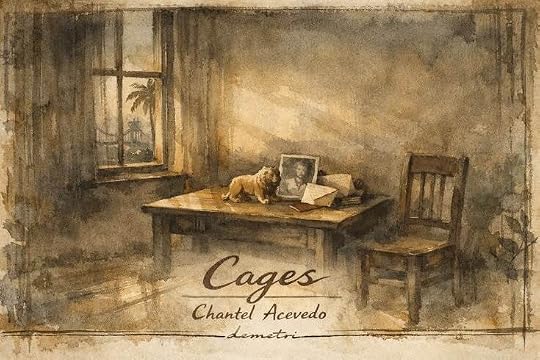
In the hush of a room arranged by memory rather than certainty, a wax lion, a photograph, and a bar of evening light turn one life into an archive no witness can fully order.
The cleverest thing “Cages” does is dare you to think Felix can be solved. He is handsome, divided, catalytic, mourned by half the cast and misunderstood by the other half. He is exactly the sort of man fiction usually promises to yield up if you stare hard enough. Surely someone, eventually, will tell us what he really was. Chantel Acevedo never does. Better still, she makes that defeat the engine of the book. One witness after another takes the stand to explain Felix, excuse him, accuse him, mourn him, reclaim him. Each account clarifies something. It is rarely Felix. He enters other people’s speech and changes its temperature. By the end, “Cages” is less a portrait than a struggle over who gets to narrate one life, and who gets to live with the version that remains.
That design could have turned merely schematic. Instead, Acevedo gives it real voltage by building the novel around voices that are not just different in information but different in appetite. Each speaker wants something from the story they are telling. Some want absolution. Some want order. Some want a lost love back in language, if nowhere else. Some want to keep grief from becoming spectacle. Some want to prove that they themselves were not the fool in the room. This is what gives the book its pressure. “Cages” is not interested in the old pieties about memory being slippery, truth being complicated, identity being unstable. Those are givens. What interests Acevedo is the much touchier question of motive. Why this story now? Why this detail and not another? Why this tenderness, why this omission, why this sudden fit of candor? A life is not merely remembered here. It is edited, defended, staged, and quietly fought over.
René sees Felix first and sees him hottest. In Havana during the Missile Crisis, both men work at the zoo: Felix, a veterinarian and director; René, his assistant, already married to Elenita, already living in a country where desire must learn to whisper. Felix can soothe a lioness, operate on a monkey that has swallowed a diamond ring, exert command without seeming to try. René falls for him with the hunger of a man who mistakes danger for atmosphere until the atmosphere starts knocking over furniture. Around them revolutionary Cuba closes in – committees, slogans, raids, informants, the stale civic air of a system that makes even tenderness feel indictable. Acevedo does not let politics remain rhetorical. She drags it into kitchens, clinics, committee meetings, police stations, and beds. The danger is not only that the state may catch you. It is that everybody may.
René’s section is where the book stops clearing its throat and starts speaking plainly, because it refuses him the shelter of innocence. He is both endangered lover and participant in the same little apparatus of denunciation that later threatens him. He votes with his neighborhood committee against two suspected gay men, then tries too late to save them. He knows what the system does because some version of it has already moved into him. That is what gives the opening movement its ethical recoil. René suffers, but he also helps transmit suffering. Acevedo keeps worrying that arrangement: tenderness tangled up with cowardice, love braided with self-exculpation, injury inseparable from complicity. It is a strong beginning not because it asks us to pity René, though it does, but because it denies him the cleaner shapes pity prefers.
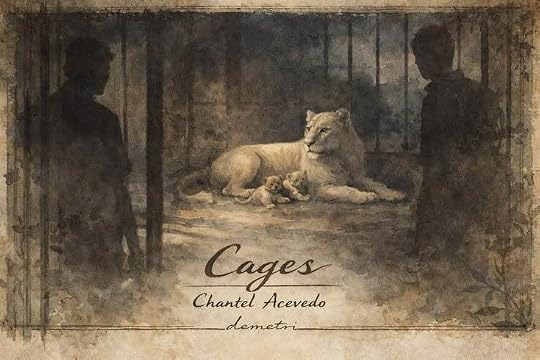
Under moon-struck bars, Mambisa and her cubs hold the novel’s founding pressure – beauty, captivity, secrecy, and desire sharing the same dim air.
The zoo is the image the novel leans on hardest and, luckily, the one that keeps yielding. It links captivity, display, spectatorship, breeding, trade, transport, export, and narration itself. Animals are admired, tranquilized, fed, butchered, shipped, bred for rarity, kept for wonder. Human beings are watched, denounced, handled, hidden, moved from one enclosure to another and told to call movement freedom. A white lioness can be both miracle and freight. A marriage can be both shelter and trap. Even storytelling begins to resemble enclosure: each narrator arranges Felix inside a different set of bars and calls the arrangement truth. Acevedo does not need to nudge us every time this parallel appears. She has built it so thoroughly into the novel’s metabolism that the image keeps working even when unannounced.
When Felix finally leaves Cuba under cover of a zoo transfer, taking a prized white lioness with him, the move lands with exactly the right doubleness. It is escape. It is also shipment. Exile here is not liberation. It is a change of address. London alters the weather, not the man. That becomes unmistakable in Claudia’s section, which gives the novel the jolt of vanity, comedy, and self-dramatizing intelligence it badly needs by that point.
Claudia, an aspiring actress in London, is vain, funny, wounded, intermittently absurd, and invaluable to the novel precisely because she is not noble. She meets Anabél and then Felix at the London Zoo, where he has resumed life among animals, records, and a carefully compartmentalized self. If René gives us Felix in the first heat of danger, Claudia gives us Felix under fluorescent light: still handsome, still drawing, still capable of making other people feel chosen, but also practiced, evasive, a little theatrical in his own right, forever arranging separate lives and hoping they will not collide. Claudia wants art, glamour, permission, a life commensurate with her own sense of latent significance. What follows is not tragic love so much as misreading dressed up for the occasion. Acevedo gets that balance just right. Claudia is needy and observant, selfish and imaginative, alive to style and blind in the old ways desire makes people blind. The book wakes up further when it admits how faintly ridiculous she can be. Not because it mocks her, but because it understands that self-invention is often one costume change away from self-delusion.
London gives Felix new routes, new lovers, new alibis, but not a new self. That is one of the novel’s shrewdest recognitions. Exile changes logistics faster than it changes habit. Secrecy travels well. So does shame. Acevedo is particularly good on the disappointment of discovering that a new city does not necessarily produce a new moral weather. London is not offered as a place of clean reinvention. It is only a place where old fractures acquire new furniture.
In a nearly vacant room, Claudia stoops toward the tiny relic from which she will build an irresistible and catastrophically mistaken story.
Virgilio, Anabél, and Rita do not replace René and Claudia so much as wear at them until the earlier omissions begin to show. Virgilio, Anabél’s brother, is one of the novel’s main anti-pieties: loud, funny, possessive, vulgar, protective, a family mythmaker with a gift for turning warning into anecdote. He keeps the book from drifting into reverent sorrow. In his mouth, love sounds like surveillance, profanity, unsolicited advice, and comic overstatement, which is to say: like family. Acevedo uses him well. He is not there merely for flavor. He is there to remind us that private history is always being retold in forms that sound half ridiculous until one notices how much of a household’s moral weather they actually control.
Anabél’s section moves the reader onto different moral ground. She is not the wronged wife preserved in amber while others narrate around her. She is the woman who absorbs losses, betrayals, political humiliations, dead babies, damaged loyalties, and the daily work of endurance until silence becomes not passivity but engineering. Her account of miscarriages, state violence, marital damage, and friendship turned treacherous shifts suffering from collateral matter to central fact. After Anabél speaks, the earlier sections do not collapse. They simply lose the right to innocence. More than that, the novel’s moral geometry changes. What had looked, from a distance, like Felix’s tragedy begins to look like a system for distributing harm.
This is one of Acevedo’s strongest achievements. She understands that the public language of male damage can sometimes swallow everyone around it. “Cages” does not deny Felix’s suffering, or the brutal historical conditions that helped shape it. But it steadily refuses to let that suffering become monopolistic. Anabél’s section is where the novel most fully earns its complexity, because she is neither saint nor mere victim. She can be patient, proud, naïve, calculating, withholding, loyal beyond prudence, and finally exhausted by loyalty itself. Acevedo does not flatten her into an emblem of long-suffering womanhood. She lets Anabél remain difficult in the right ways, and the book is stronger for it.
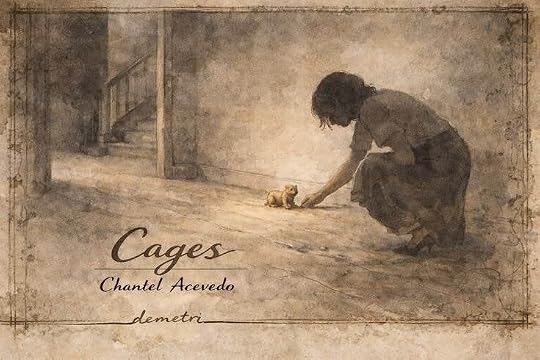
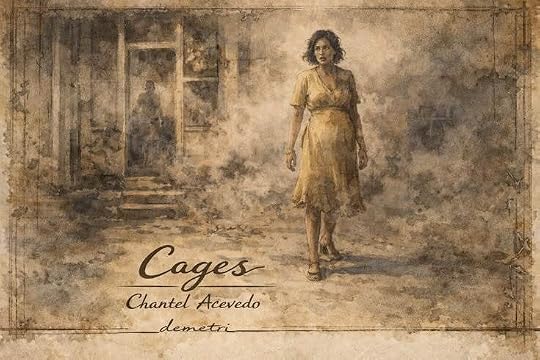
Smoke, shock, and a damaged heel carry Anabél out of history’s violence and into the private wreckage that the book refuses to sentimentalize.
Rita, Felix’s daughter in London, arrives with the hard clarity of someone who has loved an inconsistent father long enough to stop expecting coherence from him. By then Felix is dying in a Miami hospice. There the book stops performing and speaks under its breath. After so much backward-told grief, the bed, the blanket, the protruding feet, the rough machinery of breath restore a needed blunt fact. The hospice scenes are written in a pared-down register with no appetite for flourish. Illness is a ruthless editor. Rita knows his habits, his records, his vanity, the slight comedy of his slippers, the shape of his face because it is her own. She also knows that a person can love you and fail you in the same motion. Here the novel quiets down and becomes harder to dodge.
Acevedo is best when she lets things do the feeling for her: a wax lion, a pair of gold hoops, a lipstick mark rubbed off too hard, a hospital bracelet, a record sleeve, a bag of ice, a hand arranged on a blanket as though that might still count as care. She is not a writer of decorative shimmer. Her prose works through rhythm, object-pressure, and delayed recognition. It has enough lyric lift to register longing, but it does not spend itself on atmospheric mist. More often it prefers an image that returns with altered force. The wax lion is not just motif but method: a small, handled object onto which different lives project different claims. The same is true of music, letters, photographs, and the zoo itself. Physical detail does the ethical labor.
The voices are also genuinely differentiated, which matters in a book like this more than almost anything else. René’s sentences breathe and circle, full of hunger and retrospective self-mitigation. Claudia’s have theatrical quickness and vanity. Virgilio’s come at the reader with anecdote and elbow. Anabél’s are steadier, graver, more controlled in their grief. Rita’s are plainer, hospice-clear, with just enough irony to keep sentiment from taking over the room. Without that tonal intelligence, “Cages” would tilt either toward melodrama or toward tasteful vagueness. Acevedo knows how much polyphonic fiction depends on voice not merely as sound but as pressure system.
The structure is where the book does its hardest thinking. Acevedo does not use multiple narrators as ornament or as a clever way to keep the pages turning. Each section revises the one before it, though seldom by issuing a clean correction. Acevedo wants something messier, harsher, and truer than that tidy mechanism allows. Contradictions pile up and begin to accuse the speakers who make them. A later narrator does not cancel an earlier one; she exposes the need that shaped it. In this respect “Cages” sits nearer the perspectival friction of Lauren Groff’s “Fates and Furies” than the dutifully panoramic family chronicle, though its historical bloodstream has more in common with Cristina García’s “Dreaming in Cuban.” Even those comparisons only get you so far. Acevedo’s design is tighter, more inwardly pressurized. She is less interested in family sprawl than in the fight over who gets final possession of one life.
That fight is the thing the novel keeps circling and cornering. “Cages” presents itself, reasonably enough, as a novel about Felix and the people around him. What it is actually doing is asking who gets to tell a life and what happens to that life once the telling begins. No witness here is disinterested. René wants to preserve the grandeur of a first devastating love. Claudia wants to understand how she mistook performance for destiny. Virgilio wants to defend the family he built against the man who damaged it. Anabél wants to keep pain from becoming spectacle. Rita wants some workable proportion between affection and accusation. Even at their tenderest, they are still arranging the evidence, and arranging it partly in order to survive him. No one gets final possession of Felix’s meaning, not even the daughters. A letter proves only that it was written. A keepsake proves only that someone kept it. A story proves the need that selected it.
Acevedo’s composure costs her something. The discipline of staying partial gives the novel much of its power and also creates a small late-book slackening. By the final movements, the book has already persuaded us that Felix cannot be wholly known, that each account doubles as self-portrait, and that inheritance arrives in shards. At points, the novel restates its uncertainty when one would prefer fresh pressure. There is, too, a faint flattening in the way Felix, so alive and contradictory early on, grows slightly diagrammatic later – less a startling man than an emblem of one. That abstraction is built into the design, but it occasionally costs the novel felt life. At moments, the structure tidies feelings that would be stronger left untidy.
Even so, what stays with you is less plot than residual pressure. The clinic raid. The white lioness. Claudia pocketing the wax lion and building from it the wrong conclusion. Anabél realizing, too late, that patience is not the same thing as salvation. Rita at the hospice bedside, hearing her father half remember the wrong daughter. These scenes persist because Acevedo refuses the easy release valve. No one gets to solve Felix and go home early. The daughter does not inherit truth. She inherits an argument, and the self-serving edits inside it.
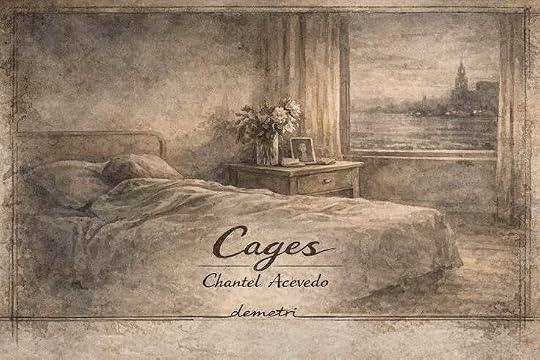
At the edge of the bay, the bedside flowers, photograph, and half-withdrawn body make mortality feel less like closure than a room still negotiating its claims.
I’d rate “Cages” 89 out of 100 – 4 stars in Goodreads terms – a score that suits a novel with formal control sturdy enough to hold a real ache, one whose occasional habit of restating its uncertainty keeps it just shy of the rarest company. It refuses the quick sugar-rush of obvious feeling, which will irritate some readers and stay with others longer. By the end, the title has shifted under your feet. A cage is not only a nation, or a marriage, or a body under surveillance. It is also the story someone builds around a life in order to keep it legible, contained, and from getting loose. Acevedo’s last shrewd turn is that the life inside still paces.
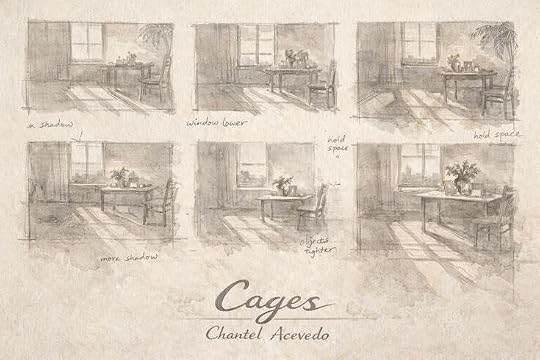
Early compositional thumbnails testing how enclosure, negative space, and the arrangement of evidence might become the image’s emotional architecture.
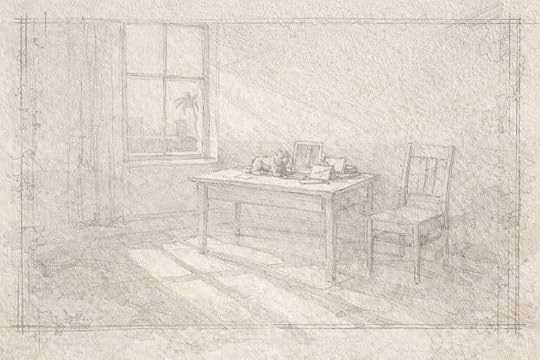
The graphite skeleton of the final painting, where window, chair, shadow bars, and object cluster begin to discover their uneasy proportion.
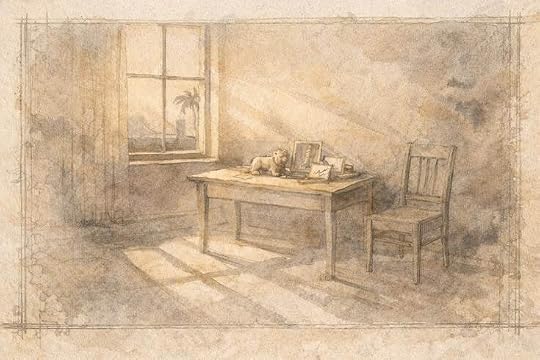
First washes arriving over the pencil scaffold, with memory, dusk, and archival atmosphere only just beginning to stain the room.
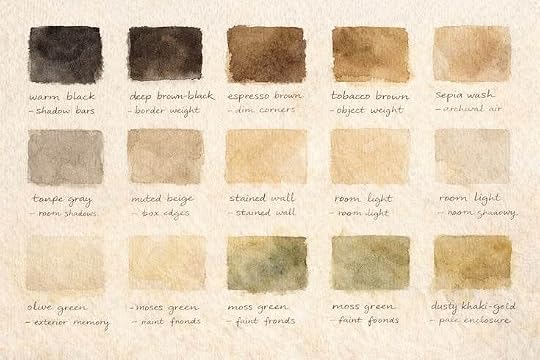
A restrained cover-derived palette study, showing how muted browns, grays, creams, and weathered greens carry the review’s visual world.
All watercolor illustrations by Demetris Papadimitropoulos.
Chantel Acevedo’s novel begins as the portrait of an elusive man and deepens into a bruising account of wives, lovers, siblings, daughters, and exiles all trying to make meaning out of the same impossible inheritance.
By Demetris Papadimitropoulos | April 9th, 2026
In the hush of a room arranged by memory rather than certainty, a wax lion, a photograph, and a bar of evening light turn one life into an archive no witness can fully order.
The cleverest thing “Cages” does is dare you to think Felix can be solved. He is handsome, divided, catalytic, mourned by half the cast and misunderstood by the other half. He is exactly the sort of man fiction usually promises to yield up if you stare hard enough. Surely someone, eventually, will tell us what he really was. Chantel Acevedo never does. Better still, she makes that defeat the engine of the book. One witness after another takes the stand to explain Felix, excuse him, accuse him, mourn him, reclaim him. Each account clarifies something. It is rarely Felix. He enters other people’s speech and changes its temperature. By the end, “Cages” is less a portrait than a struggle over who gets to narrate one life, and who gets to live with the version that remains.
That design could have turned merely schematic. Instead, Acevedo gives it real voltage by building the novel around voices that are not just different in information but different in appetite. Each speaker wants something from the story they are telling. Some want absolution. Some want order. Some want a lost love back in language, if nowhere else. Some want to keep grief from becoming spectacle. Some want to prove that they themselves were not the fool in the room. This is what gives the book its pressure. “Cages” is not interested in the old pieties about memory being slippery, truth being complicated, identity being unstable. Those are givens. What interests Acevedo is the much touchier question of motive. Why this story now? Why this detail and not another? Why this tenderness, why this omission, why this sudden fit of candor? A life is not merely remembered here. It is edited, defended, staged, and quietly fought over.
René sees Felix first and sees him hottest. In Havana during the Missile Crisis, both men work at the zoo: Felix, a veterinarian and director; René, his assistant, already married to Elenita, already living in a country where desire must learn to whisper. Felix can soothe a lioness, operate on a monkey that has swallowed a diamond ring, exert command without seeming to try. René falls for him with the hunger of a man who mistakes danger for atmosphere until the atmosphere starts knocking over furniture. Around them revolutionary Cuba closes in – committees, slogans, raids, informants, the stale civic air of a system that makes even tenderness feel indictable. Acevedo does not let politics remain rhetorical. She drags it into kitchens, clinics, committee meetings, police stations, and beds. The danger is not only that the state may catch you. It is that everybody may.
René’s section is where the book stops clearing its throat and starts speaking plainly, because it refuses him the shelter of innocence. He is both endangered lover and participant in the same little apparatus of denunciation that later threatens him. He votes with his neighborhood committee against two suspected gay men, then tries too late to save them. He knows what the system does because some version of it has already moved into him. That is what gives the opening movement its ethical recoil. René suffers, but he also helps transmit suffering. Acevedo keeps worrying that arrangement: tenderness tangled up with cowardice, love braided with self-exculpation, injury inseparable from complicity. It is a strong beginning not because it asks us to pity René, though it does, but because it denies him the cleaner shapes pity prefers.
Under moon-struck bars, Mambisa and her cubs hold the novel’s founding pressure – beauty, captivity, secrecy, and desire sharing the same dim air.
The zoo is the image the novel leans on hardest and, luckily, the one that keeps yielding. It links captivity, display, spectatorship, breeding, trade, transport, export, and narration itself. Animals are admired, tranquilized, fed, butchered, shipped, bred for rarity, kept for wonder. Human beings are watched, denounced, handled, hidden, moved from one enclosure to another and told to call movement freedom. A white lioness can be both miracle and freight. A marriage can be both shelter and trap. Even storytelling begins to resemble enclosure: each narrator arranges Felix inside a different set of bars and calls the arrangement truth. Acevedo does not need to nudge us every time this parallel appears. She has built it so thoroughly into the novel’s metabolism that the image keeps working even when unannounced.
When Felix finally leaves Cuba under cover of a zoo transfer, taking a prized white lioness with him, the move lands with exactly the right doubleness. It is escape. It is also shipment. Exile here is not liberation. It is a change of address. London alters the weather, not the man. That becomes unmistakable in Claudia’s section, which gives the novel the jolt of vanity, comedy, and self-dramatizing intelligence it badly needs by that point.
Claudia, an aspiring actress in London, is vain, funny, wounded, intermittently absurd, and invaluable to the novel precisely because she is not noble. She meets Anabél and then Felix at the London Zoo, where he has resumed life among animals, records, and a carefully compartmentalized self. If René gives us Felix in the first heat of danger, Claudia gives us Felix under fluorescent light: still handsome, still drawing, still capable of making other people feel chosen, but also practiced, evasive, a little theatrical in his own right, forever arranging separate lives and hoping they will not collide. Claudia wants art, glamour, permission, a life commensurate with her own sense of latent significance. What follows is not tragic love so much as misreading dressed up for the occasion. Acevedo gets that balance just right. Claudia is needy and observant, selfish and imaginative, alive to style and blind in the old ways desire makes people blind. The book wakes up further when it admits how faintly ridiculous she can be. Not because it mocks her, but because it understands that self-invention is often one costume change away from self-delusion.
London gives Felix new routes, new lovers, new alibis, but not a new self. That is one of the novel’s shrewdest recognitions. Exile changes logistics faster than it changes habit. Secrecy travels well. So does shame. Acevedo is particularly good on the disappointment of discovering that a new city does not necessarily produce a new moral weather. London is not offered as a place of clean reinvention. It is only a place where old fractures acquire new furniture.
In a nearly vacant room, Claudia stoops toward the tiny relic from which she will build an irresistible and catastrophically mistaken story.
Virgilio, Anabél, and Rita do not replace René and Claudia so much as wear at them until the earlier omissions begin to show. Virgilio, Anabél’s brother, is one of the novel’s main anti-pieties: loud, funny, possessive, vulgar, protective, a family mythmaker with a gift for turning warning into anecdote. He keeps the book from drifting into reverent sorrow. In his mouth, love sounds like surveillance, profanity, unsolicited advice, and comic overstatement, which is to say: like family. Acevedo uses him well. He is not there merely for flavor. He is there to remind us that private history is always being retold in forms that sound half ridiculous until one notices how much of a household’s moral weather they actually control.
Anabél’s section moves the reader onto different moral ground. She is not the wronged wife preserved in amber while others narrate around her. She is the woman who absorbs losses, betrayals, political humiliations, dead babies, damaged loyalties, and the daily work of endurance until silence becomes not passivity but engineering. Her account of miscarriages, state violence, marital damage, and friendship turned treacherous shifts suffering from collateral matter to central fact. After Anabél speaks, the earlier sections do not collapse. They simply lose the right to innocence. More than that, the novel’s moral geometry changes. What had looked, from a distance, like Felix’s tragedy begins to look like a system for distributing harm.
This is one of Acevedo’s strongest achievements. She understands that the public language of male damage can sometimes swallow everyone around it. “Cages” does not deny Felix’s suffering, or the brutal historical conditions that helped shape it. But it steadily refuses to let that suffering become monopolistic. Anabél’s section is where the novel most fully earns its complexity, because she is neither saint nor mere victim. She can be patient, proud, naïve, calculating, withholding, loyal beyond prudence, and finally exhausted by loyalty itself. Acevedo does not flatten her into an emblem of long-suffering womanhood. She lets Anabél remain difficult in the right ways, and the book is stronger for it.
Smoke, shock, and a damaged heel carry Anabél out of history’s violence and into the private wreckage that the book refuses to sentimentalize.
Rita, Felix’s daughter in London, arrives with the hard clarity of someone who has loved an inconsistent father long enough to stop expecting coherence from him. By then Felix is dying in a Miami hospice. There the book stops performing and speaks under its breath. After so much backward-told grief, the bed, the blanket, the protruding feet, the rough machinery of breath restore a needed blunt fact. The hospice scenes are written in a pared-down register with no appetite for flourish. Illness is a ruthless editor. Rita knows his habits, his records, his vanity, the slight comedy of his slippers, the shape of his face because it is her own. She also knows that a person can love you and fail you in the same motion. Here the novel quiets down and becomes harder to dodge.
Acevedo is best when she lets things do the feeling for her: a wax lion, a pair of gold hoops, a lipstick mark rubbed off too hard, a hospital bracelet, a record sleeve, a bag of ice, a hand arranged on a blanket as though that might still count as care. She is not a writer of decorative shimmer. Her prose works through rhythm, object-pressure, and delayed recognition. It has enough lyric lift to register longing, but it does not spend itself on atmospheric mist. More often it prefers an image that returns with altered force. The wax lion is not just motif but method: a small, handled object onto which different lives project different claims. The same is true of music, letters, photographs, and the zoo itself. Physical detail does the ethical labor.
The voices are also genuinely differentiated, which matters in a book like this more than almost anything else. René’s sentences breathe and circle, full of hunger and retrospective self-mitigation. Claudia’s have theatrical quickness and vanity. Virgilio’s come at the reader with anecdote and elbow. Anabél’s are steadier, graver, more controlled in their grief. Rita’s are plainer, hospice-clear, with just enough irony to keep sentiment from taking over the room. Without that tonal intelligence, “Cages” would tilt either toward melodrama or toward tasteful vagueness. Acevedo knows how much polyphonic fiction depends on voice not merely as sound but as pressure system.
The structure is where the book does its hardest thinking. Acevedo does not use multiple narrators as ornament or as a clever way to keep the pages turning. Each section revises the one before it, though seldom by issuing a clean correction. Acevedo wants something messier, harsher, and truer than that tidy mechanism allows. Contradictions pile up and begin to accuse the speakers who make them. A later narrator does not cancel an earlier one; she exposes the need that shaped it. In this respect “Cages” sits nearer the perspectival friction of Lauren Groff’s “Fates and Furies” than the dutifully panoramic family chronicle, though its historical bloodstream has more in common with Cristina García’s “Dreaming in Cuban.” Even those comparisons only get you so far. Acevedo’s design is tighter, more inwardly pressurized. She is less interested in family sprawl than in the fight over who gets final possession of one life.
That fight is the thing the novel keeps circling and cornering. “Cages” presents itself, reasonably enough, as a novel about Felix and the people around him. What it is actually doing is asking who gets to tell a life and what happens to that life once the telling begins. No witness here is disinterested. René wants to preserve the grandeur of a first devastating love. Claudia wants to understand how she mistook performance for destiny. Virgilio wants to defend the family he built against the man who damaged it. Anabél wants to keep pain from becoming spectacle. Rita wants some workable proportion between affection and accusation. Even at their tenderest, they are still arranging the evidence, and arranging it partly in order to survive him. No one gets final possession of Felix’s meaning, not even the daughters. A letter proves only that it was written. A keepsake proves only that someone kept it. A story proves the need that selected it.
Acevedo’s composure costs her something. The discipline of staying partial gives the novel much of its power and also creates a small late-book slackening. By the final movements, the book has already persuaded us that Felix cannot be wholly known, that each account doubles as self-portrait, and that inheritance arrives in shards. At points, the novel restates its uncertainty when one would prefer fresh pressure. There is, too, a faint flattening in the way Felix, so alive and contradictory early on, grows slightly diagrammatic later – less a startling man than an emblem of one. That abstraction is built into the design, but it occasionally costs the novel felt life. At moments, the structure tidies feelings that would be stronger left untidy.
Even so, what stays with you is less plot than residual pressure. The clinic raid. The white lioness. Claudia pocketing the wax lion and building from it the wrong conclusion. Anabél realizing, too late, that patience is not the same thing as salvation. Rita at the hospice bedside, hearing her father half remember the wrong daughter. These scenes persist because Acevedo refuses the easy release valve. No one gets to solve Felix and go home early. The daughter does not inherit truth. She inherits an argument, and the self-serving edits inside it.
At the edge of the bay, the bedside flowers, photograph, and half-withdrawn body make mortality feel less like closure than a room still negotiating its claims.
I’d rate “Cages” 89 out of 100 – 4 stars in Goodreads terms – a score that suits a novel with formal control sturdy enough to hold a real ache, one whose occasional habit of restating its uncertainty keeps it just shy of the rarest company. It refuses the quick sugar-rush of obvious feeling, which will irritate some readers and stay with others longer. By the end, the title has shifted under your feet. A cage is not only a nation, or a marriage, or a body under surveillance. It is also the story someone builds around a life in order to keep it legible, contained, and from getting loose. Acevedo’s last shrewd turn is that the life inside still paces.
Early compositional thumbnails testing how enclosure, negative space, and the arrangement of evidence might become the image’s emotional architecture.
The graphite skeleton of the final painting, where window, chair, shadow bars, and object cluster begin to discover their uneasy proportion.
First washes arriving over the pencil scaffold, with memory, dusk, and archival atmosphere only just beginning to stain the room.
A restrained cover-derived palette study, showing how muted browns, grays, creams, and weathered greens carry the review’s visual world.
All watercolor illustrations by Demetris Papadimitropoulos.
June 11, 2026
A really well written novel about a young bisexual man in Cuba, as seen through the eyes of various people in his life (his children, his wife, his various lovers) throughout different parts of his life. The cages of the title are both metaphors and literal, as our main character works at zoos throughout his life. It's not exactly the most uplifting story, but it's an amazing exercise in narrative voice, and how people never see the same side of a person to some degree. Highly recommended.

Review of advance copy received from NetGalley
I requested and received an eARC of
Cages
by Chantel Acevedo via NetGalley. Cages is the portrait of Felix, a queer Cuban zookeeper, presented through the eyes of those who loved, feared, and betrayed him. The novel opens in Cuba during the Missile Crisis as Felix conducts a forbidden affair with René, a fellow zookeeper. It follows Felix as he becomes an exile in London with his family, while an aspiring actress named Claudia finds herself inexplicably drawn to him. We get to know all of the soft spots and sharp edges that make up Felix through several pivotal moments throughout his life.
Cages was a stunning, informative, and quite remarkable read. I love it when an author is able to craft a thought-provoking narrative in such a small amount of space, and that is exactly what Acevedo has done in her new novel. Felix is an alluring, near-mythical figure in the story. As I moved between the voices and recollections that give us a glimpse into his life, I found my mind spinning. Who is Felix? How would he define and defend himself against the memories that constitute his being as we know it? Does it matter how any of us define ourselves, or are we all simply a construction of how others perceive us and how we affect them?
All of the characters in the novel relate to the central subject in different but compelling ways, and each one peels back a layer of the great mystery that is Felix. René serves as the perfect introduction, and his story is beautifully written by Acevedo, but the real emotional gut punch for me comes later in the text. The chapters written in Anabel and Rita’s voices struck me deep in the core and made me pause to sit with the story The author weaves together beautiful threads of humanity through distinctive narrative voices that show how the tides of history have shaped Felix’s life and all of them by extension. It is a truly spectacular novel, and I am eager to obtain a physical copy so I can revisit it in the future.
Cages was a stunning, informative, and quite remarkable read. I love it when an author is able to craft a thought-provoking narrative in such a small amount of space, and that is exactly what Acevedo has done in her new novel. Felix is an alluring, near-mythical figure in the story. As I moved between the voices and recollections that give us a glimpse into his life, I found my mind spinning. Who is Felix? How would he define and defend himself against the memories that constitute his being as we know it? Does it matter how any of us define ourselves, or are we all simply a construction of how others perceive us and how we affect them?
All of the characters in the novel relate to the central subject in different but compelling ways, and each one peels back a layer of the great mystery that is Felix. René serves as the perfect introduction, and his story is beautifully written by Acevedo, but the real emotional gut punch for me comes later in the text. The chapters written in Anabel and Rita’s voices struck me deep in the core and made me pause to sit with the story The author weaves together beautiful threads of humanity through distinctive narrative voices that show how the tides of history have shaped Felix’s life and all of them by extension. It is a truly spectacular novel, and I am eager to obtain a physical copy so I can revisit it in the future.

June 10, 2026
Chantel Acevedo’s “Cages” is an expansive narrative that spans across the globe and through time. Told from multiple perspectives, readers piece together Felix’s story—a queer man and zookeeper in Cuba during the Cuban Missile Crisis.
The story is narrated as stories told to Felix's adult child, with each person sharing how their lives intersected with his. The title aptly reflects more than just the zoo, symbolizing the social and legal restrictions of the era—people treated as dangerous creatures to be contained or as beings to be protected from. It also suggests that time itself might act as a cage, since these events are in the past and unchangeable.
Though it may seem tragic, Acevedo reminds us of our complexity and multifaceted nature. Life blends pain and joy, and if we’re lucky, we find love in many forms. That resilience and perseverance—despite societal pressures—are what can help us break free. I found this book to be a suspenseful and well-structured read. It also allows us to see the characters fully developed before passing judgment. I look forward to the author's future works. Thank you, Europa Editions and NetGalley, for the ARC in exchange for my honest review.
The story is narrated as stories told to Felix's adult child, with each person sharing how their lives intersected with his. The title aptly reflects more than just the zoo, symbolizing the social and legal restrictions of the era—people treated as dangerous creatures to be contained or as beings to be protected from. It also suggests that time itself might act as a cage, since these events are in the past and unchangeable.
Though it may seem tragic, Acevedo reminds us of our complexity and multifaceted nature. Life blends pain and joy, and if we’re lucky, we find love in many forms. That resilience and perseverance—despite societal pressures—are what can help us break free. I found this book to be a suspenseful and well-structured read. It also allows us to see the characters fully developed before passing judgment. I look forward to the author's future works. Thank you, Europa Editions and NetGalley, for the ARC in exchange for my honest review.
Review of advance copy received from NetGalley
I knew from the powerful writing on the first page that this was going to be a strong novel, and it didn't disappoint. Readers gradually learn the full story of Felix, a closeted Cuban veterinarian-turned-zookeeper, from the points of view of those closest to him: his lovers in Cuba and London (René and Claudia), his wife (Anabél), Anabél's brother (Virgilio), and Felix's second daughter (Rita), as they tell Felix's first daughter, Eva, their point of view of her father's life as he lies dying of AIDS in 1980s Miami. I felt fully immersed in 1950's Cuba before/during Castro's rise to power, and 1960's London, including Sylvia Plath cameo. The zoo animals, especially the lions, sprang to life on the page. Highly recommend to those who enjoy multiple POV stories in which the puzzle pieces slowly fit together into a full portrait. I appreciated the Spanish phrases interspersed throughout. My only nit-pick is that I would have liked to have heard from Eva herself at the end. Thanks to NetGalley and the publisher for the eARC.
This entire review has been hidden because of spoilers.

July 3, 2026
This was not only a beautifully-written story but one I couldn't put down. Acevedo writes with love, specificity, and tenderness for each and every character. Reading it reminded me of looking at a film negative—at the heart of the story is Felix, a queer, Cuban zookeeper who is exiled from his home and lover in the midst of the Cuban missile crisis—but because we only learn about him through the POV of those who loved and knew him, it is his aching absence that carves out the shape of who he was to each of them.
Each character is so distinct and their voices so vividly alive that I was sad to turn the last page and leave a family I'd become so fully invested in emotionally.
Each character is so distinct and their voices so vividly alive that I was sad to turn the last page and leave a family I'd become so fully invested in emotionally.

Review of advance copy received from Netgalley
Such a beautiful story. The time period and the events at that time were so well explained especially for someone like me who wasn’t even around then. The zookeeping was so unique and very interesting, especially as an animal lover. Felix and Rene’s story is a palpable one that had me getting emotional. I loved the subtle symbolism and the overall theme of forbidden love. This book put an ache in my chest by the time I finished. I received an advance review copy for free, and I am leaving this review voluntarily.

Review of advance copy received from NetGalley
Thank you to NetGalley and Europa Editions for an eARC of this work.
Wow, this was a heavy read. Super emotional, but a perfect book for those who love historical fiction that looks at the queer experience. There's shame, lust, heartbreak, and tons of impactful writing. Poetic and gut-wrenching.
If you're a fan of 'Blackouts' by Justin Torres or 'The New Life' by Tom Crewe, I highly recommend you pick this up when it's out!
Wow, this was a heavy read. Super emotional, but a perfect book for those who love historical fiction that looks at the queer experience. There's shame, lust, heartbreak, and tons of impactful writing. Poetic and gut-wrenching.
If you're a fan of 'Blackouts' by Justin Torres or 'The New Life' by Tom Crewe, I highly recommend you pick this up when it's out!
July 3, 2026
Cages is a beautifully written novel that explores exile, identity, forbidden love, and family through multiple perspectives. Chantel Acevedo creates richly layered characters whose voices gradually reveal the complexities of one man's life and the lasting impact of his choices.
An emotionally resonant work of historical and literary fiction that lingers long after the final page.
An emotionally resonant work of historical and literary fiction that lingers long after the final page.

August 25, 2026
The style of this novel - the portrait of a man through the eyes of the people core to his life and character - is hard to accomplish, but I found the author did a fantastic job. It’s a fairly short read, which in part means you get an incomplete picture of Felix, but this felt entirely intentional. The cage theme was a bit on the nose (and Sylvia Plath being oddly central to part of the plot?) but I found all of the settings and perspectives engaging.
September 14, 2026
I wanted to love this more than I do - the middle section in London really dragged, and made me question whether I wanted to keep going. The whole young actress (I’ve already forgotten her name) was just really uninteresting and felt like a waste of time, only being (slightly) redeemed by her daughter’s voice at the end.

September 26, 2026
Life in Cuba during the missile crisis and beyond, centering on a homosexual whose "risky" behavior -- considered a crime by the Cuban government -- put himself and his family in constant danger. Heart wrenching.

June 11, 2026
Very moving. 4.5

July 24, 2026
A deeply fascinating look at one man through the people who knew him. The reveals were slow and thoughtful, and it was lovely all the way around.

September 3, 2026
The center of the novel is Felix, a Cuban man who is either gay or bisexual. He has a wife and a daughter whom he loves very much, but he is constantly unfaithful to his wife with other men and a few women as well. The story is told from the perspective of people who know Felix. Felix is the head of a zoo. He loves animals, but eventually comes to understand that animals don't belong in cages. Nor do people. Cuba under communism is also a cage. Acevedo writes well and the characters held my interest for awhile, but I got kind of tired of the story, which peters out at the end.
Displaying 1 - 20 of 20 reviews