A riotous revenge novel about a woman’s quest to escape her stalker ex-boyfriend—by stalking him herself.
"It’s impossible for a book so chilling, so uncanny, so urgent to also be this funny. Nerve Damage is a major debut.” —Kaveh Akbar, New York Times bestselling author of Martyr!
Clarice’s breakup with P.T. began the usual way—she discovered he was cheating. Then came the constant texts, the nonstop emails from burner accounts, countless phone calls from dozens of different numbers. He showed up outside her apartment and her office. He sent her flowers and poems, and, perhaps most sinister of all, a link to the music video for Dido's “White Flag.” Relief arrived only when Clarice finally obtained a restraining order and one-way ticket from New York to L.A.
Just as the restraining order expires—and three years to the day since she left him—Clarice spots a man who looks suspiciously like P.T. at a nightclub. Could it be him? Her best friend thinks she’s imagining things. Her therapist wants her to focus on healing her inner child. Her mother is busy planning her wedding to her fourth husband. A psychic medium can reveal only that P.T.’s energy is too volatile to locate on the spiritual plane. As painful memories resurface, Clarice is convinced her ex has returned to ruin her life. But with scant evidence to prove it, she takes increasingly unhinged steps to uncover the truth, ultimately leading to a place where paranoia and reality begin to blur.
A profane and poignant debut novel, Nerve Damage is a different kind of survivor narrative, about how far one woman will go to wrest back control of her life in a world determined to send her spiraling.
"So much of love is whatever horrible shit only the two of you know."
What happens when crazy meets someone even crazier?
Phew! This was f**king wild!
The thing that caught my eye was obviously the cover. Then the synopsis hit me. There was no way that I could turn my back on something like this and I'm glad that I didn't because this was insane in the best way possible.
What we have here is something I've never seen before. The stalked becomes the stalker. Let me tell you, this was one hell of a wild ride. I was glued to these pages and could not put this down. I was in disbelief as I kept reading. Maybe cringed a little bit. Clarice had me screaming obscenities as more of her story unfolded. Even after finishing, I sat there stunned. I may still be sitting here with wide-eyes thinking about this story.
'Nerve Damage' is a must read. I love a good unhinged woman and Clarice is just that. Her decent into becoming more and more unhinged as the story progressed was a masterpiece. I'm ready to read it again. Don't sleep on this book or Clarice will get you!
I am so thankful to Annakeara Stinson, aaknopf books, and NetGalley for granting me advanced access to this spiraler of a book before it hits shelves on May 12, 2026.
Unfortunately, Clarice is living a hell so many of us have felt, utter delusion following the messy breakup and further harassment from her ex-lover turned stalker. After multiple restraining orders and protective rulings, she thinks she spies him at a concert venue across the country, thus sending her into a state of delusion that has her risking her life and the safety of those in her space to uncover the truth.
Stinson unveils the years of generational trauma Clarice underwent throughout her youth, leading her to the present day, where her expectations of love set a low bar. Sad but true, this is so real and felt by many, and I felt this was a very accurate description.
"So much of love is whatever horrible shit only the two of you know. You mistake that for loyalty, living through what you don’t want. Enduring is the work."
Whew, this one hit me where it hurts. If you have ever been abused, stalked, or harassed, this is going to feel so real.
What really struck me about this book is the nuances of the relationship between a man and the woman who fears him. Women are often raised to be afraid of men in a variety of ways, and those fears are rendered entirely legitimate over and over, literally driving some of us to madness.
I really recommend this, if anything for its dark humor, but also for its hard-hitting truths about relationships and the terror of a toxic ex.
“Nerve Damage” follows a woman named Clarice who has fled from New York to California to escape her obsessive, stalker ex-boyfriend. Shortly after the limits of the restraining order have lifted, Clarice is convinced that she spots her ex-boyfriend, P.T., at a bar. Falling down a rabbit hole of obsession, Clarice begins desperately trying to uncover if P.T. has truly followed her cross-country in order to find her. The ensuing story is what happens when the stalked becomes the stalker.
This was a really fun time! Clarice is well explored as a character, to the point of it becoming uncomfortable. But, ultimately, that’s what the novel is exploring: how our trauma and our lived experiences alter the trajectory of our lives. Clarice had an extremely turbulent and unstable upbringing, which allows the reader to empathize with her, while also understanding the lens through which Clarice views the world around her. Clarice’s obsessive tendencies, while unhealthy for her, are so addictive to read about, and made the novel extremely easy to binge. I’d compare this to “A Good Person” by Kirsten King, but I’d say Clarice is more likable as a narrator.
Based on the description and other early reviews, I was expecting this to be a bit more unhinged than it was. Not to say that Clarice’s behavior was sane, but I thought the narrative would lean more so into the absurd than it did. There were a lot of moments in the book that were like “laugh-out-loud” absurd, but I was expecting more of the “wacky-crazy-unhinged” kind of absurd, too. That didn’t diminish my enjoyment of the novel, I still had a great reading experience with it, but it didn’t entirely meet my expectations, in that sense.
Overall, still, this was 4 stars!
Thank you to Knopf and NetGalley for the advance eARC in exchange for an honest review!
This book is so good, covering hard topics (trauma, stalking, isolation) in a way that is somehow profound and funny, relatable and revelatory all at once. I felt like I knew the protagonist and cared about her right away, so that as she stumbles and makes mistakes and navigates her life and fear I was fully invested in understanding what led her to this place and how she would find her way out again. I laughed out loud (which rarely happens, even in books marked for humor) and also re-read passages to drink in the language and ideas. I was in a reading rut before I picked this up, struggling through a handful of well-written books tackling big concepts but that were hard to pick up and easy to put down. This was the opposite. I tore through this and had a hard time putting it down at night because I wanted so much to know what happened and spend time with these characters. Readable and exciting, different, fun and moving. What more can you ask for?
Thank you Netgalley and Knopf, Pantheon, Vintage, and Anchor for the ARC in exchange for an honest review!
"You don't realize how free you are just walking around living life until you aren't anymore, until you're always expecting something."
Annakeara Stinson's debut novel is bold, captivating, and at times darkly funny. What starts as a harrowing recount of obsessive harassment and stalking evolves into an unpredictable psychological journey as the main character confronts her past. The story is sharp, propulsive, and I didn't want it to end. I wish I had a million books like this one waiting on my shelf, and I hope Annakeara Stinson plans to write many more novels, because I will absolutely be reading them.
Unique, strange, and addicting - I couldn’t out this book down. Flipping the tables on an obsessive stalker ex, Clarice is an epic main character. It was fascinating to see her becoming more unhinged as the book goes on. I was becoming as paranoid as she was and really felt like I was inside her brain. This is a must read for women. I received an advance review copy for free, and I am leaving this review voluntarily.
Thanks to Net Galley for an early version of the book.
Man, trauma really does move in waves and this book nailed that feeling. I found myself relating way too much to those moments where your thoughts just spiral and suddenly you’re deep down a rabbit hole, overanalyzing everything. It felt real in a way that kind of sneaks up on you. I do wish there was a little more closure on one piece, but maybe that was the point-some relationships just end messy and aren’t worth reopening. Overall, I really enjoyed it and it stuck with me.
I went into Nerve Damage wanting one of those strange, slightly feral "weird girl" books I typically reach for as a palate cleanser, and instead found something far more tender and psychologically awake.
This book understands how damage can disguise itself as desire.
Clarice is unraveling, yes, but the novel never treats her as a spectacle or a diagnosis. Her mess has history. It has heartbreak in it. You feel how a life shaped by neglect and abuse can bend a person toward confusing attention for love, and chaos for intimacy.
There's sorrow in that, but also recognition.
PT (her ex) is soul-eroding toxic. The kind of man who survives on emotional extraction. And the book is so clear-eyed about why someone starved for love might keep mistaking hunger for devotion.
I loved that even in breakdown, Clarice is not abandoned by the novel. She has people. Damian, her brother, her friends & roommates…these beautiful mirrors of her core self. The one deep in there. So much fiction about female unraveling gives us isolation as destiny. This book leaves room for witness. For repair. And I loved that.
There's something deeper humming too in the mother-daughter dynamic. A subtle, strange inversion where the daughter becomes the steadier emotional presence, to me anyway. It adds another layer to the ache of the book.
And the suspense…this is where the novel pulled me in. The tension isn't only in what may or may not be happening around Clarice, but in the instability of perception itself. What is threat? What is trauma echo? What is memory doing in the nervous system? The book lets you chew on those.
And somehow it's funny. Darkly funny. Clarice is doing unhinged, crazy stuff, and somehow it's hilarious.
Stinson’s sentences have bite and edge.
The book's understanding that damage doesn't just wound us, it can organize the way we love until something breaks open and asks to be seen. I studied functional medicine, somatics and depth psychology for 20+ years to get that!
I thought I was reading a darkly offbeat literary suspense novel and found, instead, a book interested in how people survive what formed them. And maybe how they begin to come back to themselves. I loved it.
I really savored this one because the writing of how someone with a traumatic past sees love - made for beautiful liners.
“We don’t love these guys despite them being assholes, I’ll tell her. We love them because they’re assholes! These are the subtle power of self-hatred.”
“I’ve only recently begun to suspect that love and struggle are not necessarily one enterprise.”
“The reason you are the unfortunate way you are, it’s got to be transgenerational stress inheritance.”
What happens when you are on fight or flight mode since the beginning? Since you were a child. You were shown love you don’t see on TVs. Your innocence taken and you’re pushed into adulthood faster than you can say stop. So you keep pushing through, pushing the bad memories down. Down so deep. Where ultimately, you don’t know if you can believe your eyes or your mind. You had to learn to make your reality a different scenario to make it through. To survive it. Your paranoia then becomes your closest ally. Your friend in survival.
thank you netgalley and knopf for the advanced copy!!
HAPPY PUBLICATION DAY!!
“nerve damage” follows a young woman named clarice navigating the very scary threat of her ex-boyfriend (PT) potentially stalking her again after her restraining order ends. and of course, no one really believes her, leading her to mostly rely on her own resources while also feeling doubt. constantly, there is an undercurrent of clarice asking this question about herself: am i crazy?
which is a valid question, being that this book has the themes of the typical unhinged weird girl literary fiction. most of the female narrators in these books ARE unhinged and crash, constantly dancing between the line of good and evil. but they (most of the time) are also victims/results of the patriarchy.
but “nerve damage” is a little different in that clarice is actually very sane. she is just dealing with the affects of trauma—whether it’s from her dysfunctional upbringing, her strange relationship with her father, her psychotic ex boyfriend. i like the distinction that stinson makes. trauma does damage people psychologically but it doesn’t necessarily mean that the victims are crazy or even damaged goods. that’s what i liked about clarice—yes, she made some very questionable choices but she is refreshingly honest and does seek healing. her path to recovery might be different but it’s more than what other characters were doing in this book.
as far as the twist—it’s sad that clarice had to take control of her situation with PT when she thought she saw him again after 2/3 years. people—her therapist, her friends—constantly doubted her and that is a real thing that a lot of victims face. most people won’t outright say it—“you’re crazy”—when the victims finally get the courage to involve someone. but it’s the little questions—“are you really sure?”—that makes victims feel like they’re completely alone. and that’s where clarice was. yes, it’s unhinged to stalk your stalker but what else was she supposed to do?
i liked how the story itself was structured. we got to see how she and PT got together, how it ended, and what it could have ended like had she stayed with him (demonstrated by the stories of her mother’s relationships and clarice’s neighbors).
the dark humor and the writing style in particular reminded me of the narrators from otessa moshfegh and mona awad’s books and “i’m a fan” by sheena patel.
this wasn’t 5 ⭐️ but dang, it was mighty close to it. the story was compelling (and funny), full of fleshed out themes, and had a remarkable protagonist. the only thing i didn’t fully care for was the ending—it fell kind of flat to me. but i am definitely interested to see more of stinson’s works!
Nerve Damage is an interesting literary novel that evokes discomfort in the reader. We follow Clarice, our paranoid narrator through life as she’s convinced her old stalker has returned and she turns every way to figure out what to do (therapist, psychic, etc).
This book is slower pace than I expected. It’s very well written I just went into it thinking it’d be different than it is. Thanks Knopf for the arc.
Thank you Netgalley and Knopf for giving me access to this eARC!
The stalked becomes the stalker. I was biting my nails during parts of this book, oh my god! I’d say Nerve Damage is definitely for the weird girl lit lovers.
Just one month after the restraining order is up, while at a bar with friends for a Halloween celebration, Clarice believes she sees her ex boyfriend, turned stalker. It’s been three years since she last saw P.T., but the possible sight of him that night makes it clear that she is still struggling with the trauma of her past. Becoming increasingly paranoid, anxious, and fearful that her abuser could be lurking at any turn, she begins obsessively searching for clues that may lead to knowing the truth. Is he really tormenting her again or just a figment of her traumatized imagination, and just how far is she willing to go to find out?
This book gives such a closeup look at the psychological and physical toll of PTSD, fear, and paranoia. Being inside Clarice’s head as she recounts not only her relationship with P.T. and the stalking, but also the childhood abuse she endured that led her to being with someone like him all feels incredibly real. I think Nerve Damage is a story that many women could relate to in one way or another (with that being said, keep any trigger in mind). I liked the dark humor, the chilling descent, and was hooked by the unhinged nature of this book. I recommend if you like thrilling psychological stories with messy, flawed protagonists!
This story was suspenseful, yet trippy... and a super quick read! My only qualm was I didn't 'love' the ending, but I could appreciate the purpose of it and why the author took the characters in that particular direction. Thanks NetGalley for the ARC!
If you enjoy the fast pace of a thriller, but want something more emotionally/psychologically driven, you’ll want to add Nerve Damage to your tbr right now! Seriously, add it.
Clarice is attempting to heal: from her absent father, parade of unhealthy men her mother brought into her adolescence, and most pressingly, her last relationship . Having moved across the country to avoid her ex-boyfriend, PT - whose harassment escalated to the point of requiring a protective order - Clarice has been able to focus on therapy, friendships, and her remote job. But when the two-year protective order expires and she thinks she spots PT at a local bar on the West Coast, she understandably panics. Rather than waiting to be found, Clarice becomes consumed with locating PT first, setting the novel’s tense tone and quick pace. As a reader, I felt second-hand anxiety driving me to keep reading until I also had the answers Clarice was searching for!
Clarice is a deeply developed FMC and will be (unfortunately) relatable to many women, in some capacity. Stinson skillfully provides just enough background to understand Clarice more fully without slowing down the current day plot line. I greatly appreciated the portrayal of a woman actively engaging in therapy, genuinely trying to process her trauma in a healthy way, though I fully empathized with (and maybeee even rooted for) her more unhinged moments. The depiction of the protective order process was also powerful; it depicted how bureaucratic, drawn out, and retraumatizing seeking protection through our judicial system can be.
Know going in that there are some really heavy themes (harassment, stalking, SA, addiction/ACOA, etc.) and take care of yourself if needed while reading. But Nerve Damage is a must read in my book!
Thanks to Netgalley and Knopf for the ebook. Clarice is irrationally in love with P.T., even though it feels so unhealthy. When he cheats on her, she finally leaves him. Then P.T. seems to have a manic period where he’s constantly emailing, calling and texting Clarice until see has to get a restraining order. Three years later, Clarice lives in LA, but is still dealing with the wounds of that relationship, alone and petrified to even think about dating. Her best friend drags her out to a bar and she’s shocked to see P.T. at the bar, flirting with a bartender. She flees, but did she really see him? So now Clarice is forced to make sure. It’s not lost on her that she’s now stalking her stalker. Somehow the author makes this story hilarious and harrowing.
Holy generational trauma, Batman! I went into this thinking it was all feminine rage and revenge, and this was not that. This was trauma, laid out in its fullest glory and shown in every single possible light. This was by no means an easy read. I saw an unfortunate reflection of more of my life than I’d wanted it. It’s deep. It’s heavy. It’s a little out there. And it’s a familiar story to more than a few of us. When a relationship takes a turn from unhealthy to volatile, Clarice finds herself stuck. In life, in love, and in her head. Surrounded by her friends and a very dysfunctional family, she’s trying to find her way out of it. This book did not go where I would have thought it would. It’s a very frank look at the way trauma (generational and regular flavor) shapes who we are, who we choose for ourselves, and how we see ourselves. Annakeara Stinson works through it all in first person. Nerve Damage is dark, acerbic, sarcastic, and blaringly honest.
Nerve Damage hits shelves May 12.
Huge thank you to Alfred A. Knopf and Annakeara Stinson for sending an early release copy for the opportunity to read and review. All opinions are my own.
Overall I liked this, but it wasn’t the book I was expecting. From the blurb I thought there would be more action, with more time spent in the present and more unhinged, questionable behaviour. I expected to feel tense and uncomfortable, but in reality it felt a bit low stakes.
A lot of time was spent in the past explaining the situation, but it didn’t seem to progress much. The writing, while good, felt a bit young. That’s not necessarily a bad thing, as it made it very readable, just not what I was expecting.
Thank you to NetGalley and the publisher for the ARC in exchange for an honest review.
I think this book explores themes of mental health and trauma quite deeply, so if those are not themes you usually enjoy reading about, it might be a difficult read for you.What made the novel so engaging for me, though, was how well-written the main character was. Her thoughts, paranoia, and emotional state feel incredibly vivid throughout the story, to the point where you can almost sense her anxiety on every page.I also think the book does a very effective job of playing with the reader’s perception by constantly making us question who is actually stalking whom. That shifting sense of uncertainty adds a strong psychological tension to the story and keeps the suspense engaging throughout.
Thanks to NetGalley and the publisher for the advance copy in exchange for my honest review. Stinson absolutely captured the fear and anxiety far too many women have to contend with at the hands of former romantic partners. This quote from when Clarice is granted the long term restraining order will stick with me: “I had legally been given what I was already due. Space and the greater possibility of peace.” If that isn’t a damning indictment of the way women are forced to move through this world, I don’t know what is. I look forward to reading whatever Stinson writes next.
this is less of a revenge novel and more of a look into how past traumas affect us in the present. nonetheless, there are still thrilling moments, important messages, and the main character is a hoot despite what’s happened to her.
thank you knopf and netgalley for the digital arc!
The Difference Between Being Mistaken and Being Unbelieved Annakeara Stinson’s “Nerve Damage” asks what happens when a survivor’s fear misreads the present without falsifying the past. By Demetris Papadimitropoulos | May 12th, 2026
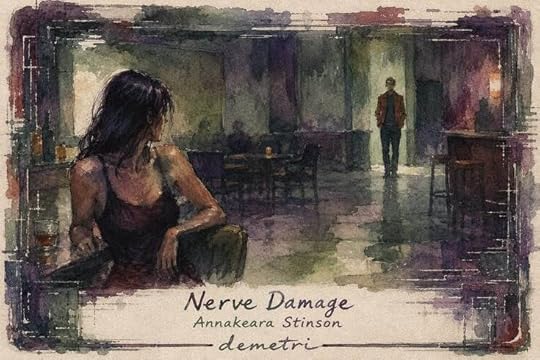
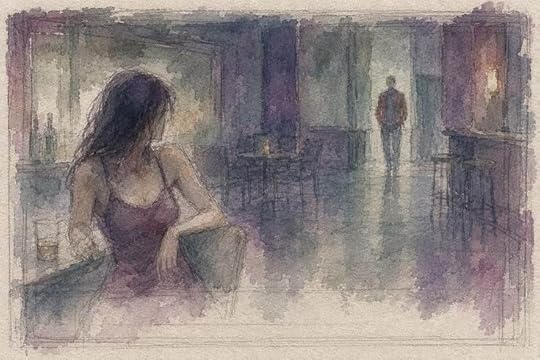
“Afterlife Misrecognition” – A solitary Clarice turns across the dim room toward a half-legible figure in Annakeara Stinson’s “Nerve Damage,” caught in the charged instant when fear arrives before proof.
Annakeara Stinson’s “Nerve Damage” opens on a misrecognition that feels, in the body, like recognition before the mind has caught up. Clarice is at a Los Angeles nightclub called Afterlife – a name with all the subtlety of a haunted-house flyer and the cold accuracy of a chart note. Across the bar she sees a man she believes is P.T., the ex-boyfriend whose harassment drove her out of New York and into the lock-clicking life of a new coast. The hair is right. The posture is right. He has the ease of a man not scanning the exits. He is wearing the kind of jacket memory knows how to prosecute. Clarice’s body has prepared its case before the plot has opened the folder.
That is the first sharp move of “Nerve Damage”: it lets fear make its case before it asks whether fear is telling the truth. Stinson has not written a revenge plot with the moral corners sanded down, though the premise has the clean snap of one: a woman stalked by her ex begins stalking him back. It also has the wobble of a cart with one wheel determined to die in public.
Revenge is only the lure. The real pressure is proof – how a clue lands in the stomach before it reaches the mind; how a room, a phone, a jacket, a face can become hostile after the body has learned what danger looks like, sounds like, writes like, returns like.
Clarice has reason to fear P.T. Their breakup begins with the ugly discovery of cheating and curdles into something harder to report in one frightened sentence: burner addresses, repeated calls, fake accounts, mailed pleas, unwanted gifts, appearances near her home and workplace, and finally, a restraining order.
P.T. does not merely want her back. He wants the story reopened until his desire can call itself love again.
Stinson is at her sharpest on the grubby bureaucracy of harassment: screenshots, blocked numbers, new numbers, new accounts, dates saved because one day someone may demand a timeline. Even a link to Dido’s “White Flag” can feel less like a plea than a hand testing the doorknob. It is not, at first, spectacular violence. It is a drip, a buzz, a knock nobody else hears. The inbox becomes a door he keeps trying. The phone becomes a window. A gift becomes a threat wearing florist tissue.
Three years later, just as the restraining order has expired, Clarice thinks she sees him again. From that sighting, the book starts moving like a woman checking every lock twice. She searches his social media, returns to the nightclub, questions a bartender, and recruits a socially awkward lawyer named Rich as a fake date and investigative accomplice. Soon she is following the woman P.T. may now be sleeping with, climbing a tree to spy through a window, breaking into an apartment, smashing a car window, and stealing a book she believes confirms everything. The pursued woman becomes watcher, trespasser, amateur detective, and, eventually, someone with a hammer and a very bad plan.
It would be funny if it were not frightening. It is funny anyway.
“Nerve Damage” is strongest when it refuses to treat those responses as mutually exclusive. Clarice is not polished into a tasteful emblem of survival. She is rude, horny, ashamed, obsessive, loyal, funny, self-lacerating, sometimes cruel, and frequently mistaken in ways that do not make the original harm disappear. Here is the risk Stinson keeps choosing: she lets a survivor behave badly without turning that bad behavior into a verdict against her. Clarice misreads the present but was violated in the past. She damages another person’s property but has been damaged herself. She is, in the novel’s most unsettling moral weather, both witness and hazard.
The prose is the reason this balance holds. Stinson writes in a first person that feels caffeinated, bright with static, and allergic to good taste in the best possible way. Clarice’s sentences move by inventory and escalation: nightclub costumes, bad drinks, weird neighbors, vapes, texts, court language, family lore, snacks, sexual memories, household objects acquiring the dreadful dignity of clues.
Her mind is an evidence locker with mood lighting. The narration is profane without being lazy, mordant without becoming merely quippy, and bodily in ways that are often unpleasantly exact. Used Q-tips taped to a door are not just disgusting; they become a theory in a filthy envelope. A brown bomber jacket is not outerwear; it is exhibit A. A book visible through a car window becomes testimony. Clarice looks at the world as though every object has been subpoenaed.
The style is not embroidery on the plot; it is the plot’s nervous system. Clarice’s narration scans, inventories, doubles back, jokes, recoils, and indicts because hypervigilance has become her syntax. Stinson catches something tidier novels about harm often miss: injury does not always speak in solemn sentences. Sometimes it talks too much. Sometimes it makes a joke while checking the lock. Sometimes it turns a room into a list because lists feel safer than feelings. Clarice’s humor is not decoration; it is a flare sent up before panic takes the whole sky.
That voice will not satisfy everyone, nor is it meant to. Some readers will lean toward it as toward a siren; others will keep one hand ready to lower the volume. Both reactions make sense. The voice rarely slackens, but it asks the reader to keep pace rather than settle in. Its velocity is part of the book’s form of truth: a mind that has learned to survive by noticing too much cannot suddenly narrate with tasteful restraint.
Formally, the novel is less unruly than Clarice is. It does not need elaborate scaffolding. The chapters alternate between L.A., where Clarice becomes increasingly certain that P.T. has found her, and New York, where the earlier harassment and court proceedings are reconstructed. In New York, fear must become a file. In L.A., the file has closed but the alarm keeps ringing. That alternation prevents the present plot from becoming a patronizing portrait of paranoia and the backstory from becoming a notarized trauma statement. We see why Clarice believes herself before we see how belief can become dangerous.
The legal material matters because the book understands the exhausting distance between being afraid and being believed. Clarice must collect, recount, preserve, and perform her fear: to friends, family, lawyers, judges, therapists, herself. Yet the novel does not pause to instruct; it lets the phone, the inbox, and the court file do the explaining. Stalking, here, is not one grand gesture. It is pattern. It is repetition. It is the cumulative theft of ordinary confidence: opening an email, walking into a bar, trusting that a stranger’s face is only a stranger’s face. “Nerve Damage” belongs to a world in which an ex can multiply through accounts, messages, screenshots, tags, and fake profiles, while the person being pursued is asked to prove that all those fragments add up to menace. The pressure is there in the smallest records: a saved email, a fake account, a phone that has become a little haunted.
The nearby shelves help, though none can hold the book for long. “Nerve Damage” has some of the abrasive comic voltage of Jen Beagin’s “Big Swiss,” but more threat in its bones. It brushes against the surveillance circuitry of Caroline Kepnes’s “You,” but moves the watching eye into the survivor’s hand. Its interest in how a harmed person tells, retells, and doubts her own story recalls Carmen Maria Machado’s “In the Dream House,” not in shape but in ethical pressure. Still, Stinson’s novel keeps slipping categories: comedy with a restraining order in its purse, thriller with a joke in its throat, trauma novel with its mascara already ruined.
By then, the title has stopped feeling metaphorical. Clarice’s nerves still work, but not reliably. They fire at a jacket, a hand, a resemblance, a dirty offering at the door. Sometimes they are right. Often enough, they have been right. That is the awful difficulty. If Clarice were merely delusional, the book would be thinner and meaner. If she were merely correct, it would be flatter and more comforting. Stinson is interested in the damaged instrument that cannot be thrown away because it once kept the player alive. Fear here is sense and symptom, alarm bell and tinnitus.
The final turn sharpens that idea with a restraint cooler than the premise has trained us to expect. The man Clarice has pursued in Los Angeles appears not to be P.T. after all. The objects outside her apartment, which seemed to confirm his proximity, are explained by a neighbor’s petty campaign of building-wide weirdness. The book Clarice thought proved the man’s identity has another plausible origin. Then, near the end, she sees the real P.T. on a New York subway train and knows, with a clarity almost cruel in its lateness, that she was mistaken.
The revelation is not a trapdoor. It does not say: see, she imagined everything, case closed. Instead it makes the novel more troubling and more generous. Clarice was mistaken about the man in Los Angeles. She was not mistaken about what P.T. did to her, or about the kind of world he taught her to expect. The book refuses the lazy bargain by which a survivor’s factual error becomes an excuse to dismiss the original harm. That refusal is its hardest ethical work. It separates misidentification from falsehood, mess from fraud, panic from invention.
Its heat is part of the pleasure and part of the problem. “Nerve Damage” sometimes routes too much through one alarm. Clarice’s father, mother, stepfathers, ex, therapist, neighbors, sexual history, and bodily dread all feed the same hard channel of male harm, inherited warning, and self-protection gone feral. Much of this is psychologically persuasive. Trauma is not known for respecting subplot boundaries. Still, the novel occasionally crowds itself. Bunny, Roz, Amanda, and Clarice’s mother are vivid in flashes, but they often appear most fully as mirrors, irritants, witnesses, or tools inside Clarice’s crisis. Her voice is a floodlight, and floodlights do not flatter depth perception.
The middle stretch also circles more than it always tightens. Obsession does not proceed in elegant increments, but even purposeful spirals can test the reader’s calves. The riffs often sparkle; a few keep talking after the room has already nodded. There are moments when one wants the novel to trust its strongest image and move on before adding three more, a joke, a family memory, and a snack wrapper. Stinson’s abundance is part of the pleasure. It is also what keeps the book just below the highest tier. My final rating is 87/100, which translates under my rubric to a Goodreads-compatible 4/5 stars: a strong, admiring score for a novel with memorable voice, real artistic nerve, and some over-density in the wiring.
The expected showdown never arrives, which is one reason the book lingers. A lesser version would have built toward exposure, punishment, revenge, maybe a violent reckoning staged under neon with a playlist that knew too much. Stinson chooses something stranger and sadder. Clarice sees P.T., flips him off, and lets the train carry him away. The gesture is comic, juvenile, exact. It is not healing, and the novel is too honest to pretend otherwise. But it is a boundary in miniature, a little obscene punctuation mark at the end of a sentence she did not get to finish years earlier.
In the final pages, the book moves not toward victory but toward rest. After all the watching, refreshing, remembering, documenting, trespassing, fleeing, and scanning, Clarice imagines becoming anonymous among strangers, one body on a train moving toward the airport, no longer required to interpret every signal. The damaged nerve does not vanish. It simply stops firing for a while. For a novel so alive to dread, that pause feels almost radical: not absolution, not even peace, but the small mercy of a world that, for one ride, keeps its hands to itself.
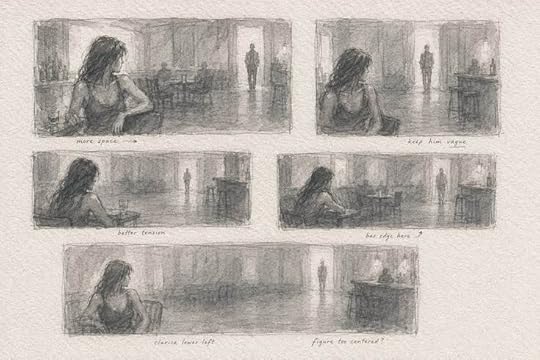
“Compositional thumbnail study” – Early layout sketches testing how Clarice, the distant figure, and the empty space between them could carry the whole emotional architecture of “Nerve Damage.”
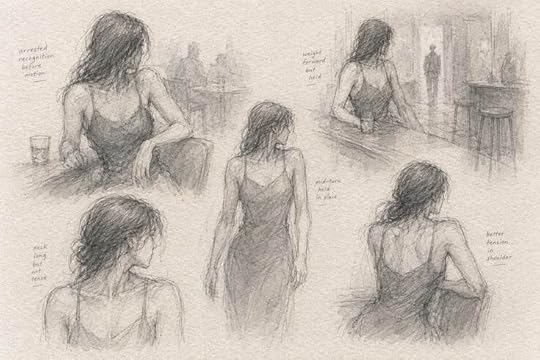
“Character posture study” – A loose anatomical study of Clarice’s arrested turn, refining the shoulder line, seated tension, and bodily recognition that anchor the final watercolor.
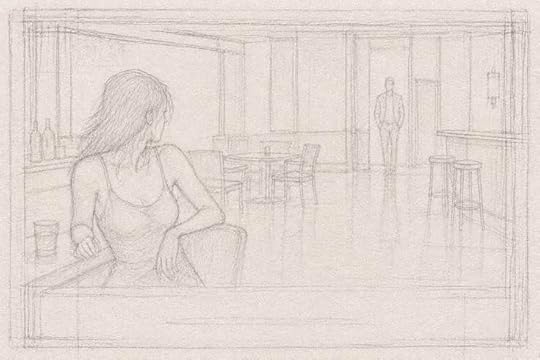
“Faint pencil underdrawing” – The first quiet structure of “Afterlife Misrecognition,” with the bar, figure placement, sightline, and negative space mapped before the washes begin.
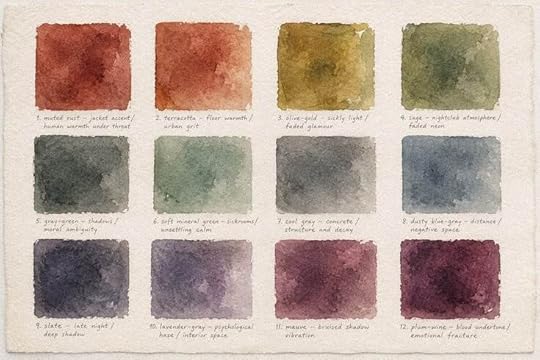
“Cover-palette swatch study” – A controlled test of rust, sage, slate, mauve, plum, gray-green, and bruised violet tones to keep the watercolor visually tied to “Nerve Damage.”
“Pencil and first-wash stage” – The initial watercolor pass, where Clarice’s solitude, the nightclub atmosphere, and the uneasy distance across the room first begin to surface.
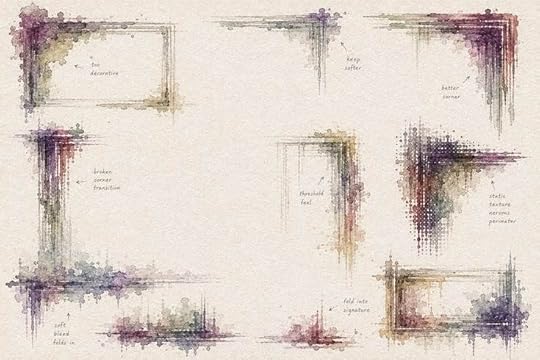
“Watercolor border study” – A study for the tremulous outer edge, testing how the border could suggest thresholds, static, containment, and the nervous perimeter of the final image.
All watercolor illustrations by Demetris Papadimitropoulos. Watercolors are done on 140lb vellum and then scanned into the computer using an Epson scanner. From there, they are finalized in Procreate. All art and opinions are my own.
Nerve Damage by Annakeara Stinson. Thanks to @knopf for the gifted Arc ⭐️⭐️⭐️⭐️
Clarice’s restraining order on her ex has just expired and she thinks she’s seen him even though she now lives on the opposite coast of the US. Trying to figure out if it’s him, she begins stalking her stalker.
I thought this was going to be a thriller, but I read it more as a literary fiction, which was actually a nice surprise. It really makes you think as you live with Clarice and the aftermath of the experience. This is a good reflection on the emotional damage harassment can cause ; as some may question the harm when there was no violence or physical abuse. I liked how her family history came into play as well.
“You don’t realize how free you are just walking around living life until you aren’t anymore, until you’re always expecting something.”
Read if you like: -Stalking tropes -Survivor narratives -Mental health fiction