

What do you think?

What Came West
Author of the New York Times Notable The Great Glass Sea (“The most unexpected second book by a writer of note to appear in years.” –John Freeman, Boston Globe) returns with a gripping adventure story that probes the expansive, shifting wilds of the Sierra Nevada during the Gold Rush.
Since childhood, Silas Hall has never been at ease with people. Only alone in nature, can he find peace. He is relentlessly bullied by classmates and even proximity to his own family fills him with dread. Still, despite his increasing isolation from others, he manages to forge a connection with Delia, a non-verbal housekeeper, and is surprised by the strength of the bond he feels with the child they come to share. But as his son, Elisha, grows up, even that closeness becomes more than Silas can bear. So, he leaves his family to travel west, journeying ever farther in search of a life in which he might belong.
Under the cover of the wilderness, Silas burrows deeper into seclusion. By late 1840, he is one of few white people to have crossed the Sierra Nevada, where he coexists with the native Nisenan villagers at a mutually wary distance. But this fragile peace is disrupted when the promises of the Gold Rush bring a sudden flood of other whites west, leading Silas to commit an act of violence that will drive the last chapter of his life and incur upon the world he loves the full wrath of the world he fled.
In interweaving parts, one a third-person account of Silas’s flight from the manhunt that pursues him and the other an epistolary narrative from Silas to his abandoned, What Came West confronts different forms of American the yearning for freedom and the grandeur of the wild, the corrupting nature of greed, the unforgiving ideals of Manifest Destiny, and the environmental destruction and genocide wrought upon native peoples living on the land that would become known as “Gold Country.”
What Came West is the story of a soul split after a defining moment and the ways in which one man tries to save himself and the world he loves as it vanishes beneath his feet.
Since childhood, Silas Hall has never been at ease with people. Only alone in nature, can he find peace. He is relentlessly bullied by classmates and even proximity to his own family fills him with dread. Still, despite his increasing isolation from others, he manages to forge a connection with Delia, a non-verbal housekeeper, and is surprised by the strength of the bond he feels with the child they come to share. But as his son, Elisha, grows up, even that closeness becomes more than Silas can bear. So, he leaves his family to travel west, journeying ever farther in search of a life in which he might belong.
Under the cover of the wilderness, Silas burrows deeper into seclusion. By late 1840, he is one of few white people to have crossed the Sierra Nevada, where he coexists with the native Nisenan villagers at a mutually wary distance. But this fragile peace is disrupted when the promises of the Gold Rush bring a sudden flood of other whites west, leading Silas to commit an act of violence that will drive the last chapter of his life and incur upon the world he loves the full wrath of the world he fled.
In interweaving parts, one a third-person account of Silas’s flight from the manhunt that pursues him and the other an epistolary narrative from Silas to his abandoned, What Came West confronts different forms of American the yearning for freedom and the grandeur of the wild, the corrupting nature of greed, the unforgiving ideals of Manifest Destiny, and the environmental destruction and genocide wrought upon native peoples living on the land that would become known as “Gold Country.”
What Came West is the story of a soul split after a defining moment and the ways in which one man tries to save himself and the world he loves as it vanishes beneath his feet.
470 pages, Kindle Edition
First published June 2, 2026
About the author
Josh Weil
10 books154 followersJosh Weil is the author of the novels What Came West and The Great Glass Sea, the novella collection The New Valley, and the story collection The Age of Perpetual Light.
Published internationally, his books have been New York Times Editor's Choices and selected for the Powell's Indiespensible program. They have been awarded the Dayton Literary Peace Prize, the Sue Kaufman Prize from The American Academy of Arts and Letters, the California Book Award, the Library of Virginia's Literary Award, the GrubStreet National Book Prize, the New Writers Award from the GLCA, and a “5 Under 35” Award from the National Book Foundation. Weil's short fiction has garnered a Pushcart Prize and appeared in Granta, Esquire, Tin House and One Story, among others. He has written non-fiction for The New York Times, Orion, Poets & Writers and The Sun. A recipient of fellowships from the Fulbright Foundation, the MacDowell Colony, the Merrill House, and Virginia Center for the Creative Arts, he has been the Picador Guest Professor at the University of Leipzig, the Grisham Writer-in-Residence at the University of Mississippi, the Distinguished Lecturer at The Sozopol Writing Seminars, and the visiting writer at the University of California Irvine and Bowling Green State University. He has taught at Columbia University, New York University, The New School, Brooklyn College, Sierra Nevada College, and Bennington College, as well as at numberous conferences, including the Community of Writers and Bread Loaf.
Published internationally, his books have been New York Times Editor's Choices and selected for the Powell's Indiespensible program. They have been awarded the Dayton Literary Peace Prize, the Sue Kaufman Prize from The American Academy of Arts and Letters, the California Book Award, the Library of Virginia's Literary Award, the GrubStreet National Book Prize, the New Writers Award from the GLCA, and a “5 Under 35” Award from the National Book Foundation. Weil's short fiction has garnered a Pushcart Prize and appeared in Granta, Esquire, Tin House and One Story, among others. He has written non-fiction for The New York Times, Orion, Poets & Writers and The Sun. A recipient of fellowships from the Fulbright Foundation, the MacDowell Colony, the Merrill House, and Virginia Center for the Creative Arts, he has been the Picador Guest Professor at the University of Leipzig, the Grisham Writer-in-Residence at the University of Mississippi, the Distinguished Lecturer at The Sozopol Writing Seminars, and the visiting writer at the University of California Irvine and Bowling Green State University. He has taught at Columbia University, New York University, The New School, Brooklyn College, Sierra Nevada College, and Bennington College, as well as at numberous conferences, including the Community of Writers and Bread Loaf.
Ratings & Reviews
Friends & Following
Create a free account to discover what your friends think of this book!
Community Reviews
Displaying 1 - 30 of 35 reviews

August 3, 2026
A dark, beautiful, challenging novel of westward expansion seen through the eyes of a troubled white man--today we would diagnose autism but in the 1830s and 40s, there was no name for it--who ends up fleeing city life and civilization in the East, most of all his fellow humans, and \ finds his way to the Western Sierra, where he coexists with the native people--so carefully rendered, so well researched--just as the Gold Rush signals the destruction of that world.
The rawness and intensity of the novel for me recalled Cormac McCarthy's Suttree--the harshness, the urgency, the sudden violence--but not so much the degraded world Suttree sought as subliminal punishment, but rather the portrait of a man who simply cannot live alongside ordinary, social man. The book is elevated by the soaring beauty of Weil's language--I'm a huge fan, having started with the Great Glass Sea and then reading them all--and gloriously illustrated with Weil's own detailed naturalist's drawings.
Anybody interested in California, or the Sierra in particular, in the ecological disaster of Western man, another side of the mythology of the West, in autism, in native cultures or just intense literary fiction, will be richly rewarded.
The rawness and intensity of the novel for me recalled Cormac McCarthy's Suttree--the harshness, the urgency, the sudden violence--but not so much the degraded world Suttree sought as subliminal punishment, but rather the portrait of a man who simply cannot live alongside ordinary, social man. The book is elevated by the soaring beauty of Weil's language--I'm a huge fan, having started with the Great Glass Sea and then reading them all--and gloriously illustrated with Weil's own detailed naturalist's drawings.
Anybody interested in California, or the Sierra in particular, in the ecological disaster of Western man, another side of the mythology of the West, in autism, in native cultures or just intense literary fiction, will be richly rewarded.

June 9, 2026
It took me a while to read this book, and it may take me a while to review it more fully. Overall I really loved this novel. It is slow paced, very heavy on nature description as well as self contemplation, with brutal acts of violence sprinkled throughout. I switched to combining audio and physical about halfway through, and that method worked very well for me. By reading only a physical copy, I found it was taking much longer to read than I generally choose to spend on one book. The narrators for the audio are fantastic, and I recommend both formats depending on your preference.
I'm not sure who the audience for this book is, but I suspect if people give it a try, they'd like it. I'd have called this a western, but I don't really read the genre and other reviewers say the label doesn't quite fit.
I'm not sure who the audience for this book is, but I suspect if people give it a try, they'd like it. I'd have called this a western, but I don't really read the genre and other reviewers say the label doesn't quite fit.

May 31, 2026
Some fathers teach you how to survive. Others leave you trying to figure out why they couldn’t stay.
What Came West by Josh Weil felt more like a confession than a western.
Silas Hall is a man who finds more peace in wilderness than in people, and that truth follows him from childhood into fatherhood and eventually into the Sierra during the Gold Rush. His story isn't just about his flight from family or the letters reaching toward the son he abandoned. It was the ache underneath it all—a father trying to explain himself long after the damage is done.
Weil writes fathers and sons in a way that feels honest. Love is there, but so is fear, silence, and the damage people carry when they don’t know how to be close to each other. It made me think about what sons inherit beyond blood—how much of a father stays with you, even when he’s gone.
And this book never lets you forget whose land this story is unfolding on. The wilderness Silas runs toward isn’t empty land waiting to be claimed. Native communities are already there, living with the consequences of settlers pushing west. Weil doesn’t romanticize that history. The Gold Rush comes with greed, violence, and the destruction that follows when people start seeing land as something to take instead of something to live with.
That tension sits at the center of the novel for me. A man looking for freedom while moving through a history built on displacement and loss.
Moody, brutal, and unexpectedly tender, What Came West haunted me not because of its violence, but because of the questions it leaves behind—about fathers and sons, belonging, and what America destroyed in pursuit of becoming itself.
What Came West by Josh Weil felt more like a confession than a western.
Silas Hall is a man who finds more peace in wilderness than in people, and that truth follows him from childhood into fatherhood and eventually into the Sierra during the Gold Rush. His story isn't just about his flight from family or the letters reaching toward the son he abandoned. It was the ache underneath it all—a father trying to explain himself long after the damage is done.
Weil writes fathers and sons in a way that feels honest. Love is there, but so is fear, silence, and the damage people carry when they don’t know how to be close to each other. It made me think about what sons inherit beyond blood—how much of a father stays with you, even when he’s gone.
And this book never lets you forget whose land this story is unfolding on. The wilderness Silas runs toward isn’t empty land waiting to be claimed. Native communities are already there, living with the consequences of settlers pushing west. Weil doesn’t romanticize that history. The Gold Rush comes with greed, violence, and the destruction that follows when people start seeing land as something to take instead of something to live with.
That tension sits at the center of the novel for me. A man looking for freedom while moving through a history built on displacement and loss.
Moody, brutal, and unexpectedly tender, What Came West haunted me not because of its violence, but because of the questions it leaves behind—about fathers and sons, belonging, and what America destroyed in pursuit of becoming itself.

Review of advance copy
The Distance Between Mercy and Harm
Josh Weil’s “What Came West” is a beautifully severe novel about a man who flees human closeness only to discover that absence leaves its own marks.
By Demetris Papadimitropoulos | May 31st, 2026
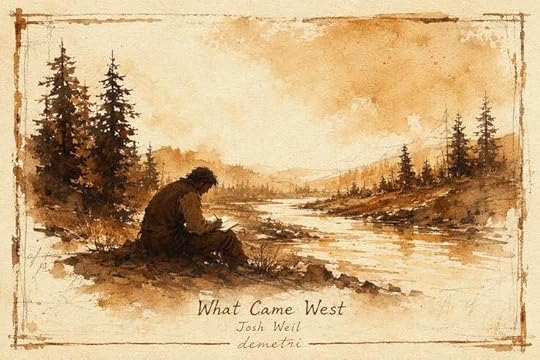
“The Letter at the River’s Edge” — Silas writes beside the river that has become witness, boundary, and burden, turning “What Came West” by Josh Weil into a visual meditation on distance, confession, and the fragile hope that a letter might cross where a life could not.
Distance is the first faith Silas Hall practices, long before he has the language to call anything faith. In Josh Weil’s “What Came West,” distance promises mercy: from the family table, the schoolroom, the camp; from touch, voices, rooms, the hot insistence of other bodies. Silas does not merely prefer solitude. Human nearness reaches him like weather inside the skin. The novel’s hardest intelligence lies in making that bodily fact historical. A crowded room becomes a mining camp. A flinch becomes a claim. The West is not empty space where a damaged soul may be repaired by quiet; it is a place already inhabited, already storied, and soon to be broken open by men who mistake arrival for title deed.
Even to call “What Came West” a Western is both useful and pinched, like using a tin cup to measure a river. There are guns, mules, ravines, campfires, traps, pelts, gold, and men moving through mountain country with the unearned dominion of people who have never asked whether the land has declined their company. The novel opens in autumn 1849 with a scream across the Yuba, heard by a white miner, his young son, and a Hawaiian companion. The sound may be animal, man, spirit, or warning. By morning, the dog is dead, the word GO is written in blood, and tools have been thrown into the river. The father stays, gold-drunk in the recognizably human way. The question is not only who is out there. It is what these men have already brought with them: rifles, hunger, the habit of calling desire a claim.
Much of the novel is built from the aftershock of that night. Silas, living in isolation in the Sierra Nevada near Nisenan communities, kills the boy, wounds the father, and understands that this violence will summon the very world he has spent years trying to keep away. The plot runs on pursuit, and here pursuit keeps a body count: miners following tracks, dogs catching scent, a wounded father dragged through the country as if the land itself were being made to testify. Braided through the manhunt is Silas’s final address to Elisha, the son he abandoned. He writes under sentence of death, neither neatly asking forgiveness nor cleanly surrendering self-defense. The letter becomes his last tool: map, splint, witness, and the trap he has set for his own vanishing.
Early in that letter, Silas returns to childhood, and the novel earns its sympathy there. It does not ask us to excuse him; it teaches us the pitch at which the world reaches him. There is the sky blackened by passenger pigeons, then the sudden violence that erupts from him against his family. There is the schoolroom, with children imitating his rocking and panic while teachers mistake incapacity for disobedience. There is the turtle he tries to protect, smashed by boys who want to see him break. His mother discovers a way to help him speak by asking what an animal or bird nearby might have seen. That small invention is one of the novel’s loveliest acts of mercy: it gives Silas a witness at a survivable remove. Weil does not make him a diagnosis in buckskin. He gives him nerves, shame, wonder, and a body that cannot cross the ordinary world without paying toll.
That sympathy, however, is not a pardon. The book’s governing question is whether a man can flee human violence so completely that he fails to notice he has carried it with him. Silas grows into someone who can love animals, insects, rivers, trees, tools, and silence more safely than people. Then Delia enters the story, a nonverbal woman whose presence does not invade him in the usual way. Their intimacy is tender because it is partial, awkward, practical, and negotiated through chalk, gesture, shared work, and the grace of not having to say everything. When Elisha is born, fatherhood becomes wonder and threat at once. The child’s need is too much. Silas leaves. Weil’s judgment is exact: distance may spare one kind of harm; it inflicts another.
Rather than move west toward reinvention, Silas moves west toward exposure. He passes through the fur trade, through trapper brutality and camp hierarchy, and eventually into the Sierra Nevada, where his wish for solitude enters ceremonies, obligations, griefs, and histories he cannot fully read. The Nisenan are not scenery for his pain, though the novel’s chosen gaze risks making other lives become evidence in his case. Weil knows the hazard. The book is sharpest where Silas’s care begins to look like trespass wearing mercy’s coat. No Rope, Walloki, Too Much Water, and the village of Kushna do not confirm the story Silas tells about himself. They keep exposing the parts of it he cannot see.
In one of the novel’s most decisive rebukes, Silas warns No Rope that miners are coming and imagines resistance through guns, mules, axes, and even a dam. No Rope hears something Silas does not want to hear: the axe inside the rescue plan, the white man inside the protector. That rebuke matters because it denies Silas the easy costume of the good outsider, the one who loves the land correctly. The love is not fake; that is what makes it dangerous. He can pour gold back into the river and still think in claims. He can despise the miners and still bring danger toward Kushna. He can know the river better than the men who would ruin it and still fail to understand that reverence is not ownership’s respectable cousin.
Pressure is Weil’s true medium, and the prose generates it sentence by sentence. The third-person sections move in long, loaded lines that gather river noise, smoke, stone, fur, rain, blood, moonlight, and bodily reaction until fear itself seems to have texture. Then the rhythm snaps: a shot, a body, a glint, a word. Silas’s letter is rougher, full of missing letters, ampersands, compressed spellings, and breath-cut syntax. It is a gamble the novel mostly wins. Occasionally the stylization presses its thumb too visibly into the page; more often, it makes language feel hand-hewn by a man who has never trusted speech to carry him safely. His sentences are not smooth enough to lie comfortably.
Animals crowd the book, but none arrive as green backdrop. Passenger pigeons, turtles, dogs, mules, bears, fish, deer, and skinned bodies reveal, accuse, soothe, and survive. Silas’s tenderness toward animals is one of the earliest signs of his difference, but Weil complicates that tenderness by making him trapper, butcher, hunter, and killer. He wants communion with the nonhuman world, yet his hands know snares, pelts, guns, and knives. This contradiction gives the novel much of its sting. Love of nature, Weil suggests, is not automatically a virtue. It depends what the lover believes he may do with what he loves.
Pity has to wait its turn, which is one of the book’s wiser formal decisions. We first meet Silas as terror across the river, a figure almost supernatural to the boy who will die. After that come the child mocked and bound, the husband who almost learns a livable intimacy, the father who cannot stay, the fugitive who both protects and endangers. The delay matters because pity is not allowed through the door until fear has had its say. The reader is made to fear Silas, then pity him, then understand him, then discover that understanding cannot acquit him. Had the novel begun with pity, it might have asked too little of us.
Adjacent books help here only when they clarify difference as sharply as likeness. “What Came West” shares with John Williams’s “Butcher’s Crossing” an interest in the West as a place where male fantasy meets animal slaughter and metaphysical weather. It shares with Hernan Diaz’s “In the Distance” the outsider moving through a mythic American vastness, though Weil is less fabulist and more mud-under-the-nails historical. Lauren Groff’s “The Vaster Wilds” is a useful echo for body-against-landscape intensity, but Weil’s novel is less ecstatic flight than confession under pursuit. The closest shelf is finally not a title but a question: what remains of the Western when the scenery begins answering back?
Delia may be the book’s most quietly important character because she prevents Silas’s solitude from looking inevitable. With her, he experiences relation that is neither cure nor rescue. Their bond is partial, physical, strange, funny in its shy edges, and grave in its consequences. Elisha makes the arrangement impossible not because love fails to exist, but because love exists too intensely for Silas’s body to bear. This is one of the novel’s hardest insights: incapacity does not cancel consequence. Silas can explain the tremor in his hand. The person struck still bleeds. The son left behind still grows, or does not, under the shadow of absence.
If the book has one great accomplishment, it is that Weil keeps the Western’s old momentum and poisons its innocence. The chase works. We feel the cold water, the ridge, the muzzle, the dog, the rain, the mule, the ruined face of the wounded father. Yet the book is never content to be exciting. Each action throws a shadow backward into memory and forward into history. The Gold Rush arrives not as thesis but as mud and axes: men in camps, trees cut, water dirtied, fever in the bloodstream, and the calculus of one more – one more claim, one more fire, one more shovel, one more man convinced that wanting has handed him a title deed.
My rating is 88/100, which translates to a Goodreads-compatible 4/5 stars under my rubric: a high four, not a decorative five. “What Came West” is grave, beautiful, ambitious, and emotionally forceful, but its seams matter. Its excellence is artistic, emotional, and intellectual at once; its limits are the cost of asking one man to carry too much mountain. Silas must bear sensory estrangement, abandoned fatherhood, Gold Rush catastrophe, ecological grief, pursuit narrative, spiritual misrecognition, and final confession. Most of the time, he bears it. Sometimes the pack creaks.
Its most telling cost is that Silas’s perspective pulls like an undertow. Walloki, the scarred Mountain Maidu boy whom Silas shelters and partly claims as a son, brings out both the novel’s gift and its hazard. Their relationship moves because Silas is trying, perhaps for the first time since Elisha, to care for a child without fleeing. It troubles because his care is tangled with need, projection, and meanings he cannot enter. When he argues over what Walloki is and what he might become, the scene is alive with love, fear, trespass, and misreading. That tension is valuable. It is also the book’s most revealing strain.
The Nisenan material raises the same question more broadly. Weil’s attention is serious, and the novel does not pretend that research can change who is looking. The better measure is how much life the novel allows to stand outside Silas’s need to understand himself. Often, quite a lot: No Rope’s rebukes, Too Much Water’s presence, the village’s ceremonies, Walloki’s fear and longing, the repeated insistence that Silas is being interpreted by others as much as he interprets them. Yet the novel never fully escapes his undertow. That is its design, its power, and its limit.
Rhythmically, the novel sometimes repeats its central pattern until the rut begins to shine: Silas approaches, panics, withdraws, harms, remembers; Silas loves, cannot bear nearness, leaves, narrates; Silas protects and thereby endangers. The pattern is thematically apt because compulsion repeats. A wound, in this novel, is not an event but a habit of returning. Still, in a book this long and dense, the reader may occasionally feel the recurrence before feeling the deepening. The novel turns the same dark stone more than once, though it usually finds another glint.
One reason the ending holds is that it does not grant Silas a pardon. He does not become a noble guardian of the river, nor a monster safely quarantined from pity. He is still the man who abandoned Delia and Elisha. He is still the man who killed a boy near his son’s age. He is still the man who loved a place and tried to defend it by force. He is still part of what came west. The final movement sharpens rather than softens him. Confession can show the wound. It cannot close it.
Perhaps that is why, under the plot, the book is really about the rotten bargain of leaving without leaving marks. Silas spends his life trying to cut loose: from family, society, noise, touch, commerce, settlement, history. The phrase returns with terrible irony, because no one in the novel is truly cut loose. Sons remain tied to fathers. Rivers carry what has been done upstream. Villages feel the approach of distant markets. The land bears hoof, shovel, wheel, fire, dam, and grave. Even the dead, in the belief Silas recounts, must revisit the places they knew before the heart goes west.
Opinions will split in ways the book has earned. Readers wanting clean genre pleasure may find it too inward, too willing to sit with a wound instead of riding briskly past. Readers drawn to historical reckoning may resist the depth of sympathy granted to Silas. Anyone allergic to stylized voice may balk at the letter’s rough grammar over hundreds of pages. The book refuses the two easiest exits, contempt and forgiveness, and some readers will miss the door.
Underneath its violence, “What Came West” is tender where it least wants witnesses. The tenderness is not soft. It is Silas’s mother asking what the buzzard saw. It is Delia’s silence making room rather than demand. It is a mule becoming witness. It is a river beloved and still not belonging to the lover. It is a father’s final address to a son becoming both selfish and sacred. Weil is too canny to confuse tenderness with pardon. The tenderness makes the damage harder to dismiss.
Little by little, the novel gathers force by accretion. A scream becomes a warning. A warning becomes a claim. A claim becomes a killing. A killing becomes a letter. A letter becomes a life trying, too late, to account for itself. The structure is not merely a frame; it is the book’s argument. In the present, Silas hides, sets traps, builds a dam, and waits for men to come. In the past, he writes toward the son he could not remain with. The form embodies his contradiction: he wants to be unfound by the world and found by Elisha. A neater book would choose one desire. This one lets them ruin each other.
One quiet pleasure of a novel this flint-faced is discovering that it has a dry little smile tucked under the beard. The wit is usually buried in frontier vanity and bodily awkwardness: men making metaphysics out of animal sounds because none of them wants to admit fear; rugged competence curdling into preening; Silas, who can read tracks, rivers, animals, and weather, remaining disastrously illiterate in certain human motives. The joke, when it arrives, is usually on human mastery – that antique comedy in which men mistake a temporary lack of consequences for permission.
Still, the book has gravel in its boot, and it expects the reader to keep walking. It asks for attention to syntax, terrain, cultural encounter, repeated images, and the slow cinching of consequence. It does not flatter with easy verdicts. That is both a virtue and a hazard. “What Came West” is not a quick campfire tale about a strange man in the mountains. It is a long, flinty account of the stories that taught such men to call hunger courage and possession fate. Silas goes west to vanish. The novel sends him back as a letter.
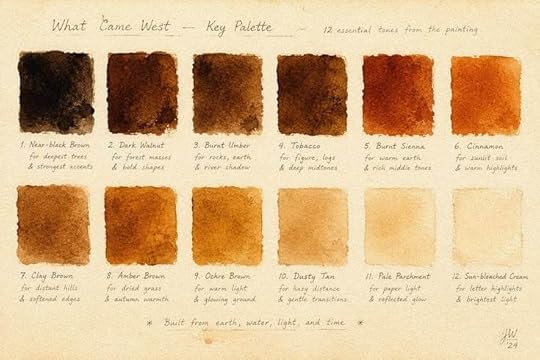
“Color Swatch Sheet” — The cover-derived browns, siennas, ochres, tans, parchment tones, and near-blacks establish the weathered visual language of the series before the river, trees, figure, and letter begin to take form.
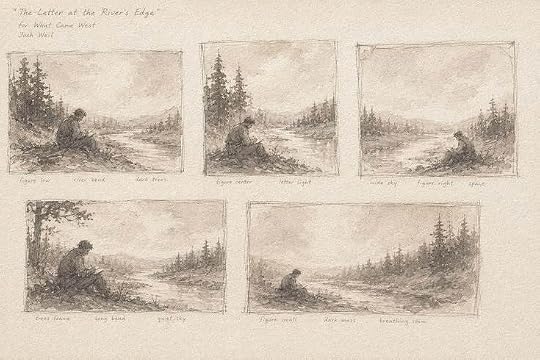
“Compositional Thumbnail Sheet” — Early thumbnail studies test the image’s emotional architecture: a small figure, a bending river, dark tree masses, and the negative space needed to make solitude feel like pressure rather than emptiness.
[image error]
“Character Anatomical / Posture Study” — These posture studies search for Silas’s grief without relying on facial detail, finding the bend of the back, the lowered head, and the hand moving over the page.
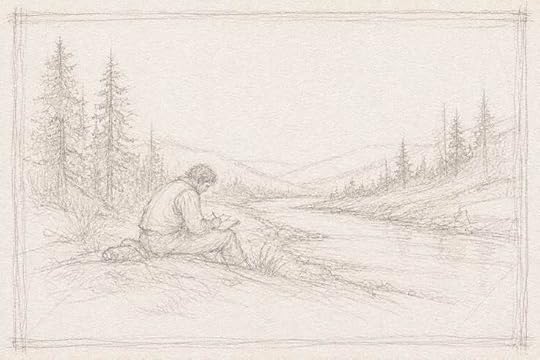
“Faint Pencil Underdrawing” — The first full drawing leaves the scaffolding visible, mapping riverbank, figure, trees, border, and page before watercolor begins turning structure into atmosphere.
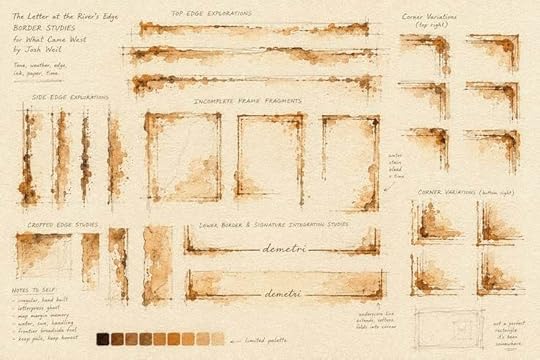
“Watercolor Border Study” — This border study develops the image as a weathered letter-page or field-note plate, letting the frame, signature line, and unfinished edges become part of the book’s language of distance and return.
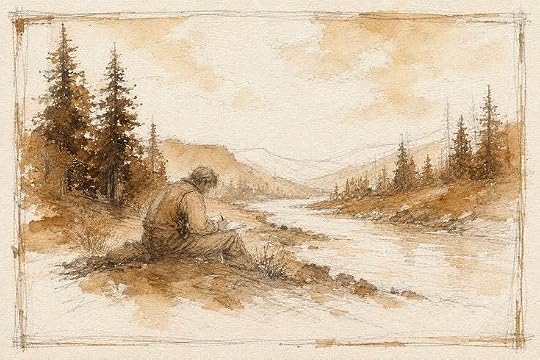
“Pencil-Plus-First-Wash Stage” — The first washes bring in the sepia light, river movement, and shadowed trees while preserving graphite and open paper, allowing the painting to remain fragile, breathable, and still in formation.
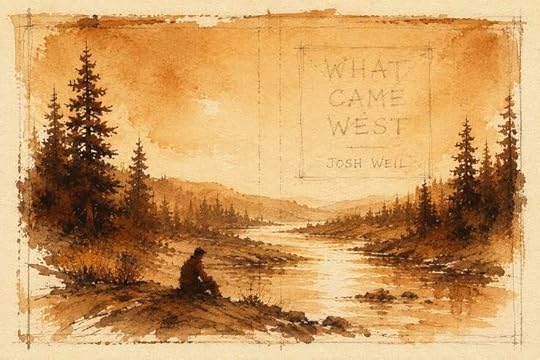
“Alternative Cover Concept Study” — A more graphic, cover-like watercolor study that reimagines “What Came West” by Josh Weil through the same river, tree, and negative-space language, showing how the review’s visual world could also become a book-cover argument.
All watercolor illustrations by Demetris Papadimitropoulos.
Watercolors are done on 140lb vellum and then scanned into the computer using an Epson scanner. From there, they are finalized in Procreate. All art and opinions are my own.
Josh Weil’s “What Came West” is a beautifully severe novel about a man who flees human closeness only to discover that absence leaves its own marks.
By Demetris Papadimitropoulos | May 31st, 2026
“The Letter at the River’s Edge” — Silas writes beside the river that has become witness, boundary, and burden, turning “What Came West” by Josh Weil into a visual meditation on distance, confession, and the fragile hope that a letter might cross where a life could not.
Distance is the first faith Silas Hall practices, long before he has the language to call anything faith. In Josh Weil’s “What Came West,” distance promises mercy: from the family table, the schoolroom, the camp; from touch, voices, rooms, the hot insistence of other bodies. Silas does not merely prefer solitude. Human nearness reaches him like weather inside the skin. The novel’s hardest intelligence lies in making that bodily fact historical. A crowded room becomes a mining camp. A flinch becomes a claim. The West is not empty space where a damaged soul may be repaired by quiet; it is a place already inhabited, already storied, and soon to be broken open by men who mistake arrival for title deed.
Even to call “What Came West” a Western is both useful and pinched, like using a tin cup to measure a river. There are guns, mules, ravines, campfires, traps, pelts, gold, and men moving through mountain country with the unearned dominion of people who have never asked whether the land has declined their company. The novel opens in autumn 1849 with a scream across the Yuba, heard by a white miner, his young son, and a Hawaiian companion. The sound may be animal, man, spirit, or warning. By morning, the dog is dead, the word GO is written in blood, and tools have been thrown into the river. The father stays, gold-drunk in the recognizably human way. The question is not only who is out there. It is what these men have already brought with them: rifles, hunger, the habit of calling desire a claim.
Much of the novel is built from the aftershock of that night. Silas, living in isolation in the Sierra Nevada near Nisenan communities, kills the boy, wounds the father, and understands that this violence will summon the very world he has spent years trying to keep away. The plot runs on pursuit, and here pursuit keeps a body count: miners following tracks, dogs catching scent, a wounded father dragged through the country as if the land itself were being made to testify. Braided through the manhunt is Silas’s final address to Elisha, the son he abandoned. He writes under sentence of death, neither neatly asking forgiveness nor cleanly surrendering self-defense. The letter becomes his last tool: map, splint, witness, and the trap he has set for his own vanishing.
Early in that letter, Silas returns to childhood, and the novel earns its sympathy there. It does not ask us to excuse him; it teaches us the pitch at which the world reaches him. There is the sky blackened by passenger pigeons, then the sudden violence that erupts from him against his family. There is the schoolroom, with children imitating his rocking and panic while teachers mistake incapacity for disobedience. There is the turtle he tries to protect, smashed by boys who want to see him break. His mother discovers a way to help him speak by asking what an animal or bird nearby might have seen. That small invention is one of the novel’s loveliest acts of mercy: it gives Silas a witness at a survivable remove. Weil does not make him a diagnosis in buckskin. He gives him nerves, shame, wonder, and a body that cannot cross the ordinary world without paying toll.
That sympathy, however, is not a pardon. The book’s governing question is whether a man can flee human violence so completely that he fails to notice he has carried it with him. Silas grows into someone who can love animals, insects, rivers, trees, tools, and silence more safely than people. Then Delia enters the story, a nonverbal woman whose presence does not invade him in the usual way. Their intimacy is tender because it is partial, awkward, practical, and negotiated through chalk, gesture, shared work, and the grace of not having to say everything. When Elisha is born, fatherhood becomes wonder and threat at once. The child’s need is too much. Silas leaves. Weil’s judgment is exact: distance may spare one kind of harm; it inflicts another.
Rather than move west toward reinvention, Silas moves west toward exposure. He passes through the fur trade, through trapper brutality and camp hierarchy, and eventually into the Sierra Nevada, where his wish for solitude enters ceremonies, obligations, griefs, and histories he cannot fully read. The Nisenan are not scenery for his pain, though the novel’s chosen gaze risks making other lives become evidence in his case. Weil knows the hazard. The book is sharpest where Silas’s care begins to look like trespass wearing mercy’s coat. No Rope, Walloki, Too Much Water, and the village of Kushna do not confirm the story Silas tells about himself. They keep exposing the parts of it he cannot see.
In one of the novel’s most decisive rebukes, Silas warns No Rope that miners are coming and imagines resistance through guns, mules, axes, and even a dam. No Rope hears something Silas does not want to hear: the axe inside the rescue plan, the white man inside the protector. That rebuke matters because it denies Silas the easy costume of the good outsider, the one who loves the land correctly. The love is not fake; that is what makes it dangerous. He can pour gold back into the river and still think in claims. He can despise the miners and still bring danger toward Kushna. He can know the river better than the men who would ruin it and still fail to understand that reverence is not ownership’s respectable cousin.
Pressure is Weil’s true medium, and the prose generates it sentence by sentence. The third-person sections move in long, loaded lines that gather river noise, smoke, stone, fur, rain, blood, moonlight, and bodily reaction until fear itself seems to have texture. Then the rhythm snaps: a shot, a body, a glint, a word. Silas’s letter is rougher, full of missing letters, ampersands, compressed spellings, and breath-cut syntax. It is a gamble the novel mostly wins. Occasionally the stylization presses its thumb too visibly into the page; more often, it makes language feel hand-hewn by a man who has never trusted speech to carry him safely. His sentences are not smooth enough to lie comfortably.
Animals crowd the book, but none arrive as green backdrop. Passenger pigeons, turtles, dogs, mules, bears, fish, deer, and skinned bodies reveal, accuse, soothe, and survive. Silas’s tenderness toward animals is one of the earliest signs of his difference, but Weil complicates that tenderness by making him trapper, butcher, hunter, and killer. He wants communion with the nonhuman world, yet his hands know snares, pelts, guns, and knives. This contradiction gives the novel much of its sting. Love of nature, Weil suggests, is not automatically a virtue. It depends what the lover believes he may do with what he loves.
Pity has to wait its turn, which is one of the book’s wiser formal decisions. We first meet Silas as terror across the river, a figure almost supernatural to the boy who will die. After that come the child mocked and bound, the husband who almost learns a livable intimacy, the father who cannot stay, the fugitive who both protects and endangers. The delay matters because pity is not allowed through the door until fear has had its say. The reader is made to fear Silas, then pity him, then understand him, then discover that understanding cannot acquit him. Had the novel begun with pity, it might have asked too little of us.
Adjacent books help here only when they clarify difference as sharply as likeness. “What Came West” shares with John Williams’s “Butcher’s Crossing” an interest in the West as a place where male fantasy meets animal slaughter and metaphysical weather. It shares with Hernan Diaz’s “In the Distance” the outsider moving through a mythic American vastness, though Weil is less fabulist and more mud-under-the-nails historical. Lauren Groff’s “The Vaster Wilds” is a useful echo for body-against-landscape intensity, but Weil’s novel is less ecstatic flight than confession under pursuit. The closest shelf is finally not a title but a question: what remains of the Western when the scenery begins answering back?
Delia may be the book’s most quietly important character because she prevents Silas’s solitude from looking inevitable. With her, he experiences relation that is neither cure nor rescue. Their bond is partial, physical, strange, funny in its shy edges, and grave in its consequences. Elisha makes the arrangement impossible not because love fails to exist, but because love exists too intensely for Silas’s body to bear. This is one of the novel’s hardest insights: incapacity does not cancel consequence. Silas can explain the tremor in his hand. The person struck still bleeds. The son left behind still grows, or does not, under the shadow of absence.
If the book has one great accomplishment, it is that Weil keeps the Western’s old momentum and poisons its innocence. The chase works. We feel the cold water, the ridge, the muzzle, the dog, the rain, the mule, the ruined face of the wounded father. Yet the book is never content to be exciting. Each action throws a shadow backward into memory and forward into history. The Gold Rush arrives not as thesis but as mud and axes: men in camps, trees cut, water dirtied, fever in the bloodstream, and the calculus of one more – one more claim, one more fire, one more shovel, one more man convinced that wanting has handed him a title deed.
My rating is 88/100, which translates to a Goodreads-compatible 4/5 stars under my rubric: a high four, not a decorative five. “What Came West” is grave, beautiful, ambitious, and emotionally forceful, but its seams matter. Its excellence is artistic, emotional, and intellectual at once; its limits are the cost of asking one man to carry too much mountain. Silas must bear sensory estrangement, abandoned fatherhood, Gold Rush catastrophe, ecological grief, pursuit narrative, spiritual misrecognition, and final confession. Most of the time, he bears it. Sometimes the pack creaks.
Its most telling cost is that Silas’s perspective pulls like an undertow. Walloki, the scarred Mountain Maidu boy whom Silas shelters and partly claims as a son, brings out both the novel’s gift and its hazard. Their relationship moves because Silas is trying, perhaps for the first time since Elisha, to care for a child without fleeing. It troubles because his care is tangled with need, projection, and meanings he cannot enter. When he argues over what Walloki is and what he might become, the scene is alive with love, fear, trespass, and misreading. That tension is valuable. It is also the book’s most revealing strain.
The Nisenan material raises the same question more broadly. Weil’s attention is serious, and the novel does not pretend that research can change who is looking. The better measure is how much life the novel allows to stand outside Silas’s need to understand himself. Often, quite a lot: No Rope’s rebukes, Too Much Water’s presence, the village’s ceremonies, Walloki’s fear and longing, the repeated insistence that Silas is being interpreted by others as much as he interprets them. Yet the novel never fully escapes his undertow. That is its design, its power, and its limit.
Rhythmically, the novel sometimes repeats its central pattern until the rut begins to shine: Silas approaches, panics, withdraws, harms, remembers; Silas loves, cannot bear nearness, leaves, narrates; Silas protects and thereby endangers. The pattern is thematically apt because compulsion repeats. A wound, in this novel, is not an event but a habit of returning. Still, in a book this long and dense, the reader may occasionally feel the recurrence before feeling the deepening. The novel turns the same dark stone more than once, though it usually finds another glint.
One reason the ending holds is that it does not grant Silas a pardon. He does not become a noble guardian of the river, nor a monster safely quarantined from pity. He is still the man who abandoned Delia and Elisha. He is still the man who killed a boy near his son’s age. He is still the man who loved a place and tried to defend it by force. He is still part of what came west. The final movement sharpens rather than softens him. Confession can show the wound. It cannot close it.
Perhaps that is why, under the plot, the book is really about the rotten bargain of leaving without leaving marks. Silas spends his life trying to cut loose: from family, society, noise, touch, commerce, settlement, history. The phrase returns with terrible irony, because no one in the novel is truly cut loose. Sons remain tied to fathers. Rivers carry what has been done upstream. Villages feel the approach of distant markets. The land bears hoof, shovel, wheel, fire, dam, and grave. Even the dead, in the belief Silas recounts, must revisit the places they knew before the heart goes west.
Opinions will split in ways the book has earned. Readers wanting clean genre pleasure may find it too inward, too willing to sit with a wound instead of riding briskly past. Readers drawn to historical reckoning may resist the depth of sympathy granted to Silas. Anyone allergic to stylized voice may balk at the letter’s rough grammar over hundreds of pages. The book refuses the two easiest exits, contempt and forgiveness, and some readers will miss the door.
Underneath its violence, “What Came West” is tender where it least wants witnesses. The tenderness is not soft. It is Silas’s mother asking what the buzzard saw. It is Delia’s silence making room rather than demand. It is a mule becoming witness. It is a river beloved and still not belonging to the lover. It is a father’s final address to a son becoming both selfish and sacred. Weil is too canny to confuse tenderness with pardon. The tenderness makes the damage harder to dismiss.
Little by little, the novel gathers force by accretion. A scream becomes a warning. A warning becomes a claim. A claim becomes a killing. A killing becomes a letter. A letter becomes a life trying, too late, to account for itself. The structure is not merely a frame; it is the book’s argument. In the present, Silas hides, sets traps, builds a dam, and waits for men to come. In the past, he writes toward the son he could not remain with. The form embodies his contradiction: he wants to be unfound by the world and found by Elisha. A neater book would choose one desire. This one lets them ruin each other.
One quiet pleasure of a novel this flint-faced is discovering that it has a dry little smile tucked under the beard. The wit is usually buried in frontier vanity and bodily awkwardness: men making metaphysics out of animal sounds because none of them wants to admit fear; rugged competence curdling into preening; Silas, who can read tracks, rivers, animals, and weather, remaining disastrously illiterate in certain human motives. The joke, when it arrives, is usually on human mastery – that antique comedy in which men mistake a temporary lack of consequences for permission.
Still, the book has gravel in its boot, and it expects the reader to keep walking. It asks for attention to syntax, terrain, cultural encounter, repeated images, and the slow cinching of consequence. It does not flatter with easy verdicts. That is both a virtue and a hazard. “What Came West” is not a quick campfire tale about a strange man in the mountains. It is a long, flinty account of the stories that taught such men to call hunger courage and possession fate. Silas goes west to vanish. The novel sends him back as a letter.
“Color Swatch Sheet” — The cover-derived browns, siennas, ochres, tans, parchment tones, and near-blacks establish the weathered visual language of the series before the river, trees, figure, and letter begin to take form.
“Compositional Thumbnail Sheet” — Early thumbnail studies test the image’s emotional architecture: a small figure, a bending river, dark tree masses, and the negative space needed to make solitude feel like pressure rather than emptiness.
[image error]
“Character Anatomical / Posture Study” — These posture studies search for Silas’s grief without relying on facial detail, finding the bend of the back, the lowered head, and the hand moving over the page.
“Faint Pencil Underdrawing” — The first full drawing leaves the scaffolding visible, mapping riverbank, figure, trees, border, and page before watercolor begins turning structure into atmosphere.
“Watercolor Border Study” — This border study develops the image as a weathered letter-page or field-note plate, letting the frame, signature line, and unfinished edges become part of the book’s language of distance and return.
“Pencil-Plus-First-Wash Stage” — The first washes bring in the sepia light, river movement, and shadowed trees while preserving graphite and open paper, allowing the painting to remain fragile, breathable, and still in formation.
“Alternative Cover Concept Study” — A more graphic, cover-like watercolor study that reimagines “What Came West” by Josh Weil through the same river, tree, and negative-space language, showing how the review’s visual world could also become a book-cover argument.
All watercolor illustrations by Demetris Papadimitropoulos.
Watercolors are done on 140lb vellum and then scanned into the computer using an Epson scanner. From there, they are finalized in Procreate. All art and opinions are my own.
July 13, 2026
This took a while. I believe that, maybe, Josh Weil is the next Cormac McCarthy. The writing of beautiful gore that is explored to its edges while telling a very simple story. The California Gold Rush is told again and again, but the dirt and grit of the complete nastiness of the whole story is a hard pill to swallow. Tens of thousands of people poured into the Sierra Nevada Mountains and surrounding area to destroy whatever was in their way to obtain gold. Many humans were in the way (considered not human), and their being there involved in their destruction. The Nisenan Tribe went from a few thousand in total strength to almost completely wiped off the face of the Earth, with a tiny handful today who are fighting to regain their tribal title. This book is brutal in many places, but has a clean flow of poetic connection that resonates the small block of time in which it was lived.
That being said, if you like McCarthy, especially Blood Meridian, or, the Evening Redness in the West, then you will like this book. Just prepare yourself.
That being said, if you like McCarthy, especially Blood Meridian, or, the Evening Redness in the West, then you will like this book. Just prepare yourself.

Did Not Finish
July 21, 2026I’m willing to believe this book turns out to be wonderfully moving, but life is too short for me to keep forcing myself to pick up this bleak book.
September 18, 2026
I absolutely loved this book. It was terrible and tragic but also beautiful.
I usually steer clear of books that are especially gory or brutal, and this was certainly both. I also don’t typically read Westerns, but What Came West, I loved this one.
The writing is beautiful, and the novel feels incredibly well researched. Some of my favorite parts were Silas’s interactions with the Nisenan and the descriptions of the land, plants, animals, and landscape of the Sierra Nevada. Living in Northern California, I recognized so much of what he described, and that made the book feel especially vivid and close to home.
I was also lucky enough to meet Josh Weil at the book launch in Nevada City at the ‘Uba Seo Gallery. I appreciated knowing that Josh consulted with Shelly Covert and the Nevada City Rancheria Nisenan Tribe while writing the book. That made the Nisenan portions of the story feel even more meaningful to me
One of the hardest parts of the book was knowing what was coming. I hated knowing what the Gold Rush would mean for the land, the animals, and the Indigenous people who were already there. The destruction of the landscape, the abuse of animals, and the killing and displacement of Indigenous people hung over the story for me even during some of its most beautiful moments.
Silas himself is such a complicated character, and I’m still thinking about some of his choices. I was especially struck by his decision to kill the boy miner while being so haunted by the son he had left behind. It almost felt as if he were trying to kill the memory of his own son, or the guilt attached to leaving him, but instead only gave himself one more thing to be haunted by.
The trapped wolf disturbed me too. Silas clearly loved animals, and by the end he was struggling even with killing them for food. I couldn’t understand why he would leave a wolf suffering in a trap rather than free her or at least end her suffering. That scene stayed with me because it seemed to expose one of the contradictions in Silas. He could feel deeply for people, animals, and the land and still fail to act when compassion required something from him.
That part of Silas also resonated with me personally. My own father loved his children, but he wasn’t always able to be the father we needed him to be. Because of that, I understood something painful in Silas that went beyond simply judging him for leaving his son. Love can be very real and still not be enough to make someone capable of showing up the way the people who love them need them to.
That is probably one of the things I will remember most about this book. Silas can be tender, loving, brutal, selfish, compassionate, and destructive, sometimes all at once. I didn’t always understand him, and I definitely didn’t always forgive him, but I held out hope for him.
This book was gory, heartbreaking, disturbing, beautifully written, and completely absorbing. It made me feel the way I want to feel after reading a book; haunted but reflective and like I survived something. I cannot wait to read it again.
I usually steer clear of books that are especially gory or brutal, and this was certainly both. I also don’t typically read Westerns, but What Came West, I loved this one.
The writing is beautiful, and the novel feels incredibly well researched. Some of my favorite parts were Silas’s interactions with the Nisenan and the descriptions of the land, plants, animals, and landscape of the Sierra Nevada. Living in Northern California, I recognized so much of what he described, and that made the book feel especially vivid and close to home.
I was also lucky enough to meet Josh Weil at the book launch in Nevada City at the ‘Uba Seo Gallery. I appreciated knowing that Josh consulted with Shelly Covert and the Nevada City Rancheria Nisenan Tribe while writing the book. That made the Nisenan portions of the story feel even more meaningful to me
One of the hardest parts of the book was knowing what was coming. I hated knowing what the Gold Rush would mean for the land, the animals, and the Indigenous people who were already there. The destruction of the landscape, the abuse of animals, and the killing and displacement of Indigenous people hung over the story for me even during some of its most beautiful moments.
Silas himself is such a complicated character, and I’m still thinking about some of his choices. I was especially struck by his decision to kill the boy miner while being so haunted by the son he had left behind. It almost felt as if he were trying to kill the memory of his own son, or the guilt attached to leaving him, but instead only gave himself one more thing to be haunted by.
The trapped wolf disturbed me too. Silas clearly loved animals, and by the end he was struggling even with killing them for food. I couldn’t understand why he would leave a wolf suffering in a trap rather than free her or at least end her suffering. That scene stayed with me because it seemed to expose one of the contradictions in Silas. He could feel deeply for people, animals, and the land and still fail to act when compassion required something from him.
That part of Silas also resonated with me personally. My own father loved his children, but he wasn’t always able to be the father we needed him to be. Because of that, I understood something painful in Silas that went beyond simply judging him for leaving his son. Love can be very real and still not be enough to make someone capable of showing up the way the people who love them need them to.
That is probably one of the things I will remember most about this book. Silas can be tender, loving, brutal, selfish, compassionate, and destructive, sometimes all at once. I didn’t always understand him, and I definitely didn’t always forgive him, but I held out hope for him.
This book was gory, heartbreaking, disturbing, beautifully written, and completely absorbing. It made me feel the way I want to feel after reading a book; haunted but reflective and like I survived something. I cannot wait to read it again.
July 6, 2026
First half was terrific

Review of advance copy received from NetGalley
Thanks to NetGalley and the publisher for an advanced copy in exchange for an honest review.
Wow. Just wow, wow, wow. This absolutely blew me away. I went into this expecting a kind of horror/mystery novel mixed with a tale of wilderness survival, and while it has elements of all of that, this is overwhelmingly a haunting, beautiful lament of humanity's capacity for the destruction of nature, and a plea for forgiveness.
This is a very slow paced story set in the 1840s, and you follow our protagonist Silas, the "honpetayim woole" (crazy white man in Nisenan), a man who since childhood can barely bear the presence of his fellow human's sound, touch, or glance without flying into a violent rage. One half of the story follows his retreat from committing a terrible act of violence in the remote Californian wilderness, while the other is Silas writing to his abandoned son about his life, from his childhood in rural Pennsylvania up to the present. I am a huge fan of nonlinear storytelling so this was amazing (be warned if you are not into that style of storytelling)! I loved how the timelines slowly intersected as more and more pieces of Silas's life were revealed.
I really struggled with liking our protagonist, and found it appalling how little heart he had for other humans, but how deeply he cared for the nature that surrounded him. This led him to commit some terrible acts of violence, even towards his own family. On the other hand, I could also completely empathize with his feeling of being crushed under the tide of industrial progress, watching the nature of his youth be destroyed, the animals dwindling, the rivers polluting... even once he moved to the remote Californian wilderness, the huge expanse of nature even there being overrun and destroyed by people seeking a profit. I started to really understand how such loss could overwhelm someone, especially someone so moved by the smallest aspects of the natural world as Silas was, someone who bonded with trees, shared a home with deer, ringtails, weasels, someone who spoke to the crows and owls.
This deep understanding and compassion for animals that Silas possesses is one of my favorite things to read about, and if you enjoyed reading about this in The Wall or Our Wild Calling: How Connecting with Animals Can Transform Our Lives―and Save Theirs then I encourage you to check this out too- I guarantee you will be moved nearly to tears.
The author paints such a beautiful and moving picture of the rich abundance of North America before/during colonization. I read this just after a nonfiction book on this topic (that comes out on the same day no less) called The Beasts of the East: The Fall and Rise of America's Eastern Wilderness – A Natural History of Elk Bison Wolves and the Effort to Restore the Wilderness which gave me another perspective on the scientific and historical accounts presented there. In this novel, the author focused on the destruction of the Western landscapes and people caused by the Gold Rush of the mid 1800s. As Silas originally comes West with a crew of fur traders, the harm done through trapping and hunting such an immense quantity of animals is also highlighted here. If you liked similar depictions of nature's old abundance in North Woods, or the future abundance that could return in The Afterlife Project, then you would also find this story impactful.
What Came West also deals heavily with the loss of Native American life in addition to the animals and trees, and the acknowledgements section is full of resources the author consulted (including the Nisenan themselves) to get the culture, customs, religion, and languages of the Nisenan (like his friend No Rope in Kushna) and other tribes who live near Silas as correct as possible. The author is able to show the vast differences in how they approach the land compared to the white men coming for gold, while successfully avoiding mystifying, fetishizing, or generalizing these communities (from my non-Native perspective).
On top of all of this already deeply moving story, the core at the heart of this novel is that between Silas and his son. Due to Silas's intolerance of human presence, he is not able to stay and be a father to his son (which he barely manages to conceive in the first place), and has left to live alone out of an increasing fear that he would hurt his son or wife one day in a moment of lost control. He never stops thinking about his son, and half of the story is written to his son in hopes that he will someday read it and understand that Silas always cared for him but he simply cannot exist in the human world- the human world where humans are not animals but seek to have dominion over everything. The parallels of Silas remembering moments with his son Elisha, his eventually taking care of the exiled Notong k'oyom maidu boy Walloki, and his final fateful meeting with the gold-mining father whose son he killed - this will break your heart!!!
This book is also peppered throughout with Silas' drawings of plants and animals, which I found so gorgeous. If you like books like What Walks This Way: Discovering the Wildlife Around Us Through Their Tracks and Signs then these drawings and Silas' descriptions of the animals he sees would fascinate you like they did me! Besides the illustrations, I have so many quotes from this text highlighted as the way this author writes is absurdly beautiful. Anyone who likes nature writing will like this- but keep in mind the author does not shy away from graphic violence, animal or human. Overall this is one of my favorites of the entire year; this is such a powerful and hauntingly beautiful story.
Wow. Just wow, wow, wow. This absolutely blew me away. I went into this expecting a kind of horror/mystery novel mixed with a tale of wilderness survival, and while it has elements of all of that, this is overwhelmingly a haunting, beautiful lament of humanity's capacity for the destruction of nature, and a plea for forgiveness.
This is a very slow paced story set in the 1840s, and you follow our protagonist Silas, the "honpetayim woole" (crazy white man in Nisenan), a man who since childhood can barely bear the presence of his fellow human's sound, touch, or glance without flying into a violent rage. One half of the story follows his retreat from committing a terrible act of violence in the remote Californian wilderness, while the other is Silas writing to his abandoned son about his life, from his childhood in rural Pennsylvania up to the present. I am a huge fan of nonlinear storytelling so this was amazing (be warned if you are not into that style of storytelling)! I loved how the timelines slowly intersected as more and more pieces of Silas's life were revealed.
I really struggled with liking our protagonist, and found it appalling how little heart he had for other humans, but how deeply he cared for the nature that surrounded him. This led him to commit some terrible acts of violence, even towards his own family. On the other hand, I could also completely empathize with his feeling of being crushed under the tide of industrial progress, watching the nature of his youth be destroyed, the animals dwindling, the rivers polluting... even once he moved to the remote Californian wilderness, the huge expanse of nature even there being overrun and destroyed by people seeking a profit. I started to really understand how such loss could overwhelm someone, especially someone so moved by the smallest aspects of the natural world as Silas was, someone who bonded with trees, shared a home with deer, ringtails, weasels, someone who spoke to the crows and owls.
This deep understanding and compassion for animals that Silas possesses is one of my favorite things to read about, and if you enjoyed reading about this in The Wall or Our Wild Calling: How Connecting with Animals Can Transform Our Lives―and Save Theirs then I encourage you to check this out too- I guarantee you will be moved nearly to tears.
The author paints such a beautiful and moving picture of the rich abundance of North America before/during colonization. I read this just after a nonfiction book on this topic (that comes out on the same day no less) called The Beasts of the East: The Fall and Rise of America's Eastern Wilderness – A Natural History of Elk Bison Wolves and the Effort to Restore the Wilderness which gave me another perspective on the scientific and historical accounts presented there. In this novel, the author focused on the destruction of the Western landscapes and people caused by the Gold Rush of the mid 1800s. As Silas originally comes West with a crew of fur traders, the harm done through trapping and hunting such an immense quantity of animals is also highlighted here. If you liked similar depictions of nature's old abundance in North Woods, or the future abundance that could return in The Afterlife Project, then you would also find this story impactful.
What Came West also deals heavily with the loss of Native American life in addition to the animals and trees, and the acknowledgements section is full of resources the author consulted (including the Nisenan themselves) to get the culture, customs, religion, and languages of the Nisenan (like his friend No Rope in Kushna) and other tribes who live near Silas as correct as possible. The author is able to show the vast differences in how they approach the land compared to the white men coming for gold, while successfully avoiding mystifying, fetishizing, or generalizing these communities (from my non-Native perspective).
On top of all of this already deeply moving story, the core at the heart of this novel is that between Silas and his son. Due to Silas's intolerance of human presence, he is not able to stay and be a father to his son (which he barely manages to conceive in the first place), and has left to live alone out of an increasing fear that he would hurt his son or wife one day in a moment of lost control. He never stops thinking about his son, and half of the story is written to his son in hopes that he will someday read it and understand that Silas always cared for him but he simply cannot exist in the human world- the human world where humans are not animals but seek to have dominion over everything. The parallels of Silas remembering moments with his son Elisha, his eventually taking care of the exiled Notong k'oyom maidu boy Walloki, and his final fateful meeting with the gold-mining father whose son he killed - this will break your heart!!!
This book is also peppered throughout with Silas' drawings of plants and animals, which I found so gorgeous. If you like books like What Walks This Way: Discovering the Wildlife Around Us Through Their Tracks and Signs then these drawings and Silas' descriptions of the animals he sees would fascinate you like they did me! Besides the illustrations, I have so many quotes from this text highlighted as the way this author writes is absurdly beautiful. Anyone who likes nature writing will like this- but keep in mind the author does not shy away from graphic violence, animal or human. Overall this is one of my favorites of the entire year; this is such a powerful and hauntingly beautiful story.
July 23, 2026
I read What Came West in a little over a day, in a campsite in Plumas National Forest in the Sierra Nevada mountains beside the Feather River. I stopped reading only to go sit in the river so my wet clothes could continue to cool me and I could keep reading. I knew I wanted to read it when I could be lost in it. Weil’s work is not a “read a chapter a night” stuff….. Highly recommend reading the book when you can be uninterrupted for long periods of time, paused when you are ready, not by the rhythms of life around you.
It is an astounding story, with characters as rich as Weil’s others. He opens with a series of killings the reader leans to believe senseless. But in that opening he leaves a loose weave in the narrative, wonderings that allow all possibilities. As he shows me who Silas is, by the end I see the opening was the inevitable ending, and feel compassion for Silas, and for all of us who live in our imperfect selves.
Weil has an incredible skill for showing people not only as fully dimensional characters for the purpose of his narrative, but also fully animated in the human realm as their own story. The internal stories we all live are complicated, and always more than the plot in which they unfold. Stories are often crafted so that the narrative seems to be the point. They aren’t very compelling to me. What draws me into writing is the invitation to imagine what life might be like from another angle, to inhabit the characters in the narrative. Weil has a skill for facilitating that. I felt fully absorbed by all the characters in this novel, whether they occupy a chapter or the whole book. Each character works to bring dimension to the other characters. It’s an orchestra of human experience.
In this story there are fathers and sons by blood, fathers and sons bound by desperate need. It is a story of the aching imperfection of our human experience, illuminated by moments of profound grace, accidental courage, survival of the unsurvivable. All told with a command of language that carried me into the world of Silas, Elisha, No Rope, Walloki so completely I did really nothing else as I read the book, and was irritated to have to stop when interrupted.
Walloki transported me, the carefully woven threads among the sons, how he helped Silas become the father he wasn’t to Elisha. A father’s instinct driving Silas to desperate acts to protect Walloki, his efforts futile against the force of history.
Silas the final priest of sorts for a man with a shot off face. Redemption? The miraculous complexity of the human experience?
No Rope, a man made fatherless by would be settlers, yet protecting Silas in a relationship that evolves and must honor not only personal commitment and connection, but cultural identity and commitment.
Each character is fully etched and invites not only understanding, but a search for self in those etchings. Be prepared to mull it over for hours after the last page is turned, finding new gems in the days after as you realize another dimension of what you’ve read
I was astounded that I could stay with a story with such brutal suffering, it is the give and take that Weil allows his reader that makes it possible— suffer with me and I will show you beauty next. The pacing is incredibly skilled. I don’t know that I have seen better in modern fiction? I enjoyed the luxury of reading the story in the setting in which it occurs, but even if you can’t, the description of the landscape, the animals, the vegetation and the river create the world. Adding to it are intricate, beautiful drawings of many of the same. Not sure if Weil’s intent, but they invite a long pause to study and admire them at each occurrence in the book, and demonstrate compassion for the energy the story asks the reader to bring. Pause, they invite, there is beauty here too, rejuvenate yourself a moment…. The drawings are incredible.
The people who once roamed the land of my campsite as I read the book are displaced, annihilated. The pristine, uneclipsed freedom of the unsettled west forever truncated and trampled.
Weil didn’t make me feel shame, he made me weep with sorrow and regret at all that is lost, and can never return. Having shown me rich, multi-dimensional characters from all the communities that navigated the story’s period of great destruction, I am not drawn to the luxury of judgement, rather forced to question, in what ways are we doing this in our world now?
Fiction that leaves you reluctant to pick up another story, lest you interrupt the reverberations of the thought it has set in place, is rare. This story does that.
It is an astounding story, with characters as rich as Weil’s others. He opens with a series of killings the reader leans to believe senseless. But in that opening he leaves a loose weave in the narrative, wonderings that allow all possibilities. As he shows me who Silas is, by the end I see the opening was the inevitable ending, and feel compassion for Silas, and for all of us who live in our imperfect selves.
Weil has an incredible skill for showing people not only as fully dimensional characters for the purpose of his narrative, but also fully animated in the human realm as their own story. The internal stories we all live are complicated, and always more than the plot in which they unfold. Stories are often crafted so that the narrative seems to be the point. They aren’t very compelling to me. What draws me into writing is the invitation to imagine what life might be like from another angle, to inhabit the characters in the narrative. Weil has a skill for facilitating that. I felt fully absorbed by all the characters in this novel, whether they occupy a chapter or the whole book. Each character works to bring dimension to the other characters. It’s an orchestra of human experience.
In this story there are fathers and sons by blood, fathers and sons bound by desperate need. It is a story of the aching imperfection of our human experience, illuminated by moments of profound grace, accidental courage, survival of the unsurvivable. All told with a command of language that carried me into the world of Silas, Elisha, No Rope, Walloki so completely I did really nothing else as I read the book, and was irritated to have to stop when interrupted.
Walloki transported me, the carefully woven threads among the sons, how he helped Silas become the father he wasn’t to Elisha. A father’s instinct driving Silas to desperate acts to protect Walloki, his efforts futile against the force of history.
Silas the final priest of sorts for a man with a shot off face. Redemption? The miraculous complexity of the human experience?
No Rope, a man made fatherless by would be settlers, yet protecting Silas in a relationship that evolves and must honor not only personal commitment and connection, but cultural identity and commitment.
Each character is fully etched and invites not only understanding, but a search for self in those etchings. Be prepared to mull it over for hours after the last page is turned, finding new gems in the days after as you realize another dimension of what you’ve read
I was astounded that I could stay with a story with such brutal suffering, it is the give and take that Weil allows his reader that makes it possible— suffer with me and I will show you beauty next. The pacing is incredibly skilled. I don’t know that I have seen better in modern fiction? I enjoyed the luxury of reading the story in the setting in which it occurs, but even if you can’t, the description of the landscape, the animals, the vegetation and the river create the world. Adding to it are intricate, beautiful drawings of many of the same. Not sure if Weil’s intent, but they invite a long pause to study and admire them at each occurrence in the book, and demonstrate compassion for the energy the story asks the reader to bring. Pause, they invite, there is beauty here too, rejuvenate yourself a moment…. The drawings are incredible.
The people who once roamed the land of my campsite as I read the book are displaced, annihilated. The pristine, uneclipsed freedom of the unsettled west forever truncated and trampled.
Weil didn’t make me feel shame, he made me weep with sorrow and regret at all that is lost, and can never return. Having shown me rich, multi-dimensional characters from all the communities that navigated the story’s period of great destruction, I am not drawn to the luxury of judgement, rather forced to question, in what ways are we doing this in our world now?
Fiction that leaves you reluctant to pick up another story, lest you interrupt the reverberations of the thought it has set in place, is rare. This story does that.
June 20, 2026
Josh Weil writes an ambitious historical novel that combines a vivid portrait of nineteenth-century America with a moving exploration of solitude, family, and human difference. Structured as a long letter from a father to the son he abandoned, the novel follows Silas Hall, a gifted artist whose behaviors strongly suggest what we would now recognize as autism, though the condition existed long before it was medically understood or named.
Silas experiences periods of overwhelming sensory and emotional distress that can erupt into uncontrollable rage when he is forced into close contact with others. Convinced that remaining with his wife and young son will ultimately harm them, he undertakes a painful westward journey, leaving behind the people he loves most. The novel unfolds as both an explanation and an apology to the son who never knew why his father disappeared.
One of the book's greatest strengths is Weil's remarkable ability to evoke place. Silas' odyssey across the American frontier is rendered in lush, lyrical prose that often takes on a dreamlike quality. Forests, mountains, rivers, and deserts become more than scenery; they are living presences that shape both the narrative and Silas himself. Weil captures the vastness and beauty of the continent while also conveying the hardships and dangers of frontier life.
The characterization is equally compelling. Silas is a deeply sympathetic figure whose struggle to balance his need for isolation against his longing for human connection creates the novel's central tension. Along the way he encounters a cast of memorable characters: his loving father, whose medical training allows him glimpses into his son's condition; a deaf cleaning woman with whom Silas forms a tender relationship; a brutal band of trappers whom he guides through the Sierra Nevada; members of an Indigenous community whose leader becomes his friend; and most poignantly, a Native American boy abandoned by his tribe after the death of his shaman father. Silas' growing attachment to the boy carries considerable emotional weight, suggesting an attempt to reclaim, in some form, the fatherhood he forfeited.
As the journey progresses, Silas eventually settles in a remote canyon near an Indigenous village. Weil convincingly depicts his transformation from an inexperienced wanderer prone to injury into a skilled woodsman capable of surviving in isolation. His carefully constructed routines, his observations of the natural world, and his ongoing drawings and writings to his absent son reveal both ingenuity and quiet resilience. Later conflicts with miners who invade the region in search of gold introduce additional tension, as Silas struggles to protect the landscape that has become his refuge.
The novel's primary weakness lies in its structure. Weil frequently abandons a linear chronology, moving abruptly through time and memory. These shifts can be disorienting, and for long stretches the various narrative threads seem disconnected. Although the disparate elements eventually coalesce into a coherent whole, the journey can feel uneven. The extended dreamlike passages that contribute so much to the novel's atmosphere sometimes interrupt the momentum of the story rather than deepen it.
Ultimately, “What Came West” is a thoughtful and often moving meditation on isolation, belonging, and the cost of human progress. Its portrayal of a man seeking both refuge and redemption is powerful, while its concern for the preservation of the natural world lends the story a distinctly melancholy tone. Despite structural flaws that occasionally undermine its effectiveness, the novel succeeds as both a frontier adventure and an intimate study of a man whose greatest challenge is learning how to exist among others. The result is a compelling, beautifully written novel whose pessimism feels earned rather than imposed.
Silas experiences periods of overwhelming sensory and emotional distress that can erupt into uncontrollable rage when he is forced into close contact with others. Convinced that remaining with his wife and young son will ultimately harm them, he undertakes a painful westward journey, leaving behind the people he loves most. The novel unfolds as both an explanation and an apology to the son who never knew why his father disappeared.
One of the book's greatest strengths is Weil's remarkable ability to evoke place. Silas' odyssey across the American frontier is rendered in lush, lyrical prose that often takes on a dreamlike quality. Forests, mountains, rivers, and deserts become more than scenery; they are living presences that shape both the narrative and Silas himself. Weil captures the vastness and beauty of the continent while also conveying the hardships and dangers of frontier life.
The characterization is equally compelling. Silas is a deeply sympathetic figure whose struggle to balance his need for isolation against his longing for human connection creates the novel's central tension. Along the way he encounters a cast of memorable characters: his loving father, whose medical training allows him glimpses into his son's condition; a deaf cleaning woman with whom Silas forms a tender relationship; a brutal band of trappers whom he guides through the Sierra Nevada; members of an Indigenous community whose leader becomes his friend; and most poignantly, a Native American boy abandoned by his tribe after the death of his shaman father. Silas' growing attachment to the boy carries considerable emotional weight, suggesting an attempt to reclaim, in some form, the fatherhood he forfeited.
As the journey progresses, Silas eventually settles in a remote canyon near an Indigenous village. Weil convincingly depicts his transformation from an inexperienced wanderer prone to injury into a skilled woodsman capable of surviving in isolation. His carefully constructed routines, his observations of the natural world, and his ongoing drawings and writings to his absent son reveal both ingenuity and quiet resilience. Later conflicts with miners who invade the region in search of gold introduce additional tension, as Silas struggles to protect the landscape that has become his refuge.
The novel's primary weakness lies in its structure. Weil frequently abandons a linear chronology, moving abruptly through time and memory. These shifts can be disorienting, and for long stretches the various narrative threads seem disconnected. Although the disparate elements eventually coalesce into a coherent whole, the journey can feel uneven. The extended dreamlike passages that contribute so much to the novel's atmosphere sometimes interrupt the momentum of the story rather than deepen it.
Ultimately, “What Came West” is a thoughtful and often moving meditation on isolation, belonging, and the cost of human progress. Its portrayal of a man seeking both refuge and redemption is powerful, while its concern for the preservation of the natural world lends the story a distinctly melancholy tone. Despite structural flaws that occasionally undermine its effectiveness, the novel succeeds as both a frontier adventure and an intimate study of a man whose greatest challenge is learning how to exist among others. The result is a compelling, beautifully written novel whose pessimism feels earned rather than imposed.

June 25, 2026
Josh Weil's What Came West is an impressive feat of storytelling filled with violence and horror - especially of the environmental impact of the Gold Rush and overall Westward migration of the 19th century. Weil's protagonist, Silas Hall, is a neurodivergent man who is as deeply empathic with nature as he is irritated by the oppressive presence of other humans. The book is told in chapters, the first half of each chapter starting with events in August of 1849, the second half filling in the backstory of how Silas got out West and became the man he is. This can sometimes be confusing to the reader as the story tends to loop back on itself, and occasionally changes points of view (the story starts out from the point of view of three gold miners.) The first 2/3 of the novel moves quickly, the plot and back stories propelling the story along, but the last 1/3 drags a bit, as the story settles in the Sierra Nevadas, and a particular river valley Silas calls home. Silas's human interactions in this part are minimal, primarily limited to bi-annual dealings with the Ninesan indians, and from another tribe, the Notong K'oyom young man named Walloki. Weil writes beautifully about the relationship of fathers and sons - at the beginning the relationship between a gold miner and his son who make the mistake of entering Silas's chosen valley home, Silas's relationship with his own father who struggled to both heal and protect his neurodivergent son, Silas's relationship with his own son, Elijah - a relationship he painfully has to walk away from, and and finally, and almost heartbreakingly, the relationship Silas has with an almost adopted son, Walloki. Silas writes to his real son, Elijah, about Walloki: "What was he to me? Everything. Everything you could not be. And you all he was not. No, it's true: he was not my son, was not. But it's true too that in the year I lived with him I was the nearest to a father I had been since I abandoned you." Weil also researches what it took to live off the land in those times, the horrible privations, but also the beauty of nature - interspersing the text with beautiful drawings Silas makes of the nature he sees around him. Overall a massive achievement and a totally immersive world - and quite different than The Great Glass Sea - Weil's first novel - which I also loved. I'd personally give it 5 stars (which I tend to reserve for books I think everyone should read), but I know this novel won't be for everyone, but those who persevere, its well worth it.

September 2, 2026
This gorgeous novel is about fathers and sons as well as about a legacy of death and violence that forged western expansion of the United States in the mid-nineteenth century. To read it is to hold your breath. The language is beautiful, the nature depicted is awe inspiring, and the tension between brutality, misunderstanding, and relief is palpable. TW for children and animals in peril.
“If there was ever a violence it was not in me but between me and the world.”
We learn Silas’s life story two ways: his personal accounting of his life in explanatory letters to his son and a distant third person POV that provides his behavior within the backdrop of his wider context. Silas is neurodivergent and the characters around him process his behavior in a variety of ways that feel very accurate to the time period’s understanding of mental struggles. The dual perspective also gives us a nuanced and engrossing view of what life is like for him and those around him.
“That whole first day out of Cincinnati the river ran with Slaughterhouse blood. Surface slick with grease. A skim of fat clinging to our paddles as we plied out way west.”
This is a book full of violence, prospecting, and nature. It’s one of those stories that plants you and holds you in the setting. There are many unflinching scenes of life on the frontier. This is not Little House on the Prairie or The Rifleman, instead it is a reckoning with government sponsored genocide and cultural clashes in difficult terrian.
Ultimately though, this story is about the bond between fathers and sons. There are several examples of paternal relationships, and all of them are filled with love and longing. It is about what men wish they could be and the reality of what they are. This one is a heartbreaker but also a journey well worth taking.
“When the heart at last goes west to rise off of the earth it can leave behind its regret.”
“If there was ever a violence it was not in me but between me and the world.”
We learn Silas’s life story two ways: his personal accounting of his life in explanatory letters to his son and a distant third person POV that provides his behavior within the backdrop of his wider context. Silas is neurodivergent and the characters around him process his behavior in a variety of ways that feel very accurate to the time period’s understanding of mental struggles. The dual perspective also gives us a nuanced and engrossing view of what life is like for him and those around him.
“That whole first day out of Cincinnati the river ran with Slaughterhouse blood. Surface slick with grease. A skim of fat clinging to our paddles as we plied out way west.”
This is a book full of violence, prospecting, and nature. It’s one of those stories that plants you and holds you in the setting. There are many unflinching scenes of life on the frontier. This is not Little House on the Prairie or The Rifleman, instead it is a reckoning with government sponsored genocide and cultural clashes in difficult terrian.
Ultimately though, this story is about the bond between fathers and sons. There are several examples of paternal relationships, and all of them are filled with love and longing. It is about what men wish they could be and the reality of what they are. This one is a heartbreaker but also a journey well worth taking.
“When the heart at last goes west to rise off of the earth it can leave behind its regret.”

July 29, 2026
4.5 stars
What came west was absolutely nothing good for the indigenous peoples and the pristine land and wildlife. The prose is beautiful and poetic and occasionally reminiscent of Cormac McCarthy in its descriptions of bloody violence. The novel opens in 1849 with such a scene, as a three-man mining party in California’s Sierra Nevada comes under attack by a person unknown, and then goes back in time to fill in the reader about who the murderer is and what drove him to wreak violence upon the mining party. We learn that he was what we now know as autistic but was then regarded as something very alien and afflicted, with absolutely no place in society except perhaps in an asylum for the insane. As a young man in the first decades of the 1800s, he fled west from his east coast home, noticing the devastation wrought upon the land by white settlers—clear-cutting, degraded rivers and air, wildlife virtually extirpated, etc—and how the further west he travelled, the more healthy and devastatingly beautiful the land became. He fetched up in northern California, at the time mostly left to its often warring indigenous populations except for trappers and the like. Events transpire that link him with solid bonds to one of the local indigenous leaders, and they find ways to communicate and assist each other, and he lives off the land, trapping and trading. And so things go for decades, until 1849 and the inexorable onslaught of swarms of gold seekers. He tries to stem the tide, but of course there’s not a thing he or any of the local tribes can do to stop the coming holocaust.
I was very moved by this story, and the only reason it didn’t get 5 stars from me is that there were passages in the middle (the book is over 500 pages) where things flagged significantly, bogged down in (beautiful, yes) descriptive passages.
What came west was absolutely nothing good for the indigenous peoples and the pristine land and wildlife. The prose is beautiful and poetic and occasionally reminiscent of Cormac McCarthy in its descriptions of bloody violence. The novel opens in 1849 with such a scene, as a three-man mining party in California’s Sierra Nevada comes under attack by a person unknown, and then goes back in time to fill in the reader about who the murderer is and what drove him to wreak violence upon the mining party. We learn that he was what we now know as autistic but was then regarded as something very alien and afflicted, with absolutely no place in society except perhaps in an asylum for the insane. As a young man in the first decades of the 1800s, he fled west from his east coast home, noticing the devastation wrought upon the land by white settlers—clear-cutting, degraded rivers and air, wildlife virtually extirpated, etc—and how the further west he travelled, the more healthy and devastatingly beautiful the land became. He fetched up in northern California, at the time mostly left to its often warring indigenous populations except for trappers and the like. Events transpire that link him with solid bonds to one of the local indigenous leaders, and they find ways to communicate and assist each other, and he lives off the land, trapping and trading. And so things go for decades, until 1849 and the inexorable onslaught of swarms of gold seekers. He tries to stem the tide, but of course there’s not a thing he or any of the local tribes can do to stop the coming holocaust.
I was very moved by this story, and the only reason it didn’t get 5 stars from me is that there were passages in the middle (the book is over 500 pages) where things flagged significantly, bogged down in (beautiful, yes) descriptive passages.

August 8, 2026
Imagine being a high-functioning autistic man in the 1830s and 1840s. This is the story of Silas Hall. He was born into a loving country family, but was never comfortable around people, even his family. He would have tantrums, act out, and hurt himself and others. He was bullied and abused, and his family tried to find cures with no success. He more or less accidentally got a girl pregnant and married her. They had a son, but Silas couldn't stand working in a city around all the noise, closeness, and chaos. He tried various cures himself as a young adult, but none worked, and finally the asylum where he tried to teach sent him west. His saving grace during that time was to draw, and there are exquisite lithographs in the book to show his work.
When he is alone in nature in the west, he finds peace in the mountains until he must interact with people. And in California, more people are encroaching due to the gold rush. Silas finds a way to live by being a trapper, but there are plenty of stresses from miners and indians. There are many scenes of death by massacre, raids by whites on indians and vice versa, and the chaos and destruction of mining camps, as well as killing animals and trapping them. There is an obvious environmental theme.
There is so much beautiful description of nature, geography, weather, and seasons. And there is a lot of interior dialogue about conflicts, dilemmas, and how to fit into his world. The structure of the novel is back and forth between the narrator's speaking and Silas writing to his son. There is also back and forth from present to past and back again.
When he is alone in nature in the west, he finds peace in the mountains until he must interact with people. And in California, more people are encroaching due to the gold rush. Silas finds a way to live by being a trapper, but there are plenty of stresses from miners and indians. There are many scenes of death by massacre, raids by whites on indians and vice versa, and the chaos and destruction of mining camps, as well as killing animals and trapping them. There is an obvious environmental theme.
There is so much beautiful description of nature, geography, weather, and seasons. And there is a lot of interior dialogue about conflicts, dilemmas, and how to fit into his world. The structure of the novel is back and forth between the narrator's speaking and Silas writing to his son. There is also back and forth from present to past and back again.
This entire review has been hidden because of spoilers.

Review of advance copy received from Netgalley
Rating 4.75 rounded up.
What Came West will definitely not be for everyone but for those of us that it is for it will be a an amazing read!
What Came West is strong on atmosphere, moral seriousness and psychological depth and does not care about pacing or reader comfort. It will make the reader uneasy, making them question, and leaving them morally uncomfortable. With themes of isolation, the violence of Manifest Destiny on cultures and the environment, this is not a light read. So, those looking for a traditional adventure or heroic frontier story may be disappointed. This story shows us the darker side by acknowledging the settler violence and environmental harm inflicted on the land, refusing to glorify it and completely steering away from nostalgia.
Weil’s writing has its moments of being poetic for such heavy topics, almost lyrical at times though for the most part Weil prioritizes a clear, direct message rather than getting lost in overly complex poetic language. The series of letters sections are among the book’s strongest elements. The letters addressed to an abandoned son tell us a lot about the father. His inability to admit guilt, always only hovering just above it.
Overall What Came West is a bleak, dark dismantling of the American frontier myth that replaces the romantic idea of going west with silence, moral rot, and the violence of expansion which will make you pensive and will lead to questions.
What Came West will definitely not be for everyone but for those of us that it is for it will be a an amazing read!
What Came West is strong on atmosphere, moral seriousness and psychological depth and does not care about pacing or reader comfort. It will make the reader uneasy, making them question, and leaving them morally uncomfortable. With themes of isolation, the violence of Manifest Destiny on cultures and the environment, this is not a light read. So, those looking for a traditional adventure or heroic frontier story may be disappointed. This story shows us the darker side by acknowledging the settler violence and environmental harm inflicted on the land, refusing to glorify it and completely steering away from nostalgia.
Weil’s writing has its moments of being poetic for such heavy topics, almost lyrical at times though for the most part Weil prioritizes a clear, direct message rather than getting lost in overly complex poetic language. The series of letters sections are among the book’s strongest elements. The letters addressed to an abandoned son tell us a lot about the father. His inability to admit guilt, always only hovering just above it.
Overall What Came West is a bleak, dark dismantling of the American frontier myth that replaces the romantic idea of going west with silence, moral rot, and the violence of expansion which will make you pensive and will lead to questions.

July 22, 2026
Silas Hall's difficulties with the human world began when he was just a child. The presence of others, even members of his own family, caused sensory overload so severe that he would erupt into fits of rage. Through a series of trials in which he attempts to assimilate into the society he was born into, he ultimately learns that it is not meant for him, or he is not meant for it. And so, he heads West.
What follows is a journey fraught with hardship. Silas craves connection as fiercely as he pushes it away. It's impossible to imagine the challenges of a person with debilitating neurodivergence in this time and place. The natural world of the unsettled West gives him what the rest of the world could not: If not joy, then at least peace. And then even that is shattered by the Gold Rush.
This book was difficult for me to read in more ways than one. It was very dense, and some chapters are in first person from a protagonist who has an interesting way of organizing his thoughts and observations. It was also very violent. However, both of these difficulties point toward a strong voice and sense of place and I think it was brilliantly done, especially as it spans almost the entirety of Silas's life.
Through this story I learned a lot about the Nisenan people of California, a tribe I was not very familiar with due to being from the Midwest. I think Weil handled the history of their people in this region with care and respect.
What follows is a journey fraught with hardship. Silas craves connection as fiercely as he pushes it away. It's impossible to imagine the challenges of a person with debilitating neurodivergence in this time and place. The natural world of the unsettled West gives him what the rest of the world could not: If not joy, then at least peace. And then even that is shattered by the Gold Rush.
This book was difficult for me to read in more ways than one. It was very dense, and some chapters are in first person from a protagonist who has an interesting way of organizing his thoughts and observations. It was also very violent. However, both of these difficulties point toward a strong voice and sense of place and I think it was brilliantly done, especially as it spans almost the entirety of Silas's life.
Through this story I learned a lot about the Nisenan people of California, a tribe I was not very familiar with due to being from the Midwest. I think Weil handled the history of their people in this region with care and respect.

October 5, 2026
Josh Weil’s *What Came West* is one of those rare novels where, early on, I found myself stopping again and again over a page, a paragraph, even a sentence, thinking: I need to talk to someone about this. Eventually I simply surrendered to the realization that the writing was going to continue being this brilliant.
The word I kept coming back to was "visceral"—even "carnal". Weil doesn’t simply describe Silas Hall’s journey through the Sierra Nevada; he makes you inhabit it. I could see where Silas placed his feet, feel for his handholds as he climbed away from a river, grimace at his pain, and experience the landscape as something physical, beautiful, dangerous, and alive.
And yet the extraordinary prose never overwhelms the human story. Silas is a deeply complicated character, and Weil gives us an intimate portrait of loneliness, longing, violence, belonging, and consequence while also confronting the brutal transformations overtaking California and the American West.
This is historical fiction with the momentum of an adventure story and the depth of serious literature. Vivid, unsettling, immersive, and extraordinarily accomplished. I finished it convinced I had just read a masterpiece—and one of the finest novels I’ve read in years.
The word I kept coming back to was "visceral"—even "carnal". Weil doesn’t simply describe Silas Hall’s journey through the Sierra Nevada; he makes you inhabit it. I could see where Silas placed his feet, feel for his handholds as he climbed away from a river, grimace at his pain, and experience the landscape as something physical, beautiful, dangerous, and alive.
And yet the extraordinary prose never overwhelms the human story. Silas is a deeply complicated character, and Weil gives us an intimate portrait of loneliness, longing, violence, belonging, and consequence while also confronting the brutal transformations overtaking California and the American West.
This is historical fiction with the momentum of an adventure story and the depth of serious literature. Vivid, unsettling, immersive, and extraordinarily accomplished. I finished it convinced I had just read a masterpiece—and one of the finest novels I’ve read in years.

July 29, 2026
There are times when you read a book and it feels like a giant epic that you immediately visualize getting a big screen treatment and wowing audiences. What Came West by Josh Weil is one of those books, and one of my favorite reads this year. We all know the book is better anyway, right?!
The book is a dual narrative switching between letters written by our main character, Silas Hall to his abandoned son, and a third-person chase. All taking place in the 1840s Sierra Nevada, following Silas as he tries to outrun his past, and attempts to belong in the wilderness before the Gold Rush.
Silas is such a complex character, clearly neurodivergent and autistic, set in a time when people didn't know about that. Behaviors, sensory issues, Weil explores this all so well in such detail and about the struggles for Silas and his family surrounding this. The compassion from some of the characters is very touching, to be reminded that there are good people out there who don't shun someone just because they don't understand them. 1800s yes, but a valuable reminder for today.
While Silas is a man with good intentions I think, making a (fragile) friendship with the Nisenan People, trying to live in solitude in the wild, he unfortunately makes some snap decisions that turn him into a fugitive and set into motion a big chain of events that I can't discuss or it will give away the story.
For me, What Came West is a fantastic book about the mythology of the American West, the conflict of being an individual and belonging in society, and the devastating impact of Manifest Destiny. This one was hard to put down, and so worth picking up!
The book is a dual narrative switching between letters written by our main character, Silas Hall to his abandoned son, and a third-person chase. All taking place in the 1840s Sierra Nevada, following Silas as he tries to outrun his past, and attempts to belong in the wilderness before the Gold Rush.
Silas is such a complex character, clearly neurodivergent and autistic, set in a time when people didn't know about that. Behaviors, sensory issues, Weil explores this all so well in such detail and about the struggles for Silas and his family surrounding this. The compassion from some of the characters is very touching, to be reminded that there are good people out there who don't shun someone just because they don't understand them. 1800s yes, but a valuable reminder for today.
While Silas is a man with good intentions I think, making a (fragile) friendship with the Nisenan People, trying to live in solitude in the wild, he unfortunately makes some snap decisions that turn him into a fugitive and set into motion a big chain of events that I can't discuss or it will give away the story.
For me, What Came West is a fantastic book about the mythology of the American West, the conflict of being an individual and belonging in society, and the devastating impact of Manifest Destiny. This one was hard to put down, and so worth picking up!

July 29, 2026
I support the project of this book--laying out the many cultural and environment depredations effected by the white man on his nineteenth century maraud through what became America--but I was not totally enjoying its execution. Too many words, I thought, and specifically too many of the words were "slick." I don't mean that different words had the quality of slickness; I mean that the actual word "slick" popped up more times than I wanted to see. I was going to give the book three stars. Then, however, I wound up sitting with my friend in the emergency room for several hours, and I read the book there, where it was a good companion (and where it was to the best that there were so many words, since my phone died). That was worth another star. Does that have anything to do with whether YOU will like the book three or four stars? I am sorry to say that it does not.

Review of advance copy received from Publisher
A saga of one man’s life from remote PA to the Sierra Nevadas of the 1840s, featuring a neurodivergent main character Silas. His thinking and behavior drive several key moments from his childhood through his travels to the West, always with a hatred of fellow man and a deep love for nature and animals. Silas manages relationships with the indigenous people of “his” mountain, through difficult situations as well as unusual friendships. Written in a beautifully descriptive style, this novel captures via 1 unique man the before of the West as well as the destructive after - that will make you question man’s treatment of both fellow man and nature. An unforgettable triumph in the Western genre.
July 31, 2026
Struggling with connection, a man flees west to start anew as a trapper living peaceably among Indigenous tribes. When the California Gold Rush arrives, peace shatters as white settlers ransack the land. This book follows our protagonist's upbringing, his journey west, and the violence that ensues on multiple fronts.
Concerning himself with the brutal history of settler colonialism in America, Weil writes on isolation, community, the violence of expansionism, and the beauty of the natural world. Such brutality is counterbalanced with great nature writing.
Despite the important subject matter and great writing, this was a labor to read. I found myself putting this down often, as momentum slowed with stream-of-consciousness writing and alternating timelines.
Concerning himself with the brutal history of settler colonialism in America, Weil writes on isolation, community, the violence of expansionism, and the beauty of the natural world. Such brutality is counterbalanced with great nature writing.
Despite the important subject matter and great writing, this was a labor to read. I found myself putting this down often, as momentum slowed with stream-of-consciousness writing and alternating timelines.
August 11, 2026
I found this book because of an excerpt in "County Highway" that I found absolutely riveting. To be honest, I think that 2000-word excerpt might have been the most interesting part of the story. I'm not much for super violent Western action stories, and that's about 95% of this book. The narrator was definitely set up to be compelling, but in the end he was rather repetitively obsessed with apologizing to his son. Just not my cup of tea overall. Reminds me why I've never attempted to read Cormac McCarthy. Learned some interesting stuff about the Gold Rush and native tribes in the Sierra Nevada, though!

June 21, 2026
Certainly not because it wasn’t a fascinating story but this book is just too difficult. Probably because of my own idiosyncrasies, I can’t continue. Too hard to read about his interactions with others; too painful to read about the animals dying; anxiety in me is growing with the knowledge of how this must end.
I always say the best books make us feel something- but I can’t keep feeling this way.
I always say the best books make us feel something- but I can’t keep feeling this way.
August 16, 2026
This book was interesting. I didn’t all the way get the authors point of writing this book. The action part was pretty good, but the letter part drug by. I ended up only reading the action part and it was kinda cool to see how the letter tied in at the end. My favorite part was the use of actual native language.

August 28, 2026
Gorgeous, violent, riveting. Dense, dark, and completely absorbing. I was thinking about Silas even when I put the book down to do daily tasks. Incredible story that is not for everyone. It was a slow go for me, simply because of the density and detail. I could see this book on some literary longlists for sure.
The audio is absolutely terrific as well.
The audio is absolutely terrific as well.
Review of advance copy received from Netgalley
Very interesting take on the Western genre. This is definitely not a traditional Western, however, it is still an engrossing read. I recommend this one.
Thank you to NetGalley and Doubleday Books for providing me with an advance copy of this book in exchange for an honest review.
Thank you to NetGalley and Doubleday Books for providing me with an advance copy of this book in exchange for an honest review.
July 6, 2026
Intriguing adventure story with unique point of view. Neurodivergent man goes west in search of the peace of nature, the only place he finds comfort. This peace is destroyed as the 49ers arrive in search of gold and in their greed destroy all he cares about. Both a heartbreaking story of family love and a story of environmental destruction.

Did Not Finish
August 27, 2026I am 100% coming back to this book. There is so much beauty and I can feel the story is good. But its soooo descriptive heavy I find my mind wandering. When im in the time of my life when im able to sit in the woods for hours and read, ill be back.

Review of advance copy received from Netgalley
very well written and intense book with some unique vibes and impressive plotting throughout. would recommend this one. 5 stars. tysm for the arc.
Displaying 1 - 30 of 35 reviews