

What do you think?

Stolen Revolution: Betrayal and Hope in Modern Iran
A moving, harrowing, and compulsively readable portrait of the lives of Iranians across five decades, tracing the promise of the 1979 revolution, its betrayal by forces of autocracy, and a people’s undying spirit of resistance
In 1979, a revolution in Iran swept aside a monarchy, fueled by the Iranian people’s dreams of social justice and political freedom. But in the years that followed, the movement’s leader, Ayatollah Khomeini, and his acolytes instead built a system that served their narrow faction and worsened beyond imagination the brutality and corruption that had existed under the previous government. In Stolen Revolution, award-winning journalists Yeganeh Torbati and Bozorgmehr Sharafedin tell the entwined stories of six Iranians who, together, have lived the arc of modern Iranian history in all its bitter twists and enduring hopes.
We meet Mehdi Karroubi, a devotee of Khomeini, who rose to the heights of power before being cast out of the inner circle. Hila Sedighi, a young activist, gave voice through her poetry to her peers’ hopes and shattered dreams. Amir Moghadam, an ambitious government bureaucrat, witnessed corruption and graft on a scale that impelled him to take enormous risks to expose the truth. Said Rahmani returned to Iran to spark a start-up boom in his native country and encountered a ruthless security state. And Rozhin Yousefzadeh and Kosar Eftekhari, both born in the 1990s, joined a mass movement that confronted a ferocious state the Woman, Life, Freedom protests. Each paid an enormous price. In this vivid and unforgettable narrative, Stolen Revolution centers ordinary Iranians and their destiny, even as it provides a gutting understanding of life in a modern authoritarian state.
In 1979, a revolution in Iran swept aside a monarchy, fueled by the Iranian people’s dreams of social justice and political freedom. But in the years that followed, the movement’s leader, Ayatollah Khomeini, and his acolytes instead built a system that served their narrow faction and worsened beyond imagination the brutality and corruption that had existed under the previous government. In Stolen Revolution, award-winning journalists Yeganeh Torbati and Bozorgmehr Sharafedin tell the entwined stories of six Iranians who, together, have lived the arc of modern Iranian history in all its bitter twists and enduring hopes.
We meet Mehdi Karroubi, a devotee of Khomeini, who rose to the heights of power before being cast out of the inner circle. Hila Sedighi, a young activist, gave voice through her poetry to her peers’ hopes and shattered dreams. Amir Moghadam, an ambitious government bureaucrat, witnessed corruption and graft on a scale that impelled him to take enormous risks to expose the truth. Said Rahmani returned to Iran to spark a start-up boom in his native country and encountered a ruthless security state. And Rozhin Yousefzadeh and Kosar Eftekhari, both born in the 1990s, joined a mass movement that confronted a ferocious state the Woman, Life, Freedom protests. Each paid an enormous price. In this vivid and unforgettable narrative, Stolen Revolution centers ordinary Iranians and their destiny, even as it provides a gutting understanding of life in a modern authoritarian state.
505 pages, Kindle Edition
Published June 2, 2026
Ratings & Reviews
Friends & Following
Create a free account to discover what your friends think of this book!
Community Reviews
Displaying 1 - 30 of 37 reviews

August 1, 2026
Like many USAmericans, I am woefully ignorant of the inner workings of Iran and the diverse peoples and movements that have occurred and continue to exist there. Despite my resistance to it, there is still consistent horrific propaganda pumped into our media sphere that also limits me. Add onto that my intentional lack of social media, where much of the real information contained within this book went viral, and it is a recipe for misunderstanding. As a result, I cannot draw on a wealth of past knowledge to judge Stolen Revolution against. What I can say is that Yeganeh Torbati and Bozorgmehr Sharafedin taught me quite a lot. After finishing this, it feels like I've read multiple books and somehow kept up with the news over time.
The book is written by multiple Persian speaking journalists drawing from a wealth of experiences and research. The reporting of the book took place over 5 years and new things kept occurring during that time. I can only imagine what it was like trying to keep up with it all.
I knew that there was authoritarianism and corruption throughout modern Iranian governments, but I think I was unprepared for just how horrific some of what I learned in this book would be. On bad days, and sometimes on good ones, any sort of resistance in the USA can feel like punching a brick wall expecting it to move. I can only imagine what organizers in Iran must feel like. I get a taste of it from the people highlighted in this text. The writers chose to focus on the stories of a few individuals, all from varying backgrounds and belief systems. I think this does well to really allow the reader to experience things as more than a list of facts and stats. Even still though, I don't think anything in print could ever capture what these people have endured.
The executions we have seen of organizers on the streets here rightfully horrified a nation followed by all of the expected defensive propaganda from the state. Iranian movements are dealing with that times a million. It is not fair to compare countries, we are obviously very different and the reasons for things that are happening there are not the same as here nor is the balance of power. But, it is hard not to want to understand things with the limited frame of reference I do have. I mention this because there are parts of the book where the ignorance caused by this comparison is evident. Anyone in the USA can point to how going "full France" here is not going to go the way it does in France. That's definitely true in Iran, yet you still have people claiming they are not resisting enough or correctly. It is a bit baffling, the paternalistic nature of such an assessment. Yet, it signifies how they are dealing with the authoritarianism inside their nation and tons of it from without, creating a perfect storm of hell.
There are moments in history from this book that I do recall living through- especially those that occurred when I was more active in organizing. I recall feeling a kinship with people then, but I also realize how little I knew at the time, even when I was actively trying to find the information. I even had a couple moments where I cringed at assumptions I made about figures possibly being virtuous by nature of (rightfully) criticizing the USA.
The generations that have followed with each evolution of resistance, continuing to carry the torch, are beyond admirable and brave. It repeatedly made me think of Hope without Hope. We have to keep going even when we fear we are getting nowhere, because it is worth doing and something is always moving.
I look forward to future works by these authors and am rooting for the people of Iran, especially with the added war that the country I reside in has shamefully tossed onto the fire. I hope that we can build solidarity between each other and fight against the idea that we are represented by the tyrants that rule the borders we exist within.
This was also posted to my storygraph and blog.
The book is written by multiple Persian speaking journalists drawing from a wealth of experiences and research. The reporting of the book took place over 5 years and new things kept occurring during that time. I can only imagine what it was like trying to keep up with it all.
I knew that there was authoritarianism and corruption throughout modern Iranian governments, but I think I was unprepared for just how horrific some of what I learned in this book would be. On bad days, and sometimes on good ones, any sort of resistance in the USA can feel like punching a brick wall expecting it to move. I can only imagine what organizers in Iran must feel like. I get a taste of it from the people highlighted in this text. The writers chose to focus on the stories of a few individuals, all from varying backgrounds and belief systems. I think this does well to really allow the reader to experience things as more than a list of facts and stats. Even still though, I don't think anything in print could ever capture what these people have endured.
The executions we have seen of organizers on the streets here rightfully horrified a nation followed by all of the expected defensive propaganda from the state. Iranian movements are dealing with that times a million. It is not fair to compare countries, we are obviously very different and the reasons for things that are happening there are not the same as here nor is the balance of power. But, it is hard not to want to understand things with the limited frame of reference I do have. I mention this because there are parts of the book where the ignorance caused by this comparison is evident. Anyone in the USA can point to how going "full France" here is not going to go the way it does in France. That's definitely true in Iran, yet you still have people claiming they are not resisting enough or correctly. It is a bit baffling, the paternalistic nature of such an assessment. Yet, it signifies how they are dealing with the authoritarianism inside their nation and tons of it from without, creating a perfect storm of hell.
There are moments in history from this book that I do recall living through- especially those that occurred when I was more active in organizing. I recall feeling a kinship with people then, but I also realize how little I knew at the time, even when I was actively trying to find the information. I even had a couple moments where I cringed at assumptions I made about figures possibly being virtuous by nature of (rightfully) criticizing the USA.
The generations that have followed with each evolution of resistance, continuing to carry the torch, are beyond admirable and brave. It repeatedly made me think of Hope without Hope. We have to keep going even when we fear we are getting nowhere, because it is worth doing and something is always moving.
I look forward to future works by these authors and am rooting for the people of Iran, especially with the added war that the country I reside in has shamefully tossed onto the fire. I hope that we can build solidarity between each other and fight against the idea that we are represented by the tyrants that rule the borders we exist within.
This was also posted to my storygraph and blog.

June 30, 2026
Thank you to Doubleday and NetGalley for the free e-ARC in exchange for an honest review
If you’re looking to learn about modern Iranian history in a way that’s rarely, if ever, available in mainstream Western media, then you need to read this. STOLEN REVOLUTION is a meticulously researched documentation of the past 50 or so years in Iran that is informative as well as empathetic, if rather dry in tone.
STOLEN REVOLUTION closely follows the lives of several Iranians, starting from around the time of the fall of the Shah and the installment of the returned-from-exile Khomeini as leader of the new Islamic Republic, up until Israel’s attacks in Summer 2025. Sharafedin and Torbati have found a range of Iranians to interview and write about. These include:
- Mehdi Karroubi, a political insider in Khomeini’s circles, whose increasingly moderate opinions about how Khamenei (Khomeini’s successor) rules Iran eventually paints the crosshairs on himself
- Iranian or diaspora Iranian businessmen who attempt to usher in the full potential of Iran’s start-up culture—until they inevitably come face-to-face with governmental corruption
- Female students who participated in the most recent “Woman, Life, Freedom” protests, and were maimed, jailed, or exiled as a result
Doing so paints a comprehensive portrait of how the Iranian people have been forced to survive and resist under Khamenei’s authoritarian rule. For this is a book that is really focused on the people. While I would have liked to have learned more about how the various appendage organizations of Khamenei’s fascism work (such as the Revolutionary Guards), I understand that this information is almost impossible to come by.
My biggest takeaway from reading STOLEN REVOLUTION, though, is just how similar all people’s fights against fascism are. Reading about Karroubi, and Hila, and Said, and more, what struck me the most was all the parallels with what’s happening in the US now. The fascist leader has his own cadre of extrajudicial thugs to carry out their own brand of “justice.” Both progressive and conservative men imposing patriarchal demands on women and girls. Political insiders getting rich off of corrupt, behind-closed-doors dealings, while ordinary people watch their cost of living soar, wages stagnate, and their movements and interactions are surveilled if there’s even a hint of them speaking up against their government. Except for luck of where and when you were born, there is no difference between Iranians, Americans, or anyone else in the world.
While not the easiest book to get through, given its length and dryness, STOLEN REVOLUTION is nevertheless an important read to better understand a famously misrepresented country of people who have been trapped under the heel of a dictator for far too long. A stolen revolution, indeed.
If you’re looking to learn about modern Iranian history in a way that’s rarely, if ever, available in mainstream Western media, then you need to read this. STOLEN REVOLUTION is a meticulously researched documentation of the past 50 or so years in Iran that is informative as well as empathetic, if rather dry in tone.
STOLEN REVOLUTION closely follows the lives of several Iranians, starting from around the time of the fall of the Shah and the installment of the returned-from-exile Khomeini as leader of the new Islamic Republic, up until Israel’s attacks in Summer 2025. Sharafedin and Torbati have found a range of Iranians to interview and write about. These include:
- Mehdi Karroubi, a political insider in Khomeini’s circles, whose increasingly moderate opinions about how Khamenei (Khomeini’s successor) rules Iran eventually paints the crosshairs on himself
- Iranian or diaspora Iranian businessmen who attempt to usher in the full potential of Iran’s start-up culture—until they inevitably come face-to-face with governmental corruption
- Female students who participated in the most recent “Woman, Life, Freedom” protests, and were maimed, jailed, or exiled as a result
Doing so paints a comprehensive portrait of how the Iranian people have been forced to survive and resist under Khamenei’s authoritarian rule. For this is a book that is really focused on the people. While I would have liked to have learned more about how the various appendage organizations of Khamenei’s fascism work (such as the Revolutionary Guards), I understand that this information is almost impossible to come by.
My biggest takeaway from reading STOLEN REVOLUTION, though, is just how similar all people’s fights against fascism are. Reading about Karroubi, and Hila, and Said, and more, what struck me the most was all the parallels with what’s happening in the US now. The fascist leader has his own cadre of extrajudicial thugs to carry out their own brand of “justice.” Both progressive and conservative men imposing patriarchal demands on women and girls. Political insiders getting rich off of corrupt, behind-closed-doors dealings, while ordinary people watch their cost of living soar, wages stagnate, and their movements and interactions are surveilled if there’s even a hint of them speaking up against their government. Except for luck of where and when you were born, there is no difference between Iranians, Americans, or anyone else in the world.
While not the easiest book to get through, given its length and dryness, STOLEN REVOLUTION is nevertheless an important read to better understand a famously misrepresented country of people who have been trapped under the heel of a dictator for far too long. A stolen revolution, indeed.

June 20, 2026
I really enjoyed this book. I lived some part of it myself. I do recommend the book to anyone who says Iranian people haven’t exhausted every possibilities and avenues for a change of their political system. I salute to the young generation and admire their bravery.
I was a bit disappointed that the authors didn’t mention the chain murders during Khatami’s era.
I was a bit disappointed that the authors didn’t mention the chain murders during Khatami’s era.

July 22, 2026
This is an expansive history of modern Iran that tells the stories of the changemakers, from the religious leaders that pushed for the overthrow of the repressive shah (only to realize later that the new government was just as brutal) to the protesters and activists through the present day. The Iranian people, especially since the start of the new millennium, show bravery that is reminiscent of the people of Minneapolis earlier this year. A must-read for anyone who is curious about this oft-misunserstood nation of contradictions.

September 16, 2026
This is two books in one. The first deals with the leaders of Iran after the revolution. It gets confusing at times as to who was president and who was leader of the parliament.
Mixed in with the first part are the women of Iran who are protesting the regime and the morality police. This is much more interesting but at times gets lost with the first part of the book.
Probably should have been two separate books to get the full grasp of everything going on.
Mixed in with the first part are the women of Iran who are protesting the regime and the morality police. This is much more interesting but at times gets lost with the first part of the book.
Probably should have been two separate books to get the full grasp of everything going on.

Review of advance copy
When the Last Permit Expires
Yeganeh Torbati and Bozorgmehr Sharafedin’s “Stolen Revolution” traces the long Iranian passage from betrayed revolution to the body as the final language of refusal.
By Demetris Papadimitropoulos | May 27th, 2026
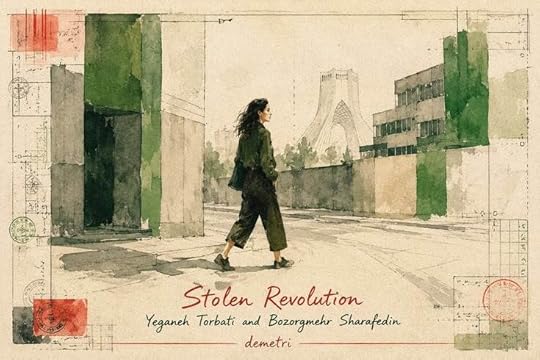
A lone woman walks unveiled through Tehran, her ordinary forward motion becoming the body-language of “Stolen Revolution,” where every approved exit has narrowed and public presence itself becomes refusal.
In “Stolen Revolution: Betrayal and Hope in Modern Iran,” politics is driven back to the place the state keeps trying to process, police, and punish: the body. Rozhin Yousefzadeh wakes in Tehran after the death of Mahsa Jhina Amini and watches grief gather and harden in Saqqez and Sanandaj around a slogan the authorities cannot arrest into silence: Woman, Life, Freedom. No one has yet called Tehran into the street. So Rozhin walks.
No headscarf. Short sleeves. Bare legs. Hair visible.
Her outfit is no costume; it is evidence. When every approved channel has been narrowed, bought, wired for surveillance, or beaten flat, the body becomes the last uncensored text. A woman walking down a street becomes a manifesto with shoes.
That is the pressure running through Yeganeh Torbati and Bozorgmehr Sharafedin’s account. The title promises betrayal; the pages deliver something colder and more interesting: exhaustion. “Stolen Revolution” is, plainly, a reckoning with how the 1979 Iranian Revolution, born from concrete demands for justice, dignity, independence, and a public life not arranged around fear, was appropriated and armored by Khomeini and his successors. But the book is less obedient to its title than expected. It is not only about a revolution stolen once. It is about each approved exit being tried and broken: clerical justice, reformist legality, elections, entrepreneurship, bureaucratic competence, exile advocacy, street protest. The tragedy is not simply that hope fails. It is that hope must keep learning the grammar of permission before it can learn to stop asking.
The authors braid the history through six Iranians, each testing a different bargain with the regime. Mehdi Karroubi, a young cleric devoted to Khomeini, helps midwife the revolution, then becomes one of its reformist casualties. Hila Sedighi, poet and activist, gives the reform generation its civic voice, then watches that voice catch in the throat after 2009. Said Rahmani, a global tech entrepreneur, returns to Iran believing startup culture might create room to build, only to discover that the security state can smell data through a locked door. Amir Moghadam, an ambitious insider, finds that corruption is not an exception but the office furniture of power. Rozhin Yousefzadeh and Kosar Eftekhari, born after the revolution had hardened into inheritance, answer back in a less obedient vocabulary: exposed hair, protest, injury, refusal.
The authors begin near the end, with Rozhin in September 2022, then walk backward into the first heat of devotion. The arrangement gives the uprising ancestry before it gives it climax. Woman Life Freedom is not handled as a topical coda to a completed history, the sort of hurried addendum that arrives smelling faintly of deadline. It is the destination and the test. To understand why a woman walking unveiled through Tehran could carry such charge, the authors reconstruct the long process by which clothing, mourning, voting, poetry, business, and workaday ambition became jurisdiction for police, judges, informants, and men in plainclothes.
In the early Karroubi chapters, revolutionary belief is allowed its first heat. In 1966, Karroubi crosses the Arvand River into Iraq to reach Khomeini in Najaf, fleeing the Shah’s secret police and entering the orbit of a teacher he reveres with nearly filial devotion. That sincerity is crucial; without it, the later remorse would be merely tidy. Torbati and Sharafedin do not treat the revolution as a trick from the start or its believers as fools waiting for history to embarrass them. The grievances are concrete: torture, censorship, blocked political life, poverty, foreign tutelage, the Shah’s tightening autocracy. Khomeini’s genius, and the danger of that genius, lies in his ability to fuse religious authority, anti-colonial nationalism, social justice, and certainty with a halo.
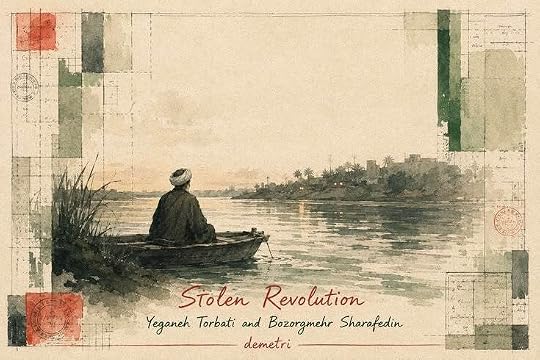
A young cleric crosses dark water toward exile and devotion, capturing the first heat of revolutionary belief before “Stolen Revolution” shows how faith begins installing its locks.
The revolution triumphs; then it begins installing its locks. Khomeini governs by decree. Institutions arise before accountability. Revolutionary courts, confiscations, relief committees, clerical networks, security organs, and ideological tests turn a coalition into clerical apparatus. Torbati and Sharafedin are sharp on an old revolutionary sleight: ideals do not disappear when betrayed. They become tools for deciding who may claim them.
Divine language is especially efficient. Once dissent can be described as rebellion against God, politics has found a convenient costume.
The reform years bring brief civic weather: a little air, then the bars around the window. Under Mohammad Khatami, newspapers, students, women, intellectuals, and civil society briefly make public life feel less airless. Hila Sedighi’s story gives these chapters their pulse. Her poetry and activism are not accessories to politics; they are among the forms politics takes when a young generation begins to imagine itself aloud. The 2009 Green Movement becomes the book’s second great collapse of officially legible hope. Citizens vote, march, film, mourn, insist that ballots should mean what ballots are rumored to mean. The reply is familiar, brutal, efficient: batons, arrests, show trials, forced confessions, house arrest. “Where is my vote?” becomes a question not only about an election but about citizenship itself.
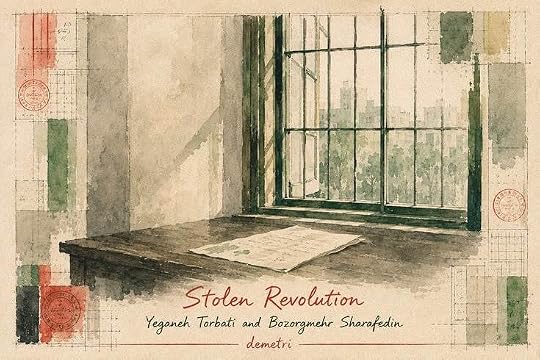
A reform-era room fills with green civic light that cannot quite become freedom, turning poetry, ballots, newspapers, and the Green Movement into an opening already learning its limits.
Then the book turns indoors: from streets and pulpits to offices, servers, investors, and men who understand ownership as another branch of security. Through Said Rahmani and Iran’s startup world, “Stolen Revolution” shows that the Islamic Republic does not only punish dissent. It places a guard at the door of opportunity. The tech chapters first look like a side corridor; they turn out to lead straight into the vault. They reveal a regime alert to the state appetite for data, commerce, networks, ambition, and return. Startup optimism enters wearing the genial fleece vest of global innovation and finds men at the door who would like a seat on the board, a look at the books, and perhaps the keys to the server room. Even modernity, here, needs a minder.
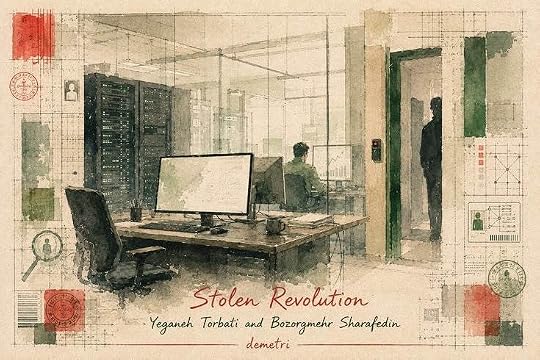
A startup office becomes another watched corridor, where screens, servers, contracts, and ambition reveal how the Islamic Republic learned to place a guard at the door of opportunity.
These money-and-data chapters are denser than the protest sections, and not every life carries the same intensity. Karroubi, Rozhin, and Kosar are hard to forget in the body. Hila gives the reform era its wounded song. Said and Amir are vital, but they sometimes illuminate wiring more than they haunt the room. That imbalance reveals the book’s own center of gravity. Without them, “Stolen Revolution” would risk becoming a protest history. With them, it becomes a more exact anatomy of capture. The Islamic Republic survives not only through jails and batons. It also survives by making every field – religion, elections, charity, commerce, information, even reform itself – answer finally to power.
The prose often starts with movement, then lets the machinery catch up. Karroubi crosses a river. Rozhin walks through Tehran. Protesters gather in a square. A family waits outside a prison. A young woman learns what a pellet round can do to an eye. The sentences gather rather than glitter. They move from action to implication, from object to institution. A headscarf becomes law. A ballot becomes accusation. A server becomes quarry. A phone becomes archive, evidence, trap. A grave becomes a courtroom with no judge.
The diction is plain, unsentimental, and direct. Torbati and Sharafedin do not soften violence with administrative gauze. They write of brutality, corruption, repression, fear, courage, dignity. Usually this directness gives the book weight. At times it presses too hard. The authors occasionally explain the verdict after the scene has already delivered it. When a state has pulled a woman by the hair into a van, raided a startup, converted a reformist into a prisoner of his own house, or left citizens to learn fear as a daily schedule, the reader does not require a second gavel.
Still, the recurrence is the point. “Stolen Revolution” is not a case file of horrors. Its design turns repetition into diagnosis. Each generation inherits the previous generation’s failed method of repair. The revolutionary generation believes seizure of the state can redeem the nation. The reform generation believes law and civil society can reopen the revolution from within. The Green Movement believes voting and mass nonviolence can shame power into recognition. The Rouhani-era optimists believe economic reintegration and technological modernization can create breathing room. Insiders believe exposure might still matter. The youngest protesters inherit the ruins and draw a colder conclusion. They do not begin by asking the system to honor its promises. They begin by breaking its choreography.
Here the book becomes more than an account of betrayed ideals. It understands authoritarianism as weather, wiring, paperwork. It gets into clothing, loans, jokes, passwords, funerals, payrolls, wedding plans, university gates, editorial meetings, medical treatment, and the small negotiations by which people learn how exposed they can afford to be. A state that cannot command belief can still command posture. It can tell you how to stand, what to wear, when to mourn, what to delete, where not to look.
The structural comparison that most clarifies the achievement is Barbara Demick’s “Nothing to Envy,” another work that uses multiple lives to illuminate a punitive system, while Masha Gessen’s “The Future Is History” shadows its attention to political possibility curdling into authoritarian habit. But Torbati and Sharafedin’s Iran is more porous, more digitally connected, more entangled with diaspora, sanctions, investment, and social media. The official revolution is never merely past. It is an unpaid debt invoked daily by those who defaulted on it.
“Stolen Revolution” makes autocracy feel like a system of interruptions inside the day. Writing about Iran from outside often drifts toward clerics, nuclear negotiations, regional conflict, policy jargon, and protest footage. Torbati and Sharafedin do not ignore those contexts, but their attention falls elsewhere: on how structures of rule enter a person’s life and reduce the number of exits. The Islamic Republic appears here as an editor of possibility, cutting away exits one by one.
That phrase may sound abstract until the book keeps proving it. It edits who can study without fear, who can publish without punishment, who can build a company without being swallowed, who can mourn without being filmed, who can dress without being hunted, who can return from abroad without becoming a hostage to leverage. Its edits reach beyond speech, into posture. Beyond politics, into timing. Beyond belief, into the distance between a person and the door.
The book’s artistic cost is tied to its strength. Betrayal is a powerful architecture, but it can become too legible. Again and again, an opening appears; again and again, the regime’s muscle memory returns: opening, backlash, punishment, mutation. That recurrence is historically persuasive, but aesthetically it can make some sections feel overdetermined. The book does show factional difference, sincere belief, miscalculation, compromise, and internal dissent, especially through Karroubi. Still, the ultimate direction is so clear that some middle chapters feel less like discovery than confirmation. The machinery can be heard before it enters the room.
A second cost follows from the six-life design. Rozhin and Kosar dominate the book’s afterimage, as they should. Karroubi supplies its tragic historical spine. Hila gives the reform era its voice. Said and Amir are indispensable to the argument, but less piercing as presences. Their function is different. Some lives carry the emotional intensity. Others reveal where the wires have been hidden.
The book does not need relevance stapled to it; the present tense is already in its pockets. Woman Life Freedom remains one of this century’s most consequential refusals, but “Stolen Revolution” is not merely topical. Its interest is diagnostic: it explains how rule can persist after belief has drained away. The internet in these pages is both window and snare. It lets Iranians see one another, organize, archive violence, expose lies. It also makes them searchable. The phone is a little republic of evidence, until it becomes an informant in your pocket.
The late chapters refuse the courtesy of consolation. Woman Life Freedom is crushed in the streets by arrests, executions, terror, and force. But it is not erased. It changes register. Women continue to appear unveiled. Songs circulate. Injured bodies testify. Exiles speak, argue, fracture, and try to assemble credible politics from abroad. Rozhin survives prison and remains defiant. Kosar, wounded in the eye, carries one of the book’s harshest images: the state does not merely demand that citizens look away; it may punish them for having looked directly.
And Karroubi, old and physically diminished, remains the book’s sharpest guilty mirror. He helped build the world that later imprisoned him. He repents, revises, criticizes, apologizes, rejects much of what the system became, yet cannot put Khomeini down. Torbati and Sharafedin do not excuse him. Nor do they flatten him into villainy. In him, the book finds one of its hardest questions: what does remorse mean when it arrives after the institution has learned to live without your consent?
Here the book is at its least sentimental and most humane. It does not pretend history is made only by monsters and martyrs. It is also made by the loyal, the hopeful, the compromised, the frightened, the patient, the ambitious, the exhausted – by people who think they can steer the machine until one day the machine thanks them for their service and locks the door.
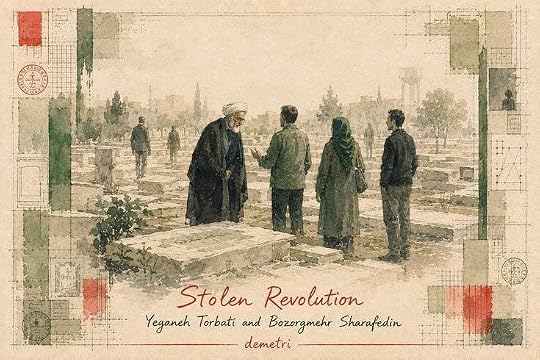
An old revolutionary stands among graves and petitioning citizens, the living and the dead gathered around the unpaid promise at the heart of “Stolen Revolution.”
My final rating: 88/100, which corresponds to 4/5 Goodreads stars. It is grave, deeply reported, and hard to shake loose, just below the highest tier because its betrayal pattern can overdetermine some sections and because not every strand carries equal human intensity. But its best pages understand that the stolen revolution is not only a political event. It is a long transfer of cost from rulers to citizens, from slogans to bodies, from men who promised justice to women asked to pay for the lie with their hair, their eyes, their freedom.
Near the end, Karroubi stands among graves at Behesht-e Zahra, listening as ordinary Iranians ask for help with sickness, hunger, unemployment, the price of staying alive. It is an almost unbearably precise image. The revolution began by speaking in the name of the poor and the oppressed; decades later, one of its old sons is left among the dead, hearing the living itemize what is still owed.
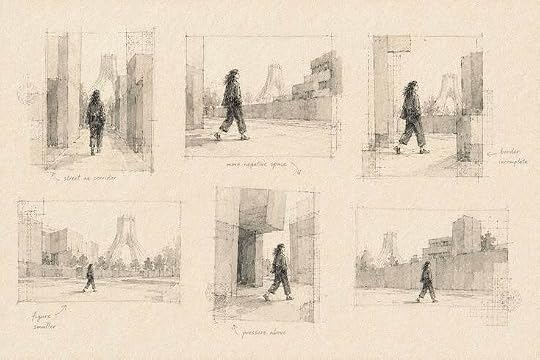
Early thumbnail studies test the review’s central visual problem: how to make a single walking figure carry exposure, negative space, state pressure, and the quiet force of refusal.
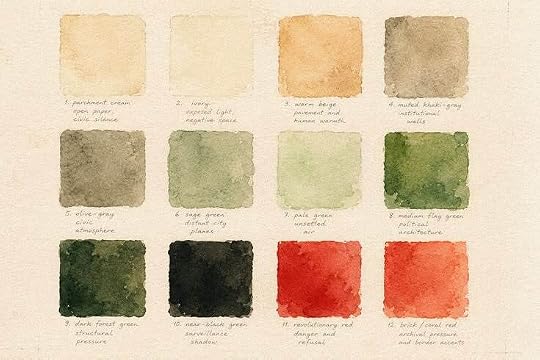
The cover-derived palette gathers into its own visual grammar, with parchment, green, charcoal, and restrained red deciding how the watercolor will hold civic air, danger, and restraint.
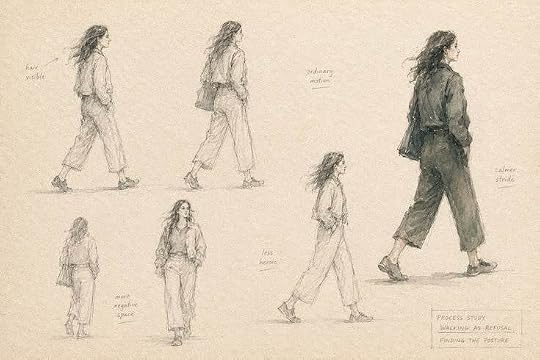
Loose figure studies search for the exact stride: not heroic, not panicked, but calm enough to make walking itself feel politically dangerous.
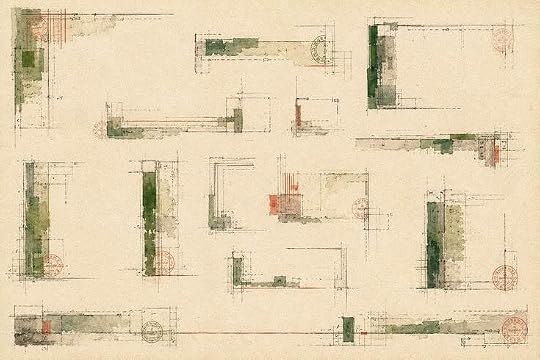
Broken border experiments turn permits, files, forms, stamps, and fractured administrative grids into a visual frame the figure can move through but not fully belong to.
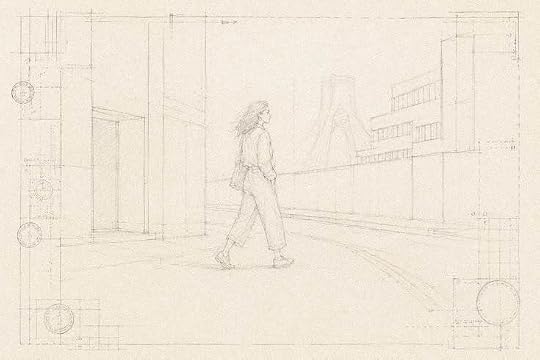
The graphite underdrawing reveals the image before atmosphere: woman, street, border, and city scaffolded into a public corridor of exposure.
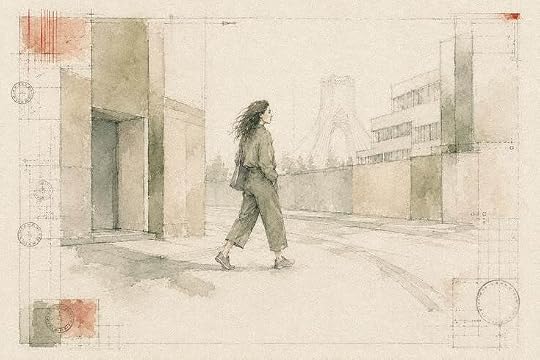
The first washes let the image begin to breathe, with green civic planes, dark bodily anchors, and preserved cream paper shaping the emotional silence around the figure.
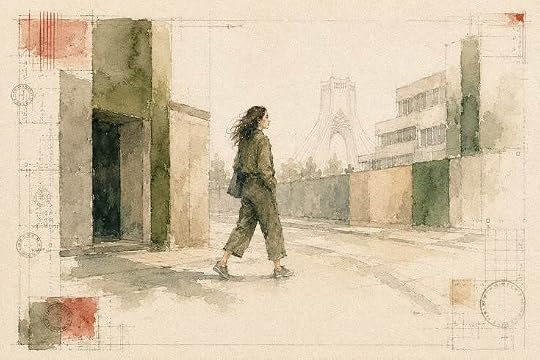
The midway blocking study shows the painting finding its architecture: figure, street, border, and shadow now legible, while the unfinished paper still keeps the image provisional and alive.
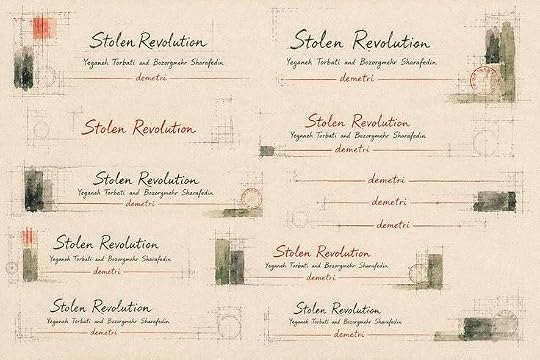
Lettering studies test how the title, author names, and “demetri” signature become part of the watercolor’s body, folding language into border, authorship, and frame.
All watercolor illustrations by Demetris Papadimitropoulos.
Watercolors are done on 140lb vellum and then scanned into the computer using an Epson scanner. From there, they are finalized in Procreate. All art and opinions are my own.
Yeganeh Torbati and Bozorgmehr Sharafedin’s “Stolen Revolution” traces the long Iranian passage from betrayed revolution to the body as the final language of refusal.
By Demetris Papadimitropoulos | May 27th, 2026
A lone woman walks unveiled through Tehran, her ordinary forward motion becoming the body-language of “Stolen Revolution,” where every approved exit has narrowed and public presence itself becomes refusal.
In “Stolen Revolution: Betrayal and Hope in Modern Iran,” politics is driven back to the place the state keeps trying to process, police, and punish: the body. Rozhin Yousefzadeh wakes in Tehran after the death of Mahsa Jhina Amini and watches grief gather and harden in Saqqez and Sanandaj around a slogan the authorities cannot arrest into silence: Woman, Life, Freedom. No one has yet called Tehran into the street. So Rozhin walks.
No headscarf. Short sleeves. Bare legs. Hair visible.
Her outfit is no costume; it is evidence. When every approved channel has been narrowed, bought, wired for surveillance, or beaten flat, the body becomes the last uncensored text. A woman walking down a street becomes a manifesto with shoes.
That is the pressure running through Yeganeh Torbati and Bozorgmehr Sharafedin’s account. The title promises betrayal; the pages deliver something colder and more interesting: exhaustion. “Stolen Revolution” is, plainly, a reckoning with how the 1979 Iranian Revolution, born from concrete demands for justice, dignity, independence, and a public life not arranged around fear, was appropriated and armored by Khomeini and his successors. But the book is less obedient to its title than expected. It is not only about a revolution stolen once. It is about each approved exit being tried and broken: clerical justice, reformist legality, elections, entrepreneurship, bureaucratic competence, exile advocacy, street protest. The tragedy is not simply that hope fails. It is that hope must keep learning the grammar of permission before it can learn to stop asking.
The authors braid the history through six Iranians, each testing a different bargain with the regime. Mehdi Karroubi, a young cleric devoted to Khomeini, helps midwife the revolution, then becomes one of its reformist casualties. Hila Sedighi, poet and activist, gives the reform generation its civic voice, then watches that voice catch in the throat after 2009. Said Rahmani, a global tech entrepreneur, returns to Iran believing startup culture might create room to build, only to discover that the security state can smell data through a locked door. Amir Moghadam, an ambitious insider, finds that corruption is not an exception but the office furniture of power. Rozhin Yousefzadeh and Kosar Eftekhari, born after the revolution had hardened into inheritance, answer back in a less obedient vocabulary: exposed hair, protest, injury, refusal.
The authors begin near the end, with Rozhin in September 2022, then walk backward into the first heat of devotion. The arrangement gives the uprising ancestry before it gives it climax. Woman Life Freedom is not handled as a topical coda to a completed history, the sort of hurried addendum that arrives smelling faintly of deadline. It is the destination and the test. To understand why a woman walking unveiled through Tehran could carry such charge, the authors reconstruct the long process by which clothing, mourning, voting, poetry, business, and workaday ambition became jurisdiction for police, judges, informants, and men in plainclothes.
In the early Karroubi chapters, revolutionary belief is allowed its first heat. In 1966, Karroubi crosses the Arvand River into Iraq to reach Khomeini in Najaf, fleeing the Shah’s secret police and entering the orbit of a teacher he reveres with nearly filial devotion. That sincerity is crucial; without it, the later remorse would be merely tidy. Torbati and Sharafedin do not treat the revolution as a trick from the start or its believers as fools waiting for history to embarrass them. The grievances are concrete: torture, censorship, blocked political life, poverty, foreign tutelage, the Shah’s tightening autocracy. Khomeini’s genius, and the danger of that genius, lies in his ability to fuse religious authority, anti-colonial nationalism, social justice, and certainty with a halo.
A young cleric crosses dark water toward exile and devotion, capturing the first heat of revolutionary belief before “Stolen Revolution” shows how faith begins installing its locks.
The revolution triumphs; then it begins installing its locks. Khomeini governs by decree. Institutions arise before accountability. Revolutionary courts, confiscations, relief committees, clerical networks, security organs, and ideological tests turn a coalition into clerical apparatus. Torbati and Sharafedin are sharp on an old revolutionary sleight: ideals do not disappear when betrayed. They become tools for deciding who may claim them.
Divine language is especially efficient. Once dissent can be described as rebellion against God, politics has found a convenient costume.
The reform years bring brief civic weather: a little air, then the bars around the window. Under Mohammad Khatami, newspapers, students, women, intellectuals, and civil society briefly make public life feel less airless. Hila Sedighi’s story gives these chapters their pulse. Her poetry and activism are not accessories to politics; they are among the forms politics takes when a young generation begins to imagine itself aloud. The 2009 Green Movement becomes the book’s second great collapse of officially legible hope. Citizens vote, march, film, mourn, insist that ballots should mean what ballots are rumored to mean. The reply is familiar, brutal, efficient: batons, arrests, show trials, forced confessions, house arrest. “Where is my vote?” becomes a question not only about an election but about citizenship itself.
A reform-era room fills with green civic light that cannot quite become freedom, turning poetry, ballots, newspapers, and the Green Movement into an opening already learning its limits.
Then the book turns indoors: from streets and pulpits to offices, servers, investors, and men who understand ownership as another branch of security. Through Said Rahmani and Iran’s startup world, “Stolen Revolution” shows that the Islamic Republic does not only punish dissent. It places a guard at the door of opportunity. The tech chapters first look like a side corridor; they turn out to lead straight into the vault. They reveal a regime alert to the state appetite for data, commerce, networks, ambition, and return. Startup optimism enters wearing the genial fleece vest of global innovation and finds men at the door who would like a seat on the board, a look at the books, and perhaps the keys to the server room. Even modernity, here, needs a minder.
A startup office becomes another watched corridor, where screens, servers, contracts, and ambition reveal how the Islamic Republic learned to place a guard at the door of opportunity.
These money-and-data chapters are denser than the protest sections, and not every life carries the same intensity. Karroubi, Rozhin, and Kosar are hard to forget in the body. Hila gives the reform era its wounded song. Said and Amir are vital, but they sometimes illuminate wiring more than they haunt the room. That imbalance reveals the book’s own center of gravity. Without them, “Stolen Revolution” would risk becoming a protest history. With them, it becomes a more exact anatomy of capture. The Islamic Republic survives not only through jails and batons. It also survives by making every field – religion, elections, charity, commerce, information, even reform itself – answer finally to power.
The prose often starts with movement, then lets the machinery catch up. Karroubi crosses a river. Rozhin walks through Tehran. Protesters gather in a square. A family waits outside a prison. A young woman learns what a pellet round can do to an eye. The sentences gather rather than glitter. They move from action to implication, from object to institution. A headscarf becomes law. A ballot becomes accusation. A server becomes quarry. A phone becomes archive, evidence, trap. A grave becomes a courtroom with no judge.
The diction is plain, unsentimental, and direct. Torbati and Sharafedin do not soften violence with administrative gauze. They write of brutality, corruption, repression, fear, courage, dignity. Usually this directness gives the book weight. At times it presses too hard. The authors occasionally explain the verdict after the scene has already delivered it. When a state has pulled a woman by the hair into a van, raided a startup, converted a reformist into a prisoner of his own house, or left citizens to learn fear as a daily schedule, the reader does not require a second gavel.
Still, the recurrence is the point. “Stolen Revolution” is not a case file of horrors. Its design turns repetition into diagnosis. Each generation inherits the previous generation’s failed method of repair. The revolutionary generation believes seizure of the state can redeem the nation. The reform generation believes law and civil society can reopen the revolution from within. The Green Movement believes voting and mass nonviolence can shame power into recognition. The Rouhani-era optimists believe economic reintegration and technological modernization can create breathing room. Insiders believe exposure might still matter. The youngest protesters inherit the ruins and draw a colder conclusion. They do not begin by asking the system to honor its promises. They begin by breaking its choreography.
Here the book becomes more than an account of betrayed ideals. It understands authoritarianism as weather, wiring, paperwork. It gets into clothing, loans, jokes, passwords, funerals, payrolls, wedding plans, university gates, editorial meetings, medical treatment, and the small negotiations by which people learn how exposed they can afford to be. A state that cannot command belief can still command posture. It can tell you how to stand, what to wear, when to mourn, what to delete, where not to look.
The structural comparison that most clarifies the achievement is Barbara Demick’s “Nothing to Envy,” another work that uses multiple lives to illuminate a punitive system, while Masha Gessen’s “The Future Is History” shadows its attention to political possibility curdling into authoritarian habit. But Torbati and Sharafedin’s Iran is more porous, more digitally connected, more entangled with diaspora, sanctions, investment, and social media. The official revolution is never merely past. It is an unpaid debt invoked daily by those who defaulted on it.
“Stolen Revolution” makes autocracy feel like a system of interruptions inside the day. Writing about Iran from outside often drifts toward clerics, nuclear negotiations, regional conflict, policy jargon, and protest footage. Torbati and Sharafedin do not ignore those contexts, but their attention falls elsewhere: on how structures of rule enter a person’s life and reduce the number of exits. The Islamic Republic appears here as an editor of possibility, cutting away exits one by one.
That phrase may sound abstract until the book keeps proving it. It edits who can study without fear, who can publish without punishment, who can build a company without being swallowed, who can mourn without being filmed, who can dress without being hunted, who can return from abroad without becoming a hostage to leverage. Its edits reach beyond speech, into posture. Beyond politics, into timing. Beyond belief, into the distance between a person and the door.
The book’s artistic cost is tied to its strength. Betrayal is a powerful architecture, but it can become too legible. Again and again, an opening appears; again and again, the regime’s muscle memory returns: opening, backlash, punishment, mutation. That recurrence is historically persuasive, but aesthetically it can make some sections feel overdetermined. The book does show factional difference, sincere belief, miscalculation, compromise, and internal dissent, especially through Karroubi. Still, the ultimate direction is so clear that some middle chapters feel less like discovery than confirmation. The machinery can be heard before it enters the room.
A second cost follows from the six-life design. Rozhin and Kosar dominate the book’s afterimage, as they should. Karroubi supplies its tragic historical spine. Hila gives the reform era its voice. Said and Amir are indispensable to the argument, but less piercing as presences. Their function is different. Some lives carry the emotional intensity. Others reveal where the wires have been hidden.
The book does not need relevance stapled to it; the present tense is already in its pockets. Woman Life Freedom remains one of this century’s most consequential refusals, but “Stolen Revolution” is not merely topical. Its interest is diagnostic: it explains how rule can persist after belief has drained away. The internet in these pages is both window and snare. It lets Iranians see one another, organize, archive violence, expose lies. It also makes them searchable. The phone is a little republic of evidence, until it becomes an informant in your pocket.
The late chapters refuse the courtesy of consolation. Woman Life Freedom is crushed in the streets by arrests, executions, terror, and force. But it is not erased. It changes register. Women continue to appear unveiled. Songs circulate. Injured bodies testify. Exiles speak, argue, fracture, and try to assemble credible politics from abroad. Rozhin survives prison and remains defiant. Kosar, wounded in the eye, carries one of the book’s harshest images: the state does not merely demand that citizens look away; it may punish them for having looked directly.
And Karroubi, old and physically diminished, remains the book’s sharpest guilty mirror. He helped build the world that later imprisoned him. He repents, revises, criticizes, apologizes, rejects much of what the system became, yet cannot put Khomeini down. Torbati and Sharafedin do not excuse him. Nor do they flatten him into villainy. In him, the book finds one of its hardest questions: what does remorse mean when it arrives after the institution has learned to live without your consent?
Here the book is at its least sentimental and most humane. It does not pretend history is made only by monsters and martyrs. It is also made by the loyal, the hopeful, the compromised, the frightened, the patient, the ambitious, the exhausted – by people who think they can steer the machine until one day the machine thanks them for their service and locks the door.
An old revolutionary stands among graves and petitioning citizens, the living and the dead gathered around the unpaid promise at the heart of “Stolen Revolution.”
My final rating: 88/100, which corresponds to 4/5 Goodreads stars. It is grave, deeply reported, and hard to shake loose, just below the highest tier because its betrayal pattern can overdetermine some sections and because not every strand carries equal human intensity. But its best pages understand that the stolen revolution is not only a political event. It is a long transfer of cost from rulers to citizens, from slogans to bodies, from men who promised justice to women asked to pay for the lie with their hair, their eyes, their freedom.
Near the end, Karroubi stands among graves at Behesht-e Zahra, listening as ordinary Iranians ask for help with sickness, hunger, unemployment, the price of staying alive. It is an almost unbearably precise image. The revolution began by speaking in the name of the poor and the oppressed; decades later, one of its old sons is left among the dead, hearing the living itemize what is still owed.
Early thumbnail studies test the review’s central visual problem: how to make a single walking figure carry exposure, negative space, state pressure, and the quiet force of refusal.
The cover-derived palette gathers into its own visual grammar, with parchment, green, charcoal, and restrained red deciding how the watercolor will hold civic air, danger, and restraint.
Loose figure studies search for the exact stride: not heroic, not panicked, but calm enough to make walking itself feel politically dangerous.
Broken border experiments turn permits, files, forms, stamps, and fractured administrative grids into a visual frame the figure can move through but not fully belong to.
The graphite underdrawing reveals the image before atmosphere: woman, street, border, and city scaffolded into a public corridor of exposure.
The first washes let the image begin to breathe, with green civic planes, dark bodily anchors, and preserved cream paper shaping the emotional silence around the figure.
The midway blocking study shows the painting finding its architecture: figure, street, border, and shadow now legible, while the unfinished paper still keeps the image provisional and alive.
Lettering studies test how the title, author names, and “demetri” signature become part of the watercolor’s body, folding language into border, authorship, and frame.
All watercolor illustrations by Demetris Papadimitropoulos.
Watercolors are done on 140lb vellum and then scanned into the computer using an Epson scanner. From there, they are finalized in Procreate. All art and opinions are my own.

Review of advance copy received from NetGalley
You have no mercy, and we have no fear.
Alright, I cannot believe I finally finished this book. I’ve been reading it for months, and it was so dense and full of details that it took me ages to get to the halfway point. It’s actually insane to think I started this book before the late-2025 protests that led to thousands of Iranians being massacred by the regime, and I’m finishing this the day a ceasefire has been announced for a war that killed Ali Khamenei. Anyways, I’ll get to the review itself, but I just wanted to add, on a personal note, that Iran has been under repression for so many decades, and I happened to read this during some of the more volatile times the country has had (especially for Khamenei, pun intended).
I was very excited to see an email offering me the chance to read this ARC, since I’ve been trying to read more on Iran after reading The Lion Women of Tehran. That book made me rage, laugh, care, and cry, and you know that gets a hold of me, but I didn’t know much about the country or the Revolution. Stolen Revolution: Betrayal and Hope in Modern Iran seemed like the ideal introduction to everything that had happened, mostly because it wasn’t just a historical overview, but told history through the eyes of people who were very involved in certain moments of Iranian history. These people are: Mehdi Karroubi, a devotee of Khomeini who was later cast out of the inner circle; Hila Sedighi, a young activist and poet who was involved in the reform movement; Said Rahmani, a successful global tech entrepreneur who returned to Iran to spark a start-up boom; Amir Moghadam, a government bureaucrat who witnessed corruption; and Rozhin Yousefzade and Kosar Eftekhari, who were involved in the Woman, Life, Freedom protests.
I will say that the book was very dense and extremely detailed. You can tell the authors are journalists. I think someone who is familiar with Iranian history and really into politics would have a blast reading this. I got lost in the details and struggled to remember names, organizations, and things in general. I actually showed some pages to an Iranian person because I told him I was reading this book, and he agreed this was not beginner-friendly for someone who is just trying to get started with Iranian politics. That being said, even though I don’t think I got as much out of it as someone else would have, I still understood the trends of what was happening and the key moments (and I vaguely remember some of the names, though I butcher them if I try to pronounce them).
I guess what I’m trying to say is a bit of an “it’s not you, it’s me,” in the sense that this was too detailed for someone who is as clueless as I am. I found For the Sun After Long Nights: The Story of Iran's Women-Led Uprising focused all its efforts on three things, and it was more approachable than Stolen Revolution: Betrayal and Hope in Modern Iran, which tried to cover everything in a very detailed manner. And I mean, it covered from before the Revolution to June 2025, when Israel illegally attacked Iran, so I do find the scope very ambitious.
Struggles aside, I wanted to highlight a few things from my reading experience. I had my favorite people to follow (Hila, Rozhin, and Kosar), who were the women, and then I just didn’t really mind the men. I think I’m naturally more interested in women after the Revolution, and it was especially hard to read the sections on Rozhin and Kosar, which concentrated a higher amount of violence and brutality against women. It was in these sections where “Baraye” by Shervin Hajipour was mentioned, and we love that, I’m still obsessed with the song. On the other hand, I didn’t care about Said’s sections, and Amir’s and Karroubi’s were interesting because of the politics, but I didn’t feel very engaged with them.
The other thing to highlight is something that I want to check in other reviews (because, again, I’m clueless). I find myself naturally opposed to anything related to the ayatollahs, so the fact that we see Karroubi so much in this book and he’s not necessarily presented in a negative light (maybe because he’s pro-Khomeini, anti-Khamenei?) still makes me struggle with the idea that Khomeini was okay. I just find that the people we follow are introduced somewhat objectively, and the only subjectivity comes from their own thoughts, but my brain was trying to understand if these guys were the good guys, or bad guys, or what. I’d say the book clearly highlights the abuses of the Iranian regime after the Revolution, but it was too objective if that makes sense (which is good, but I think my brain was too busy trying to understand what was happening, and I needed someone to chew the information for me and have an opinion of things I was trying to grasp. Maybe. I don’t know).
Also, I’ll finish with the last aspect that I just thought of right now: I would have liked to have a little more on Reza Pahlavi and/or the Iranian diaspora. He’s mentioned at the end with little context or explanation other than stating who he is, which is okay, but he’s such a prominent political figure, especially for the diaspora, that I think it would have been nice for him to have more presence. This is a bit crazy to say after mentioning the book was long and dense, but I would have liked to see a character who was involved with Pahlavi, just to get a sense of what the opposition to Khamenei looks like.
Anyways, this is my long review. Not the most ideal book for people who aren’t familiar with Iran, but I think if someone is into Iranian politics and history, they’ll have a blast with it.
Alright, I cannot believe I finally finished this book. I’ve been reading it for months, and it was so dense and full of details that it took me ages to get to the halfway point. It’s actually insane to think I started this book before the late-2025 protests that led to thousands of Iranians being massacred by the regime, and I’m finishing this the day a ceasefire has been announced for a war that killed Ali Khamenei. Anyways, I’ll get to the review itself, but I just wanted to add, on a personal note, that Iran has been under repression for so many decades, and I happened to read this during some of the more volatile times the country has had (especially for Khamenei, pun intended).
I was very excited to see an email offering me the chance to read this ARC, since I’ve been trying to read more on Iran after reading The Lion Women of Tehran. That book made me rage, laugh, care, and cry, and you know that gets a hold of me, but I didn’t know much about the country or the Revolution. Stolen Revolution: Betrayal and Hope in Modern Iran seemed like the ideal introduction to everything that had happened, mostly because it wasn’t just a historical overview, but told history through the eyes of people who were very involved in certain moments of Iranian history. These people are: Mehdi Karroubi, a devotee of Khomeini who was later cast out of the inner circle; Hila Sedighi, a young activist and poet who was involved in the reform movement; Said Rahmani, a successful global tech entrepreneur who returned to Iran to spark a start-up boom; Amir Moghadam, a government bureaucrat who witnessed corruption; and Rozhin Yousefzade and Kosar Eftekhari, who were involved in the Woman, Life, Freedom protests.
I will say that the book was very dense and extremely detailed. You can tell the authors are journalists. I think someone who is familiar with Iranian history and really into politics would have a blast reading this. I got lost in the details and struggled to remember names, organizations, and things in general. I actually showed some pages to an Iranian person because I told him I was reading this book, and he agreed this was not beginner-friendly for someone who is just trying to get started with Iranian politics. That being said, even though I don’t think I got as much out of it as someone else would have, I still understood the trends of what was happening and the key moments (and I vaguely remember some of the names, though I butcher them if I try to pronounce them).
I guess what I’m trying to say is a bit of an “it’s not you, it’s me,” in the sense that this was too detailed for someone who is as clueless as I am. I found For the Sun After Long Nights: The Story of Iran's Women-Led Uprising focused all its efforts on three things, and it was more approachable than Stolen Revolution: Betrayal and Hope in Modern Iran, which tried to cover everything in a very detailed manner. And I mean, it covered from before the Revolution to June 2025, when Israel illegally attacked Iran, so I do find the scope very ambitious.
Struggles aside, I wanted to highlight a few things from my reading experience. I had my favorite people to follow (Hila, Rozhin, and Kosar), who were the women, and then I just didn’t really mind the men. I think I’m naturally more interested in women after the Revolution, and it was especially hard to read the sections on Rozhin and Kosar, which concentrated a higher amount of violence and brutality against women. It was in these sections where “Baraye” by Shervin Hajipour was mentioned, and we love that, I’m still obsessed with the song. On the other hand, I didn’t care about Said’s sections, and Amir’s and Karroubi’s were interesting because of the politics, but I didn’t feel very engaged with them.
The other thing to highlight is something that I want to check in other reviews (because, again, I’m clueless). I find myself naturally opposed to anything related to the ayatollahs, so the fact that we see Karroubi so much in this book and he’s not necessarily presented in a negative light (maybe because he’s pro-Khomeini, anti-Khamenei?) still makes me struggle with the idea that Khomeini was okay. I just find that the people we follow are introduced somewhat objectively, and the only subjectivity comes from their own thoughts, but my brain was trying to understand if these guys were the good guys, or bad guys, or what. I’d say the book clearly highlights the abuses of the Iranian regime after the Revolution, but it was too objective if that makes sense (which is good, but I think my brain was too busy trying to understand what was happening, and I needed someone to chew the information for me and have an opinion of things I was trying to grasp. Maybe. I don’t know).
Also, I’ll finish with the last aspect that I just thought of right now: I would have liked to have a little more on Reza Pahlavi and/or the Iranian diaspora. He’s mentioned at the end with little context or explanation other than stating who he is, which is okay, but he’s such a prominent political figure, especially for the diaspora, that I think it would have been nice for him to have more presence. This is a bit crazy to say after mentioning the book was long and dense, but I would have liked to see a character who was involved with Pahlavi, just to get a sense of what the opposition to Khamenei looks like.
Anyways, this is my long review. Not the most ideal book for people who aren’t familiar with Iran, but I think if someone is into Iranian politics and history, they’ll have a blast with it.

August 3, 2026
Enjoyed this.
When you read a history written through the eyes of specific individuals (particularly by journalists), there’s a danger that it ends up being flimsy - but ‘Stolen Revolution’ isn’t that. The note on sources at the end makes clear how much research has gone into this book, and what results is a thorough chronicle of Iran since 1979 (which is equal parts engaging and informative). The book’s characters are well chosen too, and Bozorgmehr Sharafedin and Yeganeh Torbati avoid any questions as to representativeness. Whilst the everyday nature of the ‘Woman, Life, Freedom’ protestors is rather the point, Mehdi Karroubi is a central figure in Iran’s politics since the Revolution - and I enjoyed the exploration of Iran’s start-up scene since 2010 through focus on the tech entrepreneur Said Rahmani. The breadth of the book’s cast allows Sharafedin and Torbati to open up new perspectives, and the two things that most struck me were their (a) argument that the election of Hassan Rouhani and the reformist faction represented less the culmination of the Green Movement and more its subversion (which is not how things were presented in the West at the time); and (b) analysis of the way that the Iranian state operates, which reminded me a lot of Catherine Belton’s analysis of Russia in ‘Putin’s People’.
In terms of pitfalls: in a funny way, this book underscores the impossibility of writing a book about modern Iran. Commendably, Sharafedin and Torbati strive to be neutral and dispassionate - which means that they do not directly consider the politics of the diaspora outside of Iran (and Reza Pahlavi is only mentioned a handful of times). Fine, that’s a thorny issue to get into - and doing otherwise would have derailed the book and allowed many readers to dismiss it from the outset. Yet that choice comes with drawbacks, and it all starts to feel a bit like a catch-22. In making that editorial decision, ‘Stolen Revolution’ precludes an analysis of how the lack of any credible internal opposition has resulted in many diaspora Iranians turning to Pahlavi for leadership - a man spectacularly unsuited to such a role both personally and politically. Insofar as the book’s framing is ‘regime bad / opposition good’, it also implicitly valorises those opposition figures it cites like Masih Alinejad - without giving any hint that Alinejad is one of many who have totally lost the plot in deciding that any anti-regime force must necessarily be good (earning the condemnation of the vast majority of Iranians, particularly in Iran, by welcoming US / Israeli strikes on their own country; and like clockwork in the case of Alinejad herself, posting an absolutely mad tweet just yesterday urging Spanish PM Pedro Sanchez to “end his cowardice in the face of Islamism”).
Similarly, the book consciously maintains an Iran-centric focus on the events it describes - but particularly as it gets closer to the present day (when the book loses force, and feels as Sharafedin and Torbati were caught by surprise at the rapid change in events up to the date on which the book was sent to the printers - feeling that they had to scramble to say something about them), that can feel farcical. We are told that Israel’s 2025 strikes on Iran are Khamenei’s chickens coming home to roost - but any reader might legitimately wonder whether they might also be even the slightest bit attributable to the internal / foreign political dynamics of a heavily militarised country that has attacked several of its neighbours in the past few years. A similar point could be made about Trump’s America, which Sharafedin and Torbati address even less - though here, the dynamic is slightly different. Given (Ali) Khamenei lives at the book’s end, one must assume ‘Stolen Revolution’ was finalised before the new year; and the pace of history means its conclusions have already been slightly overtaken by events. Though not explicitly stated, the book seems based on a teleological assumption that the Islamic Republic is walking from crisis to crisis - which grow in scale and fall closer and closer in time. How, then, to account for US attacks that have caused an otherwise restive populace to at least temporarily put their demands aside? Given (Ali) Khamenei’s age, succession to the Supreme Leadership was otherwise likely to be a potential flashpoint in the next few years - and it is hard to imagine (Mojtaba) Khamenei coming to power, at least quite so seamlessly, without Trump’s strikes.
Still - a good read.
When you read a history written through the eyes of specific individuals (particularly by journalists), there’s a danger that it ends up being flimsy - but ‘Stolen Revolution’ isn’t that. The note on sources at the end makes clear how much research has gone into this book, and what results is a thorough chronicle of Iran since 1979 (which is equal parts engaging and informative). The book’s characters are well chosen too, and Bozorgmehr Sharafedin and Yeganeh Torbati avoid any questions as to representativeness. Whilst the everyday nature of the ‘Woman, Life, Freedom’ protestors is rather the point, Mehdi Karroubi is a central figure in Iran’s politics since the Revolution - and I enjoyed the exploration of Iran’s start-up scene since 2010 through focus on the tech entrepreneur Said Rahmani. The breadth of the book’s cast allows Sharafedin and Torbati to open up new perspectives, and the two things that most struck me were their (a) argument that the election of Hassan Rouhani and the reformist faction represented less the culmination of the Green Movement and more its subversion (which is not how things were presented in the West at the time); and (b) analysis of the way that the Iranian state operates, which reminded me a lot of Catherine Belton’s analysis of Russia in ‘Putin’s People’.
In terms of pitfalls: in a funny way, this book underscores the impossibility of writing a book about modern Iran. Commendably, Sharafedin and Torbati strive to be neutral and dispassionate - which means that they do not directly consider the politics of the diaspora outside of Iran (and Reza Pahlavi is only mentioned a handful of times). Fine, that’s a thorny issue to get into - and doing otherwise would have derailed the book and allowed many readers to dismiss it from the outset. Yet that choice comes with drawbacks, and it all starts to feel a bit like a catch-22. In making that editorial decision, ‘Stolen Revolution’ precludes an analysis of how the lack of any credible internal opposition has resulted in many diaspora Iranians turning to Pahlavi for leadership - a man spectacularly unsuited to such a role both personally and politically. Insofar as the book’s framing is ‘regime bad / opposition good’, it also implicitly valorises those opposition figures it cites like Masih Alinejad - without giving any hint that Alinejad is one of many who have totally lost the plot in deciding that any anti-regime force must necessarily be good (earning the condemnation of the vast majority of Iranians, particularly in Iran, by welcoming US / Israeli strikes on their own country; and like clockwork in the case of Alinejad herself, posting an absolutely mad tweet just yesterday urging Spanish PM Pedro Sanchez to “end his cowardice in the face of Islamism”).
Similarly, the book consciously maintains an Iran-centric focus on the events it describes - but particularly as it gets closer to the present day (when the book loses force, and feels as Sharafedin and Torbati were caught by surprise at the rapid change in events up to the date on which the book was sent to the printers - feeling that they had to scramble to say something about them), that can feel farcical. We are told that Israel’s 2025 strikes on Iran are Khamenei’s chickens coming home to roost - but any reader might legitimately wonder whether they might also be even the slightest bit attributable to the internal / foreign political dynamics of a heavily militarised country that has attacked several of its neighbours in the past few years. A similar point could be made about Trump’s America, which Sharafedin and Torbati address even less - though here, the dynamic is slightly different. Given (Ali) Khamenei lives at the book’s end, one must assume ‘Stolen Revolution’ was finalised before the new year; and the pace of history means its conclusions have already been slightly overtaken by events. Though not explicitly stated, the book seems based on a teleological assumption that the Islamic Republic is walking from crisis to crisis - which grow in scale and fall closer and closer in time. How, then, to account for US attacks that have caused an otherwise restive populace to at least temporarily put their demands aside? Given (Ali) Khamenei’s age, succession to the Supreme Leadership was otherwise likely to be a potential flashpoint in the next few years - and it is hard to imagine (Mojtaba) Khamenei coming to power, at least quite so seamlessly, without Trump’s strikes.
Still - a good read.
July 26, 2026
For many people, what they know of Iran is a selective set of moments and ideas from a mostly western perspective. They may have heard of the USA's CIA involvement in replacing heads of state, the 'Embassy Hostage Crisis' as memorialized as a unit by headlines, that little thing called a nuclear program, or more recently the oppression faced by women. I was one of them. In fact, I can't even say I knew all of that.
I have much more to learn even now. But this book delivers something I haven't found in the few years I've spent trying to learn about these people, the system they're under, and the culture that is simultaneously unique and threaded throughout much of the region. No book, fiction or non-fiction, has given such a balanced and comprehensive picture of life after the '79 revolution.
Featuring people from across the spectrum of backgrounds the readers is given a glimpse into nearly every sector. The religious, the arts, business, activism, the establishment, and the common person alike are all given a voice. It is a hefty read, make no mistake, but it contained a vast web in a way I think will be accessible to someone unaware of the big picture let alone ever having heard some of the more influential names.
There is a running theme through all of these. Betrayal. Disappointment. It's a portrait of a system that's lust for power and control offers no security for anyone. Not those that have the ear of the regime leaders or those that are controlled.
Yet it is also full of hope. Time and time again the Iranian people have been defiant. They shouldn't have to be so resilient. Nor for so long. I can't imagine the exhaustion. The excess of 'almost' or potential turning point moments does not let this spark seem excessively optimistic. Even more so when at the time of reading my county is pinning civilians between the regime that sees them only as fodder and our administration's own greed.
I find the admiration and optimism in that as vicious as the results have been it hasn't stopped people from seeking a life and the dignity they deserve. If all of us were as stalwart we wouldn't be starting down a path that looks more and more like the one they've already been fighting repackaged. I truly hope it clears the misconception that it is somehow the fault of their own lethargy. That has never been the problem. The rigged system and pocket lining is.
This was a really great addition to anyone's modern history collection. It functions as an overview of the power dynamics , cultural, and economical elements of the country. At the same time it turns names into people that can be related to. It is a reminder that a place is more than its policies and politics. That every action has influence on the life of someone not so different than you.
I have much more to learn even now. But this book delivers something I haven't found in the few years I've spent trying to learn about these people, the system they're under, and the culture that is simultaneously unique and threaded throughout much of the region. No book, fiction or non-fiction, has given such a balanced and comprehensive picture of life after the '79 revolution.
Featuring people from across the spectrum of backgrounds the readers is given a glimpse into nearly every sector. The religious, the arts, business, activism, the establishment, and the common person alike are all given a voice. It is a hefty read, make no mistake, but it contained a vast web in a way I think will be accessible to someone unaware of the big picture let alone ever having heard some of the more influential names.
There is a running theme through all of these. Betrayal. Disappointment. It's a portrait of a system that's lust for power and control offers no security for anyone. Not those that have the ear of the regime leaders or those that are controlled.
Yet it is also full of hope. Time and time again the Iranian people have been defiant. They shouldn't have to be so resilient. Nor for so long. I can't imagine the exhaustion. The excess of 'almost' or potential turning point moments does not let this spark seem excessively optimistic. Even more so when at the time of reading my county is pinning civilians between the regime that sees them only as fodder and our administration's own greed.
I find the admiration and optimism in that as vicious as the results have been it hasn't stopped people from seeking a life and the dignity they deserve. If all of us were as stalwart we wouldn't be starting down a path that looks more and more like the one they've already been fighting repackaged. I truly hope it clears the misconception that it is somehow the fault of their own lethargy. That has never been the problem. The rigged system and pocket lining is.
This was a really great addition to anyone's modern history collection. It functions as an overview of the power dynamics , cultural, and economical elements of the country. At the same time it turns names into people that can be related to. It is a reminder that a place is more than its policies and politics. That every action has influence on the life of someone not so different than you.

Review of advance copy received from NetGalley
When I started Stolen Revolution by Yeganeh Torbati and Bozorgmehr Sharafedin, I was wondering how they could cover five decades of Iran post-revolution without making their book 5,000 pages. It turns out, you can cover a whole heck of a lot if you focus on the people. The books I always love the most do that, and this one pulls that off.
The authors look at Iran starting with the close of the Iranian Revolution in 1979. There are four parts to the book, but it felt like three to me. The first two parts are mostly centered on Mehdi Karroubi and Hila Sedighi. Karroubi is a political animal trying to make his way in a whole new world. Sedighi is a young woman and budding poet who is destined to run into plenty of problems with what Iran would become.
The first two parts introduce us to a lot. This includes people and aspects of the Iranian state. I had started to worry that Sedighi, for instance, seemed entirely superfluous to the narrative at first. There was already a dizzying amount of names and she seemed totally extraneous. However, I should have had more faith in the authors. They clearly anticipated this. What they do is introduce people slowly so we get to understand who they are and what they will become before they fully take the spotlight. In short (too late!), if you feel a bit overwhelmed at first, stick with this. The authors know what they are doing. Plus, you will feel as off-kilter as the people of Iran so added bonus for atmosphere.
Part three follows various business folk as they make the horrible choice to trust the Iranian government to be open and honest about, well, anything. Part four follows two young women who have a few issues with how women are treated in Iran. Part four ends right near present day.
This book is absolutely packed to the gills with great reporting and colorful characters. Most importantly, the authors don't pull punches. There are multiple times where Karroubi is much closer to a villain than a hero. In fact, you could argue he only looked like one in comparison to the people who turned on him. I love books like this because I could argue either way. If you want to know what it's been like for people in Iran over the past five decades, then you need to pick this one up.
(This book was provided as an advanced reader copy by Doubleday Books and NetGalley.)
The authors look at Iran starting with the close of the Iranian Revolution in 1979. There are four parts to the book, but it felt like three to me. The first two parts are mostly centered on Mehdi Karroubi and Hila Sedighi. Karroubi is a political animal trying to make his way in a whole new world. Sedighi is a young woman and budding poet who is destined to run into plenty of problems with what Iran would become.
The first two parts introduce us to a lot. This includes people and aspects of the Iranian state. I had started to worry that Sedighi, for instance, seemed entirely superfluous to the narrative at first. There was already a dizzying amount of names and she seemed totally extraneous. However, I should have had more faith in the authors. They clearly anticipated this. What they do is introduce people slowly so we get to understand who they are and what they will become before they fully take the spotlight. In short (too late!), if you feel a bit overwhelmed at first, stick with this. The authors know what they are doing. Plus, you will feel as off-kilter as the people of Iran so added bonus for atmosphere.
Part three follows various business folk as they make the horrible choice to trust the Iranian government to be open and honest about, well, anything. Part four follows two young women who have a few issues with how women are treated in Iran. Part four ends right near present day.
This book is absolutely packed to the gills with great reporting and colorful characters. Most importantly, the authors don't pull punches. There are multiple times where Karroubi is much closer to a villain than a hero. In fact, you could argue he only looked like one in comparison to the people who turned on him. I love books like this because I could argue either way. If you want to know what it's been like for people in Iran over the past five decades, then you need to pick this one up.
(This book was provided as an advanced reader copy by Doubleday Books and NetGalley.)
September 25, 2026
I truly appreciate the authors’ tremendous efforts to help us get a glimpse into, what felt like, day-to-day Iranian life (as much as possible) via the various people they chose to include.
Overall, the narrative is however uneven. Oftentimes, the details included in certain arcs are overwrought/tangential. I often found myself glazing over many such details, which was very saddening as I was extremely keen on the subject matter. For a large part, the book also didn’t allow for a palpable human connect despite describing the monstrous regime's atrocities against its own people. And the end of a chapter always felt abrupt. In those moments, it felt like a very straightforward introduction (textbook-ish) to the Islamic Republic—important and accessible but both over-described and fragmented. It failed to sustain/create much emotional resonance either.
Fortunately, the last few chapters were much more cohesive and emotionally resonant. The book truly comes alive when it starts describing the women’s protests and the lives of some of those women; and we get an inkling of what the book could have been if perhaps the framing (or even editing) had been adjusted.
PS: I wonder if it’s just me, but I also found the narrative overly US-centric. Of course, the authors’ choices of perspectives are their own and I do understand that there are limitations to what all can be discussed. But I would have loved to understand, even briefly, how, say, the Chinese investments are transforming the political landscape, if at all, in the given context. Or how Iranians working in the neighboring countries is impacting the politics or even the new wave of protests.
Overall, the narrative is however uneven. Oftentimes, the details included in certain arcs are overwrought/tangential. I often found myself glazing over many such details, which was very saddening as I was extremely keen on the subject matter. For a large part, the book also didn’t allow for a palpable human connect despite describing the monstrous regime's atrocities against its own people. And the end of a chapter always felt abrupt. In those moments, it felt like a very straightforward introduction (textbook-ish) to the Islamic Republic—important and accessible but both over-described and fragmented. It failed to sustain/create much emotional resonance either.
Fortunately, the last few chapters were much more cohesive and emotionally resonant. The book truly comes alive when it starts describing the women’s protests and the lives of some of those women; and we get an inkling of what the book could have been if perhaps the framing (or even editing) had been adjusted.
PS: I wonder if it’s just me, but I also found the narrative overly US-centric. Of course, the authors’ choices of perspectives are their own and I do understand that there are limitations to what all can be discussed. But I would have loved to understand, even briefly, how, say, the Chinese investments are transforming the political landscape, if at all, in the given context. Or how Iranians working in the neighboring countries is impacting the politics or even the new wave of protests.

July 4, 2026
This is an insightful account of the lead up to the Iranian Revolution and what has gone wrong since. Told through the eyes of a range of people who have impacted and been impacted by events in Iran over recent decades, it brings history to life and creates a new understanding of how the Islamic leadership has maintained its grip on power.
When I visited Tehran to speak at a conference about 12 years ago, I was struck by how different the people there were to the images drawn for us in the West. We are told that Iran is a fundamental, extremist society. But while religion casts its shadow across everyday life, that is less at the desire of the populace and more a means of power over them. And that divide has widened over the generations. This shines through in this book.
It also sadly portrays why the mass protests over recent decades haven’t changed anything in terms of overall power and how the hardliners have kept control.
Above all, this book shares inspiring and moving stories of some remarkable individuals across generations, particularly the brave young women who drove and engaged in more recent counter regime protests. Their stories, growing more prominent in the second half of the book, ultimately bring a tear to the eye.
When I visited Tehran to speak at a conference about 12 years ago, I was struck by how different the people there were to the images drawn for us in the West. We are told that Iran is a fundamental, extremist society. But while religion casts its shadow across everyday life, that is less at the desire of the populace and more a means of power over them. And that divide has widened over the generations. This shines through in this book.
It also sadly portrays why the mass protests over recent decades haven’t changed anything in terms of overall power and how the hardliners have kept control.
Above all, this book shares inspiring and moving stories of some remarkable individuals across generations, particularly the brave young women who drove and engaged in more recent counter regime protests. Their stories, growing more prominent in the second half of the book, ultimately bring a tear to the eye.

Review of advance copy received from Publisher
Doubleday graciously sent me a copy of Stolen Revolution by Yeganeh Torbati and Bozorgmehr Sharafedin, and I am so thankful they did. I probably would have been intimidated to pick it up myself.
I have never struggled so much to write a review as I have with this. Not because the books bad, it is great. But because of the subject, because I am not an expert in the field, because I worry I'd say the wrong thing. Nuance is the word that kept coming to my mind. It's not a black and white clear cut anything.
So here's the deal, I am not an expert, but I am a human with empathy, with a [broken] heart, and a desire to learn and hear more from voices that arent in my backyard. I think we gain empathy only through reading and words, sharing stories. I think that IF more people were to read this book, they might see how similar we all are. Honestly what happened historically politically there feels and reads like it could be about current times...ahem, here.
The Iranians in this book deserve to have their voices heard, their stories told, and our compassion and audience. To let us see the hope. Torbati and Sharafedin have done the heavy lifting here, all we have to do is listen. It could also serve to be a bit of useful knowledge to tuck away that we can come back to if needed....
I have never struggled so much to write a review as I have with this. Not because the books bad, it is great. But because of the subject, because I am not an expert in the field, because I worry I'd say the wrong thing. Nuance is the word that kept coming to my mind. It's not a black and white clear cut anything.
So here's the deal, I am not an expert, but I am a human with empathy, with a [broken] heart, and a desire to learn and hear more from voices that arent in my backyard. I think we gain empathy only through reading and words, sharing stories. I think that IF more people were to read this book, they might see how similar we all are. Honestly what happened historically politically there feels and reads like it could be about current times...ahem, here.
The Iranians in this book deserve to have their voices heard, their stories told, and our compassion and audience. To let us see the hope. Torbati and Sharafedin have done the heavy lifting here, all we have to do is listen. It could also serve to be a bit of useful knowledge to tuck away that we can come back to if needed....

June 10, 2026
Torbati & Sharafedin's text, Stolen Revolution: Betrayal and Hope in Modern Iran was sent to me by the publisher, @DoubledayBooks -- and introduced me to a world that I do not know. The book is packed with information, history and details, spanning years of repression. As an American I have heard about the stories that Western media deems important, or those that impact us. This book delved much deeper into the realities of life under the regime, covering the start of the Revolution through very recent days.
This isn't simply a historical overview however. It is much more intimate than that. This is a book that shows the personal impact of political repression. Real people who tell their own stories. The authors are journalists, and it shows. The research and storytelling are reflective of their profession. Dense. Detailed. Packed full of facts. And, then tied to real people. It is brilliant but probably better understood by someone who isn't a complete beginner to the study of Iran's history.
This isn't simply a historical overview however. It is much more intimate than that. This is a book that shows the personal impact of political repression. Real people who tell their own stories. The authors are journalists, and it shows. The research and storytelling are reflective of their profession. Dense. Detailed. Packed full of facts. And, then tied to real people. It is brilliant but probably better understood by someone who isn't a complete beginner to the study of Iran's history.
July 24, 2026
A timely and useful book about a country that has suffered misrule and false dawns for so long that no one living will be able to recall any time of stability. Oil has been a curse, attracting the attention of Britain, the U.S. Russia and China. The Shia conflict with Israel has made things even worse. Ayatollah Khomeini confiscated the assets of the Shah‘s corrupt kleptocracy and some was distributed to the poor, but after his death and the impoverishment caused by the bloody Iran-Iraq war the regime kept the funds to pay returning soldiers who were also, however inept, put in charge of businesses and state enterprises. Others massively strengthened the Revolutionary Guard, which now underpins a new kleptocracy with totalitarian control. Dissent is crushed and democracy is effectively dead. Many of the brightest and most enterprising have moved abroad - Iran has a huge diaspora. What a shame and what a mess. The book is brought alive by being based on the lives and experiences of real individuals.
September 23, 2026
Wow, what a book. 5/5 stars!
I felt a bit hesitant starting this book knowing so little about the recent history of Iran and worrying I wouldn't be able to follow the events in the book. However, it's written so well that even I was able to understand the engrossing story. The text follows multiple people across the history of modern Iran through very personalized storytelling, such that you feel like you know each of these people personally: their ideals, hopes, worries, etc. By the end of the book I truly felt like I better understood the complex, diverse lives of Iranian people.
The stories, which are delivered in narrative fashion, feel thoroughly-researched yet highly personal -- offering both objective and subjective details.
The stories are woven together in an organized structure with smooth prose, making it digestible. There are some photos that help you get a real sense of things. The audiobook is beautifully read and I highly recommend listening as a form of taking this book in.
I felt a bit hesitant starting this book knowing so little about the recent history of Iran and worrying I wouldn't be able to follow the events in the book. However, it's written so well that even I was able to understand the engrossing story. The text follows multiple people across the history of modern Iran through very personalized storytelling, such that you feel like you know each of these people personally: their ideals, hopes, worries, etc. By the end of the book I truly felt like I better understood the complex, diverse lives of Iranian people.
The stories, which are delivered in narrative fashion, feel thoroughly-researched yet highly personal -- offering both objective and subjective details.
The stories are woven together in an organized structure with smooth prose, making it digestible. There are some photos that help you get a real sense of things. The audiobook is beautifully read and I highly recommend listening as a form of taking this book in.
September 6, 2026
A great book to read more about the developments in Iranian modern history through storytelling. Sharafedin and Torbati have chosen a handful of particular characters to weave a web of stories to create an overview of Iran starting just before the Islamic Revolution in 1979. I would say the choice of Mehdi Karroubi as more or less ‘red threat’ storyline is very interesting, as he stood at the beginning of the revolution, profited of it, became a major player in the regime and in the end regretted his part in it, all because of his ideology. Surely a very interesting cleric and statesman. Moreover, to utilise Kosar and Rozhin’s stories as gateway to understand the Woman, Life, Freedom movement was really good.
Overall a great read and an in-depth telling of recent history. Mostly, the book portrays the resilience, resourcefulness and pride of the Iranian people. Definitely an important picture to put next to Iran’s current reality.
Overall a great read and an in-depth telling of recent history. Mostly, the book portrays the resilience, resourcefulness and pride of the Iranian people. Definitely an important picture to put next to Iran’s current reality.

June 30, 2026
God, this book broke my heart. Especially the story of Kosar Eftekhari. I burst into tears when I turned the page that bore her photograph.
I don’t know what to make of it. Why do the profound and terrible injustices in Iran not galvanize the world’s ire in the same way that other geopolitical issues do?
This book belongs more to the genre of human-interest journalism like Ramita Navai’s City of Lies or Tara Kangarlou’s The Heartbeat of Iran. It’s not a particularly academic book, nothing like as challenging or deep as Children of Paradise. But it’s a book that contains hope.
Stolen Revolution paints a portrait of a generation raised on the internet, unmediated by the regime’s version of reality, who have watched their parents and grandparents wait and lose, a generation that has decided it isn’t willing to make the same compromises.
I don’t know what to make of it. Why do the profound and terrible injustices in Iran not galvanize the world’s ire in the same way that other geopolitical issues do?
This book belongs more to the genre of human-interest journalism like Ramita Navai’s City of Lies or Tara Kangarlou’s The Heartbeat of Iran. It’s not a particularly academic book, nothing like as challenging or deep as Children of Paradise. But it’s a book that contains hope.
Stolen Revolution paints a portrait of a generation raised on the internet, unmediated by the regime’s version of reality, who have watched their parents and grandparents wait and lose, a generation that has decided it isn’t willing to make the same compromises.

July 17, 2026
This book is a bit uneven. Because of access, some parts are more sketches based on publicly available sources, while others (especially as the book goes on) are deeply intimate, deeply reported accounts of the people and movements protesting Iranian leadership.
But the parts that are good are really really good. And I think the authors kind of had to make the choice to tell the wider story, to really make their argument about the diversity and complexity of a) Iranians' relationship to the revolution and b) the variety and heterogeneity of the protest movements. Stolen Revolutions communicates that pair of points clearly and for me, that was very helpful insight.
I learned a lot.
But the parts that are good are really really good. And I think the authors kind of had to make the choice to tell the wider story, to really make their argument about the diversity and complexity of a) Iranians' relationship to the revolution and b) the variety and heterogeneity of the protest movements. Stolen Revolutions communicates that pair of points clearly and for me, that was very helpful insight.
I learned a lot.
July 21, 2026
Outstanding reporting on what some people’s lives have been like in Iran over the past 50 years or so. There’s nothing really surprising here in the description of the regime’s actions—corruption, brutality, oppression, rape, absurd hypocrisy, horrific political violence—but this book really drives it home. Much of it is heartbreaking. Unfortunately the book doesn’t provide any reason to hope that things will get better for Iranians. As with the other books I’ve read about Iran, there’s very little information about the apparently large cohort of Iranians who support the regime, or about the presumably even larger cohort that just wants to forget about politics and be left alone.

July 28, 2026
A lengthy book but includes such important information and perspectives. Truly shows how a government is not representative of all its people and that we cannot generalize or make assumptions. Incredibly inspiring stories of bravery, pride, and strength. Noticed some familiar themes of corruption such as 1) government using religious justification for violent enforcement and inhumane control/laws and 2) making rich regime-loyal government officials richer at the cost of the people. A frightening comparison.
July 18, 2026
This book was truly depressing and made me even more convinced of the need for a democratic Iran. The book details the history of the Iranian Revolution in 1979 and many activists of different protest movements throughout the forty year history of the Islamic republic. Iranian activists are incredibly brave and my wish for them is that they finally see a democratic Iran, one they've been fighting for so long.
August 15, 2026
Good overview of modern Iranian history for someone who knew very little about Iran. The book's timeframe started shortly after fall of the Shah of Iran up to modern day Iran. I decided to read this book as it was recommended in NY Magazine and was not disappointed. The authors did a remarkable job in making this history a page turner. I only wish that there was a glossary of the people mentioned in the book and that the photos were at the beginning.
August 23, 2026
Excellent. If you want to understand how Iran got where it is now, this book is a godsend. Not only is its reportage thorough and illuminating, but it's written in a way that's very engaging. The use of the personal stories of individuals at key intersections of the revolution and its theocratic, despotic, corrupt abd ruthless aftermath is wonderfully effective.

September 18, 2026
Dense but fascinating, epscially the deeply researched and illuminating portraits of the people inside the history. I learned a lot about how the Islamic Revolution let down the people of Iran. Tragic yet injected with so much hope from the folks working, and risking, to make their country more free.

June 20, 2026
Movingly written and devastatingly lays out the malignancy of the Islamic Republic’s rule in Iran. Examines the political events that occurred in Iran between the 1979 Revolution and the 12 Day War in 2025 through the lives of several activists, politicians, and entrepreneurs. Hard to walk away feeling hopeful about the future of Iran and its citizens.
August 19, 2026
Excellent at putting you into the world of the regular Iranian individuals. Diverse set of people. Good lessons in how a revolution with a stated purpose can be diverted to something completely different.

September 25, 2026
Tears at the end of the every chapter! Very well written and detailed story of the Iran from past to present to woman, life, freedom. Would recommend to anyone who is interested to gain an insight into irans working.

July 6, 2026
very sad and upsetting, many opportunities to change came up, and they didn't do it. Provides some perspective on what is going on there now.
Displaying 1 - 30 of 37 reviews