

What do you think?

The Traveler: One Man's Quest for Humanity from the South Seas to Revolutionary Paris
Step into the life and times of George Forster, the young naturalist and revolutionary who journeyed to the far reaches of the known world and whose radical ideas about humanity and freedom made waves in eighteenth-century Europe—from the bestselling author of The Invention of Nature and Magnificent Rebels.
From an early age, it was clear that George Forster possessed a brilliant mind. A polyglot and gifted scientist, he became an invaluable asset to the ambitions of his domineering father, Reinhold. As a young boy, he travelled with his father from the plains of West Prussia to the wild shores of the Volga to St. Petersburg and London on scientific endeavors, and soon became the breadwinner by publishing translations of hugely popular exploration accounts. When Reinhold Forster was offered the position of naturalist aboard Captain James Cook’s second voyage, he accepted on the condition that his seventeen-year-old son serve as his assistant.
The HMS Resolution set sail in 1772 with orders to find the hypothetical southern continent of Antarctica. On her voyage to the Antarctic Circle and the islands of the South Pacific—including New Zealand, Vanuatu, Tonga, Tahiti, and Easter Island—the Resolution carried the ambitions of the most powerful empire in the world. But George Forster brought an understanding that was centuries ahead of the attitudes of his day—his ideas belonged to the future. A remarkable observer, linguist, artist, and writer whose intelligence surpassed that of his own father, he studied the diverse cultures of the world without prejudice and sought to uncover our common humanity. He was a traveler in body and mind—not bound by place, people or establishment.
Recognized as one of Europe’s brightest minds on his return, Forster held positions across the continent and regaled the world not only with tales from his travels but also radical ideas about human nature. He would write against empire, white supremacy, and slavery. He would become a revolutionary and be declared an outlaw. He would never seek to control others as he had been controlled by his father, and even embraced a liberal idea of marriage, accepting his wife’s affairs and independence Andrea Wulf’s The Traveler recounts an extraordinary life largely forgotten by history, the tale of a man who broke with convention and was unafraid to critique the world around him in dedication to his belief in the human right to dignity, equality, and freedom.
From an early age, it was clear that George Forster possessed a brilliant mind. A polyglot and gifted scientist, he became an invaluable asset to the ambitions of his domineering father, Reinhold. As a young boy, he travelled with his father from the plains of West Prussia to the wild shores of the Volga to St. Petersburg and London on scientific endeavors, and soon became the breadwinner by publishing translations of hugely popular exploration accounts. When Reinhold Forster was offered the position of naturalist aboard Captain James Cook’s second voyage, he accepted on the condition that his seventeen-year-old son serve as his assistant.
The HMS Resolution set sail in 1772 with orders to find the hypothetical southern continent of Antarctica. On her voyage to the Antarctic Circle and the islands of the South Pacific—including New Zealand, Vanuatu, Tonga, Tahiti, and Easter Island—the Resolution carried the ambitions of the most powerful empire in the world. But George Forster brought an understanding that was centuries ahead of the attitudes of his day—his ideas belonged to the future. A remarkable observer, linguist, artist, and writer whose intelligence surpassed that of his own father, he studied the diverse cultures of the world without prejudice and sought to uncover our common humanity. He was a traveler in body and mind—not bound by place, people or establishment.
Recognized as one of Europe’s brightest minds on his return, Forster held positions across the continent and regaled the world not only with tales from his travels but also radical ideas about human nature. He would write against empire, white supremacy, and slavery. He would become a revolutionary and be declared an outlaw. He would never seek to control others as he had been controlled by his father, and even embraced a liberal idea of marriage, accepting his wife’s affairs and independence Andrea Wulf’s The Traveler recounts an extraordinary life largely forgotten by history, the tale of a man who broke with convention and was unafraid to critique the world around him in dedication to his belief in the human right to dignity, equality, and freedom.
Kindle Edition
First published June 2, 2026
About the author
Andrea Wulf
15 books1,037 followersAndrea Wulf is an award-winning author of seven acclaimed books, including the Founding Gardeners and The Invention of Nature which were both on the New York Times Best Seller List. Her books have been translated into 27 languages. The Invention of Nature has won 15 international awards, including the Royal Society Science Book Award 2016, Costa Biography Award 2015 and the LA Times Book Prize 2016, as well as awards in Germany, China, France and Italy. It was selected by the New York Times as “10 Best Books of 2015” and has sold more than 800,000 copies worldwide. Magnificent Rebels. The First Romantics and the Invention of the Self was published to great acclaim in 2022 (and will be published in 15 countries). Her new book, The Traveller, about the explorer and revolutionary George Forster, will be published in 2026
Her journalism has appeared in the New York Times, Atlantic, LA Times, Financial Times and Guardian among many other publications. Andrea lectures across the world – from the Royal Geographical Society and Royal Society in London to the New York Public Library and the American Philosophical Society in the US, as well as literary festivals across the world. She is also a regular on radio, podcasts and TV in the US, the UK and in Germany. In 2019, she was part of the delegation that accompanied Germany’s President Frank-Walter Steinmeier on his trip to Ecuador and Colombian … following Humboldt’s footsteps.
She is a Miller Scholar at the Santa Fe Institute, a three-time fellow of the International Center for Jefferson Studies at Monticello and the Eccles British Library Writer in Residence 2013. She is a Fellow of the Royal Society of Literature, a member of PEN American Center and a judge of the Baillie Gifford Prize 2023.
Her journalism has appeared in the New York Times, Atlantic, LA Times, Financial Times and Guardian among many other publications. Andrea lectures across the world – from the Royal Geographical Society and Royal Society in London to the New York Public Library and the American Philosophical Society in the US, as well as literary festivals across the world. She is also a regular on radio, podcasts and TV in the US, the UK and in Germany. In 2019, she was part of the delegation that accompanied Germany’s President Frank-Walter Steinmeier on his trip to Ecuador and Colombian … following Humboldt’s footsteps.
She is a Miller Scholar at the Santa Fe Institute, a three-time fellow of the International Center for Jefferson Studies at Monticello and the Eccles British Library Writer in Residence 2013. She is a Fellow of the Royal Society of Literature, a member of PEN American Center and a judge of the Baillie Gifford Prize 2023.
Ratings & Reviews
Friends & Following
Create a free account to discover what your friends think of this book!
Community Reviews
Displaying 1 - 30 of 69 reviews

Currently Reading
August 7, 2026What a reading journey!
September 13, 2026
decent but not as good as her book on humboldt. but it could also be bcs humboldt's life was way more saturated than that of forster's. his expedition with captain cook is the centerpiece here while the rest of the book is stuck in the doldrums.

June 9, 2026
The Line Was Never Innocent
Andrea Wulf’s “The Traveler” follows George Forster from Cook’s South Seas to revolutionary Paris, tracing how one young witness learned to see empire’s borders as wounds before history knew what to call them.
By Demetris Papadimitropoulos | June 8th, 2026
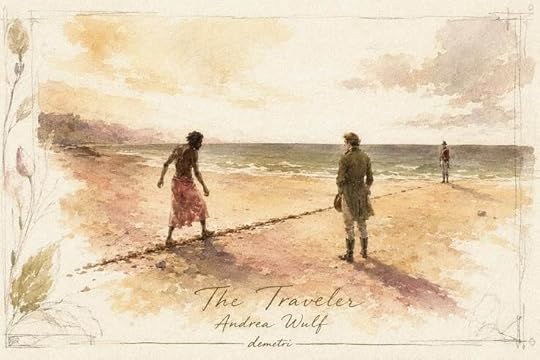
On Tanna’s shore, a faint boundary becomes the book’s central wound: the moment George Forster sees that empire can make a line look like order before it reveals itself as violence.
A man draws a line in the sand, and history calls it order. Another man crosses it, and history calls him a trespasser. On Tanna in 1774, in Andrea Wulf’s “The Traveler: One Man’s Quest for Humanity from the South Seas to Revolutionary Paris,” a European marine shoots an islander who refuses to obey a boundary imposed by strangers on his own beach. Captain Cook’s voyage has brought science, ambition, hunger, discipline, guns, maps, and the old imperial reflex of treating arrival as entitlement. George Forster, nineteen, assistant naturalist and draughtsman aboard the Resolution, sees something plainer and more damning. The line was never neutral. It was power pretending to be geography.
From that beach, the biography begins steering by a wound. Wulf could easily have written a polished retrieval from the margins of Cook’s voyage and Humboldt’s gratitude: Forster as Cook’s young naturalist, prodigy, writer, anti-racist observer, friend and influence of Alexander von Humboldt, unconventional husband, German revolutionary, and ghost who keeps slipping the shelf label. He was all of those things, and several more that make the index feel faintly out of breath. He lived as if history had given him one trunk, no stable address, and a deadline. But “The Traveler” quickens when it becomes sharper than recovery. It asks who may scratch a rule into another person’s shore, who must obey it, and who notices the price paid by the person under the rule.
Forster was born in 1754 near Gdansk, in a German-speaking patchwork of principalities, loyalties, and languages not yet pressed into a nation. His father, Reinhold Forster, was a learned, volatile Lutheran pastor who turned brilliance into household labor – a one-man university with weather issues. He educated George brilliantly and put him to work without mercy. At ten, George accompanied Reinhold across Russia to inspect German settlements along the Volga for Catherine the Great. He collected plants, pressed specimens, and saw salt lakes, steppes, Tatars, Cossacks, camels, starving settlers, corrupt officials, and the gears of despotism. It was a childhood expedition, which is to say a wonder and an injury in the same saddlebag.
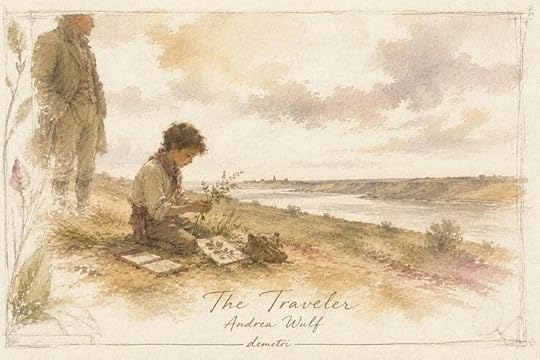
On the Volga, the young Forster’s first education in wonder is already shadowed by use, as specimens, distance, and Reinhold’s presence turn childhood curiosity into a burdened apprenticeship.
The saddlebag never emptied; it merely changed contents. George’s gifts were nurtured, then put to work. In England, still a boy, his languages and pen became family revenue: he translated other men’s voyages, served his father’s intellectual enterprise, and watched praise arrive under another man’s name. When Joseph Banks withdrew from Cook’s second voyage, Reinhold was appointed naturalist and brought George as assistant and draughtsman. At seventeen, George sailed into waters blank only to European paper.
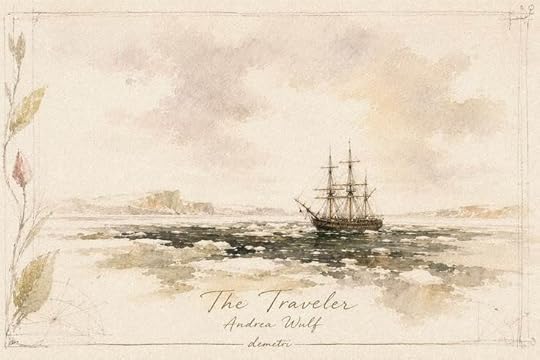
The Resolution appears small against ice, sea, and white silence, making exploration feel less like triumph than endurance: a wooden vessel carrying science, ambition, and human frailty into the glare.
The Resolution chapters offer the old shipboard ledger: Antarctic glare, sour provisions, cramped cabins, tropical abundance, strange birds, hunger, storms, quarrels, and the practical tyranny of keeping men alive in a wooden vessel at the edge of the known. Yet Wulf is not writing the captain’s story with the blood washed from the deck. Her South Pacific is green, fragrant, ceremonious, and already carrying the shadow of the gun. Across New Zealand / Aotearoa, Tahiti, Tonga, Easter Island / Rapa Nui, Tanna, and beyond, Forster watches not only landscapes and species but trades, warnings, punishments, gifts, stolen things, and fearful negotiations. He studies language, gesture, rank, hospitality, grief, music, barter, fear. He sees sailors and officers misunderstand property, sexuality, ritual, and authority, then discipline the people they have misunderstood for failing to behave like Europeans in costume.
The real division is between travel that takes inventory and travel that comes home with its assumptions dented. One collects, names, ranks, maps, claims, and calls the result knowledge. The other is forced to revise the categories it packed from home. Forster is trained in the first method but pulled toward the second. He classifies plants, records languages, observes customs, and sketches the natural world, yet looking becomes a rebuke to the map inside his own head. Difference does not confirm hierarchy. It enlarges the number of ways a person can be fully human.
Wulf is especially persuasive in showing that Forster’s humane imagination was made, not granted. No angel drops into the eighteenth century wearing better politics. He is formed by Reinhold’s control, poverty, translation labor, shipboard discipline, illness, debt, institutional dependence, marital anguish, and political exile. His belief in liberty has weight because he has known command from below. His sympathy for the man on Tanna is not ornamental kindness. He recognizes the violence of arbitrary rule because arbitrary rule is weather he had grown up breathing.
In these passages, Wulf is not merely rescuing Forster from obscurity; she is showing why obscurity found him convenient. She gives us Forster not as a plaster saint with sea legs, but as the spot where the century hurts when pressed. He exposes an age praising reason with one hand and ranking whole peoples with the other. Exploration promises knowledge while bringing disease, intimidation, and death. Science trains the eye but can harden into the neat violence of sorting. Revolution speaks of liberty while learning how quickly purity can acquire informers. Forster moves through all this, not cleanly outside the systems he opposes, but often startlingly awake inside them.
The voyage gets into his sentences. Returning to England in 1775, the Forsters are entangled in quarrels over the official account of Cook’s expedition. George writes “A Voyage Round the World” with astonishing speed, turning observation into travel literature and rebuke. He does not treat Indigenous peoples as curiosities arranged around European enterprise. He insists on their intelligence, complexity, and full human standing. Against the racial arrogance of his age, including claims made by men whose names still sit heavily in philosophy surveys, Forster argues from encounter. He has been there. He has listened, eaten, traded, guessed, erred, watched, and been changed. Hierarchies composed at a desk look rather foolish beside a beach, a body, a song, and a dead man.
Wulf’s own prose follows a similar discipline of looking. It is lucid, sensuous, fleet but grounded, and alert to the moment when beauty becomes evidence against innocence. She writes scenes before she writes arguments, allowing food, weather, ice, smoke, streets, blood, forests, manuscripts, bunks, and crowded rooms to think on the page. London smells of wealth and waste. The Antarctic cold enters the joints. Tahiti is fragrant but never allowed to remain Edenic. Mainz crackles with talk before politics becomes consequence. Paris, at the end, is less a city of ideals than a room getting smaller around a sick man.
Her rhythm is usually supple and accumulative, with short blows placed where the reader needs the cut. She knows how to let beauty gather and then ruin its composure. The effect is not decorative. In “The Traveler,” description refuses to let the other person blur. To render a person, place, or custom closely is to resist the lazy violence of category. Wulf’s best pages do what she admires in Forster: they look long enough for superiority to blush.
The four-part structure does more than count years; it tightens around him. Setting out: father, family, poverty, labor. Discoveries: ships, muskets, maps, first contact. Ambitions: jobs, debt, reputation, marriage, institutions too small for the mind they employ. Revolutions: Mainz, Paris, exile, terror, death, and reputation. The same command appears in different clothes. Father, captain, empire, marriage, republic: each asks who must obey and who gets to explain obedience afterward.
The middle does the unglamorous work. After the glamour and harm of the voyage, and before the revolutionary finale, Forster’s fame refuses to turn into security. In Kassel and Vilnius, he struggles with work, isolation, money, ambition, and the boredom of frozen institutions. His marriage to Therese Heyne is among the book’s sharpest private dramas, not for its scandal, but because the household becomes the smallest republic and the least governable. Forster’s views of women and marriage are unusually liberal; he wants intellectual companionship, emotional candor, and a marriage that does not simply absorb a woman into male possession. Yet ideals do not cancel need. Therese’s love for other men, Forster’s loneliness, and their attempts at unconventional arrangements expose the cost of living beyond convention without escaping desire, jealousy, or ordinary pain. Liberty, it turns out, does not clear the dishes.
Paris is where the book stops letting admiration travel alone. Forster’s commitment to freedom is not left safely in essays, letters, or shipboard reflections. In Mainz, he becomes a participant, not merely an observer: joining the Society of the Friends of Liberty and Equality, speaking, organizing, administering, and supporting the Mainz Republic, the first republic on German soil. He argues for union with France as protection against returning despotism. Then the door shuts. Mainz is besieged. Forster travels to Paris as part of a delegation and cannot return. The man who crossed oceans becomes trapped in a city where principle has learned to whisper names to the police. He is poor, ill, separated from Therese and his daughters, watching friends endangered, executions multiplying, and ideals acquiring an appetite for blood.
These final chapters prevent the portrait from flattening into admiration. Forster is courageous, and he is also frighteningly absolute. His conviction that one is either for freedom or tyranny gives his politics grandeur and peril. Wulf does not turn him into a fanatic without conscience, but she does show him defending revolution even as it horrifies him, insisting that the alternative – the return of despotism – would be worse. Here “The Traveler” becomes most tragic. The same imagination that allowed Forster to see dignity across oceans also binds him to a revolutionary dream that can no longer be kept clean. Freedom in a sentence is luminous. Freedom once installed in committees, armies, denunciations, hunger, fear, and prisons needs sterner housekeeping.
The praise occasionally over-lights its subject. Wulf’s warmth is often justified. Forster was brilliant, emotionally candid, cosmopolitan, anti-slavery, intellectually restless, unusually alert to women’s independence, and capable of seeing through many brutal complacencies of his age. But the biography sometimes sets too many lamps around him. Wulf tells us he was ahead of his time after the scene has already made the case. The repetition is not fatal, but it is audible: Forster as humane, Forster as unbound, Forster as later than his century. At moments one wants to tap the margin and write, gently, “Yes, Andrea, we have met him.”
Admiration is not the problem; embalming would be. A colder book would be less alive. The danger is that retrieval can become glare, and glare can flatten the face. Forster is most interesting not when he resembles an envoy from our preferred selves, but when he remains stranded inside his own century: carrying its categories even as he resists them, needing love while theorizing freedom, defending revolution while recoiling from its cruelties, escaping his father’s rule only to discover that history has sterner fathers waiting. Wulf knows this, and the late chapters prove it. Still, the biography is strongest when shadow is allowed to do its work.
The nearby books help, but mostly by showing how awkwardly Forster fits the shelf. Richard Holmes’s “The Age of Wonder” also joins science, travel, feeling, and historical transformation under skies bright with discovery and darkened by consequence. Hampton Sides’s “The Wide Wide Sea” may attract readers through Cook, the Pacific, and the reassessment of exploration, but Wulf’s book is less a captain’s story than a conscience’s itinerary. Maya Jasanoff’s “The Dawn Watch” is perhaps the sharper formal kin: one traveling writer used to read the pressures of a global age. Forster’s gaze, though, is more tender, more wounded, and more recklessly hopeful.
The book does not need to be dragged into the present; Tanna has never quite left it. Its questions rise from blood, maps, desks, ships, marriage beds, and paperwork: what exploration cost the people being explored; how universal reason coexisted with racial ranking; how borders pretend to be natural; how freedom can be endangered by the very purity invoked in its name. Wulf writes into a moment suspicious of old heroic narratives, but “The Traveler” needs no topical tether. The beach is enough. So is the ship. So is the instant when an abstraction meets an actual body and discovers, too late, that it has blood on it.
What readers may remember first is the Pacific: the ice before it, the green abundance after it, the songs, trade, fear, theft, ceremony, misunderstanding, and fatal composure of European arrival. They may remember Reinhold, too, the exhausting father whose brilliance was inseparable from damage. They will remember Forster’s youth: ten on the Volga, seventeen on the Resolution, famous in his twenties, dead at thirty-nine. Wulf makes the shortness of his life feel almost indecent. He had barely enough time to become all the things later memory would not know where to put.
The last border Forster crosses is reputation. After he dies in Paris in 1794 – sick, poor, exiled, longing for his daughters – he does not settle into a stable afterlife. He becomes problem, precursor, traitor, influence, embarrassment, inspiration. Humboldt remembers what he owes him. Others borrow, mourn, suppress, or misfile him. The epilogue matters because it shows that a life devoted to crossing boundaries may remain difficult to archive. History likes labels; Forster kept making the drawer stick.
“The Traveler” sometimes insists when it could trust, shines when it could shade, and asks one man to shoulder an alarming amount of the eighteenth century. Yet Forster mostly does not buckle. He stands where half the century collides: Cook and Humboldt, Enlightenment and Romanticism, science and sympathy, empire and anti-imperial witness, marriage and liberty, revolution and terror, Europe and the wider world it mistook for an assignment.
My final rating: 91/100, 5/5 stars.
What Wulf gives us, finally, is not a flawless hero but a way of looking. “The Traveler” understands that travel can be theft, vanity, appetite, ambition, escape, inquiry, and revelation, sometimes before breakfast. Its finest insight is that the world does not become larger merely because one crosses it. It becomes larger when one’s categories fail. On Tanna, a line is drawn in sand. A man is killed for crossing it. Another man sees, with horror and clarity, that the crime began before the shot. The line itself was already a wound.
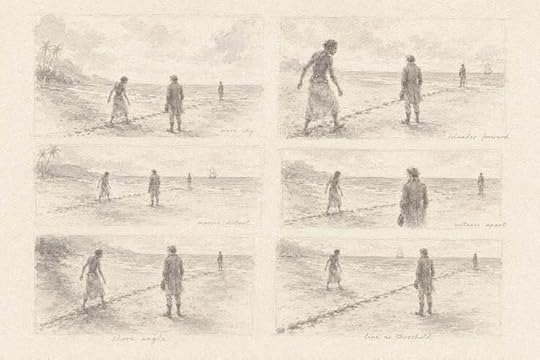
Early thumbnail studies test the shore, the figures, and the diagonal boundary, searching for the quietest arrangement in which the line can carry the whole moral weight of the image.
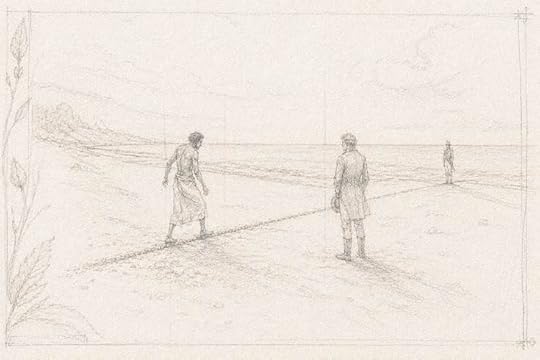
The first pencil structure leaves the scene nearly bare – shore, horizon, figures, and line – showing the visual argument before atmosphere, color, or historical weather arrives.
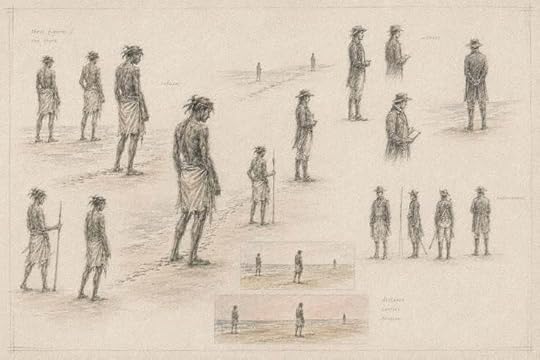
Gesture studies refine the three human positions of the scene: refusal at the threshold, witness at a distance, and enforcement held small enough to remain ominous rather than theatrical.
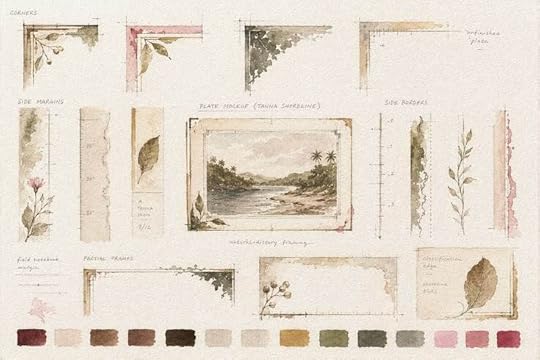
The border study treats the frame as part of the argument, borrowing from field notebooks and natural-history plates to suggest how observation, classification, and power all begin by drawing edges.
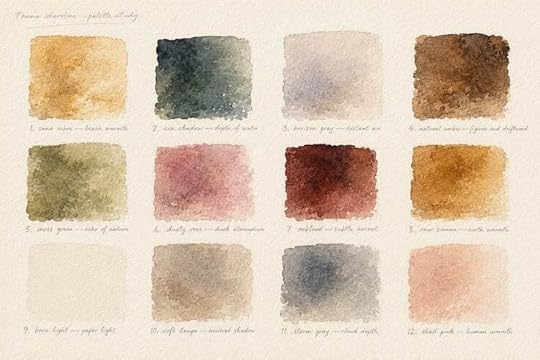
The cover-derived palette is tested in muted sand, olive, oxblood, bone, umber, and dusty rose, finding a color language sober enough for violence and delicate enough for witness.
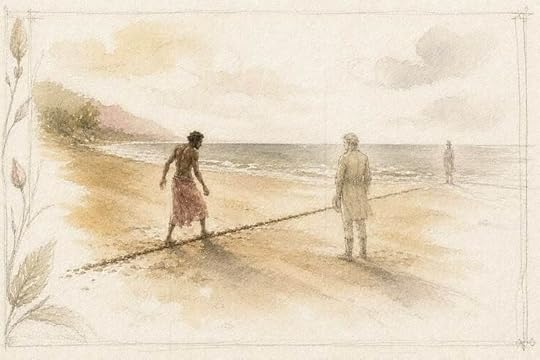
The first washes begin turning the graphite scaffold into weather and silence, letting the sand, sea, and sky gather around the still-visible line without fully closing the painting’s process.
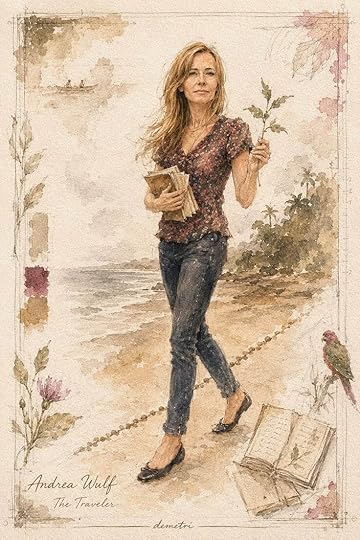
A literary watercolor portrait of Andrea Wulf for “The Traveler,” folding botanical study, shoreline, field notes, and the book’s cover palette into a respectful author image.
All watercolor illustrations by Demetris Papadimitropoulos.
Watercolors are done on 140lb vellum and then scanned into the computer using an Epson scanner. From there, they are finalized in Procreate. All art and opinions are my own.
Andrea Wulf’s “The Traveler” follows George Forster from Cook’s South Seas to revolutionary Paris, tracing how one young witness learned to see empire’s borders as wounds before history knew what to call them.
By Demetris Papadimitropoulos | June 8th, 2026
On Tanna’s shore, a faint boundary becomes the book’s central wound: the moment George Forster sees that empire can make a line look like order before it reveals itself as violence.
A man draws a line in the sand, and history calls it order. Another man crosses it, and history calls him a trespasser. On Tanna in 1774, in Andrea Wulf’s “The Traveler: One Man’s Quest for Humanity from the South Seas to Revolutionary Paris,” a European marine shoots an islander who refuses to obey a boundary imposed by strangers on his own beach. Captain Cook’s voyage has brought science, ambition, hunger, discipline, guns, maps, and the old imperial reflex of treating arrival as entitlement. George Forster, nineteen, assistant naturalist and draughtsman aboard the Resolution, sees something plainer and more damning. The line was never neutral. It was power pretending to be geography.
From that beach, the biography begins steering by a wound. Wulf could easily have written a polished retrieval from the margins of Cook’s voyage and Humboldt’s gratitude: Forster as Cook’s young naturalist, prodigy, writer, anti-racist observer, friend and influence of Alexander von Humboldt, unconventional husband, German revolutionary, and ghost who keeps slipping the shelf label. He was all of those things, and several more that make the index feel faintly out of breath. He lived as if history had given him one trunk, no stable address, and a deadline. But “The Traveler” quickens when it becomes sharper than recovery. It asks who may scratch a rule into another person’s shore, who must obey it, and who notices the price paid by the person under the rule.
Forster was born in 1754 near Gdansk, in a German-speaking patchwork of principalities, loyalties, and languages not yet pressed into a nation. His father, Reinhold Forster, was a learned, volatile Lutheran pastor who turned brilliance into household labor – a one-man university with weather issues. He educated George brilliantly and put him to work without mercy. At ten, George accompanied Reinhold across Russia to inspect German settlements along the Volga for Catherine the Great. He collected plants, pressed specimens, and saw salt lakes, steppes, Tatars, Cossacks, camels, starving settlers, corrupt officials, and the gears of despotism. It was a childhood expedition, which is to say a wonder and an injury in the same saddlebag.
On the Volga, the young Forster’s first education in wonder is already shadowed by use, as specimens, distance, and Reinhold’s presence turn childhood curiosity into a burdened apprenticeship.
The saddlebag never emptied; it merely changed contents. George’s gifts were nurtured, then put to work. In England, still a boy, his languages and pen became family revenue: he translated other men’s voyages, served his father’s intellectual enterprise, and watched praise arrive under another man’s name. When Joseph Banks withdrew from Cook’s second voyage, Reinhold was appointed naturalist and brought George as assistant and draughtsman. At seventeen, George sailed into waters blank only to European paper.
The Resolution appears small against ice, sea, and white silence, making exploration feel less like triumph than endurance: a wooden vessel carrying science, ambition, and human frailty into the glare.
The Resolution chapters offer the old shipboard ledger: Antarctic glare, sour provisions, cramped cabins, tropical abundance, strange birds, hunger, storms, quarrels, and the practical tyranny of keeping men alive in a wooden vessel at the edge of the known. Yet Wulf is not writing the captain’s story with the blood washed from the deck. Her South Pacific is green, fragrant, ceremonious, and already carrying the shadow of the gun. Across New Zealand / Aotearoa, Tahiti, Tonga, Easter Island / Rapa Nui, Tanna, and beyond, Forster watches not only landscapes and species but trades, warnings, punishments, gifts, stolen things, and fearful negotiations. He studies language, gesture, rank, hospitality, grief, music, barter, fear. He sees sailors and officers misunderstand property, sexuality, ritual, and authority, then discipline the people they have misunderstood for failing to behave like Europeans in costume.
The real division is between travel that takes inventory and travel that comes home with its assumptions dented. One collects, names, ranks, maps, claims, and calls the result knowledge. The other is forced to revise the categories it packed from home. Forster is trained in the first method but pulled toward the second. He classifies plants, records languages, observes customs, and sketches the natural world, yet looking becomes a rebuke to the map inside his own head. Difference does not confirm hierarchy. It enlarges the number of ways a person can be fully human.
Wulf is especially persuasive in showing that Forster’s humane imagination was made, not granted. No angel drops into the eighteenth century wearing better politics. He is formed by Reinhold’s control, poverty, translation labor, shipboard discipline, illness, debt, institutional dependence, marital anguish, and political exile. His belief in liberty has weight because he has known command from below. His sympathy for the man on Tanna is not ornamental kindness. He recognizes the violence of arbitrary rule because arbitrary rule is weather he had grown up breathing.
In these passages, Wulf is not merely rescuing Forster from obscurity; she is showing why obscurity found him convenient. She gives us Forster not as a plaster saint with sea legs, but as the spot where the century hurts when pressed. He exposes an age praising reason with one hand and ranking whole peoples with the other. Exploration promises knowledge while bringing disease, intimidation, and death. Science trains the eye but can harden into the neat violence of sorting. Revolution speaks of liberty while learning how quickly purity can acquire informers. Forster moves through all this, not cleanly outside the systems he opposes, but often startlingly awake inside them.
The voyage gets into his sentences. Returning to England in 1775, the Forsters are entangled in quarrels over the official account of Cook’s expedition. George writes “A Voyage Round the World” with astonishing speed, turning observation into travel literature and rebuke. He does not treat Indigenous peoples as curiosities arranged around European enterprise. He insists on their intelligence, complexity, and full human standing. Against the racial arrogance of his age, including claims made by men whose names still sit heavily in philosophy surveys, Forster argues from encounter. He has been there. He has listened, eaten, traded, guessed, erred, watched, and been changed. Hierarchies composed at a desk look rather foolish beside a beach, a body, a song, and a dead man.
Wulf’s own prose follows a similar discipline of looking. It is lucid, sensuous, fleet but grounded, and alert to the moment when beauty becomes evidence against innocence. She writes scenes before she writes arguments, allowing food, weather, ice, smoke, streets, blood, forests, manuscripts, bunks, and crowded rooms to think on the page. London smells of wealth and waste. The Antarctic cold enters the joints. Tahiti is fragrant but never allowed to remain Edenic. Mainz crackles with talk before politics becomes consequence. Paris, at the end, is less a city of ideals than a room getting smaller around a sick man.
Her rhythm is usually supple and accumulative, with short blows placed where the reader needs the cut. She knows how to let beauty gather and then ruin its composure. The effect is not decorative. In “The Traveler,” description refuses to let the other person blur. To render a person, place, or custom closely is to resist the lazy violence of category. Wulf’s best pages do what she admires in Forster: they look long enough for superiority to blush.
The four-part structure does more than count years; it tightens around him. Setting out: father, family, poverty, labor. Discoveries: ships, muskets, maps, first contact. Ambitions: jobs, debt, reputation, marriage, institutions too small for the mind they employ. Revolutions: Mainz, Paris, exile, terror, death, and reputation. The same command appears in different clothes. Father, captain, empire, marriage, republic: each asks who must obey and who gets to explain obedience afterward.
The middle does the unglamorous work. After the glamour and harm of the voyage, and before the revolutionary finale, Forster’s fame refuses to turn into security. In Kassel and Vilnius, he struggles with work, isolation, money, ambition, and the boredom of frozen institutions. His marriage to Therese Heyne is among the book’s sharpest private dramas, not for its scandal, but because the household becomes the smallest republic and the least governable. Forster’s views of women and marriage are unusually liberal; he wants intellectual companionship, emotional candor, and a marriage that does not simply absorb a woman into male possession. Yet ideals do not cancel need. Therese’s love for other men, Forster’s loneliness, and their attempts at unconventional arrangements expose the cost of living beyond convention without escaping desire, jealousy, or ordinary pain. Liberty, it turns out, does not clear the dishes.
Paris is where the book stops letting admiration travel alone. Forster’s commitment to freedom is not left safely in essays, letters, or shipboard reflections. In Mainz, he becomes a participant, not merely an observer: joining the Society of the Friends of Liberty and Equality, speaking, organizing, administering, and supporting the Mainz Republic, the first republic on German soil. He argues for union with France as protection against returning despotism. Then the door shuts. Mainz is besieged. Forster travels to Paris as part of a delegation and cannot return. The man who crossed oceans becomes trapped in a city where principle has learned to whisper names to the police. He is poor, ill, separated from Therese and his daughters, watching friends endangered, executions multiplying, and ideals acquiring an appetite for blood.
These final chapters prevent the portrait from flattening into admiration. Forster is courageous, and he is also frighteningly absolute. His conviction that one is either for freedom or tyranny gives his politics grandeur and peril. Wulf does not turn him into a fanatic without conscience, but she does show him defending revolution even as it horrifies him, insisting that the alternative – the return of despotism – would be worse. Here “The Traveler” becomes most tragic. The same imagination that allowed Forster to see dignity across oceans also binds him to a revolutionary dream that can no longer be kept clean. Freedom in a sentence is luminous. Freedom once installed in committees, armies, denunciations, hunger, fear, and prisons needs sterner housekeeping.
The praise occasionally over-lights its subject. Wulf’s warmth is often justified. Forster was brilliant, emotionally candid, cosmopolitan, anti-slavery, intellectually restless, unusually alert to women’s independence, and capable of seeing through many brutal complacencies of his age. But the biography sometimes sets too many lamps around him. Wulf tells us he was ahead of his time after the scene has already made the case. The repetition is not fatal, but it is audible: Forster as humane, Forster as unbound, Forster as later than his century. At moments one wants to tap the margin and write, gently, “Yes, Andrea, we have met him.”
Admiration is not the problem; embalming would be. A colder book would be less alive. The danger is that retrieval can become glare, and glare can flatten the face. Forster is most interesting not when he resembles an envoy from our preferred selves, but when he remains stranded inside his own century: carrying its categories even as he resists them, needing love while theorizing freedom, defending revolution while recoiling from its cruelties, escaping his father’s rule only to discover that history has sterner fathers waiting. Wulf knows this, and the late chapters prove it. Still, the biography is strongest when shadow is allowed to do its work.
The nearby books help, but mostly by showing how awkwardly Forster fits the shelf. Richard Holmes’s “The Age of Wonder” also joins science, travel, feeling, and historical transformation under skies bright with discovery and darkened by consequence. Hampton Sides’s “The Wide Wide Sea” may attract readers through Cook, the Pacific, and the reassessment of exploration, but Wulf’s book is less a captain’s story than a conscience’s itinerary. Maya Jasanoff’s “The Dawn Watch” is perhaps the sharper formal kin: one traveling writer used to read the pressures of a global age. Forster’s gaze, though, is more tender, more wounded, and more recklessly hopeful.
The book does not need to be dragged into the present; Tanna has never quite left it. Its questions rise from blood, maps, desks, ships, marriage beds, and paperwork: what exploration cost the people being explored; how universal reason coexisted with racial ranking; how borders pretend to be natural; how freedom can be endangered by the very purity invoked in its name. Wulf writes into a moment suspicious of old heroic narratives, but “The Traveler” needs no topical tether. The beach is enough. So is the ship. So is the instant when an abstraction meets an actual body and discovers, too late, that it has blood on it.
What readers may remember first is the Pacific: the ice before it, the green abundance after it, the songs, trade, fear, theft, ceremony, misunderstanding, and fatal composure of European arrival. They may remember Reinhold, too, the exhausting father whose brilliance was inseparable from damage. They will remember Forster’s youth: ten on the Volga, seventeen on the Resolution, famous in his twenties, dead at thirty-nine. Wulf makes the shortness of his life feel almost indecent. He had barely enough time to become all the things later memory would not know where to put.
The last border Forster crosses is reputation. After he dies in Paris in 1794 – sick, poor, exiled, longing for his daughters – he does not settle into a stable afterlife. He becomes problem, precursor, traitor, influence, embarrassment, inspiration. Humboldt remembers what he owes him. Others borrow, mourn, suppress, or misfile him. The epilogue matters because it shows that a life devoted to crossing boundaries may remain difficult to archive. History likes labels; Forster kept making the drawer stick.
“The Traveler” sometimes insists when it could trust, shines when it could shade, and asks one man to shoulder an alarming amount of the eighteenth century. Yet Forster mostly does not buckle. He stands where half the century collides: Cook and Humboldt, Enlightenment and Romanticism, science and sympathy, empire and anti-imperial witness, marriage and liberty, revolution and terror, Europe and the wider world it mistook for an assignment.
My final rating: 91/100, 5/5 stars.
What Wulf gives us, finally, is not a flawless hero but a way of looking. “The Traveler” understands that travel can be theft, vanity, appetite, ambition, escape, inquiry, and revelation, sometimes before breakfast. Its finest insight is that the world does not become larger merely because one crosses it. It becomes larger when one’s categories fail. On Tanna, a line is drawn in sand. A man is killed for crossing it. Another man sees, with horror and clarity, that the crime began before the shot. The line itself was already a wound.
Early thumbnail studies test the shore, the figures, and the diagonal boundary, searching for the quietest arrangement in which the line can carry the whole moral weight of the image.
The first pencil structure leaves the scene nearly bare – shore, horizon, figures, and line – showing the visual argument before atmosphere, color, or historical weather arrives.
Gesture studies refine the three human positions of the scene: refusal at the threshold, witness at a distance, and enforcement held small enough to remain ominous rather than theatrical.
The border study treats the frame as part of the argument, borrowing from field notebooks and natural-history plates to suggest how observation, classification, and power all begin by drawing edges.
The cover-derived palette is tested in muted sand, olive, oxblood, bone, umber, and dusty rose, finding a color language sober enough for violence and delicate enough for witness.
The first washes begin turning the graphite scaffold into weather and silence, letting the sand, sea, and sky gather around the still-visible line without fully closing the painting’s process.
A literary watercolor portrait of Andrea Wulf for “The Traveler,” folding botanical study, shoreline, field notes, and the book’s cover palette into a respectful author image.
All watercolor illustrations by Demetris Papadimitropoulos.
Watercolors are done on 140lb vellum and then scanned into the computer using an Epson scanner. From there, they are finalized in Procreate. All art and opinions are my own.
July 25, 2026
Opnieuw een meeslepend boek van Andrea Wulf, wat een gave heeft zij om uit een rijkdom aan bronnen en ervaringen een zo vanzelfsprekend verhaal over het leven en denken van deze Reiziger te creëren, die bijna 300 jaar geleden geboren werd. Warm aanbevolen!

Read
August 24, 2026George Forster was ten years old when he and his father, Johann Reinhold Forster, left their German-speaking hometown in northern Poland to survey, on behalf of the Russian government, Germans who had recently migrated to the Lower Volga. Johann soon came into conflict with a Russian governor, things turned violent, and father and son departed for England without pay. Despite his fractiousness, the elder Forster managed to land the job of natural historian on James Cook’s second circumnavigation of the globe in 1772. George, then 17, joined him as draughtsman. The expedition stopped at a host of Pacific Islands and made history by crossing the Antarctic Circle twice. Returning to England after three years, Johann once again fell out with his employers and was barred from publishing his account of the journey. George, free from such restrictions, hastily wrote A Voyage Round the World (1777), which strongly criticised both the contemporary stereotypes about Pacific Islanders as living in simple, unchanging societies and the various hypocrisies of European chauvinism, such as deploring cannibalism while condoning devastating wars of conquest. It became a bestseller and he was fêted across Europe. Forster then took up a series of academic jobs in Europe before landing in Mainz, near the French border, in 1788.
In these years Forster befriended some of the Enlightenment’s leading thinkers, including Johann Gottfried Herder, Georg Christoph Lichtenberg, and Alexander von Humboldt, and intervened in one of its most significant controversies, namely the purported nature of racial differences. First, he drew on his experiences abroad to challenge Immanuel Kant’s reductive division of humanity into five races. Kant, rattled, responded with an abstruse essay on teleology. Forster then turned his sights on Christoph Meiners, whose own eccentric racial theory had led him to vigorously support the transatlantic slave trade. Forster exposed Meiners’ double standards and uncritical use of unreliable sources. In both cases he made clear his opposition to slavery, dispossession, and other forms of exploitation.
Read the rest of the review at https://www.historytoday.com/archive/...
Morgan Golf-French is a postdoctoral researcher at the Turin Humanities Programme.
In these years Forster befriended some of the Enlightenment’s leading thinkers, including Johann Gottfried Herder, Georg Christoph Lichtenberg, and Alexander von Humboldt, and intervened in one of its most significant controversies, namely the purported nature of racial differences. First, he drew on his experiences abroad to challenge Immanuel Kant’s reductive division of humanity into five races. Kant, rattled, responded with an abstruse essay on teleology. Forster then turned his sights on Christoph Meiners, whose own eccentric racial theory had led him to vigorously support the transatlantic slave trade. Forster exposed Meiners’ double standards and uncritical use of unreliable sources. In both cases he made clear his opposition to slavery, dispossession, and other forms of exploitation.
Read the rest of the review at https://www.historytoday.com/archive/...
Morgan Golf-French is a postdoctoral researcher at the Turin Humanities Programme.

August 16, 2026
De reiziger van Andrea Wulf is een prachtig geschreven en meeslepende biografie over George Forster, een man die zijn tijd ver vooruit was en toch grotendeels in de vergetelheid is geraakt.
Op zijn zeventiende maakte Forster samen met kapitein James Cook een reis naar de uithoeken van de bekende wereld. Die ervaring zou zijn leven en denken blijvend beïnvloeden. Als wetenschapper, schrijver en denker ontwikkelde hij vernieuwende ideeën over vrijheid, gelijkheid en de mens. Zijn ontmoetingen met andere culturen brachten hem ertoe kritisch te kijken naar de vanzelfsprekendheden van zijn eigen tijd.
Wat mij vooral aanspreekt in dit boek, is dat Andrea Wulf niet alleen het avontuurlijke leven van Forster beschrijft, maar ook laat zien hoe bijzonder zijn ideeën waren. Hij was een vooruitstrevende denker die niet bang was om bestaande opvattingen ter discussie te stellen. Zijn betrokkenheid bij de Franse Revolutie maakte hem uiteindelijk zelfs omstreden en zorgde ervoor dat hij in Duitsland vogelvrij werd verklaard.
Ik vond De reiziger een mooi eerbetoon aan een bijzondere man die bijna vergeten is door de geschiedenis. Wulf weet zijn leven op een boeiende manier tot leven te brengen en neemt de lezer mee op zijn reizen, maar ook in zijn zoektocht naar kennis en naar een beter begrip van de mens.
Ik heb het boek met veel interesse en plezier gelezen. Het is niet alleen een verhaal over een uitzonderlijk leven en verre reizen, maar ook over ideeën die, verrassend genoeg, nog altijd actueel zijn. Voor mij is De reiziger daarmee een prachtige ode aan George Forster én aan de kracht van nieuwsgierigheid, wetenschap en vrij denken.
Op zijn zeventiende maakte Forster samen met kapitein James Cook een reis naar de uithoeken van de bekende wereld. Die ervaring zou zijn leven en denken blijvend beïnvloeden. Als wetenschapper, schrijver en denker ontwikkelde hij vernieuwende ideeën over vrijheid, gelijkheid en de mens. Zijn ontmoetingen met andere culturen brachten hem ertoe kritisch te kijken naar de vanzelfsprekendheden van zijn eigen tijd.
Wat mij vooral aanspreekt in dit boek, is dat Andrea Wulf niet alleen het avontuurlijke leven van Forster beschrijft, maar ook laat zien hoe bijzonder zijn ideeën waren. Hij was een vooruitstrevende denker die niet bang was om bestaande opvattingen ter discussie te stellen. Zijn betrokkenheid bij de Franse Revolutie maakte hem uiteindelijk zelfs omstreden en zorgde ervoor dat hij in Duitsland vogelvrij werd verklaard.
Ik vond De reiziger een mooi eerbetoon aan een bijzondere man die bijna vergeten is door de geschiedenis. Wulf weet zijn leven op een boeiende manier tot leven te brengen en neemt de lezer mee op zijn reizen, maar ook in zijn zoektocht naar kennis en naar een beter begrip van de mens.
Ik heb het boek met veel interesse en plezier gelezen. Het is niet alleen een verhaal over een uitzonderlijk leven en verre reizen, maar ook over ideeën die, verrassend genoeg, nog altijd actueel zijn. Voor mij is De reiziger daarmee een prachtige ode aan George Forster én aan de kracht van nieuwsgierigheid, wetenschap en vrij denken.

July 29, 2026
Andrea Wulf is a favorite author. Her subject in this book is George Forster. He travelled on The Resolution with Captain James Cook on Cook’s second voyage, and that experience made Forster famous. Forster was a gifted botanist, and an insightful ethnographer of the people of the South Pacific. After returning to Europe he wrote extensively about his travels and his theories. Forster met some of the great writers of his era, such as Goethe and Schiller. He was welcomed and celebrated in fashionable society in Prague and Vienna. He traveled across Europe with a young Alexander von Humboldt. For a while it was a life of adventure and acclaim.
Forster was also unlucky in love, enduring a marriage with a wife whom he adored but who did not return the sentiments. He was swept up in the fervor of the French Revolution, with disastrous consequences for his reputation, ultimately contributing to his untimely death. George Forster might just be the most famous man from late 18th century Europe whom you have never heard of.
Forster was also unlucky in love, enduring a marriage with a wife whom he adored but who did not return the sentiments. He was swept up in the fervor of the French Revolution, with disastrous consequences for his reputation, ultimately contributing to his untimely death. George Forster might just be the most famous man from late 18th century Europe whom you have never heard of.
September 5, 2026
A well-written life and times biography of George Forster. The author does an excellent job of giving insight into a very important, talented and complicated man. I particularly enjoyed her treatments of the later-half eighteen century world events. These were mostly notably the voyage of Cook's Resolution, which took a good portion of the book, and the French Revolution. Throughout his short life Forster's view and intellect were admirable and inspiring in spite of his physical and emotional trials. A recommended read for students of history and the human condition.

August 13, 2026
I’d like to introduce you to my new dead boyfriend, George Forster.
This man was everywhere with every Enlightenment thinker of note. He sailed with Captain James Cook, hung out with Ben Franklin, was good friends with Goethe, met Mary Wollstonecraft in Paris during the French Revolution… the list goes on!
Never heard of him? Neither had I. Apparently when you get involved in touchy political issues like the French Revolution, you get written out of history. But it’s such a shame because he not only inspired so many people, but he staunchly supported human rights for EVERYONE no matter your gender, your class, or your skin color! In the 1700’s!!! He sounds like an incredibly compassionate and passionate and intelligent individual and my friends and family are sick of hearing about him from me.
Please, please read this book. It’s beautifully and engagingly written and more people need to know about this dude!!! His life reads like an adventure novel and I legitimately do not understand how there aren’t a million novels and movies about him!!
This man was everywhere with every Enlightenment thinker of note. He sailed with Captain James Cook, hung out with Ben Franklin, was good friends with Goethe, met Mary Wollstonecraft in Paris during the French Revolution… the list goes on!
Never heard of him? Neither had I. Apparently when you get involved in touchy political issues like the French Revolution, you get written out of history. But it’s such a shame because he not only inspired so many people, but he staunchly supported human rights for EVERYONE no matter your gender, your class, or your skin color! In the 1700’s!!! He sounds like an incredibly compassionate and passionate and intelligent individual and my friends and family are sick of hearing about him from me.
Please, please read this book. It’s beautifully and engagingly written and more people need to know about this dude!!! His life reads like an adventure novel and I legitimately do not understand how there aren’t a million novels and movies about him!!

September 14, 2026
Weer een prachtig boek van Andrea Wulf. Niet zo geweldig als haar biografie van Alexander von Humboldt, maar wederom een prachtig tijdsbeeld. De jonge Georg Forster gaat als botanist mee op expeditie met kapitein Cook naar de Stille Zuidzee. Hij ontwikkelt zich onderweg als antropoloog, linguist, filosoof, feminist en anti-kolonialist avant la lettre. Zijn denken richt zich op vrijheid en a ls hij terugkomt stort hij zich in de Franse Revolutie. Vooral het onderwegdeel vond ik boeiend, terug in Europa met alle love-triangels wat minder, maar als geheel nog steeds 👌🏼

August 6, 2026
Heel mooi boek. Leest vlot weg al vind ik het tweede deel veel interessanter en afwisselender dan het eerste deel. Boeiende schets van een grotendeels vergeten wetenschapper die in de 18e eeuw op een zeer moderne manier de wereld verkende. Goed boek om een idee te krijgen wat de Verlichting (en de Romantiek) concreet behelsten.

July 29, 2026
I greatly enjoy History books about unknown or almost forgotten people and events. This is one of those books. I loved it. A memorable central character with an unusual and eventful life. The author takes the reader on a journey, alongside George Forster, born in 1754 in what is now Poland, as he encounters the world alongside his father, a learned man with a deep interest in the arts, science and scholarly exchange. His father had a great influence on his life, indeed he remained a presence throughout. But it is his experiences as a traveller that forms his persona, his attitude to his fellow man, his outlook on the world, perhaps his soul and ultimately his demise.
At the age of ten George accompanies his father on a 1600 mile trek in Russia, developing an interest in documenting and perhaps more importantly, understanding the flora, fauna and other elements of this new and strange environment he encounters. The author notes:
“Along the banks of the Volga, George saw the harsh reality of inequality and despotism – themes that would obsess him throughout his life…The seeds of the beliefs that shaped George Forster’s life were planted in Russia.”
By 1772, George, still only sixteen, was very much living in his father’s adult world. The pair had relocated to London, leaving George’s mother and siblings behind in Gdansk to fend for themselves, while they established their credentials in the British scientific world. George even at this young age, possessed skills and certain characteristics more refined and more in demand than those of his father. His reputation grew as he translated German and French books into English, many about travels and exploration of distant, strange new lands far from Europe. Frequenting the Royal Society and mixing in scientific circles, the pair came to the attention of the British Admiralty. Captain James Cook, following his successful first voyage on the Endeavour, was about to return to the South Pacific. One of the aims was resolving the question of a potential Southern Continent near the South Pole. Cook was in need of a Botanist as Joseph Banks, who accompanied Cook on his Endeavour voyage has pulled out at the last moment. Forster Senior was thus employed on Cook’s new ship, the Resolution, with the caveat than his son George was also taken along.
The author, as well as presenting the basic facts surrounding Cook’s voyage, also provides context of its significance in the wider world at that time. The French had recently lost lands in North America and were looking for influence, resources and wealth elsewhere. As were the Spanish, Dutch and Portuguese. The British were intent on limiting their competitors success and expanding their own influence far from Europe.
We learn much about this remarkable voyage as well as life onboard a cramped, uncomfortable ship, sailing in mostly uncharted waters. Forster Senior is portrayed as cantankerous, disliked and unpopular. His young son is the opposite; respected, liked and a valuable member of Cook’s team, documenting the exotic lands, peoples and wildlife encountered. George brought newer, deeper insights with his approach to science and ethnology. Learning new languages, observing and understanding cultures and communities. He records his experiences in detailed, descriptive often heartfelt words and also exhibits remarkable drawing skills. Skills that improved significantly during the two year voyage. In addition to this, George brought wit, endurance and patience to the voyage.
The account of Cooks exploration of the South Pacific, especially in the Polar region is fascinating. The Resolution, a relatively small, wooden sailing ship, heading south into the unknown, encountering a harsh, dangerous environment. Freezing temperatures, wind, rain and snow storms. Ice everywhere with massive icebergs threatening the ship and the men onboard. A physically uncomfortable and also dangerous time for everyone.
It is worth mentioning that the author, in researching this book, travelled to many of the places visited by the Resolution. The reader gets a visceral sense of these places, from both the authors observations and George’s written descriptions. The reader will almost feel the remoteness and isolation the crew must have experienced. And the cold, wet, icy life onboard the Resolution in the far South. Also the grander and wonder of mountains, rivers, coastlines, wildlife and vegetation, little changed today.
Cook’s leadership skills and respect from his crew is evident from the authors recounting of events. As for young George:
“Nothing rattled him. Unlike his father, he never complained, shouted or swore. To George Forster everything was new and exciting.”
Eventually the ship could go no further south and turned around to head towards New Zealand, a place Cook knew well from his Endeavour voyage. After four months at sea, New Zealand seemed like paradise after the harsh conditions encountered in southern latitudes. George Forster was thrilled and animated by all he saw and experienced, recording much in private journals as well as the many official drawing and descriptions he and his father were employed to provide. The author is thus able to recount both private and public thoughts and observations. The vegetation and wildlife was new and wonderful to George’s young European eyes. As were the peoples, cultures and communities they experienced.
Nevertheless, he was troubled by interactions with people encountered and certain events. Misunderstandings, dishonesty and violence between the crew and the native people were commonplace. The author notes:
“George Forster observed with both his mind and his heart, determined to ‘banish all rash hypotheses back into their small closet’. The emphasis he placed on feeling rather than reason and objectivity stood in contrast to many… who valued rational enquiry, repeatable experiments and empirical observation over emotions and subjectivity”.
After New Zealand the Resolution sailed to numerous isolated, largely unknown South Pacific islands. Although George and his father were employed as draughtsman and naturalist, he was a natural ethnographer, experiencing and observing all manner of activities he encountered in these new and wonderful places. Still only eighteen years old:
“…he was empathetic and perceptive…his ability to capture foreign cultures was unusual…”
In addition to objective descriptions, George’s prose captured much nuance plus elements of natural beauty and his own feeling about what he saw. But also an honesty as to the limitations of European understanding:
“…here and in many other circumstances relative to civil, political, and religious institutions, we are entirely at a loss”
George expresses a high opinion of himself, which may be valid, and perhaps expresses his self-confidence and belief in his ideas.
‘There is not a trace of intolerance in my nature..’ adding ‘neither attachment nor aversion to particular nations have influenced my praise or censure’.
It is a feature of this book that the author sometimes presents George, his words and activities without too much commentary thus allowing the reader to form their own views. The author acknowledges that George, like everyone, has faults. For example when the Resolution crew encounters cannibalism in New Zealand, George is non-judgemental, justifying the practice given the context, writing that Europeans had no right to judge something they didn’t understand. Sometime later in the voyage, cannibalism directly affects ten of George’s companions, the crew from an accompanying supply ship. One wonders if George remained quite so tolerant following this experience.
George had a modern, almost political view of some communities encountered. Non-democratic almost despotic forms of governance observed in Tonga were seen by George as:
‘… a robust hierarchical structure and a stronger central power than in the Society Islands….’
It is interesting that George encounters and indeed embraces a similar form of governance much later in his life. George’s descriptions of weapons, conflict and warfare between communities is certainly in contrast to the Rousseau’s popular myth at the time, of the “natural man“ with moral innocence, simple needs, untainted by the corrupting forces.
Further travels took George and the Resolution to Easter Island, Tahiti, back to New Zealand and again to the low southern latitudes. He was not impressed with the workmanship of the famous Easter Island statues. After nearly two years away, the Resolution heads for home.
Although there were times of adventure and excitement during the voyage, it is quite remarkable, is that amongst all the hardship, ill health, danger and cramped living conditions, George always seems to be conscientious with regard to his duties on board. Diligently writing, describing, collecting and drawing the landscapes, plants, birds and animals. As well as people and aspects of their cultures and communities. Always the first to volunteer for a task that would give him the opportunity to observe, explore and learn. His attitude and intelligence, alongside writing and draughting skills, greatly enhanced throughout the voyage would later bring him fame and status in Europe.
What follows in George’s life is perhaps the heart of the book. His experience on the Resolution and in the Pacific adds to his worldview and provides him with material for a successful book. Back in London, George writes for three years. About everything ! He did not shy away from his more contentious views, such as European attitudes towards native populations. This book was more than just scientific and geographic reporting. The author comments:
“Underlying everything was his focus on comparison and connection. …..The result was a book built around a deep love for nature and humankind. “
British and European society are impressed with his achievements. Banks, Linnaeus and Solander to name a few. The general public, at least the literate and educated, are enraptured by the experiences and adventures of this young man in distant, exotic lands. With the successful publication of ‘Voyage Around the World’ George achieves fame, celebrity, employment and most importantly, independence from his father. At the age of twenty-three he leaves Britain for a new life in Europe.
Europe offers quite a new and exciting world to George, now a famous writer and explorer. His life is certainly different, with professional and domestic complexities making it no less interesting than his Pacific adventures. Europe was a different place, in terms of society, stability and governance compared to Britain. A wife and children added to both his worries and his delight.
Throughout his time in Europe George kept diaries and journals, writing frequently to family, friends and colleagues. Despite the destruction of some documentation, the author has abundant material on this period of his life. A fascinating time and observed through the eyes of a young man who unlike many of his contemporaries had experienced life outside Europe and saw the world in a different way. A modern, almost progressive outlook, which would bring him both joy and unease.
Without giving any ‘spoilers’, George’s European life is eventful, at time exciting, privately fulfilling and frustrating. He moves beyond science into the humanities more broadly, including politics and revolution. He encounters many of the ‘great thinkers’ of the times. Goethe, Alexander von Humboldt and Schiller are impressed with this young man. George dies young, not quite forty. Unhappy and alone.
This is a remarkable book on several levels. A biography of someone almost forgotten, who was intelligent, talented and far ahead of his time with regard to his outlook on life and particularly his views on people and cultures outside Europe. His influence on his contemporaries in the world of science and writing seems to be significant, although not widely acknowledged. He lived a life of excitement and adventure as well as hardship and frustration. A complicated life. A memorable life, a story that will remain with the reader long after the book is finished.
I wish the author and publisher great success with this fine new book. The author has a busy time this year, travelling and attending book events and giving talks. I recommend attending one of these events if you are able. It is always a pleasure to see an author talk about a book, in this case she gives a sense of what attracted her to this story, what it means to her and perhaps more importantly, what it can mean more broadly in the world today, in a time of increasing division in society and intolerance of one form or another. We can learn from the past; understanding, acknowledging and appreciating the life of George Forster can help us look at the world in a different way.
At the age of ten George accompanies his father on a 1600 mile trek in Russia, developing an interest in documenting and perhaps more importantly, understanding the flora, fauna and other elements of this new and strange environment he encounters. The author notes:
“Along the banks of the Volga, George saw the harsh reality of inequality and despotism – themes that would obsess him throughout his life…The seeds of the beliefs that shaped George Forster’s life were planted in Russia.”
By 1772, George, still only sixteen, was very much living in his father’s adult world. The pair had relocated to London, leaving George’s mother and siblings behind in Gdansk to fend for themselves, while they established their credentials in the British scientific world. George even at this young age, possessed skills and certain characteristics more refined and more in demand than those of his father. His reputation grew as he translated German and French books into English, many about travels and exploration of distant, strange new lands far from Europe. Frequenting the Royal Society and mixing in scientific circles, the pair came to the attention of the British Admiralty. Captain James Cook, following his successful first voyage on the Endeavour, was about to return to the South Pacific. One of the aims was resolving the question of a potential Southern Continent near the South Pole. Cook was in need of a Botanist as Joseph Banks, who accompanied Cook on his Endeavour voyage has pulled out at the last moment. Forster Senior was thus employed on Cook’s new ship, the Resolution, with the caveat than his son George was also taken along.
The author, as well as presenting the basic facts surrounding Cook’s voyage, also provides context of its significance in the wider world at that time. The French had recently lost lands in North America and were looking for influence, resources and wealth elsewhere. As were the Spanish, Dutch and Portuguese. The British were intent on limiting their competitors success and expanding their own influence far from Europe.
We learn much about this remarkable voyage as well as life onboard a cramped, uncomfortable ship, sailing in mostly uncharted waters. Forster Senior is portrayed as cantankerous, disliked and unpopular. His young son is the opposite; respected, liked and a valuable member of Cook’s team, documenting the exotic lands, peoples and wildlife encountered. George brought newer, deeper insights with his approach to science and ethnology. Learning new languages, observing and understanding cultures and communities. He records his experiences in detailed, descriptive often heartfelt words and also exhibits remarkable drawing skills. Skills that improved significantly during the two year voyage. In addition to this, George brought wit, endurance and patience to the voyage.
The account of Cooks exploration of the South Pacific, especially in the Polar region is fascinating. The Resolution, a relatively small, wooden sailing ship, heading south into the unknown, encountering a harsh, dangerous environment. Freezing temperatures, wind, rain and snow storms. Ice everywhere with massive icebergs threatening the ship and the men onboard. A physically uncomfortable and also dangerous time for everyone.
It is worth mentioning that the author, in researching this book, travelled to many of the places visited by the Resolution. The reader gets a visceral sense of these places, from both the authors observations and George’s written descriptions. The reader will almost feel the remoteness and isolation the crew must have experienced. And the cold, wet, icy life onboard the Resolution in the far South. Also the grander and wonder of mountains, rivers, coastlines, wildlife and vegetation, little changed today.
Cook’s leadership skills and respect from his crew is evident from the authors recounting of events. As for young George:
“Nothing rattled him. Unlike his father, he never complained, shouted or swore. To George Forster everything was new and exciting.”
Eventually the ship could go no further south and turned around to head towards New Zealand, a place Cook knew well from his Endeavour voyage. After four months at sea, New Zealand seemed like paradise after the harsh conditions encountered in southern latitudes. George Forster was thrilled and animated by all he saw and experienced, recording much in private journals as well as the many official drawing and descriptions he and his father were employed to provide. The author is thus able to recount both private and public thoughts and observations. The vegetation and wildlife was new and wonderful to George’s young European eyes. As were the peoples, cultures and communities they experienced.
Nevertheless, he was troubled by interactions with people encountered and certain events. Misunderstandings, dishonesty and violence between the crew and the native people were commonplace. The author notes:
“George Forster observed with both his mind and his heart, determined to ‘banish all rash hypotheses back into their small closet’. The emphasis he placed on feeling rather than reason and objectivity stood in contrast to many… who valued rational enquiry, repeatable experiments and empirical observation over emotions and subjectivity”.
After New Zealand the Resolution sailed to numerous isolated, largely unknown South Pacific islands. Although George and his father were employed as draughtsman and naturalist, he was a natural ethnographer, experiencing and observing all manner of activities he encountered in these new and wonderful places. Still only eighteen years old:
“…he was empathetic and perceptive…his ability to capture foreign cultures was unusual…”
In addition to objective descriptions, George’s prose captured much nuance plus elements of natural beauty and his own feeling about what he saw. But also an honesty as to the limitations of European understanding:
“…here and in many other circumstances relative to civil, political, and religious institutions, we are entirely at a loss”
George expresses a high opinion of himself, which may be valid, and perhaps expresses his self-confidence and belief in his ideas.
‘There is not a trace of intolerance in my nature..’ adding ‘neither attachment nor aversion to particular nations have influenced my praise or censure’.
It is a feature of this book that the author sometimes presents George, his words and activities without too much commentary thus allowing the reader to form their own views. The author acknowledges that George, like everyone, has faults. For example when the Resolution crew encounters cannibalism in New Zealand, George is non-judgemental, justifying the practice given the context, writing that Europeans had no right to judge something they didn’t understand. Sometime later in the voyage, cannibalism directly affects ten of George’s companions, the crew from an accompanying supply ship. One wonders if George remained quite so tolerant following this experience.
George had a modern, almost political view of some communities encountered. Non-democratic almost despotic forms of governance observed in Tonga were seen by George as:
‘… a robust hierarchical structure and a stronger central power than in the Society Islands….’
It is interesting that George encounters and indeed embraces a similar form of governance much later in his life. George’s descriptions of weapons, conflict and warfare between communities is certainly in contrast to the Rousseau’s popular myth at the time, of the “natural man“ with moral innocence, simple needs, untainted by the corrupting forces.
Further travels took George and the Resolution to Easter Island, Tahiti, back to New Zealand and again to the low southern latitudes. He was not impressed with the workmanship of the famous Easter Island statues. After nearly two years away, the Resolution heads for home.
Although there were times of adventure and excitement during the voyage, it is quite remarkable, is that amongst all the hardship, ill health, danger and cramped living conditions, George always seems to be conscientious with regard to his duties on board. Diligently writing, describing, collecting and drawing the landscapes, plants, birds and animals. As well as people and aspects of their cultures and communities. Always the first to volunteer for a task that would give him the opportunity to observe, explore and learn. His attitude and intelligence, alongside writing and draughting skills, greatly enhanced throughout the voyage would later bring him fame and status in Europe.
What follows in George’s life is perhaps the heart of the book. His experience on the Resolution and in the Pacific adds to his worldview and provides him with material for a successful book. Back in London, George writes for three years. About everything ! He did not shy away from his more contentious views, such as European attitudes towards native populations. This book was more than just scientific and geographic reporting. The author comments:
“Underlying everything was his focus on comparison and connection. …..The result was a book built around a deep love for nature and humankind. “
British and European society are impressed with his achievements. Banks, Linnaeus and Solander to name a few. The general public, at least the literate and educated, are enraptured by the experiences and adventures of this young man in distant, exotic lands. With the successful publication of ‘Voyage Around the World’ George achieves fame, celebrity, employment and most importantly, independence from his father. At the age of twenty-three he leaves Britain for a new life in Europe.
Europe offers quite a new and exciting world to George, now a famous writer and explorer. His life is certainly different, with professional and domestic complexities making it no less interesting than his Pacific adventures. Europe was a different place, in terms of society, stability and governance compared to Britain. A wife and children added to both his worries and his delight.
Throughout his time in Europe George kept diaries and journals, writing frequently to family, friends and colleagues. Despite the destruction of some documentation, the author has abundant material on this period of his life. A fascinating time and observed through the eyes of a young man who unlike many of his contemporaries had experienced life outside Europe and saw the world in a different way. A modern, almost progressive outlook, which would bring him both joy and unease.
Without giving any ‘spoilers’, George’s European life is eventful, at time exciting, privately fulfilling and frustrating. He moves beyond science into the humanities more broadly, including politics and revolution. He encounters many of the ‘great thinkers’ of the times. Goethe, Alexander von Humboldt and Schiller are impressed with this young man. George dies young, not quite forty. Unhappy and alone.
This is a remarkable book on several levels. A biography of someone almost forgotten, who was intelligent, talented and far ahead of his time with regard to his outlook on life and particularly his views on people and cultures outside Europe. His influence on his contemporaries in the world of science and writing seems to be significant, although not widely acknowledged. He lived a life of excitement and adventure as well as hardship and frustration. A complicated life. A memorable life, a story that will remain with the reader long after the book is finished.
I wish the author and publisher great success with this fine new book. The author has a busy time this year, travelling and attending book events and giving talks. I recommend attending one of these events if you are able. It is always a pleasure to see an author talk about a book, in this case she gives a sense of what attracted her to this story, what it means to her and perhaps more importantly, what it can mean more broadly in the world today, in a time of increasing division in society and intolerance of one form or another. We can learn from the past; understanding, acknowledging and appreciating the life of George Forster can help us look at the world in a different way.

August 12, 2026
I read enough of this book (about half) to get a clear idea of George Forster, who was an 18th-century naturalist & also someone who had advanced views (for his time) about different populations & cultures.

August 9, 2026
This book was fantastic! It's so well-rounded and clearly, a lot of research went into it. I was impressed with the depth of information presented. Definitely recommend it to anyone looking for something substantial on George Forster.
July 12, 2026
Very long and detailed life of George Forster - an influential and famous person of his time that you never heard of. His life and accomplishments were fascinating, and his influence widespread, especially among botanists as well as philosophers of his day and beyond. Kant, Goethe, Johann Gottfried Herder, Alexander von Humboldt, etc]. The most fascinating part of his life to me was when he accompanied his father to the nether reaches of the Russian empire to report on the Germans who had moved there at the behest of Catherine the Great. [Needless to say, the honest report was gloomy and not well received in St. Petersburg). Perhaps due to my lack of knowledge of this time period, I was surprised to learn about the strong, independent, educated women in his circle, including his very unconventional wife who went on to not only write novels & articles, but became the first woman to run a newspaper in Germany.
Although I found the book very interesting, I found myself skimming paragraphs in some areas, as I felt it got a bit bogged down in details that became repetitive - the 3 year voyage with Captain Cook, which probably could have been a book on its own [indeed, Forster did write such a book] or shortened for purposes of this book; the times he awoke & went to bed to make sure he completed all of the works he was writing; his many dalliances, esp while in Vienna on his way to Vilnius.
Although I found the book very interesting, I found myself skimming paragraphs in some areas, as I felt it got a bit bogged down in details that became repetitive - the 3 year voyage with Captain Cook, which probably could have been a book on its own [indeed, Forster did write such a book] or shortened for purposes of this book; the times he awoke & went to bed to make sure he completed all of the works he was writing; his many dalliances, esp while in Vienna on his way to Vilnius.
August 3, 2026
A very interesting biography of one of the most important thinkers and writers of the last quarter of the 18th Century.
In a time when the common wisdom, including that of most philosopher's was a hierarchy of the races, George Forester argued with all that one race is no more advanced than any other but that all must be judged independently. This view came largely through his voyages to the North Pole and South Pacific when he was 14-17. His point of view came from experience and thought.
At the height of the enlightenment, he also bucked the rest of philosophy when he proposed that reality could not all be measured, but that human beings must value rational thought, and also feelings and imagination.
Forster also had a huge impact on artists and thinkers who came after him.
Perhaps he has been barely heard of because at his death, he lived in revolutionary France as an outspoken supporter of the revolution including making justification for it's indiscriminate bloodletting.
In a time when the common wisdom, including that of most philosopher's was a hierarchy of the races, George Forester argued with all that one race is no more advanced than any other but that all must be judged independently. This view came largely through his voyages to the North Pole and South Pacific when he was 14-17. His point of view came from experience and thought.
At the height of the enlightenment, he also bucked the rest of philosophy when he proposed that reality could not all be measured, but that human beings must value rational thought, and also feelings and imagination.
Forster also had a huge impact on artists and thinkers who came after him.
Perhaps he has been barely heard of because at his death, he lived in revolutionary France as an outspoken supporter of the revolution including making justification for it's indiscriminate bloodletting.
June 26, 2026
Andrea Wulf’s The Invention of Nature is one of my favorite non-fiction books, so I would have picked up her newest — The Traveler — anyway, but it was even more intriguing that her subject, George Forster, came to her attention while research the book on Humboldt. As expected, the book on Forster is vivid and compelling and an easy recommendation.
Forster (1754-1794) was a man of the Enlightenment in many ways: a naturalist, a linguist, explorer, ethnographer, political writer, essayist, translator, and toward the end of his short life a revolutionary. But Wulf sharpest interest in Forster is the ways in which he was a man not of his times, a man who abhorred slavery, argued adamantly against the rise of race-based thinking (and of course out and out racism), and believed fervently in “human rights” before the phrase became the common concept of today.
All of which is even more impressive given he barely had any formal education at all. Instead he was educated at home by his pastor father, a quarrelsome, indebted, antagonistic man with an interest in science and an urgent need to make his mark in the world. When his father was offered the position of naturalist aboard Cook’s second voyage in 1772, he took George with him on a voyage that lasted over three years sailing around the South Seas and within nearly 100 miles of Antarctica. It was, as one might assume, a transformative experience for the seventeen-year-old. Though we did see hints of his open mind in his response to the abject poverty he witnessed on another trip with his father (this one to Russia) and his keen observations and friendly interactions with the rough crew of Cook’s ship. .
Cook’s trip, however, is where we really start to see his views diverge from his fellow Europeans. When the islanders, for instance, offer their women (some young girls) to the sailors as barter, Forster wonders, “Who was worse . . . the Māori men who forced their women to have sex, or the Europeans who partook?” And as he witnesses more and more the impact of the Europeans on the islands, he writes that, “I fear that hitherto our intercourse has been wholly disadvantageous to the nations of the South Seas; and that those communities have been the least injured, who have always kept aloof from us.” This was certainly true in purely concrete fashion, Wulf informs us, as the Europeans brought syphilis and other diseases to the unprotected islanders, causing their population to shrink from 40, 000 to under ten thousand over the next six decades.
Time and again, Forster casts an empathetic and respectful eye on the islanders while his mission mates considered them barely human and many not even that. When the islander stole objects from the Europeans, as his shipmates raged and sought retribution, Forster, based on his cultural observations, considered that the islanders did not view property or ownership in the same way as the Europeans and so theft did not mean the same thing to them. Even when things turned violent, Forster often considered the Europeans the ones who provoked, commenting multiple times on how quick they were to use their guns, and how it was tough to fault the islanders for seeing the Europeans as possible invaders given their actions.
Nor did he, as Wulf shows us, idealize the islanders in Rousseau’s fashion of the “noble savage”. Forster saw how the islanders warred violently with each other and treated their women like “drudges,” and so always kept his descriptions tightly bound to his observations of their actual behavior rather than as some abstract symbol.
All of these views, his experiences, and his ecological and cultural observations were written up in the book he published afterward, A Voyage Round the World. The book was well received and the young man found himself the toast of the town and spoken of in far-off countries. Which was lucky, as the rest of his life had to be spent writing feverishly (his own work, translations, introductions) to keep up with his father’s debts and then, in addition as those never went away, his own, as he unfortunately picked up his father’s inability to manage money.
If most of the next decade was less exciting than the three years spent with Cook, it was no less successful in terms of the respect he garnered around the world from his writings and his arguments against racism and for human rights. A quick and extremely incomplete list of his visitors or those he visited or corresponded with gives a sense of the rarified circles he moved in: Benjamin Franklin, Goethe, Humboldt, Comte de Buffon, Joseph Banks, and others. He became a member of the Royal Society and even met the king. He took on various jobs around Europe and eventually got married. But even this traditional act was unconventional, as he loved his wife Theresa deeply but found his love unreturned, and then allowed her to take up with several successive lovers during their marriage, often with a good friend of his and even at times with the lover living in their house. It caused him no end of misery, but he could not abide the idea of separation from her and especially from his daughters. Wulf is no less meticulous in her research and conveyance of information here as she is with his expedition to the South Seas or his formal writing, thus giving us a full picture of a complicated human rather than an ideal “man of the Enlightenment.”
Excitement returned to Forster’s life with the French Revolution, which he eagerly supported, taking France’s side against his home nation (which he felt little allegiance to) and becoming vice-president of the Mainz Republic, Germany’s first such republic. Eventually, he found himself stranded in France, labeled a traitor at home and thus unable to return. While the bloody violence that followed the early days of the French Revolution complicated his feelings about the matter, he never lost sight of the ultimate goal of freedom and equality for all (literally “all”, not “all men” or “all whites”, etc.).
After his too-young death at 39, his reputation declined for various reasons Wulf details, leaving him all but forgotten since the end of the 18th Century. With her trademark attention to detail, impeccable research, vivid descriptions, frequent use of primary source material, and her ability to humanize Forster and bring him to life before our eyes in a compelling story, I can think of nobody better suited to reclaim him from the near-oblivion history had so long cast him into. Highly recommended.
Forster (1754-1794) was a man of the Enlightenment in many ways: a naturalist, a linguist, explorer, ethnographer, political writer, essayist, translator, and toward the end of his short life a revolutionary. But Wulf sharpest interest in Forster is the ways in which he was a man not of his times, a man who abhorred slavery, argued adamantly against the rise of race-based thinking (and of course out and out racism), and believed fervently in “human rights” before the phrase became the common concept of today.
All of which is even more impressive given he barely had any formal education at all. Instead he was educated at home by his pastor father, a quarrelsome, indebted, antagonistic man with an interest in science and an urgent need to make his mark in the world. When his father was offered the position of naturalist aboard Cook’s second voyage in 1772, he took George with him on a voyage that lasted over three years sailing around the South Seas and within nearly 100 miles of Antarctica. It was, as one might assume, a transformative experience for the seventeen-year-old. Though we did see hints of his open mind in his response to the abject poverty he witnessed on another trip with his father (this one to Russia) and his keen observations and friendly interactions with the rough crew of Cook’s ship. .
Cook’s trip, however, is where we really start to see his views diverge from his fellow Europeans. When the islanders, for instance, offer their women (some young girls) to the sailors as barter, Forster wonders, “Who was worse . . . the Māori men who forced their women to have sex, or the Europeans who partook?” And as he witnesses more and more the impact of the Europeans on the islands, he writes that, “I fear that hitherto our intercourse has been wholly disadvantageous to the nations of the South Seas; and that those communities have been the least injured, who have always kept aloof from us.” This was certainly true in purely concrete fashion, Wulf informs us, as the Europeans brought syphilis and other diseases to the unprotected islanders, causing their population to shrink from 40, 000 to under ten thousand over the next six decades.
Time and again, Forster casts an empathetic and respectful eye on the islanders while his mission mates considered them barely human and many not even that. When the islander stole objects from the Europeans, as his shipmates raged and sought retribution, Forster, based on his cultural observations, considered that the islanders did not view property or ownership in the same way as the Europeans and so theft did not mean the same thing to them. Even when things turned violent, Forster often considered the Europeans the ones who provoked, commenting multiple times on how quick they were to use their guns, and how it was tough to fault the islanders for seeing the Europeans as possible invaders given their actions.
Nor did he, as Wulf shows us, idealize the islanders in Rousseau’s fashion of the “noble savage”. Forster saw how the islanders warred violently with each other and treated their women like “drudges,” and so always kept his descriptions tightly bound to his observations of their actual behavior rather than as some abstract symbol.
All of these views, his experiences, and his ecological and cultural observations were written up in the book he published afterward, A Voyage Round the World. The book was well received and the young man found himself the toast of the town and spoken of in far-off countries. Which was lucky, as the rest of his life had to be spent writing feverishly (his own work, translations, introductions) to keep up with his father’s debts and then, in addition as those never went away, his own, as he unfortunately picked up his father’s inability to manage money.
If most of the next decade was less exciting than the three years spent with Cook, it was no less successful in terms of the respect he garnered around the world from his writings and his arguments against racism and for human rights. A quick and extremely incomplete list of his visitors or those he visited or corresponded with gives a sense of the rarified circles he moved in: Benjamin Franklin, Goethe, Humboldt, Comte de Buffon, Joseph Banks, and others. He became a member of the Royal Society and even met the king. He took on various jobs around Europe and eventually got married. But even this traditional act was unconventional, as he loved his wife Theresa deeply but found his love unreturned, and then allowed her to take up with several successive lovers during their marriage, often with a good friend of his and even at times with the lover living in their house. It caused him no end of misery, but he could not abide the idea of separation from her and especially from his daughters. Wulf is no less meticulous in her research and conveyance of information here as she is with his expedition to the South Seas or his formal writing, thus giving us a full picture of a complicated human rather than an ideal “man of the Enlightenment.”
Excitement returned to Forster’s life with the French Revolution, which he eagerly supported, taking France’s side against his home nation (which he felt little allegiance to) and becoming vice-president of the Mainz Republic, Germany’s first such republic. Eventually, he found himself stranded in France, labeled a traitor at home and thus unable to return. While the bloody violence that followed the early days of the French Revolution complicated his feelings about the matter, he never lost sight of the ultimate goal of freedom and equality for all (literally “all”, not “all men” or “all whites”, etc.).
After his too-young death at 39, his reputation declined for various reasons Wulf details, leaving him all but forgotten since the end of the 18th Century. With her trademark attention to detail, impeccable research, vivid descriptions, frequent use of primary source material, and her ability to humanize Forster and bring him to life before our eyes in a compelling story, I can think of nobody better suited to reclaim him from the near-oblivion history had so long cast him into. Highly recommended.
June 27, 2026
Not sure how this landed on my TBR. I gave it a try, but it just didn’t interest me.

Review of advance copy received from NetGalley
Rating: 4.75* of five
The Publisher Says: Step into the life and times of George Forster, the young naturalist and revolutionary who journeyed to the far reaches of the known world and whose radical ideas about humanity and freedom made waves in eighteenth-century Europe—from the bestselling author of The Invention of Nature and Magnificent Rebels.
From an early age, it was clear that George Forster possessed a brilliant mind. A polyglot and gifted scientist, he became an invaluable asset to the ambitions of his domineering father, Reinhold. As a young boy, he travelled with his father from the plains of West Prussia to the wild shores of the Volga to St. Petersburg and London on scientific endeavors, and soon became the breadwinner by publishing translations of hugely popular exploration accounts. When Reinhold Forster was offered the position of naturalist aboard Captain James Cook’s second voyage, he accepted on the condition that his seventeen-year-old son serve as his assistant.
The HMS Resolution set sail in 1772 with orders to find the hypothetical southern continent of Antarctica. On her voyage to the Antarctic Circle and the islands of the South Pacific—including New Zealand, Vanuatu, Tonga, Tahiti, and Easter Island—the Resolution carried the ambitions of the most powerful empire in the world. But George Forster brought an understanding that was centuries ahead of the attitudes of his day—his ideas belonged to the future. A remarkable observer, linguist, artist, and writer whose intelligence surpassed that of his own father, he studied the diverse cultures of the world without prejudice and sought to uncover our common humanity. He was a traveler in body and mind—not bound by place, people or establishment.
Recognized as one of Europe’s brightest minds on his return, Forster held positions across the continent and regaled the world not only with tales from his travels but also radical ideas about human nature. He would write against empire, white supremacy, and slavery. He would become a revolutionary and be declared an outlaw. He would never seek to control others as he had been controlled by his father, and even embraced a liberal idea of marriage, accepting his wife’s affairs and independence Andrea Wulf’s The Traveler recounts an extraordinary life largely forgotten by history, the tale of a man who broke with convention and was unafraid to critique the world around him in dedication to his belief in the human right to dignity, equality, and freedom.
I RECEIVED A DRC FROM THE PUBLISHER VIA NETGALLEY. THANK YOU.
My Review: A man as astonishing as Author Wulf's previous science-biography topic, Alexander von Humboldt (see here). Forster has been brought out of obscurity at a time when his delighted curiosity in the world is curdling die to the way we as a species ignored the warnings of imbalance von Humboldt was observing and reporting on. Forster is still known to us today because he wrote of his travels extensively. He was unusual for his attention to the contributions of women and his respect for the contributions of non-whites in many fields around the world. He died before he was fifty; it's a sadness to me personally that he and Alexander von Humboldt never traveled together. As Forster was two decades older than von Humboldt, I can only dream of what the synergy in these men's inclusive, broad views might have gifted us.
A man born in 1754 writing passionately about the flimsiness and dishonesty of white supremacy, and the idiocy of the idea of dominionism deserves a wide audience in the twenty-first century. If we're going to lionize dead white men, let's lionize George Forster the proponent of equality, the supporter of women's rights, the spreader of Enlightenment values. Here's a British man worthy of our respect and deserving of emulation.
Forster's travels broadened his mind and his spirit. He was a person who saw, as his private papers show, the connections among people in a time when colonialism and sexism were drawing ever thicker lines between us. I am saddened that his first-hand observations of the idiocy and evil that Othering (in today's terminology) colonized people was exacting never gained traction. I dream of a Forster who lived to lift up Mary Wollestonecraft, who worked effectively with Revolutionary Parisians to moderate the evils inherent in destroying systems to rebuild them fairly.
Author Wulf has, as is her wont, seen past History's battlefield fog to choose another target of worth and merit to remind us how long the world has been falling from Grace.
And how many before us saw it.
Honoring their legacies by taking action seems appropriate to me. I hope you'll read this dynamically written, thoroughly researched work on an unjustly underknown thinker, and feel inspired to do just that.
The Publisher Says: Step into the life and times of George Forster, the young naturalist and revolutionary who journeyed to the far reaches of the known world and whose radical ideas about humanity and freedom made waves in eighteenth-century Europe—from the bestselling author of The Invention of Nature and Magnificent Rebels.
From an early age, it was clear that George Forster possessed a brilliant mind. A polyglot and gifted scientist, he became an invaluable asset to the ambitions of his domineering father, Reinhold. As a young boy, he travelled with his father from the plains of West Prussia to the wild shores of the Volga to St. Petersburg and London on scientific endeavors, and soon became the breadwinner by publishing translations of hugely popular exploration accounts. When Reinhold Forster was offered the position of naturalist aboard Captain James Cook’s second voyage, he accepted on the condition that his seventeen-year-old son serve as his assistant.
The HMS Resolution set sail in 1772 with orders to find the hypothetical southern continent of Antarctica. On her voyage to the Antarctic Circle and the islands of the South Pacific—including New Zealand, Vanuatu, Tonga, Tahiti, and Easter Island—the Resolution carried the ambitions of the most powerful empire in the world. But George Forster brought an understanding that was centuries ahead of the attitudes of his day—his ideas belonged to the future. A remarkable observer, linguist, artist, and writer whose intelligence surpassed that of his own father, he studied the diverse cultures of the world without prejudice and sought to uncover our common humanity. He was a traveler in body and mind—not bound by place, people or establishment.
Recognized as one of Europe’s brightest minds on his return, Forster held positions across the continent and regaled the world not only with tales from his travels but also radical ideas about human nature. He would write against empire, white supremacy, and slavery. He would become a revolutionary and be declared an outlaw. He would never seek to control others as he had been controlled by his father, and even embraced a liberal idea of marriage, accepting his wife’s affairs and independence Andrea Wulf’s The Traveler recounts an extraordinary life largely forgotten by history, the tale of a man who broke with convention and was unafraid to critique the world around him in dedication to his belief in the human right to dignity, equality, and freedom.
I RECEIVED A DRC FROM THE PUBLISHER VIA NETGALLEY. THANK YOU.
My Review: A man as astonishing as Author Wulf's previous science-biography topic, Alexander von Humboldt (see here). Forster has been brought out of obscurity at a time when his delighted curiosity in the world is curdling die to the way we as a species ignored the warnings of imbalance von Humboldt was observing and reporting on. Forster is still known to us today because he wrote of his travels extensively. He was unusual for his attention to the contributions of women and his respect for the contributions of non-whites in many fields around the world. He died before he was fifty; it's a sadness to me personally that he and Alexander von Humboldt never traveled together. As Forster was two decades older than von Humboldt, I can only dream of what the synergy in these men's inclusive, broad views might have gifted us.
A man born in 1754 writing passionately about the flimsiness and dishonesty of white supremacy, and the idiocy of the idea of dominionism deserves a wide audience in the twenty-first century. If we're going to lionize dead white men, let's lionize George Forster the proponent of equality, the supporter of women's rights, the spreader of Enlightenment values. Here's a British man worthy of our respect and deserving of emulation.
Forster's travels broadened his mind and his spirit. He was a person who saw, as his private papers show, the connections among people in a time when colonialism and sexism were drawing ever thicker lines between us. I am saddened that his first-hand observations of the idiocy and evil that Othering (in today's terminology) colonized people was exacting never gained traction. I dream of a Forster who lived to lift up Mary Wollestonecraft, who worked effectively with Revolutionary Parisians to moderate the evils inherent in destroying systems to rebuild them fairly.
Author Wulf has, as is her wont, seen past History's battlefield fog to choose another target of worth and merit to remind us how long the world has been falling from Grace.
And how many before us saw it.
Honoring their legacies by taking action seems appropriate to me. I hope you'll read this dynamically written, thoroughly researched work on an unjustly underknown thinker, and feel inspired to do just that.

June 9, 2026
What a book! What a read. I loved every word, every illustration, every adventure and all the travels.
After Humboldt and the philosophers of Jena, star author Andrea Wulf now turns to George Foster (1754-1794). In the forty years of his life he travelled the world and witnessed various momentous events – which live on in our shared imagination of the past.
Forster was born on mainland Europe, but lived in London and England for some of his formative years. He travelled in Russia with his father as a young boy, before they joined James Cook on his second voyage, circumnavigating the world. Together the Forsters were the resident researchers on the ship the Resolution. With enough detail, but without getting tedious Wulf takes us along on this journey and into the mind of Forster. And what a mind that was! An open minded and critical thinker he was not hindered by the misconceptions and prejudices of his contemporaries. Almost always he has an enlightened remark or a sharp observation during the events that still capture the imagination in which he takes part.
After the years long journey the Forsters found a way to capitalize their adventures by publishing a bestselling account. What stands out in all his reports is the open mind of George, who always gave voice to the worlds of the people who were ‘discovered’ and gave an understanding of their point of view. When an inhabitant of Tanna is shot by one of Cooks crew, George Forster is outraged and sides not with the European perpetrator but with the victim. This makes Wulf’s portrayal of Forster very easy to like. She also uses Rousseau’s concept of the ‘noble savage’ and Forster’s critique of this as one of the red threads to keep the reader of her book focused. And this works very well. It is but one of the examples to highlight the literary skills of this author.
When his name was established as a natural philosopher, George Forster lived in Europe visiting various cities, courts and universities. He was present during some of the less and some of the more well known episodes of the revolutions that took place on the continent in the last decades of the 18th century.
Because Wulf has a great wealth of source material and has done extensive research, she finds a way to tell the story of her protagonist as if she is there. It makes for a mesmerizing book that I read within a couple of days. I found it really really hard to put down. It is a true successor to her Humboldt book that was rightly celebrated across the world.
I only wish it would have taken me a bit longer to read it, because it took me to a world so different from ours, yet so important to understand what is going on today. I absolutely loved this book and am considering reading it again, right now, just for fun.
After Humboldt and the philosophers of Jena, star author Andrea Wulf now turns to George Foster (1754-1794). In the forty years of his life he travelled the world and witnessed various momentous events – which live on in our shared imagination of the past.
Forster was born on mainland Europe, but lived in London and England for some of his formative years. He travelled in Russia with his father as a young boy, before they joined James Cook on his second voyage, circumnavigating the world. Together the Forsters were the resident researchers on the ship the Resolution. With enough detail, but without getting tedious Wulf takes us along on this journey and into the mind of Forster. And what a mind that was! An open minded and critical thinker he was not hindered by the misconceptions and prejudices of his contemporaries. Almost always he has an enlightened remark or a sharp observation during the events that still capture the imagination in which he takes part.
After the years long journey the Forsters found a way to capitalize their adventures by publishing a bestselling account. What stands out in all his reports is the open mind of George, who always gave voice to the worlds of the people who were ‘discovered’ and gave an understanding of their point of view. When an inhabitant of Tanna is shot by one of Cooks crew, George Forster is outraged and sides not with the European perpetrator but with the victim. This makes Wulf’s portrayal of Forster very easy to like. She also uses Rousseau’s concept of the ‘noble savage’ and Forster’s critique of this as one of the red threads to keep the reader of her book focused. And this works very well. It is but one of the examples to highlight the literary skills of this author.
When his name was established as a natural philosopher, George Forster lived in Europe visiting various cities, courts and universities. He was present during some of the less and some of the more well known episodes of the revolutions that took place on the continent in the last decades of the 18th century.
Because Wulf has a great wealth of source material and has done extensive research, she finds a way to tell the story of her protagonist as if she is there. It makes for a mesmerizing book that I read within a couple of days. I found it really really hard to put down. It is a true successor to her Humboldt book that was rightly celebrated across the world.
I only wish it would have taken me a bit longer to read it, because it took me to a world so different from ours, yet so important to understand what is going on today. I absolutely loved this book and am considering reading it again, right now, just for fun.

August 28, 2026
Andrea Wulf once again introduces us to a person most of us have no knowledge of, but should. A few years back I read, "The Invention of Nature," which was about the life and work of Alexander Von Humboldt. This book tells the story of the short life of George Forster, who -- like von Humboldt -- was a naturalist and explorer. In fact, von Humboldt considered Forster one of his mentors.
The name of this book could not be more apt. It's not just about a man who went places, that's a shallow definition of "traveler." Rather, it is about one who was philosophically a traveler -- i.e. one who shed biases and any pretense of superiority of his native culture over those with which he would come into contact so that his mind was ready to learn -- always. George Forster traveled on Captain Cook's second expedition, sailing through the Atlantic, across the Indian Ocean, all around Polynesia, and eventually back to England -- perilously almost getting down to Antarctica in the process. George was ostensibly on the ship as assistant and draftsman to his father, Reinhold. However, George impressed more than his father, particularly through his publications after the voyage. In fact, George's open-mindedness was all the more impressive because he got none of it from his father, who traveled about (like virtually all Westerners of that day) believing in the inherent inferiority of non-European peoples.
One reason why Forster is more obscure than his "mentee," von Humboldt (besides the fact that von Humboldt lived / worked about twice as long) is the path of Forster's life through the latter portion of the book. Forester's belief in equality wasn't limited to Pacific Islanders, he stayed true to the notion at home. He, therefore, was a supporter of the French Revolution (though he lost some taste for it in the wake of the guillotine-happy regimes that followed but still believed in the overarching goal of casting off the shackles of royalty.) Because of his support for Revolution, he was deemed a traitor by many European thinkers who had held him in the highest esteem when his support for equality was an academic abstraction (though many of them probably secretly thought him daft for believing that Tahitians [and, for that matter, women] were people, too.) At any rate, his renown plummeted, thus contributing to the fact that he's not a household name today.
In addition to the thrill of his maritime adventures and the peril of his Revolutionary politics, there is a fair amount of family drama throughout the book. Early on said drama centers on Reinhold, but later it is the wife that cuckolds him, Therese, who takes centerstage.
I found this book highly readable. It's not your run-of-the-mill biography of an 18th century naturalist. It's engaging and illuminating, and I'd highly recommend it for Travelers.
The name of this book could not be more apt. It's not just about a man who went places, that's a shallow definition of "traveler." Rather, it is about one who was philosophically a traveler -- i.e. one who shed biases and any pretense of superiority of his native culture over those with which he would come into contact so that his mind was ready to learn -- always. George Forster traveled on Captain Cook's second expedition, sailing through the Atlantic, across the Indian Ocean, all around Polynesia, and eventually back to England -- perilously almost getting down to Antarctica in the process. George was ostensibly on the ship as assistant and draftsman to his father, Reinhold. However, George impressed more than his father, particularly through his publications after the voyage. In fact, George's open-mindedness was all the more impressive because he got none of it from his father, who traveled about (like virtually all Westerners of that day) believing in the inherent inferiority of non-European peoples.
One reason why Forster is more obscure than his "mentee," von Humboldt (besides the fact that von Humboldt lived / worked about twice as long) is the path of Forster's life through the latter portion of the book. Forester's belief in equality wasn't limited to Pacific Islanders, he stayed true to the notion at home. He, therefore, was a supporter of the French Revolution (though he lost some taste for it in the wake of the guillotine-happy regimes that followed but still believed in the overarching goal of casting off the shackles of royalty.) Because of his support for Revolution, he was deemed a traitor by many European thinkers who had held him in the highest esteem when his support for equality was an academic abstraction (though many of them probably secretly thought him daft for believing that Tahitians [and, for that matter, women] were people, too.) At any rate, his renown plummeted, thus contributing to the fact that he's not a household name today.
In addition to the thrill of his maritime adventures and the peril of his Revolutionary politics, there is a fair amount of family drama throughout the book. Early on said drama centers on Reinhold, but later it is the wife that cuckolds him, Therese, who takes centerstage.
I found this book highly readable. It's not your run-of-the-mill biography of an 18th century naturalist. It's engaging and illuminating, and I'd highly recommend it for Travelers.

June 30, 2026
Some 250 years ago, George Forster began his search for our common humanity, urging that we–as a species—share the right to equality and freedom. from The Traveler by Andrea Wulf
I echo what others have written: I was enthralled and thrilled by The Traveler. Andrea Wulf resurrects a forgotten man who led a remarkable life and who early developed a respect for all peoples that was remarkable in his time.
George Forster was a teenager when he accompanied his naturalist father on Captain Cook’s second voyage. He was already a seasoned traveler and botanist, having accompanied his father on an expedition in Russia.
George was a detailed observer not only of flora and fauna with his sketches, but he also used his pen to describe the cultures and peoples encountered in the South Seas.
George emphasized that every culture had to be understood in its particular context. from The Traveler by Andrea Wulf
His attitude was open and nonjudgmental. He noted that Indigenous people had intelligence and skill that was different from Europeans, but just as sharp and critical. This attitude became foundational to all his life’s work and set him apart from the leading philosophers of the day.
After the three year voyage, George was a celebrity. He traveled and met leading thinkers and scientists of his time, including Benjamin Franklin. The depravations of the voyage had harmed his health, and his skin had been blemished by small pox, but he was feted everywhere. He wrote and served in various jobs across Europe, married for love a woman who could not be faithful, and in middle age was inspired by the ideals of the French Revolution which he hoped would bring in a new age of true liberty and equality.
His life was filled with success and trauma, making this a real page-turner. But it is his hopeful, open, mind and heart that impressed me most. Those who knew him best revered him as the best of men.
For me, George Forster’s most important legacy was his unshakable belief in humankind–this messy, uncontrollable and incomprehensible thing that is us. from The Traveler by Andrea Wulf
Thanks to Knopf for a free book through NetGalley.
I echo what others have written: I was enthralled and thrilled by The Traveler. Andrea Wulf resurrects a forgotten man who led a remarkable life and who early developed a respect for all peoples that was remarkable in his time.
George Forster was a teenager when he accompanied his naturalist father on Captain Cook’s second voyage. He was already a seasoned traveler and botanist, having accompanied his father on an expedition in Russia.
George was a detailed observer not only of flora and fauna with his sketches, but he also used his pen to describe the cultures and peoples encountered in the South Seas.
George emphasized that every culture had to be understood in its particular context. from The Traveler by Andrea Wulf
His attitude was open and nonjudgmental. He noted that Indigenous people had intelligence and skill that was different from Europeans, but just as sharp and critical. This attitude became foundational to all his life’s work and set him apart from the leading philosophers of the day.
After the three year voyage, George was a celebrity. He traveled and met leading thinkers and scientists of his time, including Benjamin Franklin. The depravations of the voyage had harmed his health, and his skin had been blemished by small pox, but he was feted everywhere. He wrote and served in various jobs across Europe, married for love a woman who could not be faithful, and in middle age was inspired by the ideals of the French Revolution which he hoped would bring in a new age of true liberty and equality.
His life was filled with success and trauma, making this a real page-turner. But it is his hopeful, open, mind and heart that impressed me most. Those who knew him best revered him as the best of men.
For me, George Forster’s most important legacy was his unshakable belief in humankind–this messy, uncontrollable and incomprehensible thing that is us. from The Traveler by Andrea Wulf
Thanks to Knopf for a free book through NetGalley.

August 26, 2026
George Forster, whose account of Cook’s second voyage of discovery to the Pacific Ocean inspired Samuel Taylor Coleridge’s great poem The Rime of the Ancient Mariner, was a polymath and linguist from the early age of 10 when his father Reinhard won a commission to study Catherine the Great’s early attempts to settle German farmers on the Volga basin and took his eldest son with him on this epic journey as his assistant.
Thus began a long and lasting for George of the natural world, pressing plants into his books and documenting their discoveries.
After continuing their wanderings to Great Britain and establishing the bonafides as naturalists, Forster père and son earned a new commission on Cook’s second voyage. This voyage took three years of enormous courage, deprivation, and ultimately discovery made both men quite famous fir the rest if their lives as their subsequent publication drew a wide readership.
George Forster’s unorthodox and prescient understanding of the Polynesian peoples presaged our current understanding of the migration of the early Indonesian peoples across the Pacific founding the Maori of New Zealand, the Tahitian, Tongan, and Hawaiian cultures among many others.
Forster was an outstanding writer, a gifted nature illustrator, and eventually a founding father of liberty and Romanticism in the Prussian landscape.
That he suffered so under a tyrannical father and unfaithful wife makes thus telling of his story all the more poignant and universal.
His passion for liberty, for the equality of peoples and the rights of humankind led him to abandon his later job as librarian to the ruler of Mainz, join the French Revolution and become one of its chief apologists before the reign of Napoleon Bonaparte.
He died poor and alone in Paris in 1793 at the age of 39 at the height of his fame and as an enigma to some of his closest associates even the great German writer Goethe.
I think if Andrea Wulf ever writes so sad a story again I’m going to cross the sea and hand her a spanking myself.
Thus began a long and lasting for George of the natural world, pressing plants into his books and documenting their discoveries.
After continuing their wanderings to Great Britain and establishing the bonafides as naturalists, Forster père and son earned a new commission on Cook’s second voyage. This voyage took three years of enormous courage, deprivation, and ultimately discovery made both men quite famous fir the rest if their lives as their subsequent publication drew a wide readership.
George Forster’s unorthodox and prescient understanding of the Polynesian peoples presaged our current understanding of the migration of the early Indonesian peoples across the Pacific founding the Maori of New Zealand, the Tahitian, Tongan, and Hawaiian cultures among many others.
Forster was an outstanding writer, a gifted nature illustrator, and eventually a founding father of liberty and Romanticism in the Prussian landscape.
That he suffered so under a tyrannical father and unfaithful wife makes thus telling of his story all the more poignant and universal.
His passion for liberty, for the equality of peoples and the rights of humankind led him to abandon his later job as librarian to the ruler of Mainz, join the French Revolution and become one of its chief apologists before the reign of Napoleon Bonaparte.
He died poor and alone in Paris in 1793 at the age of 39 at the height of his fame and as an enigma to some of his closest associates even the great German writer Goethe.
I think if Andrea Wulf ever writes so sad a story again I’m going to cross the sea and hand her a spanking myself.

August 31, 2026
The Traveler: One Man's Quest for Humanity From the South Seas to Revolutionary Paris. Andrea Wulf. Knopf, 2026. 512 pages.
I love discovering important people whose lives and accomplishments have been forgotten by history. George Foster is one of those men. Foster was one of the most celebrated and respected men in 18th century Europe, a naturalist who gave Europeans a spectacular new view of the world, and an active participant in a couple of the most monumental events in world history. A brilliant child, he began accompanying his father as a botanist on expeditions at age ten, and at age 12 he became the family's chief breadwinner by translating books and pamphlets from German to English and vice versa. At age 17, he became the junior naturalist on Captain Cook's second voyage voyage, spending the next several years on board the Resolution in search of the hypothetical continent of Antarctica, exploring the islands of the South Seas in the process. His published account of the expedition became a sensation, and his career took off. Besides his remarkably insightful descriptions of the flora, fauna, and cultures that he encountered, the remarkable thing about Foster was his condemnation of European imperialism, colonialism, and racism. Shockingly, he rejected the ideas of racial superiority growing into acceptance at the time and insisted that Europeans shouldn't impose their cultural standards on people of other cultures. He truly embodied the ideals of the Enlightenment philosophers, ideals like freedom and equality and the radical belief that humanity has more in common than not. He put these beliefs into practice, supporting the French Revolution and leading the push to introduce those ideals into Germany. As a result, he was branded a traitor, and German authorities, his former German friends and admirers, and his own widow, who never loved him, all worked to erase him from history. Here, Wulf has resurrected him and restored his place in history. It's an excellent biography.
I love discovering important people whose lives and accomplishments have been forgotten by history. George Foster is one of those men. Foster was one of the most celebrated and respected men in 18th century Europe, a naturalist who gave Europeans a spectacular new view of the world, and an active participant in a couple of the most monumental events in world history. A brilliant child, he began accompanying his father as a botanist on expeditions at age ten, and at age 12 he became the family's chief breadwinner by translating books and pamphlets from German to English and vice versa. At age 17, he became the junior naturalist on Captain Cook's second voyage voyage, spending the next several years on board the Resolution in search of the hypothetical continent of Antarctica, exploring the islands of the South Seas in the process. His published account of the expedition became a sensation, and his career took off. Besides his remarkably insightful descriptions of the flora, fauna, and cultures that he encountered, the remarkable thing about Foster was his condemnation of European imperialism, colonialism, and racism. Shockingly, he rejected the ideas of racial superiority growing into acceptance at the time and insisted that Europeans shouldn't impose their cultural standards on people of other cultures. He truly embodied the ideals of the Enlightenment philosophers, ideals like freedom and equality and the radical belief that humanity has more in common than not. He put these beliefs into practice, supporting the French Revolution and leading the push to introduce those ideals into Germany. As a result, he was branded a traitor, and German authorities, his former German friends and admirers, and his own widow, who never loved him, all worked to erase him from history. Here, Wulf has resurrected him and restored his place in history. It's an excellent biography.

July 15, 2026
4.5 stars for a beautifully narrated, well-researched and very interesting book. For me, not a full 5 stars as a lot the material was about Captain Cook's journeys that I had read about fairly recently in the equally good book, Wide Wide Sea. I did not realize so much material would be duplicated, although told from George Foster's POV in this book.
This was a fascinating look at a fascinating man, George Foster. As the eldest son, he was taken at a very young age by his father and put to work during many difficult journeys. His father was a very difficult man, and George was a captive to his mood swings and bad temper, effectively erasing any childhood he might have had. But in these far flung places, he learned so much about different cultures, the people, the plant life and species found there, drawing, cataloging, learning languages. And from these travels, George developed a strong determination that all men and women should be free and equal. These thoughts were very unusual in the 18th century and made him unique.
I was very interested in his experiences during the French Revolution and the description of that period in this book. Although he was Prussian by birth, he identified with the revolutionaries, to the detriment of his own reputation. This was a very deep dive into a most interesting 18th century individual.
This was a fascinating look at a fascinating man, George Foster. As the eldest son, he was taken at a very young age by his father and put to work during many difficult journeys. His father was a very difficult man, and George was a captive to his mood swings and bad temper, effectively erasing any childhood he might have had. But in these far flung places, he learned so much about different cultures, the people, the plant life and species found there, drawing, cataloging, learning languages. And from these travels, George developed a strong determination that all men and women should be free and equal. These thoughts were very unusual in the 18th century and made him unique.
I was very interested in his experiences during the French Revolution and the description of that period in this book. Although he was Prussian by birth, he identified with the revolutionaries, to the detriment of his own reputation. This was a very deep dive into a most interesting 18th century individual.
August 3, 2026
Wulf presents a biography of George Forster, an important forgotten naturalist from the 18th century. Forster was on Cook's second voyage around the world, and Wulf quotes freely from writings of Forster and those who knew him. That voyage and his writings about it made him a star. Notably against the flow of the times and most of the important thinkers, Forster felt all humans were the same, despite their cultural differences. He opposed ranking of humans from white Europeans to yellow Asians to black Africans to red Americans, which dominated the European view of he world.
Despite his enlightened view of humanity, Forster has been forgotten. There are many reasons. First, his views were strongly criticized when he was alive. Second, his father completely dominated him for twenty years and later often took credit for his son's work. Third, his marriage was a disaster that led to a live-in sexual partner for his wife. His wife outlived him by decades, burned Forster's letters to her, and controlled the narrative about him in her writings. Fourth, his support for the French revolution made him an outcast in his native Germany, and he was not looked upon kindly by England, where he grew up. Finally, Forster died at 39, leaving no students or disciples. Wulf does what she can to bring his views forward to the modern world.
Despite his enlightened view of humanity, Forster has been forgotten. There are many reasons. First, his views were strongly criticized when he was alive. Second, his father completely dominated him for twenty years and later often took credit for his son's work. Third, his marriage was a disaster that led to a live-in sexual partner for his wife. His wife outlived him by decades, burned Forster's letters to her, and controlled the narrative about him in her writings. Fourth, his support for the French revolution made him an outcast in his native Germany, and he was not looked upon kindly by England, where he grew up. Finally, Forster died at 39, leaving no students or disciples. Wulf does what she can to bring his views forward to the modern world.
September 7, 2026
This book, for me, was a follow-on to "The Wide, Wide Sea," by Hampton Sides. That book was about Cook's fateful third voyage, but the person in this book was along for Cook's second voyage. It was interesting to get George Forster's impressions of the people, plants and wildlife they met, mainly in Polynesia. Cook was one of the people observed, of course. George Forster was very young, but already spoke several languages, had a knack for learning more, and he was developing a real talent for drawing. He was very evolved in his viewpoints about indigenous people, in that prevailing opinions considered Europeans to be superior to any others. Forster had deep respect for the subjects of his observations, and rightly so. The rest of his life did not seem to hold a candle to his success on the voyage, but we also get a view into the French Revolution, and other historical events. All in all, the book (which relies heavily on Forster's own writings) gives a detailed view from a largely un-biased scientific observer.
September 19, 2026
This book was enthralling, a book I would read every night, delighted to learn more about George, his family, adventures, triumphs and challenges. One of my favorite moments in the books is when George, Captain Cook and crew finally arrive at the southern tip of New Zealand, after a harrowing time in the frigid Antarctic. The crew finds an inlet, surrounded by dense jungle, and as they get closer to shore, they discover a large tree that juts out almost horizontally into the water, forming a natural gangplank that they used to disembark. Retracing the steps of these 18th Century explorers, Andrea Wulf found that exact tree! This may give you some sense of the dedication and scholarship of this writer. I do want to see that tree one day. Thank you Andrea Wulf for dedicating yourself to exploring the fascinating life and times of George Forster. Now I need to read more of your books. Highly recommended.
July 14, 2026
Another exceptionally well crafted and extensively annotated biography from one of my favorite non-fiction writers, The Traveler gives the modern reader a timely deep dive into the life and ideas of George Forster, a man truly ahead of his era. Forster escaped the clutches of an overbearing father, and made his name by joining Cook's voyage on the Resolution. The rich descriptions of his travels in the South Pacific, including multiple visits to New Zealand, were a highlight of this book. Throughout his short life, Forster held fast to his core belief of equality, becoming out of step with the vast majority of his contemporaries by rejecting prevalent theories founded on European superiority. It would be hard to find a life that better exemplifies the value of travel with an open mind.
July 26, 2026
Weer een prachtig boek van deze schrijfster. De naam George Foster zei mij niets, maar nu wel als een zeer humaan mens in een tijd waarin dit niet vanzelfsprekend was. Hij reisde als jonge man mee met de ontdekkingsreiziger Cook naar, de Zuid-Zee eilanden en Antarctica. Daarna moest hij de kost verdienen met schrijven, lezingen geven etc. Dat was geen sinecure en vooral omdat zijn veeleisende vader steeds meer van hem verwachtte. Aan het eind van zijn leven komt hij in de Franse revolutie terecht. Vooral van belang zijn zijn ideeen, ver vooruitlopend op zijn tijd. Vooral wat betreft racisme, religie, gewoontes etc. Het is een bijzonder boek geworden, Wulf put uit veel bronnen, vooral Fosters vriendschap met Humboldt is interessant. Zijn ideeen over het huwlijk waren zijn tijd ver vooruit, maar dat heeft hem niet bepaald gelukkig gemaakt.
Displaying 1 - 30 of 69 reviews