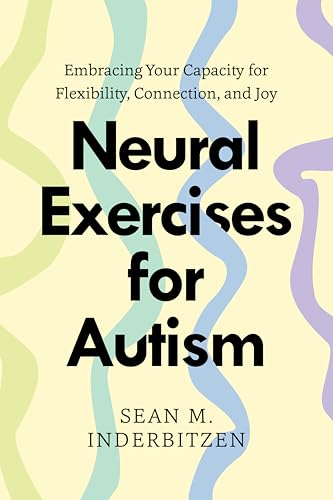
Note: I received a free copy from NetGalley to review. Thank you to the publisher and author for the copy.
I went into this hoping as a neuro-affirming therapist who also has autism that I would find some tools for my clients. Some of the exercises are indeed very helpful and ones that I use frequently (visualization, labeling feelings in unique personal language, recognizing which parts of our bodies are in fight or flight, focusing on being kinder to ourselves).
However, I disagree with the author on how autism is framed. Several times it is stated that we lack empathy and many of the exercises are about reflecting on our lack of empathy, and while this may be true of some people, it is not my experience nor most of the clients I work with. The problem with empathy is that it is often boiled down to “lacking empathy” when it’s really simply not understanding the situation or unexplained nonverbal cues, and I don’t think it would be explained in reverse as allistics “lacking empathy” because they don’t understand neurodivergent cues. It is a barrier of communication problem, and an assumption of character flaw problem, not an empathy problem. The same characteristics described as flaws or failures in someone with autism are very often described as neutral or something we just have to accept in neurotypicals. As a Level 2 (I still strongly dislike leveling but use this only to demonstrate that my diagnostic criteria were assessed at a significant deficit level), when I trace back the majority of my suffering from “autism,” the most significant parts are not autism itself but in how I was treated, forced to be inauthentic, and made to believe something was wrong with me. Yes, I have sensory issues and circular thinking and cognitive rigidity and executive functioning challenges, but almost all of those could have been accommodated in a way that didn’t label those things as bad or something to be avoided or covered up. And my relationships with my loved ones (most of whom are also autistic or heavily neurodivergent) often revolve around making mutual effort to meet each other’s differences and embrace them.
I feel like a lot of the language in this book frames autism as negative, with phrases like “being autistic means you come to the table with a nervous system locked in a state of threat” and a whole section about “less disadvantageous” forms of autism and identity definitions ignoring disabling autism. I also don’t feel this is inherently true, I feel like people with autism often learn to be in a state of threat due to mistreatment by others and being forced to mask constantly to survive. How much of the suffering and disconnection is a result of trauma and how much could be alleviated through acceptance the same way allistics are accepted as “the right way to be?” Autism is still framed in the medical field as a developmental disorder rather than a neurological difference. Instead of it being viewed simply as a brain that works differently, it is viewed as a brain that works incorrectly.
I think the author and I might disagree on the premise of where autistic connection problems are rooted. I feel very strongly that it is the social burden of being forced to make excessive effort to conform to neurotypical social norms while the same effort is not made in return. That autism itself is not inherently bad and that the deficit language that surrounds diagnostics and treatment that are almost always focused on “fixing” or “assimilating” someone into neurotypical behavior is the larger part of what makes autism disabling. While internal characteristics of autism like sensory processing and integration differences and literal thinking might lead to feelings of anxiety or disconnection, the true path forward is not trying to become more neurotypical but embracing your authentic self and finding people who want to be authentic with you. The origin of the exercises in this book are not inherently about fixing yourself, but connecting with and understanding yourself.
Not all the language in this book is negative, so I don’t want this to be interpreted the wrong way. I just think a lot of the earlier emphasis on failures and harms rather than labeling them what they mostly are (mutual misunderstandings between two people with differently “shaped” brains) puts a lot of the onus and blame on the person with autism in social situations to be doing all the heavy lifting, and that is a concept I am trying to move away from.
I think trying out some of the exercises and taking the rest of the narrative with a grain of salt would be the best way to read this book, but I also think other polyvagal exercise books can be applied more neutrally to clients with autism so that does disappoint me.
In Neural Exercises for Autism, autistic psychotherapist Sean M. Inderbitzen makes a case for understanding autism as largely a by-product of a disregulated nervous system, in contrast to more standard identity-based or disorder-based interpretations. His Polyvagal Theory of autism posits that some autistic people end up stuck in "chronic expressions of defense" due to their nervous system disregulation, and this contributes to their negative experiences of autism. Following from this, he argues that many symptoms of autism can then be explained as behaviour and emotion, rather than an immutable disorder or a part of our identity, and by regulating ourselves out of the sympathetic (fight or flight) and dorsal (shutdown) states and into ventral vagal state we will give ourselves more capacity to be flexible and build connections with others. Having made this case, Inderbitzen then goes on to present a range of scenarios relating to common autistic challenges in interpersonal relationships, suggests how nervous system disregulation might be impacting those situations, and presents neural exercises to help ease that disregulation. It is an interesting perspective, and makes sense to explain at least some of the autistic experience. I didn't find many of his scenarios personally relatable and I had different interpretations of what was happening in some of them than was presented, but I can understand his point of view. My main concern with this book is that it could be very easily misinterpreted. The carefully presented argument he makes could be easily misrepresented as another "cure" for autism, or be taken beyond the scope of what is actually presented and twisted to say that the entirety of autism is due to this nervous system disregulation, which could in turn lead to autistic folks being blamed for their challenges and for not trying hard enough to fix themselves. It is a fine line to walk. This risk increases when his arguments are inevitably summarised for synopses or reviews or clickbait, or when encountered by readers who are not familiar with interpreting psychological theories (though efforts are made to explain in layman's terms). My other concern is about how effective some of these exercises will be without support. Some of these exercises can be easily done without guidance, but others will definitely benefit from a coaching presence. Inderbitzen does acknowledge this - he says that while ideally all who need it would be able to work with a knowledgeable therapist, the reality is many people cannot access therapy services, let alone from clinicians experienced working with neurodiverse communities. A final personal barrier to me for some exercises is aphantasia, which is a problem for any activity that requires visualisatio, as so many mindfulness activities do. All in all, this is an interesting read, and I do believe nervous system regulation is beneficial to all folks, regardless of how much it actually assists symptoms of autism. Thank you to NetGalley for the eARC.
I received a free copy from the publisher through Netgalley and voluntarily reviewed it.
I DNF'd this one at 24%
This book just wasn't working for me. I had expected a very practical book with exercises, instead at 24% in there had not been any exercises and instead there was a lot of theoretical stuff that I didn't resonate with it. The way the author approaches autism just doesn't align with how I view it and the way the author talked about identity first language didn't sit well with me.
The author seemed to imply those who identify as autistic aren't wanting to change and while I think that isn't true and definitely not how everyone acts, I also think that we don't necessary have to change and if someone doesn't want to change that's totally fine. To address the point about those who identify first language not being open to change doesn’t feel true to me as I read plenty of books and listened to podcasts by autistic people and a lot of those are open for change and improving their lives and making things easier for themselves and those around them. While I am totally fine with people having a different perspective than me, the way this book was written just didn't work for me.
Anyway after getting into 24% of this book I just realized this wasn’t written for me. I was trying to read on until I got to some of the exercises as that was what I was interested in, but I just wasn’t enjoying reading it and it wasn't interesting to read, so I decided to DNF it instead.
This is an ARC review. I am so grateful to the author for diving into such an important topic. I appreciate that this attempt was made and I think we need a lot more information on the topic. From the point of view of a teacher and parent, I need more. More practical exercises and multiple options for different age groups in each. Every teacher and parent is looking for more practical exercises as well to guide those kids. Some exercises were to difficult, others simplistic.
Furthermore, there were topics that I have experienced differently, the topic of empathy for example. I cannot agree with the assessment. It is a statement that does not ring true that autistic people have no empathy. I would argue the opposite from my own experience. Also, it is a spectrum and maybe some statements made are closer to the author's personal experience but should not be blanket statements. I found the tone of the book uneven from personal story to research paper and think it would be easier to focus on the more practical aspect maybe, or one at a time. I think the title suggests something that we don't exactly get, at least how I imagined it. I appreciate the intention and since there's still not a lot out there, I was moved st times. But I don't think we need the judgement and the theories which have annoyed some readers and could have used more practical exercises as suggested by the title.
I felt both understood and enraged reading this book. As an autistic adult, I thought I would resonate with just about everything, but I was surprised to find out that it was not the case. While there were some really good parts that caused me to stop and think, there were also parts that made me feel irritated and I found myself wanting to reach through the pages to tell the author that he was way off base with his assumptions! The exercises themselves seemed to be explained well, and the purpose of each exercise was explained clearly. I cannot tell yet if any will help me in the long term simply because it hasn't been long enough for me to try all of them. But I will say, if you are interested in this book, read it with the knowledge that not every part is for every person. Overall I am glad I read it, but I wouldn't put it in my list of top books about the autistic experience.
I expected a book of exercises for coping with neurodiversity in a neurotypical world. Rather, the author mostly talked about theory (fine) and frequently reiterated how autistic people don't want to change or be flexible (not true, we are very dynamic, complex people). When I did get to the portion with “exercises”, the author spoke to us like we’re emotionally inept robots (hmmm perpetuating autism stereotypes??). I fear this was written for the perspective of autistic boy children rather than the target audeince of grown autistic adults AND it fails to consider autism in girls and women as most scientific literature and medicine so often does. Thoroughly pissed me off.
One star for the research, minus four stars for everything else.
A fantastic, deeply practical book by Autistic therapist and researcher Dr. Sean Inderbitzen. Neural Exercises for Autism brings together research, nervous-system science, and concrete exercises in a way that feels both accessible and genuinely useful. This is already becoming a useful resource for autistic clients (I am a clinician too), for other clinicians, and/or anyone wanting a useful understanding of how to effectively support Autistic people.