A death in the (dysfunctional) family – can they hold it together long enough to organise the funeral?
'Sexy, terrifying, keen and startling' DAISY JOHNSON 'At once shrewd and ethereal' CHRIS KRAUS 'A rare, funny novel' NICOLA DINAN
When Mary dies, Patch can barely keep track of her mother’s journey from the hospital to the mortuary, let alone host a wake in her childhood home.
Mary's ex Robin wants to support his daughter but, but instead of acting like a responsible father, he heads to his former the lay-by where he used to meet farmers for sex.
Jude is en route. She hasn't spoken to her cousin Patch in almost a year, and would rather stay in Naples, but she's hoping that her attendance will mean that past behaviour is forgiven.
Thrown together in Mary’s tiny house, each of them is trying to feel to grieve, atone, join in, be better. But they rarely have one another’s best interests at heart, and as the connections between them twist and contort, they lose sight of the rules and grasp towards anything that might make it all less painful.
'Sexy and intelligent' MERVE EMRE
'Immensely fun' LIZZY STEWART
'I can't remember the last time I read something so bold, tender, sexy and funny' CAMILLA GRUDOVA
'Crellin explores the boundless complications of sexuality, desire and love' RACHEL CONNOLLY
Mostly plotless character-driven story who are all unlikeable and highly sexual. Pseudo/real (wouldn't quite figure it out) incest that was pretty uncomfortable to read that I ended up skipping most of it.
The story didn't really seem to go anywhere and the actual funeral plot didn't kick in until nearer the end.
Overall, it was fast to read because of the plotlessness and skimming. It doesn't have speech marks which some readers might find jarring.
If you enjoy family dramas, complicated relationships, and queer themes, this book is definitely for you. I really loved the writing style, the way the story was told, and the overall theme.
I shared my full review on my Instagram. Check out my page for more.
Physical ARC received. Many thanks to the publisher and the author for kindly sending me this physical copy in exchange for an honest review.
I hate when I'm reading a book and I can tell that it's written to be reactionary. I'd even have persevered and finished it but the borderline incestuous relationship between Jude and Patch was enough for me to say goodbye
To say this is a dysfunctional family is putting it mildly and despite all the characters being rather unlikeable with highly questionable take's on reality I really enjoyed the ride. There's little plot as it's set over the days before and day of Mary's funeral but we follow Robin, Jude, Patch and have a few POV flashbacks from Mary as they prepare and ruminate on their current life's circumstances and relationships to one another. The writing was unsettling and kinda gross at times but that all added to atmosphere of this unhinged little family. The dialogue was my favourite, it was chaotic and blunt and very amusing. Strong themes of sexuality, gender identity, dysfunctional family dynamics, mental health and grief.
Thank you NetGalley and Random House UK Vintage for allowing me to read the ARC for an honest review.
This wasn't the book for me. It had moments I enjoyed but on the whole it was just a big book of wtaf.
The writing was good in places but I hated the dialogue. The humour was good but in some places it felt like when a comedian waits for a laugh and there's just crickets. The content was good but it also felt like it was trying to be shocking just for the sake of it. Basically: hell of a lot of potential and very little follow through.
Not to keep banging on about the dialogue but oh my god. If you're going to not put speech marks (totally fine), you need a dialogue tag or something occasionally, because without a 'he said' 'she said' situation, I HAVE NO IDEA WHO IS SPEAKING. Two pages of back and forth with random interspersed thoughts that you can't siphon from the actual speech is so frustrating anyway, but it's worse when you don't know who is speaking and there's 4 people in the room. Maybe that's the point, but I stand by that you can write a good book without speech marks if you do it properly and this just wasn't it. Also, it was just weird. People don't ever speak like that, I swear. Rant over.
I can absolutely see why so many people have DNF'd it though because that bit grossed me out. IYKYK.
The Problem Is Not That They Grieve Badly, but That They Already Loved Badly “A Sense of Occasion” uses a death in the family to expose older systems of dependence, humiliation, taste, and misdirected care that were always waiting underneath. By Demetris Papadimitropoulos | April 8th, 2026
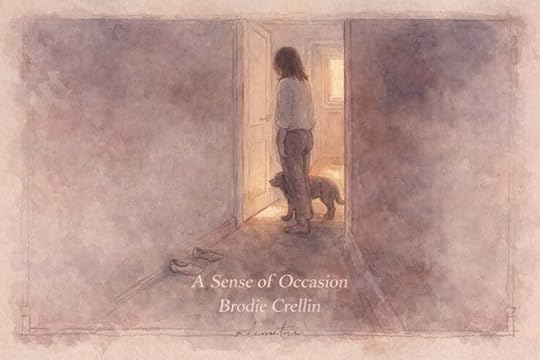
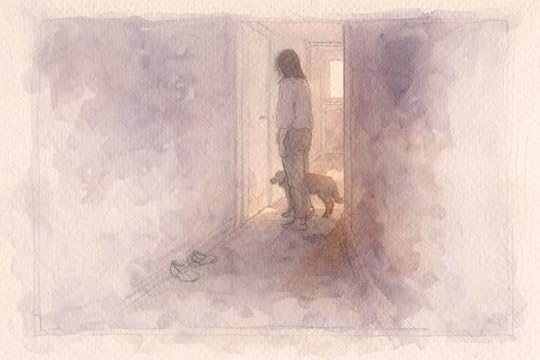
In the hush of the hallway, Patch lingers at the threshold where warmth, exclusion, and the dog’s faithful pressure turn domestic space into the novel’s central wound.
Death is supposed to simplify a family. In “A Sense of Occasion,” it mostly improves the blocking.
Brodie Crellin’s novel begins with a death and then refuses nearly every consolation that death is meant to offer fiction. It does not make the living honest. It does not strip people back to essence. It does not uncover hidden depths of goodness. What it does instead is harsher and, finally, more interesting: it reveals how fully this family already knows its roles. The fixer fixes. The charmer charms. The watcher watches. The needier party gets handled. Grief does not alter the system so much as take away its distractions.
The dead woman is Mary, a schoolteacher in a small English village, and the living gather around her absence in crooked formation. There is Patch, Mary’s daughter, prickly, literal-minded, chronically misread, and far sharper than the people around her allow. There is Robin, Patch’s father, charming, camp, self-dramatizing, intermittently tender, and almost professionally unable to keep his appetites from becoming other people’s problems. And there is Jude, Patch’s cousin, arriving from Naples with expensive groceries, stimulant energy, erotic volatility, and an unnerving gift for making domination sound like care. Around them orbit Mel, Mary’s neighbor and would-be helper, Juliette, Jude’s moneyed and ruinously composed mother, and a wider social field of former lovers, former students, old colleagues, and village mourners. Crellin lets all of them enter bearing their habits intact. Nobody is improved by occasion.
That title turns out to be quietly ruthless. An occasion is something one rises to, dresses for, performs within. It is a test of form. Crellin’s great insight is that form is precisely where these people live. They are always arranging tone, calibrating gesture, choosing menus, choosing music, choosing what sort of person they would like to look like while something difficult is happening. In this novel, attention is one of the least trustworthy forms of love. People inspect, manage, correct, flatter, seduce, supervise, and aestheticize one another constantly. What they do not do, with any regularity, is actually meet.
Patch is where the book’s failures of reading become easiest to see. She is watched all the time and understood badly by almost everyone. Mary reads her as weak, difficult, underformed, a daughter in permanent need of shoring up. Robin reads her as a child who can always be soothed by charm, indulgence, or atmosphere. Jude reads her as dependence itself – need, inconvenience, appetite, devotion when it is useful to call it that. Juliette reads her as pathology. Yet Patch is the novel’s keenest detector of counterfeit feeling. She notices when grief becomes style. She notices when food has been chosen for the living rather than for the dead. She notices the fake flowers, the wrong air in a room, and the moment a performance of concern hardens into exclusion. She may not be the most verbally agile person in the book, but she is the one with the most reliable sensor for falseness.
This is one of the novel’s most underdiscussed strengths: Crellin has made her least socially fluent character into its best reader of social fraud. Patch is not sentimentalized. She can be passive, rude, petulant, narcissistically wounded, and capable of real pettiness. But she is also the person least taken in by prefab feeling. That matters because “A Sense of Occasion” is a book full of people who know how to package emotion. Patch’s real misfortune is not merely that she is neglected. It is that care reaches her in the wrong register. It comes as correction, logistics, pity, erotic management, cultural tutoring, or display.
Crellin builds the novel not out of grand scenes of revelation but out of tasks people like to call minor. Shopping. Chopping. Dressing a salad. Dyeing hair. Choosing a reading. Making lasagna. Arranging photographs on a cork board. Selecting flowers for the crematorium. Debating what constitutes suitable funeral food. These are not connective tissues between the major events. They are the major events. This is where power gets exercised and disguised. This is where family feeling shows its teeth.
The novel understands with almost comic exactness that domestic competence is never merely practical. In this household, it is erotic, moral, and classed all at once. Jude arrives and immediately makes herself indispensable. She washes up, plans menus, clears surfaces, sources ingredients, installs tone. Her competence is real, but it is never only competence. It is also a way of governing the room and of proving, to herself as much as to anyone else, that she belongs above the fray. Crellin is very good on this sort of superiority – the kind that does not announce itself as superiority but as taste, helpfulness, standards, or simply knowing what is done. Class in this novel rarely arrives as slogan or explicit grievance. It arrives as pronunciation, fabric, ingredients, playlists, second homes, school histories, private ease with cultural reference, and the ability to know what belongs in which room. Taste is one of the book’s chief instruments of force.
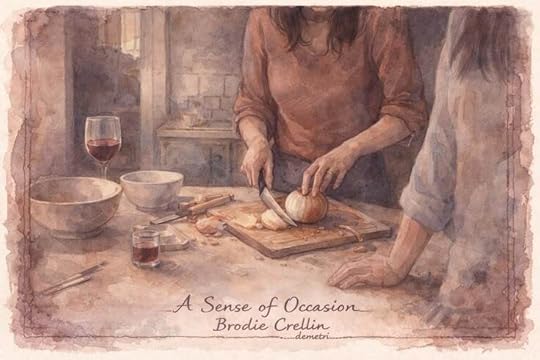
At Mary’s table, chopping, correcting, and feeding become one more family language through which competence passes for love and irritation for intimacy.
The prose is what allows all this to bite. Crellin writes like someone who knows that humiliation has a smell. Her sentences are supple without being showy, tactile without becoming lush. They often begin in inventory and end in injury. Objects rarely sit on the page as mere décor. They irritate, expose, accuse. An old onion. A dirty towel. A ruined cake. A school shirt. A packet of tissues. A hospital box of belongings. Plastic flowers. A dead phone. The novel’s material world is never symbolic first and physical second. It is physical first, and meaning grows out of contact, misuse, stink, leakage, stickiness, decay. Even grief does not rise into atmosphere here. It clings to surfaces. It curdles in food. It sweats through fabric. It shows up in bodies that bruise, leak, smell wrong, stiffen at the wrong moment, and refuse to cooperate with the ceremonies built around them.
Crellin is especially good at dialogue, though not in the flashy sense of one-liners alone. She is excellent at the way intimacy and aggression can occupy almost the same cadence. People in this book apologize, flirt, soothe, instruct, and insult in nearly identical tonal registers. Jude is the virtuoso of that mode. She can sound brilliantly alive one moment and morally appalling the next without any audible gear change. Robin, too, is rendered with marvelous precision. He is lovely in the way some people are lovely right up to the instant they become useless. His softness, his verbal fluency, his willingness to feel, even his sex positivity, all have warmth in them, but Crellin never lets warmth pass uninspected. He can be generous. He can also be evasive, adolescent, and structurally selfish while sounding like a man of feeling. That doubleness is one of the book’s accomplishments.
Formally, the novel’s design is stronger than it first appears. The present-tense action of death, funeral, wake, sex, and aftermath is braided with flashbacks that do not merely explain how these people got here. They keep altering the moral weather of the present. A scene that first seems comic later turns cruel. A memory that initially plays as backstory later becomes an indictment. Old birthdays, custody weekends, Christmases, school humiliations, parental flirtations, sexual arrangements, and tiny acts of social violence all return not to fill in information but to redistribute sympathy and blame. The past in this book is never stable evidence. It is active pressure. Crellin knows that families do not simply remember; they curate, withhold, stylize, and weaponize memory. That structural principle deepens the novel considerably. It turns “A Sense of Occasion” from a sharp grief comedy into something more ambitious: a novel about the family as a system of bad reading.
That is what the book is really about beneath its funeral premise. Not grief, exactly, though grief matters. Not even sex, though sex matters a great deal. It is about the ways people misrecognize one another while insisting, often sincerely, that they are being loving. It is about what happens when attention becomes possession, when care becomes management, when erotic fluency masquerades as insight, when competence becomes a mode of domination, and when a family grows so accustomed to its own scripts that nobody can tell the difference between intimacy and use. Death does not create those conditions. It merely removes the decorum that kept them from looking quite so naked.
The sexual material is where the novel takes its largest artistic risk, and it is also where some readers will part company with it. I think Crellin earns that risk because the sexual scenes are not detachable provocation. They are of a piece with everything else the novel is doing. The bedroom does not suddenly import scandal into an otherwise domestic book. It intensifies the existing logic of the domestic world: tutelage, rivalry, humiliation, dependency, management, appetite, the longing to be taken care of, the longing to be above taking care. The sex matters because it is not an exception. It belongs to the same moral weather as the menus, the shopping lists, the flowers, the speeches, the late-arriving cake. Crellin’s real boldness lies in refusing to prettify this or to turn discomfort into lesson. The scenes are hard because the relationships are already hard.
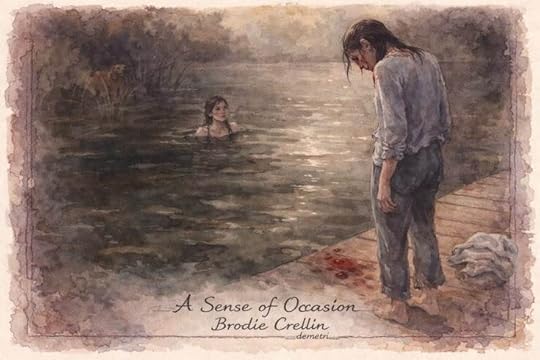
At the water’s edge, failed grace and unwanted instruction leave humiliation, desire, and tenderness sharing the same dark surface.
The crematorium sequence is where the novel’s critique of performed solemnity comes fully into focus. A funeral ought, in theory, to bring a life into clarity. Instead Crellin gives us a room full of badly judged substitutions: plastic backup bouquets, overly managed music, folk uplift where actual ceremony might have been more honest, a slideshow, applause, paper booklets, and a general atmosphere of administrative tenderness. People cry anyway. That is part of the point. False form does not cancel feeling; it merely mixes with it. Public grief here is both sincere and second-hand, moving and faintly embarrassing. The room is too smooth, too impersonal, too determined to offer “occasion” where what Mary’s death seems to demand is something rougher, quieter, less cosmetically correct. Patch senses this at once. She cannot quite say it, but the novel says it for her.
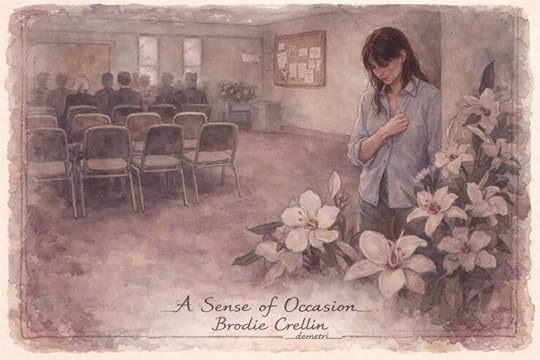
Among backup lilies and managed solemnity, Patch confronts the false calm of ritual and the strange artificiality of public grief.
There is a cost to Crellin’s method. She occasionally presses a strength long enough for it to announce itself as a strength. Jude, especially, is almost overstocked: witty, depressive, manipulative, sexually omnivorous, chemically inflated, theatrically articulate, socially fluent, always at risk of making herself the most interesting thing in the room. She remains compelling, but the novel knows it has made her compelling and occasionally leans on that knowledge a touch too hard. Some of the secondary figures, particularly Juliette and Mel, can also feel, at moments, slightly too perfectly placed to crystallize the book’s ideas about class, repression, and occasion. And because Crellin returns so insistently to the same damaged sites – sex, food, grief, taste, correction, dependency – there are moments when the repetitions confirm the argument rather than complicate it.
Still, I would take that kind of overpressure over tasteful underreach every time. “A Sense of Occasion” is an unusually alive novel: nasty, funny, sexy, embarrassing, tender against its own better judgment. Its excellence is mainly artistic and emotional, though it has more intellectual bite than it may first appear to. It is not a thesis novel hiding behind characters. Nor is it a loose social comedy accidentally stumbling into pathos. What Crellin thinks she is doing, I suspect, is writing a darkly funny family novel about grief, sex, class, and bad behavior. What she is actually doing on the page is more exact and more unsettling: she is anatomizing the forms by which people make themselves feel loving while failing, over and over, to love well.
That is why the ending lands. It does not seek grandeur, healing, or the false authority of epiphany. Patch drives away in Mary’s car thinking not of wisdom but of cigarettes, potatoes, lists, tomorrow. It is a small ending, but not a slight one. By then the novel has taught us what smallness can contain: defiance, fatigue, appetite, damage, misrecognition, and the first faint outline of a life that might have to be lived outside the family’s old arrangement of watchers and watched.
High above the fields, Patch performs the novel’s most private ceremony, releasing what the official one could not contain.
For me, “A Sense of Occasion” is a 92/100, and a 5-star book on the Goodreads scale. That score reflects a novel I admire fiercely rather than one I love tidily. It is barbed, exact, and willing to be difficult in ways that feel earned. What remains afterward is not the scandal of what happens, nor even the funeral itself, but the residue it all leaves behind: old onions, bad towels, a dog searching the house, the hospital box, the plastic orchids, the dropped phone, the school shirt unbuttoned at the wrong moment, the bag of potatoes waiting at the end of the road.
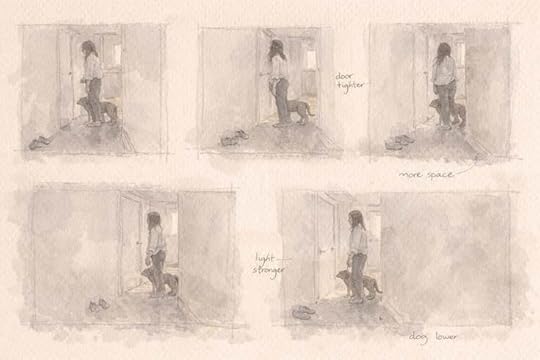
These first thumbnails test the emotional geometry of the threshold, searching for the right balance of distance, dog, door, and withheld light.
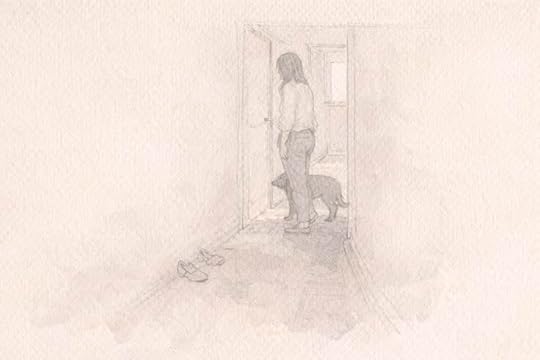
The graphite underdrawing maps the hallway’s quiet architecture before color arrives, letting placement and negative space carry the ache.
The first wash begins to separate shadow from warmth, turning drawing into atmosphere while the room beyond the door stays deliberately withheld.
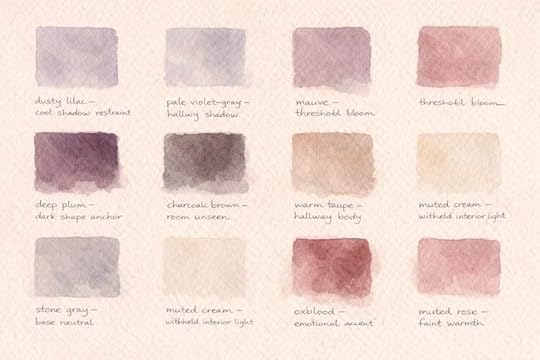
The palette study fixes the review’s visual logic in advance, choosing muted bruise-tones and restrained warmth to keep every image in one emotional family.
All watercolor illustrations by Demetris Papadimitropoulos.
Thanks to Netgalley and Riverhead Books for the ebook. Did you ever see codependent young family members and wonder what their lives are like behind closed doors? If they’re like the characters in this novel, it might be better not to find out. But it is so entertaining to read a book about them. Jude, pretty, and from a much richer family, rules over her cousin Patch. It’s so unhealthy that Jude has run away to Naples, ostensibly to work on a new play, but really to get out of the apartment she shares with Patch in London. But when Patch’s mother dies, they both have to descend to a small, rural town in England and finally see if they can settle their differences or tear each other apart, both emotionally and physically. A fascinating and dangerous read.
This was an eclectic and wild novel that explored family drama, transgressions of sex and relationships all wrapped up with a highly dysfunctional family and a funeral setting.
After Mary's sudden death, a fractured family has to reunite in a small village for the funeral. Throw into the mix that this family all stay at Mary's small house and a hot summer weekend, and it all felt really oppressive and like a pan of hot boiling water ready to spill over into something terrible. The setting was a really great feature of this book. It really added to the dark, simmering atmosphere of tense family relationships.
The story explores themes of grief, gender identity, dysfunctional family dynamics, mental health and there is a strong and often grossly uncomfortable and deep look into sexuality. The writing was unsettling, but I think that suited the themes of the book. The story is also told through multiple POVs, which I always like as you get to dig deeper into a character's thoughts. We also jump back and forward through the timeline to see the background of their lives, which I enjoyed too.
The characters are just as wild as the storyline. Patch and Jude are cousins who are dealing with the death of Mary, Patch's mother. Robin, Patch's gay father, is the other central character in this story. I have to say I didn't really take to most of the characters in this book. I thought Robin and Jude were too wrapped up in themselves. My thoughts about Patch changed as I read this. I didn't like her at first but then as well read through the book we see that she is totally misunderstood by everyone, including her mother. They are disparaging towards her and we are made to believe that she is unable to think clearly for herself, but she is far more astute than that.
This isn't full of action. Not a lot really happens in the book but the deep dive into human behaviour is really good. I enjoyed this element of the book. The sexual content is risky and bold. I didn't particularly take to this element of the book but I could see that this mirrored the difficult and tricky relationships of the characters.
A fascinating but uncomfortable read.
Thank you NetGalley and Random House UK Vintage for allowing me to read the ARC for an honest review.
Thanks to Netgalley and Riverhead Books for the ARC!
When I read the premise, I was intrigued and thought this book would be a good fit for me. Patch and Jude are cousins who are dealing with the death of Mary, Patch's mother. Robin, Patch's gay father, is the other central character in this story.
The familial drama reminded me of Long Island Compromise. I felt that the story pitched these characters as messy, but unfortunately, I found them all to be boring.
I wish that the characters were more unlikeable because it would have made the story more interesting. I had no investment in any of the characters in this story and did not care about their story arcs. Nothing happens for the majority of this book. Most of the scenes are flashbacks. The author reveals some important scenes toward the 70% mark when the characters prepare for Mary's funeral.
I don't mind when authors write dialogue without quotations, but I don't think this style worked for this story. That said, this book is well-written, and there are some funny moments.
If you enjoy character-driven stories with minimal plot, then you should maybe try this book. Normally, I love plotless literary fiction, but I couldn't wait for this story to end.
This book explores dysfunctional family dynamics, grief, sexuality, and mental health. Patch has always relied on her family to make decisions and get things done. So, she's a bit in over her head when she unexpectedly finds herself planning her mother's funeral. Plus, her father (who's been separated from her mother for decades) isn't much help either.
When Patch's cousin Jude arrives, she tells them there's no way they'll be serving baked potatoes at a funeral. She promptly begins baking a cake and lasagna while Patch falls into old habits, allowing Jude to take control.
Jude attempts to keep her cousin involved, despite Patch's reluctance to complete the simplest of tasks like mixing ingredients for salad dressing. Jude becomes even more irritable when she learns that Patch slept with her ex-girlfriend. Patch is annoyed too; she's jealous of how alike her father and cousin are. She recalls how her mother always seemed more at ease when Jude was around as well.
As the story unfolds, we learn more about these complex family dynamics through the events leading up to the funeral and through flashbacks that reveal the nuances of Patch's parents' relationship.
ᴛʜɪɴɢꜱ ɪ ᴀᴘᴘʀᴇᴄɪᴀᴛᴇᴅ This book offered lots of bi representation! I loved kicking off Pride Month with queer characters who were funny, flawed, and uninhibited. Their relationships were messy, but they each seemed to care for one another. I also appreciated the focus on mental health struggles and neurodivergence.
ᴛʜɪɴɢꜱ ɪ ꜱᴛʀᴜɢɢʟᴇᴅ ᴡɪᴛʜ I don't want to give any spoilers, but one scene in particular overshadowed the rest of the story for me. Even though I enjoyed my journey up to that point, it's difficult to overlook and colors my perception of the book.
A very dysfunctional family reunited after the death of one of the parents. We get the story of what ensues in the days leading up to the funeral. It is a very character driven story and we get a glimpse into very messed up people who are just trying to figure out their way through their heightened emotions and misplaced feelings.
There’s a lot of sexual discourse in the telling of the characters motivations and stories. In a way it tends to lead the plot line a lot which causes it to stall a bit in some parts. That being said I did enjoy the writing, it was funny, visceral and made you pay attention. If you enjoy messy drama literary fiction with characters that are far from perfect then this would be a great read for you.
Brodie Crellin is a great writer and has a talent for writing complex, well developed characters. I enjoyed the writing style and the emotional journey throughout this novel, but I was just a bit too put off by the weird sexual dynamics at play here. The nonchalant attitude the author takes towards incest felt very jarring to me. Overall, this book made me feel uncomfortable, and not the kind of intentional discomfort that is designed to make a reader reflect on something deeper - if that were the case, I could get behind this book.
The most astonishing novel. It makes me feel less weird and lonely in my desires, my feelings to have someone articulate so beautifully and generously the complex ways we all love each other, want to be loved by one another, fail to understand ourselves & each other, but keep trying regardless. Can’t recommend this more highly. Also, best sex scenes in any book ever.
This was such a fun read. Chock full of humor and interesting characters. There is a lot going on and it did feel a bit crowded in terms of characters and relationship dynamics at certain times, but all the characters contribute to the story beautifully. The chaos is kind of part of the vibe.
Thanks to NetGalley and the publisher for the ARC!
A Sense of Occasion is a lively, feel-good read with plenty of humor, unexpected moments, and genuine heart. Brodie Crellin keeps things fun and entertaining, making it an easy pick for a light, enjoyable escape.
Here’s the thing… I kinda have to give it to the author for their audacity and polarizing ending.
Messy, codependent cousins (+ a dad/uncle) prepares for the funeral of their family member Mary (mom/aunt). It’s bold, uncomfortable, and very stream of consciousness.
**Let it be known that I do NOT recommend this book. Please spoil yourself before reading and decide for yourself.
I loved this. The world is so detailed, so vividly textured, and filled with characters and histories in a way that seems so opposed to the kind of airy autofiction that feels like the dominant contemporary mode. I was completely absorbed by the family dynamics, the way that sex is used to mediate power, and all the things they refuse to confess or talk about, to the extent that I was sad when the book ended; I'd gotten so used to these people and their difficulties. Something about the slow elegance and ponderousness of the descriptions reminded me of Hollinghurst's The Folding Star, or the Line of Beauty, and then the pitilessness of how people treat one another of the cynicism and cruelty of Martin Amis's novels. That said, it's also a strangely tender story. I'll be thinking about it for a while.