

What do you think?

Triage
A groundbreaking new direction for Claudia Rankine, the best-selling author of Citizen and Just Us
Claudia Rankine has widened contemporary literature with her consciousness-raising, genre-defying works. In her first book after her celebrated American trilogy, presented with full-color visuals, Rankine shifts into sustained narrative, memory, criticism, and essay to offer her most personal and emotionally resonant writing yet.
Triage follows the turbulent friendship between two composite characters, the narrator and the theorist, self-identified sisters struggling to define their wounded histories and their shared but separate lives. During college, they invent a game of Every time they see each other, they have to stop and fall to the ground. As their kinship continues off and on for decades, “collapse” takes on new meanings that are seen and felt in the violence of their pasts, artworks depicting couches where someone might ease their exhaustion, the ongoing devastation in Gaza, and the antagonism of their conversation and their love for each other.
Triage is an argument for the necessity of grieving and the demand for action in our time of relentless loss. “No matter our posture,” Rankine writes, “we are all among the rubble.” This is a book for those complicated but beautiful friendships that we come to rely on to unsettle us, to make us better.
Claudia Rankine has widened contemporary literature with her consciousness-raising, genre-defying works. In her first book after her celebrated American trilogy, presented with full-color visuals, Rankine shifts into sustained narrative, memory, criticism, and essay to offer her most personal and emotionally resonant writing yet.
Triage follows the turbulent friendship between two composite characters, the narrator and the theorist, self-identified sisters struggling to define their wounded histories and their shared but separate lives. During college, they invent a game of Every time they see each other, they have to stop and fall to the ground. As their kinship continues off and on for decades, “collapse” takes on new meanings that are seen and felt in the violence of their pasts, artworks depicting couches where someone might ease their exhaustion, the ongoing devastation in Gaza, and the antagonism of their conversation and their love for each other.
Triage is an argument for the necessity of grieving and the demand for action in our time of relentless loss. “No matter our posture,” Rankine writes, “we are all among the rubble.” This is a book for those complicated but beautiful friendships that we come to rely on to unsettle us, to make us better.
192 pages, Hardcover
Published August 4, 2026
About the author
Claudia Rankine
52 books1,674 followersClaudia Rankine is an American poet and playwright born in 1963 and raised in Kingston, Jamaica and New York City.
Rankine is the author of five collections of poetry, including "Citizen: An American Lyric" and "Don’t Let Me Be Lonely"; two plays including "The White Card," which premiered in February 2018 (ArtsEmerson and American Repertory Theater) and will be published with Graywolf Press in 2019, and "Provenance of Beauty: A South Bronx Travelogue"; as well as numerous video collaborations. She is also the editor of several anthologies including "The Racial Imaginary: Writers on Race in the Life of the Mind." In 2016, she cofounded The Racial Imaginary Institute. Among her numerous awards and honors, Rankine is the recipient of the Bobbitt National Prize for Poetry and the Poets & Writers’ Jackson Poetry Prize as well as fellowships from the Guggenheim Foundation, the Lannan Foundation, the MacArthur Foundation, United States Artists and the National Endowment of the Arts. She is a chancellor of the Academy of American Poets and teaches at Yale University as the Frederick Iseman Professor of Poetry. She lives in New Haven, Connecticut.
(source: Arizona State University)
Rankine is the author of five collections of poetry, including "Citizen: An American Lyric" and "Don’t Let Me Be Lonely"; two plays including "The White Card," which premiered in February 2018 (ArtsEmerson and American Repertory Theater) and will be published with Graywolf Press in 2019, and "Provenance of Beauty: A South Bronx Travelogue"; as well as numerous video collaborations. She is also the editor of several anthologies including "The Racial Imaginary: Writers on Race in the Life of the Mind." In 2016, she cofounded The Racial Imaginary Institute. Among her numerous awards and honors, Rankine is the recipient of the Bobbitt National Prize for Poetry and the Poets & Writers’ Jackson Poetry Prize as well as fellowships from the Guggenheim Foundation, the Lannan Foundation, the MacArthur Foundation, United States Artists and the National Endowment of the Arts. She is a chancellor of the Academy of American Poets and teaches at Yale University as the Frederick Iseman Professor of Poetry. She lives in New Haven, Connecticut.
(source: Arizona State University)
Ratings & Reviews
Friends & Following
Create a free account to discover what your friends think of this book!
Community Reviews
Displaying 1 - 23 of 23 reviews

August 20, 2026
"Our present government has systematically stripped away the mechanisms put in place to combat a moment like this. The absolute we took for granted are now in the wind. It’s crippling to see what’s happening and have the knowledge be met with shush. It’s like living in a state of non sequitur, where the logic exists in the brutal, illogical worldmaking of supremacy within a lying structure, I said. How can a situation remain this alarming for years? There are no inviolable rights anymore. It’s impossible, everything feels impossible, even as I’m not in despair all day long. The the lack of despair causes despair."
It's rare for me to rush out and buy a recently released book. Even rarer to then actually start reading it within days of doing so. I was late to discovering Rankine (not until the publication of Citizen: An American Lyric), but I've been hooked since. She has a finger on the social/political pulse of the U.S. and merges image, insight, and lyricism in a way few other writers can.
"Dear one, once upon a time, the wind was touch. Its speed tore apart sky. In all directions the clouds’ tears cascaded light, its illuminated softness streaming. From the ground, the blues of the sky, blackening, offered nothingness, this abandonment of clarity, Glissant’s opacity. Say yes to this, I whispered to the theorist, though they were far ahead, up there at the podium. There is texture in whatever is touched when one touches down."
I'm not sure if this would resonate quite as much for readers not living in the current U.S. environs, but for those of us caught in what feels like an untenable fraying of the social and political fabric, Rankine manages to capture the overwhelming nature of it all on a personal level through the examination of her relationship with "the Theorist," art (namely, imagery/sculpture based on couches as crazy as that may sound), personal accountability/anecdote, and the notion of collapse (as escape, as coping mechanism, as involuntary response). (To be fair, she also addresses, sometimes indirectly, the global populist bent, the ongoing wars, refugee crises, the endless things to doomscroll.)
"For the theorist and me there had always existed a ritual of collapse that lived beyond any crash. But within the excess of these times, they’d become unrooted. Perhaps they now felt there was nothing left to reinforce, our repetitions had loss as their anchor. I would have given them my seat on any couch so they could rest and be at home with me before rising up again. Copy Me. Replace Me. But then I recalled Rosemarie Trocke’s couches, and knew everything had lost its softness. Everything was on a collision course with the hardness of now."
It's a book that says, "Here's a couch. Come sit down. And tell me all about it... "
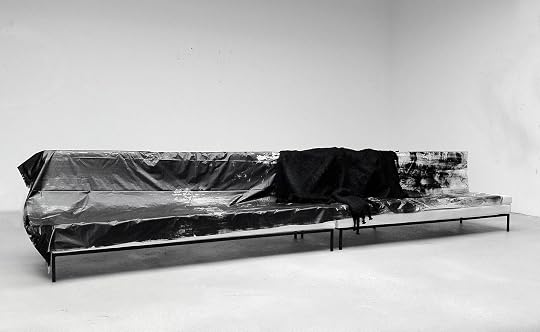
Sculpture by Rosemarie Trockel
"The future happens here and happens there, while tapping us on the shoulder. Casualties inform and form. Our eyes open not in order to see, but in order to not be here. We wanted joy. We wanted good news. These were the dreams. But sometimes the house burns down."-----------------------------------
LARB Podcast with Rankine
https://lareviewofbooks.org/av/claudi...
-----------------------------------
WORDS THAT STILL OFFER NO PLACE TO SIT...
algos | merism | obtunded | Creon | anaphora

August 22, 2026
I look forward to re-reading this in the near future in order to save some of its exquisite prose and moral rigor in notes. As it is I read a library book that had many holds on it and wanted to return it asap to spread its wealth. It is a cri de coeur in the face of moral atrocities and I am always grateful for that though I’m not smart or academic enough to understand its heady threads and references (hence the highly subjective 3 star review). I look forward to her interview on Between The Covers podcast to get a better understanding.

Read
September 2, 20263 stars for me, personally.
I think a guided reading of some sorts may have helped me enjoy this more. There’s probably a lot of references I didn’t understand. There are some beautiful sentences throughout, but I can’t say I enjoyed reading this very much. I put it down a few weeks ago and picked it back up to finish reading in the train, which once again, maybe not the best setting/mode to engage with this work. I didn’t like the dialogue, it kind of took me out of things, I just kind of am not charmed/convinced by people speaking in metaphors all the time. The authors relationship with the theorist is definitely compelling. Rankine definitely captures the sense of desperation/grief/helplessness that comes with living in a collapsing society, and doesn’t try to make the reader feel better, which is fine.
I think a guided reading of some sorts may have helped me enjoy this more. There’s probably a lot of references I didn’t understand. There are some beautiful sentences throughout, but I can’t say I enjoyed reading this very much. I put it down a few weeks ago and picked it back up to finish reading in the train, which once again, maybe not the best setting/mode to engage with this work. I didn’t like the dialogue, it kind of took me out of things, I just kind of am not charmed/convinced by people speaking in metaphors all the time. The authors relationship with the theorist is definitely compelling. Rankine definitely captures the sense of desperation/grief/helplessness that comes with living in a collapsing society, and doesn’t try to make the reader feel better, which is fine.

August 13, 2026
This is a hard one to read. The author is working through her feelings about the radical changes laid upon America, and especially Black and other minorities, since early 2025. She recounts her college friendship with a brilliant person who fled Ramallah and found a home in the US. After a long absence, they reunited recently. Much of the book consists of exchanges with this person as they work out their emotions and understanding of our new reality.

August 9, 2026
i was moved.


August 4, 2026
She gotten gentler but the text is so sticky
August 30, 2026
"The future happens here and happens there, while tapping us on the shoulder. Casualties inform and form. Our eyes open not in order to see, but in order to not be here. We wanted joy. We wanted good news. These were the dreams. But sometimes the house burns down."
This book. 10 stars.
For those of us struggling with how to respond/fight/grieve for the world burning in front of our eyes; the horror, the grief, the outrage can be overwhelming. Everyone struggles to contend with a global dynamic that looks and feels catastrophic. Too much.
Rankine offers us a conversation that lasts over decades between friends who met in college; our narrator and "the theorist". Using the Sophocles play of Antigone, Rankine identifies our narrator as Ismene, the sister who wishes to operate within human law(avoid open civil disobedience), and "the theorist" as Antigone, who believes divine and family law take priority. For her, action is requisite. These two opposing possible ways of being come together in this relationship/conversation; could a possible third alternative response arise?
"Our present government has systematically stripped away the mechanisms put in place to combat a moment like this. The absolutes we took for granted are now in the wind. It’s crippling to see what’s happening and have the knowledge and be met with shush. It’s like living in a state of non sequitur, where the logic exists in the brutal, illogical worldmaking of supremacy within a lying structure, I said. How can a situation remain this alarming for years? There are no inviolable rights anymore. It’s impossible, everything feels impossible, even as I’m not in despair all day long. The lack of despair causes despair."
I find it hard to articulate how potent this conversation felt to me. I read this in a rush over two
days and now want to reread it immediately. I want to buy this book for all my friends who feel the horror and pain of NOW.
The narrator and the theorist develop a game when they are on campus: anytime they see each other, they fall to the ground. This metaphor of "collapse" or "fall" is a constant throughout the book and points to something ever-present in the background of our daily living that we disregard, ignore, or deflect. But it is always there.
"Looking back, I think our falling was a refusal of continuance, refusal of the illusion of flow, a recognition of injury, ours, everyone's, as we traveled through time. A way to say things were unaligned, not right, we were not right. Sorrow needed notation. Release tasted of soil."
My god, I loved this book, this writing, a poetry articulating the despair of NOW.
Brilliant.
"The overwhelming 'toomuchness', that's the term the theorist used during their lecture-it came to me. The phrase expressed a desire to hurl the self into the audience's panicked arms. This flooded feeling, the theorist described, prevents sleep and suspends one in the space of collapse. There one is on one's own in the moment of free fall, falling involuntarily, endlessly, even after touching down....To remain in the collapse, internally though it was occurring all the time, externally, while remaining in this world, would tighten gravity's hold and decompose the will. The known trauma of that. Although the Latin origin of collapse means falling together, the rise up, the grasp back onto any ledge, the taking hold of any hand was not there for the theorist in those moments of wanting a crash."
This book. 10 stars.
For those of us struggling with how to respond/fight/grieve for the world burning in front of our eyes; the horror, the grief, the outrage can be overwhelming. Everyone struggles to contend with a global dynamic that looks and feels catastrophic. Too much.
Rankine offers us a conversation that lasts over decades between friends who met in college; our narrator and "the theorist". Using the Sophocles play of Antigone, Rankine identifies our narrator as Ismene, the sister who wishes to operate within human law(avoid open civil disobedience), and "the theorist" as Antigone, who believes divine and family law take priority. For her, action is requisite. These two opposing possible ways of being come together in this relationship/conversation; could a possible third alternative response arise?
"Our present government has systematically stripped away the mechanisms put in place to combat a moment like this. The absolutes we took for granted are now in the wind. It’s crippling to see what’s happening and have the knowledge and be met with shush. It’s like living in a state of non sequitur, where the logic exists in the brutal, illogical worldmaking of supremacy within a lying structure, I said. How can a situation remain this alarming for years? There are no inviolable rights anymore. It’s impossible, everything feels impossible, even as I’m not in despair all day long. The lack of despair causes despair."
I find it hard to articulate how potent this conversation felt to me. I read this in a rush over two
days and now want to reread it immediately. I want to buy this book for all my friends who feel the horror and pain of NOW.
The narrator and the theorist develop a game when they are on campus: anytime they see each other, they fall to the ground. This metaphor of "collapse" or "fall" is a constant throughout the book and points to something ever-present in the background of our daily living that we disregard, ignore, or deflect. But it is always there.
"Looking back, I think our falling was a refusal of continuance, refusal of the illusion of flow, a recognition of injury, ours, everyone's, as we traveled through time. A way to say things were unaligned, not right, we were not right. Sorrow needed notation. Release tasted of soil."
My god, I loved this book, this writing, a poetry articulating the despair of NOW.
Brilliant.
"The overwhelming 'toomuchness', that's the term the theorist used during their lecture-it came to me. The phrase expressed a desire to hurl the self into the audience's panicked arms. This flooded feeling, the theorist described, prevents sleep and suspends one in the space of collapse. There one is on one's own in the moment of free fall, falling involuntarily, endlessly, even after touching down....To remain in the collapse, internally though it was occurring all the time, externally, while remaining in this world, would tighten gravity's hold and decompose the will. The known trauma of that. Although the Latin origin of collapse means falling together, the rise up, the grasp back onto any ledge, the taking hold of any hand was not there for the theorist in those moments of wanting a crash."

September 4, 2026
Claudia Rankine's work is designed (if that is the right word) to make you, the reader, feel uncomfortable. The first time I taught Rankine's Citizen, I confess I was terrified that I wouldn't be able to make sense of the work, let alone help students understand its meaning. The work was, and remains, very much out of my wheelhouse. But my worry was completely unfounded. Rankine's work teaches itself, in part because the discomfort is generates is so vivid and productive. Every line matters. And a single line can be the basis for an entire philosophical and political conversation. Citizen deftly acted out the felt experience of institutional racism. In a way, it helped to diagnose or describe one of society's great problems. Triage offers something else: a way of thinking about how each of us responds to these moments of social failure and even breakdown. It is also a book rooted in discomfort, namely the discomfort felt by two lifelong friends (the narrator and the theorist) who respond to our current political and social crises in very different ways. It isn't giving anything away to say that the theorist proposes direct action, even if that action is small. Protest. Say something. Do *something*. The narrator, perhaps a version of Rankine herself, articulates a vision of action rooted in language: in describing problems and, I assume, thinking about how to overcome them. By the end, though, the narrator is deeply uncomfortable with her own position, which in turn leaves all of us who have read Rankine's work--an expression of language--feeling the same. Ultimately, I'm not entirely sure whether Triage is a call to *specific* action. But it does seem to be a call for each of us to look in the mirror and examine how we are acting in a moment of crisis. The reflection each of us sees might be different, as might be the way each of us proceeds after that. At least, I *think* that's what Rankine would say. But Triage makes clear that any person of conscience can avoid neither the mirror nor the reflection it reveals.

Review of advance copy received from Publisher
I’ve never forgotten the galvanizing effect of reading Claudia Rankine’s Citizen, an intimate prose poem about the lived experience of racism. It made me feel alert and hesitant in the way one anticipates a static shock.
Her new book, Triage, is, if anything, even more startling. It’s a memoir or a novella or maybe another prose poem — Rankine has never given categories any quarter — about enduring in a world that cannot be endured.
It’s fundamentally a book about a complicated friendship forged in college with someone she refers to only as the theorist. Early on, they establish their own strange form of greeting on campus:
“When we spied the other during the day, we had to collapse,” Rankine writes. “The collapse was literal and, on occasion, an inconvenience to those around us.”
What might look like a bit of sophomoric melodrama is, in fact, a way to keep from breaking, to keep refusing — an echo of the protester’s passive resistance or an allusion to Antigone’s preparation to be buried.
“The collapse was an antidote to an unbearable but borne disturbance we glimpsed in the face of each other. At last, here was another who embodied the expression of our puzzling predicament: Another life brought up to endure, not live, the harsh weather the seasons would not own.”
As the book progresses in a series of....
You can read the rest of this review on my free Substack newsletter:
https://roncharles.substack.com/i/209...
Her new book, Triage, is, if anything, even more startling. It’s a memoir or a novella or maybe another prose poem — Rankine has never given categories any quarter — about enduring in a world that cannot be endured.
It’s fundamentally a book about a complicated friendship forged in college with someone she refers to only as the theorist. Early on, they establish their own strange form of greeting on campus:
“When we spied the other during the day, we had to collapse,” Rankine writes. “The collapse was literal and, on occasion, an inconvenience to those around us.”
What might look like a bit of sophomoric melodrama is, in fact, a way to keep from breaking, to keep refusing — an echo of the protester’s passive resistance or an allusion to Antigone’s preparation to be buried.
“The collapse was an antidote to an unbearable but borne disturbance we glimpsed in the face of each other. At last, here was another who embodied the expression of our puzzling predicament: Another life brought up to endure, not live, the harsh weather the seasons would not own.”
As the book progresses in a series of....
You can read the rest of this review on my free Substack newsletter:
https://roncharles.substack.com/i/209...

Review of advance copy received from Publisher
This book manages to be essay and poetry and even novella all at once, turning simple ideas into much deeper musings on vulnerability and connection. Rankine surrounds the reader with various images, both literal and written, of what it means to collapse while exposing a tumultuous friendship. We watch all the ways their dynamic changes, both successfully and in vain, for better and for worse. A desire for some sort of resolution shines through within it, and it becomes clear that this isn’t simply about one relationship but instead about the world as a whole and our place within it. This is a gorgeous work of cultural criticism, an acknowledgement of the overwhelm, and a steady cry for much needed action.
August 29, 2026
The visceral falling of the body onto the grass to show the shape of grief, to be “there with the rest-all the others who were ever and ever given over, a body, bodies, every corpse, to collapse.” Seeking “Antigone’s clarity, the unwavering knowing, the willingness to risk all”. It all seemed so possible to the narrator in college. But how to upset her norm at 60?
For the theorist, we are the frog in the water as the temperature slowly rises, we adapt even to our crumbling world: “It’s numbing, our acceptance of our unfolding reality, the ability to adjust to anything.”
But the narrator is fated to be Ismene to the theorist’s Antigone: grief in what she is prepared to bring to the battle. But is that enough? Antigone says, “No.”
For the theorist, we are the frog in the water as the temperature slowly rises, we adapt even to our crumbling world: “It’s numbing, our acceptance of our unfolding reality, the ability to adjust to anything.”
But the narrator is fated to be Ismene to the theorist’s Antigone: grief in what she is prepared to bring to the battle. But is that enough? Antigone says, “No.”

August 15, 2026
** 4 stars **
Like Rankine's other volumes, Triage left me thinking, which I appreciate. Her focus here is on her longstanding relationship with a friend from college she refers to as "the theorist" and on recurring motifs of collapse (including couches, which she sees as literal and figurative sites of collapse). Although the title of the volume is Triage, there is much more discussion of despair and collapse, and her conclusion seems to be that while there are no easy solutions or triage for our future moving forward as a country, we have to do *something* even if it feels like all we can do or want to do is collapse.
Like Rankine's other volumes, Triage left me thinking, which I appreciate. Her focus here is on her longstanding relationship with a friend from college she refers to as "the theorist" and on recurring motifs of collapse (including couches, which she sees as literal and figurative sites of collapse). Although the title of the volume is Triage, there is much more discussion of despair and collapse, and her conclusion seems to be that while there are no easy solutions or triage for our future moving forward as a country, we have to do *something* even if it feels like all we can do or want to do is collapse.

Review of advance copy received from Publisher
Triage is a book you finish and realize you’ve dog-eared every damn page. Poetic and wise, Claudia Rankine composes lyrical snapshot essays around a life-defining friendship. Art, literature, war, grief... Rankine searches everywhere for meaning and connectivity. The literal and figurative idea of "collapse" in these pages is particularly poignant and thought-provoking. Claudia Rankine is a superb wordsmith and a passionate intellect, and I cherish any opportunity to witness her ideas take flight.

September 6, 2026
So. Rankine/the narrator is researching and writing about artsy couches when she reconnects with an frenemy from college who fled Ramallah in their teens. It was really hard for me to get into this one. I struggled for the first twenty or so pages, and then it was fine, and then I got to the end and realized it was pretty brilliant. This one isn't for everyone, but it was for me.

September 6, 2026
4.5 | i think this book deserves a reread from me. it had so many cutting, punch-you-in-the-stomach moments (as all rankine’s work does), but a lot of it, especially in the beginning, felt too abstract for me to really engage with. i think if i returned to it after seeing the whole picture i would like it more.
August 27, 2026
I’m very glad I read this. It’s terrific. It’s a bit of prose but written with the heart of the poet on the sleeve. It’s brilliant and painful and honest and searing. It is an amazing piece of literature. An artifact for those coming in the future.

Want to Read
July 2, 2026As seen in the July/August People’s Book newsletter.
August 14, 2026
Inertia is a form of culpability.

August 14, 2026
eloquent and graceful
August 23, 2026
Not sure I'm smart enough to read this without a class or some guidance but wow

September 10, 2026
Saw this book on NYT new releases but didn’t realize when I bought this the writing style was as poetic as it was and I just unfortunately don’t enjoy reading poetry so this wasn’t for me
Displaying 1 - 23 of 23 reviews