Rediscover the joy of creating – with kid-inspired insights from the bestselling author of Steal Like an Artist
Feeling burnt out, distracted, and out of fresh ideas? In every creative person's life, there are times when you lose the energy, joy, and freedom you had when you were first starting out. From the recent art school graduate to the retiree searching for their creative third act, we all need help returning to the excitement, the sense of discovery, and the raw creativity of a child at play. Don't Call It Art is a creative liberation handbook for looking at the world with fresh eyes, unlearning what you've learned, and making new leaps in your life and work.
Since his breakout New York Times bestseller Steal Like an Artist, Austin Kleon has been one of the world's leading teachers of creativity. His books have sold nearly two million copies and translated into 30 languages. Now, in his most encouraging and inspiring book yet, Kleon shares ten rejuvenating lessons he learned from being a studio assistant to the artists closest to his his two young sons. Kleon discovered that nurturing his kids taught him how to create the conditions under which his own – and everyone's creativity – can thrive.
Don't Call It Art offers inspiring advice for readers looking to free their creative spirit
Permission to be badBelieve in magicThrow out the instructionsShow and tellThink outside your head Illustrated in Kleon's signature style of illustrations, quotes, stories and examples, Don't Call It Art is a blast of creative energy that will give you permission to play, make a mess, and venture beyond your imagination – and ultimately, to feel the unbridled joy of creating in your own unique way.
This is actually a one star book for me but I want to be nice since I was given a free copy. Put simply, I am not the audience for this book. On paper, one would think so: lifelong multifaceted artist who has been making a living full time as such for the last seven years, painter, award-winning filmmaker, musician & published author. (pretentious much? jesus christ we get it)
This book is for those who would *like* to make cool things, but have never actually done so. This book is for the normies, the uncreative, for those who have never had an original idea in their life & who think that reading a book will provide them with one. This book is for the bored stay at home housewife who makes fuzzball and hot glue crafts to sell at the flea market, or for the Instagram makeup influencer who buys this at the airport to skim through on a flight because she dreams of deeming herself an artist.
Any true artist, and by that all I simply mean is someone who is currently, actively making things that are even remotely interesting or unique, already knows the majority of the extremely generic information in this book. This is like the Sesame Street version of Rick Rubin‘s book on Art, except even that is too generous because *that* book would still have some interesting points.
I can’t help but notice that the author just seems to be making derivatives of his first work, and from a cursory glance, all four of his books look essentially the same in content and substance. But hey, 2 million sold copies don’t lie, and if I had struck gold on something, I would probably keep mining that vein as well. Flannery O’Connor once talked about how you can make an extraordinary amount of money if you write badly enough.
I know I’m being extra mean, but books like this just make me bristle in particular because they feel like such a network TV version of trying to get at something so deep, beautiful and profound that words fail to describe it—we’re talking about the source essence of life itself here and the inexpressible wonder of this mysterious existence, and the ability to create tiny little moments of meaning that make us feel more joy and less alone and like someone out there understands us because we witness what they made. Now distill all that down for the lowest common denominator human and make it into a generic ass cliffnotes.
The good parts: I recognize that he was inspired by and made this with his kids, which is sweet. As a father myself, I get it, it’s cute, and yes kids are genuinely a great reminder to be wild and unabashed in our expressions, and it would serve us all well to be more childlike, curious and playful in all areas of our lives. There are a few interesting observations and points, and a few reminders or words of encouragement that were pretty solid.
I can see a world in which a person, creative or not, could find useful, inspiring and empowering messages in this book that spur them to make something cool, or at the very least to get them past their own blocks and limitations in hesitating to do so—that, of itself, is a good thing and an admirable intent of the book.
Lastly, the unique formatting & integration of art throughout is a nice touch, I always appreciate an unconventional approach and the work that goes into laying out every single page differently.
I hope to god the author doesn’t read these and if you do Austin, god bless you brother and I’m glad you seem to be having fun in this life, I’m glad that a lot of people like your books even though I am not one of them, and I mean shit you’re doin better than me financially probably, so i mean you got the upper hand in a sense. All the best (and getting a handmade print from you with the book was a supremely nice touch, hella respect for that).
This was quick to read - the pages and illustrations zip along - but it'll take time for all its wisdom to percolate and become part of my creative practice. It's also a book I'll be returning to, to remind myself of its pearls! Especially the importance of playtime (so that I don't fall into a play-deficit, which I now see could hinder my creative life just as much as a sleep-deficit); permission to be an amateur, not a master (I never thought about the literal meaning of the word 'amateur' until reading this book! The etymology links it to 'lover'); and the potential of third spaces. On the latter, I particularly enjoyed the discussion of diners and libraries, and the suggestion to Parent Like a Librarian - yes! That's exactly how the book works on both levels: on one level for our inner kid, and on another as a really helpful guide to nurturing the creativity of the kids in your life. Kleon's past work is a hard act to follow, but I'd say he's been successful, and I'll be drawing upon his philosophy to inform my own approach to creative work.
This book, I think, is for people who are creative, maybe drawing, painting or writing, and who probably have young children. This is my entirely judgemental judgement. Thank you to NetGalley for providing this book for my consideration, this is all my own rambling, honest and personal opinion. Ok this request was an error. I thought it would be about creativity, I think it actually is but not the type of creativity I enjoy. I enjoy, dancing, gardening, knitting and reading and I’m not sure I felt seen by this book. It annoyed the hell out of me. At times it was chilled and then it would talk about your “work”. It sort of felt like an emotional support book for an artist who has had a breakdown and can’t paint anymore. There are many contradictory statements which was so annoying. There are pages with shouting, chapters are introduced with full capital letters and I wonder if it’s a UK thing but I found it annoying. There was cute drawings throughout and I wonder if I’d have enjoyed it more if I had young children. At times, when there was mention of the getting the child to use a pencil properly before they got to school and ruining their writing and drawing I was incandescent with rage. It felt like the author was intrinsically going against their own ethos! So many of the suggests felt banal. On reflection this book is not for me, it’s not going to help me become more creative… and yet I’m thinking no I am creative dam you just because I don’t fit into your narrow concept of creativity and art. I will show you. Then I wonder actually is this actually not a 1 ⭐️book maybe actually it is 4 ⭐️ because whilst annoying I’ve come out of it thinking I’m creative and wanting to actually go with my own creativity rather than a book that tells me how to draw a cat. 🐈⬛ On reflection, make sure you understand what this book is like, it shouts, it has quotes throughout out from a wide range of people. It talks a lot about “kids”, to me it feels American but I’m guessing if you are American that’s not a bad thing. I, foolishly, thought there were 10 exercises to help build my creativity, this was not true but I’m going out now to be creative in my garden so it seems to have achieved its aim… although it also might not have had one. 🌿🌿🌿🌿🌿🌿
It was my favorite of his books. I can’t really pinpoint why but it seemed to speak to my soul. I love children’s illustration and the talk about the library and children’s books just sparked so much creativity for me.
I am both a sucker for picking up and reading this sort of book (creativity/self-helpy, etc) and am also almost always disappointed in them. This one really worked for me though. I've definitely at times been stuck in my creativity by ideas about what it should be, so the suggestions and the reframing of making resonated with me.
I've already put the advice of the book to good use. I got extremely bored camping, then started drawing the lichen and plants around me and have been on a roll with collecting specimens and drawing since them (also shout out to the book Let's Botanize for getting me looking real closely at plants in a way I haven't before). I borrowed a kid and had a great time making weird things in clay together without any big ideas about what i was going to make or how it should turn out. This book also made me rein in some of my inclination to show her how to do everything and mostly let her explore, but giving tips when it seemed actually helpful.
There were some other things, but you get the point. I'll probably return to this book in the future.
The author is well known for these mini creative books that are a compilation of tips, quotes,and blackout poetry, sprinkled with a few drawings. This one reads like a curated commonplace book on the topics, and my fave parts were actually the included quotes. Some good tips for living a creative life that are applicable to adults and kiddos. Rounding down would more accurately reflect my feelings but am in a generous mood today.
Rating for Austin Kleon books Steal Like an Artist: 10 Things Nobody Told You About Being Creative - 4 Keep Going: 10 Ways to Stay Creative in Good Times and Bad - 4 Show Your Work!: 10 Ways to Share Your Creativity and Get Discovered- 3 Don't Call It Art: 10 Ways to Create Like a Kid Again -3
"In the book Art & Fear, David Bayles and Ted Orland tell a parable about a ceramics teacher who split his students into two groups. "All those on the left side of the studio, he said, would be graded solely on the quantity of the work they produced, all those on the right solely on its quality." The teacher graded the quantity group by the pounds of pottery they produced, and the quality group by the one "perfect" pot they created. "The works of highest quality were all produced by the group being graded for quantity," Bayles and Orland wrote. "It seems that while the quantity group was busily churning out piles of work-and learning from their mistakes—the 'quality group had sat theorizing about perfection, and in the end had little more to show for their efforts."
The input section is a solid 5, while the rest of this book is a 3 for me, but because I appreciate and admire Austin Kleon’s voice so much, I’m going to average that as a 4. I’m just not his audience for this one. I hope those who need this message, this advice, find it and hear it!
I like this book enough to read it all over again—one of the things the author says he learned to do from his kids. Don’t Call it Art appealed to me because I’ve recently taken up a new creative outlet I’m obsessed with but don’t feel particularly good at. This book gives me permission to play, to waste time, to copy, to throw out the instructions and to create without expectation or judgment. Freedom!! Okay, enough about the book, time to go make stuff.
"Getting down on the floor and playing with a kid will give you a fresh perspective on life - Borrow a kid and let them teach you how to be alive in the world"
The idea of an adult that stuck in life and gain inspiration and learn from kids is so heart-warming. I feel lots wiser and happier whenever I spent time with my nephews, they bring lots of new perspectives towards life. This is my fourth book from Austin Kleon and I first started reading "Steal Like an Artist" years ago when I just began my adult life and it feels nostalgic to finally read his book again.
When I was a kid, I promised myself I will not become a dull and bitter adult, I want to keep my child like wonder and see the world as a wonderful place full of possibilities, that's the only way to know if I wins life. Sometimes its an easy thing to do but sometimes its a very hard challenge to do so. What's with the war going on, problematic government, some dreams that's not realized some disappointment towards people we once loved, how to maintain that wonder and love towards life?
I think getting to know ourselves is a life long journey, we grow, we change but there are things that remain the same, and this book, to some degree, reminds me of who I used to. There's nothing new with any of this content if we are being honest, but its a gentle reminder nonetheless. While the book talking about Art, as a non-artist myself I still can learn a lot from it as Kleon talk more about life,
Thank you Penguin Press UK – Allen Lane, Particular, Pelican, Penguin Classics | Particular Books and Netgalley for the ARC, this review is my honest review.
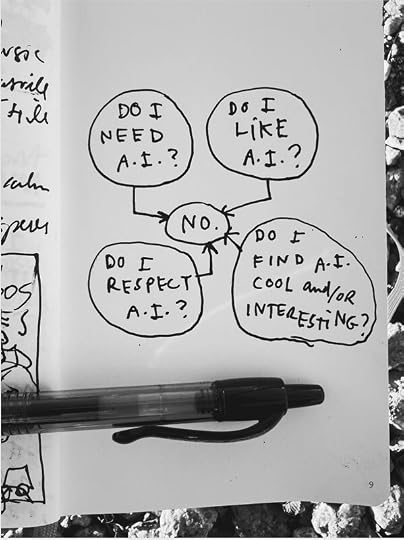
“Make lots of stuff and put it in the world and see what happens,” Austin Kleon told me over #0 breakfast tacos in Austin, Texas back on Chapter 111 of 3 Books. And Austin sure does that well with his Substack and social media (“I use social media as a public notebook”) and endless parade of creativity-inspiring books! The man is a master of the pull-quote and the flow-chart. I remember when he drew this viral one on Instagram earlier this year about AI:
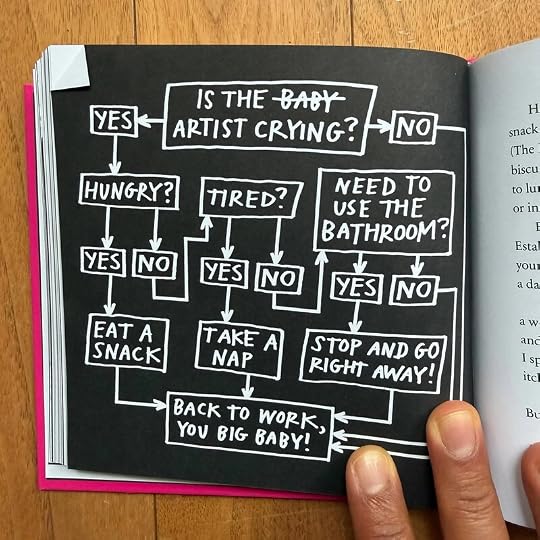
And here’s one that made me laugh from Page 102 of his new book:
Really, there was just one problem with ‘Don’t Call It Art’—I kept stopping and wanting to do something. Work on something. Close the book. Get going! Not a huge problem. But means reading the book in bits and pieces. Which is a fine way to read, of course. Ultimately, ‘Don’t Call It Art’ lowers the stakes and helps you get out of your own way when it comes to making art from your soul—the art you were destined to make. It has fun advice like focusing on quantity instead of quality (“if I sit down to make one perfect poem, I usually get a stiff, crappy poem that I will throw out, but if I sit down and try to make a big stack of poems, I’ll usually find at least one decent stanza in the stack.”) and taking more trips to the library (“The public library is a real space, away from the algorithm, where learning is self-directed, natural, and free.”). A gem.
Short and fun, as I expected based on Austin Kleon’s previous books. It’s not as concise as ‘Steal like an artist‘, but it does the job. I think you can apply the principles not only to things you physically create, but to intangible self-expression too (and indeed, to life as whole).
I enjoyed some of the ideas more, some less, but in general, this parenting mindset is one of the few that speaks to me and stands apart from today’s mostly perfectionist, oppressive approach towards kids.
There are a lot of quotes in the book and it was a bit annoying, because the mention of all the names broke up the flow of the text for me. However, the book reminded me of this George Orwell quote in a similar spirit, so here you go:
“If you want to be a grocer, or a general, or a politician, or a judge, you will invariably become it; that is your punishment. If you never know what you want to be, if you live what some might call the dynamic life but what I will call the artistic life, if each day you are unsure of who you are and what you know you will never become anything, and that is your reward.”
If you want to live the artistic life, this book is pointing towards the right direction. And remember, living the artistic life has nothing to do with being an ‘artist’ in the traditional sense ;)
Do you remember having a child like spark? Do you remember to play and have fun? That’s when creativity happens! It’s so easy to lose track of time. Austin Kleon says his kids were the most creative when they were supposed to be doing something else. I taught art for 45 years and that certainly happened, especially in the enrichment art room. It was full of creative students whose minds popped with energy and often were their most creative when they were supposed to be doing something else. He gives us lessons he has learned from his sons on ways to let your creativity bloom or rebloom. He does suggest getting off-line. Towards the end of my teaching career, too many of my student’s seemed to live online and they would ask what to do next or even what color to use. That didn’t happen early-on (no cell phones); I use to start to give some ideas and before I could even complete a sentence, they would run off to continue to create. Austin, I agree, get offline. Many are saying it is a self-help book and even though I’m no longer teaching, Austin’s tips and ideas reminded me I am still creative and can have fun. As a teacher I was always learning and this quote hit home, “To be a teacher, remain a student.” I was still learning every day in my classroom and Austin’s book reminds me to continue to do that and create. It’s a great read and will become a guide for you.
A huge thank you to NetGalley and the publisher for providing me with an advanced reader copy (ARC) of this book.
Don't Call It Art was a completely refreshing surprise. I went into this read knowing absolutely nothing about Austin Kleon or his previous work, but I came away feeling like I’ve added invaluable new tools to both my parenting and creativity toolboxes.
What I loved most is how practical and immediate the advice is. We have already implemented some of the ideas, like making art materials easily accessible to the kids. This simple shift has led to an explosion of creativity in our house; our collection of drawings is massive, and even our one-year-old is getting in on the action! It has also inspired me to sit down and draw with them. Together, we’re all genuinely improving. Right now, our living room is happily covered in pictures of Princesses, Mario, and Bluey characters.
This is going to be a Day 1 purchase for me when the physical copy releases. I’m incredibly intrigued by Kleon's philosophy and can't wait to dive into his backlist. Highly recommended for parents, educators, or anyone looking to spark a little more everyday creativity.
I really like Kleon’s newsletter, and Steal Like an Artist is truly a great book. The trouble is, and I almost hate saying this, it feels like he’s just writing the same book over and over again. Same shape and size, same format, same basic ideas, just a different color. I’m giving this one 3 stars because I like his writing style, and because the third chapter inspired me to clear off the table in my spare room and set up a creative space. He said in his newsletter, “the sentence I want to hear after a reader reads one of my books: ‘[it] made me want to make things again.’” Which this book did for me.
I have bought all 4 of his books (Steal Like an Artist, I’ve bought 4 times, and given 3 away) as a way of supporting his work, since I don’t pay for a subscription to his newsletter. But this might be the last book of his I buy. Might be time to pay for the newsletter.
(Personal aside: the first bookstore where I looked for this book, I had to ask the guy at the counter. He looked it up on the computer, and then told me, "Yeah, we don't have it. That guy married my ex-girlfriend." No idea if the two things were related.)
‘Don’t Call It Art’ by Austin Kleon is a must-read for all creatives, especially those who find themselves stuck or falling out of love with their pursuits. I’ll definitely be picking up a copy and keeping it in plain sight so I can refer to it whenever I start to take my art too seriously or I’m in need of a creative boost.
In terms of the content, none of the tips are groundbreaking, but they are presented in a way that is clear and memorable, and more importantly, actionable and inspiring. The book is also just fun to read, and I love the inclusion of all the artwork and quotes.
Though geared towards creatives, the tips are useful for life in general as well. I don’t think readers will necessarily learn anything new by reading this book, but that isn’t the point—the point is to unlearn all our bad habits and unhelpful thoughts, and to see the world and to create like we did as children.
Many thanks to NetGalley, Austin Kleon, and Particular Books for the ARC.
Just like his other books, this was a fantastic read! He talks a lot about learning to let go and just going with the flow and working with what’s in front of you. I really appreciated the things that he taught in this book because they were things that I needed to hear. He talks about how it’s OK to quit sometimes to move onto better things. He continues to say that when you quit things once you come back to it you feel a renewed sense of energy towards that thing. I really loved that. It helps me feel a lot better about the path I am going on with my own art. I love the idea of not saying that you’re making art but just saying that you’re making stuff and taking the pressure off of what you’re making. That is what a child does. Their imagination is endless and their freedom to create is endless. I hope to begin incorporating the ideas from this book into my own stuff. I would highly recommend this book to any creative person! There are so many good nuggets of knowledge in here.
Read parenting books to learn how to parent yourself
Were we to meet our inner critic socially, we would think there was something wrong with them - Adam Phillips
“We are all apprentices in a craft where no one ever becomes a master.” -Ernest Hemingway
Our world is awash in information. What it is lacking is wonder. We need to spend more time figuring things out on our own.
“The most mature human beings living are also childlike. That is not as contradictory as it sounds. The most mature people are the ones that can have the most fun.” - Abraham Maslow
Pretend life is a comedy (vs tragedy)
Anyone who’s spent time with little kids knows that if they ask “Why?” more than two or three times, the world suddenly becomes very strange and unknown to you. When approaching a problem, try asking Why five times in a row.
The idea your brain serves up to you when you finish the question “Wouldn’t it be funny if…?” is a gift.
Thank you to NetGalley and the author for letting me read and review this book.
The cover of this book caught my attention, with its bright cover and simple title. Then I read the description and I knew I'd like to read it.
This was a quick and easy read, split into sections so I'd imagine a proper paperback version would be nice to flick through and keep on the coffee table.
I've personally highlighted several parts to come back to-including allowing yourself to quit or move on from something you aren't enjoying (whether it's a book or a project) and not feel any guilt.
Also loved reading about 'wasting time'...... it's easy to feel guilty for not being productive enough and for mucking about/having fun for the sake of it.
This book isn't just about art, but lots of other parts of our life. Family, work etc.
The aim of “Don’t Call It Art” is to open up the reader’s creativity akin to our childhood selves, without the rules and expectation placed on us as adults.
It is a book of lessons and reflections that were fun to read. It made me remember when I wrote poetry and drew pictures, just because I could and not because I was great at it, which I haven’t done for years. Why don’t we make more time for play and creativity as adults?
I enjoyed reading this short book. It’s not quite what I expected from the description, but that didn’t stop me from racing through it, making a few notes on how I can bring more childlike qualities into my day-to-day life, and thinking about who I could buy it for as a gift!
Thanks to Austin Kleon, Penguin Press UK and NetGalley for this ARC in return for an honest review.
A delightful surprise when my library hold came through!
Another great book by Austin Kleon. I read his three previous ones in rapid succession (after discussing Steal Like an Artist with my book group) and I love the way that he approaches his storytelling. These books are great to flip through if you're in a slump, if you've hit a rut, or if you need a laugh. He discovers new ways to be creative by watching how his kids play. I took multiple photos while reading and have shared his wisdom (and the wisdom of others that he mentions) with countless colleagues.
This book was a good reminder to do the things you love and that bring you joy. If a thing (book, project, activity, etc.) is not serving you, put it down and find something else. Give yourself time to play with no expectations. Connect with your inner child and engage in things that would bring them joy.
I dived into this book without knowing anything as it was suggested by a friend. I’m glad I did that. The advice is not ground breaking or unconventional, but it's the sort of advice which can be applied immediately without major changes to our everyday life.
The book is not parenting advice but it's advice the author got from his kids. I thought that’s a unique take and heartwarming too. I felt intrigued in the initial chapters itself. The thoughts with simple words and simplistic art made it more an enjoyable read.
It kinda gave me a nudge to start posting the reviews again tbh. It made me accept the fact that not everything needs to be called ‘art’ and we don’t need to give labels to the things we do and it doesn’t have to be perfect all the time.
I hope to read this on repeat over the next few decades until the chapters hopefully, slowly replace all the negative “shoulds” about doing creative work I’ve had echoing in my head since art school. Thanks for a really wonderful self-parenting book!
I also hope that all of the negative reviewers here keep this book around on their shelves awhile longer, and when they next run into one of the “cliche” problems that “all real artists know how to deal with already” then they return to this book and get a lot more from it. I think cliches only feel shallow and trite until you experience them, then those phrases resound with wisdom and you’re so glad someone vocalized the struggle and it helps you to think about those problems in a new way- like is done in this book!
Delightful! What a sweet little homage to what we can learn from children while reciprocating non-judgemental creativity! I needed this book to encourage me to be ok to fail in creative pursuits- both at my sketchbook and journal but also at work. Docked a star for difference of opinion in the power of visioning. Missed opportunity to reframe as imagination and expanding on letting yourself dream big. Overall very cute and sweet with exercises I am itching to try. I read another review that said this book was reductive but I think they can shut it. Sometimes we adults forget to live a little and create and this was the reminder I needed. I especially loved the recipe of all creative kids (even us big ones) need space +time+materials. BRB while I beautify my office for creativity!
I reckon that Austin Kleon’s Steal Like an Artist, Show Your Work, and Keep Going are some of the best deliveries of accessible, concise advice on how to live and nurture a creative life, both for the things you want to make, and to just live a damn good, creatively fulfilling life. Kleon presents his wisdom in these compact books, all shaped by his blackout poetry and flowcharts that really do drill down to what creative practices and mindsets should be included. Don’t Call it Art takes Kleon’s own children as his inspiration and examines the creative process of kids who aren’t yet bogged down by self-imposed rules, while still offering practical guidance to adult readers. Some rich ideas here.