The spectacular story of the Great Centennial Exhibition of 1876—held in the shadow of a highly contested presidential election that triggered the collapse of Reconstruction and laid the foundations of the Republican Party we know today
“Those who were there felt that the wheel of history itself had turned before their eyes.”
Held at Fairmount Park, in Philadelphia, the extravaganza attracted 10 million Americans—nearly 20% of the population, among them the likes of P. T. Barnum, Frederick Douglass, and Mark Twain—and visitors from around the world, including the Emperor of Brazil, Dom Pedro (who couldn’t get enough of the exhibition). On display were inventions that signaled the changing landscape of American life, from the typewriter to the telephone to Heinz Tomato Ketchup.
This celebration of America’s past 100 years came at a moment when its future seemed more precarious than ever—as big money infiltrated government, Black Americans struggled to exercise their hard-won freedom, underpaid workers waged the first national labor strike, feminists demanded rights for women, and Native tribes went to war to repel the advancing settlement in the west.
In this engrossing, kaleidoscopic history, Fergus Bordewich brings the reader down onto the fairgrounds, animating these converging crises through the lives of four protagonists—Rutherford B. Hayes, Alexander Graham Bell, railroad magnate Tom Scott, and sculptor Edmonia Lewis. Centennial reveals a country in metamorphosis, still striving to live up to the promise of its Founders while bracing for the tidal wave of the twentieth century.
FERGUS M. BORDEWICH is the author of eight non-fiction books: "Congress at War: How Republican Reformers Fought the Civil War, Defied Lincoln, Ended Slavery, and Remade America"; "The First Congress: How James Madison, George Washington, and a Group of Extraordinary Men Invented the Government" (awarded the Hardeman Prize in American History, in 2019); "America's Great Debate: Henry Clay, Stephen A. Douglas and the Compromise that Preserved the Union" (winner of the Los Angeles Times award for best history book, in 2013); "Washington: The Making of the American Capital" (named by the Washington Post as one f the best books of 2008); "Bound for Canaan: The Underground Railroad and the War for the Soul of America (named by the American Booksellers' Association as one of the ten best books of 2005)"; "My Mother’s Ghost," a memoir; "Killing the White Man’s Indian: Reinventing Native Americans at the End of the Twentieth Century"; and "Cathay: A Journey in Search of Old China." He has also published an illustrated children’s book, "Peach Blossom Spring" and has written the script for a PBS documentary about Thomas Jefferson, "Mr. Jefferson’s University." He also edited an photo-illustrated book of eyewitness accounts of the 1989 Tiananmen Massacre, "Children of the Dragon." He regularly reviews books for the Wall Street Journal. His articles and essays have appeared in The New York Times, TIME Magazine, American Heritage, Smithsonian Magazine, the Civil War Monitor, and many other publications. He lives in San Francisco with his wife, Jean Parvin Bordewich.
BORDEWICH WAS BORN in New York City in 1947, and grew up in Yonkers, New York. While growing up, he often traveled to Indian reservations around the United States with his mother, LaVerne Madigan Bordewich, the executive director of the Association on American Indian Affairs, then the only independent advocacy organization for Native Americans. This early experience helped to shape his lifelong preoccupation with American history, the settlement of the continent, and issues of race, poverty, and political power. He holds degrees from the City College of New York and Columbia University. In the late 1960s, he did voter registration for the NAACP in the still-segregated South; he also worked as a roustabout in Alaska’s Arctic oil fields, a taxi driver in New York City, and a deckhand on a Norwegian freighter.
He has been an independent writer and historian since the early 1970s. As a journalist, he traveled extensively in Asia, the Middle East, Europe, and Africa, writing on politics, economic issues, culture, and history, on subjects including Islamic fundamentalism, the plight of the Kurds in northern Iraq, civil war in Burma, religious repression in China, Kenya’s population crisis, German Reunification, the peace settlement in Ireland, and other issues. He also served for brief periods as an editor and writer for the Tehran Journal in Iran, in 1972-1973, a press officer for the United Nations, and an advisor to the New China News Agency in Beijing, in 1982-1983, when that agency was embarking on its effort to move from a propaganda model toward a western-style journalistic one.
We here in the United States are living through a very divisive period. So I was struck by the similarities in this book, a snapshot history of America during the 1876 Centennial in Philadelphia. The same chasm between the rich and poor and working class, racism and voting rights, the fight for women's equality, and an election clouded by cries of election fraud. I know the author is drawing the reader's attention to this, but it's still disheartening. Excellently written and researched, this is a must read for all historians and lovers of history, especially American history.
Thanks to NetGalley and Knopf for the digital copy of this book; I am leaving this review voluntarily.
As someone who can only vaguely remember the Bicentennial in 1976, the history nerd in me realized I had never heard anything about the Centennial. I’ve read several other books about World’s Fairs during the Gilded Age, and the American Centennial in Philadelphia looked to be a similar book.
The Centennial exposition was visited by hundreds of thousands of people from all over the world. There was also a lot going on in the United States at the time. 1876 was a presidential election year, and the results of that election ended Reconstruction. Race relations in the country at the time are studied in this book, as well as women’s rights, too.
The Gilded Age was beginning, and the robber barons were already in full swing in ingratiating themselves into the government, as well as stepping on the backs of the working men and women of the country. Sound familiar?
For all that was happening in 1876, I almost wish that some aspects of the Centennial were skipped. While the narrative style of the book held my interested, and the book is not that long, it still felt a little bloated. I’d still recommend because I have not seen many books on the country’s centennial.
A Showroom Republic “Centennial” follows the engines, statues, platforms, and certificates through which America displayed its first century and betrayed its next. By Demetris Papadimitropoulos | June 7th, 2026
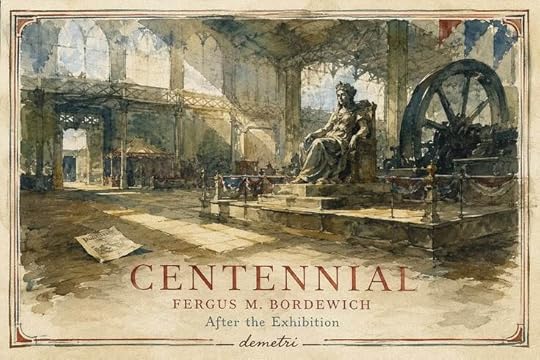
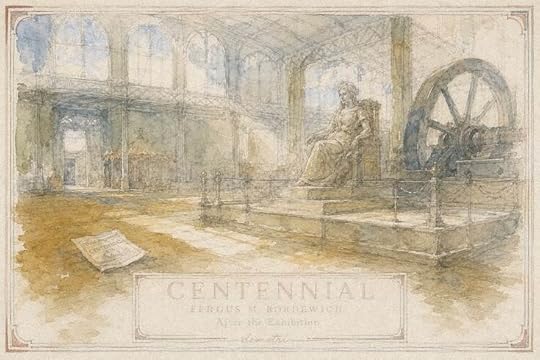
“After the Exhibition” – An emptied Centennial hall, rendered in the cover’s muted blues, ochres, greens, and dusty reds, holds the book’s central afterimage: the wheel still implied, the statue still waiting, the paper trace still on the floor after the birthday pageant has gone quiet.
Deep inside Fergus M. Bordewich’s “Centennial” is the old joke history keeps telling at America’s expense: the country is never more revealing than when it is trying to look its best. In 1876, the United States staged a hundredth-birthday pageant in Philadelphia. It filled Fairmount Park with glass halls, engines, statuary, foreign pavilions, improving slogans, and flag-draped confidence. Then it invited the world to admire the staging and miss the rigging. In Bordewich’s telling, the Great Centennial Exhibition was more than a fair. It was a showroom republic, polished for visitors, crowded with wonders, and smudged, everywhere, by the hands that arranged it.
Every national anniversary is an argument pretending to be a celebration. The Centennial offered engines, goods, culture, reunion talk, and destiny in bunting; Bordewich asks what had to be kept from gate, platform, or program for that story to hold. Ulysses S. Grant opens the fair with Emperor Dom Pedro II of Brazil; the Corliss Engine begins to turn; looms, shafts, belts, and smaller machines answer in obedient chorus. The scene is dazzling, and the book lets it remain dazzling. Then it begins, patiently and with some relish, to unscrew the floorboards beneath the bunting.
Much depends on how Bordewich reads the fairground itself. He does not make the Exhibition a gilt backdrop for Reconstruction, the disputed Hayes-Tilden election, Alexander Graham Bell, railroad capitalism, women’s rights, or the Plains wars. He reads patriotic self-flattery through halls, platforms, engines, menus, and absences arranged almost as carefully as the displays. Machinery Hall, Memorial Hall, the Women’s Pavilion, the opening-day platform, the railroad depot, Frederick Douglass at the edge of ceremony, even the southern-themed restaurant trading in plantation nostalgia – all belong to the unofficial show. The Centennial is not a mirror, exactly. It is a Victorian case packed too full: ornate, instructive, and covered, on close inspection, with fingerprints.
Even the subtitle, “The Great Fair of 1876 and the Invention of America’s Future,” proves less metaphor than shipping manifest. The next century arrives crated and labeled, with wires coiled beside ballots the country has not yet learned – or chosen – to count cleanly. Bell brings voices crossing copper. Scott brings rails, subsidies, freight, and purchased patience. Hayes brings legal form with surrender folded inside. Lewis brings canon formation, neglect, and belated recovery. Nothing here is misty. The future has wires, rails, ballots, certificates, marble, rifles, wages, and compromises.
The table of contents is orderly; the book itself moves like a switchboard. Philadelphia remains the hub, but Bordewich keeps sending lines outward to Ohio, Rome, South Carolina, Louisiana, coal country, conventions, the Montana prairie, and Washington rooms where power changes hands in voices too polished for the damage being arranged. He names four principal figures – Hayes, Scott, Lewis, and Bell – but “Centennial” is not really a balanced quartet. It is a mural with four recurring figures brightened in the foreground while a crowd gathers behind them, impatient to be understood as more than background.
Rutherford B. Hayes gives the book its electoral count and its cleanest chill. Bordewich presents him as decent, conscientious, reform-minded, personally honorable, and dangerously available to compromise. His rise at the Republican convention and eventual one-vote victory over Samuel Tilden supply suspense; his presidency supplies the cost. Federal protection recedes in South Carolina and Louisiana. Black Republicans are left exposed. By the end, Hayes’s moderation no longer looks merely temperamental. It looks like a clean glove worn while something dirtier is being handed over.
In Tom Scott, by contrast, Bordewich finds a figure with more voltage: ingenious, tireless, ruthless, and almost indecently useful to the book. Scott’s Pennsylvania Railroad does not simply deliver visitors to the Centennial. It helps create the conditions under which the Centennial can exist. Tracks, depots, stock subscriptions, lobbying, and quiet payments with loud consequences turn infrastructure into public virtue with a freight office attached. Scott is the book’s less photogenic Corliss Engine: no gleaming ceremonial wheel, just belts and shafts of influence running through Harrisburg, Philadelphia, and Washington. If Bell supplies the romance of connection, Scott supplies the harder lesson that connection can be owned.
Placed beside the book’s colder stories, Bell’s thread throws a wire of light across the room. Bordewich handles him as inventor, teacher, lover, and anxious showman. His reluctant trip to Philadelphia, damaged equipment, nervousness before the judges, and Dom Pedro’s delighted recognition of him make one of the book’s brighter set pieces. The telephone’s first public astonishment has the theatrical neatness of a magic trick that happens to be true. Bell brightens “Centennial,” though at moments his story seems to have slipped in from a sunnier gallery.
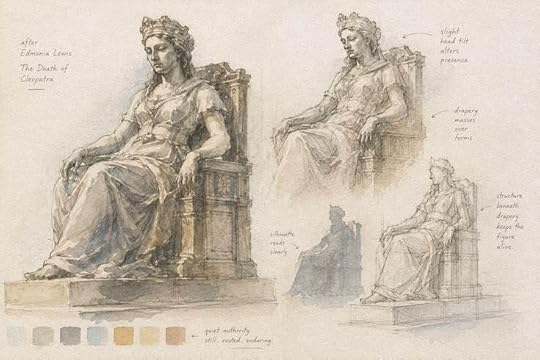
Among the four central figures, Edmonia Lewis is the one the book asks the most of. Her “The Death of Cleopatra” is not simply another artwork in Memorial Hall. It is Bordewich’s counter-exhibit, a sculpture too ambitious, too unsentimental, and too self-possessed for the fair’s easier stories about refinement and uplift. Lewis, Black and Native-identified, self-fashioned and self-protective, pious when useful and shrewd when necessary, arrives as a rebuke to absences arranged almost as carefully as the exhibits. Her Cleopatra is dead, enthroned, and impossible to make cozy. In a book crowded with engines, the sculpture does not move. Everyone else must.
Public ceremony turns wonderfully unstable whenever someone excluded from it steps forward with paperwork. The finest example arrives with Susan B. Anthony’s Fourth of July intervention. As the nation rereads its sacred founding text and congratulates itself on liberty, Anthony and her allies present a women’s declaration that exposes the male ownership of that liberty. Bordewich does not need to embroider the scene. Its choreography does the arguing before he has to. Official history is performing itself on one platform; the excluded arrive with a competing document, correcting the program.
A more consequential turn arrives in the epilogue, “1877, Pittsburgh,” where the bill comes due. The fair closes, the Corliss Engine stops, exhibits are packed away, and Philadelphia’s pageant becomes memory. But the count moves from fairground to Capitol. Hayes takes office; Reconstruction ends not with one theatrical collapse but through withdrawal, calculation, exhaustion, and trust extended to men who had not earned it. Black Republicans who helped rescue Hayes are left outside the bargain that makes him president. The chill is filed, negotiated, and announced.
During that same turn into 1877, Pittsburgh burns. The Great Railroad Strike brings the labor question out from beneath the polished machines. Workers resist wage cuts; militia fire into crowds; railroad property goes up in flames; federal power appears more promptly for corporate order than for Black citizenship. The epilogue narrows the book’s wide canvas into a ledger of consequences. The fair’s machines are no longer only machines; the railroads are no longer only rails. Bordewich moves from ceremonial abundance to the harder settlement of troops, withdrawal, and fire.
If “Centennial” has a weakness, it is the price of overcuration. The book is about an exhibition and sometimes behaves like one: here is the engine, here the sculptor, here the railroad man, here the suffragist, here the coal field, here the ballot dispute, here Custer and the doctrine of progress, here Walt Whitman just off to the side, lowering the barometer. Much of this is richly lit and necessary. A few displays remain illuminated after they have made their case. Bordewich wants every label legible, every object granted its emblematic due.
More consequential than sprawl alone is the way the book’s rhythm becomes familiar: pageant, then pressure; exhibit, then omission; progress, then invoice. The pattern is true enough; that is why it can become visible. One begins to hear the trapdoor already creaking. The four-protagonist frame also promises a balance the book does not really seek. Lewis and Scott carry enormous narrative weight; Bell delights; Hayes governs the constitutional plot. Yet the real protagonist is the network of rails, returns, platforms, troops, and memory. The book is strongest when 1876 overwhelms its chosen lives and the design has the good sense to yield.
Its prose is energetic, tactile, and happily overfurnished. Bordewich’s sentences often move like processions: bands, flags, levers, pavilions, scandals, slogans. That accumulative rhythm suits a book about a fair, where the eye is supposed to be overwhelmed before judgment catches up. He has a good instinct for the object that can carry civic meaning: a lever, a scroll, a depot, a certificate, a train, a corpse in marble. When the prose binds such objects to the larger claim, it has real charge. When it keeps upholstering after the chair is built, one wants to open a window in Memorial Hall.
Tonal control is one of the book’s least noisy virtues. Bordewich does not sneer at the Centennial. He lets its wonder remain real. The fair was astonishing; the inventions mattered; the crowds were not fools for being dazzled; the American appetite for experiment was not merely vanity in a stovepipe hat. The restraint matters because national myths do not endure by being wholly false. They endure by containing enough beauty, courage, and hope to make their omissions dangerous. “Centennial” is most persuasive when praise and invoice arrive together, politely dressed and not especially pleased to see each other.
Rather than leaning heavily on comparisons, one might place the book at a useful angle to a few neighbors. Erik Larson’s “The Devil in the White City” also treats a world’s fair as a dream structure with shadows, but Larson’s menace is gothic and criminal, while Bordewich’s is constitutional, racial, corporate, and procedural. Richard White’s “The Republic for Which It Stands” sits nearer the intellectual neighborhood, though Bordewich is more scenic. Bill Bryson’s “One Summer: America, 1927” offers a year-as-prism cousin, but Bordewich’s wit wears darker shoes.
Of course, readers may divide according to what they thought they had bought a ticket to see. Those looking for a tight fair history may find themselves pulled farther into politics than expected. Those wanting a pure account of the Hayes-Tilden crisis may wonder why they are standing so long among sculptures, pavilions, and machines. Those coming for Bell may get more Scott than they ordered; those coming for Reconstruction may wish the telephone would stop ringing. Bordewich’s claim is that these stories were not separate. The fairground, the railroad, the voting returns, the women’s declaration, the Native artifact case, and Lewis’s marble queen all belong to the same pressure system.
Present-day relevance enters most naturally through commemoration, not through any crude “then and now” machinery. A national anniversary is never only a birthday. It is a claim on memory, an exercise in lighting, an invitation to admire the cake without asking too closely who baked it and who was kept from the table. “Centennial” has an unforced pull for later anniversary seasons, disputed procedures, and debates over public memory, but its relevance does not need to be stapled on. It shows how celebration can preserve evidence against itself.
One reason the book’s limitations feel tolerable is that they resemble the problem it studies. Its crowding, its inventories, its near-compulsive range – these are not accidental blemishes pasted onto a tidy project. They are the cost of writing about a country that, in 1876, tried to display itself as unified, industrious, reconciled, inventive, and free while negotiating the terms of abandonment and force. Bordewich’s book is overcurated because its subject is overstocked with proof. The crowding has to become thought, not inventory. Often, it does.
Under the book’s own terms, I would rate “Centennial” 84/100, or a Goodreads-compatible 4/5 stars. That reflects a book whose gears actually catch, but not one built for compression or perfect control. Its best chapters do more than persuade; they relabel the exhibits. Its weaker habits are those of the overzealous guide who cannot bear to leave a gallery unexplained. Still, Bordewich understands that a fairground is already an argument, especially when everyone insists it is only a celebration.
Long after the official Exhibition has been dismantled, “Centennial” leaves its machinery running. The country has put its engines on view, and its evasions with them. It has shown the world its inventions, and its bargaining habits too. It has praised liberty while narrowing protection, honored progress while disciplining labor, celebrated reconciliation while leaving Black citizens exposed, admired art while failing to know what to do with Edmonia Lewis. The great wheel turns again in Bordewich’s pages – splendid, noisy, beautifully made, and already part of the bargain.
One last after-image belongs to Lewis’s Cleopatra, enthroned in death and too severe to be converted into patriotic uplift. Around her, the fair moves, chatters, sells, boasts, classifies, commemorates. She sits still. Against the engines and railroads, against the wires and returns, against all the confident motion of a country congratulating itself on its direction, Lewis gives Bordewich a figure for everything the Exhibition could display but not quite understand.
So the image that lingers from “Centennial” is not a finished birthday portrait, but a hall being emptied after closing time. The banners come down; the machines are crated; the visitors go home with sore feet and improved opinions of the republic. After the visitors leave, the wheel keeps turning. Somewhere, a certificate is counted, a train guarded, a platform denied, a statue left waiting for its second life. The celebration ends; the evidence remains.
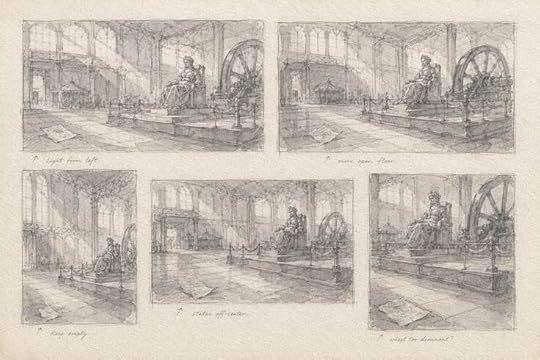
Compositional Thumbnail Sheet – Small graphite studies test how the hall, wheel, statue, platform, and open floor might balance one another before the final image finds its quiet diagonal.
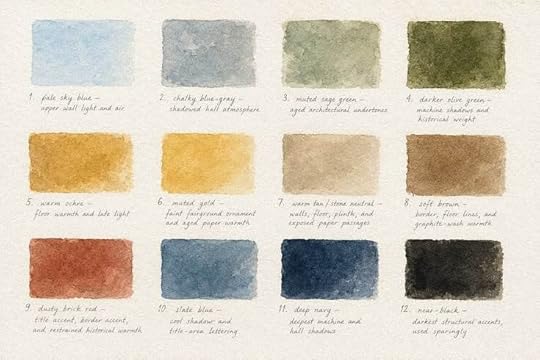
Cover Palette Swatch Sheet – Watercolor swatches translate the book cover’s pale blues, muted greens, ochres, browns, dusty reds, and slate darks into the restrained atmosphere of the final plate.
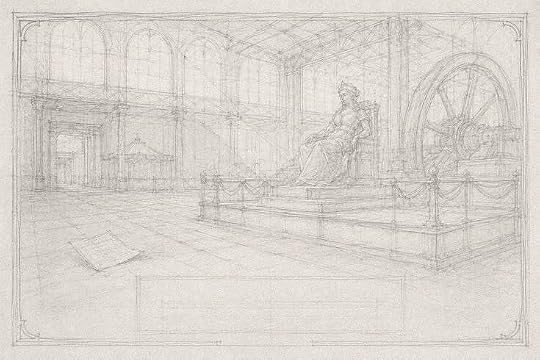
Faint Pencil Underdrawing – Bare construction lines establish the exhibition hall’s perspective, the machine arc, the statue’s silhouette, the paper trace, and the border before the first wash enters.
Pencil + First Wash Stage – The first blue-gray and ochre washes begin to turn scaffolding into atmosphere, leaving paper unpainted where the final image needs breath and afterlight.
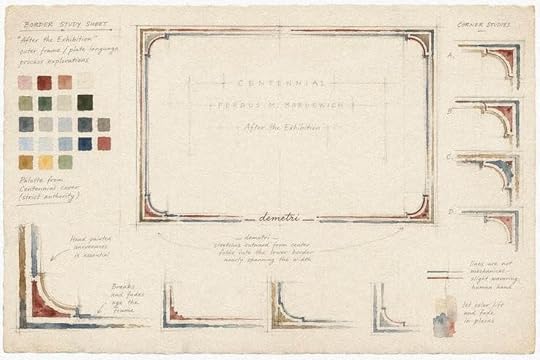
Watercolor Border and Lettering Study – A narrow study works out the exhibition-plate border, the hand-painted title block, and the long “_ demetri _” underline that folds into the frame.
Sculptural Anatomy Study for Cleopatra – Graphite and light wash clarify the seated figure’s weight, drapery, posture, and stillness so the final statue can feel humanly plausible without becoming over-rendered.
[image error] Title and Lettering Integration Study – Graphite guides and muted watercolor trials test how the language can sit inside the plate without turning the image into a poster.
All watercolor illustrations by Demetris Papadimitropoulos. Watercolors are done on 140lb vellum and then scanned into the computer using an Epson scanner. From there, they are finalized in Procreate. All art and opinions are my own.
The great fairs have always fascinated me, and Fergus Bordewich has done an exemplary job not only capturing the innovations of the 1876 centennial fair but also the historical - and contentious - political election of that year. While the fair moved us forward technologically, the election sent us backwards politically and socially for a century. A warning that is as relevant today as it was then.
David J. Kent Author: "Lincoln in New England" and "Lincoln: The Fire of Genius"
Centennial; the great fair of 1876 and the invention of the American future by Fergus .M Bordewich, I have read mini books about great world fairs in our history and the history of other countries and I must say this one was the shortest with the biggest list of what they don’t have as opposed to what they did have and it just left me wanting. they really had no great explanations of any grand exhibits except for the ones that they would point to to show how inferior it was as to how it could’ve been. They had an exhibit for notable females but as the author said it was mostly educated well to do women and not those who work in industrial parks factories sewing houses etc I get it I really do but it seems he would only tell you things so you could see how in comparison it could’ve been that they did ABC. They initially wanted Frederick Douglas to be one of the opening day speakers but in the end got a black pastor to say a prayer instead so as not to offend southern gentlemen and Frederick Douglas was supposed to sit on the Centennial board when he approached the fair he wasn’t allowed in that was notable I get why he put that but in other books they talk about how grand it was like the one about the 1892 fair when the man describes the lights coming on I could feel the awe of the crowd sing electricity for the first time, but this was just like a gossip rag from 1876 he hit all the main players they had many notable things but Mr. Bordewich instead of letting you see it through the eyes of the modern day viewer he make sure you look at it through 21st century lens en I think any good writer would have that expose notes put everything from the Native American exhibit to the exhibit of the black culturist he made certain you saw it through a racist lens with no benefit of credibility for anyone. now let me say this this was a well research book but I think when someone is reading a book like this however problematic we want to see it the way the person of the day saw it and I get it they were racist and did a lot of racist things and the patriarchy was strong and so women just had a small exhibit in the back I get all that but to beat me on the head with so much stuff they should’ve done just really it was only an OK read I love nonfiction but this was just I don’t know I know I’m coming off as a racist and I’m totally not oh so glad we are where we’re at and hopefully getting better I believe everyone has the right to be happy but I just after reading great books about world fairs I was expecting something different, I guess. I mean the worlds fair in 1892 had a hole famous serial killer attached to it and they mention it in the book but we also got to see exhibits through the eyes of the modern day viewer and they do have news papers from modern day but most of them agree with Mr. Bordewich. maybe I’m stating it wrong and not explaining myself the right way I am glad he put those things in the book I just wish we could’ve heard more about Alexander Gram Bell‘s recording machine which he does make one or two comments about that but it’s isn’t made a big deal Love despite it was a big deal back then. That’s what I’m trying to say the things he should’ve expanded on he didn’t show us to tell us all the things that could’ve been but wasn’t. Sorry this is so long #NetGalley,#TheBlindReviewer, #MyHonestReview,
The Great Centennial Exposition of 1876 brought nearly 20% of the nation's. population to Philadelphia, neatly delivered by convenient rail transportation. There were more than 200 buildings of displays, the majority focused on the most up-to-date inventions, agricultural techniques, art and just about anything else you can think of. Some people complained that many of the exhibits resembled jumbled piles of stuff, but most attendees were delighted to see what their country had achieved in its first 100 years.
But Fergus Bordewich tells us that things were actually pretty shaky. The Gilded Age had already begin and big money was wheedling its way into government--or even just charging in, full tilt--weakening the Founders' promises. Following the death of Abraham Lincoln reconstruction was a mess, leaving Black Americans fighting for their place, as Native tribes battled to keep US soldiers out of their places. Labor exploitation was brutal and widespread. Bordewich uses four historical figures to animate the issues--railroad tycoon Tom Scott, inventor Alexander Graham Bell, Presidential candidate Rutherford B. Hayes, and Edmonia Lewis, a sculptor of Black and Native heritage.
If you know anything about fashion history, the 1870s were extraordinarily decorated with fringe, tassels, ruffles, patterns, colors, beading, bustles and you name it. Rooms were crammed with frilly pouffy decorative furniture. From the descriptions it sounds like much of the Exposition followed the same design esthetic.
And so does this book. Fergus Bordewich tries to cover the history, the politics, the Zeitgeist of the time through the event itself as well as by notable attendees and it is overwhelming. Centennial is enjoyable but overstuffed with so much that was going on during this crucial period. Perhaps a longer book is called for.
With the 250th anniversary of the US approaching, there is a lot to learn from this book, some warnings and a few kudos. Timely, readable, and full of period detail, Centennial is an excellent look at the US during the first centennial celebration. Bordewich is a writer to explore.
Thanks to Knopf and NetGalley for a DRC of this book in exchange of an honest review. 3.5 stars rounded up.
As we celebrate the 250th year of independence in the United States, Fergus M. Bordewich takes us back to the 100th celebration in his book, Centennial.
The Great Fair of 1876 took place in Philadelphia and is said to have attracted 20% of the population at the time, roughly 10 million visitors. American innovation was on full display as Bordewich highlights, nearly one hundred patents were being issued every single day by the federal Patent Office. From farm equipment and industrial machinery, to the telephone, introduced by Alexander Graham Bell, and a machine that could calculate twenty difficult calculations per minute called the George Grant Difference Engine. Inventions were all the buzz.
An excerpt from the book; “To see the emerging future was to become part of it. In a sense, that was the point of the Exposition—to demonstrate that the surging tide of American greatness resided in the thousands of dazzling vitrines, the opulence of consumer goods, and the countless pulsating engines that embodied the industrial behemoth the country was fast becoming.”
Bordewich is able to also use the fair to shine a light on the more controversial issues of the day. In this post Civil War era, he highlights the Northern and Southern veterans and attendees and the representation presented by each, to the chagrin of the other. He reflects on the rocky political climate between Republicans and Democrats that Rutherford B Hayes ran his Presidential campaign under, and shines a light on the lack of representation of the black citizens role in America’s success as well as the missing continent of Africa in the World showcases. Susan B Anthony was in attendance with her Suffragettes and Edmonia Lewis submitted her exceptional sculpture, breaking down common generalizations of the time with her gifted talents.
While I would have liked far more details of the fair itself, there was plenty to enjoy from this book.
In this fascinating look at the Great Centennial Exhibition of 1876, Bordewich delves into the history of the exhibition, the many famous Americans who attended the events, and the visitors from around the world who came to witness history. Tracking the celebration of the centennial through the many social, political, and economic changes taking place, the book explores the complexities of converging national crises in Philadelphia as the next century of the United States begins to take shape through these debates and the lives of Rutherford B Hayes, Alexander Graham Bell, Tom Scott, and Edmonia Lewis (and their interactions with the centennial). Informative and detailed, readers will love the lens through which the narrative develops and how these four central figures shape the presentation of the Great Centennial Exhibition. The background conflicts and crises really highlight the turning point the nation was at in 1876, and the historical research really shines through every page of the book. The side figures continue to flesh out the magnitude and importance of the event, while the pacing and structure of the book similarly highlight its importance to national history and culture. A fantastic and readable title, this is a great book for history fans who enjoy people-centric narratives about major events.
Thanks to NetGalley, Knopf, Pantheon, Vintage, and Anchor, and Knopf for the advance copy.
It was an interesting - if somewhat disjointed, read. Perhaps it was just me, and my expectations - I thought I would be reading about the Centennial Fair. Instead, I was reading about politics, labor unions, and an interesting connection between the Molly Maguires (I live near where the Mollies lived) and the great railroad strike of 1877. That's a connection I hadn't put together before now, and I find it very intriguing. Although having studied the mollies, I disagree with a few of his statements - such as the one about there not being documented murders before the Pinkerton agent got involved. More than 50 murders took place in Schuylkill county between 1861 & 1875. More than half were never solved. McParlan arrived on the scene in 1873.
And then a lot about Edmonia Lewis - an absolutely fascinating woman, who perhaps made up her own history, and was being championed for that but at the same time persecuted for her color... I think I'd enjoy a biography of Lewis. I'm not really certain why she was singled out to be included - other than to extend the list of things that were wrong with the world in 1876.
That makes it sound like I did not like this book, and that's not true either. I found it interesting. But it sort of felt like the author didn't decide what he was writing about until about half way through the book, and didn't bother to change the title, nor the beginning chapters of the book, to fit the new topic.
In 1974 we moved to the Philadelphia area. We have fond memories of the excitement and activities surrounding the Bicentennial. We also learned about the Centennial Fair and told Memorial Hall was all that remained. Since then, I have read how exhibits at the fair influenced culture and art. Bordewich’s book took me deep into the political and social turmoil behind the event meant to unite the country.
This book began as the story of the greatest event of America’s Gilded Age, the spectacular Centennial Exhibition of 1876, an extravaganza concocted to celebrate the nation’s first century. It quickly grew beyond the fair’s confines to become a book about America itself. from Centennial by Fergus M. Bordewich
It is a story of “winners and losers in the great American struggle for survival and success” in politics and society. It was a time of technological innovations that would soon change the world.
This history reminds that our country has always been a work in progress, with all the turmoil and conflict that entails.
The 1876 Centennial Exposition in Philadelphia allowed the U.S. to show off. Science, industry, agriculture, and the arts were on display. Thousands of people traveled to see the halls packed with the latest and greatest that their fellow Americans had invented and produced. All the glitter distracted from the tremendous inequities roiling society. Black people were victims of racism in the north, to say nothing of the their persecution in the south. Women's suffrage was dismissed. Native Americans were being subjugated. (The Battle of Little Big Horn was at the end of June, 1876, just a week before the July 4 Centennial.) Working conditions, especially for miners, were dangerous and attempts at collective organizing were soundly (often bloodily) dealt with. The 1876 presidential election was truly precarious.
Historian Fergus Bordewich weaves all the threads together in a very readable and truly informative book.
This book uses the Philadelphia centennial exposition of 1876 to write on various points of American history in that year. It is very topical--but that year had going on, so it's easy to maintain interest.
You could consider the fair itself and the demonstration of Bell's telephone. You had the highly contentious presidential election, which led to a supra-constitutional committee that considered dueling ballots from three southern states, where white Democrats tried to quash black Republican voters. You had race riots and union riots (think: Molly Maguires).
And don't forget about Custer and the Battle of the Little Bighorn! Like I said--a lot going on. The author brings far too many of his c. 2026-era priorities into his writing, but the material is so good that it is only a minor irritation. But a minor irritation is still, well, an irritation; hence the three stars.
I enjoyed this book about the `1876 Centennial. I had never heard of it, so I learned a lot. It took place in Philadelphia, and millions of people from all over the world visited. It showcased lots of interesting exhibits and inventions. The author also explained what was going on in the world at this time. He included topics like women's rights, racial relationships and even a presidential election. I enjoyed reading about all the famous people that attended. I had recently read another book about Edmonia Lewis, so it was fun to read more about her. I recommend this book if you are a history buff like me.
I picked tis book up from the library. I was particularly attracted to the subtitle. Too bad I didn't learn much from reading it. This book provided few insights, and it was not fun to read. Even though the book is subtitled, in part, "the Invention of America's Future", it was barely forward-looking at all. Not recommended.
Short, interesting book about how America was perceived at 100 and how the Great Fair was used to display inventions and national ambitions, while delving into some of the conflicts at the time about racism, sexism, and labor.
I really appreciated the insights about the difficulties of the American story, and how, through all of the ugliness and hurt, there is still so much greatness to behold. There are a lot of examples of how we can do better to all of those around us.
Great book! It touches well on the fair itself, along with the historical events happening across the country during that year and how those events tied into the Centennial fair!
This was such a amazing book filled with history and pictures inside the book! I have always loved the history of Fairs and this was so so interesting and definitely worth reading!