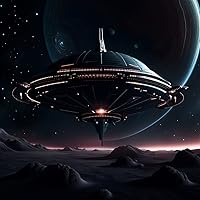
The Darkness Between the Stars is a novella speculating on the possibility of panspermia as the reason why life arose so quickly on Earth 4.2 billion years ago.
Commander Dario Andretti and First Officer Jane McDermott are on board the Horizon Surveyor, searching the Oort Cloud for asteroids left over from the formation of the solar system, hunting for relics from previous star systems. After more than a year in space, boredom is setting in. And then come the voices...
FIRST CONTACT is a series of stand-alone novels that explore humanity's first interaction with extraterrestrial life. This series is similar to BLACK MIRROR or THE TWILIGHT ZONE in that the series is based on a common theme rather than common characters. This allows these books to be read in any order. Technically, they're all first as they all deal with how we might initially respond to contact with aliens, exploring the social, political, religious, and scientific aspects of First Contact.
The Darkness Between the Stars By Peter Cawdron This is a short book from the First Contact series. It has a very unique aliens who connect by whispering to one of the astronauts. Interesting and short.
If you have read any of my other reviews you know that at this point I’m getting dangerously close to being a Peter Cawdron groupie. He churns out new books at an alarming rate (this is book number 32 in his first contact series) and each one is excellent. Not only does he keep coming up with new ideas of what first contact might look like, each book is scientifically based, well researched, and well written. And they keep coming with five already published this year!
The Darkness Between The Stars is the shortest in the series being a novella and coming in at only fifty-six pages. Of course René Descartes “Cogito, ergo sum" (I think, therefore I am)” is only three words in Latin and yet I have been pondering the immense meaning of the phrase since I first heard the quote.
In this latest book, Cawdron addresses the idea of panspermia; the concept that life on earth originated somewhere else in the universe. We know that the early universe contained no elements on the periodic table heavier than iron but once early stars starting exploding the number of elements in the universe increased rapidly. So, could it be that life started in simpler forms elsewhere in the universe and, once it made it to the earth, it had an evolutionary head start. If so, it is possible that our first contact will be with a race of beings far older than life on earth. As always, Cawdron goes into great detail about the science behind the story in his Afterword, which is always one of my favorite parts of his books.
Getting back to the actual story line, I was not as enamored of this Cawdron book as I am of his many others. Part of this is due to its short length which results in the characters not being fleshed out and the storyline truncated. I felt that he rushed to the first contact and left gaps in the background of the earth ship’s mission, the crew, and the technology. The bits and pieces about long space flight, including exercise, vision, fuel, etc. were haphazardly inserted. I am not sure why Cawdron rushed this book out but it really need to marinate a bit longer.
All of that said, I am glad I read it and it has given me new ideas and information to think about. If you are a first time Cawdron reader, please read any of his other first contact books before this one. If you are a long term fan like me, be prepared to be both intellectually challenged but, simultaneously, emotionally disappointed.
First contact sci-fi that evokes feelings of existential dread is right up my alley and this short story did not disappoint.
We are along for the ride with Commander Dario Andretti and First Officer Jane McDermott as they sail through the Solar System aboard the Horizon Surveyor. The only thing I can say is (short story and also don’t want to give any spoilers) if you like sci-fi, you MUST add this to your TBR!
I really hope the last sentence… The End, for now… is true, because I would absolutely read more of these two well written, relatable characters.
The Darkness Between the Stars by Peter Cawdron is my second reading from the First Contract series of books from the author, which is a series of standalone sci-fi thriller novels exploring the concepts of the human races first contact with an alien lifeform.
This short story features Commander Dario Andretti and First Officer Jane McDermott who are piloting a deep space explorer vessel which is searching the galaxy for asteroids left over from the formation of the solar system, when McDermott starts to hear 'voices'. First she considers these to be a side effect of the boredom of a repetitive year of isolation and limited company in Space until she suffers from a 3-day blackout and the voices become clearer so she and Andretti ignore the medical emergency guidance set down and return to the point in space when the voices were strongest, and where the believe the point of origin to be a previously undiscovered dark planet within the far reaches of the solar system.
Cawdron is a detailed writer, ‘sciency’ without overdoing it but with an obvious eye for detailed research. Some of the tech may be a little remote to a casual sci-fi reader and I had to use the kindle look-up facility to explain a couple of the concepts contained in the story (e.g. panspermia) but this doesn't detract from the story and to be honest I quite enjoyed the science led nature thrown in with the mystery thriller elements.
An interesting novella for those who prefer sci-fi with a hint of realism thrown in (hard sci-fi, I think it's referred to?). ⭐⭐⭐ for this outing as it is a little brief to develop the themes further, but a good intro to the series and an author and series I'll dip into again in the future.
Humanity has found evidence of alien life on a jagged chunk of rock orbiting a black planet. The aliens are long deceased, but their consciousness communicates with the two astronauts that discovered the planet and moons on a return trip to Earth from a 3 year mission of exploration. First hearing voices in her head, Jane McDermott thinks that she is hallucinating. Upon discovering the planet, she knows it is the origin of the voices. As they descend to the surface of the moon, her captain, Dario Andretti, hears them also. Long abandoned, 3 aliens told of the destruction of their planet and the fleeing of their race. Overcoming fear, the two races establish an understanding of their differences and commonalities, and the fragility of life as well as its stubborn will to survive. As usual, thought-provoking.
This short little sci fi novella was such a good read! It’s the first book I’ve read by Peter Cawdron and I really enjoyed it. And this isn’t even the most popular of his books.
The Darkness Between Stars takes place way out in outer space. A pair of astronauts are making their way through the Oort Cloud when one of them hears voices being transmitted directly to her. Upon further investigation, they make first contact with an alien race.
I was just so engrossed with this short story, I really wish it was longer! But I’m happy to see this author has written over 35 first contact books, so I’m excited to read some more of his work.
If you like sci fi books, or even if you’ve never really read any, I’d recommend this one. It’s short, so not a long time investment, but really good. If you’re still on a Project Hail Mary high and want to read something else, here you go!
'Deep within the Oort Cloud, life stirs, awakened by the approach of the Horizon Surveyor, an exploration ship from Earth.'
Smart and science-y. There's a crew of two on a research vessel way out in the Oort Cloud. It's a long mission and they're very bored. Then one of them starts hearing voices. This is hard science and the thrill of discovery in a tight 56 page story of First Contact.
'Jane speaks to the darkness beyond the reinforced glass window in the cockpit of the Horizon Surveyor. “Who are you?”'
A short yet pleasant read, it played with the usual tropes and made a pleasant change to them, I recommend it for those wanting a first contact story with a slight twist to it. It has it's problems as the characters are not memorable, given the size sacrifices had to be made, they are more tools to get to the good part, there is a scientific bases for the story, though pseudo it still tries to keep things realistic.
I was going to take a break from this author's collection, but at only $0.99, I figured, "Why not?". I still overpaid. I realize it's a novelette, but I expected more than just three pages of action. If this author would stop writing for quantity over quality, he'd have some amazing books, just based on his ideas. But instead, it feels like a quick-job and info dump.
( Format : ebook ) "From the darkness we thank you."
This author's books, and this is no exception, are always thought provoking as well as.A good story. Did life start before our planet was formed and came here to seed our developing world? Fascinating - a short read but one which will stay with the reader for much longer.
I really liked this short story. First Contact and also exo-archaeology are some of my favourite themes to read in sci-fi, and this story delivers a lot in 56 pages. I liked how the contact was built up as something eerie and ominous in the reader's eye, but then it ends in an unexpected way. I really hope the suggestion at the end of the story that this isn't the end is true!
A small ship exploring the Oort Cloud stumbles into an anomaly—and, no, for a change, it is not an alien starship, but that doesn’t mean that there aren't some aliens—well, sort of, in the area. It is Peter Cawdron, after all. The Darkness Between the Stars is a stylish little novella with credible dialogue between the captain and his first officer. And what a fun twist at the end.
This was an unexpected pleasure to read . Though short it was well done and thought provoking and included a human side to the thought process that was moving and a little scary, as far as what would happy to the characters. Thanks, PC! I will be checking out your other works. That's a promise!
This book Is part of What's referred to as the "First Contact" series. This definitely falls into the category of speculative sci-fi. A relatively short novella, it was well written, and left many questions unresolved. Maybe that is part of what makes it speculative?
I honestly found this novella boring the last half saved it from a one star. I found the ending emotional and sad for the aliens but left hope for the future. Jane was kind of flat as a character and I found dario more interesting and actually having self preservation as I originally thought ut would end with Jane dying to the aliens.
Once you have read several Cawdron books you feel like e you have read them all. Mr Cawdron I challenge you to reach into your inner self and take your stories to the next level Suzanne from Brisbane
I really like the fact that Peter goes into such detail in his books. Makes it hard to put down. If you really like reading about first contacts you'll love this one.
good read.. a little light on plot..good character development...i would recommend a sequel to build aliens characters.. we don't know much about them except they are very ancient..
Simple tale of exploration in the Oort Cloud when an astronaut swears she’s hears voices in her head. Is she crazy or is something out there in the darkness?
Very enjoyable. A great take on first contact with no monster aliens with lasers and mass of hungry fangs. This is measured thoughtful and thought provoking. Recommend.
Love the hard science fiction Cawdron writes, and even though short, very well written. His First Contact stories are all varied and, to me, excellent.
Why twenty? Why is it so hard to believe that life of some sort is out there in the trillions of places in the void? Your science is very good Mr. Cawdron!!