Paul white was an Australian missionary doctor in Africa who learnt to clothe his Bible teaching in fables, creating stories with a timeless quality. When he returned home to Australia his stories were discovered and published to world-wide acclaim. In this first collection, enjoy the first four books in the series, Jungle Doctor and the Whirlwind, Jungle Doctor on the Hop, Jungle Doctor Spots a Leopard, and Jungle Doctor's Crooked Dealings.
Librarian Note: There is more than one author in the Goodreads database with this name.
Paul White was an Australian missionary doctor in Africa who learned to clothe his Bible teaching in fables, creating stories with a timeless quality. When he returned home to Australia his stories were discovered and published to world-wide acclaim.
Jungle Doctor, first published in 1942, is the first in a series of nineteen books by the Australian Christian missionary doctor, Paul White. Paul White became a Christian at the age of 16 and joined the Evangelical Union. He studied medicine at Sydney University, and in 1938 he and his wife Mary went to Central Tanganyika (which now forms part of Tanzania) as missionaries.
Paul White’s medical expertise led him to be put in charge of a hospital as part of the Mvumi Mission. He virtually established this from scratch, as the building had no electricity or running water. He also learned Chigogo and Swahili so that he would be understood by the countless patients who arrived seeking help. He recruited local people to assist him. This book describes the daily events at this hospital; each of the fourteen chapters telling a different anecdotal story. The others follow in kind. They are very entertaining to read, and the style is such that it can be read by adults or young people.
I read virtually all this series as a young teenager, and found them hugely enjoyable and informative. It was a new experience for me to read books based in Africa, depicting African folklore and missionary adventures, and especially interested me since my cousin was a Christian missionary in Africa. It was intriguing to read of surgical operations in the wild using the most basic equipment, and about the indigenous people of what was shortly to become Tanzania.
In all the stories, Paul White is assisted by his friend Daudi Matama, helping with the battle against the village witch doctors. Several stories include moral teachings, and are tales of good winning against evil. Although the stories would strictly be classified as fiction, they are based on fact, as they are based on Paul White’s own experiences. In fact other writers may well have been tempted to present them as highly coloured autobiographical accounts. The author’s evangelism and Christian beliefs are present throughout. These are most definitely proselytising books, and these early editions were initially published by “The Paternoster Press”. Current editions are published by “Christian Focus Publications”. For some this may seem laudable; for others it may equally be a reason not to read them. I shall attempt to review them impartially, which again may be a description which irks you - or something you approve of.
For a non-Christian, the books are interesting as lively tales of life in Africa, missionary adventures, and moral lessons. In fact, the stories may never have been written at all, if Paul White’s missionary career had not been cut short by his wife’s illness. The couple had to return to Australia, along with their two young children, in 1941.
Back at home, Paul White worked part-time at a medical practice whilst continuing to support Christian mission work, and publishing a factual account of his time in Africa. Shortly after this he began writing his Jungle Doctor books, which proved immensely popular. In total, he wrote over 50 books, which have sold over a million copies, having been translated into over 100 languages. He encouraged the development of these into comic books, audio, filmstrips, radio and television. Paul White presented broadcasts on the radio for twenty-five years; the final programme being aired in 1985. He also shared his love of birds with others by producing bird songs on audio.
The appeal of the books is undeniable. Perhaps his early influences played a large part. His father used to tell him stories about his own experiences in the Boer War, which captured the young Paul’s imagination. However, Paul White’s father died of meningitis in an army camp when the author was only five years old. Paul White clearly inherited his father’s storytelling gift, along with a mischievous sense of humour. Once in Africa, he quickly learned that one of the best ways to teach effectively was by means of a story, and that idea stayed with him all his life. Paul White credited his African assistant Dan Mbogoni with helping him to understand how to effectively communicate with his patients, many of whom had only ever experienced the treatment for ailments offered by the local witch doctor.
The village witch doctor’s mistreatment is a recurring theme, and oddly, still topical. I recently watched a television documentary presented by Ade Adepitan MBE, a paralympian athlete, my friend and ex-pupil. Although now a thorough Londoner, Ade spent his first three years in Nigeria, and sadly contracted polio. He travelled back to Nigeria a couple of years ago at some personal risk, to chart the progress of the disease there.
Watching the programme was a real eye-opener. Black magic is still practised, and people are advised by practitioners of this to avoid “white men's magic”. The inoculations are there for all, supported by the government, but polio is still a big threat, because the people are too fearful to have the inoculation. I could feel Ade’s frustration as he tried to get through to these people, the one person from overseas whom they might listen to, as a fellow former countryman and sufferer.
Ade was in danger for his own life more than once. There was an attempted assassination of the Emir of Kano, a school was burned down, and a policeman shot. A week after he returned, nine of the people he had tried to interview had also been shot (Ade had only been allowed to stay in the country for three days). The Islamic extremist terrorist group, Boko Haram, is very active in northern Nigeria, and poverty is rife, so there are many issues to face. There has been some progress, and the country has curently been free of new cases for a year, but the disease still looms over Nigeria, one of only three countries in the world where polio is still a risk (the others are Afghanistan and Pakistan). Back in 2003, a malicious rumour had been spread in Nigeria, saying that the polio vaccine contained a contaminate that caused children to become infertile, and that it was a conspiracy to restrict the population in Nigeria. The government suspended the campaign for nine months while the vaccine was looked at, and Nigeria still has not recovered from that nine month period. Even in the 21st century, we are still not free from supersitition; a fact we may forget in more privileged areas.
This diversion, about a current situation rather than an historial one, and in a different African country, perhaps needs some explanation. As a non-Christian, and someone who has been involved in multiculturalism for decades, I am puzzled to find that I approve of these books. I am therefore trying to square the ethics of a missionary doctor with my own. There is no question that white Europeans have shamefully plundered various countries for many decades, in the colonial past, and the treatment of indigenous peoples is a crime that resonates down the centuries. This is a fact of which Paul White will have been well aware, as a white Australian with European ancestry.
However, I can detect no disrespect in Paul White’s behaviour towards the indigenous people. Their use of “Bwana” is habitual, and indicative of the time, but it is used in a sense of friendship and respect. Given the author’s beliefs, he genuinely attempted to share his faith - and his medical knowledge - freely. Some atheists may argue that he was replacing the witch doctor’s superstitions with another set, but this would be a grossly unfair criticism. Even with such hard-line opposing beliefs, there is room for mutual respect. There is a world of difference in the ethics of most major world religions (except at their most fundamental) and witchcraft.
Witch doctors rely on black magic to gain power, and this manipulative behaviour is what extremists of all types have in common. Paul White does not use his knowledge to do this, although he does view medical work as “the spearhead for the teaching of the Gospel”. For instance, although most of the stories are success stories about healing his patients, on the rare occurrences when there is failure, the Christian words of comfort are used. A now blind boy is told that he will see the light of Jesus, his brother assuring him that “there was still light for one's soul”. The brother of a patient who dies, tells the author that he is now with Christ, in the kingdom of heaven, where they will all be together in glory,
“He's gone to be with God. The disease had gone too far ... But he wasn't frightened Bwana. He knew where he was going ... There is no fear in death when you are a friend of the Lord Jesus, and you know He is waiting to welcome you."
For me these passages are difficult, and meld uncomfortably with the medical work this doctor was doing. Nevertheless, it has to be said that in the books Paul White treats all comers, and the medical treatment takes first priority. It is sometimes then followed by a passage like this,
“Listen my friends ... We do not rely on medicine only. We are here because we know God. We can speak to Him and we know that He will answer. I tell you frankly, my medicines are not enough to save this lad's life unless we have the help of God. Let us ask Him to help us now.”
In the book, which has a cheeky sense of humour, this is immediately followed by “The grandmother spat!” She will have none of it, and stalks out of the hospital grounds. The father of the young boy tells the author not to take any notice but urges him to speak to God.
Paul White shows none of the arrogant colonial attitudes one might have expected from a writer of this time. He comes across more as a spiritual teacher, which is probably how he viewed himself. Despite some reservations, I feel this book is a four star read. I do not plan on rereading the rest of the series, but as far as I remember, it keeps up the standard. I think the books would be excellent for those whose beliefs parallel the author’s. For others of different religious persuasions, or none, I think the values and ethics are sound. These books are still published, and have an enthusiastic following, as they have not dated in any significant way.
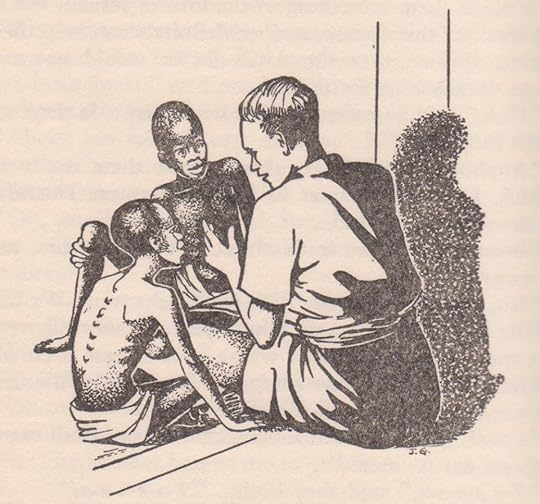
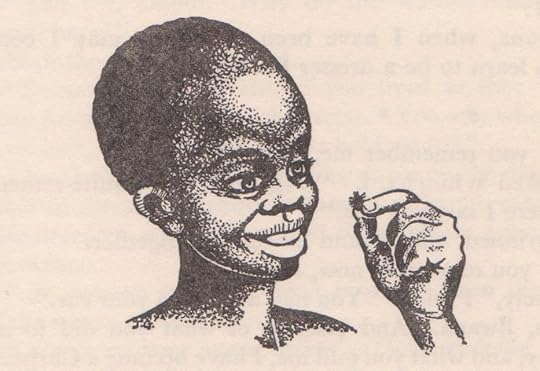
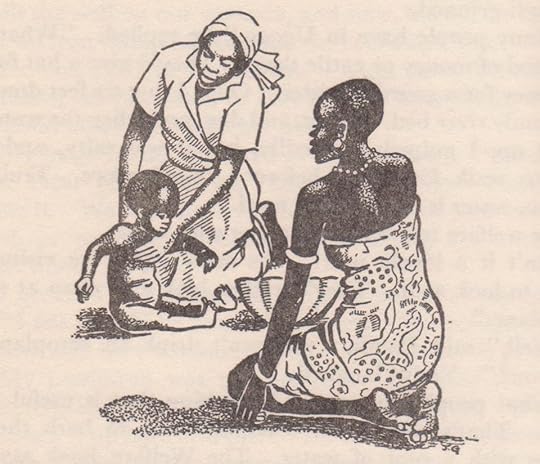
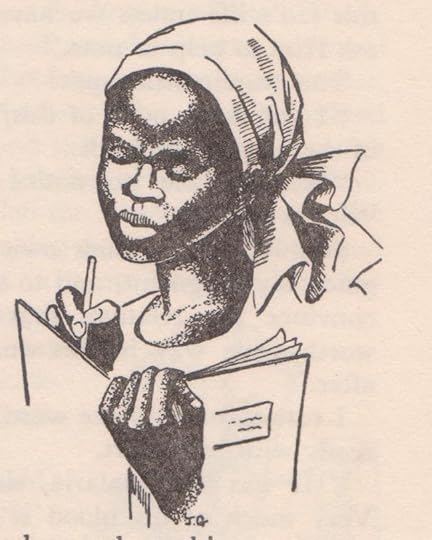
The illustrations in this one are by Joy Griffin; they are good, sensitive, line drawings with much use of stippling to make the shaded areas,
Here is a complete list of Jungle Doctor books:
Jungle Doctor (1942) Jungle Doctor on Safari (1943) Jungle Doctor Operates (1944) Jungle Doctor Attacks Witchcraft (1947) Jungle Doctor's Enemies (1948) Jungle Doctor Meets a Lion (1950) Jungle Doctor to the Rescue (1951) Jungle Doctor's Casebook (1952) Jungle Doctor and the Whirlwind (1952) Eyes on Jungle Doctor (1953) Jungle Doctor Looks for Trouble (1953) Jungle Doctor Goes West (1954) Jungle Doctor Stings a Scorpion (1955) Jungle Doctor Hunts Big Game (1956) Jungle Doctor on the Hop (c 1957) Jungle Doctor's Crooked Dealings (1959) Jungle Doctor Spots a Leopard (1963) Jungle Doctor Pulls a Leg (1964) Jungle Doctor Sees Red (c 1968)
Bog-standard medical reminiscences, one case or so at a time, by an Australian missionary doctor in a remote posting in East Africa. The cases themselves are pretty mediocre, no House level of intrigue here, but the stories about what it was like to live in East Africa as a European in the 1940s are wild and fascinating. Just in the last chapter, they have to cross seventy rivers in twenty-eight miles, and all of East Africa runs out of meningitis treatments, nbd.
Five-star reading experience to my daughter, but that's in part because I'm a missionary kid from Tanzania, and the little background details of which Paul White supplies a wealth launched us into several memories about mosquito nets and tyre punctures and washed-out dirt roads &c., after which we determined that we want to visit Tanzania, but maybe with more reliable transportation than ol' PW.
I've really enjoyed all the books I've read in this series so far, so I was interested to read the one that started it all. After reading this, I can say that the modern editions have done a great job of staying true to the originals! Everything here was the same as I loved in the rest of the series--the honest, often humorous, and always affectionate descriptions of life in Africa without most of the modern conveniences. The dignity and respect shown to the African people, despite the ignorance and superstition that still binds them at times. The simple, beautiful faith of the people, and the attempts of the doctors and missionaries to bring both health and the gospel in ways that they can understand and accept. I especially loved seeing the way that the Africans were able to take things like a confusing portion of the Gospel message or a prescribed way of cleaning a baby, see the reasons why it wouldn't translate well to the African setting, and find an illustration or a process that accomplished the same result in a way that the people would understand.
This book definitely had some sadder moments than some other books in the series, but that is a reality of life at the time...and sometimes just life in general. But I really appreciated the way that the hope of Christ shone through even the darkest moments.
Note that in the newer editions this book is titled "Jungle Doctor's Africa," but the story is the same, with only a few changes and explanations relating to confusing terminology.
Content--mentions of various illnesses/injuries and their treatment; mentions of deaths; mentions of superstitions, witchdoctors, folk medicine treatments, etc.
This book will make you smile and laugh, and it will break your heart and have you in tears. It will also make you grateful for all you have. Jungle Doctor is a touching compilation of cases that will show what can be done when you trust in God, and show you the doors that God opens with others when you live a righteous life.
Amazing! Made me laugh and then cry. I love how the doctors & nurses wove the gospel through their conversations with the people who came to the hospital.
Opening book in the long missionary series about the Jungle Doctor has some interest, historically and missions wise but it is pretty tough going in parts, even for a short book. It felt dated in parts and like a person disguising memoirs as fiction.