

What do you think?

Cat Love
A contemporary dystopian elegy narrated by a cat imprisoned in a Schrödinger’s box, by the prizing-winning poet and memoirist whose writing "cuts to the core with electrifying force" (The Free-Lance Star).
The indelible cat heroine of this unexpected tale recalls her life with “the Mustache,” her beloved owner. Trapped in a one-way mirrored box, displayed in a classroom for people who must contemplate her fate as part of their training to become "Emotional Support Humans," she weaves a self-soothing paean to the poetry, music, and creature comforts she shared with her Mustache—the best products of a society that has gone off the rails in its violence and intolerance.
The trainees in the room, a motley crew our kitty describes with a novelistic flair of her own, are assigned to consider what they feel about her. They also argue about whether there’s really a cat in there, or are they just being manipulated? Their daily required quizzes, reproduced in each chapter, are as poignant and witty as our narrator herself; meanwhile, the mystery of her cat-kidnapping is revealed to us, along with her potential next move on a more spectral plane.
An elegy to freedom, dignity, and connection for all living beings, this slim novel engenders powerful feelings in the reader, as it shows us to ourselves from the other side of the mirror.
The indelible cat heroine of this unexpected tale recalls her life with “the Mustache,” her beloved owner. Trapped in a one-way mirrored box, displayed in a classroom for people who must contemplate her fate as part of their training to become "Emotional Support Humans," she weaves a self-soothing paean to the poetry, music, and creature comforts she shared with her Mustache—the best products of a society that has gone off the rails in its violence and intolerance.
The trainees in the room, a motley crew our kitty describes with a novelistic flair of her own, are assigned to consider what they feel about her. They also argue about whether there’s really a cat in there, or are they just being manipulated? Their daily required quizzes, reproduced in each chapter, are as poignant and witty as our narrator herself; meanwhile, the mystery of her cat-kidnapping is revealed to us, along with her potential next move on a more spectral plane.
An elegy to freedom, dignity, and connection for all living beings, this slim novel engenders powerful feelings in the reader, as it shows us to ourselves from the other side of the mirror.
224 pages, Hardcover
First published June 9, 2026
About the author
Tomás Q. Morín
13 books39 followersTomás Q. Morín is the author of the collection of poems Machete and the forthcoming memoir Let Me Count the Ways, as well as the poetry collections Patient Zero and A Larger Country. He is co-editor with Mari L’Esperance of the anthology, Coming Close: Forty Essays on Philip Levine, and translator of The Heights of Macchu Picchu by Pablo Neruda. He teaches at Rice University and Vermont College of Fine Arts.
Ratings & Reviews
Friends & Following
Create a free account to discover what your friends think of this book!
Community Reviews
Displaying 1 - 30 of 151 reviews

May 11, 2026
In this dystopian world, even empathy has been stolen by capitalism. “The Mustache,” as he is called by his cat, is having a rough go of it—and he’s not the only one. He takes a job as an “emotional support human,” and then his cat is kidnapped. In his story, Morín explores human nature, empathy, and our society through the eyes of the cat. Her memories of the Mustache and what happens after she’s kidnapped and placed in a classroom’s Schrödinger’s box are poignant, poetic prose.
The vast amount of pop culture, poetry, and book references from the cat are a lot of fun. I wish my cats were this intelligent (I think… This cat has a lot of opinions on humanity). It means the story can feel chaotic as our cat heroine quickly jumps from current day to memory and back again, but the payoff is worth it. It’s a book that’s meant to make you think. If you pause and consider the quizzes and take your time with each moment a chapter brings you, there’s a lot to unravel with Morín’s story.
Thank you to NetGalley and Pantheon for the eARC!
The vast amount of pop culture, poetry, and book references from the cat are a lot of fun. I wish my cats were this intelligent (I think… This cat has a lot of opinions on humanity). It means the story can feel chaotic as our cat heroine quickly jumps from current day to memory and back again, but the payoff is worth it. It’s a book that’s meant to make you think. If you pause and consider the quizzes and take your time with each moment a chapter brings you, there’s a lot to unravel with Morín’s story.
Thank you to NetGalley and Pantheon for the eARC!

August 13, 2026
WTF was this. I hated this book. Like actually hated it.
SPOILERS AHEAD SO DONT READ ANY MORE OF THIS REVIEW IF YOU DON’T WANT TO KNOW WHAT HAPPENS. If you don’t care, then keep reading the review.
Spoiler below
Obviously I picked up a book called Cat Love because I love cats. I knew it wasn't necessarily going to be a happy little cat story, but I was NOT expecting this.
This poor cat gets taken away from the person she loves, sold, put into a box for some bizarre human experiment, and then left there without food or water while everyone sits around talking about whether or not there's a cat in the box. Meanwhile THERE IS A CAT IN THE BOX.
And she dies.
I get what the book was trying to do. The cruelty and absurdity are intentional BUT STILL MAKES NO SENSE. It's about empathy and love and human indifference and how people can spend all this time talking about caring without actually DOING anything to help. I get it. I still hated reading it. and why the hell did an actual cat have to be in there for this stupid experiment?!
The quizzes annoyed me. The philosophical stuff didn't resonate with me. A lot of the surreal parts just felt weird and confusing. And mostly I could not stop thinking about this poor cat and how much she loved the Mustache and just wanted to get back home to him.
This sucked.
Justice for the cat. 1 star.
SPOILERS AHEAD SO DONT READ ANY MORE OF THIS REVIEW IF YOU DON’T WANT TO KNOW WHAT HAPPENS. If you don’t care, then keep reading the review.
Spoiler below
Obviously I picked up a book called Cat Love because I love cats. I knew it wasn't necessarily going to be a happy little cat story, but I was NOT expecting this.
This poor cat gets taken away from the person she loves, sold, put into a box for some bizarre human experiment, and then left there without food or water while everyone sits around talking about whether or not there's a cat in the box. Meanwhile THERE IS A CAT IN THE BOX.
And she dies.
I get what the book was trying to do. The cruelty and absurdity are intentional BUT STILL MAKES NO SENSE. It's about empathy and love and human indifference and how people can spend all this time talking about caring without actually DOING anything to help. I get it. I still hated reading it. and why the hell did an actual cat have to be in there for this stupid experiment?!
The quizzes annoyed me. The philosophical stuff didn't resonate with me. A lot of the surreal parts just felt weird and confusing. And mostly I could not stop thinking about this poor cat and how much she loved the Mustache and just wanted to get back home to him.
This sucked.
Justice for the cat. 1 star.

August 31, 2026
If you've ever wanted to hear Schrödinger's cat narrate her (after)life and all the people/places/things she loved, then 1. you're depressed as fuck and 2. this book is absolutely for you.

August 2, 2026
All the orange flowers for this kitty 🐈
4.5
4.5
June 21, 2026
I cryed 🥹

June 22, 2026
Quick and engaging story with a conclusive ending. However, the attempted humor was a major failure to me. Worse than dad jokes, I could just feel the author trying to be quirky and funny, which really turns me off. Also while it is a complete story, I couldn't immediately identify a point to it. What was it trying to say? Yes he successfully pointed to failures of modern society: capitalism, prison systems, pity, but then what about it? I expect more from a philosophical premise than just pointing at things and saying "and think about that!" It was almost getting somewhere with its focus on empathy, but didn't quite manage to bring it home. Nothing is unpacked or chewed. If the goal is just entertainment, well fine, I guess. Things happen and then stop happening.
From the synopsis I was hoping this would be a more serious, deeper, and more philosophical story. The premise was there, but the execution was not.
Also, another personal opinion, but the title and cover make it seem like a "Facebook Mom" kind of book and doesn't do it any favors. I'd be embarrassed to be seen reading this without context.
I know my opinions aren't mainstream, but it makes me want to know more about the people that are giving this 5 stars. What do they read that this is as good as it gets? This thought alone is more philosophical than this book ended up being; I'll think about this for months.
From the synopsis I was hoping this would be a more serious, deeper, and more philosophical story. The premise was there, but the execution was not.
Also, another personal opinion, but the title and cover make it seem like a "Facebook Mom" kind of book and doesn't do it any favors. I'd be embarrassed to be seen reading this without context.
I know my opinions aren't mainstream, but it makes me want to know more about the people that are giving this 5 stars. What do they read that this is as good as it gets? This thought alone is more philosophical than this book ended up being; I'll think about this for months.
January 29, 2026
I genuinely can’t tell if this book went over my head or if it was just poorly executed. It was definitely weird. Some parts were very obvious in their intentions, while others felt unclear. The cat behavior, however, was great. As a cat lady, those sections rang true and were easily my favorite moments. While I don’t think this book was fully for me, I can appreciate what it was trying to do and wouldn’t call it a bad read, just an unusual one that may resonate more with the right audience.
Thank you NetGalley for the eARC
Thank you NetGalley for the eARC

June 19, 2026
What the fuck did I just read

July 1, 2026
It's just not the time for me to read a book this sad. I have way too much empathy.

August 26, 2026
This was not exactly what I expected based on the summary I originally read, but it was still a good read. It took me until about two thirds of the way to really begin to enjoy it to the point I didn't want to stop reading and then it ended far too quickly. And not in a good way, which is why I suppose I'm only giving this a like and not a really like. Otherwise, I do appreciate a lot of the messages here, the history and character building, and the music taste.
Read
June 29, 2026Beautiful, weird, and heartbreaking. I loved this.

June 24, 2026
I get where he’s going with this. Maybe it’s a little Meta for my taste. He’s obviously a cat lover, but any idea of harming an animal in a horrible experiment made it really difficult for me to read this book.
September 13, 2026
Well. What a strange journey this small novel has been. I started out hating it because it made absolutely no sense to me. Thought it was "above me," that I was just missing something. When , halfway through, it became clear what was going on, I did a 180 and consider it one of the most touching stories I have read of late. No desire to go back to the beginning to see if I could make sense of it. I want to leave it with its ending.

June 9, 2026
what’s in the box? schrödinger’s cat!
of all the books i’ve read where the cat is the witty protagonist, this is one of the better ones.
i will say that many of the pop culture references i was not familiar with, but regardless i found the cat and its tastes to be endearing.
i found the quizzes and other ethical questions formatting to be unique. i really enjoyed trying to answer them and also guess what the “correct” answer would be for an “emotional support human.”
of all the books i’ve read where the cat is the witty protagonist, this is one of the better ones.
i will say that many of the pop culture references i was not familiar with, but regardless i found the cat and its tastes to be endearing.
i found the quizzes and other ethical questions formatting to be unique. i really enjoyed trying to answer them and also guess what the “correct” answer would be for an “emotional support human.”

June 24, 2026
Another great emotional book. Made me want to hold and hug my cat.

July 14, 2026
Morín did a remarkable job visualizing the thought experiment and bringing it to life for readers. I can applaud his accomplishment while also recognizing that I might not have been the right audience for this one. It made me very sad, but it didn’t do a lot for me beyond that.
However, I did love that it was all shown through the cat‘s perspective. Morín succeeded in making her feel very much like a real cat as she told her story. 😺
I am immensely grateful to Pantheon Books, NetGalley for my copy. All opinions are my own.
However, I did love that it was all shown through the cat‘s perspective. Morín succeeded in making her feel very much like a real cat as she told her story. 😺
I am immensely grateful to Pantheon Books, NetGalley for my copy. All opinions are my own.

July 16, 2026
I genuinely don't know what I read.
On paper, "Cat Love" sounds delightfully strange — a calico cat recounts her life with her beloved owner after being kidnapped and placed in a one-way mirrored box where trainees at an Emotional Statistics School debate whether she's even real.
Then it wandered off in every possible direction. The cat is apparently dead and haunting people. She gets green fur and an armadillo shell. At one point she's talking to an aborted fetus. There's a lengthy discussion about Italian cows versus American cows. It starts reading like a novel created with Mad Libs.
The quiz interludes between chapters — pointed questions about empathy and desensitization — are the most interesting thing in the book. The final chapter is genuinely moving, but everything in between is a fever dream.
I still don't know how I'd explain this book to someone else. I think this review is still going because I'm still trying to explain it to myself.
On paper, "Cat Love" sounds delightfully strange — a calico cat recounts her life with her beloved owner after being kidnapped and placed in a one-way mirrored box where trainees at an Emotional Statistics School debate whether she's even real.
Then it wandered off in every possible direction. The cat is apparently dead and haunting people. She gets green fur and an armadillo shell. At one point she's talking to an aborted fetus. There's a lengthy discussion about Italian cows versus American cows. It starts reading like a novel created with Mad Libs.
The quiz interludes between chapters — pointed questions about empathy and desensitization — are the most interesting thing in the book. The final chapter is genuinely moving, but everything in between is a fever dream.
I still don't know how I'd explain this book to someone else. I think this review is still going because I'm still trying to explain it to myself.

June 20, 2026
A weird as hell book told from the perspective of the imprisoned Schrödinger's cat. The cat is trapped in this fully mirrored box she can't see out of, and people can't see her in it. She's being imprisoned as part of an experiment to train people to become "Emotional Support Humans."
The people taking this class contemplate her fate and whether there's actually a cat in the box or not. I didn't expect this book to be melancholic. It raised some bittersweet feelings as we went through the cat's journey. I tend to find books told through the perspective of an animal hit or miss, but I was able to follow along easily with this one. It never strayed too far into magical realism or a "fever dream" setting. A dystopian book that explores humanity, compassion, capitalism, and intrinsic violence in the world.
The people taking this class contemplate her fate and whether there's actually a cat in the box or not. I didn't expect this book to be melancholic. It raised some bittersweet feelings as we went through the cat's journey. I tend to find books told through the perspective of an animal hit or miss, but I was able to follow along easily with this one. It never strayed too far into magical realism or a "fever dream" setting. A dystopian book that explores humanity, compassion, capitalism, and intrinsic violence in the world.
July 6, 2026
A beautiful and poignant fusion of novel and poetry. Cat Love is filled to the brim with pop culture, charming quirk, and soul-grabbing poetry. Some may find the millennial humor cringey (one of the main characters is just called “The Mustache”), but it’s done with such sincerity that it quickly becomes endearing. Contrasting with its dystopic setting, Cat Love’s twee style and “love conquers all” messaging feels at once nostalgic and defiant of our present era of irony and bitterness.
If you liked the episode of Futurama where Fry finds his dog Seymour, you’ll like this book.
If you liked the episode of Futurama where Fry finds his dog Seymour, you’ll like this book.

August 14, 2026
4.5
LOVED the characterization of the cat, she was so fun, whimsical through her memories, and lovingly murderous for "My Mustache." I am going to go cuddle my cat tonight so much.
Also, Mustache did nothing wrong and I stand by that statement forever.
LOVED the characterization of the cat, she was so fun, whimsical through her memories, and lovingly murderous for "My Mustache." I am going to go cuddle my cat tonight so much.
Also, Mustache did nothing wrong and I stand by that statement forever.
September 14, 2026
I think the author is secretly an actual cat.
All jokes aside, the book went a direction I was not expecting but am very pleased by. The story is creative and truly one of a kind. I need more books with cats as main characters in my life.
All jokes aside, the book went a direction I was not expecting but am very pleased by. The story is creative and truly one of a kind. I need more books with cats as main characters in my life.
July 19, 2026
Easy to get through but weird

September 25, 2026
Who would ever have thought we would have a story from the POV of Cat who finds herself in Schrödinger’s box. This cat is super sassy and bad*ss. The story very much feels like you’re in the mind of a cat.

Review of advance copy
A Very Offended Ghost Cat Explains the Problem with Civilization
Tomás Q. Morín’s “Cat Love” is a comic elegy with claws, opinions, and an empty bowl at the center of its moral universe.
By Demetris Papadimitropoulos | June 7th, 2026
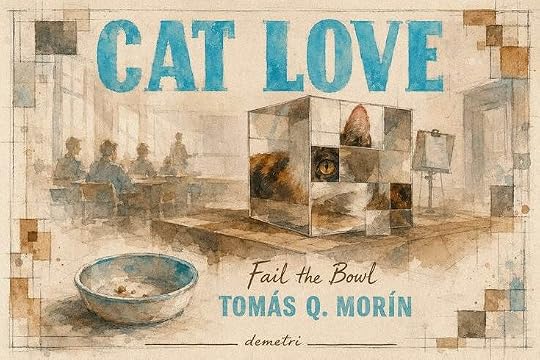
“Fail the Bowl”: The emblematic watercolor for “Cat Love” places the bowl before the box, turning Morín’s famous thought-experiment reversal into a spare visual accusation: feeling has been studied, framed, and certified, while the creature’s thirst remains unanswered.
Dead cats are most useful to philosophers, which is one of the complaints “Cat Love” brings against us, hiss included. Schrödinger’s cat has spent nearly a century as an abstraction with fur: neither alive nor dead until observed, famous less as a creature than as a convenience. Tomás Q. Morín begins by returning stolen property to its owner: the cat gets herself back. He gives her the floor, and she immediately starts taking inventory. She is hungry. She is thirsty. She is vain, profane, funny, frightened, armed with opinions, and in love with the man she calls the Mustache. She would like her water bowl filled correctly, her litter smoothed to professional standards, and the world to stop mistaking attention for care.
Everyone in “Cat Love” is, in some way, grading feeling while the bowl stays empty. The cat has been kidnapped and sealed inside a mirrored box for an “Emotional Statistics” course, where students in protective gear study her condition as preparation for becoming Emotional Support Humans. The joke starts absurd, and then one notices the teeth. The course has quizzes, equipment, rules, certificates, and the tidy confidence of people who believe a form can hold a living creature still. Inside the box, however, is not a lesson in feeling. Inside the box is a cat whose throat is dry. The whole accusation is already there: a culture can laminate feeling and still fail the bowl.
Morín’s premise could have behaved like a tidy little premise-machine: take the famous thought experiment, make it literal, let the animal talk back, wait for the cleverness to purr. “Cat Love” is less mechanism than creature rattling inside one. Its narrator is not a classroom problem with whiskers attached. She has a past: kittens, owners, appetites, beds, grudges, songs, films, poems, and a beloved human whose lap gives the day one of its fixed places. Her happiest years were with the Mustache, a shoe salesman and secret poet who writes on blank receipts, listens to blues and Coltrane, reads to her, feeds her carefully, and receives her affection with the gratitude of someone not entirely practiced at being loved. Their attachment is domestic, repetitive, nearly liturgical: bowl filled, litter smoothed, music on, hand lowered, lap made available to the little monarch.
Even the kidnapping is intimate enough to accuse. The neighbor boy who betrays her knows her habits. He smooths the litter correctly. He fills the water to the level she requires. He washes and dries the bowl marked QUEEN. Then he lures her into the carrier with catnip and sells her to the man in the tacky trench coat. It is one of the book’s sharpest moral traps: tenderness and treachery carried out by the same small hands. Morín understands that cruelty is more frightening when it has learned the household rituals.
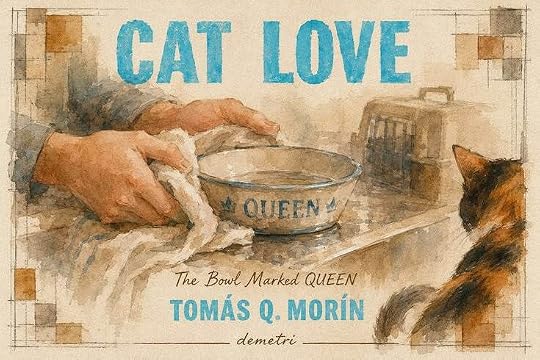
“The Bowl Marked QUEEN”: In this early pivotal watercolor, the boy’s careful hands and the bowl marked QUEEN hold the book’s most intimate betrayal: care has learned the cat’s rituals before it sells her.
The cat dies in the box. The novel does not smuggle her out through a last-minute trick, and that refusal keeps the book from becoming one. She discovers her own dead body and curls around it, grieving the creature who will never again sit in the Mustache’s lap. Then the story enters a second life bright with impossible colors. The cat becomes an alebrije-like spirit with green fur, orange toes, and a blue shell, able to pass through walls, memory, and a glowing orange-flower realm. Death does not free her from the body. It makes her miss the body more sharply: the food it wanted, the water it lacked, the hand it knew.
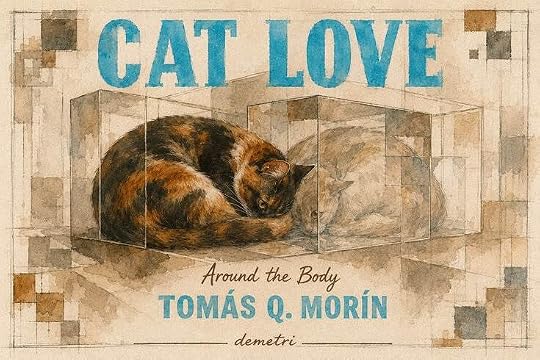
“Around the Body”: This hushed doubled image marks the instant when the clever premise can no longer protect itself from consequence, as the cat curls around the body the box has made real.
Rather than marching through plot, “Cat Love” stalks, doubles back, sniffs at a culprit, disappears into memory, and returns with another hair at the scene. The cat follows students, discovers the woman who bought cats for the boxes, trails the neighbor boy to the hospital room of Bonaparte, the trench-coat man, and finally finds the Mustache in jail after he has attacked Bonaparte in grief and rage. Some episodes earn their oddness; others drag in extra chairs: Emotional Support Humans, Pity Party Planners, a prison program involving an egg, a spectral cowgirl guide. The satire can be broader than the grief requires. Still, the wound keeps its shape. Who saw the suffering? Who profited from it? Who regretted it? Who opened anything?
It is tempting to call the narrator anthropomorphic, but the word does not quite catch the trick. Yes, she knows “Moby Dick,” Vermeer, Michelangelo, Clint Eastwood, Sondra Locke, jazz, blues, poetry, and more than one human institution she would be happy to scratch until the stuffing shows. At moments she sounds like a tiny essayist with claws, which is both pleasure and risk. Yet the best passages do not simply dress a human intelligence in tortoiseshell fur. They keep interrupting her brilliance with thirst, hunger, scent, wet fur, meat, catnip, and the insult of a dirty bowl. Her erudition may be extravagant, but her needs are not.
Prose is the cat’s proof of life. Morín writes in a first-person rush of insult, memory, appetite, aesthetic judgment, and lyric recoil. The sentences can arrive as clipped swats, then lengthen into riffs, as if the narrator’s attention were pouncing, circling, vanishing under the sofa, and returning with something mangled and meaningful. The diction keeps changing collars: barroom mutter, poetry shelf dust, animal sensation, prayer, stand-up aside, elegy. The cat can move from Coltrane to kibble without changing her one demand. She is always asking what it means to have had a world.
At full volume, the narration is the book’s evidence and its trouble. The cat is dangerously good company: the extra riff, the prolonged tangent, the joke that stretches one paw past its landing. Not everything needs the full flourish. Occasionally the overcrowded brilliance presses too close to the wound. There are moments when grief seems to have brought the whole record collection to the water bowl. Still, the excess is not incidental. The cat has too much in her to be filed away: appetite, taste, fear, memory, rage, and a splendidly low tolerance for fools.
Part of the book’s wit lies in refusing the solemnity its premise seems to invite. A cat in a death box is terrible. A cat in a death box who also has strong opinions about Michelangelo’s torsos, “The Gauntlet,” and the indignity of wet fur is less stable and more alive. Morín’s humor is not a release valve. It is a pressure gauge. Each joke shows how much personality must be ignored before an animal can be filed as a lesson. The cat’s asides do not distract from the horror. They thicken the life being wasted.
A glance at two nearby books helps, though neither quite houses this creature. Henry Hoke’s “Open Throat” offers another hungry nonhuman witness moving through human disorder; André Alexis’s “Fifteen Dogs” turns animal consciousness into a philosophical wager. Morín is less spare than Hoke and less cleanly fable-like than Alexis. “Cat Love” is messier, more allusive, more bodily, and more willing to risk sentiment because the cat is not an idea. It is not the kind of cat book that curls up politely. Readers arriving for whiskers and comfort may find a mirrored chamber and a very offended ghost.
Daily quizzes make a second box out of paperwork. They are funny, absurd, sometimes pointedly ridiculous, and they keep returning the reader to the institution that has converted the cat’s suffering into coursework. They also save the novel from becoming only a flood of feline consciousness. The quizzes ask students to classify, choose, process, react – anything but interrupt. Their failure is built into the repetition: they keep asking what people feel while nobody opens the box.
Inside the ten-day frame, the quizzes keep failing in the same way. They ask. They repeat. They do not interrupt. The course gives the book its memorable architecture, but the middle wanders by design and sometimes by indulgence. The hunting trip, Gladys’s house, Teddy’s hospital visits, the jail and prison sequence – each adds pressure, though not every detour cuts equally deep. What rescues the sprawl is the way the ledger of harm keeps getting smudged. Teddy sells the cat, then reads to Bonaparte with real devotion. The Mustache is the gentlest figure in the cat’s life, then commits a brutal act. Mercy, the novel insists, is not distributed according to neat categories of guilt.
More than empathy, the book cares about attention that becomes practice: bowl, bed, water, shelter, lap. The Mustache’s love is proved not by declarations but by acts so small they almost disappear: the right food, the clean bowl, the exact water level, the smoothed litter, the poems read aloud. The cat’s later love becomes stranger and darker. She watches over him in jail and prison. She protects him from a threatened killing by haunting Randy, entering his dreams, terrifying him, and biting off part of his ear. This is not soft mercy. It is love with claws, and the book is wise enough not to file them down.
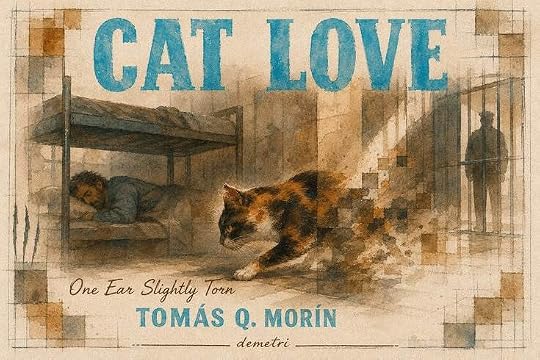
“One Ear Slightly Torn”: The prison watercolor gives Morín’s tenderness its rough edge, showing love after death not as consolation but as vigilance, dream, claw, and the small torn proof of protection.
If the novel has a price, it is the price of carrying this much furniture. Measured feeling versus actual care. Credentialed emotion versus the opened box. Emotional Statistics, Emotional Support Humans, and Pity Party Planners are memorable satirical inventions, but they can arrive underlined. The book’s moral contrast is sharp; sometimes the lamp shines directly on the blade. It asks less to be decoded than followed. That keeps it shy of greatness, not short of force. Its voice and ending have more staying power than some of its machinery.
The book is most contemporary where it stops pointing outward. We live among systems eager to certify care, measure emotion, process grief, monetize comfort, and turn vulnerable bodies into data, lesson, content, or instrument. “Cat Love” exaggerates that world into farce, then asks a question older than any of its furniture: when a creature suffers in front of us, do we open the box, or do we explain how we feel about it? The joke is contemporary. The failure is ancient.
Rating a book this odd feels a little like offering a performance review to a weather system; still, numbers can be useful when they do not pretend to be final: “Cat Love” earns an 84/100, which translates to 4/5 Goodreads-compatible stars. That score reflects a novel I admire more for risk than polish. Its voice and ending are stronger than its pacing. Its premise is sharper than some of its satirical extensions. Its emotional intelligence is deeper than its occasional cleverness. It is a strong book, not a flawless one, and the distinction helps. Some cats are better loved with one ear slightly torn.
On the ending, Morín makes his bravest refusal. The cat is not saved. The box remains a fact. The death is not revealed as dream, illusion, or reversible trick. Instead, the novel follows the Mustache through imprisonment, release, aging, new love, children, and the long continuation of a life that once seemed broken beyond repair. The cat stays near him until he no longer needs her in the same way. Then she finds her own afterlife: an Italian barn, cows, hay, rain, milk given freely, and a tempo of being untouched by quizzes.
Past the classroom, the ending works because it lowers its voice. The novel does not imagine heaven as splendor. It imagines heaven as corrected scale. After the mirrored box, there is space. After the classroom, weather. After observation, companionship without experiment. After thirst, milk. The Mustache eventually arrives after his own long life, and the reunion moves precisely because the book has refused all cheaper consolations. Love has not prevented loss. It has endured as memory, guardianship, and the hope of being recognized again.
Overfullness remains the fair objection. The cat knows a great deal, says a great deal, and sometimes circles a thought already neatly killed. The dystopian furniture can creak, especially when the labels face outward. The bag of tones – animal suffering, stand-up complaint, literary allusion, ghost story, prison threat, pastoral afterlife – will send some readers under the sofa. Those who want quiet realism may retreat. Those who want pure satire may find the ending too soft. Those who want tidy tenderness may wonder why the cat has such strong feelings about cinema. Yet the division seems built into the project. The strangeness is not decoration. It is the price of this particular aliveness.
Underneath all the invention, “Cat Love” is about the old scandal of being loved by a mortal creature. Pets make theologians of ordinary people without asking. They turn routine into liturgy, then leave behind bowls, beds, habits, and the awful grammar of absence. Morín understands that an animal’s life is not small from inside the fur, and not small to the person who has learned its rituals. The cat’s grandeur comes not from being secretly human. It comes from being fully herself in a world that keeps trying to make her illustrative.
Love, here, is not a clean noun. It is appetite, annoyance, vigilance, vanity, violence, memory, and the absurdly exact labor of knowing how another creature likes the world arranged. The title sounds almost mug-ready; the novel earns it by making love less cute than accountable. Cat love is partial, demanding, hidden, bodily, and fierce. It does not solve suffering. It does not make the box disappear. It remembers who was inside.
One image stays under the skin even more than the cat in the mirrored box, though that box is the small engine of accusation. It is the barn at the end, where the machinery of feeling has fallen silent and the world has become animal again: cows chewing time, hay dark with rain, milk offered without coercion, the Mustache sitting beside the cat after years and years of human life. The thought experiment has been answered, but only after the question has done its damage.
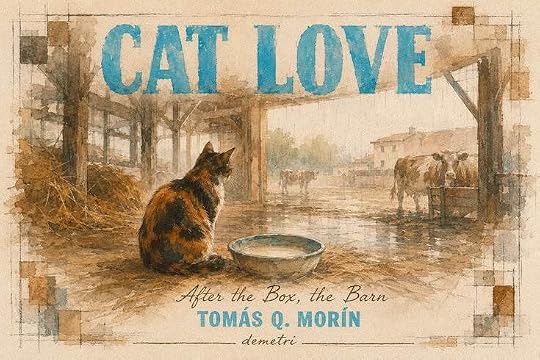
“After the Box, the Barn”: The closing watercolor opens the review’s visual field into hay, rain, cows, milk, and the Mustache, answering the mirrored box with space that does not erase what happened inside it.
So the final answer is not philosophical, and not tidy. The cat was alive. The cat was dead. The cat was loved.
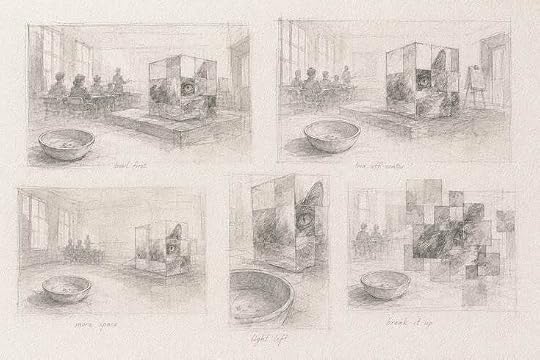
Compositional Thumbnail Sheet: Small graphite studies test the image’s moral geometry – whether the eye should move first to the mirrored box, the partial cat, or the empty bowl that finally carries the accusation.
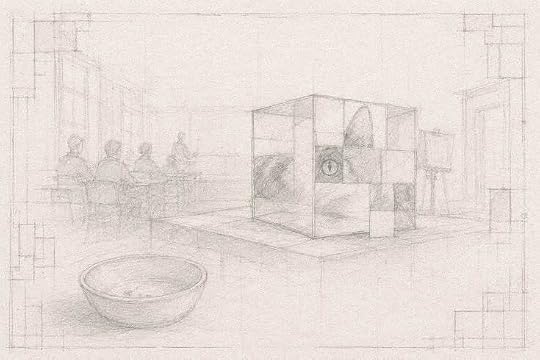
Faint Pencil Underdrawing: The bare perspective lines, box edges, bowl ellipse, and incomplete border show the watercolor before atmosphere arrives, when the room is still only a system waiting to fail.
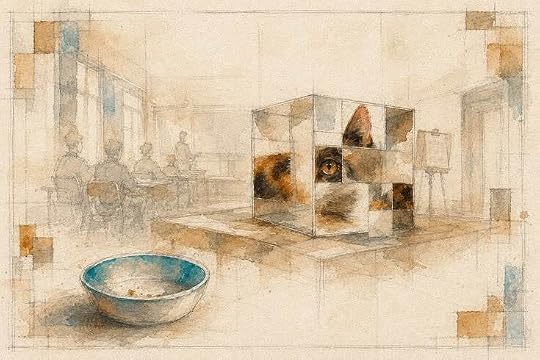
Pencil + First Wash Stage: The first pale washes bring institutional air into the drawing, letting cream paper, taupe walls, rust-brown fur, and a turquoise bowl accent begin to separate body from apparatus.
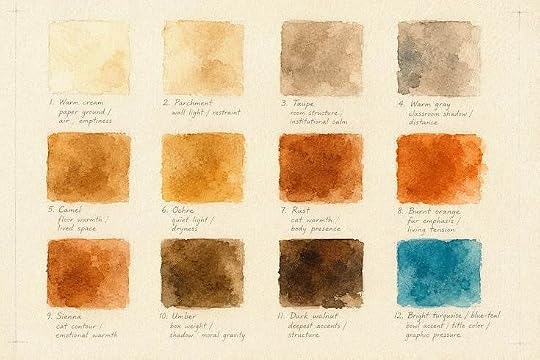
Color Swatch Sheet: The cover-derived palette becomes a working grammar of feeling: parchment, caramel, rust, umber, walnut, near-black brown, muted olive, and blue-teal arranged before they enter the room.
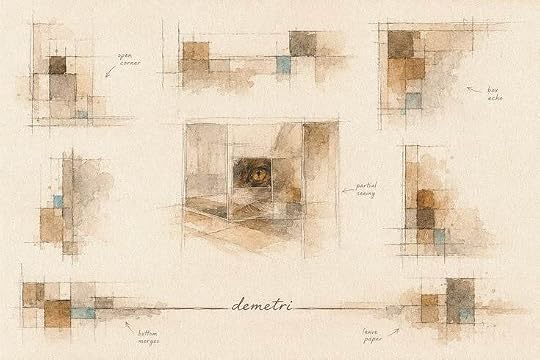
Watercolor Outer Border Details Study: Broken graphite rules, pale washes, and interrupted square forms turn the border into a second enclosure, half box and half paperwork, with the bottom signature line already folding into it.
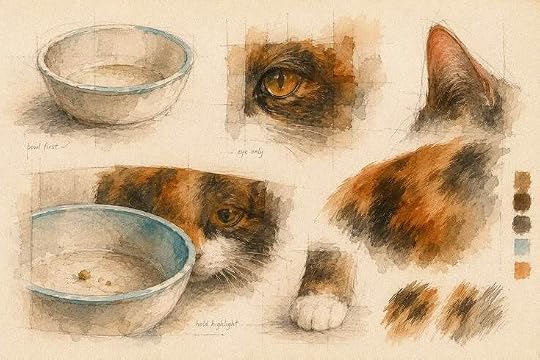
Cat / Bowl Detail Study: A close study of the bowl, rim, waterline, and partial tortoiseshell presence shows how the finished image locates its emotional weight in ordinary care withheld.
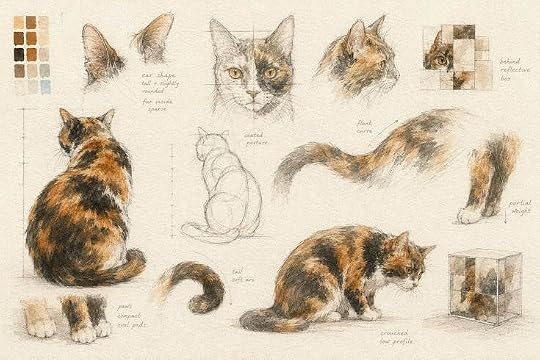
Character Anatomical Study: Ear, eye, flank, paw, and tail studies keep the cat creaturely rather than cute, giving the final image enough animal specificity to resist becoming only an idea.
All watercolor illustrations by Demetris Papadimitropoulos.
Watercolors are done on 140lb vellum and then scanned into the computer using an Epson scanner. From there, they are finalized in Procreate. All art and opinions are my own.
Tomás Q. Morín’s “Cat Love” is a comic elegy with claws, opinions, and an empty bowl at the center of its moral universe.
By Demetris Papadimitropoulos | June 7th, 2026
“Fail the Bowl”: The emblematic watercolor for “Cat Love” places the bowl before the box, turning Morín’s famous thought-experiment reversal into a spare visual accusation: feeling has been studied, framed, and certified, while the creature’s thirst remains unanswered.
Dead cats are most useful to philosophers, which is one of the complaints “Cat Love” brings against us, hiss included. Schrödinger’s cat has spent nearly a century as an abstraction with fur: neither alive nor dead until observed, famous less as a creature than as a convenience. Tomás Q. Morín begins by returning stolen property to its owner: the cat gets herself back. He gives her the floor, and she immediately starts taking inventory. She is hungry. She is thirsty. She is vain, profane, funny, frightened, armed with opinions, and in love with the man she calls the Mustache. She would like her water bowl filled correctly, her litter smoothed to professional standards, and the world to stop mistaking attention for care.
Everyone in “Cat Love” is, in some way, grading feeling while the bowl stays empty. The cat has been kidnapped and sealed inside a mirrored box for an “Emotional Statistics” course, where students in protective gear study her condition as preparation for becoming Emotional Support Humans. The joke starts absurd, and then one notices the teeth. The course has quizzes, equipment, rules, certificates, and the tidy confidence of people who believe a form can hold a living creature still. Inside the box, however, is not a lesson in feeling. Inside the box is a cat whose throat is dry. The whole accusation is already there: a culture can laminate feeling and still fail the bowl.
Morín’s premise could have behaved like a tidy little premise-machine: take the famous thought experiment, make it literal, let the animal talk back, wait for the cleverness to purr. “Cat Love” is less mechanism than creature rattling inside one. Its narrator is not a classroom problem with whiskers attached. She has a past: kittens, owners, appetites, beds, grudges, songs, films, poems, and a beloved human whose lap gives the day one of its fixed places. Her happiest years were with the Mustache, a shoe salesman and secret poet who writes on blank receipts, listens to blues and Coltrane, reads to her, feeds her carefully, and receives her affection with the gratitude of someone not entirely practiced at being loved. Their attachment is domestic, repetitive, nearly liturgical: bowl filled, litter smoothed, music on, hand lowered, lap made available to the little monarch.
Even the kidnapping is intimate enough to accuse. The neighbor boy who betrays her knows her habits. He smooths the litter correctly. He fills the water to the level she requires. He washes and dries the bowl marked QUEEN. Then he lures her into the carrier with catnip and sells her to the man in the tacky trench coat. It is one of the book’s sharpest moral traps: tenderness and treachery carried out by the same small hands. Morín understands that cruelty is more frightening when it has learned the household rituals.
“The Bowl Marked QUEEN”: In this early pivotal watercolor, the boy’s careful hands and the bowl marked QUEEN hold the book’s most intimate betrayal: care has learned the cat’s rituals before it sells her.
The cat dies in the box. The novel does not smuggle her out through a last-minute trick, and that refusal keeps the book from becoming one. She discovers her own dead body and curls around it, grieving the creature who will never again sit in the Mustache’s lap. Then the story enters a second life bright with impossible colors. The cat becomes an alebrije-like spirit with green fur, orange toes, and a blue shell, able to pass through walls, memory, and a glowing orange-flower realm. Death does not free her from the body. It makes her miss the body more sharply: the food it wanted, the water it lacked, the hand it knew.
“Around the Body”: This hushed doubled image marks the instant when the clever premise can no longer protect itself from consequence, as the cat curls around the body the box has made real.
Rather than marching through plot, “Cat Love” stalks, doubles back, sniffs at a culprit, disappears into memory, and returns with another hair at the scene. The cat follows students, discovers the woman who bought cats for the boxes, trails the neighbor boy to the hospital room of Bonaparte, the trench-coat man, and finally finds the Mustache in jail after he has attacked Bonaparte in grief and rage. Some episodes earn their oddness; others drag in extra chairs: Emotional Support Humans, Pity Party Planners, a prison program involving an egg, a spectral cowgirl guide. The satire can be broader than the grief requires. Still, the wound keeps its shape. Who saw the suffering? Who profited from it? Who regretted it? Who opened anything?
It is tempting to call the narrator anthropomorphic, but the word does not quite catch the trick. Yes, she knows “Moby Dick,” Vermeer, Michelangelo, Clint Eastwood, Sondra Locke, jazz, blues, poetry, and more than one human institution she would be happy to scratch until the stuffing shows. At moments she sounds like a tiny essayist with claws, which is both pleasure and risk. Yet the best passages do not simply dress a human intelligence in tortoiseshell fur. They keep interrupting her brilliance with thirst, hunger, scent, wet fur, meat, catnip, and the insult of a dirty bowl. Her erudition may be extravagant, but her needs are not.
Prose is the cat’s proof of life. Morín writes in a first-person rush of insult, memory, appetite, aesthetic judgment, and lyric recoil. The sentences can arrive as clipped swats, then lengthen into riffs, as if the narrator’s attention were pouncing, circling, vanishing under the sofa, and returning with something mangled and meaningful. The diction keeps changing collars: barroom mutter, poetry shelf dust, animal sensation, prayer, stand-up aside, elegy. The cat can move from Coltrane to kibble without changing her one demand. She is always asking what it means to have had a world.
At full volume, the narration is the book’s evidence and its trouble. The cat is dangerously good company: the extra riff, the prolonged tangent, the joke that stretches one paw past its landing. Not everything needs the full flourish. Occasionally the overcrowded brilliance presses too close to the wound. There are moments when grief seems to have brought the whole record collection to the water bowl. Still, the excess is not incidental. The cat has too much in her to be filed away: appetite, taste, fear, memory, rage, and a splendidly low tolerance for fools.
Part of the book’s wit lies in refusing the solemnity its premise seems to invite. A cat in a death box is terrible. A cat in a death box who also has strong opinions about Michelangelo’s torsos, “The Gauntlet,” and the indignity of wet fur is less stable and more alive. Morín’s humor is not a release valve. It is a pressure gauge. Each joke shows how much personality must be ignored before an animal can be filed as a lesson. The cat’s asides do not distract from the horror. They thicken the life being wasted.
A glance at two nearby books helps, though neither quite houses this creature. Henry Hoke’s “Open Throat” offers another hungry nonhuman witness moving through human disorder; André Alexis’s “Fifteen Dogs” turns animal consciousness into a philosophical wager. Morín is less spare than Hoke and less cleanly fable-like than Alexis. “Cat Love” is messier, more allusive, more bodily, and more willing to risk sentiment because the cat is not an idea. It is not the kind of cat book that curls up politely. Readers arriving for whiskers and comfort may find a mirrored chamber and a very offended ghost.
Daily quizzes make a second box out of paperwork. They are funny, absurd, sometimes pointedly ridiculous, and they keep returning the reader to the institution that has converted the cat’s suffering into coursework. They also save the novel from becoming only a flood of feline consciousness. The quizzes ask students to classify, choose, process, react – anything but interrupt. Their failure is built into the repetition: they keep asking what people feel while nobody opens the box.
Inside the ten-day frame, the quizzes keep failing in the same way. They ask. They repeat. They do not interrupt. The course gives the book its memorable architecture, but the middle wanders by design and sometimes by indulgence. The hunting trip, Gladys’s house, Teddy’s hospital visits, the jail and prison sequence – each adds pressure, though not every detour cuts equally deep. What rescues the sprawl is the way the ledger of harm keeps getting smudged. Teddy sells the cat, then reads to Bonaparte with real devotion. The Mustache is the gentlest figure in the cat’s life, then commits a brutal act. Mercy, the novel insists, is not distributed according to neat categories of guilt.
More than empathy, the book cares about attention that becomes practice: bowl, bed, water, shelter, lap. The Mustache’s love is proved not by declarations but by acts so small they almost disappear: the right food, the clean bowl, the exact water level, the smoothed litter, the poems read aloud. The cat’s later love becomes stranger and darker. She watches over him in jail and prison. She protects him from a threatened killing by haunting Randy, entering his dreams, terrifying him, and biting off part of his ear. This is not soft mercy. It is love with claws, and the book is wise enough not to file them down.
“One Ear Slightly Torn”: The prison watercolor gives Morín’s tenderness its rough edge, showing love after death not as consolation but as vigilance, dream, claw, and the small torn proof of protection.
If the novel has a price, it is the price of carrying this much furniture. Measured feeling versus actual care. Credentialed emotion versus the opened box. Emotional Statistics, Emotional Support Humans, and Pity Party Planners are memorable satirical inventions, but they can arrive underlined. The book’s moral contrast is sharp; sometimes the lamp shines directly on the blade. It asks less to be decoded than followed. That keeps it shy of greatness, not short of force. Its voice and ending have more staying power than some of its machinery.
The book is most contemporary where it stops pointing outward. We live among systems eager to certify care, measure emotion, process grief, monetize comfort, and turn vulnerable bodies into data, lesson, content, or instrument. “Cat Love” exaggerates that world into farce, then asks a question older than any of its furniture: when a creature suffers in front of us, do we open the box, or do we explain how we feel about it? The joke is contemporary. The failure is ancient.
Rating a book this odd feels a little like offering a performance review to a weather system; still, numbers can be useful when they do not pretend to be final: “Cat Love” earns an 84/100, which translates to 4/5 Goodreads-compatible stars. That score reflects a novel I admire more for risk than polish. Its voice and ending are stronger than its pacing. Its premise is sharper than some of its satirical extensions. Its emotional intelligence is deeper than its occasional cleverness. It is a strong book, not a flawless one, and the distinction helps. Some cats are better loved with one ear slightly torn.
On the ending, Morín makes his bravest refusal. The cat is not saved. The box remains a fact. The death is not revealed as dream, illusion, or reversible trick. Instead, the novel follows the Mustache through imprisonment, release, aging, new love, children, and the long continuation of a life that once seemed broken beyond repair. The cat stays near him until he no longer needs her in the same way. Then she finds her own afterlife: an Italian barn, cows, hay, rain, milk given freely, and a tempo of being untouched by quizzes.
Past the classroom, the ending works because it lowers its voice. The novel does not imagine heaven as splendor. It imagines heaven as corrected scale. After the mirrored box, there is space. After the classroom, weather. After observation, companionship without experiment. After thirst, milk. The Mustache eventually arrives after his own long life, and the reunion moves precisely because the book has refused all cheaper consolations. Love has not prevented loss. It has endured as memory, guardianship, and the hope of being recognized again.
Overfullness remains the fair objection. The cat knows a great deal, says a great deal, and sometimes circles a thought already neatly killed. The dystopian furniture can creak, especially when the labels face outward. The bag of tones – animal suffering, stand-up complaint, literary allusion, ghost story, prison threat, pastoral afterlife – will send some readers under the sofa. Those who want quiet realism may retreat. Those who want pure satire may find the ending too soft. Those who want tidy tenderness may wonder why the cat has such strong feelings about cinema. Yet the division seems built into the project. The strangeness is not decoration. It is the price of this particular aliveness.
Underneath all the invention, “Cat Love” is about the old scandal of being loved by a mortal creature. Pets make theologians of ordinary people without asking. They turn routine into liturgy, then leave behind bowls, beds, habits, and the awful grammar of absence. Morín understands that an animal’s life is not small from inside the fur, and not small to the person who has learned its rituals. The cat’s grandeur comes not from being secretly human. It comes from being fully herself in a world that keeps trying to make her illustrative.
Love, here, is not a clean noun. It is appetite, annoyance, vigilance, vanity, violence, memory, and the absurdly exact labor of knowing how another creature likes the world arranged. The title sounds almost mug-ready; the novel earns it by making love less cute than accountable. Cat love is partial, demanding, hidden, bodily, and fierce. It does not solve suffering. It does not make the box disappear. It remembers who was inside.
One image stays under the skin even more than the cat in the mirrored box, though that box is the small engine of accusation. It is the barn at the end, where the machinery of feeling has fallen silent and the world has become animal again: cows chewing time, hay dark with rain, milk offered without coercion, the Mustache sitting beside the cat after years and years of human life. The thought experiment has been answered, but only after the question has done its damage.
“After the Box, the Barn”: The closing watercolor opens the review’s visual field into hay, rain, cows, milk, and the Mustache, answering the mirrored box with space that does not erase what happened inside it.
So the final answer is not philosophical, and not tidy. The cat was alive. The cat was dead. The cat was loved.
Compositional Thumbnail Sheet: Small graphite studies test the image’s moral geometry – whether the eye should move first to the mirrored box, the partial cat, or the empty bowl that finally carries the accusation.
Faint Pencil Underdrawing: The bare perspective lines, box edges, bowl ellipse, and incomplete border show the watercolor before atmosphere arrives, when the room is still only a system waiting to fail.
Pencil + First Wash Stage: The first pale washes bring institutional air into the drawing, letting cream paper, taupe walls, rust-brown fur, and a turquoise bowl accent begin to separate body from apparatus.
Color Swatch Sheet: The cover-derived palette becomes a working grammar of feeling: parchment, caramel, rust, umber, walnut, near-black brown, muted olive, and blue-teal arranged before they enter the room.
Watercolor Outer Border Details Study: Broken graphite rules, pale washes, and interrupted square forms turn the border into a second enclosure, half box and half paperwork, with the bottom signature line already folding into it.
Cat / Bowl Detail Study: A close study of the bowl, rim, waterline, and partial tortoiseshell presence shows how the finished image locates its emotional weight in ordinary care withheld.
Character Anatomical Study: Ear, eye, flank, paw, and tail studies keep the cat creaturely rather than cute, giving the final image enough animal specificity to resist becoming only an idea.
All watercolor illustrations by Demetris Papadimitropoulos.
Watercolors are done on 140lb vellum and then scanned into the computer using an Epson scanner. From there, they are finalized in Procreate. All art and opinions are my own.

July 3, 2026
Honestly not what I was expecting but what a beautiful story about love and loss. Brb I’m gunna go hug my cats

July 11, 2026
Strange read.

October 3, 2026
I love the idea, but Morín couldn't make it through one paragraph without cuss words and non-family-friendly moments.
August 5, 2026
Well. This is a peculiar little book. Loved the beginning, endured strange twists and awkward dialogue in the middle, sobbed at the end. I appreciate the originality of telling the story of Schrödinger’s cat from the cat’s POV, and of the Emotional Support Humans and Pity Parties in personkind’s future. There is some really gorgeous language. But it is so uneven, poorly plotted, and (back to) awkward. It feels like a rough draft and not a complete idea.

September 30, 2026
Dystopian story told through the eyes of a cat? Yes, please.

August 27, 2026
Honestly not sure what I just read.
Displaying 1 - 30 of 151 reviews