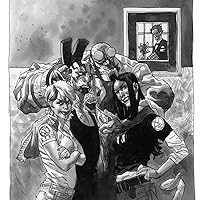
Makie is a natural-born killer bred to be a geisha. Splitting her life between servitude and slaughter could lead to an untimely death, so it's time she chooses a path, but her choice could mean trouble for Manji, the immortal samurai. It's round two for the man who gave up his right to die and the woman who gave up her right to dream. And this time, there'll be no winners.
Hiroaki Samura ( 沙村広明) is a Japanese cartoonist and illustrator. He is best known for writing and illustrating the manga Blade of the Immortal (1993-2012). Among his other manga series Die Wergelder (2011-2018) and Wave, Listen to Me!, the latter serialised since 2014.
We're introduced to Makie, a geisha and swordswoman caught between two worlds. Does Anotsu really love her or just want her to fight for him? Can Manji truly offer her a fight, or is she really his better? In all of this what will he or Rin learn about her journey to revenge and his to absolution?
A really compelling installment that opened up a new facet to this world. I was really engrossed and hope there is more along these lines to come.
Hasta ahora, mi volumen favorito. Es curioso -y se agradece- la manera en que Samura dibuja a sus personajes mujeres: con verdadera adoración por su belleza.
Hiroaki Samura begins to crystalize themes of honor, love, duty and what forces us to live on in this striking volume of the Blade of the Immortal saga. Whereas Volume 2's second immortal storyline gave way to gratuitous bloodshed, the key conflict of Dreamsong is with a fundamentally good, or at least sympathetic woman. There is violence (the art style gets as frantic as it has ever been in the first three volumes), but this time we deal more with why the antagonist is acting, and how much it hurts her to do so. We begin to sympathize with why the people serve the charismatic and cruel Kagehisa Anotsu, as well as just how traumatic Rin's past is.
Manji is a ruthless ronin stricken with the curse of immortality. To undo his curse, he must take the lives of a thousand sinners. He's a wandering sword for hire that kills without mercy and hunts down evil warriors all over feudal Japan. He wanders and kills without purpose for quite some time, but his long journey to end his own life takes an unexpected turn when he meets a compassionate young girl named Rin who is seeking revenge for her parents after they were murdered by members of a brutal new sword school called the Itto-ryu. Manji accepts the role of Rin's guardian and their drastically different ideals and personalities begin to change each other in ways neither of them could've foreseen as they clash with one merciless sinner after another.
The story cycles between several groups of samurai warriors each with their own moral codes and objectives. Other than Manji and Rin, there is Anotsu Kagehisa; the leader of the Itto-ryu and his band of rogues that openly defy old traditions as they seek to revolutionize the way of the samurai through force. Hyakurin and her partner Giichi who work as government cutthroats under a faction called the Mugai-ryu along with a serial killer named Shira, and so on. There are also hundreds of assassins, criminal gangs and shady individuals that wish to learn the secrets of Manji's immortality for their own nefarious purposes. With so many vicious people on the loose, it's no surprise that this ends up being one of the most brutal and bloody samurai tales ever told.
Blade of the Immortal makes ultra-violence look like a poetic art form. Blood and limbs fly like scarlet paint. Blades cut through flesh and bone like knives through butter. The use of clever battle poses and finishing techniques against the backdrop of hyper-stylized Edo period art makes for some museum-worthy battle and death scenes.
Despite how glamorized violence and bloodshed is throughout the series, it does not shy away from exploring the aftermath of said violence and how it impacts the psychological state of the characters. A sweet girl like Rin seeks revenge against Anotsu of the Itto-ryu for leading an assault that resulted in the murder of her family and slowly grows accustomed to the constant brutality that the path of revenge leads to. Anotsu himself isn't the one-dimensional evil monster that Rin believes him to be as he is driven by a sense of revenge himself; his revolution against outdated traditions begins only because people he loved were hurt, killed and outcasted by the harsh rules and teachings of the old sword schools. Even those who live through vicarious swindling and assassination such as Hyakurin and her partner Giichi have very traumatic upbringings and take no joy in their work.
We see how violence warps these characters into killing machines and then we see how the violence they inflict on others leads to more tragedy and bloodshed. Whether it be physical, mental or sexual, the violence throughout the series never goes unexplored or unpunished. It somehow manages to be brutally elegant and mature at the same time, the bloody battles are fantastic and the effects it has on the characters is even more so.
What seems to be a cliche samurai revenge story subtly transforms into an exploration of the psychological effects that violence has on many different types of individuals. Some are defined by it, some are bound to it, some love it while others allow themselves to grow from it or be destroyed by it. Violence and revenge are never fully justified nor condemned. It's presented from a very neutral and realistic point of view, allowing you to see it from every angle possible and judge for yourself whether it can be justified or not.
The story is simple, but the webs of conflict between many groups of complex and dangerous characters is where it truly shines. Strong development, elegant violence, moral ambiguity and an unusually modern punk tone in the dialogue and mannerisms of the characters offers a unique way of exploring a feudal-era drama that defies the expectations of a traditional revenge story.
The are is still amazing. The story is alright. I sort of wished there was a little more detail to a bit of the character development stories, but maybe there will be more in time. I'm somewhat disappointed that Rin hasn't shown any real change so far. I was hoping to see more character development rather than some petty jealousy. Guess I'll just have to read the next volume.
1. Dreamsong (3/5): We learn the backstory of Anotsu's past and his early meeting with O-Makie. She finally meets again with Manji for a final showdown 2. Dreamsong (4/5): A fierce battle between them while Rin explores the town 3. Dreamsong (5/5): The battle comes to close and Rin makes a decisive entrance. 4. Rin's Bane (1/2): Manji begins Rin's training with the flying daggers. Wondering through the woods she meetsa most unexpected person! 5. Rin's Bane (2/2): Rin begins to have second thoughts about her mission.
The story was well written and good but I can't stand the art. It's drawn with pencils only and it has so many little lines that it gives me a headache.
Makie Otono-Tachibana is a beautiful and talented warrior. Her father, unable to be trained in the warrior arts, Makie is abandoned by her family and adopted by the Itto-ryo. But when Makie is ordered to kill Manji she finds she doesn't have it in her.
While reading volume 3 I found a few places hard to fallow. The text bubbles where not always clear on who was speaking and some of the scenes didn't have as clear a transition. Aside from those issues everything else was on point and I think I might have found my favorite character.
I spoke too soon about the translation issues — they seem to be back in volume 3, though in lower quantities. There are certain expressions that the translator should have adapted for the Western audience. For example, Manji speaks a line that goes something like "take me across the river". The issue with that, as an Asian, I am guessing that means to kill him, but we don't quite know. The reader is supposed to just know that the 'other side of the river' means the afterlife. This is the kind of thing that the translator should have picked up on, yet didn't.
Volume 3, titled Dreamsong, continues the narrative setup established in the first two books, with Manji and Rin trying to find and kill Anotsu. Every volume, they run into a handful of Anotsu's swordsmen, and the two — though mostly Manji — fight and defeat them. In that respect, all three volumes have been fairly similar: here's a bad guy and let's watch them fight. However, the good news is that the bad guys are given enough back story, for the most part, for the plot to be different enough.
In this book, we are introduced to Makie, a master swordsman who is also Anotsu's lover (I think). In fact, Makie is in many ways a better swordsman but, for some reason, she loses her skills when she doesn't concentrate. Yes, it's a weird Achilles' Foot, and it doesn't really have an explanation. For example, she'd backstab Manji from around the corner, break her concentration and be startled for her "cowardly act". It is a characterisation that is a little perplexing, though it doesn't bother me as a whole. I think Makie continues to be the most intriguing of all the villains introduced thus far.
As for our protagonists, Manji is uncharacteristically talkative and forgiving towards Makie. They two fight twice in this volume and, instead of doing away with his assassins in previous volumes, he just gives Makie a talking to for the most part. At the end of the second fight, Manji even becomes a sort of psychiatrist or motivational speaker for Makie — again, another somewhat perplexing characterisation.
As with the previous volumes, the action continues to be baffling. I find it difficult to follow the fight scenes. To make matters a little more confusing is the fact that Manji has several different weapons, and you never quite know which weapon he is using, or when he switches from one to the next. One moment he is using a spear, then the next he has a two-pronged dagger. Again, I sincerely hope the action improves in subsequent volumes, because these set pieces take up a hefty chunk of the page count. You want to know what is happening, instead of summing all 15 sword strokes in a two-page spread, which Samura does from time to time.
(Zero spoiler review for the deluxe edition this volume collects) 4.75/5 Thank the comic gods, I've finally found a manga series that isn't either a promising although poorly executed concept (See Berserk, which I do think is pretty good regardless). Or an absolute trash fire of poor storytelling in both pictures and words. I can't claim to have a massive amount of experience with the genre, although I have certainly tried a number of very well thought of titles, and to say I have been underwhelmed by the stories themselves, but the genre in general would be an understatement. If I didn't already have a couple of the Blade of the Immortal deluxe editions sitting there already, I would never have tried this series, and would have solemnly vowed to never pick up a manga volume again (or for a long while at least). So again, thank the comic gods that this story pretty much ticks every box I look for in a graphic novel, and stands head and shoulders above every other manga I've touched. The story actually has some flow about it. Word panels connect nicely with each other, and the dialogue and narration has a poetry and structure that is not only more akin to a well told Western story, but simply put, a well told story period. The narrative can actually be quite beautiful at times. Yes, there is very occasionally a bit of the Japanese 'cheese' that I've found all too common, and rather galling within this medium. The characters are extremely well fleshed out and varied. All of them have some amazingly unique traits, and no one is over powered or flawless, as is far too overdone within the medium. Another plus, it is an ongoing narrative, and it is very well executed. Within the 600 or so pages in this volume, there were numerous opportunities to phone an arc in, and do the usual, safe, samurai tale. But no, each one of these stands out as unique and very well done. It is a very rare thing for to be shocked about a plot twist, although I never quite knew what was going to happen throughout these stories. Or if I knew the overall destination, I certainly didn't foresee the journey. The art is absolutely phenomenal. Best manga I've seen. Yep, better than Berserk. It might not be technically as adept a Muira's work, although it is far more evocative and meaningful. I don't think I've ever lingered on panels as long as I did here. Sure, some are rushed inks, although Samura's pencil work is exquisite. So yeah, before I drown myself in a hyperbolic soup of my own making, go out and check out this book. I'm so glad I have volume two to pull off the shelf and carry on with. And volume three is about to come out as well. God only knows what I'll do when I've read all of those. A very painful wait, I guess. 4.75/5
The execution of the three volumes I read was uneven, and I seriously have no idea where this is going... I understand how the ideals of the samurai class and the kenshi clash, but I'm not sure the story made me cared all that much, so far? So far, the plot is: We've Rin who has vowed to avenge her father - and somehow, she forgot along the way, that maybe she should ACTUALLY be looking for her mother who was raped and kidnapped? But naw. Unlike the traditions of the samurai class, Rin uses throwing knives, but she ain't that good. So, she hires a bodyguard, who has a manji on his back. (I understand that the symbol has another meaning in Japan, but it makes my skin crawls nonetheless.) He can't die, so he goes around trying to kill a hundred bad men. That doesn't happen like that. He just kills people. A lot.
I don't know what I'm expecting anymore.
The art is next level gorgeous, but the storyline keeps spinning in all direction in each volume, and I just don't get it.
As a lover of historical fiction, I'm torn about this manga. While I appreciate the focus on the house system/ comfort women during the Edo era (did you know that Japan had a legalised prostitution system overseeing almost the entire duration of the Edo period, which was regulated by the government?) the dialogue can be difficult to follow at times. I'm curious if this issue is resolved in the omnibus editions. Despite the inclusion of backstories, I still feel like I don't know these characters very well. However, I must acknowledge that the manga has some truly *badass* female characters. What’s more, the art style is undoubtedly beautiful. All in all, I am still unsure if I will continue reading the series.
This volume introduced a conflicted but badass in a fight female character and we get a bit more of the head of the Itto-Ryu and his backstory. There are a few fight scenes in this volume that would have benefited from better flow in the art style as they were hard to follow at times. That being said, is was a very solid and enjoyable volume.
I do find some of the character designs very similar to each other and it can get confusing as to who is who at times.
Rin getting jealous is not helping her seeming very immature, but is not unrealistic based on her character. I realize that she is only 16, but 16 was not that young during those times.
I appreciate an MC who is not OP and gets his are kicked every now and again (..or a lot in this case)...
i juuuust waaaaaas noooot impressed. the characters were bland. the premise was a troupe that ive seen retold before and better. maybe my impression wouldve been a lil more gentle if i realized it was vol 3 of a series, but even with that knowledge- i found this clip of the story to fall short and flat. the cover is the best part of this creation IMO, the creative outlay and imaginative perspective is what caught my attention. but the actual innards lost my focus.
i was pleased to see the beginning had a note on the symbolism on the ronins jacket.
It was nice to learn more about Kagehisa's past through Makie I wonder why Kagehisa is so determined to avenge his father when his father was such a horrible individual Makie could of died if she wasn't an amazing fighter! I'm not sure if I like where Manji and Rin's relationship is going because of what she said last time but I'm just gonna guess it's because she's still young and it was funny how Manji constantly broke the tension by angering Rin It's interesting that Kagehisa ran after Makie I like the "human" aspect being added to Kagehisa's character
This entire review has been hidden because of spoilers.
Manji keeps proving he’s one of the coolest antiheroes around—gritty, tough, but with just enough heart to keep you rooting for him. His dynamic with Rin is really starting to hit its stride, especially as they face some seriously brutal enemies. But the real MVP here is the artwork—Samura’s style is just incredible.
The action scenes are smooth, intense, and almost feel like they’re jumping off the page, and the way he captures emotion and detail is on another level. Especially motion which I won't shut up about until the end of this journey.
8/10 This volume was my favourite so far. I like how in Samura's version of medieval Japan the most deadly natural born killer warrior is a frail, existentially depressed young lady. Usual stream of Kami-tier cartooning, where detailed art meets gritty rendering, may it be in ink or in the sporadic full pencil panels. Fluidity of inking strikes that goes with fluidity of hyper dynamic movements of these over the top characters. Sometimes it's hard to follow the sword clashes, but if you pay attention and manage to get the gist of the choreographies, it is quite a rewarding reading experience.
Que bonita y que emotiva la resolución de la historia de Makie, la ex-prostituta-espadachina-geisha (cosas de los mangas). Pero todavía tiene mucho margen de mejora el tebeo, aunque de momento resulta entretenido.
The story really gets rolling at this point. The first two volumes are still of exceptional quality, however the pacing really picks up in this volume and the characters were developed enough to justify a longer arc.
Story is getting more interesting. Unfortunately illustrations are not as good. On static scenes they aren't bad, there are even some well illustrated scenes but dynamic scenes aren't authors strong suit as it can be hard to discern what is going on and what characters are suppose to be doing.
I like the premise and the art. The story feels a bit slow or maybe I'm comparing it too much with Kenshin and Samurai X. It doesn't have the hardest hitting story beats just yet.