

What do you think?

Villa Coco
Andrew Sean Greer, Pulitzer Prize-winning author of Less, showcases his wit, sophistication, and deep knowledge of focaccia in this magical and madcap tale of a young man who takes an unspecified job with a charismatic elderly Baronessa at her crumbling villa in the Tuscan hills.
An aspiring archivist determined to begin a “serious” life after an undistinguished undergraduate career takes up residence in the Italian countryside. Here, he becomes the all-purpose assistant to the Baronessa, known to her friends as Coco, a defiantly youthful and naturally flamboyant woman of ninety-two. Amid a chaotic and colorful milieu of gin-swilling princesses, incomprehensible handymen, roaming boarhunters, nuns, and other local wildlife, our young man does his best to catalog the villa’s extensive collection of art and antiques—although he notices that things seem to go missing from right under his nose.
Despite himself, he tumbles into an affair with a married man, complicating his future plans considerably. And when the Baronessa loses someone close to her, he becomes an unwitting accomplice in the acceleration of Coco’s great and final plan: to locate the love of her life and be reunited before it’s too late. Told with the signature wit, charm, and humanity that made Less an international phenomenon, Villa Coco is a dazzling, sun-soaked ode to life itself, a meditation on how seriously we ought to take ourselves, and a bawdy Mediterranean ballad about becoming who we’ve always wanted to be.
An aspiring archivist determined to begin a “serious” life after an undistinguished undergraduate career takes up residence in the Italian countryside. Here, he becomes the all-purpose assistant to the Baronessa, known to her friends as Coco, a defiantly youthful and naturally flamboyant woman of ninety-two. Amid a chaotic and colorful milieu of gin-swilling princesses, incomprehensible handymen, roaming boarhunters, nuns, and other local wildlife, our young man does his best to catalog the villa’s extensive collection of art and antiques—although he notices that things seem to go missing from right under his nose.
Despite himself, he tumbles into an affair with a married man, complicating his future plans considerably. And when the Baronessa loses someone close to her, he becomes an unwitting accomplice in the acceleration of Coco’s great and final plan: to locate the love of her life and be reunited before it’s too late. Told with the signature wit, charm, and humanity that made Less an international phenomenon, Villa Coco is a dazzling, sun-soaked ode to life itself, a meditation on how seriously we ought to take ourselves, and a bawdy Mediterranean ballad about becoming who we’ve always wanted to be.
270 pages, Kindle Edition
First published June 9, 2026
About the author
Andrew Sean Greer
28 books3,574 followersAndrew Sean Greer (born 1970) is an American novelist and short story writer.
He is the bestselling author of The Story of a Marriage, which The New York Times has called an “inspired, lyrical novel,” and The Confessions of Max Tivoli, which was named one of the best books of 2004 by the San Francisco Chronicle and received a California Book Award.
The child of two scientists, Greer studied writing with Robert Coover and Edmund White at Brown University, where he was the commencement speaker at his own graduation, where his unrehearsed remarks, critiquing Brown's admissions policies, caused a semi-riot. After years in New York working as a chauffeur, theater tech, television extra and unsuccessful writer, he moved to Missoula, Montana, where he received his Master of Fine Arts from The University of Montana, from where he soon moved to Seattle and two years later to San Francisco where he now lives. He is currently a fellow at the New York Public Library Cullman Center. He is an identical twin.
While in San Francisco, he began to publish in magazines before releasing a collection of his stories, How It Was for Me. His stories have appeared in Esquire, The Paris Review, The New Yorker and other national publications, and have been anthologized most recently in The Book of Other People, and The PEN/ O. Henry Prize Stories 2009. His first novel, The Path of Minor Planets, was published in 2001.
He is the bestselling author of The Story of a Marriage, which The New York Times has called an “inspired, lyrical novel,” and The Confessions of Max Tivoli, which was named one of the best books of 2004 by the San Francisco Chronicle and received a California Book Award.
The child of two scientists, Greer studied writing with Robert Coover and Edmund White at Brown University, where he was the commencement speaker at his own graduation, where his unrehearsed remarks, critiquing Brown's admissions policies, caused a semi-riot. After years in New York working as a chauffeur, theater tech, television extra and unsuccessful writer, he moved to Missoula, Montana, where he received his Master of Fine Arts from The University of Montana, from where he soon moved to Seattle and two years later to San Francisco where he now lives. He is currently a fellow at the New York Public Library Cullman Center. He is an identical twin.
While in San Francisco, he began to publish in magazines before releasing a collection of his stories, How It Was for Me. His stories have appeared in Esquire, The Paris Review, The New Yorker and other national publications, and have been anthologized most recently in The Book of Other People, and The PEN/ O. Henry Prize Stories 2009. His first novel, The Path of Minor Planets, was published in 2001.
Ratings & Reviews
Friends & Following
Create a free account to discover what your friends think of this book!
Community Reviews
Displaying 1 - 30 of 2,718 reviews

February 2, 2026
Some books feel like an escape. Villa Coco feels like being gently carried away on warm Tuscan air, dropped into a place where time bends, rules blur, and every strange little moment somehow adds up to something quietly profound.
Andrew Sean Greer doesn't rush to impress you. He wins you over slowly. At the center of this story is a young man without a clear direction who takes a job in Italy expecting something respectable and orderly—and gets anything but. Instead of neatly cataloging art, he finds himself pulled into the orbit of Lisabetta "Coco," a force of nature dressed in widow's black, whose villa feels less like a workplace and more like a living, breathing thing filled with secrets, memories, chaos, and longing.
What follows is part comedy, part emotional unraveling, part surreal adventure. Each day brings a new task that sounds slightly absurd but somehow matters: navigating eccentric visitors, running strange errands, becoming the accidental guardian of Coco's unfinished love story. What starts as a paycheck quietly becomes something far more intimate—a crash course in devotion, vulnerability, and what it means to let other people's lives change your own.
Greer's writing glides between playful and deeply sincere. The humor is warm rather than showy, and the emotional moments sneak up on you when you're not bracing for them. Beneath the antics and lively personalities is a tender meditation on youth brushing against mortality, on love that lingers long after time should have erased it, and on how even the most aimless seasons of life can quietly reshape who we become.
The Italian setting adds its own kind of magic. The villa, the hills, the meals, the drifting conversations—all of it creates a dreamy, sunlit haze where past and present overlap, where small choices start to feel significant. This isn't a story driven by high drama or plot twists. It's driven by atmosphere, connection, and the slow realization that sometimes the most important journeys don't look heroic at all.
Villa Coco left me smiling, slightly wistful, and unexpectedly moved. It's the kind of book that reminds you how strange and beautiful people can be, how love doesn't fade on schedule, and how growth often arrives disguised as chaos.
A heartfelt thank you to NetGalley and Doubleday Books for the digital review copy in exchange for my honest thoughts.
Follow me on medium.com to read my articles about books, movies, streaming series, astrology:
medium.com
instagram
facebook
twitter
Andrew Sean Greer doesn't rush to impress you. He wins you over slowly. At the center of this story is a young man without a clear direction who takes a job in Italy expecting something respectable and orderly—and gets anything but. Instead of neatly cataloging art, he finds himself pulled into the orbit of Lisabetta "Coco," a force of nature dressed in widow's black, whose villa feels less like a workplace and more like a living, breathing thing filled with secrets, memories, chaos, and longing.
What follows is part comedy, part emotional unraveling, part surreal adventure. Each day brings a new task that sounds slightly absurd but somehow matters: navigating eccentric visitors, running strange errands, becoming the accidental guardian of Coco's unfinished love story. What starts as a paycheck quietly becomes something far more intimate—a crash course in devotion, vulnerability, and what it means to let other people's lives change your own.
Greer's writing glides between playful and deeply sincere. The humor is warm rather than showy, and the emotional moments sneak up on you when you're not bracing for them. Beneath the antics and lively personalities is a tender meditation on youth brushing against mortality, on love that lingers long after time should have erased it, and on how even the most aimless seasons of life can quietly reshape who we become.
The Italian setting adds its own kind of magic. The villa, the hills, the meals, the drifting conversations—all of it creates a dreamy, sunlit haze where past and present overlap, where small choices start to feel significant. This isn't a story driven by high drama or plot twists. It's driven by atmosphere, connection, and the slow realization that sometimes the most important journeys don't look heroic at all.
Villa Coco left me smiling, slightly wistful, and unexpectedly moved. It's the kind of book that reminds you how strange and beautiful people can be, how love doesn't fade on schedule, and how growth often arrives disguised as chaos.
A heartfelt thank you to NetGalley and Doubleday Books for the digital review copy in exchange for my honest thoughts.
Follow me on medium.com to read my articles about books, movies, streaming series, astrology:
medium.com

June 4, 2026
i'm summering in europe.
(this is what i'm calling "spending the next several months reading books about travel.")
unfortunately, though, this book was an attempt at a charming/witty/Profound book about a gangly and ungainly gay man trying to find himself/love/purpose internationally.
it was, in other words, a less successful LESS.
it all felt effortful and it all fell short. so much of the writing came down to repeating verbatim quasi-deep statements about life that were fairly meaningless the first time, which contributed to the confusion that can only come from unrealistic characters behaving nonsensically.
i spent most of my time reading it waiting for something to give, dropping us into a version of the author's charms with more of a spine, but no dice.
so when it ended i just felt annoyed.
bottom line: bummer.
(thanks to the publisher for the e-arc)
(this is what i'm calling "spending the next several months reading books about travel.")
unfortunately, though, this book was an attempt at a charming/witty/Profound book about a gangly and ungainly gay man trying to find himself/love/purpose internationally.
it was, in other words, a less successful LESS.
it all felt effortful and it all fell short. so much of the writing came down to repeating verbatim quasi-deep statements about life that were fairly meaningless the first time, which contributed to the confusion that can only come from unrealistic characters behaving nonsensically.
i spent most of my time reading it waiting for something to give, dropping us into a version of the author's charms with more of a spine, but no dice.
so when it ended i just felt annoyed.
bottom line: bummer.
(thanks to the publisher for the e-arc)

November 26, 2025
The author in a letter to his readers wonders “ whatever happened to the “charm novel” ….a world in which even the worst of circumstances could provide a funny story and a sense of hope.” So he decided to write one and he has indeed written a story with charm. A young American man is hired by a ninety two year old Italian Barroness to catalog her art and artifacts at her villa. “Our young man” as he is referred to doesn’t find the luxurious villa he imagined , nor the structured job he expected . Instead he becomes her assistant, finds a villa in need of repair, and a parade of eccentric characters . In addition to the Barronessa, there’s an aging principessa, a quirky artist, and more . An escapade to say the least, picking olives and grapes, helping with repairs, listening to the Baronessa’s stories before he can get down to the work he was hired to do. Some hilarious moments, some tender moments, some moments of awakening in this gentle, funny and entertaining novel with endearing characters . It’s full of life and love and is reflective on doing what you’re meant to do and meant to be.
I received a copy of this book from Doubleday through NetGalley.
I received a copy of this book from Doubleday through NetGalley.

May 31, 2026
I requested Villa Coco expecting a charming Italian escape full of wit, heart, and maybe enough focaccia talk to make me hungry.
Well, I was hungry, but mostly for chapters.
The story is divided into three large sections with no chapters in between, which turned reading this book into an endurance event. Nothing says "relaxing Italian escape" quite like desperately searching for a stopping point that doesn't exist.
The writing felt incredibly disjointed and difficult to follow. Characters appeared, disappeared, and wandered back in again. More than once, I found myself flipping back a few pages wondering if I'd accidentally skipped something. Y’all, I had not.
The Tuscan setting was lovely, with beautiful descriptions, moments of wit, and an eccentric cast of characters. Coco herself was particularly intriguing, and there were flashes of the magical charm I was hoping for. Unfortunately, those bright spots were buried beneath a disjointed narrative that seemed determined to make me work for every ounce of understanding. Getting to the good parts felt a bit like hiking uphill in flip-flops while carrying an urn you may or may not have stolen from a funeral (iykyk). By the time I figured out where the story was going, I wasn't entirely sure I cared anymore.
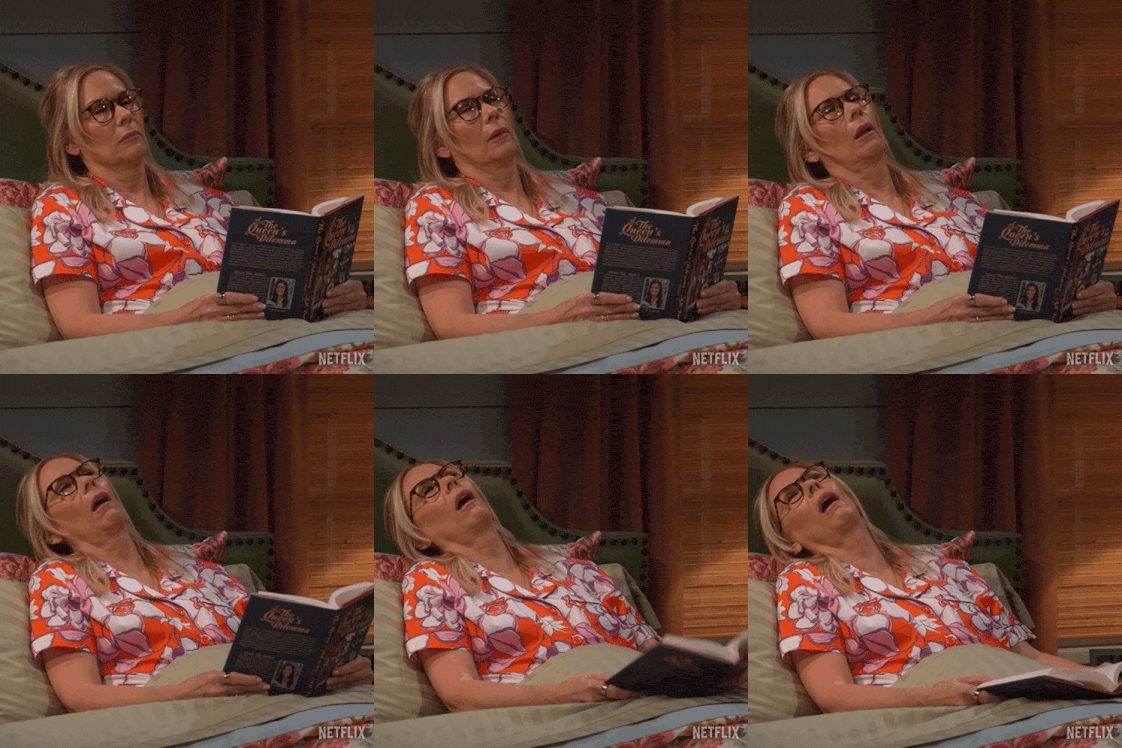
When I reached the end, I admired what the book was trying to do far more than I enjoyed reading it. It wasn't a terrible experience, but it was definitely a long one for such a short book. A very, very long one.
If you're looking for a dreamy Italian countryside story filled with quirky characters and don't mind a narrative that meanders through the vineyards without a map, this may work for you.
As for me, I finished it mostly because I'm stubborn and refuse to let a book win. And because I needed to know if I was ever going to find out the narrator’s real name.
Many thanks to NetGalley and Doubleday for this review copy.
Well, I was hungry, but mostly for chapters.
The story is divided into three large sections with no chapters in between, which turned reading this book into an endurance event. Nothing says "relaxing Italian escape" quite like desperately searching for a stopping point that doesn't exist.
The writing felt incredibly disjointed and difficult to follow. Characters appeared, disappeared, and wandered back in again. More than once, I found myself flipping back a few pages wondering if I'd accidentally skipped something. Y’all, I had not.
The Tuscan setting was lovely, with beautiful descriptions, moments of wit, and an eccentric cast of characters. Coco herself was particularly intriguing, and there were flashes of the magical charm I was hoping for. Unfortunately, those bright spots were buried beneath a disjointed narrative that seemed determined to make me work for every ounce of understanding. Getting to the good parts felt a bit like hiking uphill in flip-flops while carrying an urn you may or may not have stolen from a funeral (iykyk). By the time I figured out where the story was going, I wasn't entirely sure I cared anymore.
When I reached the end, I admired what the book was trying to do far more than I enjoyed reading it. It wasn't a terrible experience, but it was definitely a long one for such a short book. A very, very long one.
If you're looking for a dreamy Italian countryside story filled with quirky characters and don't mind a narrative that meanders through the vineyards without a map, this may work for you.
As for me, I finished it mostly because I'm stubborn and refuse to let a book win. And because I needed to know if I was ever going to find out the narrator’s real name.
Many thanks to NetGalley and Doubleday for this review copy.

August 15, 2026
“I spent years in a life I did not want, and not for love. It was because I did not think another life was possible. But it is always possible.”
Readers begin this scenic adventure with a nameless narrator, known only as “the young man.”
Readers soon learn that this young American is aimless, fresh out of graduate school, and has answered a job advertisement that takes him to Tuscany, to live and work at Villa Coco, the residence of his 92-year-old employer, the Baronessa.
He arrives burdened with “books, luggage, gin, fish oil, and doubt”—and it doesn’t take long to discover that he may have bargained for considerably more than he intended.
My first experience with this author was his book, “Less,” his 2018 Pulitzer Prize winning novel, in which I found less wasn’t more. But I didn’t completely give up on this author, as I did read his sequel, “Less is Lost,” which I liked a tad more. But I haven’t read him since.
Still, when a hotlist book is donated to my Little Free Library Shed, curiosity gets the better of me.
This time, this light, breezy summer read surprised me.
Set in the 1990s during the AIDS epidemic, our young man chooses to put his own sexual identity aside for his work as an archivist at the Baronessa’s dilapidated Tuscan estate.
The story follows him as he attempts to navigate Tuscany at Villa Coco—and a job that bears little resemblance to what he expected.
Then temptation arrives in the form of the Baronessa’s handsome young ‘straight’ married cousin, Giacomo.
Adding to the adventure is an eccentric cast of characters, including the flamboyant Baronessa, whose presence alone gives the story much of its charm. There’s also plenty of humor, and an abundance of sun-soaked Italian countryside.
Ultimately, though, this is a tale of a young man attempting to find himself along the way. But it is also a story that celebrates aging with exuberance.
Will ‘our young man’ eventually have a name and find himself?
(No spoilers from me.)
“Less” Review: https://www.goodreads.com/review/show...
“Less is Lost” review: https://www.goodreads.com/review/show...
Readers begin this scenic adventure with a nameless narrator, known only as “the young man.”
Readers soon learn that this young American is aimless, fresh out of graduate school, and has answered a job advertisement that takes him to Tuscany, to live and work at Villa Coco, the residence of his 92-year-old employer, the Baronessa.
He arrives burdened with “books, luggage, gin, fish oil, and doubt”—and it doesn’t take long to discover that he may have bargained for considerably more than he intended.
My first experience with this author was his book, “Less,” his 2018 Pulitzer Prize winning novel, in which I found less wasn’t more. But I didn’t completely give up on this author, as I did read his sequel, “Less is Lost,” which I liked a tad more. But I haven’t read him since.
Still, when a hotlist book is donated to my Little Free Library Shed, curiosity gets the better of me.
This time, this light, breezy summer read surprised me.
Set in the 1990s during the AIDS epidemic, our young man chooses to put his own sexual identity aside for his work as an archivist at the Baronessa’s dilapidated Tuscan estate.
The story follows him as he attempts to navigate Tuscany at Villa Coco—and a job that bears little resemblance to what he expected.
Then temptation arrives in the form of the Baronessa’s handsome young ‘straight’ married cousin, Giacomo.
Adding to the adventure is an eccentric cast of characters, including the flamboyant Baronessa, whose presence alone gives the story much of its charm. There’s also plenty of humor, and an abundance of sun-soaked Italian countryside.
Ultimately, though, this is a tale of a young man attempting to find himself along the way. But it is also a story that celebrates aging with exuberance.
Will ‘our young man’ eventually have a name and find himself?
(No spoilers from me.)
“Less” Review: https://www.goodreads.com/review/show...
“Less is Lost” review: https://www.goodreads.com/review/show...

June 17, 2026
In 2018, hours after Andrew Sean Greer won a Pulitzer Prize for Less, I got him on the phone in Italy and asked if he was surprised.
“Oh, come on,” he shot back. “Everyone was surprised!”
True.
Not that we were disappointed — not at all. But there was an abiding sense, sure as death, that serious honors were reserved for serious books. A great comic novel, even one as great as Less, might attend the tournament, but decorum dictated that it should remain seated quietly in the stands.
Poppycock.
Greer has brought the same iconoclastic verve to his new book, Villa Coco, about an indomitable baronessa in Italy. If you think “charming” is a dismissive, diminutive compliment, wait till you see that term restored to its original enchantment. Villa Coco isn’t mere ice cream; it’s stracciatella gelato served in one of the most beautiful places on earth.
The story comes to us as a memory polished for years to bring out its comic sheen. Near the end of the 20th century, when the narrator is a rudderless college graduate clutching a degree in Archives and Record Management, his parents insist he begin taking life seriously. And so, like Ferdinand at the start of Love’s Labour’s Lost, he swears off romance and commits himself only to work of consequence.
An advertisement for an assistant in Italy seems to promise just the labor he needs. The duties include dictation, pruning, hunting weasels and cataloging the contents of a country house.
He doesn’t speak Italian — or hunt weasels — but how hard could it be?
All he knows is that he’s led a carefully protected life, “cosseted as a Pekingese,” and he’s ready for something. “Was it adventure I craved?” he wonders. “Having never had any real challenge or adventure, how did I know I wanted it?”
As he showed in Less and its sequel Less is Lost, Greer is a master of confusion, the kind of rolling bafflement that picks up twigs and small animals as it crashes along. Even before he reaches Tuscany, his host has confused his name with the date of his arrival, so he shall forever be known as Giovedì or Thursday. No attempt to....
You can read the rest of this review for free on Substack:
https://roncharles.substack.com/p/and...
“Oh, come on,” he shot back. “Everyone was surprised!”
True.
Not that we were disappointed — not at all. But there was an abiding sense, sure as death, that serious honors were reserved for serious books. A great comic novel, even one as great as Less, might attend the tournament, but decorum dictated that it should remain seated quietly in the stands.
Poppycock.
Greer has brought the same iconoclastic verve to his new book, Villa Coco, about an indomitable baronessa in Italy. If you think “charming” is a dismissive, diminutive compliment, wait till you see that term restored to its original enchantment. Villa Coco isn’t mere ice cream; it’s stracciatella gelato served in one of the most beautiful places on earth.
The story comes to us as a memory polished for years to bring out its comic sheen. Near the end of the 20th century, when the narrator is a rudderless college graduate clutching a degree in Archives and Record Management, his parents insist he begin taking life seriously. And so, like Ferdinand at the start of Love’s Labour’s Lost, he swears off romance and commits himself only to work of consequence.
An advertisement for an assistant in Italy seems to promise just the labor he needs. The duties include dictation, pruning, hunting weasels and cataloging the contents of a country house.
He doesn’t speak Italian — or hunt weasels — but how hard could it be?
All he knows is that he’s led a carefully protected life, “cosseted as a Pekingese,” and he’s ready for something. “Was it adventure I craved?” he wonders. “Having never had any real challenge or adventure, how did I know I wanted it?”
As he showed in Less and its sequel Less is Lost, Greer is a master of confusion, the kind of rolling bafflement that picks up twigs and small animals as it crashes along. Even before he reaches Tuscany, his host has confused his name with the date of his arrival, so he shall forever be known as Giovedì or Thursday. No attempt to....
You can read the rest of this review for free on Substack:
https://roncharles.substack.com/p/and...

June 19, 2026
My gosh, I am behind in my reviews. My bad. But if you have been living under a rock and have missed the love the treasure of a novel called VILLA COCO has been receiving the last two weeks, let me be the first to tell you: Andrew Sean Greer (LESS, LESS IS LOST, etc.) has done it again. A young archivist arrives in Tuscany to "catalog"a 92-year-old Baronessa's antiquities and art at her villa, but she has other plans. And pugs. And sewer problems. And an olive grove. And the stolen toe of a classic Venetian sculpture. And an obsession with what is clearly a terrible TV program about a detective. And demands he only speak Italian in the car. And a terrifying three-wheeled truck. And a cousin who is half her age and with whom our archivist just might fall in love. And a wild animal that throws itself against the villa's windows. As we like to say, "hijinks ensue," but underneath this delightful, funny, and very smart novel is an exploration of longing and trying to decide this: what WILL we do with that one wild and precious life we are given? Join Greer in Tuscany. You'll thank me.

July 3, 2026
Villa Coco is a celebration of a life lived and the potential of life to be lived.
Set at the end of the 1990s in Tuscany, a young American archivist - “Giovedi”- enters the wonderful world of Lisabetta( Coco) - the Baronessa and her friends. He is employed to catalogue the items within Coco’s house but her demands lead in different directions and adventures
This is a book full of love ,being in the moment and sharing stories of a life well lived with others - even when there might be a few embellishments along the way. This is also somewhat of a critique of exposing the insular nature of many Americans not wanting to look beyond their own country’s culture and history.
Andrew Sean Greer has written summer 2026 ‘s must read full of joyous escapism
Full of humour, delightfully quirky characters and wonderful scenes but dig deeper and there are some messages that we can all reflect upon especially when making decisions.
It’s also a book full of wonderful sentences - a compendium of pearls of wisdom 😊
Highly recommended- a true summer read ☀️☀️☀️
Set at the end of the 1990s in Tuscany, a young American archivist - “Giovedi”- enters the wonderful world of Lisabetta( Coco) - the Baronessa and her friends. He is employed to catalogue the items within Coco’s house but her demands lead in different directions and adventures
This is a book full of love ,being in the moment and sharing stories of a life well lived with others - even when there might be a few embellishments along the way. This is also somewhat of a critique of exposing the insular nature of many Americans not wanting to look beyond their own country’s culture and history.
Andrew Sean Greer has written summer 2026 ‘s must read full of joyous escapism
Full of humour, delightfully quirky characters and wonderful scenes but dig deeper and there are some messages that we can all reflect upon especially when making decisions.
It’s also a book full of wonderful sentences - a compendium of pearls of wisdom 😊
Highly recommended- a true summer read ☀️☀️☀️

June 9, 2026
You never know the last moments you will have with someone.
A young American travels to Tuscany to catalog the possessions of the 92-year-old Baronessa. There he finds eccentric characters, and the woman's household in a state of functioning chaos, making it very difficult for him to do his job. I had to laugh out loud when she stated that she wanted her books arranged not alphabetically, but by the "country of the author's birth."
This is a bright and sunny, occasionally poignant read. Greer's book manages to be sweet without being maudlin, and makes for a pleasant diversion between heavier stories (and today's headlines).
Thanks to NetGalley and Doubleday for sharing.
A young American travels to Tuscany to catalog the possessions of the 92-year-old Baronessa. There he finds eccentric characters, and the woman's household in a state of functioning chaos, making it very difficult for him to do his job. I had to laugh out loud when she stated that she wanted her books arranged not alphabetically, but by the "country of the author's birth."
This is a bright and sunny, occasionally poignant read. Greer's book manages to be sweet without being maudlin, and makes for a pleasant diversion between heavier stories (and today's headlines).
Thanks to NetGalley and Doubleday for sharing.

May 19, 2026
I’m not sure how this one would translate reading the physical but the audio made all the characters come alive! Edorado Ballerini narrating was perfection! I loved how quirky the ride was, but did feel the ending was rushed and not as wrapped up as it could have been.

June 17, 2026
Villa Coco follows a young American who takes a job at a crumbling Tuscan villa, becoming entangled in the chaotic orbit of the elderly Baronessa Coco and her assortment of eccentric friends, relatives and hangers-on. The novel is set against an undeniably attractive Tuscan backdrop, with plenty of food, sunshine and colourful characters.
For me, though, it was trying far too hard to be charming and funny, and succeeded at being neither. The setting is lovely and the Tuscan atmosphere comes across well, but after a while I found myself thinking: get on with it, man.
The book meanders all over the place. There are endless incidents, quirky characters and digressions, but not enough structure to carry me along. Without a stronger narrative backbone, I struggled to stay engaged and found my attention wandering long before the novel reached its conclusion. The humour felt forced and the eccentricity became wearing rather than entertaining.
Clearly this one has found plenty of admirers, but it simply wasn’t the book for me.
For me, though, it was trying far too hard to be charming and funny, and succeeded at being neither. The setting is lovely and the Tuscan atmosphere comes across well, but after a while I found myself thinking: get on with it, man.
The book meanders all over the place. There are endless incidents, quirky characters and digressions, but not enough structure to carry me along. Without a stronger narrative backbone, I struggled to stay engaged and found my attention wandering long before the novel reached its conclusion. The humour felt forced and the eccentricity became wearing rather than entertaining.
Clearly this one has found plenty of admirers, but it simply wasn’t the book for me.

June 27, 2026
Surrendering to the Vibe
Forget the plot: “Villa Coco” by Andrew Sean Greer is an atmospheric immersion rather than a traditional novel. Designed as a self-described 'charm novel,' it envelops the reader in the lush, sun-drenched hills of Tuscany, but the experience largely depends on the expectations you bring to the table.
Entering this book without a roadmap is essential. Readers seeking a high-stakes, driving narrative may find themselves distracted, as I initially was, by the lack of traditional plot momentum. Once I recognized the author's intent—to create an experience built for savoring rather than solving—the book’s meandering, episodic nature shifted from a frustration to a feature.
Once you surrender that need for structure, the book’s true strengths emerge. Greer’s prose is witty and stylish, painting the Tuscan setting with a richness designed to feel like a warm hug. The cast is delightfully eccentric, with the Baronessa—known as Coco—serving as the mercurial, formidable heart of the story. Her verbal swordplay with our young narrator and the whimsical anecdotes they share reflect the author's sharp observational humor.
In the end, “Villa Coco” functions as an atmospheric 'vibe' rather than a fast-paced thriller. It is a sun-soaked meditation on life, love, and the beauty of place. For those prepared to set aside their preconceptions and simply surrender to the atmosphere, the result is a charming, subtly moving journey.
“Relax. It’s only a game.” – Thich Nhat Hanh
Thank you to Doubleday Books and NetGalley for providing an advance reader copy in exchange for an honest review. #VillaCoco #NetGalley
Forget the plot: “Villa Coco” by Andrew Sean Greer is an atmospheric immersion rather than a traditional novel. Designed as a self-described 'charm novel,' it envelops the reader in the lush, sun-drenched hills of Tuscany, but the experience largely depends on the expectations you bring to the table.
Entering this book without a roadmap is essential. Readers seeking a high-stakes, driving narrative may find themselves distracted, as I initially was, by the lack of traditional plot momentum. Once I recognized the author's intent—to create an experience built for savoring rather than solving—the book’s meandering, episodic nature shifted from a frustration to a feature.
Once you surrender that need for structure, the book’s true strengths emerge. Greer’s prose is witty and stylish, painting the Tuscan setting with a richness designed to feel like a warm hug. The cast is delightfully eccentric, with the Baronessa—known as Coco—serving as the mercurial, formidable heart of the story. Her verbal swordplay with our young narrator and the whimsical anecdotes they share reflect the author's sharp observational humor.
In the end, “Villa Coco” functions as an atmospheric 'vibe' rather than a fast-paced thriller. It is a sun-soaked meditation on life, love, and the beauty of place. For those prepared to set aside their preconceptions and simply surrender to the atmosphere, the result is a charming, subtly moving journey.
“Relax. It’s only a game.” – Thich Nhat Hanh
Thank you to Doubleday Books and NetGalley for providing an advance reader copy in exchange for an honest review. #VillaCoco #NetGalley

June 1, 2026
VILLA COCO
By Andrew Sean Greer
3.5 stars rounded up
This magical tale is set in the 1990s in a remote corner of Tuscany, where a broke and aimless young American man takes a job working for an eccentric ninety-two-year-old Baronessa in her crumbling villa. Giovedi is hired to catalog her belongings, but he soon discovers he is actually managing the Baronessa’s chaotic household, and the cataloging quickly falls by the wayside.
The Baronessa regales Giovedi with stories from her remarkable life and introduces him to an array of exotic friends and family as she embarks on a quest to reconnect with a lost love.
With its quirky cast of characters, lush Italian setting, and vivid descriptions, this is unlike any book I’ve read. You will fall in love with the Baronessa as what begins as a series of madcap escapades gradually becomes a beautiful ode to life itself. At its heart, it is a story about becoming who you have always wanted to be.
Filled with humor, warmth, eccentric characters, and an immersive Italian atmosphere, this novel allows readers to travel to Italy without the crowds and enjoy a delightful, magical experience.
I also loved the cover, which is what initially inspired me to pick up the book.
Thank you to NetGalley and Doubleday Books for the eARC.
By Andrew Sean Greer
3.5 stars rounded up
This magical tale is set in the 1990s in a remote corner of Tuscany, where a broke and aimless young American man takes a job working for an eccentric ninety-two-year-old Baronessa in her crumbling villa. Giovedi is hired to catalog her belongings, but he soon discovers he is actually managing the Baronessa’s chaotic household, and the cataloging quickly falls by the wayside.
The Baronessa regales Giovedi with stories from her remarkable life and introduces him to an array of exotic friends and family as she embarks on a quest to reconnect with a lost love.
With its quirky cast of characters, lush Italian setting, and vivid descriptions, this is unlike any book I’ve read. You will fall in love with the Baronessa as what begins as a series of madcap escapades gradually becomes a beautiful ode to life itself. At its heart, it is a story about becoming who you have always wanted to be.
Filled with humor, warmth, eccentric characters, and an immersive Italian atmosphere, this novel allows readers to travel to Italy without the crowds and enjoy a delightful, magical experience.
I also loved the cover, which is what initially inspired me to pick up the book.
Thank you to NetGalley and Doubleday Books for the eARC.

September 4, 2026
It was lovely to be transported to beautiful,Tuscany. I could just feel the sun and the warm breezes
The young man in the story becomes an assistant to Lisabetta a wealthy widow of 92 years old known as Coco. He has been hired to catalogue the artifacts and art the Baroness possesses.
When he arrives, he finds the mansion dilapidated and needing repairs and his job responsibilities not what he expected. Everyday was a new adventure for the young man not knowing what demands Lisabetta would instill on him.
This book is full of humor and quirky characters. It is beautifully written about a young man trying to find himself. The plot meanders but it was wonderful to read about the beautiful lush setting .
It is a book full of love and friendship.
The young man in the story becomes an assistant to Lisabetta a wealthy widow of 92 years old known as Coco. He has been hired to catalogue the artifacts and art the Baroness possesses.
When he arrives, he finds the mansion dilapidated and needing repairs and his job responsibilities not what he expected. Everyday was a new adventure for the young man not knowing what demands Lisabetta would instill on him.
This book is full of humor and quirky characters. It is beautifully written about a young man trying to find himself. The plot meanders but it was wonderful to read about the beautiful lush setting .
It is a book full of love and friendship.

June 30, 2026
An utterly charming tale of a 21-year-old young man off to Europe to work as an archivist for an Italian "baronessa." As he starts his life, he finds a new version of himself. A self he would have never found had he not left the temple of his familiar. In his months abroad, he writes a story of himself that he suspects is going to be funny one day. There is a sprinkling of Travels With My Aunt, a whiff of A Room With a View, maybe a hint of Portrait of the Artist as a Young Man, but this is very much its own story. This was a joy. A perfect beach read with substance. That can be a tough kind of book to find, and for me it is always welcome. It did not have the surprises and brilliant insights of Greer's Less books, but still a pleasurable and worthy trip to Tuscany.
Edoardo Ballerini's narration is also spectacular, as always.
Edoardo Ballerini's narration is also spectacular, as always.

Read
July 11, 20264 ⭐️ This was a slow to develop character driven story full of humor and quirky characters.
Geoffrey accepts a position at Villa Cocco in the Tuscan Hills to catalog the expansive collection of the elderly Barronessa. She’s filled with hilarious stories of her past and has a collection of employees and friends that are eccentric and unique. Their escapades along the way had me laughing more than once.
Smart, funny, and highly entertaining, I enjoyed every antic along the way to the perfect ending that I did not see coming!
Thanks to NetGalley and Doubleday Publishers for the eARC . In exchange for my honest review
Geoffrey accepts a position at Villa Cocco in the Tuscan Hills to catalog the expansive collection of the elderly Barronessa. She’s filled with hilarious stories of her past and has a collection of employees and friends that are eccentric and unique. Their escapades along the way had me laughing more than once.
Smart, funny, and highly entertaining, I enjoyed every antic along the way to the perfect ending that I did not see coming!
Thanks to NetGalley and Doubleday Publishers for the eARC . In exchange for my honest review

July 13, 2026
This was an absolute pleasure, with prose as lush and indulgent as an Italian dinner (which feels exactly as the author intended it). I wanted to write down so many good lines and images but ended up just writing this one: "The sunlight through the leaves tatted the shadows into lace." When I pulled myself away from this book I honestly felt as if I'd just been somewhere (the falling-down villa of an eccentric Italian contessa).

June 20, 2026
Thank you so much to Penguin Random House Audio for the review copy of the audiobook for Villa Coco by Andrew Sean Greet. I’ve enjoyed all of his earlier books that I’ve read (or listened to) and this was another delightful story.
Edoardo Ballerini proves once again why he is one of my favorite audiobook narrators. He handles all the different characters and accents so beautifully! It made listening a pleasure.
The story is told by a man looking back on a special and momentous season of his life, when, right after graduating from college in the US (in the 1990s, I think), he is recommended for a job as an archivist for a 92-year-old “Baronessa” in the Tuscan countryside. He knows no Italian, but the job is supposed to take several months and he doesn’t have a lot of other prospects, so he jumps at the chance. Right away we get a picture of the rundown nature of this estate, starting with the local train station, which has definitely seen better days. The humor continues throughout the book, even as we grow fonder and fonder of all the characters we encounter. The Baronessa insists on calling him “Giovedi”, which translates to Thursday (as in Robinson Crusoe’s Friday). We don’t actually learn his real name until nearly the end of the book.
There were a lot of characters to keep track of, but “Giovedi” is the center of it all. He has sworn off relations with other men, after some wild college days, but of course he finds someone (a much younger cousin of the Baronessa, in fact) who piques his interest, only to find out the man is married (a marriage of convenience, but still). I adored the Baronessa. What a life she led! All is not as it seems at first, and we gradually get bits and pieces of her backstory.
This was a short book and a lovely way to pass several hours. And the food descriptions will make you hungry!
Edoardo Ballerini proves once again why he is one of my favorite audiobook narrators. He handles all the different characters and accents so beautifully! It made listening a pleasure.
The story is told by a man looking back on a special and momentous season of his life, when, right after graduating from college in the US (in the 1990s, I think), he is recommended for a job as an archivist for a 92-year-old “Baronessa” in the Tuscan countryside. He knows no Italian, but the job is supposed to take several months and he doesn’t have a lot of other prospects, so he jumps at the chance. Right away we get a picture of the rundown nature of this estate, starting with the local train station, which has definitely seen better days. The humor continues throughout the book, even as we grow fonder and fonder of all the characters we encounter. The Baronessa insists on calling him “Giovedi”, which translates to Thursday (as in Robinson Crusoe’s Friday). We don’t actually learn his real name until nearly the end of the book.
There were a lot of characters to keep track of, but “Giovedi” is the center of it all. He has sworn off relations with other men, after some wild college days, but of course he finds someone (a much younger cousin of the Baronessa, in fact) who piques his interest, only to find out the man is married (a marriage of convenience, but still). I adored the Baronessa. What a life she led! All is not as it seems at first, and we gradually get bits and pieces of her backstory.
This was a short book and a lovely way to pass several hours. And the food descriptions will make you hungry!

July 24, 2026
Rating 4.5
Oh, what a fun read! A villa in Italy and quite the cast of characters. I wasn't sure what to expect from this one, but I was drawn in by the title and cover. I ordered it so long ago from my library that when I started the audio, I couldn't recall exactly what it was about. It was narrated by the amazing Edoardo Ballerini—one of my favorite narrators. I had to bump up the rating a bit just due to the narration! There were a few times I laughed out loud and rewound the audio to listen again. A great summertime read that will make you laugh and want to go to Italy.
Oh, what a fun read! A villa in Italy and quite the cast of characters. I wasn't sure what to expect from this one, but I was drawn in by the title and cover. I ordered it so long ago from my library that when I started the audio, I couldn't recall exactly what it was about. It was narrated by the amazing Edoardo Ballerini—one of my favorite narrators. I had to bump up the rating a bit just due to the narration! There were a few times I laughed out loud and rewound the audio to listen again. A great summertime read that will make you laugh and want to go to Italy.

September 6, 2026
I listened to the audiobook of Villa Coco by Andrew Sean Greer and found it to be a charming and ultimately touching escape to the Tuscan countryside. The story followed Geoffrey, a young American archivist who arrived at Villa Coco to catalog the art and possessions of 92 year old Baronessa Lisabetta, known as Coco. Instead, Geoffrey became immersed in the Baronessa’s eccentric world and the colorful people around her.
What began as a simple job turned into a coming of age journey that involved helping to solve problems at the villa, unexpected romantic complications and unusual adventures. At the center of the story was Coco, a very memorable character. I never knew what to expect from her.
I especially enjoyed the contrast between Geoffrey, who believed he needed to have his life figured out, and Coco, who at 92 still had plans, desires, regrets and unfinished business. Beneath the humor and absurdity, Coco Villa offered a lovely message about friendship, love, aging and not taking life or ourselves too seriously.
Eduardo Ballerini’s narration brought these eccentric characters and Italian setting vividly to life. Coco Villa by Andrew Sean Greer was a funny and surprisingly poignant audiobook that I recommend.
What began as a simple job turned into a coming of age journey that involved helping to solve problems at the villa, unexpected romantic complications and unusual adventures. At the center of the story was Coco, a very memorable character. I never knew what to expect from her.
I especially enjoyed the contrast between Geoffrey, who believed he needed to have his life figured out, and Coco, who at 92 still had plans, desires, regrets and unfinished business. Beneath the humor and absurdity, Coco Villa offered a lovely message about friendship, love, aging and not taking life or ourselves too seriously.
Eduardo Ballerini’s narration brought these eccentric characters and Italian setting vividly to life. Coco Villa by Andrew Sean Greer was a funny and surprisingly poignant audiobook that I recommend.

August 6, 2026
It was meh! in every sense. Like a sit. com. but with much less savvy to the wit. At first I thought it was going to be insight humor with some depth or core. But that's not what I got by the half way point at all. Instead I got all the stereotypes of quirky or snobby old people, Italian Tuscan villa habits, with a young and foreign newcomer (American) holding quantities of both intrepidness and snark. Almost exactly like the fare that used to be in the daily TV soap opera shows like General Hospital or All My Children the longer the tale went on. The writing was average, at least a 3 star there. But I am absolutely not the audience for this, despite the setting. It is super, super cheesy to me.

Read
February 23, 2026This novel tells the story of a young American man, who is a recent college graduate (an archivist) with no clear direction in life. He takes a job making a list of art objects in a villa in Italy. The villa is owned by an imperious but very elusive baroness. The story begins as the young man shows up at the villa (Villa Coco) and, instead of beginning his listing of art pieces, he is given numerous menial tasks because “the rooms aren’t ready”. Clearly some big issue is being hidden.
The novel is full of lovely, tangible descriptions of Italy, from food to landscape to buildings. I enjoyed these descriptions a great deal, and I felt as if I had taken a little trip to Italy. The novel is also full of eccentric characters with whom I just did not fully connect. I found the baroness to be rather unlikeable and her many friends did not touch my heart. Further, and likely because I am old, I just could not get into the life issues of a 22 year old young man. Sadly, the big art secret reveal did not work well for me either. I know I am in the minority on my views, and I think I was just not the right reader for this book at this moment.
The novel is full of lovely, tangible descriptions of Italy, from food to landscape to buildings. I enjoyed these descriptions a great deal, and I felt as if I had taken a little trip to Italy. The novel is also full of eccentric characters with whom I just did not fully connect. I found the baroness to be rather unlikeable and her many friends did not touch my heart. Further, and likely because I am old, I just could not get into the life issues of a 22 year old young man. Sadly, the big art secret reveal did not work well for me either. I know I am in the minority on my views, and I think I was just not the right reader for this book at this moment.

June 24, 2026
What is even happening in this story? It’s meandering, and dull.

June 22, 2026
Boring and not funny

June 27, 2026
Villa Coco is the fifth stand-alone novel by award-winning, bestselling American author, Andrew Sean Greer. Our American protagonist, unnamed until the final pages, is twenty-one when he emerges from the sexual freedom of his college days with a qualification in Archives and Record Management.
His college advisor alerts him to an advertised position cataloguing a collection at a country house in Tuscany. It includes a stipend, travel, board and room. His parents are relieved he is finally going to take life seriously, and he vows celibacy after his recent excesses.
Finally arriving at San Drogo, he learns his employer has given him the name Giovedi, calling him her man Thursday, and despite his protestations, the name clings. Baronessa Lisabetta, known to many as Coco, is ninety-two, not as frail as she looks and often imperious, always accompanied by two pugs, Pushkin and Gorky, and occasionally by a failed truffle dog called Cesare.
It’s late September and he has until Christmas to do the job. He’s a little concerned about the Baronessa’s cavalier approach: feeding the pugs, pruning her roses, making appointments, preventing the stone marten from killing the chickens, and dealing with the overflowing septic tank seem to take priority over the cataloguing.
When he manages to start, trying to get some sort of direction about how she wants the many objects classified produces anecdotes that often bear little relevance to the work, and the way she wants her books sorted is certainly novel. “I’m trained in archives and records. Organization. But Villa Coco is nothing but chaos”, he remarks, and wonders “Was she sitting on a fortune? Or a trash heap?”
He finds he is expected to interrupt his work to help with the olive harvest and, early on, the Baronessa stipulates three requirements. He is to: dress for dinner, learn to speak Italian, and learn about Italian history and culture. With the second, her close friend, Oscar suggests he find a warm dictionary. Giacomo, the cousin in the lizard-green Fiat fits the bill, sorely testing his vow.
His naivete still sticks out: “… being American seemed to me, before my later travels, the natural state of being in the world. What could be wrong with that?” Along the way, he learns style and acquires some decent clothing, and the food! “Everything I had tasted in America, everything Italian, was a distant memory of the old country. Like a spell written down but never heard. Of course some enchantment was lost.”
But there is something going on behind the scenes to which Giovedi is not privy, and he begins to wonder if he is in the company of thieves and forgers…
What a wonderful tale! It is filled with characters the reader can’t help but find endearing, the mistranslations and quirky customs are hilarious, and the dialogue, priceless: “’The mechanic says it needs a new belt or a fan.’
‘A belt! Or a fan!’ she said. ‘This is a very well-dressed car.’”
Greer’s descriptive prose is simply marvellous. He charms the reader on the first page with San Drogo’s statue: “The saint wore a floppy hat and seemed overburdened with a crosier, a scythe, and a sleeping lamb, as if he were carrying the shopping for another, more important saint” and doesn’t let up: “There were seasonal clothes to be brought out, brushed of mothballs or unwrapped from tissue, all the while brushing mothballs from her old stories and unwrapping her peculiar thoughts from the tattered tissue of her discretion.” Absolutely delightful!
This unbiased review is from a copy provided by Hachette Australia
His college advisor alerts him to an advertised position cataloguing a collection at a country house in Tuscany. It includes a stipend, travel, board and room. His parents are relieved he is finally going to take life seriously, and he vows celibacy after his recent excesses.
Finally arriving at San Drogo, he learns his employer has given him the name Giovedi, calling him her man Thursday, and despite his protestations, the name clings. Baronessa Lisabetta, known to many as Coco, is ninety-two, not as frail as she looks and often imperious, always accompanied by two pugs, Pushkin and Gorky, and occasionally by a failed truffle dog called Cesare.
It’s late September and he has until Christmas to do the job. He’s a little concerned about the Baronessa’s cavalier approach: feeding the pugs, pruning her roses, making appointments, preventing the stone marten from killing the chickens, and dealing with the overflowing septic tank seem to take priority over the cataloguing.
When he manages to start, trying to get some sort of direction about how she wants the many objects classified produces anecdotes that often bear little relevance to the work, and the way she wants her books sorted is certainly novel. “I’m trained in archives and records. Organization. But Villa Coco is nothing but chaos”, he remarks, and wonders “Was she sitting on a fortune? Or a trash heap?”
He finds he is expected to interrupt his work to help with the olive harvest and, early on, the Baronessa stipulates three requirements. He is to: dress for dinner, learn to speak Italian, and learn about Italian history and culture. With the second, her close friend, Oscar suggests he find a warm dictionary. Giacomo, the cousin in the lizard-green Fiat fits the bill, sorely testing his vow.
His naivete still sticks out: “… being American seemed to me, before my later travels, the natural state of being in the world. What could be wrong with that?” Along the way, he learns style and acquires some decent clothing, and the food! “Everything I had tasted in America, everything Italian, was a distant memory of the old country. Like a spell written down but never heard. Of course some enchantment was lost.”
But there is something going on behind the scenes to which Giovedi is not privy, and he begins to wonder if he is in the company of thieves and forgers…
What a wonderful tale! It is filled with characters the reader can’t help but find endearing, the mistranslations and quirky customs are hilarious, and the dialogue, priceless: “’The mechanic says it needs a new belt or a fan.’
‘A belt! Or a fan!’ she said. ‘This is a very well-dressed car.’”
Greer’s descriptive prose is simply marvellous. He charms the reader on the first page with San Drogo’s statue: “The saint wore a floppy hat and seemed overburdened with a crosier, a scythe, and a sleeping lamb, as if he were carrying the shopping for another, more important saint” and doesn’t let up: “There were seasonal clothes to be brought out, brushed of mothballs or unwrapped from tissue, all the while brushing mothballs from her old stories and unwrapping her peculiar thoughts from the tattered tissue of her discretion.” Absolutely delightful!
This unbiased review is from a copy provided by Hachette Australia

April 2, 2026
I think if I had never read the authors note that went along with this ARC, claiming that he wrote this book to ‘create a world you never want to leave, that would be reread yearly as a balm to the soul’, I may have approached this with much lower expectations. But I read it, and I kept waiting for the characters to become fleshed out and lovable, and for the chicken soup for the soul to hit me like a hug… and it just never did.
What I did get was a semi-atmospheric story of one man’s slightly kooky job for one autumn in Italy. There’s a dash of silliness, a sprinkle of a love story, and not really much happening. There is a decent cast of characters but not one of them really comes to life in any meaningful way, and I never felt like I knew them well. I wish we’d have learned more about all of them and maybe then this book would have been more interesting. It honestly took me nearly 60% in to feel comfortable in the story and figure out what the point of anything was. Way too long.
I stuck this one out for the sake of the ARC, but had I grabbed this without being on the hook for a review, I’d have set it down by 25% in.
Thank you to NetGalley and the publisher for providing this ARC in exchange for my honest review.
What I did get was a semi-atmospheric story of one man’s slightly kooky job for one autumn in Italy. There’s a dash of silliness, a sprinkle of a love story, and not really much happening. There is a decent cast of characters but not one of them really comes to life in any meaningful way, and I never felt like I knew them well. I wish we’d have learned more about all of them and maybe then this book would have been more interesting. It honestly took me nearly 60% in to feel comfortable in the story and figure out what the point of anything was. Way too long.
I stuck this one out for the sake of the ARC, but had I grabbed this without being on the hook for a review, I’d have set it down by 25% in.
Thank you to NetGalley and the publisher for providing this ARC in exchange for my honest review.

June 22, 2026
I came to this author via LESS (5*) and its sequel (4*) and this is slighter and less funny than those slight, funny books. A callow youth is educated in life by an elderly baronessa and her employees and friends. The whole coming-of-age takes place in Tuscany so it is very picturesque and the food sounds amazing. There’s no noticeable character development, so when a Big Emotional Event occurs, it’s difficult to care. It ends about how you’d expect. Atmospheric, not meaningful.

August 7, 2026
Villa Coco is a story of friendship between a nonagenarian Baronessa (Coco to her friends) and a young American archivist, a recent college graduate trying to find his way in the world. He takes a job in Italy expecting to catalogue her collection of artistic treasures, but when he arrives he is told the rooms are not ready.
In the meantime, Coco assigns him odd jobs around the villa that extend well beyond his job description, such as harvesting olives and grapes and repairing the trellis. Giovedì, as she calls him, meets a cast of eccentric characters at the Tuscan villa and discovers the pleasures of Italian life. He has sworn himself to abstinence, so of course he falls in love. I especially enjoyed the comedy of Giovedì as the oblivious American who does not speak a word of Italian and figures he can skate by anyway.
Greer has given us memorable characters who are full of life, and their interactions with Giovedì and with each other give the book its emotional core. The reader will soon find, as Giovedì does, that all is not as it seems at the villa and that the Baronessa has her own secrets. I found it witty, warm, and hopeful. If you are looking for a character-driven story that is light and fresh, give this one a try.
In the meantime, Coco assigns him odd jobs around the villa that extend well beyond his job description, such as harvesting olives and grapes and repairing the trellis. Giovedì, as she calls him, meets a cast of eccentric characters at the Tuscan villa and discovers the pleasures of Italian life. He has sworn himself to abstinence, so of course he falls in love. I especially enjoyed the comedy of Giovedì as the oblivious American who does not speak a word of Italian and figures he can skate by anyway.
Greer has given us memorable characters who are full of life, and their interactions with Giovedì and with each other give the book its emotional core. The reader will soon find, as Giovedì does, that all is not as it seems at the villa and that the Baronessa has her own secrets. I found it witty, warm, and hopeful. If you are looking for a character-driven story that is light and fresh, give this one a try.

July 14, 2026
Have you ever had an affogato? A scoop of creamy vanilla gelato surrounded by espresso. Well let me tell you … it’s an ideal combination of sweet and bitter, something so simple in its ingredients, but when combined, a surprising delight.
Greer’s latest novel is an affogato. I smiled from beginning to end, chuckled along the way and found myself completely satisfied at the end. It’s not overly complicated as a gay man coming-to-adulthood. Setting it in the Italian countryside villa of a 92 year-old baroness with a very complicated life provides the shot of espresso that delighted me.
An easy, enjoyable romp, perfect as a vacation read.
"And so I came home with Tonino's wardrobe and began the slow transformation from an American into a man."
Greer’s latest novel is an affogato. I smiled from beginning to end, chuckled along the way and found myself completely satisfied at the end. It’s not overly complicated as a gay man coming-to-adulthood. Setting it in the Italian countryside villa of a 92 year-old baroness with a very complicated life provides the shot of espresso that delighted me.
An easy, enjoyable romp, perfect as a vacation read.
"And so I came home with Tonino's wardrobe and began the slow transformation from an American into a man."

June 13, 2026
Maybe I was too easily distracted while listening to the audiobook, but I got a bit lost in the final quarter of the book. I also never felt connected to any of the characters.
Displaying 1 - 30 of 2,718 reviews