Born in Miami, Florida in the early 1960's, Holly Valero grew up on a 100-acre farm in rural Pennsylvania, where the family gardened, farmed, and raised a variety of chickens, barn cats and sheep through the 1970s.
She spent several years as the night shift DJ at WTTC Radio, a 500-watt AM/FM station with an audience largely comprised of dairy cattle, playing standards from the 1940s-50's, country music, and – oddly – polka.
Radio took her to Concord, New Hampshire, where she became involved in early community efforts to establish legal protections for gay and lesbian rights. It was there she began writing a regular series for a statewide gay and lesbian community newspaper.
A move to Portland, Maine and a change in careers (marketing, publishing, and the newspaper industry) led her eventually to the World Wide Web where she established her own web and graphic design business in 2000, called HollyWorks, and more recently, the digital publishing company Boilerplate Books.
In 2023, she created a children's series called Mouse and Elephant Books, featuring Mouse and Elephant – lifelong friends sharing discoveries and adventures in a rural neighborhood similar to her childhood Pennsylvania farm setting.
Mouse and Elephant is about friendship, sustainability, and happiness.
Holly is a writer, illustrator, designer, programmer and publisher living in Southern Maine with her partner, Janet McKenney.
I received a complimentary copy of this book from Reedsy Discovery. I voluntarily chose to read and post an honest review.
Wander is a wordless children’s book that allows readers to infer what is happening on each page using expressive illustrations and pictorial symbols along the side of each page. Readers might wonder what these symbols mean. How do they relate to the beautifully crafted illustrative pages? At first glance, some symbols can be confusing for kids and (possibly) adults. There are a few symbols that kids should be able to deduce their meaning without guidance, such as the flame representing a hot or warm day, and the wavy lines representing water. There are animal symbols, too, which should not stump the author’s target audience: 9+ years. However, with 72 symbols in total, the author realizes readers will need help, so they have thoughtfully included a glossary page for the glyphs. My advice: bookmark these pages because you will need them!
Wander, with or without glyphs, is a book that sparks the imagination of children of all ages. The bright, bold illustrated pages are perfect to catch a baby and toddler’s attention. For kids three and older, the illustrative story will undoubtedly be a source of joy and serve as a valuable tool for cognitive development, allowing them to express their thoughts and interpretations of the pages.
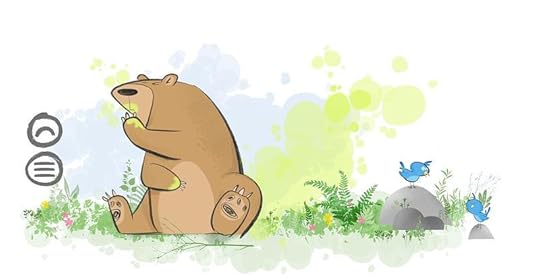
Wander is full of expressive imagery, where, as the saying goes, a photo really does say a thousand words. We watch as a bear emerges from hibernation during spring to greet the seasonal changes. His watchful expression is mirrored by the puffy-looking, but adorable, bubble bees. He greets a bright two-tone caterpillar who probably wishes the bear slept a bit longer. The bear’s exploration of the seasonal changes leads him to a stream where his path crosses with a reptile. As summer turns into fall, the sweet bear finds himself in a precarious situation. Young readers can infer the mood during the autumn months by looking at the characters’ eyes; no decoder needed for these pages! The animal’s journey in Wander comes full circle, beginning with a large, brown bear waking from hibernation and concluding with snowflakes signaling it’s time to hibernate once more.
Wander, a brightly colored pictograph storybook, is recommended by the author for children nine years and older. While the pictographs and in-depth conversation are suitable for this age group, the illustrations are timeless, making it a book that families can cherish for many years to come.
Wander is a quietly powerful and deeply immersive book that invites readers to slow down and truly observe.
Told entirely through illustration and glyphs, this story trusts its readers in a refreshing way. There are no conventional words to guide you, only visual language and symbolism that encourage interpretation, curiosity, and reflection. The experience feels less like reading a book and more like entering a meditative journey alongside the bear.
The seasonal arc is beautifully handled. From waking after hibernation to exploring the changing world and eventually returning to rest, the bear’s journey mirrors the natural rhythms of life. The artwork is expressive and emotionally rich, allowing readers to infer mood, tension, and wonder without being told what to feel.
The inclusion of glyphs adds an extra layer of depth. While the glossary is essential for older readers to fully engage with the symbols, the illustrations alone are accessible even to much younger children. This makes Wander a rare book that grows with its audience, offering different experiences at different ages.
Wander celebrates observation, empathy, and the interconnectedness of all living things. It is a book that rewards patience and curiosity, and one that families can return to again and again, discovering something new each time.