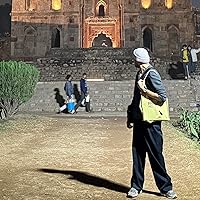
Delhi’s urban villages are paradoxical spaces—at once ancient and evolving, marginalized yet central to the city’s modern economy. These are places where centuries-old traditions coexist with pop-up cafés and start-ups, and where the past is never quite past. Born out of state-led land acquisitions from the early 20th century, these villages were thrust into transformation through urban expansion. What emerged was not a seamless integration, but a complex part city, part village, part memory, part reinvention. This book journeys into those spaces—exploring how people remember, resist, and reimagine their place in a city that’s always on the move. Through stories of place, identity, and power, Sheher Mein Gaon uncovers how these neighbourhoods reflect the deeper tensions of modern urban life—between tradition and progress, belonging and exclusion, history and ambition.
If you’re at all interested in the history of Delhi, chances are you would have heard of the ‘seven cities of Delhi’. Of how some of the most ambitious rulers sought to assert their claim to the throne by building massive citadels and cities of their own. From Lal Kot to Tughlaqabad, Firozabad to Shahjahanabad and New Delhi, these ‘cities’ (not all historians agree on their number: there were very likely more than seven Delhis) have been discussed and described time and again. Their establishment, their layout, their evolution, their socio-cultural and economic make-up have been studied by numerous scholars.
What of Delhi’s villages, though? The villages of Delhi rarely find anything beyond a fleeting mention in the city’s chronicles, whether factual or fictitious. They are tucked away, hidden behind the towering facades of palaces and skyscrapers, grand monuments and sweeping flyovers. Yet—as Ekta Chauhan writes in her book Sheher Mein Gaon: Culture, Conflict and Change in the Urban Villages of Delhi—perhaps to understand Delhi’s villages, we need to first re-examine our concept of a city. Chauhan quotes historian Sohail Hashmi as saying that ‘there are no cities without migration’; Chauhan goes on to add: ‘He elaborated that a place only begins to transform into a city when diverse groups arrive—bringing with them new trades, skills, stories and ways of life. Until then, it remains a village: self-contained and unlayered. Migration is what makes a city…’
Of course, with migration, with the growing of a village into a city (or part of a city), there comes flux. There is change, there is conflict, there is disagreement between what was, what is, and what may be. This—the past, the present, and the possible future—of Delhi’s villages, is what Chauhan sets out to examine in this slim but important book, which looks at nine villages spread across Delhi.
After an introduction, the author plunges straightaway into the first of the villages, Begumpur. This is followed by some of Delhi’s best-known ‘urban villages’: Shahpur Jat, Hauz Khas and Khirki, before the book moves on to some of the lesser-known gaons: Kalu Sarai, Deoli, Mitraon, Sungarpur, and finally Sonipat. Chauhan devotes a chapter to each village, and ends with an epilogue, Khirki Kay Paar: Beyond the Rural-Urban Dichotomy.
There is no set pattern to the chapters, to Chauhan’s exploration of these villages and their residents, both permanent as well as temporary. Each chapter, instead, flows organically, examining as it goes the history of the village, how it has evolved, who are its inhabitants, how they earned a living (and what they do now, in the absence of fields or other ‘rural’ means of livelihood). Who are the newcomers, the migrants who have made that particular village their home for the time being.
For each village, Chauhan weaves together facts, opinions, and observations, ranging from insights about pressures on land to ill-advised government policies, from the stress on migrant kaarigars in Shahpur Jat to the stark division between university campuses and gated communities on the one hand, village fields on the other, in Sonipat. There are conversations with people: with villagers as well as migrants. There are glimpses—at times heartbreaking, at times frustrating—into the lives of these rural communities, stranded in the middle of one of Asia’s largest metropolitan sprawls.
One of the many remarkable things about Sheher Mein Gaon is the way Ekta Chauhan has chosen the villages she highlights. She mentions in the course of the book that Delhi has close to 350 villages; surely among those many, there would be several that would mirror the same problems as she highlights through the stories of Begumpur, Khirki, Shahpur Jat, et al? But Chauhan chooses her focus carefully, with each of the villages distinct in its own way. If Shahpur Jat is synonymous with fashion and Hauz Khas (its chapter aptly titled Chasing the ‘Cool’) with the hip crowd, there’s Mitraon (Ya Toh Gangster, Ya Toh Khiladi), the hair-raising description of which reads like a blood-soaked Bollywood film of gang warfare. There’s Sungarpur, still with its fields, still seemingly embodying the idyllic rural charm of urban imagination. There’s Begumpur, its mosque increasingly a focal point of communal tensions.
Chauhan’s writing is very readable. The credibility is there in the facts, the (obviously solid) research that backs them up. Chauhan’s background—with degrees in history, public policy, and World Heritage Studies—means that she brings to this book a solid grounding in several pertinent disciplines, helping her to analyze and articulate the many tangled issues that surround Delhi’s villages. This scholarliness is balanced perfectly with the human element: the exact words (written in the Roman script, followed by a translation) of the people of these villages. Both those whose families have lived in these villages for many generations, as well as those who have just arrived.
The voices in this book run the gamut from Afghan refugees in Khirki to students preparing for the UPSC in Kalu Sarai; from Bina Ramani and her memoir of Hauz Khas Village, to a farmer in Sungarpur. There are stories of anger and intolerance, but there are also instances of hope and resilience, for instance in the establishment of organizations like Dilli Dehat and the Simurgh Centre. If there is a lack, it is in the voices of women; there are too few of these, but it is something Chauhan herself admits and hopes to rectify in future projects.
At the beginning of Sheher Mein Gaon, Chauhan (who is an assistant professor at OP Jindal Global University) describes her growing-up years: she was born and brought up in Khirki Village. That—the duality in her own life—is possibly what helps Chauhan see both sides of the coin. The result is an empathetic yet objective view of Delhi’s villages. This book is an eye-opener, a reminder of why the sheher needs to keep its gaons in mind as it grows and progresses.
Brilliant book on a very under explored facet of Delhi's history. I think that for anyone with extensive experience of navigating built environments in the megacity, pieces of a puzzle fall into place with each chapter. Friends often talk of 'neglected' neighbourhoods, with narrow lanes and visible signs of apathy by the municipal authorities, that seem to be right next door to some of the fanciest quarters of post-Partition Delhi (the Kotla Mubarakpur to Defence Colony, or the Zamrudpur to Greater Kailash). It's almost like everyone that lives in Delhi is aware of the existence of the villages that the city 'absorbed' as it rapidly expanded in the decades after 1947, but without knowledge of the villages as historical entities of their own.
I find it particularly interesting to read this in light of how the current trend is to lament recent 'explosive migration' to Delhi from the relatively impoverished parts of the country, and blame these working class people for everything from urban decay to Delhi's famously terrible law and order situation. The blame is often levelled by middle-class or generally well-off people who are descendants of Partition refugees from modern day Pakistan themselves, their association to the city no more than three generations old. The denizens of Delhi's centuries-old villages, however, had their own value judgments about the 'Punjabis' and their alien culture that they saw as a threat to their own way of life. A useful reminder of the basic fact that we are all migrants.
I loved the writing on how heritage spaces were part of community life in these villages, and how the ASI's preference for separating 'monuments' from the 'living spaces' of the city disrupted that way of life. A community centre in a 700 year old mosque, for example, would become sealed premises that allows only tourists in. Complicated, also, by how fascist era India brands any heritage associated with its Muslim past. I also learned a lot from the descriptions of how homes and farmlands were organised in these villages, and how their economies adopted when farmland was acquired for building gated communities most villagers won't be able to afford living in.
The classism, Islamophobia, and outward racism experienced by migrants in Delhi generally, but specifically in urban villages (in part because vulnerable migrants would flock to these villages in search for cheaper rent) was very well described, and I learned a lot about neighbourhoods that in some cases I have literally lived for years in. Delhi's Afghan community for example, and how they cluster by shared ethnicity and language in different parts of the city, as a microcosm of ethnic enclaves back in Afghanistan. Or the fact that even Raisina Hill, which has always looked timeless to me despite the fact of it being part of 'New' Delhi, is named for a village whose land was acquired to build the imperial capital.
Can't believe writing on this is as scant as it is, and I never noticed the lack of it until I read this.
This was THE Delhi book that waiting to be written. There are hundreds of historical and fictional accounts of the "seven cities of Delhi", but not one about the "villages" of the contemporary city. Unknown to pretty much everybody outside of Delhi, and most within Delhi too, there are 350+ villages within Delhi - sometimes called "lal doras" for the red threads that were used to demarcate them on the map originally - that fall outside of pretty much all municipal norms. They were created to let the villagers who had been living in these areas for centuries to retain their way of life while the city grew around them, and are not bound or supported by most city systems - building regulations, or water, electricity or sanitation systems, and are often run by the locals in line with their age-old traditions. Some of these villages were still dependetly entirely on agriculture till as recently as 35/40 years ago.
But, unsurprisingly, the city has invaded them, and vice-versa. Some of these villages are now hotspots for culture, F&B, artists and designers, and most recently "dark stores" and "cloud kitchens". They are hotbeds for migrants with their lower cost of living and few-questions asked approach. They have become melting pots of castes and regions and religions, but that has unsusprisingly brought its own set of conflicts and tensions.
Ekta shares both from lived experience (she grew up in Khirki, one of the better-know villages in South Delhi) and extensive research. She weaves in history and monuments dating back 2000 years with conversations both from the elders who can still recount their farming years with the youngest generation that is sometimes entirely oblivious about living inside a 500-year building, to weave a engaging narrative of these urban anomalies.
I am likely biased both because I live in Delhi (and in the erstwhile farmlands of one of these villages) and am fascinated by its history, but I think it's a fab book anyway.