

What do you think?

We Are Gathered Here Today
The Wedding People meets The Celebrants in this hilarious and profound novel about a recently engaged gay man second guessing marriage, and his cousin’s chaotic Texas wedding weekend with old friends and unexpected strangers that will help guide him to the truth, from the beloved author of The Old Place.
At 36, Finlay Hightower has attended countless incredible, cringe-worthy, and disastrous wedding celebrations with his best friends. Their secret to surviving wedding chaos? The Hour of Disrespect—a pact to reserve judgement to one hour after the couple’s Big Day, protecting the wedding glow and leaving only with the good memories.
But this next wedding will test their decade-old tradition in more ways than one. Now, one of their own is getting married—Fin’s beloved cousin, Elaine—at a Wild West-themed venue in the sweltering Texas summer heat that is as meticulously itineraried as it is kitchy. Reserving opinions won’t be easy, and on top of that Fin has a secret that threatens his officiant he’s just gotten engaged to the man of his dreams, and a sense of unease has him questioning if he believes in the institution of marriage at all.
As Fin joins the rambunctious and increasingly unhinged “queer table”, old friendships are tested and new relationships are formed. Will each guest hold back their particular views on love, commitment, and the wedding before Elaine can say “I do”? And if not, could those confessions ultimately give Fin the courage to uncover his truth?
Like any good wedding, We Are Gathered Here Today is funny, heartfelt, and full of surprises. Like any terrible wedding, it’s something you’ll never forget.
At 36, Finlay Hightower has attended countless incredible, cringe-worthy, and disastrous wedding celebrations with his best friends. Their secret to surviving wedding chaos? The Hour of Disrespect—a pact to reserve judgement to one hour after the couple’s Big Day, protecting the wedding glow and leaving only with the good memories.
But this next wedding will test their decade-old tradition in more ways than one. Now, one of their own is getting married—Fin’s beloved cousin, Elaine—at a Wild West-themed venue in the sweltering Texas summer heat that is as meticulously itineraried as it is kitchy. Reserving opinions won’t be easy, and on top of that Fin has a secret that threatens his officiant he’s just gotten engaged to the man of his dreams, and a sense of unease has him questioning if he believes in the institution of marriage at all.
As Fin joins the rambunctious and increasingly unhinged “queer table”, old friendships are tested and new relationships are formed. Will each guest hold back their particular views on love, commitment, and the wedding before Elaine can say “I do”? And if not, could those confessions ultimately give Fin the courage to uncover his truth?
Like any good wedding, We Are Gathered Here Today is funny, heartfelt, and full of surprises. Like any terrible wedding, it’s something you’ll never forget.
320 pages, Hardcover
First published June 16, 2026
Ratings & Reviews
Friends & Following
Create a free account to discover what your friends think of this book!
Community Reviews
Displaying 1 - 30 of 222 reviews

Read
July 8, 2026
Book Riot’s Best Books of 2026 (So Far)
While a destination wedding at a Wild West-themed venue may sound like a version of hell, Fin is determined to make the best of it and write a perfect officiant speech. Along with his friend Jacque, he quickly allies with the other queer people at the wedding. The group identifies wedding enemies, assesses each other’s relationships, and discusses the value of marriage in general. The elongated weekend of celebration makes space for everything a wedding has to offer: awkward mic moments, passive aggressive comments, and true transcendent joy. This book unravels the differences between love, weddings, and marriage with tenderness and wit.
- Julia Rittenberg
While a destination wedding at a Wild West-themed venue may sound like a version of hell, Fin is determined to make the best of it and write a perfect officiant speech. Along with his friend Jacque, he quickly allies with the other queer people at the wedding. The group identifies wedding enemies, assesses each other’s relationships, and discusses the value of marriage in general. The elongated weekend of celebration makes space for everything a wedding has to offer: awkward mic moments, passive aggressive comments, and true transcendent joy. This book unravels the differences between love, weddings, and marriage with tenderness and wit.
- Julia Rittenberg

March 31, 2026
I really wanted to like this, especially because I loved the author's previous book, Four Squares. Unfortunately, the writing and characterization were so weak that I lost interest about 2/3 of the way through, and I only finished the book out of a sense of duty. I can't recommend this! You should go read Four Squares instead.
This is supposed to be a character-driven drama about a queer group of friends reuniting for a wedding in the Hill Country. The issue is the writing perspective. Most of the book is third-person omniscient and focused on the protagonist, Fin, but the author frequently jumps over to other characters' perspectives, sometimes in the same paragraph. That means you're constantly told exactly how the characters are thinking or feeling, so there's no room for nuance or true conflict. Even worse, there are a few crucial scenes where only Fin's perspective is provided. Removing the other perspectives at these stages is obviously only done to drive drama, which I think is a cheat if you constantly switch perspectives otherwise. The writing overall feels choppy, and sometimes characters assert feelings that don't seem to match up to the actual events. The most egregious example is .
The author clearly has something to say about the nature of marriage and how it works (or doesn't) for queer relationships, but that doesn't really come through in the characterizations. The asides get shoehorned in. Basically, none of this worked for me, though I did like that this was set in the Hill Country and that there were many references to Austin landmarks and geography.
There are several references to Covid and its impact on the characters, which makes me think this book may have been written a few years ago and only recently edited for publication.
Thank you to the publisher and Netgalley for sending me a copy!
This is supposed to be a character-driven drama about a queer group of friends reuniting for a wedding in the Hill Country. The issue is the writing perspective. Most of the book is third-person omniscient and focused on the protagonist, Fin, but the author frequently jumps over to other characters' perspectives, sometimes in the same paragraph. That means you're constantly told exactly how the characters are thinking or feeling, so there's no room for nuance or true conflict. Even worse, there are a few crucial scenes where only Fin's perspective is provided. Removing the other perspectives at these stages is obviously only done to drive drama, which I think is a cheat if you constantly switch perspectives otherwise. The writing overall feels choppy, and sometimes characters assert feelings that don't seem to match up to the actual events. The most egregious example is .
The author clearly has something to say about the nature of marriage and how it works (or doesn't) for queer relationships, but that doesn't really come through in the characterizations. The asides get shoehorned in. Basically, none of this worked for me, though I did like that this was set in the Hill Country and that there were many references to Austin landmarks and geography.
There are several references to Covid and its impact on the characters, which makes me think this book may have been written a few years ago and only recently edited for publication.
Thank you to the publisher and Netgalley for sending me a copy!
July 3, 2026
This book felt like standing in a circle of people at a wedding who all went to college together and they’re talking about someone they all know and you have no clue what’s going on. A little funny but ultimately not that interesting

May 16, 2026
3.5 rounding up
We Are Gathered Here is a particularly melancholy book from an author I’ve come to associate with introspective, slow burn melancholy. Finlay Hightower (great name) is approaching the climax of a crisis of uncertainty - he doesn’t know what he’s doing with his career, his relationship, his friendships or his future - when he’s thrust into the peculiar suffocation of the forced fun of a wedding weekend spent with friends of friends that you don’t actually know and may not even like. This setting is a little uncomfortable, not just for the characters, but for the reader too. It’s also a slow burn of a story, which means you sit in this discomfort and suffocation for a while and it really does feel like you’re out on a lawn chair for endless hours trying to fight off the Texas sun. I’m a freak, so I really appreciate that sort of atmosphere building, but it doesn’t make for the most *fun* reading experience. While Bobby’s dry, quiet humor is here, it’s very understated, and I think it’s more likely to resonate with fans of his who can pick up on his particular setups and cues than newcomers.
I ended up enjoying the book, but I wonder how much of that can be attributed to my own willingness to sit in this discomfort because I’m a fan of Bobby Finger’s - not just his previous books, but his podcast as well. Recommend for fellow fans of his, but caution new readers that they are signing up for a slow exploration of intimacy, which is a delicate topic that doesn’t lend itself to big flashy emotions.
Thank you to NetGalley and the publisher for the ARC in exchange for an honest review!
We Are Gathered Here is a particularly melancholy book from an author I’ve come to associate with introspective, slow burn melancholy. Finlay Hightower (great name) is approaching the climax of a crisis of uncertainty - he doesn’t know what he’s doing with his career, his relationship, his friendships or his future - when he’s thrust into the peculiar suffocation of the forced fun of a wedding weekend spent with friends of friends that you don’t actually know and may not even like. This setting is a little uncomfortable, not just for the characters, but for the reader too. It’s also a slow burn of a story, which means you sit in this discomfort and suffocation for a while and it really does feel like you’re out on a lawn chair for endless hours trying to fight off the Texas sun. I’m a freak, so I really appreciate that sort of atmosphere building, but it doesn’t make for the most *fun* reading experience. While Bobby’s dry, quiet humor is here, it’s very understated, and I think it’s more likely to resonate with fans of his who can pick up on his particular setups and cues than newcomers.
I ended up enjoying the book, but I wonder how much of that can be attributed to my own willingness to sit in this discomfort because I’m a fan of Bobby Finger’s - not just his previous books, but his podcast as well. Recommend for fellow fans of his, but caution new readers that they are signing up for a slow exploration of intimacy, which is a delicate topic that doesn’t lend itself to big flashy emotions.
Thank you to NetGalley and the publisher for the ARC in exchange for an honest review!

June 26, 2026
A fun one to read having just gone through the experience of planning a wedding and getting married. I really like how Finger told an honest story about the realities of making a life-altering decision and commitment to another person. I think I liked Four Squares better and am now eager to read The Old Place. This was a little predictable but still an enjoyable part of my summer reading season.

July 2, 2026
Literally the perfect summer read.

July 21, 2026
Really wanted to like this, but the points of view switched so often I kept getting confused. The story is mostly told from Fin’s perspective, but it will sporadically jump to a different character mid-chapter (sometimes mid-paragraph). It made the writing feel rushed and sloppy. There were several unnecessary plot points; the couple of flashbacks to other weddings were pointless and Fin’s dead parents didn’t add much either.
June 28, 2026
WHOLIGANS RISE

June 13, 2026
This is a somewhat entertaining story about guests at a Texas wedding. I found most of the main characters (the group of gay guests) to be a bit insufferable. They’re in their mid-30s and all seem to have difficulty making important decisions or dealing with real life. It’s been a while for me, but I don’t remember being that immature at that stage of life.
There’s nothing wrong with unlikable characters in a book as long as they’re complex or do something interesting. The events in this book over a long weekend sound like fun, but the characters manage to bring everything down.
Where the book works best is in the one-on-one scenes between some of the protagonists. There are some heartfelt conversations that unveil deep-seated anxieties about life.
Thank you to Putnam and NetGalley for an ARC in exchange for an honest review.
There’s nothing wrong with unlikable characters in a book as long as they’re complex or do something interesting. The events in this book over a long weekend sound like fun, but the characters manage to bring everything down.
Where the book works best is in the one-on-one scenes between some of the protagonists. There are some heartfelt conversations that unveil deep-seated anxieties about life.
Thank you to Putnam and NetGalley for an ARC in exchange for an honest review.
July 4, 2026
Bobby is an instant buy author for me since I’m a wholigan but also because he’s a great author!!! I love the worlds he creates with great descriptive writing and interesting and real characters. This was a slower build for me but I loved the climax of the building tension and drama of this forced wedding fun friend group. Everyone has been to a wedding where they’ve been forced to make friends with complete strangers for a few hours and everyone has absolutely complained after the wedding about the annoying parts of the wedding on the way home! Crunch crunch!

September 14, 2026
3.5 rounded up
Bobby’s books have a way of growing on me. The beginning was a bit boring, but it actually served me well because having so much normal time on page with the characters made me really attached to them when conflict finally started happening.
I loved how the plot was centered around Elaine and Rupert’s wedding but Rupert was barely a character at all! Plus I was puzzled by Haley being included in the plot.
The writing was kinda trite, especially at the end, but all the build up and wedding drama was fun.
Not his best work but I ended up enjoying the experience.
Bobby’s books have a way of growing on me. The beginning was a bit boring, but it actually served me well because having so much normal time on page with the characters made me really attached to them when conflict finally started happening.
I loved how the plot was centered around Elaine and Rupert’s wedding but Rupert was barely a character at all! Plus I was puzzled by Haley being included in the plot.
The writing was kinda trite, especially at the end, but all the build up and wedding drama was fun.
Not his best work but I ended up enjoying the experience.

July 2, 2026
WHOLIGAN FOR LIFE!!!! I love how Bobby has such a distinct writing style, so descriptive and character driven, that you know from page 1 that you are getting a Bobby Finger novel. I think maybe Four Squares is my favorite of his, but I really like this one too. I love when books are set over one clear period of time, in this case a wedding weekend in Texas and I like how the plot builds slowly until things boil over during a float down the river. Crunch crunch!

August 15, 2026
3.25⭐️ i'll be honest when i looked up the reviews on goodreads i was quite terrified but i was pleasantly surprised ! Was it the best book ever written? No. Do i even like weddings? No. But was it a quite funny character driven book? Yes. Not the best but not the worst either. A decent beach read🤷🏻♀️

August 9, 2026
I’ve never seen more insufferable characters
August 18, 2026
Right off the bat let me say that this is actually a three and a half star book but Goodreads. It is slightly above average but not much.
Fin Hightower is attending the wedding of his closest cousin which is taking place at a western-themed venue in Texas. He's been placed at the "queer"table along with his best friend, a bickering married couple, and their best friend. The five wind up spending the weekend together, participating in all the games and activities, and getting to know each other. Fin has not revealed to his cousin Elaine or his friend Jacque that he has become engaged to his boyfriend, he is unsure if marriage is what he really wants, and on top of that, he finds himself mildly attracted to a member of the couple.
This is not by any means a bad book. Weddings always make for a fun read, especially outlandish ones, Fin is a nice character, and the writing is fine. The "Hour of Disrespect" which Fin, Jacque, and Elaine have always allotted themselves after a wedding is discussed constantly but turns out not to be as much fun as one would expect. I just found that I really didn't care about the outcome of the story.
This was a Goodreads win so my thanks to them and to the publisher, G.P. Putnam's & Sons.
Fin Hightower is attending the wedding of his closest cousin which is taking place at a western-themed venue in Texas. He's been placed at the "queer"table along with his best friend, a bickering married couple, and their best friend. The five wind up spending the weekend together, participating in all the games and activities, and getting to know each other. Fin has not revealed to his cousin Elaine or his friend Jacque that he has become engaged to his boyfriend, he is unsure if marriage is what he really wants, and on top of that, he finds himself mildly attracted to a member of the couple.
This is not by any means a bad book. Weddings always make for a fun read, especially outlandish ones, Fin is a nice character, and the writing is fine. The "Hour of Disrespect" which Fin, Jacque, and Elaine have always allotted themselves after a wedding is discussed constantly but turns out not to be as much fun as one would expect. I just found that I really didn't care about the outcome of the story.
This was a Goodreads win so my thanks to them and to the publisher, G.P. Putnam's & Sons.

Did Not Finish
July 28, 2026Read about half of this (to page 133) before it was due back at the library. I kept prioritizing other books ahead of it so I doubt I'll follow-up and finish it. I went into it hopeful – I'd seen people describe it as an LGBTQ+ twist on The Wedding People, which I really enjoyed. Unfortunately, there wasn't much depth to the characters, instead just catty quips.
August 9, 2026
Audiobook: almost dnf. It was slow towards the beginning and the narrator of the story sounded melancholic due to the inflection. It has it sound like it was a sadder story than what it was. And maybe that works as the main character did have a little of that vibe -stuck in their own, dealing with problems that may not fully exist in real life due to over thinking- but made this wedding story seem sad for no reason.
August 17, 2026
No depth to the characters- I made it 60% of the way through the book without having any sense of who these people were or true history of their relationships. Making it 60% in was a STRUGGLE. It’s rare that I cannot finish a book- but I couldn’t force it any longer and honestly wasn’t even interested enough to look up how it ends since it wasn’t actually going anywhere.

June 24, 2026
Wow, I LOVED this book! A perfect summer read about a millennial-ish gay guy newly engaged and feeling all sorts of ways about it while at a wedding weekend for his straight beloved cousin, Elaine.
I found this book so relatable- what DOES commitment mean? and HOW CAN YOU EVER BE SURE YOU ARE MAKING THE RIGHT CHOICE? in addition to laughing out loud at the dynamics of the friend group.
Warm hearted, realistic, and just damn delightful!
I found this book so relatable- what DOES commitment mean? and HOW CAN YOU EVER BE SURE YOU ARE MAKING THE RIGHT CHOICE? in addition to laughing out loud at the dynamics of the friend group.
Warm hearted, realistic, and just damn delightful!

July 18, 2026
A meditation on millennial marriage, with a strong dose of queer marriage thrown in as well. Loved all the Texas references from someone who knows what he’s talking about. I thought it started a bit slow, but I was very invested by the end.
August 17, 2026
“To be best friends with someone is to exist under a permanent cease-fire, both parties with ample means to destroy the other but choosing not to engage out of the fear of mutually assured destruction. That, and loving each other.”
Read
August 23, 2026Wanted to like this more than I did. Liked the musings on relationships and marriage and had some funny moments like the scavenger hunt scene and the hour of disrespect, but found it a bit clunky at times. Ending was lovely but kinda rushed.

September 1, 2026
⭐️⭐️⭐️.5!!
such an interesting take on weddings in general! loved the different perspectives we saw as the story progressed but feel like the message was sorta lost somewhere in the middle. very unique book & was a cutesy mindless read!
such an interesting take on weddings in general! loved the different perspectives we saw as the story progressed but feel like the message was sorta lost somewhere in the middle. very unique book & was a cutesy mindless read!

September 13, 2026
How millennial! This book was a drag, and I do not think it knew what it wanted to be. All the characters were uninteresting and even when there was objective drama going down, it was still boring. I only finished it because the audiobook is narrated by Michael Crouch and he's my favorite narrator.
August 5, 2026
DNF: Not my cup of tea.

August 5, 2026
Oof. Not good.

September 1, 2026
3.5 stars, rounded up. I enjoyed the cast of characters and found the ending very satisfying!

September 15, 2026
I want to go to a wedding with this much intrigue :/
September 24, 2026
I enjoyed reading this book but it seemed anticlimactic. The surprises weren’t really surprising but it was an easy, fun read

Review of advance copy received from NetGalley
Save the Date, Save the Seating Chart, Save Your Opinions for the Hour of Disrespect
Bobby Finger’s “We Are Gathered Here Today” is a wedding novel that knows the buffet line, the group text, and the emotional support cousin can be just as narratively consequential as the vows.
By Demetris Papadimitropoulos | April 17th, 2026
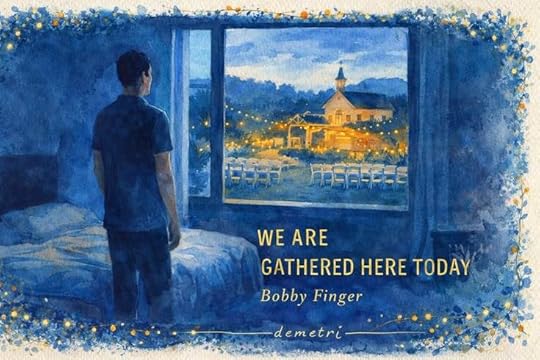
A solitary figure at blue hour looks out over the staged warmth of the Hideout, where “We Are Gathered Here Today” turns wedding spectacle into a study of distance, longing, and the private life of ceremony.
Weddings are among the last places where adults agree, en masse, to behave as though certainty can be staged. Two people make a choice. Everyone else gets dressed, finds the right chair, holds a drink, and pretends for a few expensive hours that love has resolved itself into something sturdy enough to photograph. Bobby Finger’s “We Are Gathered Here Today” knows how faintly ludicrous that is. It also knows why people keep wanting it anyway. Finger can make a wedding look ridiculous without turning it into an easy target, and that doubleness – cattiness on the surface, actual hurt underneath – gives the novel both its engine and its tenderness. What at first looks like a sharp wedding-weekend comedy turns out to be a book about how adults turn scraps of evidence into entire beliefs about how life works.
Finlay Hightower, thirty-six, lives in Brooklyn, makes dippable-food videos for the internet, and has come back to central Texas for the wedding of his cousin Elaine. “Cousin” is true but not sufficient. Elaine is also one of the people around whom his emotional life still takes shape, along with his best friend Jacque, the third point in a long-running triangle of intimacy, sarcasm, and mutual forensic attention. Fin is newly engaged to his boyfriend, Mark, and telling almost no one. Elaine, meanwhile, is marrying Rupert after years of obvious fit and a surprisingly delayed proposal, and she is doing so at the Hill Country Hideout, a faux-Western venue complete with saloon, chapel, poker table, scavenger hunt, clue cards, room-key codes, and enough cowboy décor to make the first little snarl of critique rise in any decent guest’s throat. The place looks as though it were assembled from three vendor catalogs and dropped onto the Hill Country overnight. For all its catalog rusticity, it still has to absorb real feeling.
The book’s best piece of comic architecture appears before the luggage is fully unpacked. Fin, Elaine, and Jacque have long observed the Hour of Disrespect, a standing pact whereby all wedding complaints must be saved for one post-event stretch of sanctioned bitching. It is a terrific joke. It is also the key to the whole novel. Fin does not simply have feelings; he turns them into a filing system. He delays, quarantines, curates, withholds. The Hour of Disrespect is not just comic etiquette. It is Fin’s private theology of self-protection. His secret engagement, his anti-marriage speechifying, even his understanding of himself all depend on managed release. He does not merely hesitate. He builds procedure around hesitation and then calls the result maturity.
The weekend comes in preplanned blows: karaoke, lawn games, scavenger hunt, tubing trip, bonfire, rehearsal dinner, ceremony, reception. Finger is very good at making such sequences do more than fill pages. Karaoke becomes rehearsal – for embarrassment, longing, and the strange bravery required to be earnest in public. The scavenger hunt, with its fake psychics, faux wranglers, clue cards, and old family photographs, becomes a lesson in how memory gets prettied up, laminated, and sold back to people as heritage. The tubing trip, meant to relax everyone, curdles into soaked public embarrassment: cans fly, secrets spill, police intervene, and dignity drifts downstream in koozies while strangers watch from nearby tubes. The bonfire nearly turns operatic. The children are truly hellish. Hailey, the wedding planner, glides through it all with the eerie calm of someone who could extinguish both a literal fire and an emotional one without scuffing a boot.
The novel stops merely amusing and starts exposing people when the evidence Fin has been treating as settled turns out to be evidence he himself has bent into shape. His parents were quiet, sealed-off people, not visibly demonstrative with each other or with him. Fin has taken that silence and made a whole worldview out of it: marriage is entrapment, permanence is delusion, choosing once means getting stuck forever. He presents this as intelligence. Really it is fear put into a blazer and taught to cite theory. Finger’s sharpest move is not to refute Fin in the abstract, but to show that the evidence itself has been mistranslated – that Fin took reserve for lovelessness, then mistook that misreading for wisdom.
That correction arrives through Johanna, Fin’s great-aunt, old enough to be done with ceremonial niceness and funny enough not to turn wise by becoming solemn. She gives Fin his late mother Martha’s diary, and the novel immediately starts asking more of itself. Up to this point, “We Are Gathered Here Today” is a very good social comedy of itineraries, resentments, old loyalties, overheated politeness, and the emotional traffic jam any wedding produces. The diary shifts the book out of event-comedy and into family revision. Martha, it turns out, had once been engaged to another man before leaving him for James, Fin’s father. The diary reveals not a woman trapped into marriage but a woman choosing it, and choosing it with a fervor Fin never guessed at. This is not backstory added for emotional upholstery. It changes the terms of the novel. Fin has mistaken parental silence for unhappiness, then mistaken that mistake for adulthood.
That is the book’s most underdiscussed strength. It understands how adults turn coping mechanisms into convictions they admire in themselves. Fin does not say, plainly, that he is frightened love will sour and trap him. He says the institution is compromised, permanence is coercive, marriage is structurally suspect. Some of that may be true. The more revealing fact is that truth and evasion can live in the same sentence. Adults do this constantly. They turn a wound into a principle, then congratulate themselves on their realism.
The prose moves like practiced gossip – quick, dry, and able to nick social flesh without making a show of the blade. Finger is especially good on public abrasions: the child question, the seating-chart politics, the passive-aggressive curiosity about how internet work becomes money, the condescension directed at anyone who does not commute to an office, the wedding-guest panic of having to make a life sound coherent to near-strangers in nice clothes. This is nimble prose, socially acute and lightly needling. It is more deft than dazzling, which matters. Its softest passages are the ones in which pain arrives already translated into insight. Now and then distress is expressed a shade too cleanly, as if panic had been given one extra pass in revision before being sent onstage.
Still, the tonal control is impressive. A novel with this much wedding logistics and emotional traffic can die on the dance floor before dessert. Too much sneering, and the entire enterprise becomes a carnival duck. Too much uplift, and everyone starts floating above the page like reception balloons. Finger mostly avoids both traps. The Hideout remains gloriously, insistently fake, which is crucial. Hailey never stops being a little alarming. The fake snake remains fake. The faux saloon remains faux. But when the ceremony arrives, when Fin officiates, when Johanna speaks at the reception in her purple dress and shellacked gray curls, the book does not flinch from feeling. Finger understands that performance is often the only form sincerity can take in public. The vows land. So do the speeches. He earns that.
And the book’s pulse is often strongest a few feet away from its official romance. The friendship between Fin and Jacque has more charge in it than almost anything else here. Their shorthand, their grievances, their instinctive knowledge of one another’s worst habits, the cease-fire quality of any long friendship with enough history to become dangerous – all of this is beautifully caught. Elaine deepens too, especially once the wedding stops being fantasy and starts looking like project management in nice shoes. Her admission that she is ninety percent sure she wants to spend her life with Rupert is one of the novel’s cleanest and best choices. Ninety percent is not romantic failure. It is adulthood speaking in a register fiction too often refuses. Johanna, meanwhile, is the book’s load-bearing beam. She is the one person allowed to say that love is work without sounding as though she bought the phrase engraved on reclaimed wood.
Mark is the clearer limitation. He improves markedly in the final stretch, especially around the diary, where his steadiness stops feeling generic and becomes dramatically useful. But for much of the novel he arrives as solution rather than person. He is sexy, patient, decent, available to be hurt, and eventually firm. All of that matters. It is also thinner than what the book does with Jacque, Elaine, Johanna, and even Todd, whose collapsing marriage becomes a sharper mirror than the central love story. The middle, likewise, worries the same bruise once or twice too often. Fin’s panic about permanence is real, but the novel circles it in only slightly altered language enough times that one begins waiting for the diary to arrive and force the book into deeper water.
When that happens, the novel gets better. The river fiasco is extremely funny once it is no longer happening to you. The diary does more than deepen the book; it hauls it out of the narrower, shinier category the first half threatens to stay inside. Fin’s officiant speech, which could easily have turned soft or self-impressed, comes off. Johanna’s reception speech is better still. She can say, flatly, that love is labor and that people fail each other all the time, then threaten to come back from the dead and haunt her granddaughter’s husband, and somehow make marriage sound lived-in rather than sermonized. By that point Finger has earned the right to let a wedding speech do what wedding speeches almost always promise and almost never manage: enlarge the room.
Part of what makes “We Are Gathered Here Today” inseparable from this overadministered, overinterpreted moment is how cleanly it catches a certain adult habit. It understands people who want ritual while distrusting the institutions ritual blesses. It understands jobs, travel, apps, disclosure politics, guest-room logistics, visibility, aging relatives, and the private math of who gets told first and who gets left out. More than that, it understands the contemporary urge to treat commitment like homework that must be completed before life can begin. That is a real diagnosis. It is also where the novel’s limits show. Finger is more incisive in naming ambivalence than in dramatizing life beyond it. The book is observant, deft, funny, and emotionally plausible. It is also a little more neatly jointed than its opening commotion leads you to expect. Its insights are real, but it sometimes seems content to name a problem rather than force it to the wall. Its comedy pleases consistently, wounds selectively. Its revelations arrive with just enough neatness that you can sometimes feel the novelist’s hand laying them down.
Those limits do not flatten the novel, but they do keep it from becoming stranger, harsher, and better. I’d put “We Are Gathered Here Today” at 83/100, or 4 stars on Goodreads: a smart, likable, emotionally alert novel that does more than its sales pitch suggests, even if it finally works better as a comedy of manners, feeling, and emotional self-protection than as a truly exceptional novel. Finger can make weddings look faintly absurd without draining them of their heat. Better, he understands what weddings give the people who do not have to keep them going. The couple leaves with the labor. The guests leave with something lighter and far less dependable: a little authorized fire of hope, burning for a few hours in rented space, long enough for everyone standing nearby to mistake warmth for permanence.
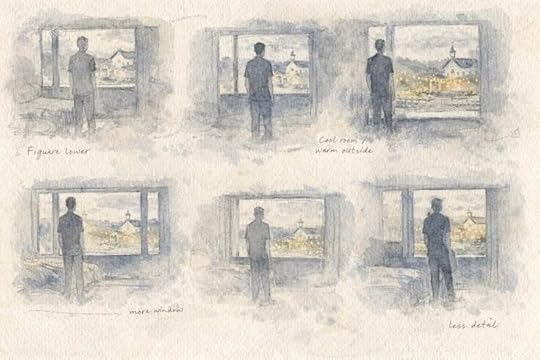
Early thumbnail studies searching for the right balance between lodge-room stillness and the glowing public theater of the wedding weekend.
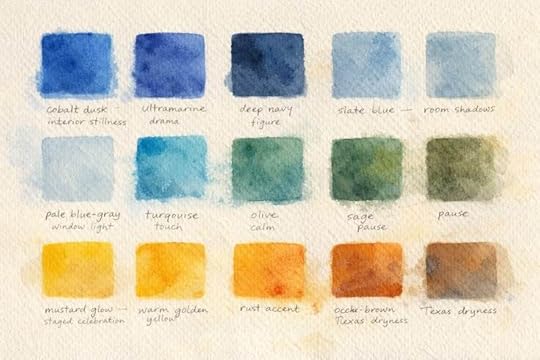
The cover-derived palette gathered into twelve working colors, from cobalt dusk to mustard glow, showing how the painting’s atmosphere was built through restraint rather than excess.
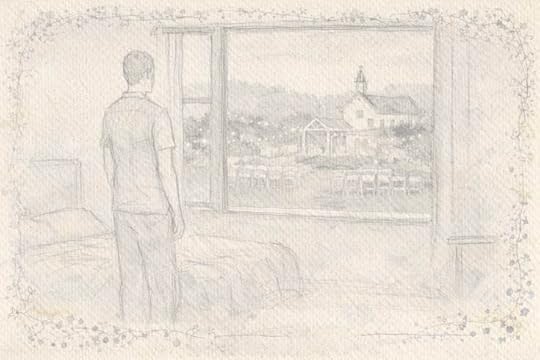
The first graphite architecture of the scene, where figure, window, chapel, and empty chairs begin to organize hesitation into composition.
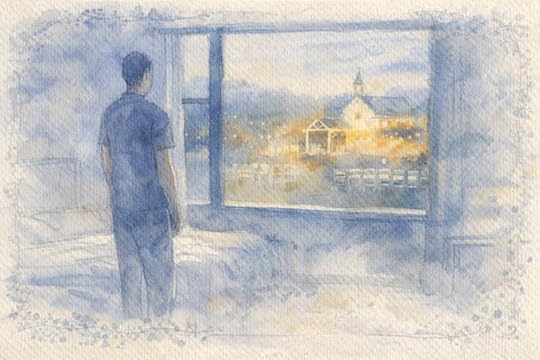
Cool interior blues and the first warm exterior glows stain the page, establishing the emotional split between solitude and celebration.
[image error]
The values deepen and the room begins to hold its own against the ceremony outside, clarifying the painting’s core tension without resolving it completely.
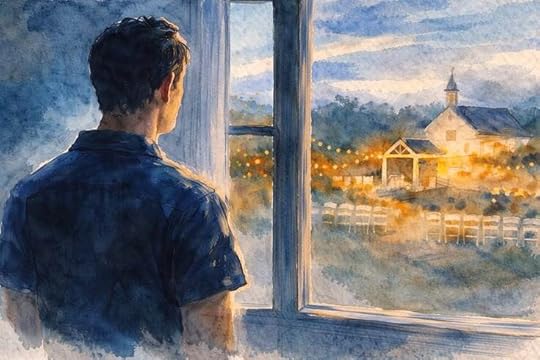
A close study of the figure at the window, where edge, silhouette, and the meeting of cool and warm light carry the image’s private drama.
[image error]
Exploratory border fragments testing how wildflowers, string lights, and ceremonial rhythms might quietly frame the image without prettifying away its unease.
All watercolor illustrations by Demetris Papadimitropoulos.
Bobby Finger’s “We Are Gathered Here Today” is a wedding novel that knows the buffet line, the group text, and the emotional support cousin can be just as narratively consequential as the vows.
By Demetris Papadimitropoulos | April 17th, 2026
A solitary figure at blue hour looks out over the staged warmth of the Hideout, where “We Are Gathered Here Today” turns wedding spectacle into a study of distance, longing, and the private life of ceremony.
Weddings are among the last places where adults agree, en masse, to behave as though certainty can be staged. Two people make a choice. Everyone else gets dressed, finds the right chair, holds a drink, and pretends for a few expensive hours that love has resolved itself into something sturdy enough to photograph. Bobby Finger’s “We Are Gathered Here Today” knows how faintly ludicrous that is. It also knows why people keep wanting it anyway. Finger can make a wedding look ridiculous without turning it into an easy target, and that doubleness – cattiness on the surface, actual hurt underneath – gives the novel both its engine and its tenderness. What at first looks like a sharp wedding-weekend comedy turns out to be a book about how adults turn scraps of evidence into entire beliefs about how life works.
Finlay Hightower, thirty-six, lives in Brooklyn, makes dippable-food videos for the internet, and has come back to central Texas for the wedding of his cousin Elaine. “Cousin” is true but not sufficient. Elaine is also one of the people around whom his emotional life still takes shape, along with his best friend Jacque, the third point in a long-running triangle of intimacy, sarcasm, and mutual forensic attention. Fin is newly engaged to his boyfriend, Mark, and telling almost no one. Elaine, meanwhile, is marrying Rupert after years of obvious fit and a surprisingly delayed proposal, and she is doing so at the Hill Country Hideout, a faux-Western venue complete with saloon, chapel, poker table, scavenger hunt, clue cards, room-key codes, and enough cowboy décor to make the first little snarl of critique rise in any decent guest’s throat. The place looks as though it were assembled from three vendor catalogs and dropped onto the Hill Country overnight. For all its catalog rusticity, it still has to absorb real feeling.
The book’s best piece of comic architecture appears before the luggage is fully unpacked. Fin, Elaine, and Jacque have long observed the Hour of Disrespect, a standing pact whereby all wedding complaints must be saved for one post-event stretch of sanctioned bitching. It is a terrific joke. It is also the key to the whole novel. Fin does not simply have feelings; he turns them into a filing system. He delays, quarantines, curates, withholds. The Hour of Disrespect is not just comic etiquette. It is Fin’s private theology of self-protection. His secret engagement, his anti-marriage speechifying, even his understanding of himself all depend on managed release. He does not merely hesitate. He builds procedure around hesitation and then calls the result maturity.
The weekend comes in preplanned blows: karaoke, lawn games, scavenger hunt, tubing trip, bonfire, rehearsal dinner, ceremony, reception. Finger is very good at making such sequences do more than fill pages. Karaoke becomes rehearsal – for embarrassment, longing, and the strange bravery required to be earnest in public. The scavenger hunt, with its fake psychics, faux wranglers, clue cards, and old family photographs, becomes a lesson in how memory gets prettied up, laminated, and sold back to people as heritage. The tubing trip, meant to relax everyone, curdles into soaked public embarrassment: cans fly, secrets spill, police intervene, and dignity drifts downstream in koozies while strangers watch from nearby tubes. The bonfire nearly turns operatic. The children are truly hellish. Hailey, the wedding planner, glides through it all with the eerie calm of someone who could extinguish both a literal fire and an emotional one without scuffing a boot.
The novel stops merely amusing and starts exposing people when the evidence Fin has been treating as settled turns out to be evidence he himself has bent into shape. His parents were quiet, sealed-off people, not visibly demonstrative with each other or with him. Fin has taken that silence and made a whole worldview out of it: marriage is entrapment, permanence is delusion, choosing once means getting stuck forever. He presents this as intelligence. Really it is fear put into a blazer and taught to cite theory. Finger’s sharpest move is not to refute Fin in the abstract, but to show that the evidence itself has been mistranslated – that Fin took reserve for lovelessness, then mistook that misreading for wisdom.
That correction arrives through Johanna, Fin’s great-aunt, old enough to be done with ceremonial niceness and funny enough not to turn wise by becoming solemn. She gives Fin his late mother Martha’s diary, and the novel immediately starts asking more of itself. Up to this point, “We Are Gathered Here Today” is a very good social comedy of itineraries, resentments, old loyalties, overheated politeness, and the emotional traffic jam any wedding produces. The diary shifts the book out of event-comedy and into family revision. Martha, it turns out, had once been engaged to another man before leaving him for James, Fin’s father. The diary reveals not a woman trapped into marriage but a woman choosing it, and choosing it with a fervor Fin never guessed at. This is not backstory added for emotional upholstery. It changes the terms of the novel. Fin has mistaken parental silence for unhappiness, then mistaken that mistake for adulthood.
That is the book’s most underdiscussed strength. It understands how adults turn coping mechanisms into convictions they admire in themselves. Fin does not say, plainly, that he is frightened love will sour and trap him. He says the institution is compromised, permanence is coercive, marriage is structurally suspect. Some of that may be true. The more revealing fact is that truth and evasion can live in the same sentence. Adults do this constantly. They turn a wound into a principle, then congratulate themselves on their realism.
The prose moves like practiced gossip – quick, dry, and able to nick social flesh without making a show of the blade. Finger is especially good on public abrasions: the child question, the seating-chart politics, the passive-aggressive curiosity about how internet work becomes money, the condescension directed at anyone who does not commute to an office, the wedding-guest panic of having to make a life sound coherent to near-strangers in nice clothes. This is nimble prose, socially acute and lightly needling. It is more deft than dazzling, which matters. Its softest passages are the ones in which pain arrives already translated into insight. Now and then distress is expressed a shade too cleanly, as if panic had been given one extra pass in revision before being sent onstage.
Still, the tonal control is impressive. A novel with this much wedding logistics and emotional traffic can die on the dance floor before dessert. Too much sneering, and the entire enterprise becomes a carnival duck. Too much uplift, and everyone starts floating above the page like reception balloons. Finger mostly avoids both traps. The Hideout remains gloriously, insistently fake, which is crucial. Hailey never stops being a little alarming. The fake snake remains fake. The faux saloon remains faux. But when the ceremony arrives, when Fin officiates, when Johanna speaks at the reception in her purple dress and shellacked gray curls, the book does not flinch from feeling. Finger understands that performance is often the only form sincerity can take in public. The vows land. So do the speeches. He earns that.
And the book’s pulse is often strongest a few feet away from its official romance. The friendship between Fin and Jacque has more charge in it than almost anything else here. Their shorthand, their grievances, their instinctive knowledge of one another’s worst habits, the cease-fire quality of any long friendship with enough history to become dangerous – all of this is beautifully caught. Elaine deepens too, especially once the wedding stops being fantasy and starts looking like project management in nice shoes. Her admission that she is ninety percent sure she wants to spend her life with Rupert is one of the novel’s cleanest and best choices. Ninety percent is not romantic failure. It is adulthood speaking in a register fiction too often refuses. Johanna, meanwhile, is the book’s load-bearing beam. She is the one person allowed to say that love is work without sounding as though she bought the phrase engraved on reclaimed wood.
Mark is the clearer limitation. He improves markedly in the final stretch, especially around the diary, where his steadiness stops feeling generic and becomes dramatically useful. But for much of the novel he arrives as solution rather than person. He is sexy, patient, decent, available to be hurt, and eventually firm. All of that matters. It is also thinner than what the book does with Jacque, Elaine, Johanna, and even Todd, whose collapsing marriage becomes a sharper mirror than the central love story. The middle, likewise, worries the same bruise once or twice too often. Fin’s panic about permanence is real, but the novel circles it in only slightly altered language enough times that one begins waiting for the diary to arrive and force the book into deeper water.
When that happens, the novel gets better. The river fiasco is extremely funny once it is no longer happening to you. The diary does more than deepen the book; it hauls it out of the narrower, shinier category the first half threatens to stay inside. Fin’s officiant speech, which could easily have turned soft or self-impressed, comes off. Johanna’s reception speech is better still. She can say, flatly, that love is labor and that people fail each other all the time, then threaten to come back from the dead and haunt her granddaughter’s husband, and somehow make marriage sound lived-in rather than sermonized. By that point Finger has earned the right to let a wedding speech do what wedding speeches almost always promise and almost never manage: enlarge the room.
Part of what makes “We Are Gathered Here Today” inseparable from this overadministered, overinterpreted moment is how cleanly it catches a certain adult habit. It understands people who want ritual while distrusting the institutions ritual blesses. It understands jobs, travel, apps, disclosure politics, guest-room logistics, visibility, aging relatives, and the private math of who gets told first and who gets left out. More than that, it understands the contemporary urge to treat commitment like homework that must be completed before life can begin. That is a real diagnosis. It is also where the novel’s limits show. Finger is more incisive in naming ambivalence than in dramatizing life beyond it. The book is observant, deft, funny, and emotionally plausible. It is also a little more neatly jointed than its opening commotion leads you to expect. Its insights are real, but it sometimes seems content to name a problem rather than force it to the wall. Its comedy pleases consistently, wounds selectively. Its revelations arrive with just enough neatness that you can sometimes feel the novelist’s hand laying them down.
Those limits do not flatten the novel, but they do keep it from becoming stranger, harsher, and better. I’d put “We Are Gathered Here Today” at 83/100, or 4 stars on Goodreads: a smart, likable, emotionally alert novel that does more than its sales pitch suggests, even if it finally works better as a comedy of manners, feeling, and emotional self-protection than as a truly exceptional novel. Finger can make weddings look faintly absurd without draining them of their heat. Better, he understands what weddings give the people who do not have to keep them going. The couple leaves with the labor. The guests leave with something lighter and far less dependable: a little authorized fire of hope, burning for a few hours in rented space, long enough for everyone standing nearby to mistake warmth for permanence.
Early thumbnail studies searching for the right balance between lodge-room stillness and the glowing public theater of the wedding weekend.
The cover-derived palette gathered into twelve working colors, from cobalt dusk to mustard glow, showing how the painting’s atmosphere was built through restraint rather than excess.
The first graphite architecture of the scene, where figure, window, chapel, and empty chairs begin to organize hesitation into composition.
Cool interior blues and the first warm exterior glows stain the page, establishing the emotional split between solitude and celebration.
[image error]
The values deepen and the room begins to hold its own against the ceremony outside, clarifying the painting’s core tension without resolving it completely.
A close study of the figure at the window, where edge, silhouette, and the meeting of cool and warm light carry the image’s private drama.
[image error]
Exploratory border fragments testing how wildflowers, string lights, and ceremonial rhythms might quietly frame the image without prettifying away its unease.
All watercolor illustrations by Demetris Papadimitropoulos.
Displaying 1 - 30 of 222 reviews