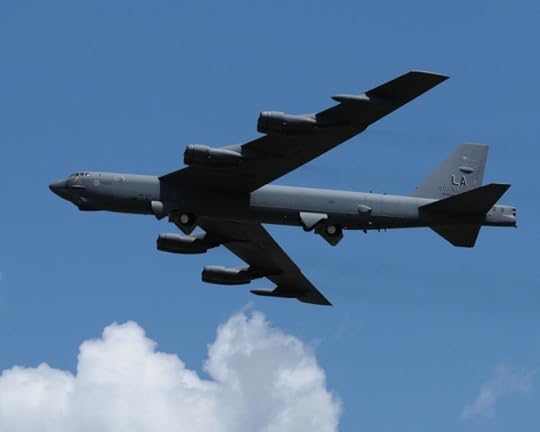
Once perfected, the aircraft nicknamed 'DreamStar' will be America's new air-superiority fighter and the world's deadliest combat-ready weapon. Even the advanced 'Cheetah', a heavily modified two-seater F-15E, is beginning to show its age – relegated to being the older, less 'intelligent' cousin of DreamStar. But, unknown to the Cheetah’s pilot, Lieutenant Colonel Pat McLanahan – former navigator of the B-52 'Old Dog' a KGB mole has infiltrated the DreamStar project. When the mole hijacks the superplane, it is up to McLanahan to get the fighter back – despite the overwhelming odds stacked against him.
Former U.S. Air Force captain Dale Brown is the superstar author of 25 consecutive New York Times best-selling military-action-aviation adventure novels: FLIGHT OF THE OLD DOG (1987), SILVER TOWER (1988), DAY OF THE CHEETAH (1989), HAMMERHEADS (1990), SKY MASTERS (1991), NIGHT OF THE HAWK (1992), CHAINS OF COMMAND (1993), STORMING HEAVEN (1994), SHADOWS OF STEEL (1996) and FATAL TERRAIN (1997), THE TIN MAN (1998), BATTLE BORN (1999), and WARRIOR CLASS (2001). His Fourteenth Novel AIRBATTLE FORCE will be published in late Spring 2003... Dale's novels are published in 11 languages and distributed to over 70 countries. Worldwide sales of his novels, audiobooks and computer games exceed 10 million copies.
Dale was born in Buffalo, New York on November 2, 1956. He graduated from Penn State University with a degree in Western European History and received an Air Force commission in 1978. He was a navigator-bombardier in the B-52G Stratofortress heavy bomber and the FB-111A supersonic medium bomber, and is the recipient of several military decorations and awards including the Air Force Commendation Medal with oak leaf cluster, the Combat Crew Award, and the Marksmanship ribbon. Dale was also one of the nation's first Air Force ROTC cadets to qualify for and complete the grueling three-week U.S. Army Airborne Infantry paratrooper training course.
Dale is a director and volunteer pilot for AirLifeLine, a non-profit national charitable medical transportation organization who fly needy persons free of charge to receive treatment. He also supports a number of organizations to support and promote law enforcement and reading.
Dale Brown is a member of The Writers Guild and a Life Member of the Air Force Association and U.S. Naval Institute. He is a multi-engine and instrument-rated private pilot and can often be found in the skies all across the United States, piloting his own plane. On the ground, Dale enjoys tennis, skiing, scuba diving, and hockey. Dale, his wife Diane, and son Hunter live near the shores of Lake Tahoe, Nevada.
This was an entertaining read. 3.5 stars rounded up to 4.
Here be the male equivalent of Wuthering Heights and whatnot for men. Cheesy, corny, cliche, with simple characters, lot of rebellion against the establishment, Top Gun maverick types, MILFs everywhere, hardcore 80s action. Everything you need for pure enjoyment.
I've read Dale Brown in the past and remembered the techno-thriller streak. Less so this time. I guess my tech savviness has increased manyfold since, and I don't find the technical details as engaging in the past. But that's fine, because the book is good enough even if the technobabble is aimed at the non-congnoscenti (plus lots of mistakes - the M61 Vulcan caliber is referenced liberally as anything between 20 and 30 mm).
Anyway, Patrick McLanahan (that's a rad, cool name, ain't it) is back. We have the well-proven formula. Soviet spies. Hi-tech aircraft. Thought-controlled cockpit. Crazy pilots. Intrigue. Conspiracy. Darn good dog fights. The mandatory use of B-52 (Dale was a WSO on a BUFF in his USAF career). Imagine a typical 80s VHS action movie. Transpose it into writing. You get this.
Day of the Cheetah was written in 1989 - and the action in the book takes place in mid-90s. It's funny to see how the author imagined the tech leap in that era. Very accurate on one hand, very naive on the other. He nailed it with modern satellite comms and stealth technologies, he missed it with computers, terminals and smartphones. 'Tis a trip into the past, and it's very endearing.
There were also a whole lot of typos in the book, but I don't mind that.
All in all, good - and it improves as you read on. I was a bit skeptical in the first 10-15%, but then Dale added some depth, made the plot gently more convoluted, and introduced nice, colorful combat. This is where his writing shines - air battles. Accurate, gritty and captivating. Well, he knows his air stuff.
I shall continue reading the neverending McLanahan saga, for sure.
A little song to accompany me sweet review:
Revvin' up your engine Listen to her howlin' roar Metal under tension Beggin' you to touch and go
Highway to the danger zone Ride into the danger zone
Headin' into twilight Spreadin' out her wings tonight She got you jumpin' off the track And shovin' into overdrive
Highway to the danger zone I'll take you Ridin' into the danger zone
Dale Brown's Cheetah, with forward-sweeping wings.
As a longtime Tom Clancy fan, I really wanted to like this book (my first by Dale Brown). And admittedly, the premise for the book, the military/spy storyline, and the delving into secretive world of modern military aircraft were all attractions for me. But I became really turned off by the constant unexplained techno and military jargon which was a major distraction and went way beyond the pale of entertainment. My other gripe (and I'm usually not very picky about this kind of thing) is that this book was clearly not edited. I'd go so far as to venture that the publisher (Random House) accepted this book in raw form with literally NOT ONE EDIT. It was riddled with typos and sentences which made absolutely no sense. I'm talking every other page throughout the book. This book could have been so much better with a couple edits and a little less blah blah blah that only an aerospace engineer or military air traffic controller could interpret. My 3 rating was in my mind a bit generous.
It's 1996, and the United States somehow possesses a jet fighter that looks like a heavier X-29, and is controlled by the Human mind...well, more specifically, is controlled by a Human mind that is somehow directly linked to a highly advanced artificial intelligence...but, it's okay, because since, as this novel proclaims, we only use 30% of our brain (that old trope), the A.I. is able to tap into that other 70% to augment itself. And, of course, one must enter a perfect hypnotic state to interface with the A.I., and it's so intensively strenuous on the Human body, that the pilot loses several pounds in the space of an hour whilst being connected - which must be all water weight - which means one must become horrifically dehydrated during the interface - and the bottom of the cockpit must just be sloshing around with a gallon of stinky, sweat water....mmmmm....so, this is like "Firefox," but with blackjack and hookers.
Not only that, but we're also sneaking in a subplot involving the spooky, scary communist plot to create perfect doppelgangers of American citizens who could replace them - which is something that, as far as I can tell, never existed outside of "ooga booga" anti-Soviet CIA propaganda because "be scared kids"...which fits the author, who has stated that it was easier to write during the Cold War because it was clear who the "good guys" were versus the "bad guys," unlike today where there are several factors involved and subtlety and nuance and multiple players and grey areas and no clear demarcation...and all I can think is that he swallowed the CIA lies hook, line, and sinker, because - whilst I'm not saying the USSR was a saint and the USA was bad - to perceive that the USA could do no wrong and the USSR were unquestioningly evil is an ignorant position that never rises above grade-school level politics.
But, I digress. In this world of 1996, the USSR is still going strong and has influence over Central America, notably possessing airbases in Nicaragua. This is something that would never have happened, in the real world, by the way. However, it's okay, because after the spy steals the super plane, the X-34 it is called, we violate Nicaraguan sovereignty frequently to bomb the Soviet airbase repeatedly. It always makes me laugh that this author has his American characters take the high-ground when they demand justice because a Soviet agent or action ended in the death of a handful of Americans (the motivation to destroy a Soviet base in "Flight of the Old Dog" was because they shot down a plane with a dozen American airmen on it), so the American characters take actions that often lead to the deaths of hundreds of Soviet citizens, but there's no reckoning or apology or regret or remorse - because, as we all know, American lives are far more valuable than any other Human on the planet. Fucking gag me...
I also have to comment on the X-29, because the super fighter in this book performs ridiculous acrobatic feats based on it's reverse angle wings, making it superior to every fighter before it. Well, after extensive testing of the X-29, let's just say there's a reason it never got out of the prototype stage. Whilst on paper, the mathematics work, in practice, the X-29 didn't live up to its hype. Eventually, it was determined that if it had more power or was given bigger wings, it may match up to its reputed maneuverability, however, the Soviets copied it with the Sukhoi S-47, which has more power and bigger wings...and they only made one, too. So, the design is just not what it wants to be. Which, sort of takes me out of the story as this X-34 is like what a 5-year old would describe a plane to be.
Anyway, the story is okay. It's more machismo and arrogance and disregard of pragmatism because the ideal is paramount and it doesn't matter who needs to die to achieve it. Because, as we all know it's the good guys who follow the mantra: "The Ends Justify the Means."
I re-read this book after going back and re-reading Flight of the Old Dog. Well, if Old Dog held up really well, Cheetah didn't hold up quite as well. Don't get me wrong, it was solid, but it didn't blow me away.
Eight years after the Old Dog, Brad Elliot is in charge of Dreamland. Of course the whole gang is there and Patrick McLanahan is running the Dreamstar project, basically a combination of a thought-controlled airplane and a next-generation jet with a lot more maneuverability and technology than the current version.
Unfortunately the test pilot for Dreamstar is Kenneth James, who is actually a deep cover Soviet spy who was put in place before he even joined the Air Force Academy. The Russians come up with the idea that James should steal Dreamstar, since they haven't been able to replicate the technology with the information he's been giving them. He succeeds and then McLanahan has to chase him all over the Western hemisphere.
There's a lot here. Sci-fi. Spy drama. Military jargon. An old-fashioned revenge novel. Some parts work better than ever. 25 years later, I'm not sure Dale Brown convinced me that a thought controlled airplane is better than one powered by a computer built in 2014. But the flying is good and the spy drama is good.
Wow! What a good read. Like chocolate and peanut butter, the combination of fast planes and continuous action is an irresistable combination. At first I was skeptable. First you read about a KGB camp that trains Russians to pass for Americans. Where have I heard that before? (Nelson DeMille.) Then you read about high tech flying machines in all their technical details, reminiscent of Tom Clancy. The details are so exact and so prophetic, you wonder if Dale Brown is giving away State secrets. And then there is the irritation that this book is a sequel to "Flight of the Old Dog." Despite not having read "Old Dog," the plot was very understandable. But once you get into the plot, you cannot put the book down. The book is a winner with non-stop action, Cold War tension and psychological drama. During the heist of DreamStar, you almost don't know who to root for. Brown takes you through the angst of being a deep undercover spy who is no longer sure of his own identity. The title makes you anticipate the ultimate mano a mano dog fight between Cheetah and DreamStar.
The plot is good, character development pretty good, too. I just have such a hard time getting "into" all the details about the technical specifications of all the fighter jets and such. I know - I should know what I'm getting into by now, as this is the third book of his that I've read. I just look at it as educational! :)
Oh my gosh I thought this book would never end. I had high hopes for a great story and it started off well but then the reader is buried in an avalanche of military jargon, bullet, bomb, missile, airplane technical descriptions that really do nothing to enhance this story. I'm sure Dale Brown has many readers that eat all of this up bit I am not one of them. Had Mr. Brown just told the story and skipped all the other stuff the book could have been 100 pages less and much more enjoyable.
Day of the Cheetah merupakan novel kesinambungan terus atau sekuel kepada novel sebelumnya iaitu The Flight of the Old Dog. Garis masa atau timeline novel ini berlaku lapan tahun selepas TFotOD. Justeru itu,beberapa watak yang wujud di dalam novel sebelumnya ditampilkan semula oleh penulisnya,Dale Brown. Watak-watak itu adalah seperti Patrick McNalahan,David Elliot,Wendy Tork dan Hal Briggs. Kesemua watak ini terlibat di dalam projek ketenteraan dalam mengubahsuai pesawat pengebom era Perang Dingin iaitu B-52 Stratofortress yang dipanggil Old Dog. Modifikasi ini dilakukan di sebuah fasiliti milik Tentera Udara Amerika Syarikat yang dipanggil DreamLand.
Seperti novel sebelumnya,DotC juga merupakan sebuah novel yang bergenrekan thriller-ketenteraan. Sebuah novel yang ternyata sangat sarat dengan aksi terutamanya pertempuran udara. Oleh itu,novel ini tidak terlepas daripada istilah dan jargon yang berkaitan dengan avionik dan ketenteraan. Mujurlah,Brown ada menyediakan glosari khusus untuk rujukan dan pemahaman para pembaca. Walaupun mungkin ada orang yang tidak suka novel yang sebegini,namun,tidak pada saya. Terutamanya apabila Brown berjaya membuatkan saya terpaku asyik apabila beliau menceritakan babak pertempuran udara antara pesawat F-16 Fighting Falcon dengan MiG-29 Fulcrum dan pesawat prototaip canggih XF-34 DreamStar yang dikawal oleh watak antagonis utama iaitu Ken James atau nama sebenarnya Maraklov,di atas Laut Caribbean.
Agak menarik juga untuk dinyatakan di sini. Terdapat beberapa anakronisme yang wujud di dalam novel ini jika dibandingkan dengan dunia realiti kita. Brown melatarkan ceritanya pada tahun 1996 dan beliau sendiri menulis novel ini pada lewat 1980-an,di mana Perang Dingin masih berlangsung. Terdapat beberapa perkara yang di mana perkara itu tidak lagi benar atau fakta. Sebagai contoh,TUAS digambarkan menggunakan misil udara jenis AIM-132 ASRAAM sebagai salah satu senjata utamanya. Namun demikian, hakikatnya,tidak begitu. TUAS masih menggunakan AIM-9 Sidewinder versi X. Hal ini kerana TUAS membatalkan hasratnya untuk menggunakan ASRAAM dan sebaliknya terus menggunakan Sidewinder.
Yet another technothriller from the late-80s I have revisited having read the paperback. Dale Brown takes his lead from the first three books in the ‘Old Dog’, Lt. Col. Patrick McLanahan out of the cockpit, mostly. The latest in hi-tech aeronautics (for the time, but also for now to an extent) is the basis for a new fighter plane, codename DreamStar. Revolutionary, it promises to give the US a massive edge over the Soviets. Unfortunately, the prototype has been hijacked from Dreamland, and McLanahan must find a way to get it back. This is not a bad story. I remembered the very last page, so not much suspense this time round, but no problem. It is interesting that in some ways the tech is still cutting edge, although in others less so. The introduction, first act and ending are not too bad. However, the middle feels rather baggy – I am sure losing a hundred pages would not harm the story. Brown tends to go into a bit more technical detail than the likes of Tom Clancy and Steven Coonts – sometimes it can be a bit too much. That said, I might revisit some of the earlier in the McLanahan series, although not quite sure how he stretched it out to 19 books. Final point – there are a fair few typos/formatting issues in this book.
A KGB agent has been educated to take the place and identity of an American and get into the Air Force Academy. He gets into Dream Land and manages to learn how to fly America's most advanced fighter plane, DreamStar. He hijacks the plane and plans on getting it to Russia. To get it back, Lt. Colonel Patrick McLanahan takes on a most perilous assignment. The odds are against him as his aircraft, the Cheetah, doesn't have the speed, power, or the technology of the DreamStar. McLanahan's skills with the stick are his only advantage. It comes down to a high-flying chase of all time.
The book is not short and has an overabundance of technical jargon, but it ends in what I thought was an unexpected surprise.
I like the Dale Brown books about Patrick McLanhan. I have also enjoyed the series about Patrick's son, Brad McLanahan. I look forward to reading more.
This follows after "Flight of the Old Dog" - a story about a modified B-52. If you have been in the Air Force or are a pilot, you'd love his books as they go into great detail on the flying end. Also it's a good story about a special plane that was built at a secret facility in the high desert of Nevada. But there is an infiltration by a trained KGB pilot that has become very Americanized and is the only one that can fly this "DreamStar". He eventually wants to take it back to Russia for them to decode and learn all about its technology. He has to be stopped so there is a lot of detailed flying and dogfights in this book. All the weapons that are used are mostly real, Brown gives a glossary of such things. A good book.
I read this so long ago—at least 30 years—that I don’t have enough memory of the book or my reaction to it to write more than a cursory review. I do, however, remember a plot about a thought-controlled fighter aircraft that required very finely tuned brainwaves and a Russian sleeper agent spy who was activated to steal the jet. (Those shouldn’t be spoilers since they are revealed in the first few chapters and may even be mentioned on the book jacket or back cover.)
Unlike several other techno-thriller authors of the era, some of whom seem indistinguishable, I probably will plan to read more of Dale Brown’s novels in the future—probably after I read at least a hundred other books on my list.
As with all of my pre-2000 books, the “Date finished” may be a few years off.
This was a decent, four star combination aviation/spy novel. I didn't find the start of the story particularly exciting. It was OK but I planned to rate this book as three stars. The story later got exciting. I particularly liked the section where POTUS and his advising staff met to discuss how to handle the situation that developed in this story. It's been awhile since I read Brown's previous Patrick McLanahan story so I somewhat forgot the characters. I got to really like all the characters in Day of the Cheetah. All in all, this four star novel was worth the read.
It has been a while since I last read this book, so I thought I'd read it again. It's obviously not quite as spell-binding as the first time I read it, but enough time has passed that I did not remember as much as I thought I might have. It does take a bit of time to build up to the 'primary narrative' of the story. The copy I read was the British copy [which has what appears to be an F-18 on the cover as opposed to a modified F-15]. Despite the time it takes to build up to the 'primary narrative', it still moves at a decent pace. It held my interest throughout the entire book. It had decent character development.
It is funny, but I remember the first and second time I read the book, how much I 'despised' the politicians that Elliott and McLanahan had to deal with throughout the course of the story. This time around, I actually appreciated the politicians more [never thought I'd say that!] and how they were trying to prevent a crisis from escalating into a wider armed conflict. Elliott definitely came across in a more negative light in this story, in my opinion. It was interesting to find that my 'attitude' had changed over time, in light of the 'political' scenes in the book.
The XF-34A fighter is pretty amazing, as is the technology described to fly it in the book. At the same time, I could not help thinking about Firefox by Craig Thomas, except that this is the American version of such an aircraft. [Of course, I also enjoyed how the Cobra jet that Ripcord flies in the first G.I. Joe movie was a copy/version of the Russian jet from the movie starring Clint Eastwood.] I found myself wondering if the military was any closer to developing such technology today than it was when the book was first written. [Of course, considering the U.S. military is still using aircraft frames that are well over fifty years old kind of answers that question.] It is a fascinating concept, and I think the author does a great job describing the effects it has upon the human body to use such technology [as well as how people do not know how such technology will effect the people using it].
There was a death toward the end of the book that completely shocked me, as I had forgotten it had occurred. That does not happen very often for me, but this time it did.
It was a fun book to read. I think it has held up reasonably well, over the past twenty-five years since I first read it. It has spies, moles, high tech aircraft, dogfights, and elements of sci-fi. It has [mild] sex, revenge, human emotions, and patriotism. It has the 'classic' battle between military commanders and politicians [the security of the country versus trying to get re-elected]. I enjoyed the author's attempts at forecasting the future of American technology [in terms of air power] and how existing technology could be modified into something even better [or more powerful] [I love the concept of a flying B-52I Megafortress, a 'flying battleship'!]. The action ranges from the American Southwest to Mexico to Nicaragua, the Caribbean Sea, before ending in Costa Rica.
One thing that stood out to me is that the author is very detailed when it comes to flight operations, including the pre-flight checklist. That might have been a little too much information in terms of detail. The first time the checklist was described, okay; the second time, borderline; but after that, holy cow! Seriously, though, the author does provide an enormous amount of information [descriptions] in terms of flight operations. It was a wealth of data to navigate. It is kind of funny, but the amount of information almost made the 'battle sequences' boring and non-exciting to read. There was so much to read, it was easy to forget that the individuals were 'fighting for their lives' on the pages of the book. The 'sudden' description of an explosion would jar the reader into realizing that was some kind of conflict occurring in the book at that moment. hahahah
On a side note: I found myself wondering if the amount of detail was because of what Tom Clancy did when he started writing his books. His first two books were amazing; then they started getting bloated. But at the same time, Clancy did an amazing job of describing military technology in terms the average person could understand. I remember how subsequent authors publishing books after Clancy were sometimes described as 'out-Clancying Clancy!', implying some author had done a better job at writing a technothriller than Clancy did. So Brown's amount of intricate details made me wonder if he was trying to make a statement that he knew more about what was going on with military tech and how it performed than Clancy did. Regardless, I enjoyed reading both of their stories as they were published [Clancy's books tended to have a broader stroke to them whereas Brown's were more focused in nature]. But enough of my 'aside'.
One of the 'better' aspects of the book was the relationship between McLanahan and J.C. Powell, in my opinion. I enjoyed the conversations between these two men, and I thought the author did a great job developing their friendship over the course of the novel.
Intriguing jets and experimental air craft are described in this book. Dale Brown writes very compellingly and decisively about the dog fights in the air. It is amazing to think an aircraft's computer could be linked with a man's brain to fly it and fight. I highly recommend this book. It was very difficult to put down this book. Enjoy! 😊
America’s most advanced fighter plane, DreamStar , has been hijacked. To retrieve it, Lt. Col. Patrick McLanahan takes on his most perilous assignment since The Flight of the Old Dog .
The odds are against him. His aircraft, the Cheetah , hasn’t the speed, the power, or the technology of the DreamStar —his skills behind the stick are the only advantage he’s got. And so begins the greatest high-flying chase of all time...
I find it hard to believe that a Dale Down book could be riddled with typos like, "food my own horn." Joe Toro, Wendy's dad is former marine. There is no such thing as an ex Marine unless he had Boiled Chicken Dinner. Counted about thirty typos. Spell check is not you friend.
The overall story line of this book was good...that got it the three stars. But with all the technical jargon it was hard to stay interested and I found myself skipping through a lot of it. I understand the author knows that stuff but it surely isn’t my cup of tea. I’m hoping his other books aren’t written in the same fashion
Dale did it again his fourth book in his series he lives up to his style. Action packed detail and realistic. Day of the chettah was a great read shows the future of aviation blended with aircraft of the past that get the job done even in today's stabdard. The cheetah or F15 will change the future like the book. Great read.
Dale Brown was a pilot and he brings excitement to the flying. Patrick is back and has to fly against an advanced fighter with the Cheetah that’s not as capable. But does He have the skills to counter the advanced plane? I love planes so this is a great book to me. This is the second book with Patrick so I don’t know why listed as #4. Also this is Dale Brown’s third book.
I thoroughly enjoyed this book. There are times when it becomes confusing and convoluted. However, overall, this book is fascinating and enjoyable. When the book becomes mired in wordsmithing, just remember that this is a work of fiction and thus the things that seem improbable make the read fun. I enjoyed this book so much that I read it twice!!!
A typical Dale Brown book. I like his books because I was a pilot. It may be a little hard for non-pilots to understand some of the flying jargon,but all in all it was a good story.
Highly unlikely and dragged on. The technology was interesting the premise a stretch. It felt like it would never end as if the author didn't know how to close the story.
It was quite amazing from the point of view of the author foreseeing the technology that is only now becoming available, but with so much "fly boy" jargon in it, it became a little tiresome at times. An interesting read, none the less.
Do not expect realistic technology or realistic people.
Interesting with planes that can outmaneuver missiles, but even if a plane can react faster than a missile, such reactions would make soft mush of the inside of the humans involved.
Another excellent story by Dale Brown. As a retired Air Force person, it's nice to see that some officers realize that sometimes things have to be done that aren't in the rules.