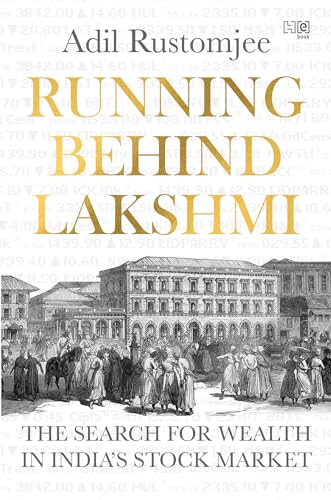
From banyan trees to electronic screens - the authoritative account of India's stock market over two centuries.
For millions of people; the stock market is the canvas on which are sketched fantasies of riches; of lives transformed. Yet; the history and methods of one of modern India's most transformative forces remain underexplored till now.
Starting from the early nineteenth century; when a few banias traded shares under banyan trees; to the Cotton and Share Mania occasioned by the American Civil War; to the decades of marking time during the Nehruvian Era; to 1991's great unshackling that made the market accessible to the public; all the way to the market cycles of the new millennium; Running behind Lakshmi brings India's stock market into focus.
By combining archival sources with observations and expertise forged through immersion in the markets; Adil Rustomjee provides a wide-ranging account that is equal parts analytical history; financial practice; and market lore. Brimming with pioneers and adventurers; grand rivalries and petty jealousies; scams and scandals; this is the story of a nation and a people told through a lens that's never been used; but is more relevant than ever.
Modern India’s relationship with money is a paradox, a nation spiritually conditioned to renunciation yet relentlessly obsessed with prosperity. "In Running Behind Lakshmi", Adil Rustomjee does not merely narrate the chronological development of Indian capital markets; he excavates how aspiration, community, mistrust, politics, colonial hangovers and reformist courage shaped the country’s financial arteries. The book is not about the stock market as a mechanistic institution; it is about the Indian psyche when exposed to risk, opportunity, greed, ingenuity, scarcity, and ambition.
At nearly 800 pages, this is not a breezy finance-for-dummies read. It is a slow-burn archival meditation where India’s financial evolution is placed alongside the nation’s philosophical, sociopolitical and cultural shifts. He writes like someone who has walked through the corridors of both history and trade terminals not a detached historian but a participant-scholar.
The book repeatedly pushes the idea that markets are behavioural ecosystems before they are economic systems. From banyan-tree bartering to algorithmic screen-based trades, every leap was driven not by efficiency alone but by trust networks, caste-based clusters, reputation economies, and community enforcement.
This is not a romantic backward gaze. By digging into colonial correspondences, community trade agreements, personal memoirs, and government files, he argues that India’s market maturity was delayed not due to incompetence but due to institutional fear of abstraction, Indians traditionally preferred land and gold because they could touch value, not imagine it.
The author treats 1991 not as a chapter but as a tectonic pivot. The founding of NSE, dematerialisation, SEBI’s emergence and the destruction of monopoly-style microstructure are narrated through the energy of revolution rather than policy reform. It shows how India’s biggest transformation was carried out by unlikely bureaucratic warriors and non-charismatic reformers, not corporate messiahs.
✍️ Strengths :
✔ From colonial Bombay banyan traders to screen-based NSDL, the continuity is impressive. No other Indian finance book attempts such civilisation-level sweep.
✔ The author does not glorify capitalism, nor does he condemn it. He presents markets as flawed reflections of flawed humans.
✔ Ethical underlayer are subtle but clear as it talks that prosperity is not a scandal; or how one chases the dream determines his dignity.
✔ He argues that reform succeeded because it changed behaviour, not merely rules, a valuable insight.
✒️ Areas for Improvement :
▪️800 pages demand stamina. Some chapters could have been tighter without losing depth. Readers will occasionally feel that detail overtakes narrative drive.
▪️While archival voices are strong, millennial and post-COVID retail psychology receives insufficient emotional space.
▪️The Nehruvian pre liberalisation sections feel longer than necessary, becoming academic rather than immersive.
▪️Comparisons with China, UK, or Japan could have amplified insights on cultural-financial evolution.
In conclusion, it is a monumental intellectual labour, part history, part economic ethnography, part institutional memoir. It forces India to acknowledge that markets are not aberrations of capitalism but authentic expressions of human aspiration. Rustomjee succeeds in showing that every scam, innovation, reform, collapse and breakthrough reflects a country still negotiating its relationship with abundance and dignity. The book deserves to be shelved not just beside finance literature, but alongside works that chronicle India’s slow but inevitable evolution from survival to ambition.