
What do you think?
Rate this book


A Hungarian interpreter obsessed with waterfalls, at the edge of the abyss in his own mind, wanders the chaotic streets of Shanghai. A traveller, reeling from the sights and sounds of Varanasi, encounters a giant of a man on the banks of the Ganges ranting on the nature of a single drop of water. A child labourer in a Portuguese marble quarry wanders off from work one day into a surreal realm utterly alien from his daily toils.
In The World Goes On, a narrator first speaks directly, tells twenty-one unforgettable stories, then bids farewell ('for here I would leave this earth and these stars, because I would take nothing with me'). As László Krasznahorkai himself explains: 'Each text is about drawing our attention away from this world, speeding our body toward annihilation, and immersing ourselves in a current of thought or a narrative...'
The World Goes On is another masterpiece by the winner of the 2015 Man Booker International Prize. 'The excitement of his writing,' Adam Thirlwell proclaimed in the New York Review of Books, 'is that he has come up with his own original forms-there is nothing else like it in contemporary literature.'
416 pages, Hardcover
First published March 1, 2013


...a world where even a bouquet of violets carries the definite odor of money. This was the place I had fallen back into with a crash.His penchant for lengthy sentences, frequent repetition, sparse punctuation and cryptic monologues add an additional layer of intricacy in reaching the essence of his words, which are unambiguously inclined towards disintegration and annihilation. But for this reader, his prose displayed the tenacity of a sleuth, waiting for the right moment to deliver a fatal blow and do so in such smooth and unhealthily subtle manner that the occurrence of the high-point may even escape the reader’s detection.
I no longer recall how long this lasted, possibly days, even weeks, until one morning I was sitting by the window, looking out at the un-consoling light, and outside, below the kitchen window, a band of sparrows burst upward from the dry twigs of an unclipped hedge only to almost instantly swoop back down again.This collection is a nasty reminder of what is dead in us. It is a reminder of our mask of indifference that keeps the pungent but urgent smoke of action from entering our innards. Krasznahorkai is unapologetic in depicting the deranged and portentous side of us that belies the febrile temperament deep-seated in our conscience. And despite our protests in establishing truth otherwise, there shall be no benevolence because the world will go on, giving two hoots to our duplicities.
Everything around it moves, as if just this one time and one time only, as if the message of Heraclitus has arrived here through some deep current, from the distance of an entire universe, in spite of all the senseless obstacles, because the water moves, it flows, it arrives, and cascades...The World Goes On is a mixture of philosophical pieces like this and short stories.
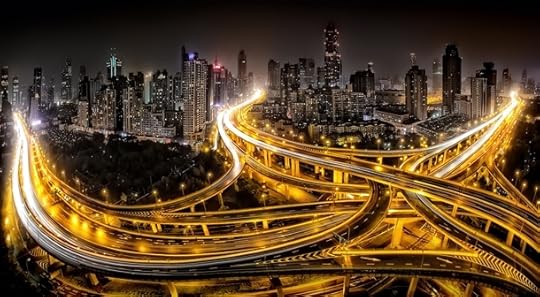
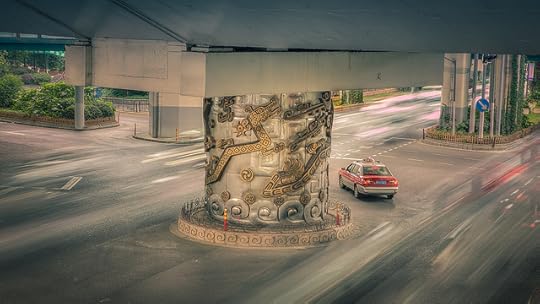
for surely that is the main thing, tranquility, this is what this person seeks in the desired distance, some tranquility from the unspeakably oppressive, painful, insane disquiet that seizes him whenever he happens to think of his current situation, when he happens to think of his starting point, that infinitely foreign land where he is now
because I would take nothing with me, because I’ve looked into what’s coming, and I don’t need anything from here
‘—he listened to this or rather let himself hear it, he had the feeling that the voice was not so much trying to say something to him as to lull him, rock him with the southern, musical sound of Cantonese dialect, to smooth away everything inside him that was rough, everything that might spill out, everything that was aching, the sound cautiously enfolded, cooled, and cooled and cooled again—’
‘Memory is the art of forgetting. It doesn’t deal with reality, reality is not what engages it, it has no substantial relation whatsoever to that inexpressible, infinite complexity that is reality itself, in the same way and to the same extent that we ourselves are unable to reach the point where we can catch even a glimpse of this indescribable, infinite complexity (for reality and glimpsing it are one and the same); so the rememberer covers the same distance to the past about to be evoked as that covered when this past had been present, thereby revealing that there had never been a connection to reality, and this connection had never been desired, since regardless of the horror or beauty that the memory evokes, the rememberer always works starting from the essence of the image about to be evoked, an essence that has no reality, and not even starting from a mistake, for he fails to recall reality not by making a mistake, but because he handles what is complex in the loosest and most arbitrary manner, by infinitely simplifying the infinitely complex to arrive at something relative to which he has a certain distance, and this is how memory is sweet, this is how memory is dazzling, and this is how memory comes to be heartrending and enchanting, for here you stand, in the midst of an infinite and inconceivable complexity, you stand here utterly dumbfounded, helpless, clueless, and lost, holding the infinite simplicity of the memory in your hand—plus of course the devastating tenderness of melancholy, for you sense, as you hold this memory, that its reality lies somewhere in the heartless, sober, ice-cold distance.’
‘—he radiated it as he passed through the security check, he glowed as he boarded the plane, his eyes sparkled as he belted himself into his sea—because he was in fact happy, except he could not speak about it, because it was impossible to speak about what he had learned in Shanghai, there was indeed nothing to do but look out through the window of the plane at the blindingly resplendent blue sky, keeping a profound silence, and it no longer mattered which waterfall it was, it no longer mattered if he didn’t see any of them, for it was all the same, it had been enough to hear that sound, and he streaked away at a speed of 900 km per hour, at an altitude of approximately ten thousand meters in a north by northwesterly direction, high above the clouds—in the blindingly blue sky toward the hope that he would die some day.’
‘Following these cogitations, or rather in their course, one day I awoke to the fact that I was nauseated, and this was a nausea radically different from all other nauseas.’
‘—the most banal realities of life, the world of table salt petrified in its container, shoelaces thinning in spots knotted day after day, street assaults and lovers’ vows trickling away into the sewer, a world where even a bouquet of violets carries the definite odor of money. This was the place I had fallen back into with a crash, where it would have been of vital importance to somehow discover the joy of so-called little things, and find, in the principle controlling the workings of the human world, the unmistakable traces of grandeur, of the eternal, in other words, a more spacious existence.’
‘—where are you going with that obsessed look in your eyes? sit down and have a rest, close your eyes and stay here for the night; but this person doesn’t sit down and he doesn’t rest, he doesn’t close his eyes, he doesn’t stay there for the night, because he doesn’t stay for long, because he says—if he says anything at all—he must be on his way, and it’s obviously a waste of time to ask him where to—’
‘I am done, although I can’t tell if this was what you expected this evening, or if I still appear to be the person you had in mind. I am afraid that I am not. Anyway, it hardly matters. We went through with it. I have spoken, you have heard me out, no harm was done.’
“You shrink back slightly from the TV screen. You are incapable of reconciling all that you feel with all that you know.”
I would leave everything here: the valleys, the hills, the paths, and the jaybirds from the gardens, I would leave here the peacocks and the priests, heaven and earth, spring and fall, I would leave here the exit routes the evenings in the kitchen, the last amorous gaze, and all of the city-bound directions that make you shudder: I would leave here the thick twilight falling upon the land, gravity, hope, enchantment, and tranquility; I would leave here those beloved and those close to me, everything that touched me, everything that shocked me, everything that fascinated and uplifted me, I would leave here the noble, the benevolent, the pleasant, and the demoniacally beautiful, I would leave here the budding sprout, every birth and existence, I would leave here incantation, enigma, distances, the intoxication of inexhaustible eternities; for here I would leave this earth and these stars, because I would take nothing with me, because I've looked into what's coming, and I don't need anything from here.


