Jump to ratings and reviews
Rate this book

Mad Eden

Rate this book
FINALIST FOR THE 2026 NATIONAL BOOK AWARD FOR FICTION. One of Kirkus' Best Fiction Books of 2026.

“A story that is dazzling and devastating, tender and unflinching . . . Sentence by sentence, Mad Eden remakes the world as it tells it.” —Morgan Talty, author of Night of the Living Rez and Fire Exit

“Mad Eden is utterly gorgeous—with so many sentences I wanted to underline—and feels utterly essential at this moment when so many of us are feeling lost.” —Charlie Jane Anders, author of Lessons in Magic and Disaster and All the Birds in the Sky


From a pathbreaking writer, a thrilling, form-bending novel about a trans healthcare worker whose carefully built life is suddenly imperiled.

Ro and Liam live in a ramshackle cabin in a secluded stretch of Florida. Neither their home nor their sometimes tumultuous relationship is what the world would call perfect, but to Ro—newly diagnosed with autism and working as a patient navigator for people seeking gender-affirming care—their life, despite the deeply hostile political climate, is a kind of paradise.

It’s hard to pinpoint exactly what shatters their peace. There’s Quentin, the unpredictable teenager to whom Liam and Ro are quasi-parents, who visits on his way to college, where he plans to finally start T. There’s the appearance of Mad Eden, an online fantasy serial about heroic dragon riders that increasingly becomes Ro’s obsession. And then there’s a seemingly innocuous patient video call that results in consequences both unexpected and grave. This myriad of circumstances sends Liam and Ro’s world spinning toward disaster—unless Ro can become the real-life hero their situation demands without betraying who they are and who they love.

With colossal heart and preternatural skill, Morgan Thomas has crafted a deliciously destabilizing debut novel that challenges us to confront and reconsider questions of language, sex, prejudice, identity, and the shifting scales of morality. Playing with the possible relationship between autism and time to forge an ingenious new kind of storytelling, Mad Eden imagines, with exhilarating courage, how we may yet joyfully live in a precarious world.

260 pages, Kindle Edition

First published June 2, 2026

Loading...
Loading...

About the author

Morgan Thomas

20 books23 followers

Ratings & Reviews

What do you think?
Rate this book

Friends & Following

Create a free account to discover what your friends think of this book!

Community Reviews

5 stars
75 (32%)
4 stars
79 (34%)
3 stars
48 (20%)
2 stars
21 (9%)
1 star
8 (3%)
Displaying 1 - 30 of 67 reviews
Profile Image for Richard Derus.
4,683 reviews2,412 followers
June 3, 2026
On the 2026 Finalists for the National Book Award for Fiction.

Real Rating: 4.5* of five

The Publisher Says: From a pathbreaking writer, a thrilling, form-bending novel about a trans healthcare worker whose carefully built life is suddenly imperiled.

Ro and Liam live in a ramshackle cabin in a secluded stretch of Florida. Neither their home nor their sometimes-tumultuous relationship is what the world would call perfect, but to Ro—newly diagnosed with autism and working as a patient navigator for people seeking gender-affirming care—their life, despite the deeply inhospitable political climate, is a kind of paradise.

It's hard to pinpoint exactly what shatters their peace. There’s Quentin, the unpredictable teenager for whom Liam and Ro are quasi-parents, who visits on his way to college, where he plans to finally start T. There’s the appearance of “Mad Eden,” an online fantasy serial about heroic dragon riders that increasingly becomes Ro’s obsession. And then there’s a seemingly innocuous patient video call that results in consequences both unexpected and grave. This triad of circumstances sends Liam's and Ro’s world spinning toward disaster—unless Ro can become the real-life hero their situation demands without betraying who they are and who they love.

With colossal heart and preternatural skill, Morgan Thomas crafts a deliciously destabilizing debut novel that challenges us to confront and reinvent questions of language, sex, prejudice, identity, and the shifting scales of morality. Playing with the possible relationship between autism and time to forge an ingenious new kind of storytelling, Mad Eden imagines, with exhilarating courage, how we might yet joyfully live in a precarious world.

I RECEIVED A DRC FROM THE PUBLISHER VIA NETGALLEY. THANK YOU.

My Review
: "Intersectionality" is a buzzword, it's true; the idea behind a person having intersecting identities has always seemed self-evident to me, so I'm been a bit eye-rolly in my response to its polysyllabifactive neologization.

Whatever, old man, what's your point?

The intersectionality of Ro's adult-diagnosed autism and Ro's trans identity would never have been used in a mainstream, high-budget novel in my youth. It would have lurked in the bottom-of-the-midlist pity-porn area of publishing throughout the entirety of the twentieth century. (Leave aside autism's hideous, abusive history for now, it's not relevant in this context. Let's just be delighted that it is not the case anymore.)

And Author Thomas would have been deprived of their métier. To all our great loss. (Singular "they" is neither error nor solecism.) To make this exploration of human...grunginess, messiness, animal-function reality...there had to be a generation of writers pushing pushing pushing against the polite prudery of nice people who act like they've never smelled, let alone touched, an asshole. If you've changed a diaper, cleaned yourself after a shit, cleaned up after your pet, yes you have. Many a nose is wrinkling now. Maybe this read is not for you, because it's very forthright in its body-ness. I think all y'all ought to unpucker and stop with the fakeness of pretending you're shocked, shocked! to find there's animal reality to beings living their life.

I suspect it will cause some people to re-evaluate their transphobia, however mild it may be, to realize that it's rooted in a concept of body-ness that belongs to a bygone era. Much like "eww-ick" homophobia, the reality of the twenty-first century is we can fix.clean/care for many, many things that killed people in older times. Keep up! Plug in! Grow some empathy for others' needs and wants, if you expect to go unchallenged in your perception of yourself as a good person.

Ro, the autistic trans guide through the deliberately desgined to be complex medical system that enriches many corporations and immiserates and impoverishes millions who live in the US, uses their autism to guide those in need through a labyrinth. Think, in this case, of the original Labyrinth and its intended function: a prison to hold a monstrous being created out of mismatched partners' uncontrollable, animal (!) passion. Is this making sense now? Ro is less Theseus, more Ariadne. A humane person, one caring for the welfare of others, helping them finr ways through the unforgiving maze, not always a "monster"-slaying self-righteous prick.

I don't offer a perfect five stars because I was less convinced by the "Mad Eden" text that Ro becomes obsessed with being all that worthy of their obsession. I was also more interested in leaning more about Ro, their partner Liam, and the couple's found-family child Quentin in relationship than I was in "Mad Eden." So, purely on personal-enjoyment grounds, I've got to go with a solid four-and-a-half stars for this rich, enriching, selfness-nourishing tale of one person's choice to use their lifee to help others find their own true selves.
Profile Image for Gumble's Yard - Golden Reviewer.
2,379 reviews1,977 followers
November 11, 2026
Nova is a magician, albeit a bad one. They have exceptional magical abilities, but they have no understanding of sameness. Nor do they understand cause and effect. Due to this, they are the only magician in their college who is not allowed to attend the scientific ritual performed daily to keep the dragnos away.

 
Finalist for the 2026 (US) National Book Award
 
That notable for two aspects: one personal, one more political.  Although I have read many winners of the prize – this is the first time I decided to read the full Finalist list which did involve a last minute dash to 5th Avenue Barnes and Noble at the end of a NYC work trip to pick up this and the other book not actually published in the UK.  And those two books in particular were perhaps at the heart of the faux controversy around this year’s longlist – with Bret Stephens in a NYT opinion piece “The Literary World’s DEI Checklist” arguing that it heavily favoured preferred identities, topics and politics – part of an identitarian drift and politicization of US literary prizes (I must admit I saw more the backlash against the piece than details of the piece).
 
This I have to say is something of a sui generis novel – one which manages to combine:
the queer-infused textuality of Goldsmith Prize winner Isabel Waidner; with the treatment of autistic narrators with the autonomous exploration of neurodiversity of say Viktoria Lloyd-Barlow’s Booker longlisted “All the Bird Hearts” (interesting for me given what would otherwise seem to be their very distinct authorial background name-checked by Morgan); with dragon infused fantasy novels; with most impressively of all a metafictional inclusion of a scientific journal psychology paper; with Carlo Rovelli’s “The Order of Time” – in a way which is nevertheless empathy generating in the true traditions of the novel.
 
I am not sure I am best placed to really explain the novel’s narrative nuances (and apologies for any misgendering or otherwise mislabelling) but the novel is mainly narrated in first person by Ro, Ro who lives in a run-down cabin in an alligator infused Florida swamp with their partner Liam, a jobbing writer and translator, works as a patient navigator for a small non-profit helping their clients navigate the state by state complexities of and restrictions on gender care.  Ro has recently been diagnoses as autistic – something which actually brings them some peace as they are able to understand more of the different ways they have always seemed to perceive the world (and particularly the operation of cause/effect and time) than others – even Liam.
 
Liam and Ro have unofficially become surrogate parents to the young trans-male Quentin – and send him to college with Ro – it turns out too optimistically - believing that he will be able to continue to get Testosterone treatment (as a ban in the college state does not apply to already started treatment).  While this causes distress - Ro themselves is pre-occupied to the point of obsession with “Mad Eden” – a short online fantasy serial in a world of dragnos, magicians and scales written with an Oulipian type constraint that the vocabulary (ideally words although sometimes part-words added together) has to be taken from a IRL psychology paper Autism as a disorder of prediction which compares that condition to a magical world (due to compromised predictive abilities rendering mundane occurrences impossible to prepare for).
 
Meanwhile – part way through the novel – Ro takes part in a lengthy video call with a purported parent of a child seeking gender-affirming treatment, a call on which despite Ro’s attempts at reticence, the sheer length of their responses allows a video to be spliced together by one individual and sent to and publicised by an anti-trans campaigner, a video which threatens the future of the non-profit for acting in what appears to be a medically reckless way.
 
Ro’s narration plays a lot with the idea of time - both as viewed from an autistic viewpoint (as discussed in the article) and from ideas in “The Order of Time” (heavily referenced in the novel) and particularly the ideas of past and future light cones - which further give the novel its distinctively designed section headers.  
 
It is (at least seemingly) broken up by a lengthy section written in the third party viewpoint of Gabbi, an autistic birth-female returning home after top surgery, who pressured by her mother to wear a dress help her father with his Alzheimer’s confusion, finds herself questioning her choices and drawn towards the world of Jennifer, a detransitioned woman now anti-trans influencer and agreeing to imagine her own gender-questioning child so as to be able to trap the very organisation that once helped Gabbi.  
 
It is perhaps less Gabbi’s own account we read than Ro’s attempts to rationalise why someone would run the sting operation - an account which at once gives her a sudden insight into Mad Eden while also standing as an act of radical empathy which is in many ways emblematic of the novel bit also oddly lacking in Ro’s characterisation of Liam (which for me - in a rare misstep - felt oddly lacking; Quentin similarly at times feeling more like a cipher for Ro and the author to explore the legal and so practical ramifications of state bans on gender affirmative care for minors already in transition).  
 
But, overall, for a novel representing not just characters whose lived experiences is very different to my own, but world views which don’t entirely intersect with my own, I found this a nuanced and empathy-inducing read. 
 
The hospitalization had led to an autism diagnosis, which had put an end to my getting testosterone prescribed by any local clinic, an effect that had surprised me given there was no law prohibiting the prescribing of testosterone for an autistic adult, not then, but the nurse at my local clinic needed a doctor to sign off on the prescription, and the doctors were scared and busy, and if the diagnosis had closed off this possibility, it had created others in its place, possibilities largely of language-meltdown instead of panic attack, stimming instead of self-harm, burnout instead of depression. The words were not meant to be comforting, borrowed as they were from descriptions of malfunctioning machines-an overloaded circuit, the accidental melting of a nuclear reactor core-but there was promise in these new phrases, a hopeful, even a joyful, promise. What it meant, though the psychologist hadn't framed it this way, had instead used words like disorder and impairment and black-and-white and pathological, what it meant was that the trauma I had searched for with hypnotists and therapists to explain my social ineptitude, my hatred of touch, my hard startle at loud noises, could be forgotten. It had never existed. My life had been the lucky, charmed life I'd suspected, and this was a part of my joy,

Profile Image for John Caleb Grenn.
371 reviews311 followers
September 25, 2026
Mad Eden is perhaps the most remarkable book out in 2026: a tall order. What follows here is my attempt at avoiding hyperbole which will surely seem like it fails, but it doesn’t, because any praise, no matter how high, is more than deserved for this timeless, excellent novel.

Thomas writes with such style that reading feels like breathing. No one else writing is capable of tackling gender, fantasy, autism, politics, and the disparity between the physics and neurocognition of time with such a playful seriousness, and with prose that feels like it’s been transported here from another time where long sentences and streaming paragraphs were more the norm of excellence than I think it is we find today. I’m always looking for a novel written by someone who’s writing something only they can write. This is it.

I have been a healthcare provider in Mississippi for patients needing gender affirming care. I’ve been a part of legal but semiunderground referral networks when politics caused the system to drop patients and fail them further. This book hits home. Thomas’s emotionally resonant capture of this phenomenon in the US while weaving it into a time-warping story from the perspective of someone burdened by so much weight—incorporating an interesting plot, a rigorously studied scientific assessment, and a poetic, stream-of-consciousness-leaning novel-lover’s novel into such a work of capital -L Literature has left me floored.

I’ll be recommending this for years and years. Beautiful.

——————

“I’m bad at recognizing the blurry line between personality and pathology.”

“Other people, maybe, have memories arranged like coat hangers along time’s linear axis, marching left to right, all of them neatly in the past tense or—if you select one-shifting obediently to the past perfect to mark the divide between past (selected, remembered, continuous and past past.) My memories are mostly bucketed. A bucket for stress. A bucket for shame. Some would pathologize this.”

“This regimented and arbitrary clock time means little to me though it does make a certain poetic sense, looking out at the world, that our most accurate clocks carefully portion out decay.”
Profile Image for Morgan Talty.
Author 7 books774 followers
Review of advance copy
March 28, 2026
Buy it and read it. It’s amazing.

Mad Eden is a dazzling novel of queer and autistic survival, where diagnosis becomes myth and politics turn intimate. It refuses binaries, choosing reverberation over resolution. What lingers is creation itself—the low, insistent hum of a book that shouldn’t call itself a masterpiece, but unmistakably is.

Profile Image for Darryl Suite.
822 reviews911 followers
October 4, 2026
Conflicted. Or am I?

The prose popped. The themes were extraordinarily explored. But did I actually like the story?

I did enjoy how confused I felt, how the novel forced me to be in a different headspace.

Appreciating and cheering on the trans and neurodivergent representation.

Genre-bending, ambitious, unlike anything I’ve ever read. So for that, I think it’s a worthwhile read.

Still on the fence about the story itself. There’s A LOT crammed into here. Maybe that’s just the crux of being over-ambitious, not everything works. But tbh, I’d rather read an over-ambitious author than one who plays it safe. It’s just that sometimes less is more.

Still think everyone should give it a read. You’ll walk away with some necessary insight.
Profile Image for endrju.
505 reviews53 followers
Read
December 30, 2025
I can’t remember reading a novel so immersive in an aspect of neurodivergent experience. The only other work that comes close is Mel Y. Chen’s Intoxicated: Race, Disability, and Chemical Intimacy across Empire—but that’s theory. An added bonus is an Oulipo-like play with a scientific text transformed into a fantasy story. It also got me thinking about what autie-aesthetics might bring to light (ahem), alongside auti(trans)gender. Now I need to track down Morgan Thomas’s short story collection. My appetite is properly whetted.
Profile Image for Demetri Papadimitropoulos.
1,094 reviews170 followers
Review of advance copy received from NetGalley
April 8, 2026
Please Do Not Let the Dragon Near the Group Chat, the State Legislature, or the Family Medical Plan
Morgan Thomas’s “Mad Eden” is funny, bruised, and brainy enough to make fantasy, queer domestic farce, and legal terror occupy the same unstable room.
By Demetris Papadimitropoulos | April 8th, 2026


Beneath pale stone and leaf-filtered light, Ro pauses in the charged stillness where exhaustion, revelation, and the joy’s altered guardianship finally meet.

Morgan Thomas’s “Mad Eden” opens on a splice. A scientific paper becomes a fantasy serial. A client consultation becomes propaganda. A season of grace, pressed hard enough, can be recut as delusion. Thomas makes that splice-work the novel’s governing action. This is a book about trans care, queer domestic life, autistic cognition, anti-trans panic, and the ordinary humiliations of living under legal threat. It is also about joy, though joy here does not behave like a mood one possesses. It behaves like a creature in the house. Running through all of it is the nastier question of what happens when words, memories, bodies, and stories are cut loose from their contexts and made to serve someone else’s need.

Ro lives with their partner Liam in a borrowed cabin in Florida. Little money, no hot water, too much weather, too much precarity. Their life is jury-rigged and tender, held together by routines, jokes, food rules, improvised economies, and a mutual devotion that is never mistaken for ease. Ro works remotely as a patient navigator for a nonprofit helping families access gender-affirming care across hostile state lines. Liam, a translator and writer, is quicker with language, more socially agile, and more willing to treat syntax as both instrument and plaything. Quentin, their quasi-son, moves through the house with the heedless sweetness and real need of a seventeen-year-old who wants parents and has found, instead, an unstable but heartfelt approximation. Then another text takes up residence in the house: “Mad Eden,” an anonymous online fantasy serial Ro discovers just after an autism diagnosis.

With its dragnos, scales, magicians, and islands of proficiency, the serial feels less like escapism than like Ro’s cognition translated into dragon grammar. Ro reads it as theory, erotic text, self-explanation, and covert autobiography all at once. It gives them a way to think about life with Liam as mutualism, asymmetry, protection, shared danger, and bodily co-translation without flattening that life into either romance plot or diagnostic case file. The dragon material stops acting like ornament almost immediately. Alligators, dragnos, friths, islands, maps, and keys are not decorative surplus. They are load-bearing.


The retention pond’s first prophecy: a rust-stained alligator locked with a snake, Florida nature already tipping toward dragon myth and doom.

Then the book is hauled out of domestic privacy and into public circulation. Quentin’s access to testosterone becomes legally precarious. Ro’s work grows riskier. A caller who sounds frightened, ambivalent, and needy is in fact recording and baiting them. The resulting consultation is cut into a grotesquely edited anti-trans hatchet job linked to the online operator Jennifer Flitok and to Gabriella Holt, a lonely, unstable woman who mistakes fixation for intimacy and drags damage behind her. St. Cat, the nonprofit where Ro works, begins buckling under legal fear and board-level panic. Emails arrive. Bomb threats follow. A pizza delivery at the cabin door becomes a tiny masterpiece of menace. Thomas has a pitiless clarity about how little it takes to wrench language free of context and make it swear to its opposite.


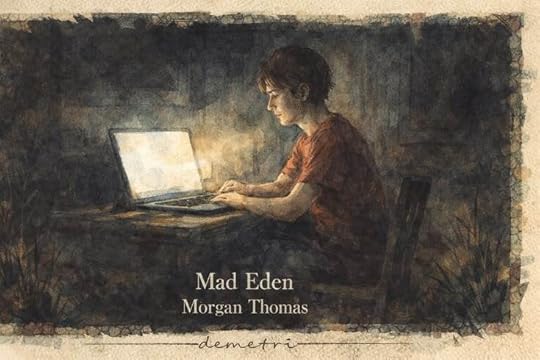
Care work under pressure – one lit screen, one exposed figure, and the small domestic room where language begins to harden into danger.

The review-worthy turn is not simply that Ro is defamed. It is that Ro gradually realizes the fantasy serial and the smear campaign share a method. “Mad Eden,” too, is made from language lifted out of an original source and forced into startling new relations. In one case the result is beauty, recognition, refuge, even a new erotic and conceptual vocabulary for being alive. In the other it is slander. The novel knows these acts are not morally equivalent. It also knows they are formal cousins. There is no neutral edit. Form is not where meaning politely resides after the fact. Form is one of the places meaning gets made, bent, and, in bad hands, sharpened into a weapon. The clipped video turns “You’re good to go” into evidence of barbarism. The serial turns autism research into dragon lore, love language, and world-making. Those acts are not the same. They are related. Thomas wants that relation to feel queasy, because it should.


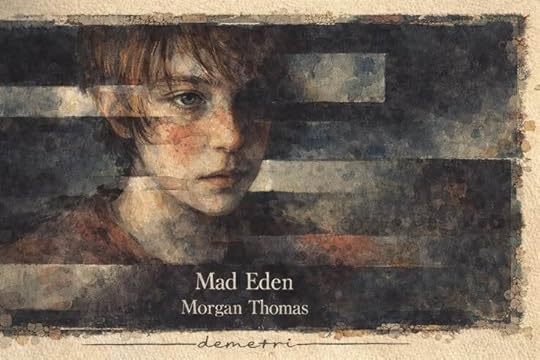
A face cut into pieces and forced to signify against itself – the cold visual logic of bad-faith editing made intimate and brutal.

Without the prose, this whole contraption would shake itself apart. Thomas writes long, recursive, revising sentences, but they do not sag. Sentence by sentence, she keeps the novel breathable. The diction moves with unusual confidence among science, theology, digital chatter, queer house language, legal dread, and a sensory register so reactive it seems to flinch. Ro does not merely remember. They bucket experience. Time does not pass cleanly but thickens, pools, stalls, and sometimes behaves like a hostile landlord. Joy does not brighten a room so much as crouch nearby, purr, cower, lash its tail, and eventually take shape. Thomas is especially good at making abstraction answer to the body. A theory of causality can lead, without strain, to yogurt, menstrual blood, a dead alligator, a badly edited sound file, or the animal-weight comfort of one sleeping body thrown across another. That range keeps the whole machine from rattling into nonsense.

The novel also knows when to loosen its collar. Ro and Liam’s private language – “Henlo,” “Spree,” “Good Ro, best Ro” – keeps the book from hardening into solemnity. These phrases are funny, tender, and a little embarrassing in the way lovers’ real speech so often is. Thomas understands that people in love can sound ridiculous and still mean every syllable. She understands, too, that a phrase cut loose from the scene that made it can become evidence against the speaker. That double knowledge gives the wit its snap. The book is never arch, never trying to look cleverer than its characters, but it has a sly domestic comedy in it: the comedy of routines, of private idioms, of one person’s survival strategy being another person’s bafflement.

Structurally, “Mad Eden” does not advance so much as circle, sidestep, and return. Ro cannot narrate cause and effect in a clean line, and Thomas refuses to clean it up from above. Memory here is not a clothesline but a system of buckets, leaks, reopened containers, stray signals, and delayed recognitions. The embedded installments of “Mad Eden” are the most obvious formal device, but the deeper structural logic lies in adjacency: philosophy beside client call, dragon lore beside state violence, hospital memory beside internet propaganda, bodily panic beside theories of time. Quietly, almost stealthily, the novel retrains the reader’s attention. You stop asking only what happens next. You start asking what has returned beside what, what this scene re-colors, what that image now means in hindsight. At its best, the structure turns interpretation itself into narrative action.

The endnotes matter more than endnotes usually do. They do not simply tidy up after the fiction. They deepen it. They show, almost with mischief, how much of the novel has been built from repurposed sources: autism research, dragon lore, ASL history, theology, animal studies, philosophy of time, song lyrics. I am usually suspicious of visible labor. Labor is not art. Here the visible making matters because it sharpens one’s sense of how carefully Thomas has worked these materials into the grain of the book. The joins have been worked by hand.

What this novel can do, unusually, is imagine joy without sentimentalizing it. Joy here is not reward, innocence, resilience branding, or a gold star for surviving history. It is a temperamental house-beast with its own tastes, aversions, and timing. It pads into a life already crowded with legal threat, financial precarity, ecological unease, bodily dysregulation, suicidal history, and the ordinary indignities of needing things. It does not cancel those conditions. It lives among them. Better still, Thomas never turns joy into a moral halo. Joy makes Ro braver, but it also licenses bad judgment. It sharpens intimacy, but it becomes another thing to interpret, guard, mistrust, and half worship. The book is at its wisest when it distinguishes that season of joy from the later, plainer contentment Ro and Liam reach after joy slips away. Ecstasy visits. Peace has to be built.

It is just as shrewd about intimacy. Ro and Liam are not offered up as saintly queer innocents besieged by the state. They are difficult with one another, asymmetrical, devoted, intermittently cruel, mutually sustaining in ways that are also risky. Liam wants speech, then admits speech was never the point. Ro mistakes one demand for another. They fail to understand each other at exactly the moments when understanding seems most necessary and remain, somehow, each other’s best chance at making a livable world. Thomas never mistakes intimacy for comprehension. One of the loveliest claims in the novel is that mutualism does not require full understanding. That matters for romance, for caretaking, and for the novel’s relation to its reader.

[image error]
At the threshold of departure, Quentin carries more than a duffel: youth, fear, chosen family, and the thin hope of becoming legible elsewhere.

There are costs. The book’s returns to causality, prediction, uncertainty, and interpretation often deepen its pressure, but not always. There are passages where the novel is thinking in real time and passages where it circles a point it has already won. Sleekness would be the wrong virtue here, but congestion is still a risk. Readers who want plot to pull harder than pattern may feel drag. Gabbi, too, though often vivid and painful, occasionally edges close to becoming more useful to the novel’s system than fully free within it. Those are structural costs, not incidental flaws.

The novel never goes out begging to be called timely. Timeliness finds it anyway, the minute a clipped video starts circulating. Thomas has a sharp eye for our edit-happy public culture, for the speed with which digital distortion becomes material threat, and for the way institutions start sacrificing care before the law has even finished commanding them to do so. But the book’s force is not merely topical. What stings is that it understands a deeper difficulty beneath the headlines: how hard it is to act ethically when every explanation is partial, compromised, and ugly in ways that do not stay abstract, when every intervention carries risk, and when every account of what happened can be cut to fit somebody else’s case. Ro’s fear is not only that they have been lied about. It is that they may no longer be able to trust the rules by which they once assured themselves they were good.

Thomas declines the cheap afterglow of a consoling ending. The novel does not restore the earlier joy as a prize for suffering well. It does not pretend that exposure, legal danger, financial damage, institutional cowardice, and moral bewilderment can be redeemed by one clarifying revelation. It chooses something harder and, to my mind, truer. Joy was never a possession. It behaved more like haunting or weather than ownership. What remains once it slips away is not emptiness but a later, leaner mode of living together – less radiant, more durable; less glamorous, more serviceable. In lesser hands the novel would stop at revelation. Thomas goes on to practice.

I’m landing at 92 out of 100, which for Goodreads purposes is 5 stars: not because “Mad Eden” is flawless, but because its best passages are too unhousebroken and too alive to fit a smaller verdict. What keeps needling me after I’ve put it down is not only the book’s anger, though it has earned it, nor even the queasy recognition that art and propaganda can sometimes use disturbingly similar tools. It is the final adjustment of scale. Joy, Thomas suggests, may not be the thing one gets to keep. It may be only the thing that passes through, catches on the path both forward and back, and leaves two people, years later, still close enough to feel where it once lay warm across their laps.


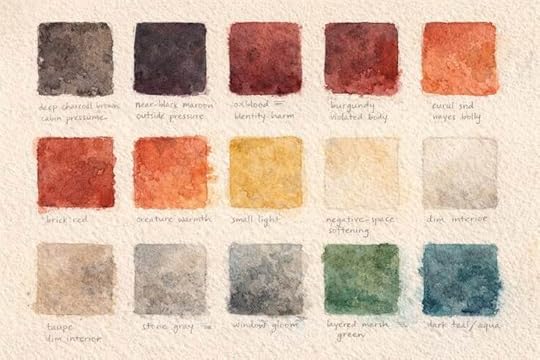
The book’s weather in pigment: ember reds, marsh greens, pale stone, and pressure-dark neutrals arranged as the emotional logic of the series.


Scale, reed, and torn-edge studies testing how the frame itself might carry dragon, wetland, and spliced language without closing the air around them.


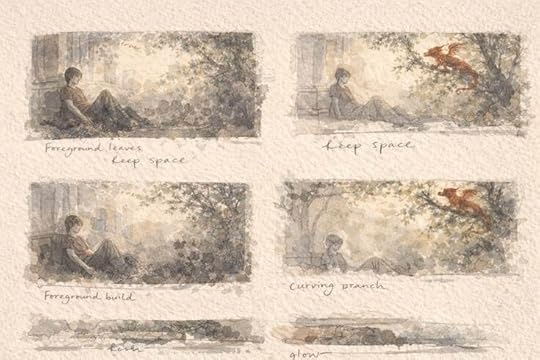
Early compositional trials for the church image, feeling out how collapse below and watchfulness above might balance in one field of suspended light.


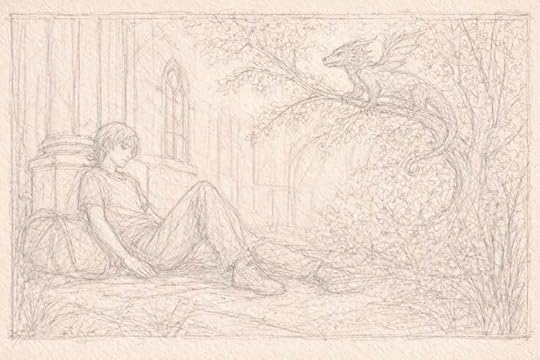
The church façade, seated figure, tree mass, and perched joy first declared in graphite – structure before atmosphere, threshold before glow.


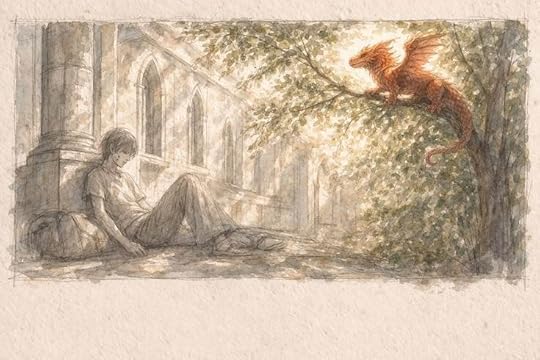
First washes of pale stone, leaf-shadow, and ember warmth, where the image begins to pass from scaffold into mood.

All watercolor illustrations by Demetris Papadimitropoulos.
1,331 reviews38 followers
June 14, 2026
As a view into perspectives and identities and ways of life and being I know little about experientially, this is an affecting and interesting novel. Was I lost at times, because of the novel’s intellectual and stylistic demands…yes (there’s some awfully high level philosophizing going on here about time, causation, perception and reality, etc.—as well as a dragon-magician narrative I’m still not sure I get). But is there at its heart an engaging and meaningful and emotionally resonant story, and one that is essential to our present time…also yes. This is a novel that is about real people facing real challenges…and it’s important that these voices be known and heard.
Profile Image for Dree.
1,849 reviews62 followers
October 20, 2026
I tend to love odd and unusual books that play with form and storytelling, which is why I picked this as my first NBA fiction nominee of the year.

There are multiple stories in this novel--there is the story of Ro, the narrator. And then there is the story Ro is reading (called Mad Eden).

The story of Ro and Liam and Quentin is interesting and timely--trans men living in the south, trying to be hidden but also trying to live their lives and be happy. Ro is also autistic, and has related struggles. Ro works for a nonprofit that links trans people and parents of trans minors with the care they are looking for. He is able to do this fully online. I found this part of the novel interesting, especially the middle of the novel, as we see Ro at work.

Mad Eden and Ro's narration about Mad Eden was exhausting. It is fantasy. I am not a fan of fantasy. Dragons/dragnos, scales (people are scales?), magicians--everything I do not like LOL. I also found the whole storyline of how Mad Eden exists to be so far-fetched and forced (if interesting in theory), and the explanation of how it actually fits into Ro's story to be unsatisfactory.

I finished this 2 days ago and I already can't remember how the main part of the story ends. I think it just...fizzles away. No one is found, or caught, or charged. I think.


Profile Image for Deedi Brown (DeediReads).
972 reviews175 followers
November 11, 2026
I’m so glad the National Book Award put this on my radar, because Mad Eden is such an impressive little novel about queerness, transness, and also autism that brings those things together in a really unique, smart way. It’s incredibly creative in terms of structure, not only in how it shapes the reading experience but in how it shapes the actual story.

I’m going to be a sucker for anything with a dragon, and this book is interspersed with sections of an online fantasy serial posted in an online forum that’s entirely crafted out of the words included in a medical report about autism. Meanwhile, the main character, Ro, works as a patient navigator who gives people advice about how they can access gender-affirming care in a version of the US that is even more legally and politically hostile toward trans folks than it is now. All I’ll say is something bad happens with their job, which sends them into quite the overwhelming spiral.

I enjoyed this book, and I reall,y really admire it. But I did find my motivation to pick it up lagging a bit in the middle, and it took me quite a while to read it, even though it isn’t that long. That is probably mostly a me thing because there is no audiobook edition at the moment, and as a toddler parent I depend on them for momentum these days. So don’t take my word for it!

Either way, this was such a compellingly creative way into a character’s experience of two things that I personally have no experience with (being trans and having autism) and that’s something that I will always, always highly value.

Give it a read if it’s calling to you!
Profile Image for Anna Muthalaly.
208 reviews5 followers
August 6, 2026
EDIT: just saw this was unbelievably (and correctly!) long listed for the National Book Award. You would think I am myself morgan Thomas with how excited that makes me. This book is remarkable, you heard it here first!

Woof, okay, I’ve been procrastinating writing this review because this book is so faceted, so genuinely expansive in its thought, that I’ve shied way from trying to summarize it. Reader, it’s almost certainly one of my best of the year.

Mad Eden is, in short, a novel told from the perspective of Ro, an autistic transmasculine person living in Florida, as they depict two distinct periods colliding: a general era of unexpected joy living with their partner, and the lead up to and backlash from Ro getting targeted and semi-doxxed by a kind of “libs of TikTok” style account because of their job as a patient navigator for a trans clinic,

That description is, almost entirely useless, because this book is so formally interesting that a description of the plot conveys very little of why Mad Eden is so remarkable. More specifically, this book is deeply structured around Autistic formations of thought. The summer of joy is caused largely by Ro discovering a Reddit story called (you guessed it) Mad Eden, which is a ,, found story, made entirely with words found from a scientific article called “Autism as a Disorder of Prediction”. This is true both in the book and IRL— that is a real scientific article with a real point about Autistic modes of thinking, and Morgan Thomas really does use only words found in the article to write the dragon fantasy story in the book.

I explain that to try to convey how much this book is rooted in autistic modes of thinking. Mad Eden’s largest preoccupations are with time and language, and both are explored in ways that genuinely established new paradigms of thinking in my head. For instance, when I say the book is about what led to Ro being doxxed— it’s far more accurate to say the book is Ro meditating on how such a statement is impossible. It’s impossible to know what event led to another. All you can see are the contexts that led to one moment and all the contexts that led away from it, like a cone of light.

It's a door I've never had opened, into completely new formations of thinking, about every possible thing. About language and its slipperiness, how any word can be twisted or cut and skewed to mean its opposite. About speaking, spoken language, about the fact that I form my thoughts through the speaking itself, what that gains and what that loses and what it means to love someone who doesn't feel that way about spoken language. About time, and the impossibility of parsing the past.

I can't express how much of this book I highlighted, how many of Thomas's sentences I wanted to keep and be able to refer back to again.

I hate book reviews that praise a book simply for representation or diversity or some shit. That does not inherently make good literature! Yes, yes sometimes people are Autistic and sometimes they are trans. That inherent reality does not necessarily imply anything unique about the novel. But Mad Eden is, deeply Autistic and transmasculine (white Autistic and white transmasculine, to be clear, the book is honest about how the WOC Autistic experience is different and less whiny but its a deeply limited perspective) in its structure and in its thinking, which to me makes it a great book because it genuinely offers unique insight.

Insight into what it feels like to go nonverbal. Insight into, frankly, Autistic uselessness under capitalism, what it means to have no real path beyond "plucking out your own hair in the dark." Into having a meltdown on the side of the highway. Into loving someone who you can't reach. Into having barely any money and no real way of getting more. Into killing yourself if you can't get your hormones. into the decision all marginalized people make-- to love someone who understands you or someone who never will and therefore is privileged enough to help. Into joy you can't understand and can barely control. Into what it means to be trans when your ultimate gender is autistic. I could go on!

At this point, I'm rambling. I want to be clear that this book was not a breezy read, and near the end I did genuinely get nervous that I wasn't gonna get through it. To which I say, PUSH YOURSELF! Do hard things! Seriously grapple with alternate structures of thought and uncomfortable circumstances. I've loved lots of books-- very few have been not only great but expansive.
Profile Image for Temple Ruff.
196 reviews5 followers
November 19, 2026
This story has a vastness but is artfully constrained by the protagonist's tightly maintained existence. In a secluded Florida cabin, Ro lives with partner Liam, watching alligators in the retention pond and meticulously planning their days.

Ro is a recently diagnosed autie who is working as a patient navigator for people seeking gender-affirming care. They are hyperaware of their individual world while navigating the larger social and political climates.

Mad Eden is the name of an online posted story with which Ro becomes infatuated. While the tale is interesting in and of itself, Ro's interaction with content reveals their heightened pattern recognition abilities. This skill helps them solve a later mystery regarding a bad actor that they are targeted by at work.

All of the secondary characters - Liam, Eva, Amalie, Quentin, Swaati, Gabi - are equally layered and interesting.

How do you recognize and define your truth when the world seems to question every aspect of your being?
Profile Image for luke.
307 reviews2 followers
Did Not Finish
September 9, 2026
Reading this felt like trying to swallow a beating heart whole and while I value the trans/neurodivergent/mental health representation I cannot read this
Profile Image for Leanne.
904 reviews101 followers
November 18, 2026
Mad Eden is ambitious and formally inventive--mixing various voices and tones, including reddit posts, emails, two POV characters and a fantasy story. The main character Ro’s voice is tender and allusive and wholly their own, and that maybe is the book’s greatest strength! The love between Ro and Liam, and the precarity pressing in on them are rendered with real care. My one reservation is that the novel presents a contested 2014 autism hypothesis as basically settled fact and uses it to explain how Ro experiences the world, which is fine if it is just Ro but... also it borrows relativity’s light cones to explain how time is experienced in autistic people, which the physics doesn’t support. It borrows the authority of science but is more pop-science, even in its metaphors and I did feel it could use a serious check by a physicist at the very least since it was confusing (or felt confused). The alligator scene and the chasing joy scenes are unforgettable. Beautiful book that is a finalist for the National Book Awards and very well might win!
Profile Image for Sara.
290 reviews6 followers
October 25, 2026
This is a 5 star book by/about a person who is intellectually too advanced and whose perception of the world and self is so far from my own tactile, overly verbal and feelings-y version of the world that it is impossible for me to appreciate this 5 star book.
Profile Image for Galen.
172 reviews2 followers
October 18, 2026
A book teeming with empathy. For those like me wandering into this book due to its NBA status, (that is to say not knowing anything else about it), I’d encourage you to keep going, as I found this read increasingly rewarding as it brought me closer to its conclusion.
Profile Image for Stormye Hendrix.
121 reviews2 followers
November 7, 2026
National Book Award finalist. Well written but I didn't connect to it. The narrator is autistic, though, so maybe that is part of the point.
Profile Image for Colleen McGuire.
37 reviews2 followers
July 12, 2026
Moving, provoking reflection and enlightening. Felt for this character’s experience as a person w autism navigating a world where neurotypical social exchange/behavior is assumed. And expected, and the rolling ball of consequence when they don’t meet those expectations. While fictional, it draws from lived experiences and research. Read through the notes, they cite a wide range of sources.
Profile Image for Torie.
378 reviews3 followers
Did Not Finish
September 13, 2026
DNF about 35% through. I love that there's space in the world for people to tell stories about overlooked groups and experiences, but the characters in this book have just about every diagnosis and neurosis found under the covid-lockdown sun. I really liked the shitty fanfic-within a research paper-within a book frame, but the extent to which Ro and Liam(and the other minor characters) seem so desperate to collect symptoms and disorders like a tumblr post is starting to make this feel framed as an ironic comedy...which i really don't think was the author's intention.
163 reviews9 followers
Review of advance copy received from NetGalley
May 11, 2026
I got to 40% but simply could not continue reading. The premise of this novel really drew me in but I struggled to follow the narration and in particular found the sections on Mad Eden confusing and hard to get through.

What I did really enjoy was Ro's descriptions of their interactions with others and the observations on how their neurodivergence affects those interactions and changes them. I did struggle a little to believe that Ro was only recently diagnosed as autistic as the way they described their own patterns of behaviour seemed to me to be on the more noticeable scale and it didn't feel as though Ro was very good at masking. Ro's work also intrigued me; not being from the US I don't understand the nuances of how cross-state healthcare can sometimes work to provide the care needed for trans and nonbinary patients. I appreciated Ro's detailed explanations via her conversations with "clients" and saw how Ro's neurodivergence was actually perhaps an asset in the particular role they fulfilled in that they were able to be clear with those they spoke to about what options were and were not possible without beating around the bush.

I think what lost me was the longwinded passages about the Mad Eden text which Ro had recently become obsessed with. The idea that the text was written using only vocabulary from a scientific publication on autism was interesting but it made it all quite nonsensical to me and the excerpts were too short for me to understand what it was about the story that so gripped Ro.

Thanks to NetGalley and Farrar, Straus and Giroux for the ARC. All opinions are my own.
Profile Image for Don Conway-Long.
151 reviews1 follower
August 4, 2026
If only the homophobic and transphobic right-wingers would read this, they just might begin to realize how gender affirming care is healthcare, plain and simple. Then go back and watch Kate Davis's brilliant film Southern Comfort to see how little we have improved on this issue since 2001.
Oh, and Mad Eden also educates very well on the experience of autism. Now combine both "conditions" - and try to live a happy life. Best of luck, in this political climate.
3,011 reviews61 followers
April 13, 2026
A novel that if it vibes with you, will extremely vibe with you. We get a story about a trans femme phone care coordinator in Florida hyperfixating on a novel coming out in installments online that is a continuation of a series from her childhood as the world starts to unravel around her. You know when this is taking place, even though it feels like a car fire you're driving slowly past on the highway. I felt the line "I follow the rules to make me good" deeply in my bones, to the point that I can't describe it accurately, though I'll be damned if I don't at least try. Definitely an author I'll be watching in the future.
Profile Image for Sacha.
2,374 reviews
Review of advance copy received from NetGalley
April 24, 2026
4 stars

This book is described as "thrilling" and "form-bending," and this is an apt perspective. I've not read anything quite like this, and I mean that in the very best way, and I really enjoyed how the intersections of form and genre matched the intersections of identity here. There is so much to dig into throughout this book.

Ro is trans and has - as an adult - just been diagnosed autistic, and this was a great example of a book hitting me at just the right time. It's Autism Acceptance month, and I think I've been to five different related trainings at work in the last two weeks! Even if you don't have the supplemental PD happening in your real-life orbit, you'll still get a TON out of the way Thomas writes Ro, especially. I really enjoyed the representation of distinct trans experiences and Ro's experience as an autistic person. Of course, part of that includes people's gross and weird reactions, and while I don't at all enjoy those elements of our lived experience, I did find the insidiousness of other people both terrifying and markedly realistic here.

And the way Mad Eden comes in? Superb. This is just an extremely inventive and unique way to match motifs and messaging.

I knew I really enjoyed this as soon as I finished it, but some of the content is really tough, and that makes it harder to really process on the spot. The more I sit with it, the more I appreciate the experience. This is my first encounter with this author, but I'm already actively seeking more points of access and will absolutely be on the lookout for new content, too!

*Special thanks to NetGalley and MCD for this arc, which I received in exchange for an honest review. The opinions expressed here are my own.
Profile Image for Clara Ward.
Author 12 books37 followers
July 31, 2026
Can language be a character in a story? Possibly, in the framing of this story, I should say language has a mutualistic relationship with other characters. (I’m tempted to end this review here and say you should just go read it!)
Fairly early in the book we learn that the fantasy story-within-the-story titled “Mad Eden” is composed solely of words borrowed from a (real) academic paper “Autism as a Disorder of Prediction.” There are also discussions of linguistics, spiraling thoughts about words, a private language between lovers, and sign language on days when verbalizing is impossible. All of that could be framed as part of mutualism. But there is joy in this story, and that joy has character development and a character arc, so... Once I started to see joy as a character, it was hard (for me) not to see other aspects of language as characters, at least in the way cities are sometimes viewed as characters (which really works for me when it works, and this book really works for me with language as a character!).
The challenge of how to view language within the story also makes me reconsider terms like non-linear narrative and unreliable narrator. Honestly, this is one of the most neurodivergent stories I’ve ever read. It’s also queer, trans and transgressive on many levels. The expectation that time be linear or that cause and effect be orderly is questioned directly by a first-person narrator who openly re-imagines reality. Even more than with most books, the meaning and impact of this story will depend on the reader. Rather than continue with this review, I heartily recommend reading the book and appreciating the author’s own words.
Profile Image for Sue.
439 reviews46 followers
November 12, 2026
An ambitious novel that takes on a tremendous amount. Thomas explores identity, family, belonging and the realities of navigating medical and legal systems in contemporary America.

One of the things I found particularly interesting was how the novel looks at age, consent, emancipation and parental support. Q’s circumstances raise questions about what independence actually means when access to healthcare is governed by changing laws. Gabriel’s story offers another perspective, that of a young person without much family support or anyone to fall back on. The family dynamics throughout the book are complicated, and I thought these were some of its more interesting threads.

There’s also Ro, whose reliance on rules and routines is closely tied to her need to feel safe. The novel explores what happens when those rules meet the unpredictability of life, and whether we can make room for joy without having everything under control.

Thomas has clearly done an enormous amount of research. At times, the medical and legal terminology becomes quite dense, and I did find myself skimming some of those passages. But I understand why they’re there. These are real issues, and the author wanted to give them proper context.

I did wish we’d been given more of Liam’s story. He was such an important part of Ro’s life, but I never felt I got to know him as well as I wanted.

There is a lot packed into this book, and not every part is equally easy to navigate. But it is an ambitious story with plenty to consider, particularly around identity, family, independence and what it means to find support and belonging’
.
Profile Image for Siobhan.
Author 3 books124 followers
Review of advance copy received from NetGalley
March 27, 2026
Mad Eden is a novel about queer neurodivergent experience, the current realities of being trans in the US, and the potential for the fluidity of form and time. Ro is trans, has been newly diagnosed with autism, and works as a patient navigator for gender affirming healthcare, all whilst living in a cabin in Florida with partner Liam. Ro and Liam's world isn't always stable, especially not as they have become quasi-parents to trans teen Quentin, but it is thrown into further flux thanks to an online text, "Mad Eden", that Ro becomes obsessed with, and a call with a patient of Ro's that turns sinister.

This is a fascinating book that uses the concept of the academic paper turned fantasy story as a framework for imagining not only autism, but also relationships, self, and language. At the same time, it is a very real story about the threats facing trans healthcare in the US and anyone who advocates for it. Parts of the book can be painful to read, feeling so real to what people you know or have heard about have faced, but then the book also plays with frameworks and questions the kinds of stories we tell or don't.

If you like books that ask questions of form and if we need new or transformed forms to express specific ways of experiencing the world, then Mad Eden offers a chance to look at these ideas through a trans, autistic lens, whilst also confronting what it means to be trans and autistic in contemporary America.
Profile Image for Karen.
Author 2 books2 followers
November 10, 2026
Normally I can read a book of this length in about half the time I took here (4-5 days instead of 9) but you experience Mad Eden as much as you read it, and sometimes you can only digest so much. In addressing the spaces and people outside of the imposed false binaries of gender and neurodiversity (not really a binary by any stretch but I lack a term for an idea of neurotypical vs. neurodivergent) the book itself moves outside of genre. There is philosophy, and there is fantasy and wordplay, and there are concepts of time in which I got lost (past, future, cones of light), and as we move through it all with Ro, our maddening, unreliable narrator recently given a late autism diagnosis (and also in places with Gabbi via Ro), we as readers have little firm footing, I'm sure intentionally so.

No matter how much I wanted to skip over long sections of panic where a resolution felt both constantly present yet always just out of reach, where perhaps in other stories the author or narrator might provide at minimum a pin of light to serve as direction, here the reader needed to be as lost, as stuck, as the characters in both that moment and in past and future moments at once. As I'm sure you can tell, I'm not entirely sure what to make of it all. Yet for all the time I felt lost, unsteady, frustrated, and/or out of my depth, I never felt that any of it was less than genuine. There is heart (and joy here if you will), an experience more involved than just reading a book.
Profile Image for Jamad .
1,388 reviews42 followers
November 13, 2026
Certainly learnt a lot about gender-affirming healthcare in the US from this book, particularly the obstacles faced by those seeking treatment and the increasingly hostile political climate surrounding it. Set in Florida, the story follows Ro, a patient navigator helping people access gender-affirming care, whose relatively peaceful life with their partner Liam is thrown into turmoil following a seemingly innocuous video consultation.

It’s an interesting and often unsettling look at the way politics, prejudice and misinformation can have very real consequences for ordinary people. I found the insight into the healthcare system particularly illuminating, and the difficulties faced by both patients and those trying to help them make for some uncomfortable reading.

There is also a fantasy strand running through the novel, alongside its exploration of autism, identity, relationships and the importance of finding joy in an increasingly hostile world. Unfortunately, the fantasy element didn’t really work for me. Fantasy generally isn’t my thing, and I found myself much more interested in the very real-world issues the book explores.

An inventive and thought-provoking read that certainly broadened my understanding of an issue I knew relatively little about.

I would be fascinated to get Pete Hegseth’s take on this one. I suspect it wouldn’t be making his recommended reading list any time soon.
Displaying 1 - 30 of 67 reviews