

What do you think?
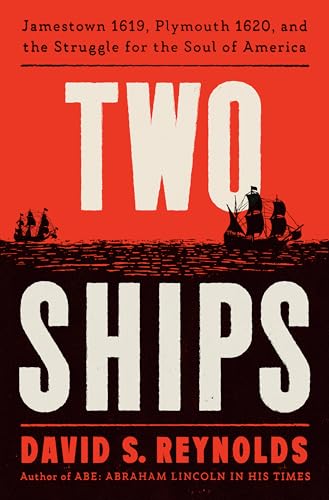
Two Ships: Jamestown 1619, Plymouth 1620, and the Struggle for the Soul of America
A revelatory history of American division through the prism of two ships, whose widespread use to define that division has been lost to memory despite their enduring legacy
In the bitterly polarized decades leading up to the American Civil War, it was commonplace to argue that America’s strife could be traced back to the arrival of two ships, less than a year apart—The White Lion, which brought the first enslaved Africans to Jamestown in 1619, and the Mayflower, which brought the Pilgrims to Plymouth Rock in 1620.
In a deeper sense, David S. Reynolds shows us, in this magnificent book, those two ships, invoked by Frederick Douglass and many others, stood for two quite distinct the Puritans and the Cavaliers, names and ideologies born in the bloodshed of the English Civil War. The Virginia colony, founded by royalists, was steeped in the ideas of divine right, which flowed down in rigid patriarchal hierarchies. Plymouth Colony’s dissenters to the king and his church, while hardly perfect, carried the seeds of a more egalitarian political vision.
These two ships of 1619 and 1620 played a key role in the battle of images and words that marked the roiling fight, and then war, over slavery. As Reynolds shows, there was a long stretch of time in America when everyone knew what Cavaliers and Puritans meant. It was North versus South, but more deeply, it was about whether social hierarchy was the natural order of things.
But then, as America descended into the long night of Jim Crow, the metaphor of the two ships went to sleep as well. The meaning of the Mayflower and of Thanksgiving changed as they became mainstream, apolitical ideas. If the ships’ status as cultural touchpoints before the Civil War tells us something vital about that conflict, their forgetting afterward tells us much about why the road to true equality has proved so stony. By dredging up these two ships’ dueling images, the great David S. Reynolds enables us to make the same use of them that Frederick Douglass and his contemporaries did—to challenge us, and to give us hope that we are up to the task.
In the bitterly polarized decades leading up to the American Civil War, it was commonplace to argue that America’s strife could be traced back to the arrival of two ships, less than a year apart—The White Lion, which brought the first enslaved Africans to Jamestown in 1619, and the Mayflower, which brought the Pilgrims to Plymouth Rock in 1620.
In a deeper sense, David S. Reynolds shows us, in this magnificent book, those two ships, invoked by Frederick Douglass and many others, stood for two quite distinct the Puritans and the Cavaliers, names and ideologies born in the bloodshed of the English Civil War. The Virginia colony, founded by royalists, was steeped in the ideas of divine right, which flowed down in rigid patriarchal hierarchies. Plymouth Colony’s dissenters to the king and his church, while hardly perfect, carried the seeds of a more egalitarian political vision.
These two ships of 1619 and 1620 played a key role in the battle of images and words that marked the roiling fight, and then war, over slavery. As Reynolds shows, there was a long stretch of time in America when everyone knew what Cavaliers and Puritans meant. It was North versus South, but more deeply, it was about whether social hierarchy was the natural order of things.
But then, as America descended into the long night of Jim Crow, the metaphor of the two ships went to sleep as well. The meaning of the Mayflower and of Thanksgiving changed as they became mainstream, apolitical ideas. If the ships’ status as cultural touchpoints before the Civil War tells us something vital about that conflict, their forgetting afterward tells us much about why the road to true equality has proved so stony. By dredging up these two ships’ dueling images, the great David S. Reynolds enables us to make the same use of them that Frederick Douglass and his contemporaries did—to challenge us, and to give us hope that we are up to the task.
475 pages, Kindle Edition
Published June 9, 2026
About the author
David S. Reynolds
31 books94 followersDavid S. Reynolds is a Distinguished Professor of English and American Studies at the City University of New York. His works include the award-winning Waking Giant: America in the Age of Jackson, Walt Whitman's America, and John Brown, Abolitionist. He lives on Long Island in New York.
Ratings & Reviews
Friends & Following
Create a free account to discover what your friends think of this book!
Community Reviews
Displaying 1 - 17 of 17 reviews

July 1, 2026
This is an interesting take on the North v South, slavery v abolition history of America, introducing me to the very old idea of two ships determining the characters of the two regions of the US: the Mayflower and the first ship to deliver African slaves to Virginia. It argues that the English factions of Cavaliers (aligned with the monarchy and Anglican church, supporting rigid hierarchy and a feudalist vibe) and the Puritans (separatists who came to America to establish a more politically egalitarian society that ended up supporting abolition and revolutionary ideals. The metaphor was used heavily for a couple hundred years until fading away in the early 20th century, when New South revisionism and post-Civil War reunification made white Americans a little more racist and xenophobic and removed some of the distinction of identity. As one who has read a lot of American history, I really liked this! It had a lot of fresh information in it (for me), especially more about the English civil war than I've ever had reason to learn. That alone gives so much more context to how the US developed, ideas-wise. I do wish this had included a little more about the 20th century; it ends somewhat abruptly in hoping that we can all use this understanding to do a little better. Given the BS coming out of Washington right now (including the SC stripping the Voting Rights Act), I'm not sure we're going in the right direction.
Thanks to netgalley and the publisher for the arc!
Thanks to netgalley and the publisher for the arc!
August 29, 2026
3.75/5
“Why this present conflict? Who were the parties to it? Where should they find the germ? The Mayflower and the Dutch galliot was the answer. These two elements were diametrically opposed to each other as much as were light and darkness, Christ and Belial; and these two elements were now struggling for ascendancy.” -Frederick Douglass (Ch.8: Then There Were Two; Pg. 263; Hardcover)
This is a unique and fascinating book. David S. Reynolds has written an expansive account of a rhetorical device that perfectly sums up the conflict between the Puritan North and the Cavalier South. From a brief history of the Mayflower expedition to Plymouth and the landing of the White Lion with its slaves in Jamestown, to the Revolutionary War, Civil War, and finally to Reconstruction, Reynolds leaves no stone unturned. The Pilgrims section thoroughly disintegrated some of my prejudices against them. I always believed that they were a theocratic society that crushed dissent within its ranks. But the history is much more nuanced and complicated. The Pilgrims established the ideas of “natural rights” and laid the foundations for a great democratic experiment. They were not perfect, and thankfully we’ve managed to enlarge our view of church-state separation to include all religions (for now). We get mini biographies on Cotton Mather and Samuel Sewall, two major figures who, “represented the capacity of Puritanism to affirm the humanity of Black people. Sewall and Mather accelerated the reformist energies that ran through Puritan New England and that eventually inspired the North and contributed to the downfall of slavery.” (Ch. 3: Puritanism, Race, and Slavery; pg. 80; hardcover)
Possibly the most fascinating section was about the English Civil War. It’s a subject I’m not familiar with and I had no idea how far the reverberations from this conflict would go. “The English Civil War had witnessed tens of thousands of casualties and terrible acts of persecution on both sides. Overall, however, the war destabilized monarchy and church hierarchy while introducing democratic principles that would contribute to the creation of the United Sates and, eventually, the abolition of slavery.” (Ch.4: Puritans, Cavaliers, and the English Civil War Era, pg. 114) The divide between Northern and Southern culture arguably began here, where the Puritans represented liberty and piety and the Cavaliers represented royalty, hierarchy, and subordination. After Charles I was executed numerous Cavaliers fled to the colony of Virginia, setting up their own form of government that represented the fallen Stuart monarchy. The Puritans in England began to form their theories on natural rights and a more just government until infighting and the dictatorial Oliver Cromwell quashed these enlightened dreams.
From there we move back to the colonies, and we learn about the governorship of William Berkley, who solidified the Cavalier attitude in the colonial South. “The Colony’s planter elite merged patriarchy, Anglicanism, and the exploitation of enslaved labor. The Cavalier based bloc ruled Virginia for decades until it was fractured by economic and political change.” (Ch. 5: The Rise and Fall of the Virginia Cavalier; pg. 128; hardcover) That economic and political change was exacerbated by the Revolutionary War. The revolutionary spirit was inspired, in part, by Puritanism. This was especially true for John Adams. He used the ideals of liberty, devotion to independence, and government by the consent to forge a path away from Great Britain. Thomas Jefferson, Patrick Henry, and Richard Henry Lee were also inspired by the ideas of Puritanism, especially the writings of John Rushworth. For a brief time, it seemed as if Puritanism (or at least the Founders view of Puritanism) would rule the day. That is, until independence was won and both cultures began to look back into the past for nostalgia. Thus, the Cavalier would make his way back to the forefront of Southern culture. Two events revived the memory of Plymouth; In 1741Thomas Faunce, a 94-year-old Massachusetts town clerk claimed that a boulder on the shoreline of Plymouth was the site of the Pilgrim landing and in 1769 The Old Colony Club commemorated the landing at Plymouth. The antislavery movement was also picking up steam at this time, especially in the North. Leading to a showdown and vicious rivalry between the two cultures. “The North and South, the story went, had sprung from diametrically opposite sources, symbolized by the ships.” (Ch.8: Then There Were Two; pg. 241; hardcover)
Here is where Reynolds arguments begin to become redundant. If you’re already familiar with the antebellum South and the antislavery causes of the North, then the next sections become quite tiresome. The two ships are a nice rhetorical device, but there were other causes at play in the sectional culture conflicts. Sometimes I had a hard time finding a through line in Reynolds writings, as if he feels the need to include every speech, pamphlet, and newspaper column that mentions the Mayflower or the “slave ship.” Sometimes it feels that Reynolds just combined his previous writings together in order to reach a word count. It’s impeccable research, but you don’t need to include every detail. Some sections could’ve been cut out entirely.
Anyway, we move onto the cultural factors behind the Civil War. Radical abolitionists were eager to use the two ships as a metaphor, and many did use it in their speeches. Southerners used the idea of Jamestown as the beginning of American commerce and that slavery was a natural position for supposed inferior beings. Abraham Lincoln wished to move beyond the two ship metaphor. “That Lincoln had advanced well beyond the popular Mayflower-slave ship controversy became clear in December, 1864 when Manhattan lawyer Joseph H. Choate invited him to a celebration of Forefathers’ Day…” he declined, writing that “The work of the Plymouth emigrants was the glory of their age. While we reverence their memory, let us not forget how vastly greater is our opportunity.” (Ch. 10: The Culture War Behind the Civil War; pg. 348; hardcover) After the end of the war and Lincoln’s assassination, Radical Republicans passed through Congress the 13th, 14th, and 15th amendments and Civil Rights legislation. The Freedman’s Bureau and Freedman’s Bank were set up to give newly freed slaves a firm footing in society. And Black men were elected to state legislatures in the South. But this was not to last. After 1877, military personnel were moved out of the South and Jim Crow began to rise. “The collapse of Reconstruction led to reconciliation between the Cavaliers and Puritans, based on a shared suspicion of non-white Americans and a wave of immigrants.” (Ch. 12: Beyond the Two Ships; pg. 395; hardcover) Radical Puritanism would later influence the Civil Rights movement of the 1950s and 60s.
Overall, a niche topic that is well researched but bogged down by too much detail. Two Ships is a fascinating look at a rhetorical device we no longer see anymore. It shows how the clash between cultures can reverberate for decades and how for every step forward there is always a small step backward. One cannot help but see some eerie parallels in our own time that hopefully will not lead to a bloody, prolonged conflict. I think I’ll end on a note of hope, as Reynolds writes, “For [Abraham Lincoln], America was a single ship, not two. This brings to mind a recurring dream he reported having in which he was on a ship that was rapidly moving toward an indefinite shore. Whatever the dream meant for Lincoln, it can be seen as a metaphor for the ship of the nation, sometimes foundering but always pressing on. It remains to be seen whether Lincoln’s dream can prevail over the divisions that the two ships signified back then- and that have taken a new shape in today’s America.” (Ch. 12: Beyond The Two Ships; pg. 396; hardcover)
“Why this present conflict? Who were the parties to it? Where should they find the germ? The Mayflower and the Dutch galliot was the answer. These two elements were diametrically opposed to each other as much as were light and darkness, Christ and Belial; and these two elements were now struggling for ascendancy.” -Frederick Douglass (Ch.8: Then There Were Two; Pg. 263; Hardcover)
This is a unique and fascinating book. David S. Reynolds has written an expansive account of a rhetorical device that perfectly sums up the conflict between the Puritan North and the Cavalier South. From a brief history of the Mayflower expedition to Plymouth and the landing of the White Lion with its slaves in Jamestown, to the Revolutionary War, Civil War, and finally to Reconstruction, Reynolds leaves no stone unturned. The Pilgrims section thoroughly disintegrated some of my prejudices against them. I always believed that they were a theocratic society that crushed dissent within its ranks. But the history is much more nuanced and complicated. The Pilgrims established the ideas of “natural rights” and laid the foundations for a great democratic experiment. They were not perfect, and thankfully we’ve managed to enlarge our view of church-state separation to include all religions (for now). We get mini biographies on Cotton Mather and Samuel Sewall, two major figures who, “represented the capacity of Puritanism to affirm the humanity of Black people. Sewall and Mather accelerated the reformist energies that ran through Puritan New England and that eventually inspired the North and contributed to the downfall of slavery.” (Ch. 3: Puritanism, Race, and Slavery; pg. 80; hardcover)
Possibly the most fascinating section was about the English Civil War. It’s a subject I’m not familiar with and I had no idea how far the reverberations from this conflict would go. “The English Civil War had witnessed tens of thousands of casualties and terrible acts of persecution on both sides. Overall, however, the war destabilized monarchy and church hierarchy while introducing democratic principles that would contribute to the creation of the United Sates and, eventually, the abolition of slavery.” (Ch.4: Puritans, Cavaliers, and the English Civil War Era, pg. 114) The divide between Northern and Southern culture arguably began here, where the Puritans represented liberty and piety and the Cavaliers represented royalty, hierarchy, and subordination. After Charles I was executed numerous Cavaliers fled to the colony of Virginia, setting up their own form of government that represented the fallen Stuart monarchy. The Puritans in England began to form their theories on natural rights and a more just government until infighting and the dictatorial Oliver Cromwell quashed these enlightened dreams.
From there we move back to the colonies, and we learn about the governorship of William Berkley, who solidified the Cavalier attitude in the colonial South. “The Colony’s planter elite merged patriarchy, Anglicanism, and the exploitation of enslaved labor. The Cavalier based bloc ruled Virginia for decades until it was fractured by economic and political change.” (Ch. 5: The Rise and Fall of the Virginia Cavalier; pg. 128; hardcover) That economic and political change was exacerbated by the Revolutionary War. The revolutionary spirit was inspired, in part, by Puritanism. This was especially true for John Adams. He used the ideals of liberty, devotion to independence, and government by the consent to forge a path away from Great Britain. Thomas Jefferson, Patrick Henry, and Richard Henry Lee were also inspired by the ideas of Puritanism, especially the writings of John Rushworth. For a brief time, it seemed as if Puritanism (or at least the Founders view of Puritanism) would rule the day. That is, until independence was won and both cultures began to look back into the past for nostalgia. Thus, the Cavalier would make his way back to the forefront of Southern culture. Two events revived the memory of Plymouth; In 1741Thomas Faunce, a 94-year-old Massachusetts town clerk claimed that a boulder on the shoreline of Plymouth was the site of the Pilgrim landing and in 1769 The Old Colony Club commemorated the landing at Plymouth. The antislavery movement was also picking up steam at this time, especially in the North. Leading to a showdown and vicious rivalry between the two cultures. “The North and South, the story went, had sprung from diametrically opposite sources, symbolized by the ships.” (Ch.8: Then There Were Two; pg. 241; hardcover)
Here is where Reynolds arguments begin to become redundant. If you’re already familiar with the antebellum South and the antislavery causes of the North, then the next sections become quite tiresome. The two ships are a nice rhetorical device, but there were other causes at play in the sectional culture conflicts. Sometimes I had a hard time finding a through line in Reynolds writings, as if he feels the need to include every speech, pamphlet, and newspaper column that mentions the Mayflower or the “slave ship.” Sometimes it feels that Reynolds just combined his previous writings together in order to reach a word count. It’s impeccable research, but you don’t need to include every detail. Some sections could’ve been cut out entirely.
Anyway, we move onto the cultural factors behind the Civil War. Radical abolitionists were eager to use the two ships as a metaphor, and many did use it in their speeches. Southerners used the idea of Jamestown as the beginning of American commerce and that slavery was a natural position for supposed inferior beings. Abraham Lincoln wished to move beyond the two ship metaphor. “That Lincoln had advanced well beyond the popular Mayflower-slave ship controversy became clear in December, 1864 when Manhattan lawyer Joseph H. Choate invited him to a celebration of Forefathers’ Day…” he declined, writing that “The work of the Plymouth emigrants was the glory of their age. While we reverence their memory, let us not forget how vastly greater is our opportunity.” (Ch. 10: The Culture War Behind the Civil War; pg. 348; hardcover) After the end of the war and Lincoln’s assassination, Radical Republicans passed through Congress the 13th, 14th, and 15th amendments and Civil Rights legislation. The Freedman’s Bureau and Freedman’s Bank were set up to give newly freed slaves a firm footing in society. And Black men were elected to state legislatures in the South. But this was not to last. After 1877, military personnel were moved out of the South and Jim Crow began to rise. “The collapse of Reconstruction led to reconciliation between the Cavaliers and Puritans, based on a shared suspicion of non-white Americans and a wave of immigrants.” (Ch. 12: Beyond the Two Ships; pg. 395; hardcover) Radical Puritanism would later influence the Civil Rights movement of the 1950s and 60s.
Overall, a niche topic that is well researched but bogged down by too much detail. Two Ships is a fascinating look at a rhetorical device we no longer see anymore. It shows how the clash between cultures can reverberate for decades and how for every step forward there is always a small step backward. One cannot help but see some eerie parallels in our own time that hopefully will not lead to a bloody, prolonged conflict. I think I’ll end on a note of hope, as Reynolds writes, “For [Abraham Lincoln], America was a single ship, not two. This brings to mind a recurring dream he reported having in which he was on a ship that was rapidly moving toward an indefinite shore. Whatever the dream meant for Lincoln, it can be seen as a metaphor for the ship of the nation, sometimes foundering but always pressing on. It remains to be seen whether Lincoln’s dream can prevail over the divisions that the two ships signified back then- and that have taken a new shape in today’s America.” (Ch. 12: Beyond The Two Ships; pg. 396; hardcover)
Review of advance copy received from Netgalley
*Thanks to NetGalley and the publisher for an advance reader copy of this book in exchange for an honest review.*
Two Ships discusses the two ships that were formative in the development of America. The White Lion which came to America in 1619 and brought the first enslaved Africans to Jamestown in 1619 and the Mayflower which arrived at Plymouth Rock with the first pilgrims. These two ships represented two different American realities going all the way back to the English Civil War. The ideologies of the two ships led to the Puritans and the Cavaliers but also the idea of the North versus South. This book discusses where the two ships landed, the Puritans and Cavaliers, the American Revolution, the North versus South and Black Reconstruction.
I enjoyed reading this book and I found it fascinating to learn about the Puritans and Cavaliers and their origins in the English Civil War. I think this author did well to tie a lot of different topics such as slavery, the Civil War and Reconstruction all the way back to the two ships. I will be recommending this book and I think this is a valuable addition to the books on American history and slavery. I appreciate this book because of how it discusses a lot of topics as well as slavery and I found it very interesting to learn about different attitudes towards slavery and how some of these beliefs went all the way back to the two ships.
Two Ships discusses the two ships that were formative in the development of America. The White Lion which came to America in 1619 and brought the first enslaved Africans to Jamestown in 1619 and the Mayflower which arrived at Plymouth Rock with the first pilgrims. These two ships represented two different American realities going all the way back to the English Civil War. The ideologies of the two ships led to the Puritans and the Cavaliers but also the idea of the North versus South. This book discusses where the two ships landed, the Puritans and Cavaliers, the American Revolution, the North versus South and Black Reconstruction.
I enjoyed reading this book and I found it fascinating to learn about the Puritans and Cavaliers and their origins in the English Civil War. I think this author did well to tie a lot of different topics such as slavery, the Civil War and Reconstruction all the way back to the two ships. I will be recommending this book and I think this is a valuable addition to the books on American history and slavery. I appreciate this book because of how it discusses a lot of topics as well as slavery and I found it very interesting to learn about different attitudes towards slavery and how some of these beliefs went all the way back to the two ships.
September 4, 2026
America commemorates its semiquincentennial. In his book Two Ships: Jamestown 1619, Plymouth 1620, and the Struggle for the Soul of America, historian David S. Reynolds asks: "How did America pull it off?" How did the thirteen colonies unite to defeat the mother country in the Revolution and forge a new nation under the Constitution? Americans have asked these questions for 250 years. We must keep asking them.
Two Ships takes its title from the Dutch ship White Lion, which brought 20 enslaved people to Jamestown in 1619, and the Mayflower, which brought the Pilgrims to Massachusetts in 1620. It's a revelatory history of American division, told through two vessels once widely invoked — by Frederick Douglass and many others — as symbols in the war of ideas between North and South, a struggle whose echoes persist today.
Reynolds shows that those two ships stood for two distinct realities: the Puritans and the Cavaliers, names and ideologies born in the bloodshed of the English Civil War. The Virginia colony, founded by royalists, was steeped in divine right and a rigid patriarchal hierarchy. Plymouth Colony's dissenters from the king and his church, while hardly perfect, carried the seeds of a more egalitarian political vision. For a long stretch of American history, everyone understood what Cavalier and Puritan meant — North versus South, but more deeply, a dispute over whether social hierarchy was the natural order of things.
Then, as America descended into the long night of Jim Crow, the metaphor went to sleep. The Mayflower and Thanksgiving hardened into mainstream, apolitical symbols, scrubbed of the conflict they once embodied. If the ships' power as cultural touchstones before the Civil War tells us something vital about that conflict, their quiet erasure afterward tells us just as much about why the road to genuine equality has proved so stony. By dredging up their dueling images, Reynolds lets us use them as Douglass once did—to challenge us and suggest that we may yet be equal to the task.
This history is complicated and contentious. It reminds us that any country that cannot agree on its origin story is destined for divisive times. The facts of these two voyages and the meanings attached to them are precisely what made them such a powerful metaphor for two competing visions of American identity — and why recovering that metaphor matters now. As America marks 250 years, we would do well to heed Reynolds's blunt advice: America has to grow up.
Two Ships takes its title from the Dutch ship White Lion, which brought 20 enslaved people to Jamestown in 1619, and the Mayflower, which brought the Pilgrims to Massachusetts in 1620. It's a revelatory history of American division, told through two vessels once widely invoked — by Frederick Douglass and many others — as symbols in the war of ideas between North and South, a struggle whose echoes persist today.
Reynolds shows that those two ships stood for two distinct realities: the Puritans and the Cavaliers, names and ideologies born in the bloodshed of the English Civil War. The Virginia colony, founded by royalists, was steeped in divine right and a rigid patriarchal hierarchy. Plymouth Colony's dissenters from the king and his church, while hardly perfect, carried the seeds of a more egalitarian political vision. For a long stretch of American history, everyone understood what Cavalier and Puritan meant — North versus South, but more deeply, a dispute over whether social hierarchy was the natural order of things.
Then, as America descended into the long night of Jim Crow, the metaphor went to sleep. The Mayflower and Thanksgiving hardened into mainstream, apolitical symbols, scrubbed of the conflict they once embodied. If the ships' power as cultural touchstones before the Civil War tells us something vital about that conflict, their quiet erasure afterward tells us just as much about why the road to genuine equality has proved so stony. By dredging up their dueling images, Reynolds lets us use them as Douglass once did—to challenge us and suggest that we may yet be equal to the task.
This history is complicated and contentious. It reminds us that any country that cannot agree on its origin story is destined for divisive times. The facts of these two voyages and the meanings attached to them are precisely what made them such a powerful metaphor for two competing visions of American identity — and why recovering that metaphor matters now. As America marks 250 years, we would do well to heed Reynolds's blunt advice: America has to grow up.

August 18, 2026
Today, we revere the esteemed colonists of Jamestown and Plymouth Plantation as the original founders of our American experiment, who fought the elements and unsure nature of a New World to establish a foothold for religious liberty and a kingdom away from the Old World and its oppression of monarchy.
However, this idea of united colonists working to establish a new nation wasn’t the case for most of American history. The Plymouth colony was seen as an extension of Puritan principles and equality of the races with religious freedom for all. Jamestown was associated with 1619 and the Dutch ship that first introduced slavery to America’s shores.
These two ships, hence the title, created vastly different ideas of how the new nation would be run and the reasons behind why each colony was able to grow and prosper.
There became the idea that “two forms of civilization” emerged from each of these colonial foundations at the source of this new nation called America. Puritans brought ideas of individual freedom and equality, while Jamestown brought aristocracy and absolutism in the form of a Cavalier class of a superior race that held a natural order to be served through the institution of slavery.
Through this reading, we see that Puritanism was born of a desire to rebel against the hierarchy of the Church of England, which when applied in the New World, nurtured democracy and equal rights, supported by the likes of Locke and shaped by the ideals of the English Civil War against Charles I. We see as well, from that conflict, that Jamestown was founded by dedicated supporters of hierarchy and social order enshrined in the South’s peculiar institution.
These two vastly different ways of life came to conflict in the Civil War and only one could triumph to continue the American experiment of a united people. That just happened to be from the Northern perspective, the Mayflower and Puritanism.
However, this idea of united colonists working to establish a new nation wasn’t the case for most of American history. The Plymouth colony was seen as an extension of Puritan principles and equality of the races with religious freedom for all. Jamestown was associated with 1619 and the Dutch ship that first introduced slavery to America’s shores.
These two ships, hence the title, created vastly different ideas of how the new nation would be run and the reasons behind why each colony was able to grow and prosper.
There became the idea that “two forms of civilization” emerged from each of these colonial foundations at the source of this new nation called America. Puritans brought ideas of individual freedom and equality, while Jamestown brought aristocracy and absolutism in the form of a Cavalier class of a superior race that held a natural order to be served through the institution of slavery.
Through this reading, we see that Puritanism was born of a desire to rebel against the hierarchy of the Church of England, which when applied in the New World, nurtured democracy and equal rights, supported by the likes of Locke and shaped by the ideals of the English Civil War against Charles I. We see as well, from that conflict, that Jamestown was founded by dedicated supporters of hierarchy and social order enshrined in the South’s peculiar institution.
These two vastly different ways of life came to conflict in the Civil War and only one could triumph to continue the American experiment of a united people. That just happened to be from the Northern perspective, the Mayflower and Puritanism.

Review of advance copy received from NetGalley
This is a stellar read (thank you NetGalley and Penguin Press for allowing me access to this ARC). Using two ships as symbols of the divide in America for the Civil War was such an interesting concept.
The argument is that the Mayflower, arriving in Massachusetts in 1620, represents “antislavery” and the White Lion, a ship that brought twenty slaves to Jamestown in 1619, could represent the antithesis is explored in this book. Many of Lincoln’s contemporaries noted this as did Fredrick Douglass. A northern journalist after Lee surrender wrote that “The Slave Ship has foundered. The Mayflower floats in triumph.”
The book explores the differences between Jamestown and Plymouth Colony though the dueling ships. Entrenched in this story was the reality that everyone knew at that time of the Cavaliers and the Puritans - the North versus the South. Though this is lost in our times, the idea of these dueling ships brings back a reminder of the roughy road to freedom for all humans. One quote in this book stuck with me when Reynolds writes borrowing from another historian that the South was a slave society but the North was a society with slaves. The South was governed by monarchists who had rigid social classes while in the North there was a more democratic flavor with the belief the “only monarch” was Christ (in today’s America I think a few folks have forgotten this). A great irony Reynolds points out that both Jamestown and Plymouth were administratively founded by the sane man: Robert Rich.
This is a revelatory book for me and possibly others who have never thought about how two ships in the early 17th C could reveal so much about the cruel and unjust divide in this country. This is a must read. Highly recommend.
The argument is that the Mayflower, arriving in Massachusetts in 1620, represents “antislavery” and the White Lion, a ship that brought twenty slaves to Jamestown in 1619, could represent the antithesis is explored in this book. Many of Lincoln’s contemporaries noted this as did Fredrick Douglass. A northern journalist after Lee surrender wrote that “The Slave Ship has foundered. The Mayflower floats in triumph.”
The book explores the differences between Jamestown and Plymouth Colony though the dueling ships. Entrenched in this story was the reality that everyone knew at that time of the Cavaliers and the Puritans - the North versus the South. Though this is lost in our times, the idea of these dueling ships brings back a reminder of the roughy road to freedom for all humans. One quote in this book stuck with me when Reynolds writes borrowing from another historian that the South was a slave society but the North was a society with slaves. The South was governed by monarchists who had rigid social classes while in the North there was a more democratic flavor with the belief the “only monarch” was Christ (in today’s America I think a few folks have forgotten this). A great irony Reynolds points out that both Jamestown and Plymouth were administratively founded by the sane man: Robert Rich.
This is a revelatory book for me and possibly others who have never thought about how two ships in the early 17th C could reveal so much about the cruel and unjust divide in this country. This is a must read. Highly recommend.
August 1, 2026
A lot of information here...& it's kind of like reading a textbook... It presents a lot of English history, like in the 1400-1600's, leading up to & explaining why those people decided to get aboard the Mayflower & set sail across the ocean. It expounds on the early colonist's politics, religion, & England's/the King's influence on them. Then the comparisons begin regarding the 2 ships that landed within a year of each other: the White Lion (mostly known as 'the slave ship') in Jamestown in 1619 vs the Mayflower in Plymouth in 1620.....in the veins of, for example, cavaliers vs puritans, slavery vs freedom, dark vs light......& the aftermath of this history....thru the revolution & the civil war...& after. I learned a lot, but there was a lot of families & their history/lineage, historical dates/time frames, locations & politics to keep track of....it was a slower read, but comprehensive!
I received an e-ARC for publisher Penguin Press via NetGalley for review purposes. This is my own fair/honest review.
I received an e-ARC for publisher Penguin Press via NetGalley for review purposes. This is my own fair/honest review.
July 6, 2026
This is another fine entry in what seems to be a trend of following a theme over time, which includes Marx in America (Marxism, doh) and Chosen Land (Religiosity). This book traces the ideology and tensions between the Mayflower and the White Lion (the ship from the 1619 Project) in terms of slavery, abolition, and racism in America. It is well-researched and makes important points that will irritate numerous people. While some might suggest bias by the author (He is a multiple Mayflower descendant), I believe he presents a balanced and nuanced product. With the exception of a certain 'snarckiness' towards the First Families of Virginia (the FFV, don't you know), he presents an overall, balanced, and necessary work. This is a must-read that helps explain some of the divisions in our country today.

September 28, 2026
The author covers the history of the north (influenced by the puritans from the Mayflower) and the south (influenced by the people that sailed with the Virginia Company to Jamestown) and the impact of both groups on our nation. Both ships were common references in speeches, newspapers, etc. for many years. I was not aware of this comparison often used to categorize differences between the two populations, especially when slavery was legal. Though there was slavery in the North, it was people often from the North who advocated the hardest for abolishing slavery everywhere in the U.S. Excellent read! I will follow this author for future works.

July 24, 2026
I couldn’t enjoy this book at all, and didn’t finish it. The writing style was academic and I didn’t care at all about Cromwell, who never set foot in America, or any other British drama happening at the time. When I quit this book I started An Indigenous Peoples’ History of the United States. Same story, better writing and much mire honest perspective. History is written by the winners, and this book proves the point. I never got as far as the Civil War, too much of a slog.

August 12, 2026
I'm always leery of subtitles such as "the untold story" or "the battle for America's soul." Reynolds does stick to this as a theme though, and does well at tracing a connection I've often used in the classroom for the seeds of Civil War being planted with two of our earliest colonies, and the two most famous at that. For me, I learned for the first time how prevalent the "two ships" theme was in pre Civil War rhetoric.

July 29, 2026
An interesting look at how the memory and symbolism of the Jamestown and Plymouth colonies impacted the history of the later United States, up to and including the Civil War. Feels so distant, and yet so familiar...

July 17, 2026
An interesting take on the differences between the North and South before the American Civil War.
August 2, 2026
informative about Puritan roots in US as opposed to Cavalier southern ways.
Have a greater appreciation for Puritan thought and the people behind its growth.
Have a greater appreciation for Puritan thought and the people behind its growth.

August 6, 2026
Learned quite a bit from this one, including the cultural influences (from the two ships) on the antebellum north and south.

September 28, 2026
I enjoyed the book, I just went it went further into the present time and discussed how the two opposing factions persist into present day

Review of advance copy received from Publisher
It looks like I owe the Plymouth Colony an apology. See, I often will point to Plymouth as the nexus of judgmental American thought. Admittedly, the Puritans were not known to be a fun time. They might be the American origin of fuddy-duddiness (copyright pending). However, I should have been blaming the Massachusetts Bay Colony the whole time. That said, Two Ships by David Reynolds compares Plymouth with Jamestown and there is no contest about which unleashed the worst aspect of our early American society.
Initially, I thought Reynolds may be doing his own think-piece on how the United States grew out of two completely different places. One, Plymouth, with its Puritanical bend versus Jamestown and the first slave ship to land in the English Americas. What I didn't realize is that Reynolds wasn't trying to take credit for this thought. Instead, he is giving an in-depth look at how this philosophical discussion has always been there and never faded. Authors and politicians have used the metaphor of the two ships to show the huge differences which would ultimately result in the Civil War. Reynolds traces this all to England (of course) with the English Civil War of the Roundheads (always hilarious to see in print) and the Cavaliers (which is inarguably a cooler nickname).
Ultimately, what you end up with is part philosophy but mostly great history. This is one of those books that will end up making you think long after you finish the final page.
(This book was provided as an advanced reader copy by NetGalley and Penguin Press.)
Initially, I thought Reynolds may be doing his own think-piece on how the United States grew out of two completely different places. One, Plymouth, with its Puritanical bend versus Jamestown and the first slave ship to land in the English Americas. What I didn't realize is that Reynolds wasn't trying to take credit for this thought. Instead, he is giving an in-depth look at how this philosophical discussion has always been there and never faded. Authors and politicians have used the metaphor of the two ships to show the huge differences which would ultimately result in the Civil War. Reynolds traces this all to England (of course) with the English Civil War of the Roundheads (always hilarious to see in print) and the Cavaliers (which is inarguably a cooler nickname).
Ultimately, what you end up with is part philosophy but mostly great history. This is one of those books that will end up making you think long after you finish the final page.
(This book was provided as an advanced reader copy by NetGalley and Penguin Press.)
Displaying 1 - 17 of 17 reviews