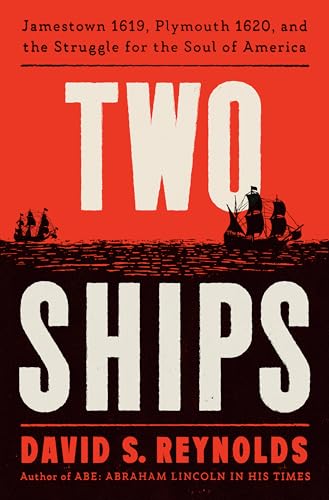
A revelatory history of American division through the prism of two ships, whose widespread use to define that division has been lost to memory despite their enduring legacy
In the bitterly polarized decades leading up to the American Civil War, it was commonplace to argue that America’s strife could be traced back to the arrival of two ships, less than a year apart—The White Lion, which brought the first enslaved Africans to Jamestown in 1619, and the Mayflower, which brought the Pilgrims to Plymouth Rock in 1620.
In a deeper sense, David S. Reynolds shows us, in this magnificent book, those two ships, invoked by Frederick Douglass and many others, stood for two quite distinct the Puritans and the Cavaliers, names and ideologies born in the bloodshed of the English Civil War. The Virginia colony, founded by royalists, was steeped in the ideas of divine right, which flowed down in rigid patriarchal hierarchies. Plymouth Colony’s dissenters to the king and his church, while hardly perfect, carried the seeds of a more egalitarian political vision.
These two ships of 1619 and 1620 played a key role in the battle of images and words that marked the roiling fight, and then war, over slavery. As Reynolds shows, there was a long stretch of time in America when everyone knew what Cavaliers and Puritans meant. It was North versus South, but more deeply, it was about whether social hierarchy was the natural order of things.
But then, as America descended into the long night of Jim Crow, the metaphor of the two ships went to sleep as well. The meaning of the Mayflower and of Thanksgiving changed as they became mainstream, apolitical ideas. If the ships’ status as cultural touchpoints before the Civil War tells us something vital about that conflict, their forgetting afterward tells us much about why the road to true equality has proved so stony. By dredging up these two ships’ dueling images, the great David S. Reynolds enables us to make the same use of them that Frederick Douglass and his contemporaries did—to challenge us, and to give us hope that we are up to the task.
David S. Reynolds is a Distinguished Professor of English and American Studies at the City University of New York. His works include the award-winning Waking Giant: America in the Age of Jackson, Walt Whitman's America, and John Brown, Abolitionist. He lives on Long Island in New York.
It looks like I owe the Plymouth Colony an apology. See, I often will point to Plymouth as the nexus of American thought when it becomes too judgmental. Admittedly, the Puritans were not known to be a fun time. They might be the American origin of fuddy-duddiness (copyright pending). However, I should have been blaming the Massachusetts Bay Colony the whole time. That said, Two Ships by David Reynolds compares Plymouth with Jamestown and there is no contest about which unleashed the worst aspect of our early American society.
Initially, I thought Reynolds may be doing his own think-piece on how the United States grew out of two completely different places. One, Plymouth, with its Puritanical bend versus Jamestown and the first slave ship to land in the English Americas. What I didn't realize is that Reynolds wasn't trying to take credit for this thought. Instead, he is giving an in-depth look at how this philosophical discussion has always been there and never faded. Authors and politicians have used the metaphor of the two ships to show the huge differences which would ultimately result in the Civil War. Reynolds traces this all to England (of course) with the English Civil War of the Roundheads (always hilarious to see in print) and the Cavaliers (which is inarguably a cooler nickname).
Ultimately, what you end up with is part philosophy but mostly great history. This is one of those books that will end up making you think long after you finish the final page.
(This book was provided as an advanced reader copy by NetGalley and Penguin Press.)