In this heartfelt and humorous fantasy, a dragon whose three heads bear rather…different personalities finds family in the most unexpected of places.
From the Nebula-winning author of Someone You Can Build a Nest In!
Garrodigh was once a four-headed dragon, among the most powerful in Kardoša. After an unfortunate incident, he now has three heads, one stump, and a daily whirlwind of internal bickering. Centerhead wants to rain death upon all humanity, Bottomhead is like a feral cat, and Upperhead is under the delicate delusion that he is, in fact, human.
When a nearby battle goes awry, Garrodigh sneaks into an elite dragon rider academy, pretending to be tame to get free food and a warm bed. Lucky for him, rider Rania Albright is desperate enough for a dragon of her own that she overlooks his eccentricities.
As Garrodigh recovers under Rania’s care, all three heads start to turn, for the first time, in the same direction. Each wants to protect her from the invaders who killed their fourth head—the same invaders who seek to conquer Kardoša. When the academy comes under attack, can this wild dragon and his wilder rider save their homeland together?
This cozy fantasy intertwines epic battles with loving friendships, sharing an utterly unique perspective on what it means to be a ‘monster.’
John Wiswell is a disabled author who lives where New York keeps all its trees. He won the Nebula Award for Best Novel and the Locus Award for Best Debut Novel for Someone You Can Build A Nest In, and the Nebula Award for Best Short Story for Open House on Haunted Hill, and the Locus Award for Best Novelette for That Story Isn't The Story. His fiction has been translated into over fifteen languages.
Sometimes the bravest thing a dragon can do is fall.
Garrodigh, the Great Terror, is not so fearsome anymore. Once a four-headed dragon, he now has three heads, one stump, and a lot of unresolved trauma. He can’t fly, and the remaining heads are coping in very different ways. Centerhead is proud, regal, furious, and anti-human. Standard dragon. Upperhead is convinced that he is human. Bottomhead is basically a child and only cares about eating. After a nearby battle goes badly, the three of them make the executive decision to sneak into an elite dragon rider academy in the floating Winged City, pretend to be tame, and get free food and lodgings. Unfortunately for this wild, anti-human dragon, this involves being claimed by Rania, a refugee and aspiring dragon rider who desperately wants a dragon of her own.
The relationship between Garrodigh and Rania is where this book shines. They are both outsiders. Rania is trying to belong in a city that doesn’t fully accept her, and Garrodigh is trying to recover from something that has left him physically and emotionally changed. He never really feels like he belongs with any of the dragons. Too tame for the wild dragons, and too wild for the tame dragons. The bond between Garrodigh and Rania has a warm, found-family feeling, and I loved watching this furious, traumatized dragon slowly grow attached despite their best efforts. It’s very “I am NOT emotionally invested in this human” while actively rearranging his entire worldview around her safety and happiness. Sir, please. We can all see you.
The first half of the book is so endearing. It has this cozy training montage feeling, like Eye of the Tiger, but make it dragon rehab. It’s a story about trauma, shame, fear, and remembering who you were before you fell. Remembering that the greatness isn’t lost just because you fell. I like the way Garrodigh’s heads externalize different responses to trauma. It’s silly, but there’s something tender underneath the absurdity. Centerhead wants revenge. Upperhead escapes into delusion. Bottomhead retreats into instinct.
I have to mention Oleksiy. I say this as someone with no authority on how queer characters should be written or introduced: Oleksiy is the only character in this book whose identity is made explicit on first appearance. He is introduced as a trans man before we know much else about him. No other queer character in the book, and there are several, is introduced the way he is. It's clear that they're queer based on who they date, for example. His introduction stands out by contrast, but that alone doesn't mean it's an issue. I’m curious how this lands for queer readers more broadly. When a character shares your identity, do you prefer it to be stated clearly right away, or do you prefer finding out when other pieces of their background come up naturally?
On the topic of Oleksiy, though, I love him. He has this unbothered confidence about him, calls everyone darling, and has glorious hair. If you love Howl, you will love Oleksiy. We need more MMCs like Howl and Oleksiy. Seriously, where are they?? (pls tell me in the comments)
My main issue, and the reason I'm giving this 3.5 stars, is that the book started to feel so long. It's not even that long, but it felt like it would never end. I struggle to describe why. Maybe the descriptions were too long and tangential? I love intricate side characters and all that, but sometimes it felt a bit like listening to that friend who never gets to the point because they go into 15 side stories.
Ironically, the second half, which is a lot more action-packed than the first, is when I started getting bored. The quieter moments and character detours started to feel stretched out, and the larger war plot never grabbed me as much as the Garrodigh/Rania dynamic did. It's more serious, with battles, airships, political tension, and real danger. While that gives the book more plot, it's not what I would expect from a cozy fantasy, but I am certainly no expert on the genre.
Still, despite my complaints, there’s a lot of heart in this story. The chapters are short (and named! I miss named chapters!), the humor is cute, and Garrodigh is a delightfully ridiculous creation. The book works best when it’s about the divide between dragons and humans, and how kindness can sneak past even the most stubborn defenses. I just wish the whole book had stayed as sharp and endearing as that central bond.
3.5 ⭐ rounded up A big thank you to NetGalley, DAW, and John Wiswell for the ARC!
Not a new favorite, but of course I did enjoy the book with the three-headed dragon main character. The whole concept of the three heads having all different personalities will never not make me grin, and I just loved to read about Garrodigh, the Great Terror. That's the name the dragon is widely known under, but we get to know him a little better than that. There is Centerhead, who is bloodthirsty and hostile, Bottomhead, who feels more like a dog and is mostly thinking about food, and Upperhead, who is convinced that he is a human hallucinating this whole situation. Which is understandable, because reality really doesn't look too good for Garrodigh. War made him flee his home and other wild dragons were not willing to shelter him. He can't fly anymore and is gravely injured (he used to be a four-headed dragon after all) when he comes up with the great plan of letting himself be captured by humans. The people of the Winged City tamed dragons long ago and so they might as well feed and heal Garrodigh. There's still enough time to conquer the city and destroy humanity afterwards. Especially Centerhead is determined to hate all humans, but it's hard when they show him so much love and care. One dragon-rider in particular just adopts Garrodigh and is beyond thrilled to have a new steed. John Wiswell always writes weirdly cozy and wholesome stories set in rather harsh worlds, and this one was no exception. At first it was the healing journey of a dragon with quite the repressed feelings, and a bit of a found family situation with his new rider, a woman named Rania. She was an interesting character as well, a refugee of war struggling with being accepted in her new home. I know that the dragon POV is a big part of the appeal of this book, but I wish Rania had gotten her own chapters as well. It was rather unnatural how her whole personal story was observed from an outside perspective and there were plenty of awkward moments because of that. (Really, what was up with all the sex she was having right next to her dragon?) Rania had a whole rom-com-drama going on, and I was not into it. I was very interested in the dragon-part, though. There were pretty cool dragon powers shown in this book, like dragons producing lava or them basically manipulating gravity to fly. They also had a whole religion and it was very interesting how it tied into the war plot of the story. It's definitely a mix of humor and heavier themes, so be aware of that when you pick it up expecting a fun little silly read. I enjoyed it, but I ultimately also have to call it my least favorite book from this author. But I guess it's just hard when you only ever write bangers.
Huge thanks to NetGalley and DAW for providing a digital arc in exchange for an honest review.
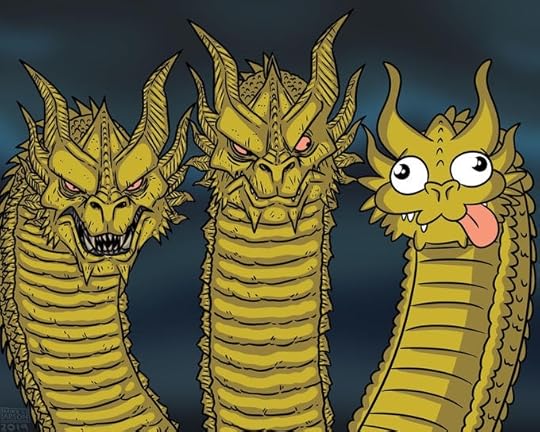
Pre-read: John Wiswell really saw that meme with the three-headed dragon and made a whole book out of it, but his dragon has one head that wants to annihilate humanity, one that thinks it's human and one that just wants some good head scritches, and I love absolutely everything about that.
3.5 ⭐️ Cozy fantasy about a three-headed dragon whose each head has a vastly different personality and the found family he picks up along the way.
Garrodigh, a wild three-headed dragon, infiltrates Winged City with thoughts of getting free meals while plotting on how to raise terror and overthrow the "evil" mortals who have waged war while riding his fellow dragons (tamed versions) into battle.
Meet the heads: Centerhead: The "leader" of the heads. Opinionated and convinced he hates humans (he doesn't). He's the one who comes up with the plan to infiltrate Winged City. Upperhead: Thinks he's a human and is hallucinating and/or comatose. This head spends the first half of this book FULLY convinced that his being a dragon is a figment of his imagination, haha. Bottomhead: Gluttonous and silly. The most "dragon-like" of all heads. Cares mainly for feeding and making friends. He's the most childlike and emotive of all heads. Lefty: Formerly a four-headed dragon. Lefty is now a stump in the place where this head used to be.
It shouldn't come as a surprise, with "cozy" in the genres, that this is far from a bloody tale of a dragon conquering a town. It's about a ball-of-sunshine human female from this town, Rania, slowly but surely forming a close bond with the injured Garrodigh. Taking a limping, torn-winged dragon and not only healing his body but also stabilizing his mind so he could fly once more.
The found family aspect was done well. The outsider woman and her "broken" dragon healed each other and rose to even higher heights together!
My main complaint is that this story lost some steam in the middle. Meandering about with a silly misunderstanding-focused love drama. Since the main character is a multi-headed dragon, I could've done without the human love life drama. Nevertheless, it was a cute story. Not revolutionary, but did its job as a cozy fantasy!
The Dragon Has Some Complaints by John Wiswell Book Blurb: A dragon whose three heads bear rather…different...personalities finds family in the most unexpected of places.
Rating: **** Feels: Amused, Impressed, Adventurey, Happy Style: Fantasy, Dragons, Cozy, Adult, Cozy Fantasy, Fiction First published July 14, 2026: 400 pages
Themes & Setting: Main Character: Garrodigh !! The Great Terror !!! Is just so much fun. We have so much personality wrapped up in this fun dragon. Centerhead made me want to believe in humanity again (while he wants to destroy humanity !!!). He went through alot of development and it was so very heartwarming. Upperhead ... thinking he was human ... was just too funny. The things he would say .. had me in stitches. Bottomhead is just the sweetheart you wanna pat on the head. Enjoy getting to know the dragon !!! FMC: Rania was such a great strong female character and I love that she was the one that got to be with Garrodigh !! Her heart and spirit are what guided everything and made this all such a very enjoyable read. Conclusion: Such a fun adventure with a dragon with the most amusing multi head personalities!!! It was really interesting to have the story from the POV from one of the heads of the dragon and that be the filter of the relationships around the dragon. The dragon’s rider is fantastic and gives great treats !! She also has a romance sub plot which is pretty fun to have narrated through center head dragon. The world building was a lot of fun as seen through the dragon and a world in the midst of a war. I always love a good conflict. I think my favorite part of this story was the POV and just enjoying this story through such a novel view. Really fun read !!
This book has: Dragons !!! Politics and Waring Nations Hidden Identities Lots of conflicts Queer Friendly
3.5 ⭐️ Very cute if a little underwhelmed. Garrodigh is an ancient four headed dragon who’s a bit worse for wear. He can’t fly, has a busted leg and one of his heads is dead. Losing Lefty has left his other three heads more than a little confused. Upperhead thinks he’s a human, Bottomhead doesn’t think just eats and Centerhead is trying to keep them all together except there’s some pretty big holes in his memory. All Centerhead knows was the humans killed Lefty & he wants revenge but he’d like some breakfast first!
This is the type of cozy that I like! There are still stakes that propel the action forward and the world is filled with positive accepting characters. The whole book is from Centerheads POV. Such a fun character to spend time with! I disliked how drawn out the final battle was & how much time it took to help the dragon goddess. There was lots of random action thrown in that felt like filler.
A bit of a random noodle. I keep thinking about how Oleksiy a trans male character, was introduced. Wiswell tells the audience that Oleksiy is trans immediately. It was done simply/to the point in the same way an author might say so and so had brown hair. I do appreciate Wiswells directness. Although I wish that Oleksiy was introduced in the same way every other character was & use of pronouns tells us what gender he is. We weren’t given additional labels for other characters like nonbinary or queer.
At multiple points, Rania, Garrodighs rider, talks about her childhood growing up with Oleksiy. We learn about how her sexuality was something to be hidden & she was sold off to be a child bride before she ran away. We also learn about Oleksiys struggles to transition/ be accepted as male before he ran away. It’s important we know about both Oleksiys & Rania past but Rania wasn’t labeled queer or child bride upon introduction…
I guess I feel if a person identifies as/is a man we should treat them the way we treat all the other male characters. If that man’s history is important to their story then we should learn they were AFAB in the same way we learn any characters backstory.
Big caveat while I’m demi gendered I am not trans. I’ve had feelings of gender incongruence but it is not even close to the same experience Trans people go through. If Trans readers are happy with or prefer the way Wiswell introduces Oleksiy then that’s what I support.
A delightful, found-family, second-chance, mostly-cozy fantasy about an iriscible three-headed dragon (whose heads quarrel among themselves, providing much of the humor) who bonds with an immigrant woman not permitted to be a dragon rider . . .
The first half is decidedly more cozy and light, with broadly-painted worldbuilding. The second half gets more grim, though not quite with enough worldbuilding gravitas to focus it. There is a tendency for the narrative voice to explain what has already been sufficiently shown, still, for diversity and acceptance of a wide variety of life experiences, this novel is an entertaining exemplar.
John Wiswell is rapidly turning into one of my favourite authors. I really love his books. This one was great, it started off pretty cozy, dragon has physical therapy!! But there were serious discussions around colonialism and refugees as well as how we deal with trauma. The characters were wonderful. I could not pick a favourite head. I love them all. Bottomhead for his directness and knowing exactly what he wanted, centerhead seemed the most like me fighting through everything and Upperhead ended up being terribly wise. The humans were great too. Definitely one to savour and read again.
I wasn't quite sure what I was getting into, but if a book contains dragons I'm going to read it! And it sure was entertaining.
In a world with a howering city high in the sky, off course human greed wins and the city gets attacked by another nation. The wild dragons on the ground are affected and injured by the ammunition falling from the sky in the clashes between airships and dragonsriders from the floating city. One of these dragons is Garrodigh, The Great Terror. He has lost one of his four heads, Centerhead the most bloodthirsty of the three remaining heads get the bright idea to trick their way to the floating city, so the dragon can get fed and heal among the tame dragons. Upperhead is very interested because he believes himself to be a human and hallucinating being a dragon. and just want to return to his people, the human. Bottomhead is a glutton and just want to eat everything presented to Garrodigh.
Not everything isn't as easy or straightforward as expected, and a bold young woman, Rania, basically bullies her way to becoming Garrodigh's rider. Hilarities ensues.
I found this story heartwarming, and the found family delightful. The way kind, gentle, and persistent relationships can heal wounds neither known or recognised.
I saw some reviews talking about the meme with the three dragon heads, but while reading I felt it more resembled the two-headed dragon (Devon and Cornwall) from Quest for Camelot fits so much better. The heads need to reconcile their differences before they can become a 'proper dragon' and fly. Getting to that stage with personal growth and help from friends is just like Devon and Cornwall in that they get outside help and guidance to reach that point. I love the movie and I enjoyed the book.
I wanted a bit more of everything I guess, though I can't exactly pinpoint what so that's why it's not getting a higher star rating. If you love the found-family tropes and healing, then this book is for you. It's not something I read much of so that may be what is affecting the rating.
3 stars
Thank you to DAW through NetGalley for the eARC in exchange for an honest review. Opinions are my own.
Big thanks to the author and publisher for providing an advance copy!
I requested this ARC because I'm a fan of John Wiswell and this has his signature caring style all over it. There were a lot of things I really loved: the unabashed queerness of the characters, the varied disability rep, the incredibly sweet romantic subplot, and the entire concept of the three-headed dragon where three distinct personalities share a body and are both separate and one are all so fantastic. The overall plot was sort of background decoration and that's fine because it wasn't the point. The characters are the point. There's a huge focus on recovering from injury and trauma that was perhaps a bit too cozy and feel-good for my personal taste, but I can see how it would speak to an audience who wants that comforting perspective.
However, I will say that in a lot of ways, this feels like a children's book (obviously minus all the boinking). The tone, the writing style, the way the dragon spells everything out for the reader, honestly if you took out the dragon rider's frequent sexual escapades and removed the curse words and references to genitals, the actual story itself feels like a middle grade fantasy novel. You've got the injured dragon, the runaway girl trying to prove herself, the mean girl thwarting her, the love interest whose attention she can't seem to get (and I did really love Olek), a simple defeat-the-bad-guys plot … I ended up feeling like it was just lacking that extra punch we got from the monster in Wiswell's first book or the crazy Hera-Hercules dynamic from the second one.
But — some people might totally go for the quieter, simpler route this novel takes. The writing is delightful and story is well-paced and easy to read, so if it looks like your cup of tea, it's definitely worth the read.
I love a dragon with personality and this one has THREE!
Just imagine King Ghidorah from Godzilla in all his magnificence except we get to be inside his head.
We follow Centerhead, the main brain, Bottomhead, the basic ID of a dragon, and Upperhead, who thinks he's a human and this is all a big mistake. Suffice to say I loved this dragon and concept. The plot? It bit off more than it could chew (badum tss)
We get a lot of world building and mystery with very big answer that I enjoyed. BUT we never get a back story about Lefty? I really was hoping to learn more about how they became injured and their past life.
Also I was at first turned off by the random banging that the human character Rania does but I feel like that ending alluded to a ROMANCE SEQUEL!? JKJK but honestly I would 100% read more about Garrodigh and his adventures heck even the previous life!
I've resolved to treat my allotment of hours more mindfully and not try to complete books for ?????? reasons, so I am dropping this, about a third of the way through, as it is dropping the ball on both the comedy and the interest inherent in a non-human protagonist who can look on and make the mundane strange.
Intend on being heart-warming with blundering bluntness. Fun, but flat and cartoonish in the wrong ways. (Politics is deadly serious but also hilarious and therefore stupid. This only does the stupid, sort of, as a byproduct of doing it sketchily, and I am not invested.) Kind of juvenile about sex.
I really wanted to like this, but the pacing was off
We start with the slowest lead-up, race through recovery, spend more time plodding through various emotional revelations, then race through a bunch of predictable and conveniently timed action bits at the end. 50 pages of this book could cover 1 event or 5 events.
I am usually a sucker for books where dragons are characters, not steeds, but frankly we spent way too much time introducing all the heads’ personalities before getting into the plot and meat of their emotional arcs. Upperhead especially like WE GET IT
Parts of this were very funny, and very sweet, and I think this is a heartwarming story and endearing set of characters, but we simultaneously spent too long on everything and not enough time on the important things. This was very much a miss for a book I expected to be a major hit for me. I kept checking to make sure the page count wasn’t magically extending every time I picked it up. I will still pick up the next book by this author because I like their style, but this one is not finding a home on my shelves
This was mildly interesting, but there is some serious tonal whiplash between the "dragon identity crisis" and "oh shit, oh shit, war!!" (I'm being vague and oversimplifying, but it was just not doing it for me by the end).
I enjoyed this book of threes -- a dragon with three heads, each with its own personality. Three main themes for the book: coping with disability and/or trauma, a romantic subplot, and a background setting around immigration due to war, also identity and belonging. Plus a little bit around religion/faith. Okay, maybe the themes of this one don't fit quite this neatly. But certainly three levels to the fantasy world that come into the story: cosy, regular and military.
This was way too much fun for three stars! But, four stars not five, because in places the various elements didn't gel together in the way I was hoping for. The story starts soft and cosy and then builds out in scope and intensity. I was happy enough following along because our narrator is such a fun character, but I did feel the last part of the story had higher stakes than were really explained by what I took from the worldbuilding.
All in all, an entertaining standalone, just maybe not one I'll come back to.
Rating: 15/20 This review is based upon a complimentary advance review copy provided by the publisher.
With his third novel, John Wiswell has firmly situated himself as my favorite auto-buy author!
Join Garrodigh, the 3 (formerly 4) headed dragon, as he infiltrates the local dragon training community of humans in this cozy, heartwarming and humorous story. I laughed, I gasped, and more than anything I was touched by this easy to read romp. There is a perfect touch of jest, making fun of how humiliating the human experience can be through the eyes of a fantastical beast.
This book just about had it all when it comes to inclusivity. The cast is wondrously diverse, not only in sexuality and gender identity, but also living with PTSD and disabilities, areas that aren’t always included when attempting a well rounded fantasy. A comedy at its heart, this approached tough subjects around war and healing. But the lens through which the story was told made it approachable. The writing creates a form of empathetic permission to discuss and heal.
This to me was a perfect, seemingly low stakes, slow coasting comedy - until it grabbed you by the shoulders and thrust you into the center of the action! HUGE thank you to John Wiswell, DAW, and NetGalley for the eARC in exchange for an honest review!
I had found Jonathan Wiswell’s short fiction a little twee for my personal taste (it’s very high quality twee, but I’m not the right reader for it), so I was pleasantly surprised by Someone You Can Build a Nest In, and I was delighted to be given the opportunity to review an advance copy of The Dragon Has Some Complaints.
The best thing about this book by far is the narrator. A three headed dragon--each head with a distinct personality and voice, is not picking your narrator on easy mode. And Centerhead is such an absolute delight. He’s grumpy, he’s vulnerable but doesn’t want to show it; he’s a whole mood. And the other heads are just as delightful. Wiswell does a fantastic job with the relationships among them, and it’s the absolute highlight of this book. In truth, I’d have rated this book 3.5 stars, but it got rounded up for the absolute charm and skill Wiswell brings to Centerhead’s narration. (I read this digitally--I hope the audiobook narrator does this justice. If they do, it will be an all timer.)
Garrodigh is a feral and wounded dragon. He scrounges up a living in a forest, but his wounds mean he can’t fly, and he doesn’t remember how he got his wounds. He’s down to three heads, and under cannonfire, when he poses as a wounded tame dragon to con a few meals out of the humans before he eats them. But then he meets Rania, who is determined to heal him and let him fly again. As he finds his place in this new world, he’ll have to fight to keep his rider and his new friends safe.
The plot is fun, and it has its twists and turns. It surprised me a few times, but there were a few times I found the world building a little confusing or inconsistent. But the beating heart of this book was the relationship between dragon and rider, and I found myself wishing for a little more edge, like Wiswell brought to SYCBNI. The singleminded focus on dragon and rider also made some of the other characters a little blurry.
Recommended for fans of T.J. Klune, and the Dealing with Dragons series.
I recieved an advance copy in exchange for this honest review.
3.5 rounding up. This was a sweet cozy fantasy and nothing like his debut which was weird and gory and funny. It struggles with pacing and gets muddled in the plotlines but the heart is in the right spot
Garrodigh was once a fearsome four headed dragon but is now down a head and heavily injured thanks to a neighboring war. He decides to let the humans take him back and pretend to be tame so he can rest and get some food for free but he doesn’t see the feisty Rania coming. She’s full of mirth and joy and love and has taken him to be her dragon and despite himself, Garrodigh might actually be softening to this outrageous girl and her cause.
There’s a lot going on in the book but I was so interested in the lore that I didn’t ever get to understand. I want to know more about the goddess and the humans and the original world and how it wound up here. I want to know about the tame vs wild dragons and why everyone is actually fighting. Instead we get a lot of pages on a tired trope filled romance and a ton of physical therapy for dragons and it felt like a waste. Nevertheless the characters are sweet and funny and carry the book
Thank you to the publishers and NetGalley for the opportunity to read this advanced copy for my unbiased opinion 😊 What a quirky read! Having not read any of the authors work, it took me some time to get into the rhythm of the story (which felt like coming in on a movie 30 minutes into the plot). Told from the perspective of Centrehead, one of 3 heads on a wild dragon, I appreciated the sardonic inner dialogue and the redemption arc from villainous to heroic. However, the pacing and lack of world building fell short for me, as did the odd juxtaposition of a naive, childlike FMC, who had multiple sexual encounters that were never mentioned again within the story. I liked the fantasy elements, and the introduction of the Goddess was a nice touch. Not my cup of tea, but will definitely appeal to readers of untraditional storylines and the authors work.
Thank you to John Murray Press/ Arcadia and NetGalley for the ARC.
3.75 stars.
A cute and cosy fantasy about a three-headed dragon named Garrodigh who can secretly speak, and a rider called Rania who becomes attached to him. I really enjoyed how all three heads of the dragon have their own personalities, and the character development that happens. The dragon-human relationship was charming, and the stakes kept me interested. As I was reading it I kept thinking how brilliant it would be as an audiobook, so maybe I'll listen to it at some point in the future too! An enjoyable read, but not one that blew me away.
Talented writer John Wiswell nails it again. He is on an absolute TEAR!
"The Dragon Has Some Complaints" is an excellent amalgam of found family, the differently abled, living through chronic pain and creating happiness.
There is a LOT going on in this novel and the author crams a TON of content into a modestly sized novel - but it is absolutely worth it. Fun and snarky protagonist, ever increasing stakes and a number of choices in which kindness wins the day.
Really enjoyed this. It's kind of a cozy fantasy story about dragons, and the main character is a four-headed dragon who lost one of his heads. It's kind of silly fun in spots, and there is some dragon-related violence.
I received a free copy from DAW via Netgalley in exchange for a fair review. Release date July 14th, 2026.
I liked Wiswell's previous two novels and was excited to get a copy of his latest book about a dragon infiltrating a dragon rider stable. In The Dragon Has Some Complaints, three-headed dragon Garrodigh is old, injured, and desperate. In a last bid for survival, he tricks his way onto the dragon stable on the floating city of Kardosa where he's nursed back to health—and also inevitably gets invested in Kardosa's endless losing war.
I liked both Someone You Can Build a Nest In and Wearing the Lion, but for me, The Dragon Has Some Complaints edges over the cute line and is just a bit too life-affirming. Wiswell's strength is his alien character voices, and I liked Garrodigh's tendency to occasionally eat people and the heads' three distinct personalities: one of them keeps putting things in its mouth, one of them thinks it's secretly a human hallucinating the whole "dragon" thing, and poor Centerhead is left to steer the body. But ultimately, the plot was just a bit too cute. I was expecting a ruthlessly ambitious twelve-year old in dragon school, and instead I got a dragon stable and a very soggy twenty-something who's into auras and affirming emotions. I wish the story had leaned a bit harder into the comedy and tension of Garrodigh's reckless fraud, like the very funny detail that all tame dragons can talk but they're just too lazy to bother. But instead the story centers Garrodigh finding love and acceptance and learning that humans aren't all that bad.
Aside from my issues with the plot, I found the worldbuilding to be simplistic. It's one of those setups where there are only three countries. In this case, one of them is the mostly perfect floating queer utopia and the other two are the cruel homophobic aggressor countries attacking it. It's a character-focused story and I don't think Wiswell is particularly interested in the complexities of the political situation. Unfortunately, the neglect of the larger stakes in favor of the smaller stakes didn't work well for me. I didn't care about Rania's romantic dramas, especially through the remove of Garrodigh's perspective. Even Rania's beloved bonded dragon Garrodigh has limited patience for the melodrama...
The concept of a multi-headed dragon with three very conflicting personalities was great, but I think that The Dragon Has Some Complaints slid into the sort of cozy-branded fantasy I don't enjoy. But don't listen to me, I'm a hater who loves gore and angst. I know lots of people will enjoy a sweet and affirming fantasy novel about being healed of your wounds and finding your place in the world. However! Not me.
Listen this book is so cute! It’s very very cozy so it simply is just not for me. I really enjoyed Centerhead, Upperhead, Bottomhead (poor lefty). I was hoping to see more action, but alas I cannot continue reading.
The writing isn’t poor and I love the queer rep, but I am a bit bored and I don’t think it’s fair for me to read anymore.
Thank you DAW for the gifted book. All opinions are my own.
The Dragon Has Some Complaints a humorous standalone dragon fantasy by John Wiswell. Garrodigh was once a four-headed dragon, but after losing one of his heads in a battle against humans, his remaining three developed very different ways of coping with the trauma. Centerhead wants revenge against humanity, Bottomhead just wants to eat, and Upperhead has somehow convinced himself he’s actually a human suffering from dragon delusions. Injured and desperate, Centerhead hatches a plan to masquerade as one of humanity’s tamed dragons and infiltrate a dragon academy. Once he has recovered his strength, he’ll destroy them from within. But after unexpectedly bonding with a new rider, Rania Albright, he begins to realize that not all humans are alike, and Garrodigh must decide where his loyalties truly lie when his new home comes under attack.
Despite its marketing, I wouldn’t really call this a cozy fantasy, nor is it much of a dragon academy story. Instead, it’s a heartfelt dragon fantasy about a slightly dysfunctional dragon and the unlikely bond he forms with his rider. While the novel is packed with humor, warmth, and the power of friendship, it also features plenty of action, surprising brutality, and an epic final battle that keep it from feeling truly cozy. It has the charm of cozy fantasy without fully belonging to the genre.
The novel’s greatest strength is its personality, embodied by Garrodigh, especially Centerhead who we follow. Giving each of the dragon’s heads a distinct personality and voice is such a fresh, entertaining concept, and Centerhead’s internal monologue is consistently hilarious. His cynical observations about humanity and constant banter with the other heads provide much of the comedy, but Wiswell also gives him a genuinely satisfying emotional arc. Watching him slowly change through his relationships with the other heads and with Rania gives the story a ton of heart.
What ultimately held the book back for me was the unnecessary interpersonal drama. Although the cast doesn’t seem to be made up of teenagers, much of the conflict feels oddly adolescent. The quasi-love triangle, tropey miscommunication, and especially the persistent “schoolyard” bullying all felt at odds with the rest of the novel’s warm, whimsical tone. The romance between Rania and her childhood best friend, Oleksiy, a trans man, was genuinely nice, but it often became overshadowed by drama that added little to the overall story.
The Dragon Has Complaints is a delightfully funny dragon adventure whose humor and heart easily outweighs the frankly unnecessary drama.
*Thank you to the publishers for the eARC via NetGalley
The Dragon Has Some Complaints by John Wiswell follows Garrodigh, a three-headed dragon (once four) struggling to survive after a devastating battle leaves him physically and emotionally scarred. Forced to hide among humans at a dragon-rider academy, he is paired with an aspiring rider named Rania. As the unlikely pair learn to trust each other, Garrodigh's three heads - each with a very different personality -must overcome their conflicts and discover that healing, friendship, and hope can be found in the most unexpected places.
The novel's greatest strength is its protagonist: Garrodigh, a three-headed dragon whose heads are in constant disagreement. What could have been a one-note comedic gimmick becomes a fascinating exploration of identity and trauma. Each head embodies a different coping mechanism: rage,; denial, and simple escapism, and their conversations are consistently funny while gradually revealing genuine vulnerability.
The relationship between Garrodigh and his rider, Rania, forms the emotional core of the story. Wiswell resists easy sentimentality, allowing trust to develop slowly through shared experiences and mutual respect. Their bond feels earned rather than manufactured.
The humor is another highlight. The three heads bicker relentlessly, and much of the comedy comes from their wildly different priorities. Wiswell balances absurd situations with heartfelt moments, so the jokes rarely undermine the emotional stakes.
Thematically, the novel explores healing after violence, disability, identity, and the possibility of reconciliation without becoming preachy. These ideas emerge naturally through the characters rather than through speeches.
Overall, The Dragon Has Some Complaints is an imaginative, compassionate fantasy that uses humor to explore difficult emotions without losing its sense of wonder. It's a book that will likely appeal most to readers who enjoy character-driven fantasy with a cozy tone, memorable dialogue, and emotionally satisfying relationships.
Thank you DAW and Netgalley for the review copy in exchange for an honest review. This does not change my opinion in anyway.
TC/CW War | Captivity | Mutilations | Death | Explosions | Shootings
With a title like The Dragon Has Some Complaints, it was bound to catch my attention at some point. And it certainly has.
Carrodigh is a disabled dragon. Having lost his fourth head, a stump and not being able to fly is hard enough already. But the three remained heads like to bicker. Upperhead is under the delusion it is in fact a human, Bottomhead is like a naughty cat and Centerhead is done with it all. Dragons don't want him because of his betrayal to humans, something he doesn't even remember. It was their fourth head. Absolutely... When they get the chance to sneak into Kardosa, a flying city of humans, Carrodigh intents to kill them. Until they meet Rania.
In a way, this book shouldn't work. I mean, it is kind of ridiculous, isn't it Mr. Slithers? I struggle to call it a cozy fantasy because there is a constant threat of war. But at the same time a lot of the slow pace and day to day do fit with a cozy fantasy.
I couldn't help fall for Carrodigh. His three heads and the way they are with each other, the sorrow that was still there from the loss of his fourth head. The way that he despised humans initially. It just worked great. I think my only complaints about him was that he changed very quickly from wanting to kill all these humans to opening up to Rania.
Rania on the other hand, I'm glad I only got her through Carrodigh eyes. I don't think I could have dealt with her as a pov character. She is a bit much. A bit naive. Carrodigh telling her she is special when she hears him talk and her believing him right away. Naming him mr. Slithers. It just goes on and on. But through Carrodigh she is managable and on occasion maybe even adorable. I don't think I needed the romance subplot through Carrodighs eyes though. That was a little cringe in places. At least Carrodigh agreed with me on that.
As a whole though, I did enjoy this book for what it was. There were fun bits and endearing bits and I will fondly remember it.
This was a very fun story! In this book we follow a three-headed dragon, Garrodigh as he fakes being one of the humans’ dragons to be rescued. However Garrodigh doesn’t seem to be like other dragons. Each of his heads talk and have very different personalities. Rania, one of the humans, claims him as her own. And after nursing him back to health and warming him up to her, the two team up to fight back the FRR attacks. Will the be able to find peace for both humans and dragons?
I really loved the story and Garrodigh was a great MC. I loved the banter between the three different heads and how differently they thought. I almost wished we could have had chapters from each of their perspectives instead of just following Centerhead. Nevertheless I did love him and I also really enjoyed the story overall. My only issue was that I didn’t get attach to Raina. I almost wish we had a few chapters by her, because it was quite weird to get attached just by seeing her through the dragons’ eyes. Loved the story and I will definitely check out more works by this author.
Thank you NetGalley and the publisher for an e-arc copy in exchange for an honest review.
Can I just say that I really want a dragon now? I mean, I’ve always wanted a dragon, but now I really want a three-headed grumpy dragon named Garrodigh, and more specifically I want the heads to be named Upperhead, Centerhead, and Bottomhead. And I want Rania to be my best friend.
Author John Wiswell had me just at the title of his newest release, The Dragon Has Some Complaints. I had read his Wearing the Lion and really enjoyed it so jumped at the chance to see what he did with dragons. I got much more than I expected as it was such a fun filled fantasy chock full of dragons.
Garrodigh sneaks into an elite dragon rider academy and Rania claims him as her dragon. Garrodigh actually hates humans and would just prefer to eat them, but tolerates Rania as she feeds him and works long and hard to heal him. Little by little, Garrodigh begins to tolerate this eccentric human, and eventually to love her.
This story is action packed and so beautifully endearing and I’m sad that it’s over.
*Thanks so much to Daw Books for the gifted ARC along with the wonderful PR package!*