Jump to ratings and reviews
Rate this book

Twenty Fragments of a Ravenous Youth

Rate this book
From the author of the 2007 Orange Prize finalist A Concise Chinese-English Dictionary for Lovers comes a wholly original and thoroughly captivating coming-of-age story that follows a bright, impassioned young woman as she rushes headlong into the maelstrom of a rapidly changing Beijing to chase her dreams.

Twenty-one year old Fenfang Wang has traveled one thousand eight hundred miles to seek her fortune in contemporary urban Beijing, and has no desire to return to the drudgery of the sweet potato fields back home. However, Fenfang is ill-prepared for what greets a Communist regime that has outworn its welcome, a city under rampant destruction and slap-dash development, and a sexist attitude seemingly more in keeping with her peasant upbringing than the country’s progressive capital. Yet Fenfang is determined to live a modern life. With courage and purpose, she forges ahead, and soon lands a job as a film extra. While playing roles like woman-walking-over-the bridge and waitress-wiping-a-table help her eke out a meager living, Fenfang comes under the spell of two unsuitable young men, keeps her cupboard stocked with UFO noodles, and after mastering the fever and tumult of the city, ultimately finds her true independence in the one place she never expected.

At once wry and moving, Twenty Fragments of a Ravenous Youth gives us a clear-eyed glimpse into the precarious and fragile state of China’s new identity and asserts Xiaolu Guo as her generation’s voice of modern China.

172 pages, Hardcover

First published September 1, 2000

76 people are currently reading
6933 people want to read

About the author

Xiaolu Guo

37 books574 followers
Xiaolu Guo (Simplified Chinese: 郭小櫓 pinyin:guō xiǎo lǔ, born 1973) is a Chinese novelist and filmmaker. She utilizes various media, including film and writing, to tell stories of alienation, introspection and tragedy, and to explore China's past, present and future in an increasingly connected world.

Her novel A Concise Chinese-English Dictionary For Lovers was nominated for the 2007 Orange Prize for Fiction. She was also the 2005 Pearl Award (UK) winner for Creative Excellence.

Ratings & Reviews

What do you think?
Rate this book

Friends & Following

Create a free account to discover what your friends think of this book!

Community Reviews

5 stars
647 (18%)
4 stars
1,368 (39%)
3 stars
1,112 (32%)
2 stars
246 (7%)
1 star
53 (1%)
Displaying 1 - 30 of 512 reviews
Profile Image for Samadrita.
295 reviews5,198 followers
August 5, 2013
Sometimes I get this nagging suspicion that there's a greater conspiracy at work to make women writers all over the world feel unloved and unappreciated.
*cough* V.S. Naipaul *cough*
There's a deliberateness in the way most fiction authored by women is either labelled 'chick lit' and dismissed right away without a second thought or made light of under various other excuses.

Why else would this book have an average rating below 3.5?

Let me offer you a word of advice. Don't go by the beautiful cover, it is highly misleading.
Neither is Xiaolu Guo's protagonist (a thinly veiled version of herself) half as slender or as pretty as the girl on it nor is this book about a girl navigating her way through the complicated labyrinth of dating and singles and finding her 'one true love' who sees her 'inner beauty'.

Twenty Fragments of a Ravenous Youth brings into focus the position of women in a country rapidly elevating itself to a position of profound importance in the global arena but curiously enough, lacking conspicuously in the human rights department.
It explores themes of isolation, urban boredom, the sheer tragedy of everyday life, personal freedom and the deep disconnect between an increasingly authoritative Communist regime and disillusioned citizens, in a quintessentially nonchalant manner.

Xiaolu Guo's heroine Fenfang speaks in a slangy Chinese, swears often and has extremely messy living habits. She is strangely apathetic to the happenings in her own life and has the rare ability of analyzing most aspects of it with a casualness that is as scary as it is unique.

After having quit the disturbingly monotonous life in the countryside where her parents are but humble farmers with little variety in their daily routines, a starry-eyed Fenfang comes to Beijing with dreams of becoming a film actress or a script-writer. But quickly she discovers, the city is not all that it is hyped up to be. Directors aren't interested in casting her as the lead and producers won't even read stories 'written by a woman' let alone accepting them as scripts for tv shows. And the old-fashioned folks of her neighborhood who take pride in sporting red Communist armbands to boot, are disapproving of the smartly dressed, independent, young female who has the audacity to bring a man home at night.

Refusing to lose heart, Fenfang starts working as extras on film and tv drama sets and slowly but surely begins carving out a niche for herself. She makes peace with stalkers, violent, physically absent, insensitive boyfriends, the cockroaches in her apartment and even the police who arrest her just to deliver a lecture on ideal behavior expected of an 'unmarried woman' and the unreasonableness of a woman being too 'individualistic'.
But even in the midst of these bleakest of surroundings, she finds an answer to the eternally baffling question of what true freedom really means.

This book has tried to lay Beijing bare - reveal the ugly facet of a city which still insists on practising blatant sexism and vigilantly guarding obsolete ideals in the 21st century, while maintaining the facade of rapid infrastructural development.
And it has helped me come to the realization that it is indeed possible to merge relevant sociopolitical issues seamlessly with an otherwise ordinary narrative of an ordinary girl.

Neither has Xiaolu Guo tried to present this book as highbrow literature nor has she made the effort to write long, verbose sentences replete with symbolism or imagery. Instead she has directed her energies at highlighting the predicament of the young, modern woman all over the world and especially in a country like China, where the so-called 'weaker sex' is still not in the driver's seat. And for me, this is an achievement she deserves praise for.

A 3.5 stars rounded off to a willing, impressed 4 stars.
I'll definitely read her other works.
Profile Image for Cecily.
1,320 reviews5,329 followers
July 22, 2018
Narrative Style and Structure

As the title implies, this is a fragmentary account of youthful ambition, rather than a conventional novel. It is deliberately raw and unpolished: fast-paced, often angry and slightly stilted.

Some of the fragment titles are amusingly banal, such as "Fenfang sits on the edge of a swimming pool but doesn't get in", and in some ways that sums up the charm of this brief book.

Plot

Fenfang is a young Chinese woman who, around the turn of the millennium, leaves the claustrophobic monotony of her family and village life to go to Beijing and get into the film industry. Even once there, she is torn between the need to conform (her "Mao drawer") and desire to rebel (leaving home).

Of course, city life isn't quite as glamorous as she hoped: her boyfriend is awful and when she does get parts, they are as the most irrelevant extra. Nevertheless, she is determined and persistent.

Realistic or Not?

I was a little puzzled as to how her menial jobs enabled her to earn enough to live the life she describes and, despite the classes she took to better herself, was surprised that a self-described uneducated peasant likened someone to a Greek god and was reading Kafka - but I suppose that reflects my prejudices.

It presents some interesting insights into Chinese life and culture (though her description of Xian doesn't chime much with either of my visits). There is the cliché of the importance of not losing face, but in the context of an only child and her parents, it is more poignant. The importance of knowing someone's age is explained and the terror of a police raid, even in "modern" China is conveyed.

Fictionalisation of Arrival in England

See her previous book, A Concise Chinese-English Dictionary for Lovers, which I reviewed HERE.

Profile Image for Ms. Smartarse.
698 reviews369 followers
February 18, 2020
At 17, Fenfang leaves her boring little village, intent on making it big in Beijing. With no practical plan to speak of, she finds herself sitting literally on the side of the road, wondering just where she'd spend her first night. Against all odds, the universe actually helps her out, if in a bizarrely morbid way. The rest of the book is an array of seemingly random episodes from our heroine's life in the big city.

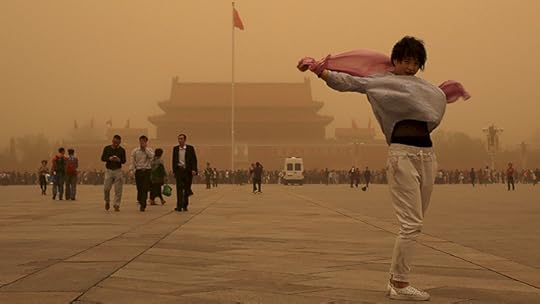
Dust storm in Beijing

Far more than the life and times of a young woman trying to make it in the big city, I was left with an intriguingly bleak impression of life in modern-day Beijing. The heroine's transition from the incredibly repetitive life in a small village to a similarly repetitive hustle and bustle in the big city, held my attention from the beginning to the very last word of the book. Often times it felt like life in Beijing and life in general were two separate concepts, that would rarely intersect:
- one stubbornly stagnating, predictable and generally bleak,
- while the other was rather more vibrant and colorful, but somehow not very... realistic.

Initially, the stories left me, I hesitate to say unimpressed, but definitely confused. Two short stories and 40 pages in, the book didn't seem to be about anything in particular, or maybe there was so much it tried to tell me, that my brain just short-circuited itself. Still, with a little over 100 pages in total, I figured I could finish it quickly enough, and go on to spend a month pondering a polite way to phrase "Beijing was bleak and I just didn't GET it".

Dust storm in Beijing

Little by little, I got more and more interested in Fenfang's progressively weird life:
- living in a one-room apartment with several people
- dealing with a violent ex-boyfriend
- getting arrested because her neighbors disliked her
... made my sentiments constantly oscillate between pity and admiration.

On the one hand, she was always alone, constantly putting up with a barrage of increasingly worse problems. On the other hand, in spite of the objective bleakness of her situation, Fenfang would always move stoically ahead, never cursing, crying, or otherwise despairing.

Score: 4/5 stars

As a "slice of life" from modern day China, this was a fascinating book. On occasion, it even made me wonder whether this is what my life would have looked today, had my country continued under a communist regime.

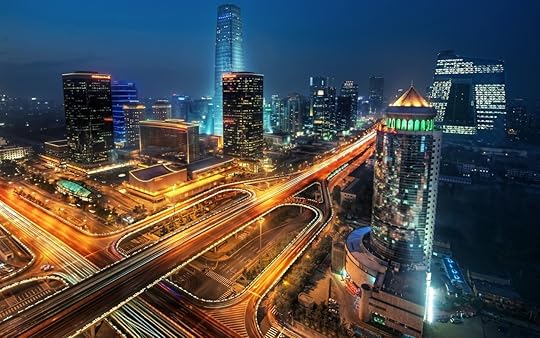
Beijing skyscrapers and lights

While I wouldn't consciously pick such a bleak book for enjoyment, there was just some je ne sais quoi to it. Objectively speaking nothing in it made me say "I enjoyed that", but if this is how all Xiaolu Guo's books feel, then I'll definitely read them.
All in all: an excellent end to my 2019 reading year.
Profile Image for Ian.
982 reviews60 followers
March 18, 2022
I seem to be zipping through works of fiction at the moment. I can’t actually remember why I decided to download this, other than my general interest in what is sometimes termed “world literature”.

Reading about the author, it seems that a version of this novel was published in China in 2000, but that she subsequently moved to live in London. I hadn’t known that before reading the book. In the acknowledgments, she explains she started working with two translators to produce an English language version, but ran into problems because in the original her lead character, a teenage girl, “speaks in slangy, raw Chinese”, that was difficult to render into English. Also the writer was no longer happy with every aspect of the original. In the end the English language version was more of a rewrite than a translation.

The book comprises 20 short chapters, although the description “fragments” in the title better conveys the feel of the book. The lead character, Fenfang, is 17 when the novel opens and has just moved to Beijing from her rural village.

“The routine of a small, desolate village can rule its inhabitants' lives more effectively than an imperial dynasty.”


Fenfang isn’t that different from young people in any other part of the world. She is looking for love, excitement, travel, and “the shiny things”. The “fragments” relate random incidents and episodes of her life, which taken together tell the story of her time in Beijing. It’s quite chaotic, involving numerous changes of job, numerous changes of address, a couple of romantic relationships that don’t work out, and a lot of struggling to get by. She gets involved with the film industry, firstly as an extra and eventually trying her hand as a scriptwriter.

Fenfang’s attitudes and behaviours don’t conform to the expectations of Chinese society. Her view of older people conflicts with the national stereotype, and she says that “For me, it was old people who were responsible for all the shit things that had happened in China.” In the book there are groups of older people who form a sort of neighbourhood watch, who sit around all day gossiping and sending reports to the Police about any young people they consider guilty of “immorality”. Fenfang regards them with that special contempt that the young reserve for the old.

This book is written in a direct style, very easy to read. There’s also some reasonably good humour, told from the perspective of someone who’s fed-up. I enjoyed it, to the extent that I intend to read more by this author.
Profile Image for Sue.
1,438 reviews650 followers
October 7, 2013
This is a contemporary novel that begins at the turn of the new millennium as Fenfang (who may be the author's alter ego of sorts) decides she can no longer tolerate the quiet, the boredom, the fields, even her parents and has to leave the countryside for Beijing and her dreams of becoming a scriptwriter or actress. Along with her we see the reality of Beijing under Communism, the crowds, the dirt, the pollution, the poverty, and the very limited expectations for all women.

She tries different strategies and repeatedly loses. She has an American boyfriend and a Chinese boyfriend stalker. She is reported to the police for her improper ways and is lectured as to the correct ways for a young woman to live. None of these things seem to have a lasting impact. Her emotions are curious; at times she is full of sorrow, at times she is amazingly passive---perhaps beaten down by the world around her. Happiness is rare.

Xiaolu Guo allows Fenfang to provide a verbal picture of Beijing near the end of the book.


"This was Beijing. A city that never showed its gentle
side. You'd die if you didn't fight with it, and there
was no end to the fight. Beijing was a city for Sisyphus
---you could push and push and push, but ultimately that
stone was bound to roll back on you." (p 157)


Not a welcoming place to a person of any age, much less a young person with dreams.

Rating 3.5*

Recommended for it's view of a different China, a modern state we don't always see. Also a young person's view as Fenfang was only 17 as the stories begin.
Profile Image for MJ Nicholls.
2,274 reviews4,846 followers
April 2, 2011
A simple, lyrical, disheartening coming-of-age story from an eminent Chinese polymath. The tone is largely bleak and hopeless, and captures the feeling young artists have of being stuck at the bottom looking at the top: nothing but a pocketful of dreams against a world of indifference. It certainly struck a chord.
Profile Image for Helly.
222 reviews3,790 followers
February 6, 2020
"Fenfang, yours is the face of a post-modern woman."

Set in modern China against the backdrop of urban fragmentation, isolation of modern life and struggles of being a woman struggling for a higher ground, 20 Fragments of a Ravenous Youth took me by surprise. Even the most disturbing and shocking incidents are conveyed with an insouciant tone that sets the novel apart. Don't read it to escape reality, but rather to feel it closer to you skin than ever before.

While nihilism is the prevalent mood of the rotten urban city, the spark and desire for something more drives the protagonist, just like it drives us in these times of turmoil and existentential dread. Highly suggested!
Profile Image for Brian.
Author 1 book1,242 followers
January 30, 2015
Tomorrow, when more clear of head and calmer of excitements I shall attempt some thoughts worthy of this book. Wow.

Thank you Samadrita for your inspiring review and recommendation of this book.
Profile Image for Luke.
1,626 reviews1,194 followers
March 12, 2017
4.5/5
Sadness was better than emptiness.
I used to follow a polling blog up until the point that the hideous disconnect between it and my reality made its reoccurring engagement with "Millennials" impossible to deal with. Why don't Millennials move as much as their predecessors? Why do so many Millennials fail to move out? Why is the life expectancy of Millennials breaking the "progress" of increasing? Why; why; why? Money, you shitsucking numbfucks, along with the aside of ever increasing fascism now that the National Endowment for the Arts is facing extinction. If you've never near starved to death in your apartment due to a spike in your permanent despair over your life and its lack of steady-job-at-21-marriage-at-23-house-at-25 choices, congrats. If you have and still persist in believing that this book is indeed, as the GR description says, 'comic', you've ripped out your heart to appease another's head.
Only foreigners know about China's history, I thought.
The great thing about the concepts of bildungsroman and künstlerroman is that anything goes. So you're in China instead of Europe/Neo-Euro, a rural traveler instead of a fortune squanderer, a woman instead of a man, Asian instead of white. What follows will not be to the expectation of anyone who's been guaranteed any portion of the US dream of 'normalcy' and all the dreams of exotification of lust that are consequent. Instead, you get the said lust control instead of the lust, the pursued instead of the pursuer, the dead body in the ditch rather than the character development that is birthed from it, the written instead of the writer. Spoilers would be tellinghow exactly this is all bleakly and tortuously subverted and bullheaded through, so I won't. I also won't say that my eyes didn't glaze over at certain points when the references were unfamiliar and the Duras-philism was a bit much, but who's to say that wasn't satire of the Genuine Passion Schtick corporations cultivate to hook in hundreds of talented yet underpaid underdogs? With prose that's deadpan to the point of provoking older neurotypical types to call suicide watch, it's nearly impossible to tell. Regardless, it's more 'real' to me right now than the litany of pull-yourself-up-by-your-bootstrap indoctrination that will result in an extra 36k deaths a year, and that's from the repeal of Obamacare alone.
"Patton, you Americans take watching films much too seriously. It's like going to church for you. For us, going to the cinema is just the same as going to the market to buy cabbages."
I didn't expect this to strike the chord that it did. It's meandering, flat, one-step-forward-two-steps-back, and ultimately far too close to the life I'm currently running the fast as I can in in order to stay in the same place. However, this made the moments of true emotion that much of a gutpunch, and there's little I'm more susceptible these days. In any case, I recommend this to all my fellow grinders who have hit their mid-twenties with nary a sign of life stability in sight. It'll either give you hope or sink you deeper, so the risk is yours.
Heavenly Bastard in the Sky, I missed the sharp edges of my life.
Profile Image for Jill.
377 reviews363 followers
January 7, 2018
In 2017, China became home to the most billionaires in the world, minting on average two new members to the billionaire club every week. 17 years earlier, at the dawn of the new millennium, the number of Chinese billionaires hovered the single digits. Therefore Twenty Fragments of a Ravenous Youth, set in Beijing around the year 2000, functions as a dual bildungsroman: the coming-of-age of a girl living in a country that is coming of age too.

Fenfang leaves a village that grows sweet potatoes for a city that sprouts movie stars. Author Xiaolu Guo paints a vivid memento of a Beijing where entire neighborhoods are emptied of inhabitants overnight and occupied by towering cranes and blocks of scaffolding the next morning. Fenfang learns a hard truth in the endless flux: just because things are changing all around her doesn’t mean that she will be changed too.

The novel is Chinese literature for Westerners, offering a peephole into a strange country at an even stranger moment in world history. Guo wields metaphors with expertise to build fantastic character portraits: Fenfang, upon leaving her tiny village, avows to “never again live like a sweet potato under the dark soil.” She constructs the novel in vignettes, the twenty “fragments” of the title, but it remains a cohesive whole. Of particular interest to me was Guo’s exploration of how to come of age as a woman without a man as a catalyst. Due to the difficulty of doing so, Fenfang oscillates between confidence—
My youth began when I was twenty-one. At least, that’s when I decided it began. That was when I started to think that all those shiny things in life—some of them might possibly be for me.
—and doubt—
I had this great urge to cry, but I didn’t want to cry alone. For a really good cry, I needed a man’s shoulder.

By the end of the twenty fragments, Fenfang’s youth is definitively ended. China, too, has entered a new age. But in Guo’s careful hands, the ending is not only abrupt and melancholy but also a hopeful start.
Profile Image for Sookie.
1,325 reviews89 followers
January 13, 2020
The protagonist Fenfang arrives at Beijing in hopes of becoming a movie star just when Beijing itself is stepping into world arena, expanding its role in modernization. China grows in the same rapid fashion as Fenfang lives moves; displaying a modicum of modernization while parts of the city (and country) remains intact. Fenfang points out her ravenous nature which is pretty much a representation of rural China in itself. She is a refreshing protagonist who looks at numbers with hope where there is none, gets through her life when people around her frowns at her choices and shapes up to be the person she thinks is the best.

This is my third book by Guo and like the previous two, this one too has a young woman at its center, alienation from family and home, quips about Chinese-English dictionary, Hollywood reference, Chinese authoritative regime, absence of the word "romance" in Chinese, to name a few. The recurring themes make the context familiar and easy to get lost in the life Guo creates for her protagonist. Written mainly from Fenfang point of view, Guo gives glimpses of life in late 90s China when modernization jarred the traditional values so much so that a police officer casually remarks "...she had it coming. What did you expect from an independent girl?" [not verbatim]. Guo doesn't linger on these observations. Fenfang understands and as does the reader.

There is quietness in this book, like you are peeking into the life of a person who is working as an extra in a popular drama. There isn't ground breaking drama, there aren't heartbreaks that go on for days. There is peaceful acceptance of decisions and moving on to the next thing.

And that's exactly what she does.
Profile Image for AC.
2,214 reviews
March 25, 2017
A lovely book - I thoroughly enjoyed reading it -- including the acknowledgments.

Basically... how does a peasant girl from rural China become a modernist ... in 20 snapshots...

...and in the blink of an eye.
Profile Image for Margitte.
1,188 reviews667 followers
December 4, 2013
"My youth began when I was twenty-one. At least, that's when I decided it began. That was when I started to think that all those shiny things in life - some of them might possibly be for me.

If you think twenty one sounds a bit late for youth to start, just think about the average Chinese peasant, who leaps straight from childhood to middle age with nothing in between. If I was going to miss out on anything, it was middle age. Be young or die. That was my plan."


Seventeen-year old Fenfang Wang decides to leave her village where nobody talks and where life begins and ends like the sweet potatoes underground. If the man coughs twice today and spit once, he will do it again the next day and the next day and the next day. She wants to experience the booming city of Beijing, escape the peasant monotony of poverty and manual labor with no intellectual development ever happening. She travels 1 800 miles to accomplish this dream where she soon finds different jobs, ending up working in the film industry as an extra, lives in different places and eventually learns that loneliness becomes a destination in a cruel world out there when a young girl wishes to be independent and not be dominated by a boyfriend and his family.

It is a coming of age novella of a young Chinese girl who experience the first harshness of the adult world she does not really understand yet, but is determined to get to know. She becomes part of a fast changing China where Comrades still sleep on their jobs they're getting paid for, and still rampantly spy on neighbors, family and friends, while the private sector is rapidly changing China into a boom fest. Even Ginger Hill village, her home turf becomes The Ginger Hill Township with new developments changing the rural landscape forever in her absence.

My comments: It is certainly not the best Chinese author I have read so far, but still a delightful read. The innocence in her observations are interesting and appreciated. Nothing escapes her and her mind is driving her emotions and fears like the crazy taxi driver who rushes her through dark city streets for late night meetings with obnoxious movie moguls. The cities never sleep.

She is ambitious, intelligent, smart. Beijing, a dynamic city, is introduced to the reader where Communism is present, but not the overwhelming focus. The energy of the different cities she lives in becomes part of the reader's heartbeat - the noise, the pollution, the smells, the food, the people, the seasons, everything. Nothing is really heart-stoppingly exciting though and I was confused with the time lapse between some of the fragments. However, it is an eye-catching coming-of-age novella.

I just wonder how she got into contact with her English editors and translators. It is not a story. The title says it all. The fragments of her life, almost written in a diary style, follow each other chronologically and bind the experience together. It ends almost on a cliffhanger and had me confused. But it is still an eye-opening read. I enjoyed it.

It was more than that to me. Thanks to Sue, it was a very special treat indeed!
Profile Image for Quaintrelle333 (Petra).
91 reviews40 followers
September 28, 2025
I completely devoured every single page of this book. I undoubtedly adored it. I am not sure what it is about this book that managed to captivate and pull me from my reading slump, but something connected with me. Maybe it was our similar circumstances in life, or the chaotic and cynical contemplations that many people in their early twenties have when they just start being independent and have to live life on their own for the first time.

This book is not anything revolutionary or groundbreaking by any means; a young girl from a small place leaves her monotonous life in the village to find success in a big city, and the reader follows her through her struggles, relationships and isolation.

What really worked for me was the structure; as the title suggests, it is told in twenty fragments, and those short fragments work perfectly with the narrative style and the novel's unrefined and raw portrayal that it is going for. I think if it were written in a conventional, linear structure, I believe it would become tedious.

I liked that the author of the book worked on the translation and rewriting of the book; that way, it feels more satisfactory for me to read in translation.

Very easy, quick read with a bleak perspective, and it certainly struck a chord with me. As I said, I don't think this book would be everyone's cup of tea, but in the book's bleakness and darkness, I managed to find a light for myself.

‘Life is just like those stewed pigs’ trotters. Sometimes you just have to eat what you’re given.’
Profile Image for Nafiza.
Author 8 books1,280 followers
February 12, 2012
Twenty Fragments of a Ravenous Youth offers a glimpse into the life of a 20-something Chinese woman trying to survive in the city of Beijing. This is a rather bare statement and does not do justice to what the book truly contains. It's a peek into the psyche of someone who is just like you and me except she exists in a city, in a country that is alien to what people in North America are used. Fenfang's voice is wry and cynical and her signature phrase (also incidentally the one that attracted me to the novel initially:

Great Heavenly Bastard in the Sky


is very revealing of her irreverent attitude towards life and the living of it. You always feel a bit removed from Fenfang. The book is told almost entirely in narration and contains very little dialogue and most of it is introverted thoughts and observations. Not something that would normally be interesting but somehow, maybe because it's pithy and so very involved, I had no trouble empathizing and feeling for Fenfang. I really loved the ending not because it tied up everything so perfectly but because it ended on this irrepressible note of possibility.

This book is a study in contradictions. There is a lot of cynicism in it but it is hope that buoys it and makes it a success. It paints a very convincing picture of a girl trying to survive the life given to her. To not just be a passive passenger in this journey but, excuse my advent into cliches, to make something of herself. I think you will enjoy Xiolu Guo's interpretation of youth and the hunger that accompanies it.
Profile Image for Gemma.
57 reviews5 followers
September 20, 2018
I really enjoyed this one.
Fenfang is a great character. I related to her a great deal. I felt for her and occasionally shook my head at some of her decisions- though we've all made bad ones. And even though the book is told in "fragments" I definitely feel like I had a clear picture of her youth and life. Will definitely be reading more of this author in the future!
Profile Image for Sonia Almeida Dias (Peixinho de Prata).
682 reviews30 followers
March 11, 2016
Loved this book. Smart, well written, comes to show what we all know already, we are all so different but we are all the same. I like reading books from cultures so different than mine, and this was an interesting portrait about coming of age on collective China, and trying to be an individual on a society where that is not allowed. Growing up in a time and in a place where everything is changing fast, and where you cannot keep up with the pace of the world around you, can be difficult and interesting at the same time.

Recommended to all those who like Asian literature, and learning new ways.
Profile Image for Trin.
2,303 reviews676 followers
May 13, 2016
It really is as fragmentary as the title suggests, but while this book doesn’t create a complete portrait, it does provide many fascinating glimpses into modern China. The perspective of Fenfang—a young, somewhat naive country girl who moves to Beijing to seek her fortune—is vivid and fresh. This was like a wonderful appetizer; I can’t wait to read some of Guo’s—likely more mature and complete—later work.
Profile Image for Jesse.
510 reviews640 followers
January 13, 2009
What at first seems a bit like hollow shards of reflection gain resonance as the pieces fall into place and some semblance of the self begin to be form. Each chapter--or fragment--conveyed in shimmery, deceptively simple prose, serves as a brief reflection of what initially seems to be a trivial situation or occurrence, only revealing its emotional weight later. It's as if the traces and residue of the "off moments" are the things that give shape to life itself, bringing to mind Joyce Carol Oates's musing "how quietly, how placidly, how invisibly the truly significant events of our lives take place...". A bit slight but rather beautiful.

"People always say it is harder to heal a wounded heart than a wounded body. Bullshit. It's exactly the opposite--a wounded body takes much longer to heal. A wounded heart is nothing but ashes of memories. But the body is everything. The body is blood and veins and cells and nerves. A wounded body is when, after leaving a man you've lived with for three years, you curl up on your side of the bed as if there's still somebody beside you. That is a wounded body: a body that feels connected to someone who is no longer there."
Profile Image for Cheri.
475 reviews19 followers
March 22, 2016
It was fascinating to experience Beijing from the point of view of a young peasant who runs away to the city to make her own way. The obstacles are many, especially for a woman, but not so different from what anyone anywhere might experience when trying to make it completely on her own. The book keeps its promise to give us only fragments, and I enjoyed the jumping around in time, but there was a little too much disconnect with Fenfang herself. I didn't quite understand her motivation (or ability) to write, how she ended up with primarily foreign friends, or why she spent three years with Xiaolin. I often couldn't tell whether she had gumption or was just out of options. Still, I was drawn into her story and enjoyed the author's wry humor.
Profile Image for Zak.
409 reviews32 followers
July 20, 2019
Raw and unapologetic. A slim novella on grit and determination in the face of seemingly miserable odds, it offers an unadorned glimpse of life in China in the midst of its modernisation, though the pace of change is so fast, it may already be outdated. I found the writing slightly unappealing at first, especially with the repeated use of the unwieldy "Heavenly Bastard in the Sky" admonishment, (wouldn't it be easier to just say "F**k!" or the ubiquitous "Cao!"), but the character slowly grew on me, such that I ended up actually wishing she would achieve at least a modicum of success. [Final rating: 3.5*]
Profile Image for Vio.
252 reviews126 followers
September 7, 2019
I don't know about you, but I like very much the way Xiaolu Guo writes. She kind of speaks *to* me. So yeah, I am super happy for having read two books by her by now and I am looking forward to reading some more.
Bring it on, Xiaolu Guo!

#power

PS Got the DVD from UFO in her eyes, gonna watch it these days, pararam pam pam. What, English doesn't know pararam pam pam? Oh.

LE Changed the rating from 4 to 5*, just because!!!
Profile Image for Alan.
Author 15 books191 followers
May 29, 2019
Nice evocation of rebellious youth in modern (2005ish) China, featuring a girl who runs away from her boring agrarian village (everything is centred on the sweet potato crop) to live in Bejing and get jobs as an extra in low budget independent films. Boyfriends smuggled up to rooms. Unfriendly landlords. Watching pirated Western DVDs (particularly Betty Blue). Very lively and enjoyable.
Profile Image for Laetitia.
165 reviews1 follower
December 28, 2015
Why isn't this novel more popular? Because it is Chinese? That cannot be why, can it?

Also, why does it only have a GoodReads rating of 3.4? It should be more than that because this is one of the best coming-of-age novels I have read in a while.

China intrigues me and sadly I don't know that much about it so I decided to read more Chinese literature. Reading Xiaolu Guo's Twenty Fragments of a Ravenous Youth was a great experience.

It is about a young Chinese woman called Fenfang, who decides to leave her life as a peasant behind and start a new life in Beijing. Fenfang is ambitious and hard-working, she wants to become an actress and begins her career as an extra. She soon realises that life in Beijing can be cruel and ruthless, especially as a woman. Communism, surveillance, poverty and sexism are part of her daily life.

She is taken to the police station because she's not behaving like a young, unmarried woman is supposed to behave. Moreover, she faces sexism in her workplace as the men in the film industry keep objectifying her and often measure her merit based on her looks and not her hard work.

Great novel, I would read it again.
Profile Image for Dana Al-Basha |  دانة الباشا.
2,360 reviews988 followers
August 24, 2017
The reason I bought this book is for the cover and because it was so short as well, I wanted to read something a bit different than what I usually go for, and reading this book was very interesting; while I was reading I was so shocked by a lot of things in the book like the traditions in the far east, the Chinese way of thinking, the poor circumstances of some people like the starving actress in this book. But there is one thing I didn't like at all, how she "the writer" wrote about God, with no respect whatsoever, it was very bad indeed, she kept calling him : "Heavenly Bastard in the sky"! I really hated that so much! Come on! Talk about anyone but not God! I'm not even Christian!


It always seems to me like the far east of Asia live in a different universe with different rules than the rest of the world, their culture bewilders me (and fascinates me)!

Profile Image for Hesper.
410 reviews57 followers
April 4, 2017
Slim and deceptively spare, impressionistic in approach. Had this been written by a white dude it would immediately get labels like "incisive," "bleak," and "bildungsroman," most likely combined into one obnoxious blurb written by, very probably, another white dude. As it is, it gets a pretty but not particularly relevant cover, and undeserved obscurity.

It's the story of Fenfang, a village girl trying to make it as an artist in Beijing, and Xiaolu Guo is an excellent writer. Her language is direct, unadorned, making for a seamless blend of social critique and pure narrative. Guo doesn't pull punches; she's simultaneously invested and clinical, a trait that echoes in Fenfang's raw yet detached voice.

As a sidenote, this book felt hugely autobiographical. Maybe I read that somewhere, and forgot I did? It's not a bad thing; if anything, it strengthens the impression that this is a work of particular relevance to its author.
Profile Image for qamar⋆。°✩.
218 reviews39 followers
August 28, 2025
4☆ — twenty fragments is narrated through the unembellished eyes of fenfang wang, a peasant girl who breaks out of a household where no one really talks to each other and devote themselves to the farming of sweet potatoes instead. and so begins twenty of the fragments that make up her life, essentially vignettes of her life as she she decides to make her fortune in the film industry in beijing where she takes up numerous extra roles, meeting scriptwriters and directors along the way. her unapologetic tone is what makes this story stand out; her naïvete isn't a wide-eyed, overly enthusiastic quest for middle- to upper-class adolescent independence, but rather a pessimistic working-class girl who occassionally dares to hope while trying to survive and make it big somehow. her passivity slices through the narrative, a passivity so intense and claimed that when it breaks down to reveal the emptiness and loneliness within, you are left feeling with an understanding of fenfang's sadness and dissatisfaction with the world. events that would usually make a person panic and burst out onto anxiety is breezed through by our protagonist, who is more interested in kindling her own individualism than giving into the collective wave of the society at the time. i adored xiaolu guo's clear writing style and characterisations and look forward to reading more of her work!
Profile Image for martinae.
207 reviews39 followers
April 28, 2023
this is my beautiful world where are you
Displaying 1 - 30 of 512 reviews

Can't find what you're looking for?

Get help and learn more about the design.