What do you think?
Rate this book


189 pages, Kindle Edition
Published October 30, 2025
"... una viajante cuyo acento era bonito, hasta el momento de enseñar el pasaporte y verificarse como parte de la plaga."
crisis de los servicios, donde destacan las fallas en el suministro eléctrico "... salvada de esa cosa horripilante que es una ciudad completamente a oscuras donde la miseria no se ve y por eso asusta más."
la pérdida del poder adquisitivo, incluso en segmentos profesionalmente preparados y que garantizarían el desarrollo futuro del país "... y ni siquiera los profesores [universitarios] tenían cómo darse el lujo de comprar semejantes superfluidades, porque los escombros no respetaban ya escalafones ni glamures ni niveles académicos y, aunque algunos ganaran casi tres veces el salario mínimo, eso no significaba nada más que un grado levemente menor de pobreza en el que un profesor universitario del más alto escalón necesitaba más de setenta salarios mínimos para comprar lo básico de lo básico."
un sistema de salud deficiente en inicio, pero absolutamente desarticulado: "... es más fácil lidiar con la diabetes que con el desgano."
la represión del gobierno, que afectó particularmente a los jóvenes: "Se cambia la camiseta manchada de violencia y baja corriendo a ser adolescente ..."
la depresión y resignación ante un panorama cada vez más deteriorado: "... no había cómo esperar la mirada de un hombre que había perdido no un ojo, sino las ganas de ver."
"... no hay nada como chistes de argentinos para fortalecer la unidad latinoamericana."
"... su look de joven pasante en empresa de administración"
"Dictadura parece ser algo que los revolucionarios combaten, no algo que ellos mismos construyen.", aunque todas las revoluciones latinoamericanas del siglo XX han terminado en dictaduras.
Y, como reflexión final, el epígrafe: "Un hombre libre, cuando fracasa, no culpa a nadie. JOSEPH BRODSKY"
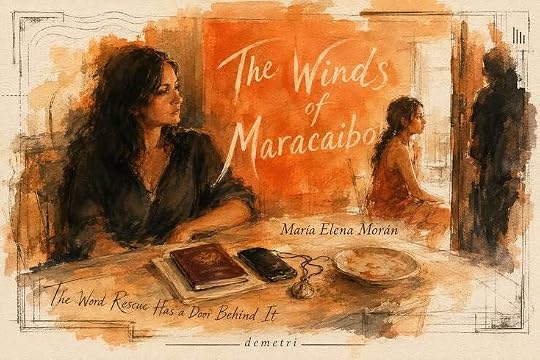
Thanks to Knopf (Christopher Metts) and NetGalley for the ARC of this novel.
The Winds of Maracaibo is an excellent novel that helps to illustrate the suffering of individuals in the collapse of the Venezuelan government after the death of Hugo Chávez. Although it might sound like lacking knowledge about recent Venezuelan history would make enjoying the novel impossible, María Elena Morán does an excellent job giving us enough contextual information about the rise of Chávez and his populist government to understand how her characters have ended up where they are when the novel opens. Morán manages to keep the tone factual, not using hindsight to explain away the failure of the era, giving a balanced view that captures the initial excitement of the Chávez reforms and the subsequent nightmare of the failure. This is where the novel's strengths are best illustrated as Morán uses a small family to encapsulate the highs and lows of the time, giving features and names to personify the suffering, struggles, choices, and resiliency of anonymous people forced to survive through extreme hardship and poverty.
Morán's writing is powerful and lean (translated by Madeline Jones), driving the story forward even when it looks to the past. Her characters are real, their motivations and behaviors sometimes selfless and sometimes selfish. At times the characters are noble, at others frustratingly useless. They are real, flawed, and imperfect. I appreciated that given the situations the characters find themselves in they weren't turned into symbols, reflecting the best or the worst in human behavior. They act like humans, sometimes making a poor decision that worsens their situation. In an interesting choice, Morán uses the second-person voice for one of her characters, notably the antagonist of the novel. Yet by using the second-person voice, the distance between the reader and the character is diminished and blurred. So while in another novel we as readers would find everything about this character reprehensible, the second-person voice forces the reader to temper the reprehension with a little understanding of the behavior of this character. The knowledge of the character's own suffering makes the reader understand more fully the flaws that lead the character to make the decision's they do. It's just one of the features of the novel that make it richer. On top of it all, there is also some South American magical realism that helps to situate the novel in a certain tradition of storytelling.
The Winds of Maracaibo is definitely a novel concerned with a specific time and place, but the struggle to survive, the struggle to keep a family together despite everything, is its true focus, and that focus is universal. It is this focus that makes the novel appealing to all readers of contemporary fiction.