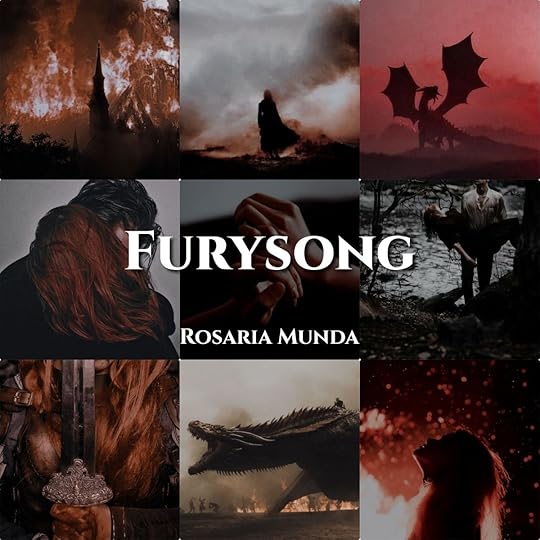
For me, Furysong was my most anticipated read of the year. After the incredible plot and character development of the past two books, I was hoping that Furysong would provide the epic finale for Lee, Annie, and the rest of the Guardians. However, I have to say, I was a bit disappointed by the book as a whole. Please be warned, SPOILERS AHEAD.
*************************************************************************
Going into it, we had major cliffhangers to dive into, with Duck being alive, Lee being trapped by Ixion and the Bassileans. However, a majority of the first portion of the book blends in to me, mainly due to the presence of the additional POVs of Delo and Griff. Now, Griff is likeable enough, and I actually enjoyed his relationship with Annie in Flamefall. However, I felt like his character fell short after the first section of the book where he leads the Woad-riders in revolution against the aristocracy. Griff experienced major loss, but I feel like we, as readers, didn't fully get to experience and immerse ourselves in his emotions, mainly because after Annie leaves and the Woad-riders are left to rebuild New Pythos, we mainly view Griff through Delo's point of view as he shows up drunk on Delo's doorstep multiple times throughout one week. It's later revealed that Griff has no recollection of that week, and as readers, we are mainly deprived of Griff's grief. Of course, we do get snippets of where he reminisces about his sister, grandfather, and nieces, but we don't get any heart-wrenching moments of agony beyond the actual death scene of his family. Griff's own sentiments towards being ruler also felt muddled to me. I didn't fully understand him as a ruler, mainly because we didn't get a lot of his own perspective.
Moving onto Delo. I disliked having his perspective included in this book. I can understand why Munda chose to do so; Delo and Griff's story served as an odd parallel to Lee and Annie's, but I found that Delo as a whole was a flat and underdeveloped character. Other than getting beat up by a group of homophobic peasants, Delo has no real moments of conflict and resolution. In my opinion, he never gets full closure with Griff, even though their relationship was muddled with complexity, with Delo's sister being responsible for the death of Griff's family, and Griff widowing most of the members of Delo's family and holding them hostage. Delo only seems to demonstrate surface-level frustration with Griff's grief coping mechanisms, and one of the only significant interactions they have in the novel is when Griff rescues Delo from the humiliation imposed upon him and his family at the feast for the Callipolan riders. Overall, although I like the idea of Griff and Delo, I don't think they were done justice in the novel.
Moving onto one of my favorite characters, Power. I think everything about Power was done wonderfully in this novel, except for his death. I loved how he was playing "traitor," only because he knew that he had to be the man on the inside to protect Annie and the rest of the Guardians. His nobility was demonstrated throughout this novel, especially in the prison cell, when he admitted that he chose between Rock and Crissa to save Crissa because he was afraid of the atrocities she might face at the hands of the dragonborn. I also love how well he works with Annie, and how he, rather than Lee, was the one to pull her out of her slump and motivate her to return to her city and save Callipolis. Annie and Power are both extremely pragmatic characters, and I loved seeing the parallel with how Power worked with the dragonborn regime to protect the rest of the Guardians in this book, to how Annie stayed with Atreus's regime to protect Lee and the Passi. I think that Power deserved a better death than he got, however. I can understand that Munda may have wanted his death to be jarring and sudden, but honestly, you could see his death coming from pages away. I'm glad he got those moments of closure and closeness with Annie, (him calling Annie "Commander" was my absolute favorite) but I think we were deprived of seeing Annie grieve one of her closest friends and partners because his death was so sudden before the Firstrider battle. (Power's death was one of the two times I cried during this book). I wish we could've seen Annie honor Power in some tangible way after the final battle, and also maybe her interacting with Power's mother, especially because we've met Power's mother before, and it's been mentioned by Annie how close Power was to his mother.
Okay. Onto the main event. Lee and Annie. There's so much to get into. Firstly, I was overall disappointed with their dynamic. I think the reason they make such compelling protagonists is because of their tension, both romantically and ideologically. In book 3, we finally see Lee and Annie come to a peaceful resolution and pursue a relationship, but their serenity takes an element of tension and excitement away from their character development. Especially in book 2, we consistently see Annie and Lee being put on opposite sides of a battle because of their approaches, with Annie being the pragmatic, and Lee being the radical. With where we left at the ending of the second book, with Annie stepping fully into the role of Firstrider, leaving Lee to fulfill his own political goals, I expected to see more of that dynamic going into this book, to see them balance each other out as they focused on their revolution. However. I feel like we catapulted backwards and into an entirely different character development plotline. Annie throws herself into freeing New Pythos at the beginning of the novel, but when that results in the Bassilean invasion, she loses all her confidence in herself as Firstrider. I disliked how we slid so far backwards from Annie's status as a poised Commander, as we saw her take the lead at the end of Flamefall. I can understand the setback, but I feel like the climb back to the Annie we know and love was staggering and too drawn-out. It was satisfying when she decided to fight Ixion after being found not-guilty by the court, but it was frustrating to me that Annie never forgave herself until the jury declared her innocent. I can understand her grief and frustration and disappointment, but her resignation to giving up her title of Firstrider and blaming herself felt overly self-deprecating and was a disservice to her determined, passionate, and practical character traits.
Also, I feel like we never got a fulfilling resolution of Annie and Lee's dynamic, with Lee never fully addressing the frustration he felt when he thought Annie was being too passive (when in reality, she was trying to work within the system to maintain her power so she could continue to effect change in Callipolis). Similarly, Annie never fully addressed her feelings of abandonment and betrayal that she felt in book 2 when Lee abandoned the Guardians to pursue his radicalism with the Passi, leaving Annie to shoulder the burdens of a failing regime (I'm fully Team Annie, and I feel like my bias shows). Lee does admit to Annie at the manor house in the Highlands that as Alternus, it was his duty to defend Callipolis while Annie was on the offensive, but I felt that it was too little, too late. Again, I feel like the complexities in Lee and Annie's relationship were mainly glossed over, whether it be because the author didn't know how to address these issues, or whether the character growth was skipped in favor of advancing the many plotlines within this book.
Another small detail that irked me within this book was the bits of folklore that were scattered throughout, but never fully developed. From the poem about the Skysung Queen to the Spring Beyond the Stars, it would've been interesting to see these myths more fleshed out, especially if it pertained to the dragons and riders separating permanently, as hinted by Lee at the end of the novel. Without a definitive conclusion (also the fact that its mentioned that Griff's father is alive(?!) and is the one who discovered the Star Spring), these threads just feel loose and messy, unless Munda is planning on writing a fourth book. Another thing that stood out to me was that the connection between Aela and Annie is mentioned to be stronger than other dragonriders, as Annie can summon Aela even without her wristlet. I wish that had been explained more in terms of proving that those who weren't born of dragonblood still were able to foster deep connections with dragons, because I feel like this was an idea that wasn't fully fleshed out. Also, the fact that Lee could bond with Aela and share her emotions after Pallor's death, as well as ride her, was infuriatingly glossed over, and it just felt like lazy writing.
As for Lee and Annie's endings, I'm conflicted. Pallor's death and Lee's widowing was heart-wrenching (it was the only other time I cried in this book), but honestly, with the details of the charter being determined, I saw a door opening for Lee that I expected him to take. Lee was the radical in book 2, the political one, who was engrossing himself in leadership society, who was writing reform articles with the Passi. Without his dragon, Lee was in a position to take up more of a leadership role without the bindings of a dragon and the unfair power balance that Pallor granted him. However, him stepping back to lead a new generation of dragon-riders seemed odd to me, as his ending didn't seem to suit him. Initially, I thought it suited Annie more than him, but on a second thought, the ending simply doesn't fit. Lee had dreams of reform, but also came to the revelation that he was meant to light the way for Annie, which is the reasoning that backs his and Pallor's sacrifice. I could see Lee stepping back to write a newspaper, to work with Lo Teiran on a publication, but seeing him step out of the city completely was a bit too jarring. Also, the fact that Lee never had an explicit discussion with Annie about his reasoning and how he believed that Annie was the right person to take on that responsibility bothered me, because again, I just feel like it was something important that was glossed over. Another thing that bothered me was that Power was the one to reinforce to Annie that it was her duty to rescue Callipolis, but Lee never had a similar discussion with her. I did like Annie's ending, I think it suits her to work with the leadership to ensure a safer, fairer future, but I think that idea should've been more developed, especially after she went through a whole process of wanting to leave the whole world of dragonriding and politics behind previously in the novel.
Overall, I still enjoyed the book, but didn't feel a strong emotional connection to it as I did with Fireborne and Flamefall. I'm a little disappointed, but it still was a decent read.