

What do you think?

Digital Apollo: Human and Machine in Spaceflight
As Apollo 11's Lunar Module descended toward the moon under automatic control, a program alarm in the guidance computer's software nearly caused a mission abort. Neil Armstrong responded by switching off the automatic mode and taking direct control. He stopped monitoring the computer and began flying the spacecraft, relying on skill to land it and earning praise for a triumph of human over machine. In Digital Apollo, engineer-historian David Mindell takes this famous moment as a starting point for an exploration of the relationship between humans and computers in the Apollo program. In each of the six Apollo landings, the astronaut in command seized control from the computer and landed with his hand on the stick. Mindell recounts the story of astronauts' desire to control their spacecraft in parallel with the history of the Apollo Guidance Computer. From the early days of aviation through the birth of spaceflight, test pilots and astronauts sought to be more than "spam in a can" despite the automatic controls, digital computers, and software developed by engineers.
Digital Apollo examines the design and execution of each of the six Apollo moon landings, drawing on transcripts and data telemetry from the flights, astronaut interviews, and NASA's extensive archives. Mindell's exploration of how human pilots and automated systems worked together to achieve the ultimate in flight -- a lunar landing -- traces and reframes the debate over the future of humans and automation in space. The results have implications for any venture in which human roles seem threatened by automated systems, whether it is the work at our desktops or the future of exploration.
Digital Apollo examines the design and execution of each of the six Apollo moon landings, drawing on transcripts and data telemetry from the flights, astronaut interviews, and NASA's extensive archives. Mindell's exploration of how human pilots and automated systems worked together to achieve the ultimate in flight -- a lunar landing -- traces and reframes the debate over the future of humans and automation in space. The results have implications for any venture in which human roles seem threatened by automated systems, whether it is the work at our desktops or the future of exploration.
359 pages, Hardcover
First published May 1, 2008
About the author
David A. Mindell
13 books28 followersElectrical engineer, historian, and entrepreneur. Co-Founder and partner at Unless, an investment firm focused on supporting companies at the forefront of industrial transformation.
A Professor of Aerospace Engineering at MIT, David is an expert on robotic navigation and human interactions with autonomous systems in air, sea, and space. As Dibner Professor of the History of Engineering and Manufacturing, David is a leading authority on generations of inventors, engineers, entrepreneurs, and workers within the great arcs of technological change. He has led or participated in more than 25 oceanographic expeditions, written seven books, and is an inventor on 34 patents in RF navigation, autonomous systems, and AI-assisted piloting. He also spent five years as a Department Head at MIT. David co- Chaired MIT’s Task Force on the Work of the Future. Founder and Executive Chairman at Humatics with a mission to revolutionize how people and machines locate, navigate and collaborate. David has undergraduate degrees from Yale and a Ph.D. from MIT.
A Professor of Aerospace Engineering at MIT, David is an expert on robotic navigation and human interactions with autonomous systems in air, sea, and space. As Dibner Professor of the History of Engineering and Manufacturing, David is a leading authority on generations of inventors, engineers, entrepreneurs, and workers within the great arcs of technological change. He has led or participated in more than 25 oceanographic expeditions, written seven books, and is an inventor on 34 patents in RF navigation, autonomous systems, and AI-assisted piloting. He also spent five years as a Department Head at MIT. David co- Chaired MIT’s Task Force on the Work of the Future. Founder and Executive Chairman at Humatics with a mission to revolutionize how people and machines locate, navigate and collaborate. David has undergraduate degrees from Yale and a Ph.D. from MIT.
Ratings & Reviews
Friends & Following
Create a free account to discover what your friends think of this book!
Community Reviews
Displaying 1 - 30 of 64 reviews

July 10, 2012
I think it's important to note that this book is really about its subtitle, not it's title. That is, it's more about Human and Machine in Spaceflight than it is about Digital Apollo. In fact, it may surprise you to know that nearly the first third of the book goes by little more than brief mentions of computers and the Apollo program.
In fact, if I had to pick a title for this book, it might be something like, "The Role of Human and Machine in Spaceflight as it Evolved Towards and in the Apollo Space Program." Okay, that's a terrible academic-sounding title. But I'd say it captures the overriding theme of the book nicely.
To be sure, you'll not be disappointed if you're reading Digital Apollo looking for details about its computer systems. In fact, there's a wealth of wonderful information. For example, did you know that the software ROM was actually woven bit-for-bit into what was known as "rope memory" by ladies in a factory?
But while that's true, I want to be clear that you'll be even less disappointed if you're looking for details about the long but little-known struggle between the "cowboy" test pilots and the "cold scientist" engineers of aviation and space flight. It's a battle that has apparently been waged since nearly the beginning of flight, perhaps peaked around the time of the Apollo program, and continues in some lesser form even today.
While not entirely what I was expecting, this book provided a look at a "controversy" I simply did not know existed. I had no idea that the astronauts regularly circumvented the automated systems of Apollo to use their judgement - and that sometimes they were wrong. Heck, I just assumed that the computers did their part and the astronauts theirs as part of a ridged schedule worked out far in advance on the ground. But that's not the case at all. In fact, it was a great surprise to me to find out that the entire flight: the Saturn V's launch, the Command Module's orbit of the Moon, the Lunar Module's landing, etc., were all under computer control (were more than likely not even possible without computer control) and could likely have been completed without human aid at all! I simply had no idea.
You'll never again hear me use the old phrase - and I'm sure you've heard it before - about a pocket calculator or modern car or whatever having "more computer 'power' than the Apollo 11." That may be true in terms of FLOPS or memory capacity. But the Apollo Guidance Computers (AGCs) were not only capable of getting the craft safely and reliably to the surface of the moon while taking into account variables such as the lost mass of spent fuel from its tanks, it was capable of doing so while being interrupted by and adapting and adjusting to human intervention at nearly every step of the process. Which in my opinion is far more amazing than just performing the tasks on its own. Never mind computing 'power', can you imagine the amount of software development and testing this would have required?
The interruptibility, the reliability, and the flexibility (all of which were put to the test in actual missions) of the computers is just staggering. And while there were mechanical and electrical failures aboard the spacecraft, the computers never once failed (they were, however, incorrectly blamed by the popular media for several problems.)
In general, the mind reels at the amount of work that went into making the amazing machine that was the Apollo spacecraft "flyable" by humans. To quote the book, "The lunar mission simulator...ran off three mainframe computers, and included five tons of glass--lenses, mirrors, and projectors to accurately recreate the scenes of a landing." They even created a Lunar Landing Research Vehicle (LLRV) with a turbofan engine to lift it into the air and then power down to approximate the Moon's gravitational pull while hydrogen peroxide rockets mimicked the Lunar Module's thrust to simulate a Moon landing on Earth. Likewise, the AGC was engineered to be as pilot-friendly as was technologically possible at the time. Incredible stuff.
I see the astronauts as no less great and brave adventurers than I did before reading Digital Apollo, but I am also adding another member, the computer itself (and all of its creators), to the roster of heroes in the Apollo missions.
The book itself? Well, yeah, I do wish it had been more about the computer.
In fact, if I had to pick a title for this book, it might be something like, "The Role of Human and Machine in Spaceflight as it Evolved Towards and in the Apollo Space Program." Okay, that's a terrible academic-sounding title. But I'd say it captures the overriding theme of the book nicely.
To be sure, you'll not be disappointed if you're reading Digital Apollo looking for details about its computer systems. In fact, there's a wealth of wonderful information. For example, did you know that the software ROM was actually woven bit-for-bit into what was known as "rope memory" by ladies in a factory?
But while that's true, I want to be clear that you'll be even less disappointed if you're looking for details about the long but little-known struggle between the "cowboy" test pilots and the "cold scientist" engineers of aviation and space flight. It's a battle that has apparently been waged since nearly the beginning of flight, perhaps peaked around the time of the Apollo program, and continues in some lesser form even today.
While not entirely what I was expecting, this book provided a look at a "controversy" I simply did not know existed. I had no idea that the astronauts regularly circumvented the automated systems of Apollo to use their judgement - and that sometimes they were wrong. Heck, I just assumed that the computers did their part and the astronauts theirs as part of a ridged schedule worked out far in advance on the ground. But that's not the case at all. In fact, it was a great surprise to me to find out that the entire flight: the Saturn V's launch, the Command Module's orbit of the Moon, the Lunar Module's landing, etc., were all under computer control (were more than likely not even possible without computer control) and could likely have been completed without human aid at all! I simply had no idea.
You'll never again hear me use the old phrase - and I'm sure you've heard it before - about a pocket calculator or modern car or whatever having "more computer 'power' than the Apollo 11." That may be true in terms of FLOPS or memory capacity. But the Apollo Guidance Computers (AGCs) were not only capable of getting the craft safely and reliably to the surface of the moon while taking into account variables such as the lost mass of spent fuel from its tanks, it was capable of doing so while being interrupted by and adapting and adjusting to human intervention at nearly every step of the process. Which in my opinion is far more amazing than just performing the tasks on its own. Never mind computing 'power', can you imagine the amount of software development and testing this would have required?
The interruptibility, the reliability, and the flexibility (all of which were put to the test in actual missions) of the computers is just staggering. And while there were mechanical and electrical failures aboard the spacecraft, the computers never once failed (they were, however, incorrectly blamed by the popular media for several problems.)
In general, the mind reels at the amount of work that went into making the amazing machine that was the Apollo spacecraft "flyable" by humans. To quote the book, "The lunar mission simulator...ran off three mainframe computers, and included five tons of glass--lenses, mirrors, and projectors to accurately recreate the scenes of a landing." They even created a Lunar Landing Research Vehicle (LLRV) with a turbofan engine to lift it into the air and then power down to approximate the Moon's gravitational pull while hydrogen peroxide rockets mimicked the Lunar Module's thrust to simulate a Moon landing on Earth. Likewise, the AGC was engineered to be as pilot-friendly as was technologically possible at the time. Incredible stuff.
I see the astronauts as no less great and brave adventurers than I did before reading Digital Apollo, but I am also adding another member, the computer itself (and all of its creators), to the roster of heroes in the Apollo missions.
The book itself? Well, yeah, I do wish it had been more about the computer.

June 15, 2013
As Tom Wolfe tells in much detail in The Right Stuff, early American astronauts were test pilots who wanted to fly their spacecraft, not just passively sit inside and let ground control or onboard computers fly them. Note that the computers of the time were very primitive by the standard of today, and could be downright dangerous: in one of the flights of the North American X-15 suborbital spaceplane, an adaptive autopilot amplified pilot error and caused the plane to break apart, killing the pilot. Apollo missions flew through a combination of onboard computer control and semi-manual control: even when the flight commander took control of the spacecraft, he did not physically move the nozzles; the computer was still the intermediary.
The most interesting part of the book is about the design of the Apollo Guidance Computer, of which both the command module and the lunar excursion module had a copy. It was one of the first computers built out of integrated circuits, each with 3 NOR gates. The ROM storing its software was physically in the form of wires woven through ferrite cores by retired seamstresses: one kind of loop was a 0, another was a 1. An early design had removable modules that astronauts could replace in flight should they fail; by the middle of the Apollo program the computer became reliable enough for this to become unnecessary. The CPU ran at 1.024MHz; double-precision floating-point multiply took 1ms. Despite being half as powerful as the later Intel 8080, the computer ran a proper operating system with jobs, priorities and interrupts. Some jobs were written in assembly language, and some in a high-level language compiled to threaded code, like Forth. During the Apollo 11 landing, the computer became overloaded processing rendezvous radar data, which it should not have been doing because the lunar module was not doing a rendezvous; it showed alarms. The guidance officer at ground control told the astronauts to ignore the alarm; he was praised by President Nixon as "the young man [who], when the computers seemed to be confused and when he could have said "Stop," or when he could have said "Wait," said, "Go." " During the Apollo 14 mission, a ball of solder in the abort switch had shaken off loose and was floating in weightlessness and shorting a circuit; programmers wrote a patch to ignore the rogue signal, and had Mission Control dictate it to the astronauts.
The next American spacecraft after Apollo was the Space Shuttle. By the time it flew, computers had become much more powerful. During its design there were voices within NASA calling to allow it to fly fully automated missions, but they were overruled because no such missions were planned. Curiously, the only part where astronauts needed to do anything was deploying the landing gear, and after the Columbia disaster even that was automated, so if reentry protection were damaged, the astronauts could evacuate to the ISS and land the shuttle on autopilot. The Soviet Shuttle clone Buran made its only flight fully on autopilot.
The most interesting part of the book is about the design of the Apollo Guidance Computer, of which both the command module and the lunar excursion module had a copy. It was one of the first computers built out of integrated circuits, each with 3 NOR gates. The ROM storing its software was physically in the form of wires woven through ferrite cores by retired seamstresses: one kind of loop was a 0, another was a 1. An early design had removable modules that astronauts could replace in flight should they fail; by the middle of the Apollo program the computer became reliable enough for this to become unnecessary. The CPU ran at 1.024MHz; double-precision floating-point multiply took 1ms. Despite being half as powerful as the later Intel 8080, the computer ran a proper operating system with jobs, priorities and interrupts. Some jobs were written in assembly language, and some in a high-level language compiled to threaded code, like Forth. During the Apollo 11 landing, the computer became overloaded processing rendezvous radar data, which it should not have been doing because the lunar module was not doing a rendezvous; it showed alarms. The guidance officer at ground control told the astronauts to ignore the alarm; he was praised by President Nixon as "the young man [who], when the computers seemed to be confused and when he could have said "Stop," or when he could have said "Wait," said, "Go." " During the Apollo 14 mission, a ball of solder in the abort switch had shaken off loose and was floating in weightlessness and shorting a circuit; programmers wrote a patch to ignore the rogue signal, and had Mission Control dictate it to the astronauts.
The next American spacecraft after Apollo was the Space Shuttle. By the time it flew, computers had become much more powerful. During its design there were voices within NASA calling to allow it to fly fully automated missions, but they were overruled because no such missions were planned. Curiously, the only part where astronauts needed to do anything was deploying the landing gear, and after the Columbia disaster even that was automated, so if reentry protection were damaged, the astronauts could evacuate to the ISS and land the shuttle on autopilot. The Soviet Shuttle clone Buran made its only flight fully on autopilot.

November 29, 2022
Digital Apollo is the serious, sober, scholarly take on the golden age of the space program, the same basic ground as Tom Wolfe's classic account The Right Stuff, but with a unique and fascinating viewpoint on how Apollo drove innovation in human and computer interaction.
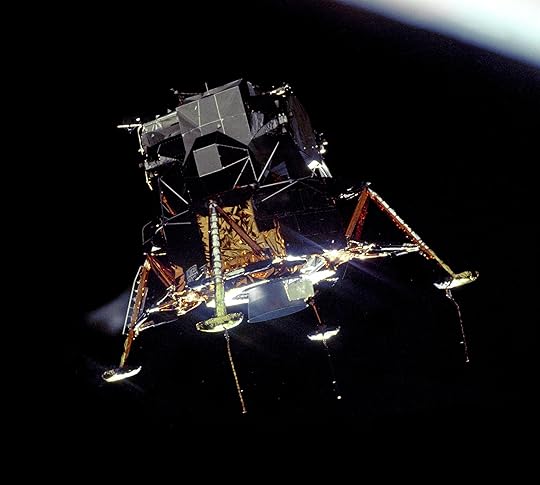
Lunar Excursion Module Eagle in orbit
Public Service Broadcasting - Go! a kicking rad song about the Apollo landing.
The basic conflict was one which stretched back to the dawn of flight, of airmen versus chauffeurs. Airmen preferred nimble, high performance machines, which represented a kind of macho challenge to be mastered. Chauffeurs were mere bus drivers, overseeing a complex machine. In the early 1960s, as the space program spun up, this was exemplified by conflict between astronaut/test pilot culture, which saw the human as both the pinnacle of precise control in the face of danger and an accurate engineering participant, and the rocket boys, who believed that rockets were too fast and complex for any human being to control, and that ICBMs provided a model for automated navigation.
The Apollo program that resulted was a synthesis, mediated by the key technologies of the Apollo Guidance Computer, the DSKY numeric input/display unit, and the MIT Instrument Laboratory as the primary contractor. Effectively, astronauts were flying a digital simulation of their own craft, with inputs being translated via various programs into thruster burns. The actual flight behavior of the lunar module was too unruly for even the best pilots to safely manage without computer controls. While it would have been theoretically possible to navigate to the moon via star sextant and sliderule, digital precision saved precious fuel and astronaut time.
While the Apollo Guidance Computer was woefully small and slow by modern standards (my microwave has higher specs), it was a wonder of engineering. Most computers in the 1960s were room sized mainframes that ran batches of punch cards. The Apollo computer was small and light, and ran in a novel asynchronous interactive mode, where many subprograms competed for resources, and functions could be changed on the fly by astronaut input. And unlike my microwave, it had to be absolutely reliable over hundreds of hours in the harshest conditions. Software in the 1960s was a new field, and unlike today with reasonable architecture, friendly syntax highlighting, test suites, and rapid deployment to production, AGC code was literally woven bit by bit into ropes of core memory at great effort and expense by 'Little Old Ladies'.
As Mindell closes by discussing, while the AGC was critical to every flight, astronauts flew the final approach by hand. While they mostly trusted the computer to handle the physics of descent, it couldn't distinguish a safe landing zone from a crater or house-sized boulders. Even as balky errors in Apollo 11 and Apollo 14 threatened safe landing, neither related to core computer functions, the AGC's robust architecture and ability to rapidly recover from faults saved the day. The AGC was the predecessor of all modern fly-by-wire technologies, used on anything with wings larger than a Cessna 172, as well as an entire paradigm that computers are something a human interacts with, rather than a tool for automating calculation.
I'll admit that Digital Apollo hits my tastes straight on, but it's truly a great work of scholarship.
Lunar Excursion Module Eagle in orbit
Public Service Broadcasting - Go! a kicking rad song about the Apollo landing.
The basic conflict was one which stretched back to the dawn of flight, of airmen versus chauffeurs. Airmen preferred nimble, high performance machines, which represented a kind of macho challenge to be mastered. Chauffeurs were mere bus drivers, overseeing a complex machine. In the early 1960s, as the space program spun up, this was exemplified by conflict between astronaut/test pilot culture, which saw the human as both the pinnacle of precise control in the face of danger and an accurate engineering participant, and the rocket boys, who believed that rockets were too fast and complex for any human being to control, and that ICBMs provided a model for automated navigation.
The Apollo program that resulted was a synthesis, mediated by the key technologies of the Apollo Guidance Computer, the DSKY numeric input/display unit, and the MIT Instrument Laboratory as the primary contractor. Effectively, astronauts were flying a digital simulation of their own craft, with inputs being translated via various programs into thruster burns. The actual flight behavior of the lunar module was too unruly for even the best pilots to safely manage without computer controls. While it would have been theoretically possible to navigate to the moon via star sextant and sliderule, digital precision saved precious fuel and astronaut time.
While the Apollo Guidance Computer was woefully small and slow by modern standards (my microwave has higher specs), it was a wonder of engineering. Most computers in the 1960s were room sized mainframes that ran batches of punch cards. The Apollo computer was small and light, and ran in a novel asynchronous interactive mode, where many subprograms competed for resources, and functions could be changed on the fly by astronaut input. And unlike my microwave, it had to be absolutely reliable over hundreds of hours in the harshest conditions. Software in the 1960s was a new field, and unlike today with reasonable architecture, friendly syntax highlighting, test suites, and rapid deployment to production, AGC code was literally woven bit by bit into ropes of core memory at great effort and expense by 'Little Old Ladies'.
As Mindell closes by discussing, while the AGC was critical to every flight, astronauts flew the final approach by hand. While they mostly trusted the computer to handle the physics of descent, it couldn't distinguish a safe landing zone from a crater or house-sized boulders. Even as balky errors in Apollo 11 and Apollo 14 threatened safe landing, neither related to core computer functions, the AGC's robust architecture and ability to rapidly recover from faults saved the day. The AGC was the predecessor of all modern fly-by-wire technologies, used on anything with wings larger than a Cessna 172, as well as an entire paradigm that computers are something a human interacts with, rather than a tool for automating calculation.
I'll admit that Digital Apollo hits my tastes straight on, but it's truly a great work of scholarship.

March 4, 2018
It's the programming and practical for the plan of Apollo .

October 11, 2010
Primarily not about the underlying computer technology (though that is covered in some detail.) The real topic is the social process that led to the decision of what to automate, and of how the technology was used.
Something I hadn't previously understood is that Apollo had much more automation than any previous vehicle or technical system -- it was the first fly-by-wire craft controlled by a general purpose programmable computer.
Programmable might be slightly over-stating things, however. Something I learned from the book is that the Apollo software was quite literally hard-wired: the ROM was implemented by magnetic core memory, with little wires woven in and around the cores to represent bits. Hence, the code had to be frozen weeks before the flight. Astounding that it worked as well as it did. As near as I can tell from the book, there were no major problems in Apollo due to software bugs. Hardware bugs, yes. Bad specification / usage decisions, yes. But not bugs, per se.
In summary, the book is a worthy treatment of a fascinating piece of engineering, discussing both the technology and also its social causes and consequences.
Something I hadn't previously understood is that Apollo had much more automation than any previous vehicle or technical system -- it was the first fly-by-wire craft controlled by a general purpose programmable computer.
Programmable might be slightly over-stating things, however. Something I learned from the book is that the Apollo software was quite literally hard-wired: the ROM was implemented by magnetic core memory, with little wires woven in and around the cores to represent bits. Hence, the code had to be frozen weeks before the flight. Astounding that it worked as well as it did. As near as I can tell from the book, there were no major problems in Apollo due to software bugs. Hardware bugs, yes. Bad specification / usage decisions, yes. But not bugs, per se.
In summary, the book is a worthy treatment of a fascinating piece of engineering, discussing both the technology and also its social causes and consequences.

Read
January 29, 2009What I've learned from this book is that I'd really like to go to MIT to work with Mindell...
August 3, 2019
Super interesting book about human machine interaction using the Apollo program. I found interesting correlations both to flying the F/A-18 and airlines. Highly recommend.

March 14, 2015
"Yet within this history lay a paradox, or at least an irony. As aviation matured, aeronautical science became increasingly adept at measuring and modeling the airflow around an aircraft and designing structures and devices to accommodate it. But the core of the aircraft was still the pilot, a human being, a subject that engineering has never fully mastered. Hence the pilot's importance: performing tasks that are difficult to measure and model" (Mindell, pg. 20).
"Today, it might seem obvious that stability should be built into an aircraft, and many engineers indeed share this view. But consensus on this point took decades to develop within aeronautics. At the heart of the debate was a tension between stability and control, which to some degree operate at cross purposes. The more stable an aircraft is, the more effort will be required to move it off its point of equilibrium. Hence it will be less controllable. The opposite is also true—the more controllable, or maneuverable, an aircraft, the less stable it will be. A fighter plane is more responsive than an airliner, but also more difficult to fly" (Mindell, pgs. 20-21).
"Stability augmentation brought the esoteric, but rapidly growing world of feedback control into the realm of flight. During World War II, electrical engineers had begun to study a wide variety of machines under the category of 'feedback systems.' These systems compared the 'desired' output of a system with its 'actual' output, subtracting them to derive an 'error signal.' The error is then 'feb back' into the input, inverted, so it drives the difference between 'desired' and 'actual' to zero. The system thus seems to pursue a 'goal' of bringing the actual and desired states together" (Mindell, pg. 33).
"Once the frequency response of a system was understood, these methods also showed how stability could be improved—not only by changing the structure of the aircraft, but also possibly by adding electronics to change the response of the components. Beginning in the late 1940s engineers began improving the stability of aircraft with stability augmentation devices, colloquially known as 'black boxes'—small electromechanical devices that aided the pilot's motions. On one hand, these devices could improve the stability of a given aircraft for less cost, in performance and weight, than adding to or enlarging the wings or the tail. On the other hand, they encroached on the pilot's abilities, for they literally took over some control of the airplane and put it into a circuit or mechanism" (Mindell, pg. 34).
"It has become fashionable to denigrate the computers of the past with phrases like 'we flew to moon with less computing power than I have on my wristwatch,' or 'can you believe the entire Apollo program fit into a mere 36 k of memory?' Simply focusing on memory size, or the computer's speed, however, misses the important engineering accomplishments of the Apollo computer. For who among us would risk our lives on our desktop computers, with all their speed, accuracy, and memory, and rely on their working flawlessly for two straight weeks? The space shuttle flies with five redundant computers. Any fully digital airliner has a minimum of three. Apollo had only one. It never failed in flight" (Mindell, pg. 124).
"But what did 'as reliable as a parachute' mean? Chilton responded vaguely because reliability requirements for Apollo were notoriously imprecise across the board. Eventually, the project settled on .999 for safety and .99 for mission success. That is, a one in a hundred chance the mission would fail, and a one in a thousand chance the astronauts would not survive. Max Faget recalled that, using these numbers, 'one of the study contractors came to me and pointed out that wasn't very much different from the expected mortality from three 40-year old individuals on a two week mission if you took the standard actuary tables.' These were not useful criteria for design decisions" (Mindell, pg. 128).
"During the early 1960s, with experience gained from the Mercury and Gemini flights, advances in electronics and signal processing, and the advent of atomic frequency standard for very precise timing, NASA learned that it could track a spacecraft with great precision from ground-based antennas. A transponder on the spacecraft listened for radar interrogation signals from three huge antennas on earth (in Spain, Australia, and California) and echoed them back. Precise measurements of time delays and Doppler shifts, improved by averaging over time, allowed NASA to calculate positions in lunar orbit to within ten meters, and velocities to 0.5 meters per second. These numbers became so accurate that greatest uncertainty in the ground-based navigation fixes became the knowledge of the coordinates of the antennas on the surface of the earth, which could only be pinpointed to a few meters" (Mindell, pg. 138).
"A digital simulator could analyze program operations in great detail, step by step, with a host of tracing and reporting tools, but at a comparatively slow speed. The simulator included routines like UNIVERSE, LUNAR, and TERRAIN to model various environments, and even one called ASTRONAUT that simulated the human operator. To complement these digital models, analog computers simulated the spacecraft's dynamics, from center of mass and rocket thrust to parameters for structural bending and fuel slosh, connected to models of the AGC that could run in real-time. Hybrid simulators mixed the two, and even included a sextant, an inertial unit, and a full user interface, allowing engineers and astronauts to exercise the system from the front panel. Together, they amounted to building the Apollo spacecraft and traveling to the moon in a completely numerical, virtual environment , and electronic equivalent of the wind tunnels of an earlier era" (Mindell, pg. 148).
"The permanent memory, which stored the flight programs, consisted of a complex series of wires running in and out of magnetic cores that determined if a particular bit in a memory location was a one or a zero. […] Thousands of these cores, meticulously threaded with thin, hair-like wires, were packed together into 'ropes' that held Apollo's programs. While cumbersome, this approach had one great advantage: the program was indestructible, literally hard-wired into the ropes. Astronauts became grateful for this feature when lightning struck Apollo 12 just after launch and the computer perfectly rebooted itself. Apollo spacecraft had no disk drives, no FLASH memory, not even any magnetic or paper tapes. The software for Apollo was an actual thing. You could hold it in your hand and it weighed a few pounds" (Mindell, pg. 154).
"'Fly' in this case is a loose term—the LM never had to work within the earth's atmosphere, to fly in air. The command module carried a sleek, aerodynamic shape around the moon because it had to push through the air on the way up and burn through it on the way down. Not so with the LM, whose odd and seemingly random protrusions kept it from resembling the fast beauty of aircraft or missiles. Still today it is the only human-occupied vehicle built to work entirely outside the earthly environment. The LM's exterior was pure function, each bulge and wrinkle reflecting a specific fuel tank, radar receiver, or human task. A practiced eye can read it like a text and see in the LM an expression of post-Cubist engineering art" (Mindell, pg. 183).
"The 'lunar mission simulator,' or LMS, ran off three mainframe computers, and included five tons of glass—lenses, mirrors, and projectors to accurately recreate the scenes of a landing. Astronauts could practice sighting landmarks, entering data into the computers, and simulate landings from about 12,000 feet to touchdown. As the pilots 'flew,' computer models of the LM's motions directed a small camera above a physical model of the lunar terrain, sixteen feet in diameter at 1:2,000 scale (actually the terrain model was mounted upside down, so the camera looked up at it from below). Craftsmen made the models from Surveyor and Orbiter spacecraft images, and later updated them with data from early Apollo missions. Their three-dimensional models recreated specific landing sites with a resolution of ten feet. A network of servos 'flew' the camera over the diorama, right down to the point of landing. Accurately creating these scenes proved a particularly difficult problem—errors in one of the dioramas caused David Scott to become disoriented during his landing on Apollo 15" (Mindell, pgs. 209-210).
"A history of simulation technology in the space program has yet to be written, but it would show how the creation of virtual reality preceded, rather than responded to, the creation of real-time computer graphics. In fact, simulations during the Apollo program became so sophisticated that visual representation became their weakest link. Yet the pilot's vision in the critical final moments was to be the central human function in the landings" (Mindell, pg. 210).
"Because the LLRV's flying qualities originated in its control systems rather than its aerodynamics, it required no sleek cowlings or streamlined shapes. Observers thought the craft was ugly, ungainly; some referred to it as 'the flying bedstead' (actually the proper name of a similar English craft). But to call it ugly was simply to acknowledge the degree to which the technical aesthetics of flying machines had been shaped by the dynamics of earthly air. The odd shape reflected how the LLRV flew in a world of its own, for the computers inside created an artificial moon" (Mindell, pg. 211).
"Another problem, Scott later concluded, was the simulator, and the plaster of paris model it used of Mount Hadley, produced by the U.S. Geological Survey. Modelers worked from the best photographs they could get of the area from lunar orbiters, but they were relatively low resolution (sixty-five feet) and taken at a different sun angle than Apollo 15 was now experiencing. The modelers 'made themselves think the terrain had more topographic relief than it really did,' overestimating the true relief of the site. The crew trained on the Lunar Mission Simulator, flying a little camera from just below the plaster of paris model. Once on the moon, features from the model either looked entirely different or seemed to be missing entirely. 'I was very surprised,' Scott stated, 'that the general terrain was a smooth and flat as it was… there were very few craters that had any shadows at all, and very little definition" (Mindell, pg. 253).
"Today, it might seem obvious that stability should be built into an aircraft, and many engineers indeed share this view. But consensus on this point took decades to develop within aeronautics. At the heart of the debate was a tension between stability and control, which to some degree operate at cross purposes. The more stable an aircraft is, the more effort will be required to move it off its point of equilibrium. Hence it will be less controllable. The opposite is also true—the more controllable, or maneuverable, an aircraft, the less stable it will be. A fighter plane is more responsive than an airliner, but also more difficult to fly" (Mindell, pgs. 20-21).
"Stability augmentation brought the esoteric, but rapidly growing world of feedback control into the realm of flight. During World War II, electrical engineers had begun to study a wide variety of machines under the category of 'feedback systems.' These systems compared the 'desired' output of a system with its 'actual' output, subtracting them to derive an 'error signal.' The error is then 'feb back' into the input, inverted, so it drives the difference between 'desired' and 'actual' to zero. The system thus seems to pursue a 'goal' of bringing the actual and desired states together" (Mindell, pg. 33).
"Once the frequency response of a system was understood, these methods also showed how stability could be improved—not only by changing the structure of the aircraft, but also possibly by adding electronics to change the response of the components. Beginning in the late 1940s engineers began improving the stability of aircraft with stability augmentation devices, colloquially known as 'black boxes'—small electromechanical devices that aided the pilot's motions. On one hand, these devices could improve the stability of a given aircraft for less cost, in performance and weight, than adding to or enlarging the wings or the tail. On the other hand, they encroached on the pilot's abilities, for they literally took over some control of the airplane and put it into a circuit or mechanism" (Mindell, pg. 34).
"It has become fashionable to denigrate the computers of the past with phrases like 'we flew to moon with less computing power than I have on my wristwatch,' or 'can you believe the entire Apollo program fit into a mere 36 k of memory?' Simply focusing on memory size, or the computer's speed, however, misses the important engineering accomplishments of the Apollo computer. For who among us would risk our lives on our desktop computers, with all their speed, accuracy, and memory, and rely on their working flawlessly for two straight weeks? The space shuttle flies with five redundant computers. Any fully digital airliner has a minimum of three. Apollo had only one. It never failed in flight" (Mindell, pg. 124).
"But what did 'as reliable as a parachute' mean? Chilton responded vaguely because reliability requirements for Apollo were notoriously imprecise across the board. Eventually, the project settled on .999 for safety and .99 for mission success. That is, a one in a hundred chance the mission would fail, and a one in a thousand chance the astronauts would not survive. Max Faget recalled that, using these numbers, 'one of the study contractors came to me and pointed out that wasn't very much different from the expected mortality from three 40-year old individuals on a two week mission if you took the standard actuary tables.' These were not useful criteria for design decisions" (Mindell, pg. 128).
"During the early 1960s, with experience gained from the Mercury and Gemini flights, advances in electronics and signal processing, and the advent of atomic frequency standard for very precise timing, NASA learned that it could track a spacecraft with great precision from ground-based antennas. A transponder on the spacecraft listened for radar interrogation signals from three huge antennas on earth (in Spain, Australia, and California) and echoed them back. Precise measurements of time delays and Doppler shifts, improved by averaging over time, allowed NASA to calculate positions in lunar orbit to within ten meters, and velocities to 0.5 meters per second. These numbers became so accurate that greatest uncertainty in the ground-based navigation fixes became the knowledge of the coordinates of the antennas on the surface of the earth, which could only be pinpointed to a few meters" (Mindell, pg. 138).
"A digital simulator could analyze program operations in great detail, step by step, with a host of tracing and reporting tools, but at a comparatively slow speed. The simulator included routines like UNIVERSE, LUNAR, and TERRAIN to model various environments, and even one called ASTRONAUT that simulated the human operator. To complement these digital models, analog computers simulated the spacecraft's dynamics, from center of mass and rocket thrust to parameters for structural bending and fuel slosh, connected to models of the AGC that could run in real-time. Hybrid simulators mixed the two, and even included a sextant, an inertial unit, and a full user interface, allowing engineers and astronauts to exercise the system from the front panel. Together, they amounted to building the Apollo spacecraft and traveling to the moon in a completely numerical, virtual environment , and electronic equivalent of the wind tunnels of an earlier era" (Mindell, pg. 148).
"The permanent memory, which stored the flight programs, consisted of a complex series of wires running in and out of magnetic cores that determined if a particular bit in a memory location was a one or a zero. […] Thousands of these cores, meticulously threaded with thin, hair-like wires, were packed together into 'ropes' that held Apollo's programs. While cumbersome, this approach had one great advantage: the program was indestructible, literally hard-wired into the ropes. Astronauts became grateful for this feature when lightning struck Apollo 12 just after launch and the computer perfectly rebooted itself. Apollo spacecraft had no disk drives, no FLASH memory, not even any magnetic or paper tapes. The software for Apollo was an actual thing. You could hold it in your hand and it weighed a few pounds" (Mindell, pg. 154).
"'Fly' in this case is a loose term—the LM never had to work within the earth's atmosphere, to fly in air. The command module carried a sleek, aerodynamic shape around the moon because it had to push through the air on the way up and burn through it on the way down. Not so with the LM, whose odd and seemingly random protrusions kept it from resembling the fast beauty of aircraft or missiles. Still today it is the only human-occupied vehicle built to work entirely outside the earthly environment. The LM's exterior was pure function, each bulge and wrinkle reflecting a specific fuel tank, radar receiver, or human task. A practiced eye can read it like a text and see in the LM an expression of post-Cubist engineering art" (Mindell, pg. 183).
"The 'lunar mission simulator,' or LMS, ran off three mainframe computers, and included five tons of glass—lenses, mirrors, and projectors to accurately recreate the scenes of a landing. Astronauts could practice sighting landmarks, entering data into the computers, and simulate landings from about 12,000 feet to touchdown. As the pilots 'flew,' computer models of the LM's motions directed a small camera above a physical model of the lunar terrain, sixteen feet in diameter at 1:2,000 scale (actually the terrain model was mounted upside down, so the camera looked up at it from below). Craftsmen made the models from Surveyor and Orbiter spacecraft images, and later updated them with data from early Apollo missions. Their three-dimensional models recreated specific landing sites with a resolution of ten feet. A network of servos 'flew' the camera over the diorama, right down to the point of landing. Accurately creating these scenes proved a particularly difficult problem—errors in one of the dioramas caused David Scott to become disoriented during his landing on Apollo 15" (Mindell, pgs. 209-210).
"A history of simulation technology in the space program has yet to be written, but it would show how the creation of virtual reality preceded, rather than responded to, the creation of real-time computer graphics. In fact, simulations during the Apollo program became so sophisticated that visual representation became their weakest link. Yet the pilot's vision in the critical final moments was to be the central human function in the landings" (Mindell, pg. 210).
"Because the LLRV's flying qualities originated in its control systems rather than its aerodynamics, it required no sleek cowlings or streamlined shapes. Observers thought the craft was ugly, ungainly; some referred to it as 'the flying bedstead' (actually the proper name of a similar English craft). But to call it ugly was simply to acknowledge the degree to which the technical aesthetics of flying machines had been shaped by the dynamics of earthly air. The odd shape reflected how the LLRV flew in a world of its own, for the computers inside created an artificial moon" (Mindell, pg. 211).
"Another problem, Scott later concluded, was the simulator, and the plaster of paris model it used of Mount Hadley, produced by the U.S. Geological Survey. Modelers worked from the best photographs they could get of the area from lunar orbiters, but they were relatively low resolution (sixty-five feet) and taken at a different sun angle than Apollo 15 was now experiencing. The modelers 'made themselves think the terrain had more topographic relief than it really did,' overestimating the true relief of the site. The crew trained on the Lunar Mission Simulator, flying a little camera from just below the plaster of paris model. Once on the moon, features from the model either looked entirely different or seemed to be missing entirely. 'I was very surprised,' Scott stated, 'that the general terrain was a smooth and flat as it was… there were very few craters that had any shadows at all, and very little definition" (Mindell, pg. 253).

January 23, 2022
Good insights but expected more
This book encompasses a lot of information about the automation and computer guidances of the X15, Mercury, Gemini and Apollo, but at the same time spends a lot of time debating phylosophical questions regarding human machine interaction and manual piloting vs full automation. I was expecting a bit more detail in specific incidents and could do with less phylosophical meandering.
This book encompasses a lot of information about the automation and computer guidances of the X15, Mercury, Gemini and Apollo, but at the same time spends a lot of time debating phylosophical questions regarding human machine interaction and manual piloting vs full automation. I was expecting a bit more detail in specific incidents and could do with less phylosophical meandering.

June 15, 2024
Overall this book was very informative without straying too far into the weeds.
That said, there were a couple things that were incorrect that threw some of the conclusions into question a bit but nothing major.
It’s a good read, especially now because you get the history leading up to the falloff in American space flight and now you can see the impacts on the other side in spacecraft we are building today.
That said, there were a couple things that were incorrect that threw some of the conclusions into question a bit but nothing major.
It’s a good read, especially now because you get the history leading up to the falloff in American space flight and now you can see the impacts on the other side in spacecraft we are building today.

January 19, 2020
I picked up this book to learn more about the technology of early space flights - how was it developed, tested, operated, what was it based upon, etc. This book truly delivers a lot of such information, but it's focused on something else - and you get a hint about that in the subtitle. This is mainly a book about a pilot's autonomy - what can and should be automated and where it's better (was better) to rely on programs, routines & machines in general.
The book gets better and better with every read page - the initial chapters about experimental pilots are not very entertaining, but once Mindell gets into detailed descriptions of e.g. landing gear & particular missions (based upon actual transcripts) - it gets much, much better. In fact, he does very well in avoiding the delivery of dry "mission log". He fluently adds some comments & builds a richer picture, so the reader has a higher chance to actually comprehend everything :)
It's a decent read if you're a geek, you're into computers plus you enjoy some digital archeology :)
The book gets better and better with every read page - the initial chapters about experimental pilots are not very entertaining, but once Mindell gets into detailed descriptions of e.g. landing gear & particular missions (based upon actual transcripts) - it gets much, much better. In fact, he does very well in avoiding the delivery of dry "mission log". He fluently adds some comments & builds a richer picture, so the reader has a higher chance to actually comprehend everything :)
It's a decent read if you're a geek, you're into computers plus you enjoy some digital archeology :)

August 1, 2019
Eines der besten Technik-Sachbücher die ich kenne. Der historische Kontext der Apollo-Mission wird detailliert aufgespannt mit dem von Anfang an ausgetragenen und mir bisher unbekannten Konflikt zwischen Piloten, die Fliegen wollen, und Technikern, die automatisieren wollen. Ich habe außerdem einiges über die Anfänge von Simulationen gelernt, über die Berechnung von Weltraumreisen, über Projekt-Management und wie absurd komplex und groß die gesamte Apollo-Mission eigentlich war. Die Quellenlage ist toll (Aussagen von Piloten werden durch Abgleich mit den aufgezeichneten Telemetrie-Daten widerlegt) und alles ist spannend, in der richtigen Länge und ansprechend strukturiert. Ich bin zufrieden.
January 26, 2020
Digital Apollo is a history of the avionics and automation developed and used for the Apollo Space Program, but it develops that history as a narrative, moving from early uses of automation (automation = sensors + computation + actuators) in aircraft to Apollo so that some of the odd choices made during the Apollo program (odd to us, 50 years on, who have grown comfortable with embedded computers that control almost everything) are shown in their proper context. Many readers will be impatient to get to the story of the Apollo computers and software, as almost all histories of the program are hagiographies of the astronauts, mechanical engineers, control room operators, or almost anyone associated with the program that didn’t work with the computers that were used in the spacecraft and for the simulators. This impatience makes the first few chapters a bit dry, as Mindell traces the development of electronic and computer control of planes along with the reactionary pushback from the test pilots who flew them. This early foundation is critical, however, for understanding the human-machine interface developed for the Apollo flights. The test pilots cum astronauts were constantly pressing NASA to let them have complete, mechanical control over the flight actuators. To modern ears, the desire to put a mechanical connection to a gimballed rocket exhaust nozzle smacks of pure insanity, as it must have to von Braun when the test pilots were pushing for it, yet that is what they wanted. NASA, for its part, needed to sell the human story of exploration to justify the enormous public expenditure. The result has been a dearth of information about how the computers were built, programmed, and used for the Apollo mission. Mindell fills that gap admirably with enough detail to get a broad view of the process while keeping the story moving briskly. Fortunately there is a treasure trove of web resources with the actual code run on the Apollo Guidance Computer as well as simulators for those who want to pursue the topic further.

June 28, 2019
This book was a little too technical for me and my taste. It has appeal for anyone who is interested in the history of computer programming or engineering, but it would help to have experience in those fields to fully follow this book. I stuck with it in part because I recently learned through one of the Apollo podcast (13 Minutes to the Moon, I think) that some of the Apollo programs were actually hardwired into the system through actual weaving in the code in material in individual 1s and 0s. I was hoping I would be able to learn more about that, and although I heard a little bit off the manufacturing process, I still don't think I fully comprehend how this feat was actually accomplished. Also the author claims to take no stance on whether the Apollo mission should have been more computer-controlled or not, but in reality comes down pretty hard on the side of automation and goes through a negative critiquing analysis of every Apollo landing. Certainly the balance between human and computer controls has implications for us with autopilot issues and software bugs in recent Boeing 737 Max planes, as well as for the idea of self-driving cars. So the topics are worth thinking about, and I don't mind reading something that stretches my understanding a little bit. Nonetheless, the book was long, technical, not all that interesting, and definitely biased.
May 17, 2021
Truly an outstanding history of NASA's Apollo series of missions from the point of view of the digital computers that made these successes possible. In 1960, the smallest real computers were still the size of refrigerators, and tended to crash at least once a day, so the idea of shrinking a capable computer to fit in one cubic foot and run reliably for several weeks at a time was breathtaking, if not crazy. Yet MIT's Instrumentation Laboratory believed they could produce such a computer. Interestingly, the original NASA procurement documents for the Apollo Guidance Computer (AGC) barely mentioned software, which quickly became the critical development item. Some amazing facts gleaned from this book: the program for the AGC was physically encoded as a "rope" of magnetic cores, meaning it had to be fixed several months before each mission; systems designers came to realize that many functions originally planned for separate hardware modules could actually be implemented by software functions; the software executive structure set the stage for real-time computing, with functions that continue to be used today. If you read nothing else in this book, Chapter 9, detailing Apollo 11's moon landing, shows the triumph of man-machine system design, as Armstrong's piloting skills were demonstrated in the context of the automatic computer-controlled descent. A thrilling book!

September 23, 2021
Idk why exactly, but audiobooks seem to take way longer for me to finish. In this case, the narrator was an acquired taste to put it mildly. The book is an interesting exposé on '60s' advances in automation and the diminishing role of humans in space exploration. I equally enjoyed the technical parts detailing the systems and the ones dealing with the politics and management scuffles inherent to a space program. Deduct a star if you consider the subject a bit too niche and pick a physical copy (if possible).
April 28, 2024
There are 100s of books on Apollo and the space race, Digital Apollo is a unique book with engineering details you won't find elsewhere, short of reading official NASA manuals and design documents. It goes into tremendous detail on the hardware and logic design. Since Apollo was an engineering marvel for its time and pushed advancement in technology faster than almost any period of time, this book also covers human evolution of how and what to use technology for. This aspect of technological evolution in human society is covered fantastically.
Engineers, programmers, and anyone interested in the digital/technical evolution of humans will enjoy this book
Engineers, programmers, and anyone interested in the digital/technical evolution of humans will enjoy this book

June 23, 2019
Perhaps too much philosophy about the relationship between humans and computers. I learned a lot about the 1202 alarms during the Apollo 11 landing. It was also interesting how the astronauts took credit for the brilliant designs of the computer builders. As a software developer,I would have liked more about the development process and the programmers themselves, but there are other books about that

March 24, 2026
Not an exciting page-turner of a book, but very fascinating in the way that it delves into how the technology for Apollo was developed during the decades of the space race. The chapters on software engineering and building the computers were particularly interesting; the people at MIT working on this project had to create whole new programming languages and work with unproven technology like transistors while developing the guidance computers.
October 27, 2019
Good study of the development of the Apollo Guidance Computer. The book also covers the debate over whether Apollo would be “flown” by pilots, by computers, or a combination of both. Also covered is how the guidance computer was an early example of “fly by wire”, where the computer translated the inputs of astronauts to control actuations.
June 1, 2021
A just enougg technical history of the men who flew the early space missions and designed the computers which kept them aloft. Pretty cool learning about the first applications of automatic control. Apparently the end of the fighter pilot has been forecast for a long time, and so far hasn’t come to fruition yet!
August 5, 2018
A fun read especially if you would like a technical history of Apollo. Sometimes it reads like a text book and leaves me wanting more intimate stories of some of the people. However if you love the Apollo program this is a very unique read.

June 30, 2022
As the author put it: this is a summary in the realm between "Apollo 11 and program errors 1201 and 1202 and the details of the AGC". Spot on! Many interesting descriptions of how the astronauts actually used and influence on the design of their spaceship and equipment.
June 15, 2023
A very comprehensive technological account of Apollo. The Apollo programme is being used to explore broader themes of technological advancement and the man vs machine debate. Very interesting but at times quite confusing.
October 28, 2025
Themes existed, but they were hard to see. What is the author trying to say? Is this a history of the Apollo program? An indictment of technophobic test pilots? A UX study of experimental aircraft? I don't know how to interpret this book.

May 24, 2026
I've had this book for years and finally got around to reading it. It was very good, but I felt it took too much time analyzing the pilots when I was mostly interested in the technology. Still a good read.
January 3, 2018
Brilliant.

January 31, 2019
Great read for engineer/computer geeks that are also space history buffs.

April 9, 2019
By far the most complete account of the Apollo program spacecraft that I have ever read. Thoroughly researched, gripping in its detail.
April 11, 2019
fav book ever
Displaying 1 - 30 of 64 reviews