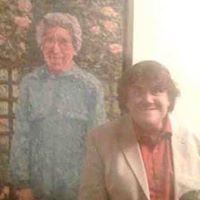
Griff relives freezing bus journeys to school and the impulsive stealing of that half-a-crown from Charlie Hume’s money box; sitting outside Butlins at Clacton (longing to be inside and on the Waltzer instead of stranded on the pebbles with his dad); hazy summer afternoons spent with feral gangs in the woods, or storming the mud flats singing extracts from the Bonzo Dog Dooh Dah Band. The memories are like Mivvis, frozen and fuzzy at the edges, but a sweet jam of pure recollected goo at the centre.
From birth to the BBC, this is a story of a confident middle child. Griff’s devoted parents Gwynneth and Elwyn gave him love, security and plenty of asparagus soup from a fake wicker vacuum flask with a plastic top. Griff’s father Elwyn, a retiring hospital doctor with a penchant for sweeties and ice-cream, loathed the tedium of English social ritual and hid behind his family and woodwork. From tree houses to boats, puppets to tables, he sawed and hammered his way into his family’s affections.
Griff left the bosom of his loving, irascible, eccentric, solid, all engulfing family for the firm embrace of real life; via the Upminster Fun Gang, the Direct Grant System and Party Sevens, losing his virginity down the back of a bunk in a twenty nine foot yacht, discovering the romantic advantages of shared babysitting engagements and the drawbacks of infatuation with identical twins.
If he hadn’t moved around so much as a child, would Griff have felt less like a voyeur, looking in on the lighted window across the square, the Georgian house glowing in the sun, the clink of glasses and the bray of public school certainties? Would he be able to tuck in his own shirt? Would he be fully detached?
A laugh-aloud buffet of baby boomer Britain, Griff’s self-deprecating, elegant, affectionate prose reveals a little bit better how on earth you got from there to here.
Griffith "Griff" Rhys Jones is a Welsh comedian, writer, actor, television presenter and personality. Jones came to national attention in the early 1980s for his work in the BBC television comedy sketch shows Not the Nine O'Clock News and Alas Smith and Jones along with his comedy partner Mel Smith. With Smith, he founded television production company Talkback Productions, now part of RTL Group. He went on to develop a career as a television presenter and writer, as well as continuing with acting work.
While at Brentwood School he met Douglas Adams (who would later write The Hitchhiker's Guide to the Galaxy). Rhys Jones followed Adams to Cambridge, reading history and English at Emmanuel College. While at university, Jones joined Cambridge Footlights Club (of which he became Vice-President in 1976). He was also president of the ADC (Amateur Dramatic Club) during his time at Cambridge.
He then joined BBC Radio Light Entertainment as a trainee producer, with his output including the satirical show Week Ending and Brain of Britain. An evening planned to spend watching his hero Frankie Howerd at the invitation of friends Clive Anderson and Rory McGrath, who were writing the show at the time, resulted in Rhys Jones replacing the show's producer, who had suffered from a stress-related illness from dealing with the comedian. He later produced Rowan Atkinson's show The Atkinson People for the BBC and has appeared twice on Whose Line Is It Anyway?.
Rhys Jones filled in several minor roles in the first series of Not the Nine O'Clock News, and was brought in as a regular cast member from the second series onwards, replacing Chris Langham, alongside Rowan Atkinson, Mel Smith and Pamela Stephenson.
In 1981, Smith and Rhys Jones founded TalkBack Productions, a company which has produced many of the most popular British comedy series of the past two decades, including Smack the Pony, Da Ali G Show, I'm Alan Partridge and Big Train. From 1984, Smith and Rhys Jones appeared in the comedy sketch series Alas Smith and Jones (the show's title being a pun on the American TV series Alias Smith and Jones). After the first series, the pair appeared on the big screen in Mike Hodges' sci-fi comedy movie Morons from Outer Space and then in 1989, the LWT production Wilt.
Rhys Jones has developed a career as a television presenter, beginning as the co-host on several Comic Relief programmes. He presented Bookworm from 1994 to 2000 and is the presenter of the BBC's Restoration programme (he began filming its third series at Lincoln Cathedral on 3 June 2006), and has done a considerable amount of fundraising work for the Hackney Empire theatre conservation project. In 2004, he led a demonstration at the Senate House in Cambridge University for the purpose of saving architecture as a degree in Cambridge.
Rhys Jones has written or co-written many of the programmes he has appeared in, and a number of spin-off books. In 2002, he started writing a book called To the Baltic with Bob, describing his adventures on the high seas with his sailing friend Bob, as they make their way to Saint Petersburg, port by port. Rhys Jones released the book in 2003. His early life has been captured in his autobiography, Semi-Detached, published in 2006 by Penguin Books. His book to accompany the BBC1 series Mountain was published in July 2007.
There are a few funny moments in here,but certainly not a laugh a minute as I hoped. I enjoyed the first half of the book,a nostalgic look back at his childhood,and struck a cord with a lot of people I'm sure. But the second half of the book,the uni years was just dull,dull,dull,and actually incomprehensible in places with his habit of switching between eras without warning.
Also it has to be said that Griff comes across as a not particularly likeable,self centered character,the part where he had a girl visit him all the way from Canada,slept with her repeatedly,only to ignore her then dump her during her visit made very uncomfortable reading. He cheated on another girlfriend with other women,then threw a tantrum when she told him she had been seeing someone else,what a guy..
3 stars for the first half of the book,not sorry I've finished it.
Quite good, with certain sections really conveying the time Griff was remembering. However, very occasionally I found the narrative a little disjointed and I found myself re-reading a couple of pages to work out how the hop from one era to another had occurred.
I definitely enjoyed some parts of this book more than others, which on average makes it a 3, but it was nearly a 2! A couple of very funny bits and some parts that really rang true saved it from an 'OK' rating.
As Griff Rhys Jones is just a year younger than me, I was looking forward to a read full of reminders of my own childhood. At first I was not disappointed with humorous tales of family life, I found myself laughing out loud! Unfortunately I found it started to drag somewhat especially after he went to university. Being a contemporary I carried on to the end, otherwise I do not think I would have done. My conclusion therefore is that unless you are going to be able to relate to any of his experiences, you will probably not find this worth reading.
Being an exact contemporary of Griff Rhys Jones I was able to relate easily to some of the trials and tribulations of his formative years. This book, however, comes over as being something of a curate's egg. While it is a warm, witty and honest memoir, Griff's habit of slipping seamlessly from the 1970s to the 2000s often left me confused and needing to backtrack a few paragraphs. Despite this I found it to be a rewarding and worthwhile read.
Loved the first half, partly because I know the places he was talking about. Once he got to Cambridge and started doing the student thing I lost interest. Anyone who's been to university has had the same experiences, and reading about the idiocy of someone else soon loses its appeal. Overall, not as funny as I had hoped.
Haven't yet finished this one, despite having started it yonks ago. A very disjointed text which I'm finding difficult to plough through. Goodness, he's self-indulgent!
A memoir of the author’s early life, from infancy to his Cambridge days. The structure of the book is a bit confusing, he darts back and forth from the present, where he is revisiting places from his early life, to his childhood, his youth, and then suddenly further forward to his father’s old age etc. sometimes I didn’t know whether he was writing about the present or the past. There are some rather personal details about some of his girlfriends which I thought could have been left out. He says of one former girlfriend ‘ I hope she doesn’t read this’. Well, why write it then? There are some inconsistencies, for instance, he says more than once that his father would not allow anyone to watch ITV - but then he describes telling his father he wanted to be an actor “My father watched Roger Moore on the telly and told me that if I wanted to be a proper actor I would have to be able to raise one eyebrow” The Saint was on ITV. The strangest passage of all is where he describes how he embarrassed everyone by crying at his aunt’s funeral - what kind of damaged emotionally repressed people are embarrassed by someone crying at a funeral? The one bit I thought really funny is when he is directing a production of The Mikado at the open air theatre at Minack in Cornwall, which is built on the edge of a cliff with a dizzying drop to the sea. The actor playing Ko-Ko insists that he must enter from the back of the stage, and Griff explains ‘The only way that Ko-Ko could make his entrance from the back of the stage were if he were to arrive by boat, scale a hundred foot cliff and surmount a ten foot concrete wall.’ The book wasn’t as amusing as I had hoped it would be, and is sometimes rather rambling, and sometimes decidedly odd in a not agreeable way. A bit of a disappointment.
What is it about well known people and their desire to tell all ? I'm not sure the average man/woman in the street would ever divulge some of the things that Griff, and others have done. Does his wife, Jo, whom he obviously loves as his previous book indicates as well as the dedication in this, really want him to tell all about his previous relationships, particularily one of 7 years ? Clearly the answer is yes, and yes from the girl involved, Charlotte. I enjoyed most of this memoir, felt sorry for some of his relations, and liked hearing about the people with whom he mixed. It's a pity it ended before he gained predominance as as a TV comedy star, documentary presenter, script writer etc.
Finding this rather difficult to get into. Thought it would be funnier. Some period detail that sparks nostalgia, but not sure I'll finsih it very quickly.
I'm not really sure why I finished this, apart from the fact that it was relatively easy to read and I didn't have anything I desparately wanted to read on my shelf. It was incredibly self-indulgent, and involved a lot of treating women rudely in the second half of the book. There were also moments where Rhys Jones mentioned situations where people talked of or treated others negatively, but although he might have briefly raised this, he didn't really question or push back. I don't think this book would be published today written as it is.
Couldn't finish this. I admit I don't know who this man is I found the book in a charity shop and I thought it would be an informative account of growing up in the 70s. Instead it was constant name dropping (of things I know nothing about), slight boasting and long rambling sentences. I guess the book aged very poorly and is not aimed at younger generations. Fair enough but I couldn't get through more than 20 pages, excruciating
Since this was first published in 2006 I was expecting more about the NTNON era and the Smith And Jones years but nothing. Mel only gets mentioned once and that's right at the end. The Spectator said that the book was 'absolutely cracking, captivating, hilarious but poignant '. Maybe nobody from the Spectator actually read the book. If they did, remind me not to buy the Spectator. Dull but readable
A book I enjoyed despite the haphazard style, narcissism and dishonesty exhibited by the author . Also he comes across as being unhappy being suburban middle class and yet seemed to have no complementing his fortunate life. He is not likable but clever and lucky in equal measure, I will read more by him but see very little in him I can relate too.
I found this book in bodrum turkey at a used book store without much of a selection. I made it half the way through. I'm calling it quits. There were some cute bits but I don't even know who this guy is, and it's so long.
Meandering recollections of an uninteresting life. No structure, jumps all over the place and lacks depth. Picked it up as it was lying around in the hotel i was vacationing at and was really apalled that something like this got published.
Initially, I found it interesting as he lived in an area that I lived in so was very familiar with. It wasn't a bad read but jumped from 'current day' to reminiscing without too much warning which was a bit confusing. I have to admit I skim-read it towards the end.
An autobiographical slow meander back through his childhood, school and university days. A couple of laugh-out-loud moment. A couple of times I had to blink away the tears. A gentle, interesting read of a time gone by. Poignant.
Started off enjoyable in his younger years, but got so bogged down with minutiae (all the plays he ever did, lits of name dropping) in his Cambridge years that I struggled to finish it.
I thought this would be entertaining, but found it dreary and haven't finished it. The memories were very personal and too self-indulgent, too long and boring,
A big fan of Griff Rhys Jones, I was looking forward to reading this and exploring how the talented Welsh actor and comedian made it into television, established Talkback Productions and went above and beyond with his various other exciting and varied pursuits.
Disappointingly, however, Semi-Detached only covers Rhys Jones’ childhood, and there’s the distinct feeling reading it of sitting down with an elderly grandparent and listening to them tell you about how it was in their day.
Semi-Detached explores the school and university period of Rhys Jones’ life, running up to the small odd-end jobs that he had shortly after graduating (amongst them petrol station attendant and security guard/bomb inspector) before finally making his big break at the BBC.
Admittedly, it does do so in a really endearing and poignant way and it’s difficult not to warm to the writer and be swept up in his really beautifully told story. However, with still so much left unwritten, this book does feel slightly anti-climatic and the reader is left feeling disappointed, knowing that part 2 of his story has still yet to come, despite the fact that seven years have since passed.
Nevertheless, it’s a delightful quick read and makes for a good piece of literary holiday escapism. Rhys Jones’ writing is at its best in the closing chapters of the book, so be prepared to see Semi-Detached through to the end if you do get around to reading it.
yeah, this was definitely semi detached, a bit like bob dylan's chronicles part 1, this definitely wasn't quite a straight biography. I did like it though, he spoke about all the things he hated his dad making him do, and then later how he subsequently did them himself as an adult. There was a wistfulness and wisdom and compassion about this book that i liked. It still didn't really say that much and wasn't that long but it was an interesting way to write, and he did deal with, examine, his relationship with his father in a both a tender, crtical, exasperated way which I enjoyed.
The weird thing too, is that i would never consider myself that close in age to him, but you realise that when you approach 40 that someone even only 15 years older than you can actually have a lot more in common with you than someone 15 years younger than you. When he was writing about the 70's i felt some of his experiences weren't so far off my own ones. I guess as we stay alive long enough, we begin to have more in common.
I was a little disappointed by this book. It is the story of Griff Rhys Jones' childhood, adolescence and early adulthood, right up to about the point he first became famous for Not the Nine O'Clock News.
Which is fine, but I was expecting a little more about what happened after he became famous. There are small references to people like Mel Smith and Rory McGrath, but nothing particularly interesting. There is nothing about how he first came to do NTNON. It's just a slow (and at times tedious) ramble through his antics as a youngster.
I found his writing style took some getting used to. He tends at times to branch off into non sequiturs. He'll also for instance start talking about one man in his life, then about another such as his uncle, then go on to say "he did this" or "he did that", without making it clear which he's talking about. I found it very confusing in places.
I bought this for thirty pence, I probably wouldn't have picked this up otherwise, because (like a surprising number of people who I have heard express an opinion on the author) I am vaguely irritated by Griff Rhys Jones, despite having sort-of enjoyed a few things he's been involved with on TV.
This was pleasant and interesting, but surprisingly slow reading and dense. It was entertaining without ever being particularly funny, but felt slightly generic - it could've described the life of numerous kids growing up in middle-class families in the England of the 1950s and 1960s.
As decent a read as it was, and great value for what I paid, I do agree with a review I read here that mentioned other autobiographies talking a lot more about the emotions associated with memories, but that this was just memories.
Almost certainly the dullest book I've ever read. I persisted because I genuinely expected it to get better. It didn't. Reads about as well as the autobiography of any schoolkid you've never met.
A note: the central conceit of the title is wrong, too. Manfred Mann's hit record which is referenced by the author at the start of the book was actually called "Semi-Detached Suburban Mr. James."