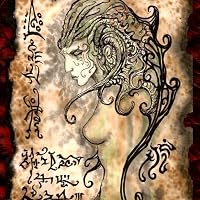
“A relentlessly haunting tale that overflows with mood and style.” —Kirkus Reviews
“The ultimate impact is nothing short of sensational”. —D. Donovan, Sr Reviewer, Midwest Book Review
Defrocked archæologist Dr Julian Corbin seeks amid dead things for signs of the unspeakable Other. Alien dreams and waking visions of lost civilisations haunt him, his steps dogged by a serial killer, leaving grisly murals in their wake. But as the death toll grows, Julian doesn't know if he is hunted or led, dreaming or awake, innocent or stained with blood...
"Grendel Wept" leaps forth from a literary tradition started by the surreal Hermeticsim of Poe and Machen; the ill-starred Gothic of Byron, the Shelleys; and the twilit fin de siècle of Wilde and "Maldoror". It is the struggle of Man and the cosmic Other, juxtaposed with Man’s struggle against himself, first spelled out in the earliest oral myths of Titanian cosmology, now given novel form.
C.P. Serret is the author of American Fictions (2025), Grendel Wept (2023), and The Metamorphoses (2026). He has an expansive background in the arts and technology, and he currently resides in the Southwest.
Its a rare but great occasion when you find something that is as much like nothing else as is possible. Sure, all fiction carries influences (and in this case I suspect Arthur Phillip's The Egyptologist may be lurking in the background) but this was one of those stand-out works of genrebending weird-exploration that you don't get very often. It must be read to be properly experienced.
I was organizing my "shelf" on Goodreads and they deleted my review, so here it is again 🤡
For me, GRENDEL WEPT was a very strange journey because it felt like some kind of thriller novel, like The Da Vinci Code, but on LSD. I love the fact that the author isn't afraid to play with formats, if that's the right way to put it—with typography, alphabets, slang, etc.
Likewise, the plot is interesting, and it becomes TOO dissociative at times, which makes it difficult to fully understand as such—and perhaps we never will.
The edition I own, the gray hardback, is a work of art if we consider the physical book itself as part of the work, as something integral to it. The layout is excellent, and the presentation is elegant.
Perhaps the only problem is that some elements from the layout software itself ended up being printed...