Mimi Pond crafts a gorgeous, dazzling biography of the Mitford Sisters
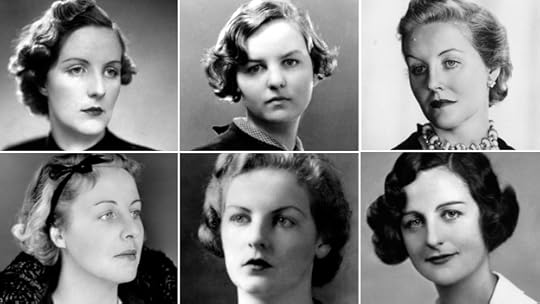
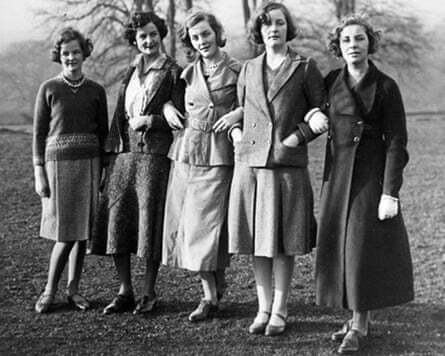
Born with pedigrees but without the pocketbooks to match, The Mitfords were certainly no strangers to lies, intrigue, or scandal. Nancy, Pamela, Diana, Unity, Jessica, and Deborah. All six sisters were weaned on their family’s well-documented upper class a ne’er do well would-be entrepreneur father; a stern, stiff-upper-lipped mother; a revolving door of governesses of varying propriety, all against the backdrop of a crumbling estate falling into disrepair.
The sisters grew from cloistered turn-of-the-century country girls into debutantes who would marry into political influence—for better or worse. Is it any wonder that a young, working class Mimi in Southern California becomes enamored with The Mitfords’ downright fanciful rich-and-famous lifestyle? This charming, inventively cartooned, and lovingly researched biography captures the dramatic, over-the-top antics of high society’s strongest personalities as they rubbed elbows with some of history’s most infamous fascists and communists.
Pond’s genius for classic cartooning in the vein of the Vanity Fair caricature and the satirical illustrations of Charles Addams brings the aesthetic decadence of the 1920s and ‘30s to life with effortless aplomb, warts and all.
Mimi Pond is a cartoonist, illustrator, and writer. She has created comics for the Los Angeles Times, Seventeen magazine, National Lampoon, and many other publications. Television credits include writing the first full-length episode of The Simpsons, “Simpsons Roasting on an Open Fire”, and episodes for the shows Designing Women and Pee Wee’s Playhouse. She lives in Los Angeles with her husband, the painter Wayne White.
Let’s go on a wildly whirling whitewater plunge through the terrible traumas of the twentieth century in the preposterously posh company of the six enormously entertaining Mitford sisters. This is a brilliant cheeky chunky (it’s big) funny graphic biography of all of them. It might be my book of the year although there are some strong contenders. There is a cast of dozens and dozens. Six sisters, two parents, many spouses and cohabitees, children, and various Famous People swirl through the pages as the sisters ricochet around the world from the 1920s to the 1980s. They rarely slow down.
There are walk-on parts for Hitler! Winston Churchill! Lyndon Johnson! William Faulkner! John F Kennedy! Nancy sings “Maxwell’s Silver Hammer”!
Mimi Pond knows a great quote when she sees one :
Winston Churchill, a man who looked like every baby ever, once described Charles de Gaulle as “a female llama, surprised in her bath”
SOME MITFORD SISTERS
The Fascists :
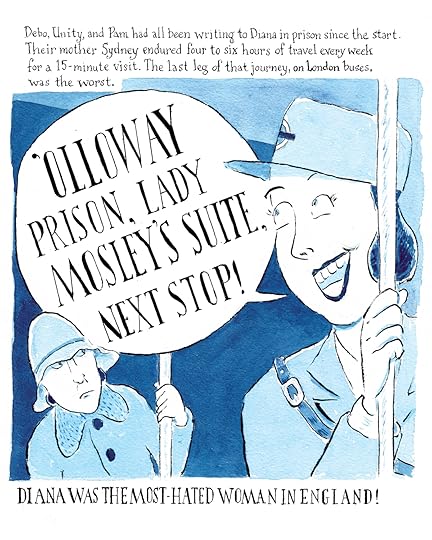
Diana married a guy named Oswald Moseley who was head of the British Union of Fascists in the 1930s – yes, they were never very popular. They were married in a private ceremony at the house of JOSEPH GOEBBELS. And Adolf himself was one of the guests . Back in Britain, when war was declared they were put into preventative detention as enemy sympathisers. Because they were being held without trial they could wear their own clothes. This led to a situation in 1940 whereby Diana is wearing a luxurious fur coat looking out of her prison bars while being bombed by her friends the Nazis. Mimi Pond comments : “That’s the kind of irony money can’t buy”.
Unity developed an obsession about Hitler too. She went to Germany in the 30s and wheedled her way into Hitler’s inner circle. Eventually he became a bit smitten too – she was six feet tall, blond, you know, extremely Aryan – but also, she would tell him all the gossip other people were scared to tell him. She told anyone who would listen that if war broke out between Britain and Germany she would shoot herself. When it did, she went to a park and shot herself. She didn’t die but she wasn’t quite herself after that, not with a bullet lodged in her brain.
The Communist :
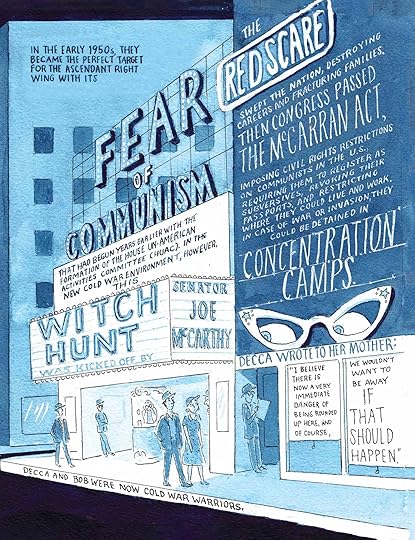
Jessica : decided to live in the USA where she got involved with every left-wing cause going and therefore found herself before the HUAC. In 1963 she wrote The American Way of Death which was a big bombshell and turned the funeral industry upside down. (I must read that one.) She was a live wire campaigning journalist.
The Author :
Nancy : she wrote The Pursuit of Love in 1945 which is hilarious – a must read! And she wrote loads more and was a big bestseller. She’s the one you’ve heard of.
The Duchess :
Deborah : she married the second son of a Duke – he wasn’t going to inherit anything but then his older brother died and his father died and he was Duke of Devonshire. Deborah found herself in charge of Chatsworth House with its numberless rooms (over 200) and six or so other stately piles dotted around England. Chatsworth was in a neglected, parlous state at the time and she resurrected the whole thing, restored everything to pristine Jane Austen-style perfection. In 2010 at the age of 90 she published the first of three memoirs. She was the last one to die, in 2014.
All of this is just to mention a few bullet points.
So for all readers who love cracking good biographies in graphic form, this is a must read.
Congratulations for a 2026 Eisner Award Nomination for Best Reality-based Work (Ben Passmore won for Black Arms to Hold You Up), and it was my second fave in this category, after Guy DeLIsle's Muybridge, but there's strong stuff in this category.
"Sisters, sisters, There were never such devoted sisters"--White Christmas
Yet another huge and impressive brick of a book in the graphic novel universe, that has made many “best of 2025” lists that I thank Rod Brown for sharing, which he predictably (and entertainingly) loathed, and I (not surprisingly) liked a lot. Do Admit: The Mitford Sisters and Me (2025) by Mimi Pond is the third brick I have loved by Ponds, Over Easy and The Customer is Always Wrong, two books about her waitressing at some restaurant in the SF bay area. Why read two books about a restaurant?! Easy: Ponds is hilarious and a terrifically talented cartoonist.
Do Admit (which is a phrase the Mitford girls say) is also entertaining, in a kind of continuous train wreck kinda way--many of the people in this rich Brit Mit family are despicable, but it is to her credit that she makes of them a generally “affectionate” satire, as Ponds’ favorite (and the most famous, maybe?) Mitford sister, Nancy, also did in writing semi-autobiographical novels about her family).
The Mitford family was well known for various reasons in the twentieth century, and Ponds writes her own interest into the tale, why a working class girl might be fascinated (as many of us still are about Hollywood and rock music rich ‘n’ famous figures) with a rich Brit fam. Nancy Mitford was the best known, the author of several well known comic sendups of her fellow rich Brits; Jessica was a Communist or what might today be called in the US a democratic socialist, having worked against Franco and spoken up against the House Un-American Committee and written the send-up of the funeral industry, The American Way of Death, which I must have read into if not finished at one time.
Unity and Diana were straight-up fascists, friends with Hitler himself and during the war, never apologetic about it even after the war! Despicable.. . . but you know, it was a page turner for me to read about the vile sometimes.
The two less interesting: Deborah, the youngest, actually came into wealth after Daddy Dearest lost most of their fortune. Daddy was a racist, colonialist asshole. Dad and Mom divorced over ideological differences. Pamela lived the longest, but what else do we know of her?
This book is really impressive, well-researched, much longer than it had to be at 500 pages, though I read it all pretty quickly, I’m in her age range of people who might like to get into what might now be an obscure topic. She is as witty as many of the Mitfords about it all, but also doesn’t ignore the fascism and other jaw-dropping things. I think it deserves to be on the best of the year lists, Rod--the art is terrific; sure, it's more illustrated book than comics, actually, with all the information in it; took her six years to do it, but as with any book, she manages to make the sisters interesting with all their letters and nicknames and politics and sex scandals (and oh, there was a brother, too!). Very deliciously dishy at some points.
Reminds me of Capote’s Women, the rich white women he befriended and then turned on to write a dishy book, who then turned on him. Eh. But then, it has its appeal, the roasting of the rich. And a bit like the Royal Tenenbaums. But also, relevant to our Present Moment, with Musk and the rest of the billionaire class of oligarchs and fascists that millions seem to adore or at least be fascinated with.
I'm dead center in the middle of the hypothetical Venn diagram showing an overlap of people with an interest in the Mitford sisters and of adults who read graphic novels, so I had really high hopes for this book. I didn't like it as much as I expected, because I struggled with the layout. Almost every page is an info-graphic (as opposed to a series of panels with a narrative), and each of these is cluttered with lines of text of different sizes placed at different angles, and I was constantly struggling to figure out what I should read first, where. The parts about the author's childhood also didn't seem to fit in, but that's a lesser complaint. Despite all this, the Mitford fascination still worked its strange spell, just not as much as I'd hoped.
Do Admit! (a favourite saying of the sisters) is cartoonist Mimi Pond’s comics biography of the Mitford sisters - Nancy, Unity, Pam, Jessica, Diana, and Deborah - as well as a mini-autobiography of her own, at least in terms of her lifelong fascination with the Mitford family. At nearly 500 pages, the book covers all of the significant parts of the sisters’ lives and puts them in the context of some of the 20th century’s major historical events.
It’s an entertaining and informative look at this intriguing family, with Pond’s enthusiasm for these real life characters rubbing off on the reader. Prior to this, I had only known of Nancy Mitford, the author of novels like The Pursuit of Love and Love in a Cold Climate (and something vaguely fascist/Hitler-adjacent about one or two of the other sisters). So it’s surprising to learn that nearly all of the sisters were authors, despite their mother’s lack of support in educating them. Although Nancy was the only novelist, Decca (Jessica’s nickname - this family and their nicknames, honestly), Debo (Deborah), and Diana all published nonfiction.
Besides Nancy the novelist, who were the Mitford sisters? Unity was six feet tall and friends with Hitler - she would also be the first to die, quite young and entirely her fault. Diana was the other Nazi sympathiser, and wife to Oswald Mosley, the leader of British fascism. Jessica/Decca was a communist who emigrated to America early in life and never returned to Britain, later becoming a civil rights crusader. Deborah/Debo became a duchess and steward to many historical country houses (all open to the public today under the National Trust). Pam was the quiet one - a farmer, who raised Diana’s children while she was imprisoned during the war, who later in life came out to be bisexual.
Although the subtitle is “The Mitford Sisters and Me”, Pond doesn’t include much of herself in the book, with the focus being almost exclusively on the Mitford Sisters, and then, mostly on Nancy, Decca and Diana. Although this is mostly because Pam was a very private person and so there isn’t much to say about her; the same could be said of Debo, whose conservation work pretty much defined her life; and Unity died young.
The Mitfords were aristocracy but it’s crazy how involved in some of the biggest names in 20th century history they were. Early in life, Decca (the communist) runs off with Esmond Romilly, Winston Churchill’s nephew, to fight the fascists in Spain, which explains why a naval Destroyer was sent to pick them up and bring them home! Both Diana and Unity insinuate themselves into Hitler’s inner circle, with Diana marrying Oswald in Goebbels’ house with Hitler as wedding guest. Their family is even vaguely connected to the Kennedys (and Debo may have hooked up with JFK once), while Nancy was friends with the literati of her day, exchanging regular correspondence with Evelyn Waugh, as well as dating the French ambassador, Gaston Palewski, who was part of DeGaulle’s government.
It’s like reading a biography of a real life Royal Tenenbaums - the family was a rich collection of eccentric characters who lived extraordinary lives. I’m not sure why Pond chose to colour the book in Prussian Blue ink but it works - the book looks great. And I especially appreciated the creative way she put across the Mitfords’ stories on each page. It’s not a series of uniform panels, but one creative design layout after another, that adds to keeping the reader’s attention on the book - and for such a big book, it’s a very quick read because Pond is such a strong storyteller.
The book does lose a bit of steam in the post-war years. Family members start dying off, the sisters are set in their lives, and the narrative becomes the sisters doing what they’ve been doing until they no longer do. And there’s perhaps too much on well-known American history than needed to be in there, as Decca (the American sister) dominates the remaining story with her social justice crusading. Also, as pretty as cursive is, it’s an absolute bugger to read and I hated the pages filled with cursive (not that many, but still).
Overall though, I do admit that this is a brilliant, informative and enthralling read about some genuinely captivating people and their remarkable lives, presented beautifully by the very talented Mimi Pond. Even if you’re not interested in learning about the Mitfords, the book makes you take an interest in them and cheerfully whisks you up into their upper class lives - for the better! Do Admit! The Mitford Sisters and Me is definitely one of the best comics of 2025 and a grand one-stop shop for learning about this complicated but undeniably compelling family.
The Mitford sisters were a mash-up of the Kardashians and the Kennedys playing Real Housewives of England in their English and French manors with World War II and the Cold War playing out in the background.
Mimi Pond does her best to communicate her enthusiasm for the siblings by occasionally injecting her childhood self into the narrative, but I could find little reason to care about this group of aristocratic debutantes and socialites. Some of them became writers of books, but not books that I've ever really heard of. And a scary percentage of them were pro-fascist worshippers of Hitler, so, you know, fuck them.
This book gets off to a shaky start as Pond seems to assume the reader will have familiarity with the family and fails to firmly establish their (in)significance before dumping us into their lives and jumping around in a scattershot fashion between the sisters and their confusing collection of nicknames. It doesn't help that the reading order of the captions gets a little murky a few too many times without borders to section the panels off from one another.
About the time I was settling into the groove of the book's style, I was also realizing just how unimportant these women were in the larger scheme of things despite Pond's protestations to the contrary.
The real drawback for me in the end though is that this is a thick monster that took forever to slog through at 30 to 60 minutes a day over the course of a week. I have nothing but regret for the time lost to what is essentially an overlong gossip column.
(Best of 2025 Project: I'm reading all the graphic novels that made it onto one or more of these lists:
A chaotic, disorganized book about chaotic family, where EVERY MEMBER was drawn to extremes. An interesting bunch of characters, but I wish I learned about them via a better medium.
I could have read a hundred more unnumbered prussian blue pages. Obsession is the heart of the book—Pond’s obsession with the Mitfords and the sisters’ own deep and disparate obsessions ranging from chickens to Hitler. They were fascinating, complicated, well-connected people who participated in history and in their own mythmaking. And the nicknames!
This is visually beautiful, and I suppose it's because I'm getting old and cranky that I want to complain about the font jumping around from tiny to huge and the text being at an angle making it harder to read and being unclear about whether I should read the panels going across or going down. I adore Nancy Mitford's novels and I should probably go ahead and read Daughters and Rebels, but I haven't yet. I learned a fair amount about the Mitford family, but the narrative does jump around in time quite a lot and at the end I found I can't remember which of the Mitford sisters ended up having a relationship with a lesbian in Switzerland (I think) and I feel like I would have to go through the whole thing again to figure it out and it's already overdue at the library, so, no, I won't be doing that. I wish the author had put more about herself and her responses to the Mitford sisters' lives in this, for example, how and when did she discover them? What was that journey like? How obsessed is she and what nutty obsessive things does she do besides put them in a graphic novel? I might read another by this author and I might not.
I’ve read a few graphic novels but I think this one is my all time favourite. There is so much to write about the six Mitford sisters and they are all so different yet fascinating so a graphic novel is a great way to find out about it all as a normal book would be a very weighty tome! Beautifully illustrated as well and the summaries comparing each sister make it really easy to follow and understand.
I had no idea who the Mitford Sisters were before reading this. They did lead interesting lives, interacting with leaders of several countries (Churchill, JFK, De Gaule, Hitler, etc.) and famous writers. Two of them were committed fascists: one marrying Oswald Moseley, leader of British fascism, and one being best friends with Hitler. Others did more noble things like fighting against Franco, exposing corruption, writing historical novels, and raising chickens.
The graphic layouts here were quite varied and interesting. However, there were quite a few pages where it was hard to guess the order in which the words should be read and the handwritten text was sometimes hard to decipher, especially when at low contrast.
I wanted to frame every page of this book. It’s so incredibly beautiful: with just blue ink, Mimi Pond brings to life the extraordinary story of the Mitford sisters. She neither glorifies nor hides the horrendous ideas most of them held; she confronts them head-on and makes them an integral part of the story. But it’s also the story of how six women took a firm grip on world history.
An overly-fond look at the Mitford family. The family contains the whole of British aristocracy from the last century: money lost and found, Nazis, prolific writers, savers of The Big Country House, quiet LGBT folks, and one who flees to America to fight for some good. Reading this book right now in American history, all I can say is: I wish someone had punched Diana and Unity in the throat. Their position as Hitler fans makes them so repugnant that it's hard to understand why anyone would want to know more about them. (Jessica? Sure. I guess.) The panel layouts were very interesting and so beautiful, but sometimes hard to follow. And there are so many names and nicknames that it's often hard to keep track of who's a quasi-decent person and who's a white supremacist scumbag. Tiny bits of the author's life are sprinkled in for no apparent reason. I keep seeing this book on 2025 best-of lists, so worth a read perhaps; but not my favorite. Great art though. And, it cannot be said enough times: Nazi sympathizers and white supremacists are hideous and not worthy of any admiration. None.
Absolutely adored all 450 dense pages of Do Admit. I vaguely knew about the Mitford sisters before going into this (certainly knew about the Nazi loving ones), but I had no idea they'd all be so interesting. And all the people they were linked to! Do Admit is essentially a history of the 20th century through the lives of six women.
The sisters are interesting enough to hold up any group biography, so Mimi Pond has a real head start. As a graphic stylist, she takes the story to the next level, weaving the life facts into exhilarating, unpredictable images that make each page turn a delight. Of course, this sometimes means the readability takes a hit, but I was certainly far more engaged with the narrative through the visuals than I would have been with a more standard graphic biography.
Pond also inserts herself into the story a bit, elaborating occasionally on how she was distantly aware of the Mitfords while growing up in suburban California. I liked how these sequences offered breathers from the usually non-stop Mitford narrative.
Do Admit is very much my kind of graphic biography. Big, unwieldy, probably overstuffed, but written about deeply interesting individuals in a deeply engaging manner. You can bet I immediately went to look up more Mitford books at my local library.
This is stupendously good, a triumph. The author nails three important facets: in-depth historical research, effective storytelling, and inventive presentation.
Six years went into the making of this graphic novel, and it shows. There's so much detail about this famous family that I knew nothing about, even with familiarity of each historical event. Reading this felt like putting puzzle pieces in place that you didn't even know were missing.
Oh, those wild Mitford girls! I've read several collective biographies and collections of letters about these six extremely colorful English women who lived in the early to mid twentieth century: Nancy, Pamela, Diana, Unity, Jessica, and Deborah--they also had one lone brother, but he's not the subject here. The author explores, in aptly whimsical and dramatic graphics, their escapades as well as their relationships with each other and their parents, their experiences and connections (with Adolf Hitler and fascism, communism, civil rights, racism to name but a few), and their influence in the world (in literature, politics, and popular culture). Pond also writes of their effect on her young life in the 1960s and 1970s in California. It's a treat--do admit!
Mimi Pond has created a masterpiece! A fabulous group portrait of the Mitford Sisters, and a memoir of her nearly-lifelong fascination with them, absolutely gorgeous to look at, and brilliant to read. This is no easy task, given that (A) there's a lot of ground to cover with this group; and (B) the Mitford industry has been going strong for a long time, so one might feel that this ground has been covered. And yet, Mimi Pond has done the impossible, and given us a compelling new look at the whole saga. Highly recommended!
Mimi Pond tells the story of six aristocratic sisters who made headlines with their colourful lives in the 1930s, a time of revolution and political uncertainty. It is beautifully illustrated and makes learning about history very entertaining!
I read this because it was on a lot of best-of lists but to say I didn’t care for it is an understatement. The Mitford sisters story is an interesting sideways look at history and how this family somehow ended up tangentially involved in all sorts of history. But Pond tying in bits of memoir doesn’t work, and disrupts the flow of the story and adds very little.
More than anything though, this thing was difficult to read. Like, genuinely hard to decipher. The balloons and captions do not flow in alogical way and I was constantly reading the wrong parts first. The spinning layout’s gave me a headache, the use of cursive in a light pencil was totally disruptive. I’m a professional comics critic who reads a lot of comics. This is a cartooning problem not a reader problem.
A few baffling mistakes not picked up by the author or publisher:
1) The Sudetenland was not previously part of Germany, stripped of it at Versailles. It was part of Austria-Hungary. The point is that this was the point Hitler had stepped past acts like entering the Rhineland et al, winding down Versailles, and actively threatened war. That is why it was appeasement as opposed to 'hey well maybe we were too harsh in the first place and is it really all that bad'.
2) The Soviets did not kill 300,000 people in Hungary during the Uprising, a figure so ludicrous it would have made any occupation impossible. The most liberal estimates put the deaths at 1% of this, 3,000.
Both of these points have little to do with the women but should absolutely have been picked up by anyone casting a diligent eye over the book.
Mimi Pond is an incredible cartoonist, and Do Admit: The Mitford Sisters and Me is clearly a labor of love. This book is long and thick, but even after hundreds of pages, Pond continues to find innovative, clever approaches to page design. Unlike other historical comics, she largely avoids falling into the trap of dry captioning over traced pictures of historical figures and settings. Pond has a knack for translating narrative ideas into visual metaphors and parallels. I was struck by her idea to infuse a map of Washington D.C. with the likeness of Franklin D. Roosevelt’s face (a detail she leaves surprisingly understated given its inventiveness). The visual playfulness of this book suits the subjects well, an eccentric family of stubborn, sharp women.
However, while I admire the hard work evident in this book, I struggled to finish it. In the same way that I don’t care at all about any member of the British royal family, I just couldn’t bring myself to care about these wealthy, entitled sisters. This partly comes down to personal preference, but Pond is also missing a strong thesis around why readers should care about the Mitford Sisters, besides the fact that they were odd and sometimes pushed against gender conventions. This book is chock full of trivia and interesting tidbits but lacks the organization of information and overarching thematic focus that contributes to great history. Deftly researched, this book’s digressions and details could support a variety of interesting arguments. Pond never fully bridges the gap between her dual impulses to “spill the tea” of the Mitford family in a gossipy, entertaining way but also present insights on their place in history with academic rigor. Pond falls short in her historiography because she struggles to see the forest from the trees.
Perhaps better editing could have helped with this project’s narrative shortcomings. I’m left wondering whether Pond brought this book to Drawn and Quarterly after she had nearly completed it, or if the publisher was involved from the onset. A prudent editor would have likely advised Pond to either better justify occasional digressions into her childhood in Southern California or cut out those frankly self-indulgent passages altogether. Moreover, I found many pages to be difficult to parse, largely because I couldn’t figure out in which order to read the text. I imagine an editor could have mitigated this issue at the thumbnail stage, although it was probably too late to make changes if Pond illustrated most of these pages before getting the publisher involved.
I admire the monumental undertaking that this book represents and plan on checking out Pond’s other work. But I’ll have to chalk this book up as “not for me.”
hmmmm wanted to really enjoy this but.... it was only okay. sometimes it was also rly hard to read the text in it an to figure out who was who. mostly it was okay amongst the sisters but they were all mostly drawn the same. structurally it was somewhat chronological but still kinda fragmented and i didnt rly like the way that mimi pond's life was mixed in, i just didnt think it worked or was interesting. politically I feel quite sceptical... it wasnt totally silly abt politics but there was definitely some weird remarks and just like... ofCOURSe diana "never apologised" about being a fascist... she WAS a fascist!!! not just 'the wife' of one, or a "sympathiser" (whatever that means...) but a literal-forever-fascist!!?! obviously !!
& some of the comments and jokes were repeated, like sometimes more than three times 'cousin of winston churchill'... it was crazzzzy that there werent page numbers!!!! at all !!!??
The illustrations are stunningly original and vibrant, but I found it impossible to read the book as a coherent narrative for two reasons: too many characters and too many styles of presentation. The pages are laid out differently, cleverly, and with great panache, but the panache made figuring out which way to read--by which I mean even in which order to read text bubbles--a challenge, especially because there are so many sisters and so many subplots that I was struggling to keep track of who's who. I completely understand the desire to keep all of the sisters in the story, and to tell all of the strange things they did, but at some point I found it all too much like standing in the middle of a traffic circle and trying to identify each and every driver whizzing past while at the same time reading all the billboards and street signs.
A bit confusing with all the names and nicknames and sometimes it's not clear where to read the text but overall very interesting story. I think watching the series may clarify who is who.