Jump to ratings and reviews
Rate this book

New Cemetery

Rate this book
A poet, at a desk, in a shed. A shed which is temple, bunker, study and look-out post all rolled into one.

Not far away, in the surrounding West Yorkshire countryside, the local council have begun “peeling back turf” to turn a former cow-field into a new cemetery.

In this brand new collection from Simon Armitage, day-to-day observations become short and layered meditations addressed to any “reader” within earshot, from the adulterers and learner drivers cruising the cemetery’s newly laid tarmac, to the cosmos itself, staring back with its “dumb face.” As the graveyard takes shape, its presence on the brow of the hill becomes a lengthening shadow over the imagination, triggering terse, sarcastic responses and quieter personal recollections, leading eventually to a grand litany of local landmarks as the poet stakes out his place among moorland reservoirs blazing with evening sun.

In New Cemetery, Armitage faces up to the bylaws of local planning committees and the laws of the universe with his customary deft wit and detached lyricism, but with a stripped-back clarity and lo-fi approach that hints at a new beginning.

120 pages, Hardcover

First published March 1, 2017

21 people are currently reading
90 people want to read

About the author

Simon Armitage

144 books371 followers
Simon Armitage, whose The Shout was a finalist for the National Book Critics Circle Award, has published ten volumes of poetry and has received numerous honors for his work. He was appointed UK Poet Laureate in 2019

Armitage's poetry collections include Book of Matches (1993) and The Dead Sea Poems (1995). He has written two novels, Little Green Man (2001) and The White Stuff (2004), as well as All Points North (1998), a collection of essays on the north of England. He has produced a dramatised version of Homer's Odyssey and a collection of poetry entitled Tyrannosaurus Rex Versus The Corduroy Kid (which was shortlisted for the TS Eliot Prize), both of which were published in July 2006. Many of Armitage's poems appear in the AQA (Assessment and Qualifications Alliance) GCSE syllabus for English Literature in the United Kingdom. These include "Homecoming", "November", "Kid", "Hitcher", and a selection of poems from Book of Matches, most notably of these "Mother any distance...". His writing is characterised by a dry Yorkshire wit combined with "an accessible, realist style and critical seriousness."

Ratings & Reviews

What do you think?
Rate this book

Friends & Following

Create a free account to discover what your friends think of this book!

Community Reviews

5 stars
35 (26%)
4 stars
59 (45%)
3 stars
31 (23%)
2 stars
6 (4%)
1 star
0 (0%)
Displaying 1 - 30 of 30 reviews
Profile Image for Meg.
305 reviews5 followers
January 27, 2026
Armitage seems to be very hit-or-miss for me. Some poems resonated, such as Lunar Thorn and Purple Cloud, but many did not. The sheer amount of moth imagery didn’t help, and I’ll own that this is a personal aversion (!), but it still impacted my overall enjoyment of the collection.

2.5*
Profile Image for A Dreaming Bibliophile.
561 reviews5 followers
December 18, 2025
Thanks to NetGalley and Knopf, Pantheon, Vintage and Anchor for providing me with an eARC.

This was a nice collection of poems. I really liked the concept of naming the poems after moths -- most of them matched quite well. This collection to me felt like the thoughts the author had about the cemetery and general feelings of weariness towards the way the world is functioning and other random observations from his chair in the shed. My favourite poems were Speckled Yellow, Campion and Buttoned Snout. I really liked the last line of Campion: "my mother at the twin-tub manhandling shirts, hauling drowning sailors from sea to deck." This was a beautiful description. In Buttoned Snout, the way it was written with carefully changing anagrams was brilliant. The rest of the poems were great as well but didn't hit as hard. Overall, I would recommend this to anyone looking for a collection of short, deep poems connected by a theme (building of a new cemetery).
Profile Image for Rebecca.
4,197 reviews3,467 followers
November 3, 2025
Not far from the English Poet Laureate’s home in Huddersfield, some cow fields were recently converted into a municipal graveyard. I can’t do better than Armitage’s own description of the style in this collection: “short-lined tercets linked with/by intermittent rhymes and half-rhymes … like threading daisy chains.” Each one is titled in brackets after a species of moth, in a rather arbitrary way, as he acknowledges. The point was to – in a time of climate breakdown – include nature in the inevitable march of death and decay. I most liked the poems about the cemetery, whereas the majority of the book is about everyday moments from a writer’s life.

There are some amusing and poignant lines among the rest:
I died and went
to Bristol Parkway
for my sins,

interchange
between soul and flesh

&

the whispered half-rhymes
of earth and death
on the spade’s tongue.

I also appreciated this haiku-like stanza: “Almond blossom / slash rotten confetti / clogging the church drains.” But there was little that struck me otherwise. I’ve tried to love Armitage’s poetry, but this third experience again leaves me unmoved. I’ve preferred his travel memoirs. Still, the book ends on the perfect note:

the dead are patiently
killing time

between visiting hours,
deaf, blind, mute
and numb,

unable to love
but capable still
of being loved.
Originally published on my blog, Bookish Beck.
Profile Image for Goodreeds User.
292 reviews21 followers
November 4, 2025
Simon's a consummate professional, has got his voice and his themes set in stone, and can turn his writing on and off like a tap. This collection is another example of that. It gets a lot of mileage out of its concept: 100 pages of poems all on the same subject matter (a new cemetery), all in the same form, with occasional variation in tone, and some ranging between carefully-curated themes. It definitely feels like a lockdown project (it's prolonged, obsessive, introspective, domestic), and it's been well executed. There are no filler poems, and no jaw-droppers either - it's a consistent time. Like the cemetery they describe, these poems are neat and well-tended. Comfortable, pretty, and naturally sad. Like gravestone text, the poems are succinct, pithy, brief. Simon's a safe pair of hands - he doesn't do anything too surprising, and he doesn't do anything boring either. Ideal for readers who like to relax, stroke their chin, and say "hmmm" out loud.
Profile Image for Demetri Papadimitropoulos.
300 reviews17 followers
January 20, 2026
A Hundred Small Poems, One Big Reckoning: “New Cemetery” Reviewed


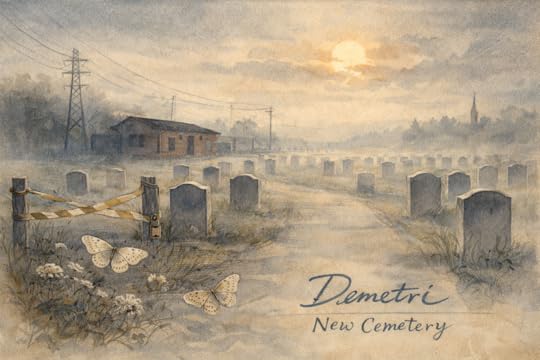
Watercolor Piece by Demetris Papadimitropoulos

Simon Armitage’s “New Cemetery” begins, as so many endings now do, with planning permission. A field near a northern town is rezoned; an argument flares and dies; the machines arrive. The dead are not yet present, but their accommodation is already being surveyed, measured, priced, mapped. Armitage, watching, does something quietly scandalous: he does not join the outcry. He does not insist that “nature” be left pure, as if purity were still an available category. He watches the work. He walks the lanes. He comes back. He keeps the first small promise of the book: to look again, without pretending that looking will save anything.

A brief prefatory prose piece names the method and the modesty of the enterprise: a walk repeated over years; a view that changes by inches; a notebook filled by accretion rather than announcement. The book that follows is built from 100 short poems, mostly in plain tercets, each tagged with the name of a moth. The moths are not a pretty gothic accessory fluttering around the graveyard lamp. They function more like dedication plaques, like the labels in a natural history drawer: “Large Emerald,” “Vapourer,” “Feathered Footman.” Each name is a small insistence that the cemetery’s story is not only ours. In the margins of human mourning, another kind of disappearing has been underway, quieter and, perhaps, more final.

Armitage has always possessed an ear for the demotic sentence and the quick turn of wit, but here the swagger is stripped down to infrastructure. We get taped gates, padlocks, cul-de-sacs, bin stores, road markings, pylons and turbines, a lychgate that doubles as toilet and storage, a gravedigger’s talk of plot “units,” and the informal patter of the digger driver explaining the job. The sacred is not abolished; it is routed through systems. The cemetery has a one-way flow. It is managed the way everything is managed now: signage, protocols, efficiency, and a faint undertone of risk.

If that sounds cold, it is not. “New Cemetery” is a tender book, but it is tender in the way a good carpenter is tender: by doing the work properly, by refusing the flourish that would weaken the joint. Armitage’s tenderness arrives as restraint. A poem will gesture toward explanation and then, as if remembering its responsibilities, withdraw. The shed becomes a recurring space of modest labor and frustrated thought – roof felt to tack down, tools to sort, hands numbing in winter – while a Velux window pours indifferent light onto the bench. Grief, here, is not a grand speech. It is a habit. It is the unromantic decision to mend rather than to mythologize.

The form enacts the same discipline. The tercet becomes a unit of hesitation. Three lines are enough to register, to pivot, to stop. The poems end before they can inflate themselves into set pieces. Rhymes often half-arrive, like a hand that reaches out and then thinks better of it. Soundplay glints and disappears: a phrase that clicks, a consonant that snaps shut. In a culture trained to hunt highlights, the sequence refuses “peak experience.” There is no centerpiece lyric meant to be framed and quoted at dinner. The poems accrue the way days accrue: in weather, repetition, minor maintenance, and the slow rearrangement of attention.

And yet crisis is everywhere, embedded in the normal. The book’s pandemic poems are among its most haunting precisely because they are untheatrical. A cemetery is sealed with tape and locks. A gravedigger in protective gear stands at an open grave, an astronaut of the municipal. Wreaths are tossed from car windows in a drive-by choreography of love. Funerals become sparse, managed, distanced, and the poems register the strange emotional mathematics of safety: protection purchased with separation. Ambulances and air ambulances cut through the background as they did through our own recent nights – not shocking anymore, simply present.

The ecological strand is woven with equal restraint. “New Cemetery” is a book about extinction written in the key of the local. Armitage does not sermonize about carbon. He gives you a moth trap’s ultraviolet false moon luring fragile bodies to their deaths, and the uncomfortable knowledge that preservation can also be harm. He gives you ash trees dying, their hearts pulped, and the sickly intimacy of blight. He gives you storms that feel less like weather than like verdict. The poems make plain that the cemetery is not an isolated enclosure of death; it is a node in a larger system of vanishing, where species, rituals, and certainties are all thinning at once.

Armitage’s gift for the low register does moral work here. He attends to what people leave behind because people have always left things behind: ornaments, stones, shells, toy cars, solar lights, football scarves, cheap flowers, small notes that vanish in rain. The objects can look like kitsch, and Armitage is too sharp not to notice the aesthetic awkwardness, but he refuses the easy sneer. The dead, he suggests, are not asking for taste. The living are asking for a way to keep showing up. In one poem the Day of the Dead turns the cemetery into something like a market, the grave acting as a stall – a scene that is both comic and, in its own way, reverent: proof that grief is a form of trade, exchange, return.

Some of the book’s best poems stage the violence of the world in miniature and thereby make it harder to ignore. A wasp nest is exterminated with professional thoroughness; later the emptied structure becomes a classroom object, curiosity divorced from consequence. Elsewhere, a peloton of cyclists passes like a line of verse, briefly reclaiming the road from combustion. A child wonders whether there exists a single word that could erase humanity – and whether it should be spoken. The question is cosmic, but the poem keeps it grounded in the domestic dread of overheard talk and everyday inheritance: what we pass along when we think we are merely making conversation.

That testing extends to belief. “New Cemetery” flirts with the supernatural only long enough to show why we flirt with it. Moths become, at moments, messengers from the dead, delivering domestic advice, rebukes, reminders. The poems do not insist on this as truth; they stage it as need. A consoling image is proposed – God as ambulance, providence as synchronized flashing light – and then rejected, briskly, as if even to indulge the metaphor would be a betrayal of the book’s honesty. Faith, here, is not doctrine. It is the stubbornness of the worker who shows up: the digger driver, the cemetery staff, the person who refills a bird feeder on a grave, the poet himself returning to the gate.

The most surprising element of “New Cemetery” is how, halfway through, it becomes unmistakably a book for one person. The dedication is to the poet’s father, and the elegies that surface are not staged as set pieces. They arrive as a remembered slope, a car ride, a piece of advice that keeps rewriting itself. One poem recalls coasting down Garrowby Hill with his father, the engine in “whispering fifth,” the weightless thrill of descent. Another turns a father’s hard-edged counsel about violence and finishing the job into a meditation on what a generation thinks it is teaching, and what the next generation actually hears. Grief in these poems is intimate, but never self-dramatizing. Armitage does not treat the father as a saint, or as a symbol. He allows him to remain blunt, practical, inconsistent, human.

These elegies do not reduce the earlier civic and ecological material to backdrop. They retroactively charge it. Suddenly the shed is not only a writing space but a place of apprenticeship. The repair work is not merely metaphor but inheritance. The cemetery becomes not only public infrastructure but personal ground. Armitage refuses to mythologize the father into a monument, and in doing so he refuses the reader a certain sentimental comfort. It is a bracing refusal. It suggests that love is not a polish applied after death. It is a way of speaking truthfully about what was difficult, what was ordinary, and what will not return.

If “New Cemetery” has a recurring argument, it is that the age’s great problems have moved into the ordinary. Pandemic, climate volatility, mass death, biodiversity collapse, the bureaucratization of care – these are no longer special topics. They are the weather. Armitage’s decision to keep the poems short, to keep returning to the same walk, to keep the diction mostly unadorned, is not aesthetic modesty alone. It tells the truth about how we live now: by adapting, by normalizing, by making room. The cemetery is built; the cemetery fills; we keep going to the supermarket; the news scrolls; the moth names flicker like tiny headlines that refuse to trend.

The book’s humor, in that context, is not relief but ballast. Armitage punctures any drift toward sanctimony by puncturing himself. He performs an anagrammatic demolition of his own name, a reminder that authorship is a flimsy costume. He imagines euthanizing a bad poem as an act of mercy, sparing it the humiliations of its future life. He jokes about becoming the world’s oldest person, and then turns the joke into terror: what would longevity mean without relation? The laughter is moral. It keeps the poet from turning grief into authority. It keeps the book from becoming a lecture.

The comp shelf clarifies the achievement. “New Cemetery” belongs among late books that have traded rhetorical display for a steadier music of responsibility: Seamus Heaney’s “Human Chain,” with its tools and lifting and bodily limits; Alice Oswald’s “Memorial,” with its anti-monumental insistence that listing can be a form of respect; Robert Macfarlane’s “Underland,” with its deep-time consciousness of what we bury and why. One might also think of Jenny Offill’s “Weather,” in its refusal to separate the personal from the planetary, the domestic from the disastrous. Armitage’s project, however, is more insistently municipal than any of these. His underworld is a place with traffic arrows and a bin store. The poetry arises not from escape but from the fact that you have to walk past it again tomorrow.

Armitage is also writing, implicitly, against a long English tradition of churchyard consolation. The ghost behind the gate is not only the recent decade’s mass death; it is the centuries of poems that promised a certain kind of soft landing: the yew tree, the moss, the stoic bell, the moral lesson that the poor man’s grave and the rich man’s grave meet in the same earth. If Thomas Gray’s “Elegy Written in a Country Churchyard” offered a harmonizing music for social difference, and Philip Larkin’s “Church Going” offered a skeptical shrug at inherited ritual, Armitage gives us a cemetery designed like a housing estate: parking bays, traffic arrows, bin stores, a management plan, a capacity problem. The point is not to mock religion or to deny comfort; it is to admit where comfort now lives. For many mourners, the old churchyard is not an option. The new cemetery is what there is. The poems ask what a secular, municipal culture owes the dead when the language available is administrative.

This is where Armitage is most evident it is in the way he lets bureaucracy and lyric rub together until each changes. A word like “unit” arrives carrying its cold utility, and then a line break tilts it toward human vulnerability. A safety protocol becomes, by repetition, a kind of prayer. A bin store, described plainly, begins to look like a shrine to the things we cannot bear to take back home. Even the moth names participate in this friction. They are scientific and fanciful at once. They sound like job titles and pub signs, bits of folklore glued to taxonomy. They also force the reader to pause. To read the sequence straight through is to keep being interrupted by the world that is vanishing just off the page. The book turns naming into a small act of resistance: not the loud resistance of slogan, but the quiet refusal to let the living world become mere backdrop to our human drama.

If the cemetery is the book’s central metaphor, it is a metaphor that does not behave. Cemeteries are supposed to tidy grief, to give it borders, to make it walkable. Armitage shows the borders leaking. A new burial ground appears because the old ones are full, but fullness itself becomes the story: capacity as destiny. The poems repeatedly return to thresholds – taped gates, locked entrances, permitted access, restricted hours – and those thresholds begin to resemble the contemporary condition. We live surrounded by systems that promise care and deliver conditions. The book’s genius is to render that truth without either cynicism or romance.

That municipal quality is what makes “New Cemetery” feel so contemporary. It understands the pressure to perform grief in public and refuses it. It understands the pressure to extract quotable lines from everything and declines the transaction. The poems are small enough to be read quickly, yet the sequence as a whole resists being consumed. It is not a scroll. It is a walk. The reader must accept the book’s tempo – a poem ends, another begins, the moth name flutters in the margin like a reminder to look closely or miss what is vanishing.

The final movement is almost audacious in its quiet. As the cemetery fills, the poems thin. They move toward a plainness that would be drab in a lesser writer and is, here, earned. The closing poem does not arrive as revelation but as responsibility. The cemetery is “entirely full.” The dead are deaf, blind, mute, unable to love – but still capable of being loved. The line offers no reciprocity, no afterlife, no guarantee that memory “matters” in any metaphysical sense. It offers only an ethics: love as action performed in the face of silence.

There are, inevitably, poems that feel like slight journal entries, gestures rather than arrivals. A long sequence gambles on accumulation, and accumulation can include redundancy. Yet even those lighter pieces are part of the method: the walk contains dull stretches, and the dull stretches are where attention is tested. The book’s rare risk is that its integrity can be mistaken for withholding, its plainness for flatness. But the longer you stay with it, the clearer the plainness becomes: not a lack of craft, but a refusal of spectacle.

To read “New Cemetery” is to watch a poet decline the easy consolations of art and the easy consolations of despair. The book does not wail. It does not preach. It checks the gates, watches the light, notes the litter, listens for the barely audible insect wing. It keeps faith with the minor, with the local, with the unglamorous forms of attention that make a life livable. For that discipline – for its exacting moral intelligence, its formal control, and its ability to carry civic, ecological, and intimate grief without raising its voice – I would place “New Cemetery” at 91 out of 100.
Profile Image for April Rose.
30 reviews1 follower
November 9, 2025
absolutely stunning, and something I'll come back to over and over
Profile Image for Julia Koncurat.
82 reviews1 follower
November 29, 2025
I met Simon Armitage and my friend asked if he was team Edward or team Jacob but he said he hadn’t seen Twilight 💔
Profile Image for Eric.
343 reviews
Read
February 8, 2026
A school of fish, a swarm of bees, a murder of crows – most animals only get one, but moths boast two collective nouns: an eclipse and a whisper. In New Cemetery, the latest collection of poems from Simon Armitage, a whispering eclipse of tercets takes wing on every page. In a poem titled “Speckled Yellow” (after the moth species that looks that way) the poet addresses the cosmos.

Read the rest here: https://ocreviewofbooks.org/2026/02/0...
Profile Image for Cay-lamity.
796 reviews21 followers
December 4, 2025
“Lunar Thorn,” “Ashworth’s Rustic,” “Clouded Brindle, “Pale Shoulder, “Lempke’s Gold Spot”

“mute and numb, unable to love but capable still of being loved”
Profile Image for Mark Redman.
1,067 reviews46 followers
October 3, 2025
Simon Armitage's "New Cemetery" is a captivating collection of poems that explores more than just the cemetery. Each poem offers a vivid meditation on nature of the landscape, and the environment. Inspired by moths observed in Armitage’s local cemetery in West Yorkshire, with each piece named after a different moth species, such as the Brown-line Bright-eye and the Lunar Thorn moth. This collection beautifully encapsulates themes of mortality, memory, and the fleeting nature of life. The edition I read was particularly striking, featuring white typeface printed on stark black pages, which enhanced the sombre yet mysterious tone of the poetry.
Profile Image for Russio.
1,217 reviews
April 6, 2017
Essentially a long poem in a beautiful edition, about the construction (if that is the right word) of a new cemetery in Kirklees. I presume this is a real occurrence and the transformation of the land has had the same unsettlement of thoughts in the mind of the poem. Some great lines "The departed have not yet arrived," yet the poem will need some rereading to connect some of the diverse dots.
Profile Image for Jamie Elvin.
8 reviews
July 18, 2017
A beautiful slim black book containing a slim black poem. A poem of tired reflection on new developments, concrete smothering, and death in local ground. The neutral black, white and grey illustrations compliment the poet's images of weather-warn materials and life spent pondering words from his sanctuary-shed.
Profile Image for W.S. Luk.
496 reviews6 followers
November 10, 2025
Click here for my full review. Thank you to Faber and Faber for sending me a digital copy of this book.

“I died and went/to Bristol Parkway/for my sins,/interchange/between soul and flesh…”

Because my brain is a very silly place indeed, the poem I most enjoyed in Simon Armitage’s new collection lists anagrams of his name, including “Steaming Moira”, “Armani Egotism”, and “I am Groin Meats”. Should our venerable Poet Laureate start an OnlyFans, that last anagram would be an excellent stage name.

This self-deprecating, introspective wit motivates NEW CEMETERY through its bleakest moments. As its introduction recounts, some land in Armitage’s neighbourhood was converted into a graveyard. Watching it go from cow fields to a cemetery that filled up during the pandemic, the scene was an unlikely muse.

NEW CEMETERY is rigorously structured, each poem constructed from loosely rhymed three-line stanzas. These rhythms are punctuated with images that startle with their haiku-like immediacy—an evening arrives like “a turd/through the letter box” (haven’t we all had days that felt like this?)...
Profile Image for Theo Smaller.
120 reviews2 followers
November 18, 2025
New cemetery is a wonderfully executed and suitably hesitant assessment on death and the way in which we process and signify it. Simon Armitage, of course, knows what he is doing, and writes with his usual acuteness to detail that makes each poem feel dense and singularly important.

The poems about his father were beautiful and sad, painting a flawed image of the poet’s late parent that felt real and relatable. The poems about the titular cemetery were well expected, and the consistent structure of each poem made the whole thing read very cohesively.

I enjoyed the quirk of each poem being named after a moth- it contributed to a unique sense of rot throughout the poem, a must of sorts that was foregrounded by the recurring setting of the narrator’s shed.

Overall, this collection is personal and visceral, providing a lovely, although not necessarily groundbreaking, insight into grief and loss.
Profile Image for Fiona.
679 reviews8 followers
December 22, 2025
Thought provoking, puzzling, modern, timeless, earthy, ethereal …
These are just some for the words that come to mind as I consider this poetry collection. Some of the poems spoke to me loudly, grabbed my heart and set me soul searching. I was completely mystified by some and feel I would need to read them a dozen times to even begin to understand them. I found the poems written after the death of his father incredibly powerful, and those responding to the new cemetery so clever. The names of the moths heading each poem was in many ways such a small addition, but I found they unexpectedly added depth and provoked thought, such that the collection would seem incomplete without them. I will never look at a moth (or a cemetery, for that matter) in the same way again …
Profile Image for Lorren.
179 reviews1 follower
January 23, 2026
This lovely, spare collection of poems is structured around a cemetery being built near the poet’s home. With short, poignant lines, the Armitage explores themes of death and the ephemeral, titling each poem with a species of moth. (I imagine it was outside the scope of printing, but I would have loved to see illustrations of each of the moths!) Armitage has a gift for anthropomorphizing objects to create a surprising image, and those lines stuck with me the most throughout. This is a moving, thoughtful collection, and I enjoyed reading it.
736 reviews
December 14, 2025
I search these poems for the building blocks of the poet’s art: allusion, illusion, connotations, metaphor and the use of the word to express a deeper meaning but in vain. To me, most of the poems are thin and insubstantial lacking in a sense of the world view seen from the poet’s perspective that I want from a poem.
Profile Image for Paul Ferguson.
134 reviews
December 27, 2025
I mean, it’s very good because it’s Simon Armitage but it’s also quite bleak and the style is the same throughout which tempers the usual jagged joyfulness of his collections. I liked it but not as much as the others.
Profile Image for megan 🧚🏻‍♀️.
16 reviews
January 19, 2026
3.5

Decay is inevitable but words are forever. Words and moths. We attempt to eclipse the winter sun but we’re not doing what hasn’t been done. Impossibility is a fine thing—and it is that which we must love.
Profile Image for Graham Sillars.
387 reviews8 followers
October 29, 2025
An interesting collection of poetry.

I enjoyed it very much indeed. Poetry to get you thinking, poetry to make you see and to make you feel, poetry that rings a bell somewhere in your mind and resonates in the synapses of your brain.

Beautiful words, beautifully crafted, beautiful!
Profile Image for Helen.
82 reviews2 followers
December 27, 2025
If I were to compile all of my favorite poems, I would include quite a few of these.
Profile Image for T P Kennedy.
1,116 reviews9 followers
October 13, 2025
Beautifully presented volume. The substations of random moth names for headings works given that so many of the poems are related. It's a relatively slight volume though the poems towards the end of the volume are more personal and have a greater impact that the early ones. Still it's clever and plays nicely with language.
Profile Image for Em Smith.
57 reviews
October 15, 2025
Some of the imagery in these are stunning I just wish there was a slight variation in structure!!
Profile Image for Day Ravenstone.
Author 5 books4 followers
October 3, 2025
I read this in one sitting and I had a tear in my eye pretty much the entire time. This was devastatingly beautiful. Listening to Alex Warren (specifically Eternity) whilst reading this really adds to the vibes and definitely contributed to nearly crying. The names of each poem being different moths was beautiful. It reminded me of the fleating nature of life. Thier lives are a blink of our eye. Who's eye are our lives a blink of?

Being from Yorkshire, this was like a taste of home whilst away at university - a good cup of tea at the end of a long day. I'm definitely going to reread when I'm feeling homesick.

Profile Image for Flora.
24 reviews
October 7, 2025
Will be thinking about the phrases "the arrival of the departed" and also "unable to love but capable still of being loved" for quite some time.
Profile Image for Hesa Almheiri.
157 reviews1 follower
November 18, 2021
I have to admit I bout it for the beautiful bounding and the title
I like the poems that address the reader the most
Displaying 1 - 30 of 30 reviews

Can't find what you're looking for?

Get help and learn more about the design.