'Captivating, mind-boggling and deeply disturbing' – Maureen Freely
'Humane, thoughtful and urgent — this book will make you think, make you laugh, make you cry, but also make you burn with rage' – Dr Mary Wellesley
A thought-provoking deep dive into the global fertility industry and the commodification of the maternal body
Should surrogacy be a paid service, an altruistic act – or even legal at all?
Is it right that you can pay more for ‘VIP’ egg donors – and to view their photos?
How much, if anything, should breastmilk cost – and who should be allowed to buy it?
The global fertility industry is rapidly growing, hugely profitable and morally complex. This an industry where one person’s biological bad luck can be another person’s financial gain. From egg freezing to black-market breastmilk, the maternal body has never been more commodified, yet the ethical, emotional and economic implications are rarely considered.
Through a combination of undercover reporting and detailed first-hand accounts – including a surrogate of 12 children, an international embryo courier and a man who buys breastmilk for his IBS – Alev Scott exposes how the IVF, surrogacy and milk industries operate around the world and who is profiting. In doing so, she considers the blurred line between exploitation and empowerment. Who should make money from the maternal only the women themselves, anyone or no one?
Timely, thought-provoking and compelling, Cash Cow is an unmissable investigation into how desire, desperation and commerce intersect, and the impact the fertility industry has on individuals.
Alev Scott (born 1987) is a British-Turkish author, journalist, and cultural commentator. She is best known for her explorations of Turkish identity, Ottoman history, and modern sociopolitical issues in the Mediterranean and Middle East.
I thought this book was fascinating. We need so much research and reporting on this topic. This book was easy to read and straightforward. There were parts I found a little redundant but appreciated the book overall.
A well researched, well rounded journalistic report on the state of the female fertility industry in the world today. The book deals with subjects like egg freezing, breast milk, IVF and surrogate births — explaining every industry in detail, talking about costs, main players, legality and morality of every part of the process to make a child. I really appreciated the author’s willingness to ask questions and not pass any judgments on any participants of the process. The book helped me make my mind up about what I personally think about some of these issues (like — is surrogacy ethical? Should it be allowed?) and whether I would ever consider them for myself. The title is so clever as well.. „Cash cow” as in — everybody makes profit from you as a female. Obviously sickening and disturbing that women are always the ones who go into potentially exploitative industries to make money using their bodies. Female bodies are valuable enough to be paid for, but not valuable enough to be protected by better laws and regulations. Ugh. Highly recommended for both genders to read and understand the complexity of what it takes to just simply give birth and nurture a child (not even talking about raising them!!!).
Thoughtful, horrifying, made me extremely glad about how ethical and genuinely caring and not at all exploitative my own IVF journey in New Zealand was. Definitely not a book I could have read until now.
Oh my word where do I start?! This book is shocking, eye-opening, thought-provoking, insanely well reasearched and just so full of empathy. I loved the audiobook version narrated by Alev Scott and I couldn't stop listening, even when I got to the grim parts. I definitely did get upset a few times, but there was so much in this book that I either didn't know or simply didn't ever think about - until now. I know this book, facts and stories within it, will stick with me for a while and I think it's important that people read it, whether you're a woman or a parent or not. The whole industry built around women and their reproductive system; using both women and people who are *so* desperate to have children; even just sharing breastmilk with another woman and child in need. There is so much to think about, there is so much to be aware of, and I am grateful to Alev Scott that she has brought all of this to our attention. A very important read.
This was such an interesting and in depth exploration into the fertility industry and the fundamental human forces that drive it, as well as all the ways it is commercialised and commodified. Read for work.
Please Itemize Your Uterus: Alev Scott’s Very Uncomfortable Tour of the Reproductive Marketplace “Cash Cow” finds milk by the ounce, eggs by the retrieval, pregnancy by the contract – and women repeatedly proving harder to price than the paperwork suggests. By Demetris Papadimitropoulos | October 14th, 2026
Milk, donor files, contracts, and a child’s cup recede toward a solitary figure, turning the book’s argument about value into a room whose arithmetic can never quite contain the person at its end.
Dollars and body parts share a ledger in Alev Scott’s “Cash Cow.” Before Milk, Eggs and Placenta, physiological facts sit beside prices in the same typographic key: calories beside customer cost, egg counts beside donor compensation, placental dimensions beside surrogacy fees. The arrangement is funny for about half a second. Then its violence becomes clear. Scott is tracking markets around the maternal body, but the book’s sharper move is to make us briefly read that body as a market would – output, inventory, risk, return – and then keep returning the person the numbers have edited out.
Early in the book, the argument begins with surplus rather than scarcity. Newly postpartum and producing more milk than her daughter needs, Scott discovers that donating it to a hospital requires screening, patience and infrastructure, while selling it online to strangers is almost frictionless. Men approach her for bodybuilding, digestive problems and erotic use. From there the inquiry widens through milk banks and pharmaceutical companies, egg donation and freezing, IVF clinics and financing, surrogacy contracts and cross-border agencies. A peculiar corner of the internet becomes something larger and less peculiar: one person urgently wants what another body can provide, and a market appears in the interval.
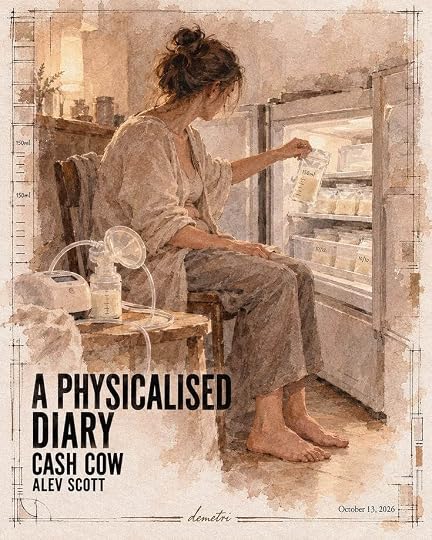
A late-night freezer turns maternal care into inventory, its stored milk, pump, exposed paper, and tired figure measuring an exhaustion no handwritten label can.
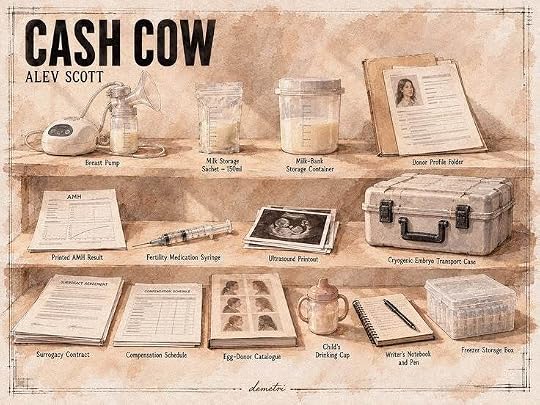
Milk, eggs and placenta are not three filing cabinets for Scott’s reporting. They mark degrees of detachability. Milk leaves the body and replenishes. Eggs leave the body but are finite, freighted with inheritance and increasingly searchable as consumer choice. Gestation cannot be bottled, banked or couriered through an airport; what changes hands is months of somebody else’s bodily time, medical risk and loss of control. Scott says the architecture was inspired by Christien Meindertsma’s “PIG 05049,” a catalogue of uses made of a single pig. “Cash Cow” borrows that inventory logic, then keeps having to put the human being back. The sequence also escalates what money is being asked to price: a substance, a reproductive possibility, then another person’s sustained bodily exposure. That progression is why the device does more than organize chapters.
Even before Scott finds a formal market, she has learned to think in units. During early motherhood she pumps obsessively and labels freezer bags “150ml, 15 February, 6 p.m.,” building what she calls a “physicalised diary of maternal anxiety.” She weighs her daughter and reads ounces and grams as if enough measurement might protect them both from uncertainty. This is one of the book’s smartest early checks on its own premise. Capitalism does not invent Scott’s wish to quantify motherhood. It finds the wish already there, fed by love, fear and the humiliating fact that bodies do not guarantee outcomes, then offers increasingly elaborate ways to make uncertainty look countable.
The sentences rarely advertise themselves; Scott prefers to let an object do the arguing first. Her default sentence is medium-length and conversational, quickened by questions, jokes and abrupt recalibrations. A scene begins in curiosity, edges toward absurdity, widens through research, then meets a person who spoils the provisional answer. That rhythm gives policy-heavy material unusual propulsion. It can also become visible as a method: by the fourth or fifth encounter in which a grotesque-looking transaction becomes harder to condemn once the woman performing it speaks, the reversal is no longer quite a surprise. Still, Scott has an excellent eye for things whose moral temperature changes as we look – freezer bags, donor profiles, cryogenic tanks, contract clauses.
Rather than treating euphemism as verbal padding, Scott follows it like money. At the Canadian NorthernStar milk bank, a director insists that women paid for milk are not donors but suppliers. Egg providers are “compensated”; surrogates receive “expenses” or reimbursement; clinics call people patients while selling packages, add-ons and guarantees. These are not innocent synonyms. They are little customs offices, allowing commerce to cross into generosity, medicine or motherhood without declaring everything in the suitcase. Scott’s subject is often less the price itself than the noun that makes the price socially tolerable.
The domestic freezer expands into public infrastructure, where ordered rows of donated milk and a distant worker make care look at once systematic, fragile, and strangely quiet.
If Scott starts a scene smiling, she often makes sure the smile has nowhere comfortable to land. At Dublin’s Future Fertility Show, Scott walks among IVF clinics, sperm banks, embryo couriers and improbable wellness offerings with the delighted alarm of a reporter who knows the room is giving her material. The scene looks built for satire until she notices couples sitting together but not touching and calls the event a “convention of grief.” The phrase does not cancel the joke. It tells us who is paying for it. Hope is being sold in a room full of people for whom hope has stopped feeling optional.
Part of Scott’s authority comes from refusing the reporter’s clean white coat. She poses as an infertile customer, browses donor catalogues, invents a younger donor persona and submits herself to the market’s gaze. One small moment tells us more than the undercover theatrics: offered a cheap AMH test that would quantify her own ovarian reserve, she balks. She already has children and does not need the number, yet she fears being graded by it. The investigator becomes her own case study. A system built to measure reproductive possibility does not have to persuade her that the number matters; she has arrived with the anxiety preinstalled.
As donor shopping becomes more explicit, choice hardens into price. One Northern Cypriot coordinator tells Scott that blond, blue-eyed donors cost more because they have a more model-like appearance. At a university hospital, another staff member explains that compensation rises with the number of eggs retrieved: more eggs, more money. The first statement prices desirability; the second prices biological yield. Neither requires a trumpet blast of outrage. Their flatness is the revelation. Very old hierarchies reappear with freshly itemized invoices.
Perhaps no scene earns more argumentative mileage than Stephenie’s. An Idaho commercial surrogate, she has carried an extraordinary number of children for other people. After one birth, an intended father treats her badly and declares theirs “a business transaction,” using payment to cancel gratitude. When the couple asks her to carry again, Stephenie repeats the phrase and raises her fee by ten thousand dollars. The words do not change. The speaker does. In his mouth, commerce strips her of relationship; in hers, it becomes leverage. A sentence meant to put her in her place becomes the tool with which she prices the insult.
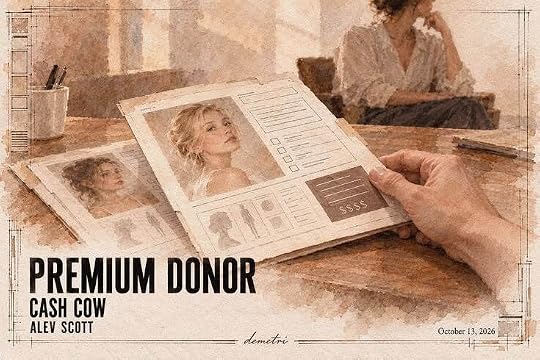
A profile, a choosing hand, and a second file beneath it compress inheritance, desirability, and price into the quiet choreography of selection.
A price, in Scott’s reporting, behaves less like a moral verdict than a reagent: it exposes what was already in the mixture. Payment can turn a body into a service platform, but it can also acknowledge work that sentimental language has expected women to perform for love. A commercial surrogate may have lawyers, escrow and bargaining power; an altruistic surrogate may receive no wage yet inherit a burden of gratitude and continued intimacy. Money can corrupt an exchange. Its absence can hide one. Scott is most persuasive when she refuses to rescue the reader from having to hold both possibilities.
During “Blighted Eggs,” one overworked noun changes jobs. For dozens of pages, egg has meant file, freezing, yield, donor, retrieval, price, transport. Then Scott looks at her daughter and imagines the eggs already inside her, nested across generations, the egg that became the child once carried inside Scott while Scott herself was inside her mother. Soon she experiences a missed miscarriage and hears the clinical phrase “blighted egg.” Commodity becomes inheritance, possibility, pregnancy, loss. The word has not changed. Scott makes the used-up word hurt.
In the same passage, she admits something less flattering and therefore more useful: the miscarriage makes her angrier at predatory fertility practices than she had been when the suffering belonged to other women. During surgery she thinks of patients pumped with hormones and sold “a little percentage of hope.” The phrase is polished enough to make me wary of it, but the confession around it is not. Empathy has arrived through resemblance. Scott’s body becomes an investigative instrument, and the instrument exposes its own calibration problem. Personal experience deepens the inquiry while showing how much easier another person’s pain can be to feel once it looks like ours.
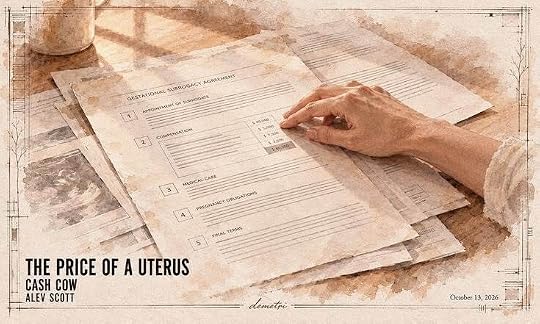
Money reaches its bleakest precision in the surrogacy contracts. Scott finds agreements that assign modest sums to the loss of reproductive organs and prorate compensation after stillbirth down to daily amounts. The obscenity is not simply that a uterus acquires a price. It is that the price is exact enough to simulate adequacy. A contract can protect a worker by making obligations enforceable while announcing, in the same clause, how little its arithmetic can comprehend the loss it has priced. Here precision is not knowledge. It is bureaucracy faced with an injury for which money is both necessary and absurd.
One surrogate faces two empty chairs across a contract, where distance turns the language of commerce into both an insult and a source of leverage.
If all this arithmetic merely showed that pricing bodies dehumanizes women, the book would shrink into its own title. Scott keeps meeting women who spoil that conclusion. Stephenie says she would not surrogate for free. Other carriers describe payment as recognition of labor. Some intended parents prefer compensation because an unpaid gift can create an almost unpayable emotional debt. Conversely, Scott meets altruistic surrogates who reject wages because payment would make them feel owned. These accounts do not abolish class inequality or bodily risk. They do make paternalism harder. Any defense of autonomy worth much has to leave room for women to choose arrangements a critic may still find unsettling.
The hardest evidentiary gap opens where that principle becomes hardest to test. In Northern Cyprus, Scott can reach agencies, lawyers, clinics and intended parents far more easily than the Central Asian women whose relative poverty and migration status make exploitation most plausible. A Georgian surrogate named Natalya declines to meet her. Later, Scott refuses an invitation to approach an Uzbek woman immediately after childbirth, recognizing that an uninvited visit would reproduce the extraction she is investigating. She flies home admitting that she has established the scope for exploitation rather than the firsthand evidence required to describe its interior life confidently.
A pale room, a small seated figure, and one restrained oval leave grief to occupy the space that clinical language cannot.
Refusing that hospital-room interview is both the right decision and a cost to the book. Scott should not turn a recovering woman into journalistic raw material because her narrative needs a stronger scene. But the resulting asymmetry matters. Comparatively empowered American surrogates become textured people with motives, jokes and contradictions; poorer women in opaque cross-border systems appear more often through brokers, documents, prices and silence. “Cash Cow” therefore knows more securely how exploitation can be structured than how the least powerful participants themselves understand the bargains being made around their bodies.
Outside the book, Anna Collinson’s BBC Radio 4 “File on 4 Investigates” documentary “Sunshine and Secrets: The Hidden Side of IVF” gives that restraint retrospective weight. After the British publication of “Cash Cow,” Collinson followed families who believed Northern Cypriot clinics had supplied different donors from those they had selected; an accredited genetic test provided very strong support that two children who were expected to share a donor were unrelated. The programme did not prove Scott’s every suspicion, still less wrongdoing across an entire fertility sector. It did show that provenance in such a market is not a fussy consumer concern. Scott had reason to doubt, and mostly stopped where her evidence stopped.
A hand hovers over clauses assigning sums to bodily loss, exposing the strange precision with which paperwork tries to make injury commensurable.
Precisely because those grey-market chapters are so vivid, they should not be allowed to stand for fertility medicine everywhere. In March 2026, the Human Fertilisation and Embryology Authority told Parliament that British fertility care poses unusual consumer-protection problems because most patients pay for treatment themselves and clinics compete in a commercial market; it also reported no evidence that vulnerable women were being systematically encouraged to donate or freeze eggs within the regulated UK system. That contrast improves Scott’s argument rather than softening it. Regulation, jurisdiction and bargaining power matter more than the mere fact that money has entered the room.
One rhythm eventually begins to show through the reporting: another bizarre transaction, another recoil, another person whose testimony makes the recoil look too easy. Milk, eggs and gestation are different enough to justify the recurrence, but not every example advances the argument equally. Scott’s analogies can overpressurize a scene too: clinics become casinos, donor networks edge toward pimping, bodies become agricultural yield. Usually the comparison exposes an economic structure. Occasionally it supplies the moral atmosphere a beat before the reporting has earned it. Those are real deductions from an otherwise unusually nimble piece of narrative journalism.
Under the invoices, dependency keeps reappearing. A premature baby needs milk it cannot produce; an intended parent needs an egg another body can relinquish; a pregnancy may require somebody else to carry it; a child, once born, needs hours no parent possesses in infinite supply. Markets can coordinate those needs, widen access and sometimes rescue people from biological bad luck. They also know exactly where desperation weakens bargaining power. Scott’s deepest insight is not that dependency destroys autonomy. It is that autonomy becomes most expensive precisely where nobody is self-sufficient.
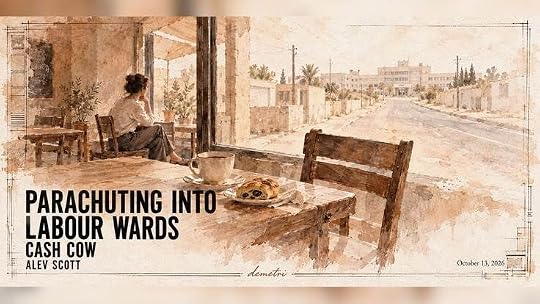
An empty chair, a waiting figure, and a road toward the clinic stage the ethical distance between what can be reported and what should not be taken.
Late in the epilogue, Scott considers artificial wombs, synthetic embryos and other technologies that might seem to solve the maternal body by engineering around it. She doubts they will end the markets she has described, because the desire for biological connection, pregnancy and parenthood is not merely a technical problem awaiting a technical fix. Then she abandons futurism for her own household. While she writes, a younger woman is being paid to care for her children. Scott has purchased time in order to write about the purchase of women’s time.
Across a domestic threshold, writing and caregiving happen at once, making purchased time the final entry in a ledger that never truly closes.
Only then does “Baby,” the heading after Milk, Eggs and Placenta, reveal its formal joke. The baby is not the final product of the reproductive economy but the beginning of new labor, new dependencies and new bargains over attention. Scott’s closing question about whether she is consumer or consumed works because the book has spent so long separating buyers from sellers before allowing the categories to leak into one another. My rating is 87/100, translating under the Goodreads quarter-star rubric to 4.50/5: a book whose structural intelligence and moral restlessness outweigh its repetition, analogical overreach and uneven access.
Scott’s title ends up both accurate and insufficient. It promises women milked, harvested and rented for profit, and finds enough to justify the provocation. The more difficult discovery is that calling reproductive labor priceless can be another way of declining to value it, while pricing that labor can recognize work and expose the worker to purchase in the same motion. Scott never gets the ledger to balance. Better that she does not. After milk, eggs, gestation and care have been counted, something remains stubbornly off the books: somebody’s body, somebody’s time, somebody’s hope, still refusing the neat little box where the price ought to go.
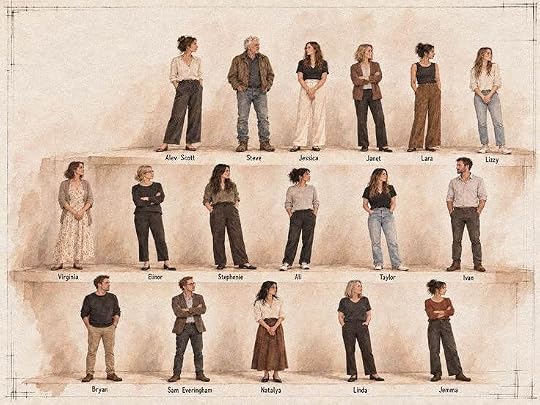
Full-body character reference sheet.
Important-objects reference sheet.
Alternate full dust-jacket watercolor study.
Cover-derived palette and pigment-behavior study.
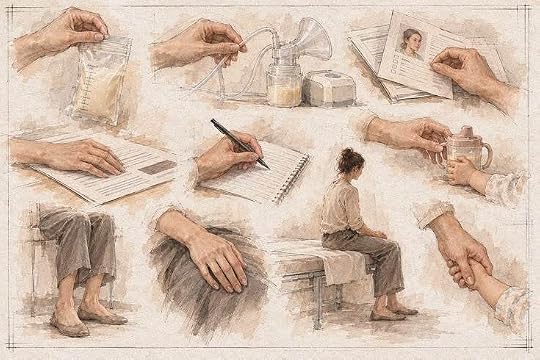
Gesture and anatomy study.
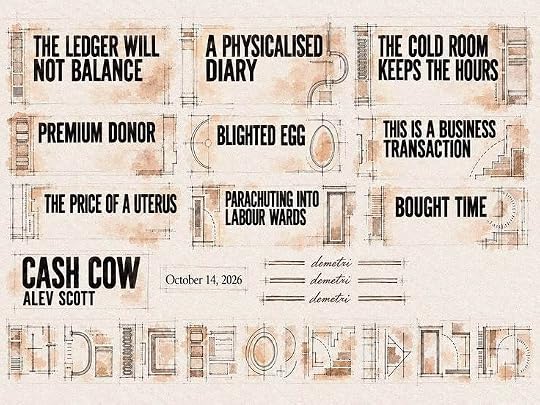
Series typography, border, and construction-line study.
Ledger, catalogue, contract, and inventory visual-grammar study.
“The Ledger Will Not Balance” – first graphite underdrawing.
“The Ledger Will Not Balance” – first watercolor wash study.
All watercolor illustrations by Demetris Papadimitropoulos. Watercolors are done on 140lb vellum and then scanned into the computer using an Epson scanner. From there, they are finalized in Procreate. No AI was used in writing this review — all art and opinions are my own.
Thought provoking, open minded and uncomfortable peek into a few industries that a lot of people probably don't even know exist, let alone have ever had to think about
I do think it's worth warning readers that this book is very much written by a journalist and maintains that tone throughout, which can sometimes be dry. If you're not 100% interested in the content, it can get dull. First of all, yes, this is a very well-researched report on the state of the fertility industry - but it is just that - a REPORT.
As someone who has benefited from a paid egg donor, is currently undergoing donor egg IVF, has miscarried, has a close family member who has been a surrogate twice for a gay couple, and has another close family member who experienced infertility but opted not to pursue any of these options, I feel like I'm extremely invested in the subject matter. And even I found several sections lacking.
While the book opens with the breast milk industry, a subject on which the author has valid opinions and personal experiences, I felt that her lack of personal experience sometimes clouded her opinions as we moved into egg freezing and egg donation. There were a few instances where she acknowledged this. Later, when discussing surrogacy, she wrote, "my own lived experience was in some ways hindering my imagination." So, at least she's self-aware.
Mostly, I wonder what this book could have been if it had been written from a purely unbiased, informative perspective, or if each section had been authored by individuals who had actually experienced these things, rather than relying on a journalist posing as a woman struggling to get pregnant at clinics and on phone calls.
I feel like my review is coming off more defensive than I intended. I did voluntarily seek this book out and have been looking forward to its US publish for many months now. Maybe I've learned I'm more sensitive than I thought. I'll leave with this - the industry is horribly corrupt and I acknowledge this, but cannot let that outshine the opportunities it gives people to start their own families. My husband and I paid an extra $10,000 for a "blastocyst guarantee" from our egg donor bank (if the first batches of eggs we bought did not produce at least 2 blastocysts, we would get an extra egg lot for free). Come to find out, donor eggs are stupid successful at making embryos. We have 8. So did we get preyed upon into spending an extra $10,000 we didn't need to? Yep. Do we also only have this chance at children because egg donors exist (paid or otherwise altruistic, doesn't matter) because I don't produce my own? Also yes.
In this book, the author investigates the 'business' of assisted insemination, pregnancy and breast feeding. she examines key pillars, namely: milk, eggs, sperm, IVF, surrogacy and ethics. This was an eye opening read, especially about the laws governing egg donation (anonymous or non-anonymous ), surrogacy and restrictions in the UK for couples seeking IVF on the NHS. The chapter on milk was quite interesting with a large market for human breastmilk (normal and black market). The chapter on surrogacy was sad but expected with some agencies/ prospective parents mistreating the surrogates and the women suffering lifelong injuries (with little compensation) from the pregnancies. However, there are positive surrogacy stories with some parents becoming lifelong friends with their surrogate. The book also discusses the ethics of sperm donors with multiple children (this is detrimental due to the possibility of their children marrying/ having kids. Which leads to an increase in the probability of genetic diseases found in the sperm donors family presenting). Overall, an interesting read that is quite relevant to the present time as more women are waiting until later life to start a family (looking for right partner, financial or academic reasons and etc., ), there will be an increase in assisted insemination but this leaves room for bad actors to take advantage of desperate people wanting a family, surrogates and egg donors. I would highly recommend.
Disclaimer: I received this book from NetGalley and HarperCollins UK, Nonfiction | HarperCollins in exchange for a free and honest review.
The origin of this book is the author’s own pregnancy. As a new mother, she stumbled into a world that she (and most other people I suspect) did not know about, and turned her skills as a journalist on it.
The topic is marketing bodies, which sounds both more and less dire than what goes on in the book. It could be a look at fertility and childbirth in general, but it has a materialist focus – what the process actually is for these things.
It reveals the unexpected, and is willing to be uncomfortable in not knowing all the answers even with it providing a lot more facts. The weakness is that some of these areas are too complex for the treatment they get, largely because the law and practice around them varies so much.
The author wants to provide a personal tone. I like this in the abstract because it makes a lot of sense in the context – personalizing the depersonalized through the author’s own participation. But the author’s voice is not consistent. She is not bound to be, of course, with the previous paragraph in mind, but there are the occasional section where her commentary falls flat.
Still, it ends up as a strong recommend based on it disclosing the uncomfortable and beginning an examination.
My thanks to the author, Alev Scott, for writing the book, and to the publisher, Harper 360, for making the ARC available to me.
I picked up this book after reading about two women who had used their own eggs and had carefully chosen one anonymous, healthy sperm donor, in order to have two babies that were related, only to find out that the second child had a different sperm donor. This may have happened in one of the clinics in Northern Cyprus that Alev herself went undercover to report on, in order to find out about this lucrative industry in IVF and sperm donors.
In a compelling narrative we discover more about this search for what many of us take for granted alongside Alev’s personal experience of donating breast milk and what lies behind its increasing commercialisation, as well as the the use of surrogacy and IVF, from personal accounts to the market driven capitalisation of this fertility business.
It is an eye opener to discover that commercial surrogacy for foreigners is legal only in the US, Ukraine, Georgia and Iran!.Parents of all sexual persuasions do pick and choose but it is still a minefield in various other countries. Alev takes us on her journey to discover where the clinics are, who profits and the happy outcomes of this trade in human life with interviews with surrogates and grateful clients, clinicians and some heartwarming stories.
I couldn't put this book down. Alev Scott takes you by the hand and drags you into a world you didn't know you needed to visit. But the minute you hear about her selling her breast milk to a trucker named Steve, you can't turn away as she journeys into the sometimes heartbreaking, sometimes seedy and always fascinating world of surrogacy, fertility and breast milk sales. These global industries are booming - and in unexpected places. Who knew Iran was a popular surrogacy destination? Not me. This book is beautifully written and researched but what sets it apart is the author's eye for the story. You can tell she's a first rate journalist. Some of the people she interviews come to life and stay with you. Stephanie, a woman who likes being pregnant enough to do it a dozen times, deserves her own Netflix series. With women's bodies being commodified and subjected to legal gymnastics, this is a timely book that leaves you grappling with the difficult moral and ethical terrain we, as a society, now find ourselves in. And though a non-fiction book, this is actually a great choice for a book club. So much to discuss!
I picked this book up as a kindle deal this month and was instantly intrigued. I’m trying to read a bit to get prepared for the next chapter, but this was a bit of a push, but one I sped through.
Scott a mother two, looks on at her own experiences and those of her friends and family on how the female anatomy is used and abused for profit, exploitation, altruism and survival, crossing borders, cultures and moral conundrums, she opens the eyes of the uneducated and the ill informed on the price of motherhood and the choices we make and the industries that exploit.
Not too much of a heavy read, but please do watch out for triggers of child loss, infertility struggles, surrogacy etc I learned a lot about the IVF/surrogacy industry in North Cyprus, the many uses of breast milk and the different global legislation surrounding surrogacy, so definitely worth a read.
This entire review has been hidden because of spoilers.
I’ve been through IVF three times, so I thought I knew this world pretty well. Alev Scott showed me how much I didn’t, and like so much of the world right now: it's totally disheartening and depressing. She covers breast milk, egg freezing, IVF, and surrogacy, and she breaks down the costs, the players, and the legal and ethical gray areas of each one. Some of it was hard to read from where I sit, especially how much money gets made off women who want a baby so badly. But also I appreciated most is that she asks the tough questions without judging anyone who takes part. She lets you work out where you land and doesn’t tell you what to think.
People can be so gross and exploitative.
Thank you to NetGalley and the publisher for the ARC!
An incredibly educational and well researched book. I learned so many new things while reading this, from the world of the breast milk market, to altruistic surrogacy. Scott presents all the facts without judgment and in a very clear and concise manner. As a woman, pregnancy and childbirth is inexplicable tied into our social expectations, and this book really opened my eyes and educated me in so many ways.
Thank you to NetGalley and the publishers for kindly providing an ARC in exchange for an honest review. #CashCow #NetGalley. All opinions are my own.
I first came across Cash Cow: How the Maternal Body Became a Global Commodity and the Hidden Costs for Women on Instagram, and I'll admit it was the cover that initially caught my attention. I looked it up almost immediately, and I'm so glad I did.
Part memoir and part investigative journalism, Alev Scott dives into the ways women's bodies and motherhood itself have become intertwined with global industries in ways I had never really considered. As a mother, I was genuinely shocked by some of the topics explored in this book. These are aspects of pregnancy, childbirth, and the journey into motherhood that had completely escaped my awareness.
What impressed me most was how accessible the writing was. Despite tackling complex, emotional, and often uncomfortable topics, Scott presents everything in a way that's engaging and easy to digest. I found myself constantly wanting to pick it back up because every chapter introduced another perspective or issue that left me thinking.
This is one of those books that informs without feeling preachy. It asks important questions, presents well-researched information, and encourages readers to think critically about systems that many of us rarely stop to examine.
I honestly think more people should be talking about this book. Whether you're a parent, planning to become one, or simply interested in women's health and the often-overlooked realities surrounding motherhood, this is a fascinating and eye-opening read.
Wow. Such an interesting book about a topic that many people may not give much thought too (I personally hadn’t before reading). I loved Alev Scott’s writing style which felt informative but also conversational. The way she sprinkled in her personal anecdotes amongst the research made for a much more engaging read. I’d 100% recommend this book to a fellow reader!
A wild ride. Alev Scott and her humane investigation into the global fertility industry brings you face-to-face with so many philosophical questions on empowerment/exploitation dilemmas and motherhood. I loved it. Some parts could have been organised better but on the whole, I am so thankful to this book.
A fascinating and compulsively readable account of the global industries related to parenthood - specifically breastmilk, egg donation and surrogacy. I found this book extremely interesting and learned loads. Very well written and thought provoking. Highly recommended.
This is an eye-opener, even for those in the industry or struggling personally with fertility issues, and beautifully written. It conveys the tension of being in that world, and the pressure of uncovering, in investigative journalist mode, what is really going on behind the scenes.
A good balance to the pro-fertility/medical forward book I read before this, illustrative of the financial basis behind milk, eggs, and placenta to bring babies into the world. Of course, colored by personal anecdotes of the author
Essential reading. I learned so much about this topic that I didn’t know. Well-written and intelligent, but accessible. Also, engaging. This is a must-read for anyone interested in the intersections of misogyny, motherhood, and capitalism.
Thanks to NetGalley and the publisher for the ARC.
Fantastic book that actually tries to think through these ethical dilemmas with evidence and doesn’t shy away from questions that should be asked but because of their nature can’t be definitively answered. It made me think as much as it informed me.
A thoroughly researched book on the surrogacy,IVF world and have its very lucrative and somewhat shady and not regulated as well as you’d think it is. Very thought provoking and discomfiting. I thought the book could have been organized better.
The first third of the book was the most riveting to me (maybe because I am still breastfeeding—it gave me so much to think about). The other sections (IVF, egg donors, surrogacy) were thought provoking and interesting, but felt a bit repetitive. Overall, a very intriguing listen.
This is so crazy, Scott brings up issues and experiences women face when it comes motherhood - some I have never even thought about as a woman who hasn't had children. Really fascinating.