

What do you think?

Hidden Creatures: Luscious Leeches, Bashful Botflies, and the Wondrous, History-Shaping World of Parasites
Welcome to the hidden, squirming world of parasites—some of the most misunderstood creatures with whom we share the Earth (and our bodies).
"Astonishing, eye-opening, and inspiring." —Chloe Dalton, author of Raising Hare
There is the tapeworm, which can grow 120 feet in length within the gut of a whale; the tsetse fly, a notorious vector of disease that can pierce the skin even of crocodiles with its needle-like mouth; and the most universal symbol of parasitic the leech. Long villainized as, well, parasitic, these creatures are actually a vital part of every ecosystem—and Dr. Dino Martins, an award-winning entomologist and biologist from Kenya, has made it his life’s mission to demystify these beguiling beings.
Hidden Creatures is a journey around the world ten times over—from Martins’ home in the wilds of East Africa, to the rainforests of the Amazon, to cities and backyards across the globe—and along the way, we encounter the brilliant and eccentric experts who join Martins on his adventures to investigate not only parasites but their hosts, from hyraxes and hippos to, of course, humans. Immersive, driven by an utterly infectious curiosity, and sure to transform every reader’s understanding of these organisms, Hidden Creatures has the magnetic force of a David Attenborough documentary and introduces a monumental, charismatic new voice in science writing.
"Astonishing, eye-opening, and inspiring." —Chloe Dalton, author of Raising Hare
There is the tapeworm, which can grow 120 feet in length within the gut of a whale; the tsetse fly, a notorious vector of disease that can pierce the skin even of crocodiles with its needle-like mouth; and the most universal symbol of parasitic the leech. Long villainized as, well, parasitic, these creatures are actually a vital part of every ecosystem—and Dr. Dino Martins, an award-winning entomologist and biologist from Kenya, has made it his life’s mission to demystify these beguiling beings.
Hidden Creatures is a journey around the world ten times over—from Martins’ home in the wilds of East Africa, to the rainforests of the Amazon, to cities and backyards across the globe—and along the way, we encounter the brilliant and eccentric experts who join Martins on his adventures to investigate not only parasites but their hosts, from hyraxes and hippos to, of course, humans. Immersive, driven by an utterly infectious curiosity, and sure to transform every reader’s understanding of these organisms, Hidden Creatures has the magnetic force of a David Attenborough documentary and introduces a monumental, charismatic new voice in science writing.
336 pages, Hardcover
Published July 7, 2026
Ratings & Reviews
Friends & Following
Create a free account to discover what your friends think of this book!
Community Reviews
Displaying 1 - 30 of 56 reviews

July 7, 2026
I would like to formally apologize to all of the maggots I’ve side-eyed. My bad, guys, you’re doing great.
Fascinating, horrifying, and surprisingly profound. I went into this because I am kind of a backyard naturalist and I like learning about weird nature stuff. This was certainly that, but I was pleasantly surprised with Martins’ ability to humanize these little freaks. They are doing their natural job and they are doing it WELL and oh my god do they care for each other? Don’t get me wrong, this gave me the jeebs. But it also gave me perspective.
This wasn’t difficult to read, in fact it was quite enthralling. Martins brings storytelling and character to the science, and I am envious of his students. I think anyone who is moderately curious about nature and has a decently strong stomach will dig this.
Thank you to Knopf, Pantheon, Vintage, and Anchor for providing an advanced copy in exchange for an honest review.
Fascinating, horrifying, and surprisingly profound. I went into this because I am kind of a backyard naturalist and I like learning about weird nature stuff. This was certainly that, but I was pleasantly surprised with Martins’ ability to humanize these little freaks. They are doing their natural job and they are doing it WELL and oh my god do they care for each other? Don’t get me wrong, this gave me the jeebs. But it also gave me perspective.
This wasn’t difficult to read, in fact it was quite enthralling. Martins brings storytelling and character to the science, and I am envious of his students. I think anyone who is moderately curious about nature and has a decently strong stomach will dig this.
Thank you to Knopf, Pantheon, Vintage, and Anchor for providing an advanced copy in exchange for an honest review.
September 15, 2026
I love when I can feel an author's enthusiasm for their topic of expertise at every page. Dr Dino J. Martin is an entomologist from Kenya and writes poetically and beautifully about insects and parasites. Each chapter is about one specific parasite or insect and their family, with illustrations at the start of each chapter so the reader easily knows what is being explained. He goes through the biology of each creature, gives an overview of the research that has taken place, a history of who discovered what, a lot of archaeology. He then describes the life cycle of the insect, each relationship between the critter and their host, the diseases they might carry and what a balance between protecting nature and protecting people might look like. I loved reading about his research trips, either as a student or a teacher, his time outside with his horse Koru and his dog Barabara, hunting insects and waiting for them to bite (literally). It was well written and very engaging, something more specific than the outdoors books I often read but I loved it.
Free ARC sent by Netgalley.
Free ARC sent by Netgalley.
August 20, 2026
This is a book about gross little bugs but it’s so much more than that. I thought I was going into this book thinking I would learn about parasites but I actually learned more about humanity, life, and the appreciation of one’s companions…AND parasites. This book acknowledges and touches on so many humanistic conundrums it’s too long of a list to mention them all. Access to education, border disputes, and compassion are amongst my favorite topics discussed.
Dr. Martins has this incredible way of story-telling using both science AND anecdotal case studies that blends into a beautiful and gut-wrenching prose. I think had this only been about bugs I would have still enjoyed it but infusing it with anecdotes made this INCREDIBLY rewarding to read and enjoy.
Dr. Martins has this incredible way of story-telling using both science AND anecdotal case studies that blends into a beautiful and gut-wrenching prose. I think had this only been about bugs I would have still enjoyed it but infusing it with anecdotes made this INCREDIBLY rewarding to read and enjoy.
August 5, 2026
I read this book on the suggestion of Tim K, and quite enjoyed it. It is not a book for the squeamish, but it is a book of beauty. The author writes with a sense of wonder towards all life that is inspiring, and the book has a vivid sense of poetry to it that is unique to African writers (I'd compare it to Alan Paton in that regard). While I'm sure the author and I have different worldviews, it was refreshing to read a science book written in an almost spiritual language with close attention to literary art. This is a unique book, and I learned a lot about parasites.

July 29, 2026
I have parasitophobia and amazingly this book served as a form of exposure therapy for me. While reading the passages of this book, my visceral disgust and anxiety transformed in to curiosity and I found solace. I surprised myself as I found myself more frequently and enthusiastically gravitating towards this book. It seems so cliché but sometimes understanding something can make it far less scary.
I too was delighted by Dr. Dino Martins broader insights on the natural world and science. Within this educational book is bits of Dr. Martins’ personal journey in science which I related with and was inspired by. It is clear that he is a champion for science and the preservation of nature and is a powerful mentor in his field who fosters a love of science among many.
I too was delighted by Dr. Dino Martins broader insights on the natural world and science. Within this educational book is bits of Dr. Martins’ personal journey in science which I related with and was inspired by. It is clear that he is a champion for science and the preservation of nature and is a powerful mentor in his field who fosters a love of science among many.

August 28, 2026
This book is disgusting.
But it is fascinating at the same time. Who doesn’t want to know about the secret lives of maggots, leeches and tapeworms? Dino Martins has an elegant way to convey his knowledge about these most reviled of creatures, excelling in his poetic descriptions of the environment, personal stories, mixed with scientific descriptions. The scientific parts are often highly detailed, filled with technical terms that are not always explained and a tendency to disappear into a rabbit hole due to the author’s enthusiasm. This makes parts of this book harder to read than needed.
But overall, this book is unique just for its content and therefore worth reading if you’re not too squeamish about all the eeky creatures it deals with.
But it is fascinating at the same time. Who doesn’t want to know about the secret lives of maggots, leeches and tapeworms? Dino Martins has an elegant way to convey his knowledge about these most reviled of creatures, excelling in his poetic descriptions of the environment, personal stories, mixed with scientific descriptions. The scientific parts are often highly detailed, filled with technical terms that are not always explained and a tendency to disappear into a rabbit hole due to the author’s enthusiasm. This makes parts of this book harder to read than needed.
But overall, this book is unique just for its content and therefore worth reading if you’re not too squeamish about all the eeky creatures it deals with.

August 2, 2026
Great info, super interesting, completely intolerable narrative, i just wanted it to end i could barely focus on the different parasites being discussed bc i just wanted it to end 😭😭😭

August 25, 2026
Hidden Creatures is equally enthralling and gross, but in the best possible way. Exploring parasites including ticks, fleas, maggots, Dino Martins offers a fresh perspective on these misunderstood creatures with care and admiration. Admittedly, parasites do make me a little squeamish, so Hidden Creatures was not necessarily a binge read for me. But I learnt an incredible amount about these creatures, and I'm glad to have a new perspective on how they shape the world around us.
Thank you to NetGalley and the publisher for providing me with an eArc in exchange for an honest review.
Thank you to NetGalley and the publisher for providing me with an eArc in exchange for an honest review.

July 11, 2026
I wasn’t sure what to expect from a book about parasites, but Hidden Creatures ended up being a really interesting read. Dino J. Martins has a way of making even the creepiest creatures surprisingly fascinating by explaining how they affect nature, history, and even our everyday lives. The book is full of fun facts and stories that keep it from feeling like a textbook, and I came away with a new appreciation for organisms I never thought I’d find interesting. If you enjoy learning unusual science facts or want a nonfiction book that’s both educational and entertaining, this is definitely worth picking up.

Review of advance copy
Love at First Bite? Not Quite
“Hidden Creatures” does not make parasites beautiful, but it does make contempt feel premature.
By Demetris Papadimitropoulos | June 17th, 2026
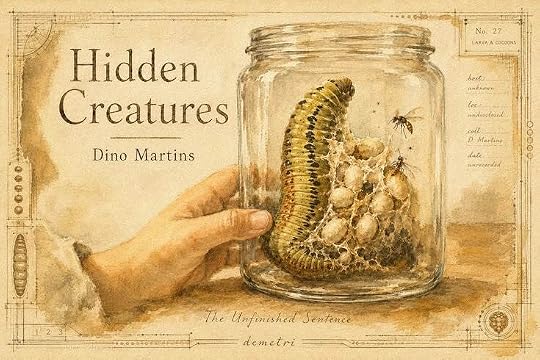
“The Unfinished Sentence” – A child’s jarred caterpillar becomes the first lesson of “Hidden Creatures”: beauty, recoil, pale cocoons, and tiny wasps held in the same unfinished act of looking.
Dino J. Martins begins “Hidden Creatures” with an education in looking after recoil. As a boy in Western Kenya, he gathers caterpillars from a pepper tree and tends them with the seriousness children reserve for small lives adults have not yet taught them to dismiss. Most become pupae. One becomes a revelation. Its body ripples with larvae; pale cocoons erupt from its skin; tiny wasps emerge; then even tinier wasps appear among them, parasites of parasites. What might have remained a scene of childhood horror becomes the book’s first discipline: the world is not a smooth skin but a set of bodies inside bodies, appetites inside appetites, lives folded into other lives. The subject is parasites. The test is whether the reader can keep looking after the body has voted to flee.
Even a generous nature writer has to make a harder case when the guest list includes pinworms, hookworms, maggots, mosquitoes, lice, fleas, ticks, botflies, tapeworms, and leeches. Fungi, as in “Entangled Life” by Merlin Sheldrake, arrive with an underground glamour. Microbes, as in “I Contain Multitudes” by Ed Yong, can be made intimate through their invisibility. Parasites, as in “Parasite Rex” by Carl Zimmer, have already had one formidable modern advocate. Martins is dealing with creatures the human imagination has long filed under trespass. His best trick is not making the reader stop saying “ew.” It is making “ew” feel like an unfinished sentence.
Martins arranges the book as an unclean parade, creature by creature, each chapter opening another jar, wound, bed seam, gut, or water trough. There is an introduction and twelve chapters, moving from worms and maggots to mosquitoes, bedbugs, botflies, tapeworms, leeches, and a closing chapter where parasite life opens into climate, travel, water, and warning. The taxonomy soon starts smelling of dung, rainwater, dog fur, and blood. Each chapter has its specimen, its life cycle, its evolutionary sleight of mouthpart. Then memory keeps breaking through the order: the pig, the horse, the dog, the child with the jar, the students peering harder than they expected to.
Early chapters show the habit in full crawl. A school pig named Miss Piggly-Pog leads to worms, dung, soil. Then come bare feet, anemia, sanitation, racialized medical fantasies, and the slow education that parasites travel through bodies, not through the categories bodies invent. A dead elephant in Tsavo becomes a lesson in maggots as heat, labor, competition, cleansing, and return. Martins cuts back the elephant’s skin and discovers not mere rot but industry. His prose does not prettify the horror. It gives the horror a job.
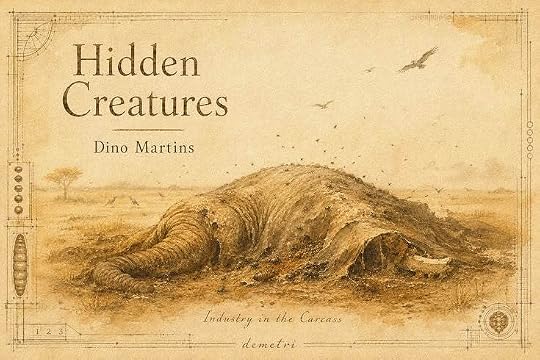
“Industry in the Carcass” – The dead elephant in Tsavo becomes neither spectacle nor horror image, but a broad field of heat, hide, flies, maggots, and hidden labor.
The prose is lush, but its best effects come from the sudden cut between beauty and bite. Martins writes in long, damp, color-rich sentences, then drops into short beats of delight, shock, or comedy. He sees lime-green grass, lemon-gold plains, pale worms, darkening pupae, mosquito larvae breathing at the surface of a puddle, leeches looping toward blood. His diction mixes scientific terminology, childhood awe, local speech, fleshly candor, and verbal overgrowth. He can move from “hyperparasitoids” to a classroom’s “monster caterpillar beast” without embarrassment, because the scientist and the child naturalist are not competing for authority. The child is not decoration; he is the first instrument.
Revulsion, in Martins’s hands, is not argued out of existence. It is given a sequence. First one flinches. Then one looks. Then one learns the route through soil, blood, bedding, water. A hookworm is sanitation, migration, skin, poverty, iron, labor, medicine, and the failure of map-thinking. In a mosquito, water and heat meet blood, Plasmodium, birds, viruses, urban adaptation, climate, and the old insult of being tiny and consequential. A flea is bedding, nests, plague, microscopy, childhood curiosity, and the shared vulnerability of domestic and wild animals.
In the strongest pages, parasites are returned to the traffic of the living without being acquitted. They steal, pierce, burrow, feed, manipulate, sicken, and kill. Yet Martins refuses the tidy human comfort of treating them as biological criminals, as if life were a landlord fantasy and the body had a clear deed. A gut is not sealed off from soil. A bed is not sealed off from travel. A dog is not sealed off from hyraxes, fleas, worms, or grief. The book’s mercy is not innocence. It is the refusal to let disgust do all the judging.
Perhaps the most moving instance comes in the tapeworm chapter, which begins not with human medical anxiety but with Mr Barabara, Martins’s Jack Russell terrier and companion in Laikipia. The chapter is tender, funny, and, eventually, quietly bruising. Barabara kills a hyrax; Martins and students examine the body; its skin and organs contain fleas, ticks, mites, worms, and an astonishing tapeworm. Later Barabara himself hosts a tapeworm, then ages, becomes ill, and dies. When Martins buries him, the parasite too emerges dying. A lesser book would have used this as a grotesque punchline. Martins turns it into a funeral with an uninvited mourner.
A similar risk governs “Parable of the Leech,” the book’s strangest formal gamble. A young shepherd named Emmanuel discovers a leech feeding at his ankle and condemns her as a thief. The leech speaks, explaining her hunger, her young, her smallness, her place among created things. The scene is perilously close to sermon; the pulpit is damp, and the preacher has excellent suction. Yet the chapter matters because it makes explicit what the rest of the book has been doing more quietly. Martins is not asking us to sentimentalize parasites. He is asking whether the imagination can widen without becoming foolish. The leech’s defense grants speech to a creature whose whole relation to us seems to be mouth.
Practical intelligence in “Hidden Creatures” does not arrive as touristic garnish; it arrives with dust on its sandals. During drought in Laikipia, Mandagoi shows how to strain leechy water through a shuka so cattle can drink without swallowing the wrong passengers. In the flea chapter, a boy named Musa and a litter of puppies become a lesson in bedding, eggs, larvae, and shared disease. In the tick chapter, students peer at ornate ticks on hippos with the seriousness usually reserved for jewels. Teaching, for Martins, is not the distribution of information from expert to novice. It is the spread of a useful itch.
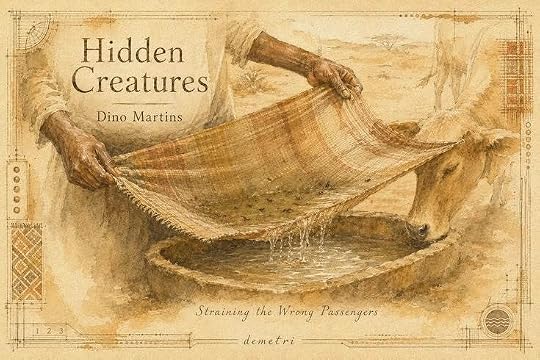
“Straining the Wrong Passengers” – Mandagoi’s shuka turns leechy water into a lesson in practical intelligence: cloth, cattle, drought, and danger handled by a knowing hand.
Against that achievement, the method has a cost. The chapters often follow the same path: lush scene, bite or burrow, life-cycle explanation, a history of water, toilets, medicine, or neglect, ecological broadening, ethical turn. The pattern trains the reader by repetition, but it also becomes easy to anticipate. By the middle of the book, one begins to know that the parasite currently making the skin crawl will soon be welcomed into a larger account of shared appetite. That account usually persuades; the pardon sometimes arrives before the itch has finished making its case.
Despite the repetition, Martins’s abundance remains difficult to resist. The problem is not that he lacks material; it is that he has almost too much of it, and too much fondness for every wriggling guest. His sentences can grow greenhouse-humid. Wonder does real work here. It can dissolve disgust. It can also soften anger, grief, and analysis into one glowing wash. Not every worm needs a garland. Not every bite needs to become a benediction. A few plainer, sterner pages would have given the lovelier ones more voltage.
Information in “Hidden Creatures” rarely descends from a clean laboratory shelf. It comes from Kenya, from classrooms and field courses, from animals Martins has cared for, from students he has taught, from dogs he has loved, from guides and herders and veterinarians, from places where parasites are not metaphors but daily terms of life. The reader does not merely receive the life cycle; one often receives the mud, smell, heat, embarrassment, animal breath, and human improvisation around it.
Mosquitoes, for instance, are never just mosquitoes here. They are larvae in puddles, bites in forests, malaria parasites moving through liver and blood, viruses in birds, and warnings about how quickly the world changes when water, heat, travel, and neglect rearrange themselves. Climate, vectors, livestock, sanitation, and frayed public trust enter through the bite marks. Martins does not need to drag relevance in by the antennae. The mosquito does it for him.
Illuminating comparisons help, though they do not quite house the book. “Parasite Rex” by Carl Zimmer remains the nearest shelf-neighbor in subject, though Martins is warmer, more autobiographical, more willing to risk tenderness. “Entangled Life” by Merlin Sheldrake is useful for hidden-world wonder, though fungi do not have to overcome quite the same public-relations problem as botflies. “I Contain Multitudes” by Ed Yong shares the lesson that a body is never singular, but Martins works with beings whose presence feels less like companionship than uninvited tenancy. The neighbors clarify the oddness without domesticating it. Field memoir, biological cabinet, public-health history, animal elegy, classroom comedy, defense brief for the bloodsucking: Martins keeps all of it moving, even when the jar fogs.
The structure does more than shelve specimens; it makes repetition a form of training. Creature by creature, the reader moves from flinch to looking, from looking to explanation, from explanation to a less flattering place among hosts, guests, and meals. Yet the structure also reveals the book’s habit of resolving difficulty into the same ethical shape. By the final third, one may occasionally wish a parasite would remain simply appalling for a page or two longer, allowed to keep its small black hat and villain music before being escorted into the choir.
Rating “Hidden Creatures” at 85/100, which corresponds to 4/5 stars, feels right because its excellence is unmistakable but needs pruning. This is vivid, generous popular natural history, memorable partly because it is not perfectly pruned. Its voice has weather, mud, dogs, classrooms, insect boxes, blood, dung, grief, and laughter in it. It is not reporting from nature’s edge. It is speaking from inside the swarm.
One should not confuse the book’s warmth with softness. Martins can be playful, but he knows that parasites make bodies pay. Hookworms drain iron. Flukes damage livers. Mosquitoes carry death from one body to another with almost insulting elegance. Fleas live in bedding and history. Bedbugs turn sleep into evidence. The book’s mercy toward parasites is therefore not innocence. It is a more demanding kind of judgment, one that insists harm and belonging can occupy the same creature.
Part of the book’s charm is also its dividing line. Readers who want lean exposition may find the prose too leafy, the self too present, the mercy too expansive. Readers who prefer nature writing safely attached to animals with fur, feathers, tusks, or large wet eyes may find the guest list inconsiderate. But those willing to sit still in the discomfort will find a book that changes the order of noticing. It does not ask for love at first bite. It asks for the second look.
Of course, the second look is not always comfortable. The JFK hotel bedbug episode works because it collapses the distance between field adventure and human vanity. The parasite is no longer in savannah grass, rainforest leaf litter, livestock dung, or a crocodile-haunted river. It is in the bed, in the seam, in travel’s little theater of clean sheets and false privacy. Martins pulls back the cover, and the unseen world has checked in before him. It has not paid extra for late checkout.
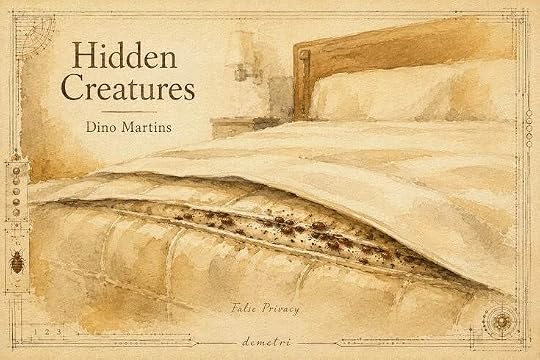
“False Privacy” – A hotel bed seam interrupts the theater of clean sheets, bringing the parasite out of the field and into the intimate architecture of human comfort.
Underneath its parasite tour, “Hidden Creatures” is about the fantasy of clean borders. Host and guest, harm and usefulness, skin and ground, science and story, revulsion and reverence: Martins does not erase these distinctions, but he makes them porous. The final chapter returns to a gorge, a dog, insects, birds, water, a praying mantis driven into the stream by hidden horsehair worms, and a rhino whose wound becomes a small theater of filarial worms, flies, and a drongo. Nearby, mistletoe draws from trees. It is not allegory imposed on nature. It is appetite, injury, and dependence caught in the same frame.
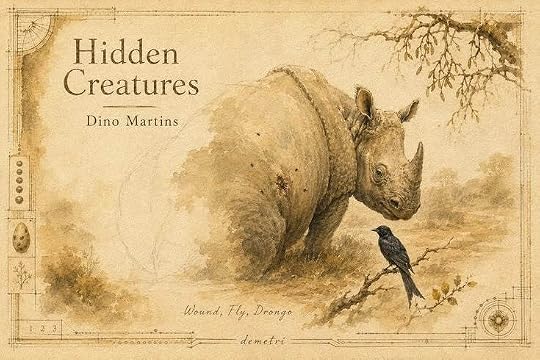
“Wound, Fly, Drongo” – A rhino’s wound, the flies that gather, the drongo nearby, and the faint branch-life around them close the sequence on appetite, injury, and dependence in one frame.
Long after the life cycles blur, what remains are not lessons but afterimages: the child with the jarred caterpillar; the elephant carcass alive with maggots; the mattress seam with its dreadful congregation of bedbugs; the students admiring ticks as if the hippo had been keeping jewels in unlikely places; Mr Barabara and the tapeworm; the leech pleading its case; the rhino standing in half-light, host to wounds and hungers not entirely its own. Martins’s gift is to make these scenes feel comic, troubling, and strangely tender without sanding off their teeth.
One leaves “Hidden Creatures” not converted into a lover of parasites, exactly. That would be too tidy, and perhaps a little suspicious. The leech remains a leech. The tick remains a tick. The botfly has not become a lifestyle brand, thank mercy. But one does leave with the reflex slightly delayed. Disgust still arrives. It no longer gets the last word merely because it arrived first.
Still, the book finally presses through sight more than thesis. A creature in light, another in shadow; a wound becoming a meal; a meal becoming flight; a tree feeding what feeds from it; the visible world threaded by small hidden hungers. Martins’s victory is not that he makes the parasite beautiful. It is that he makes contempt feel premature. In that pause – itchy, comic, unsettled, alive – the unseen world gets one more chance to appear.
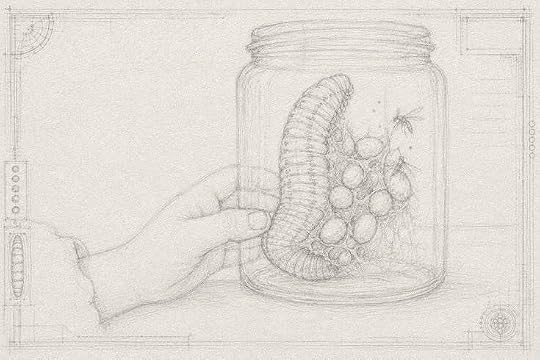
Faint Pencil Underdrawing – The first graphite scaffold maps the jar ellipse, caterpillar body, child’s fingers, cocoon clusters, and plate border before the image learns its atmosphere.
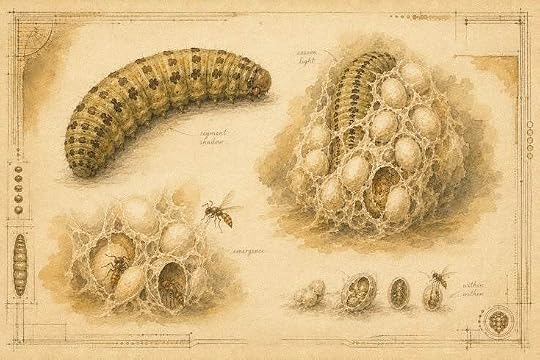
Caterpillar / Wasp Anatomical Study – A closer study of segments, cocoons, and emerging wasps turns the painting’s smallest biological event into its true center of gravity.
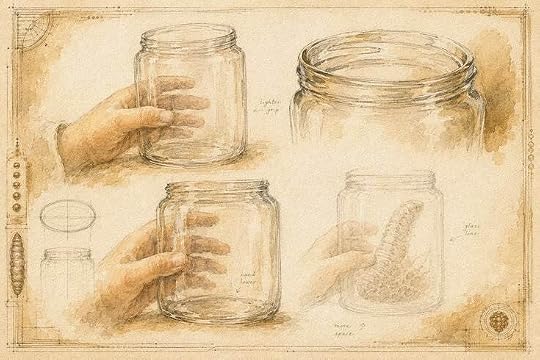
Hand and Jar Glass Study – This study works out touch, transparency, and scale, keeping the scene intimate without turning the child into the subject.
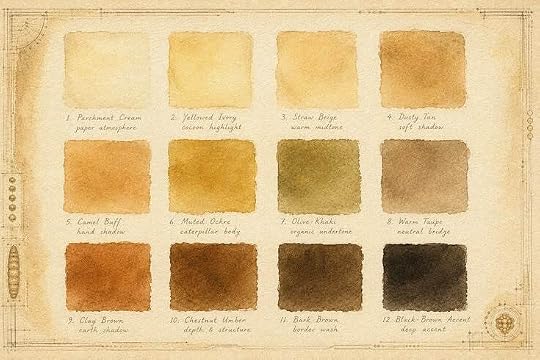
Color Swatch Sheet – Cover-derived ochres, taupes, umbers, parchment creams, khakis, clay browns, and black-brown accents establish the restrained natural-history palette for the whole image.
Watercolor Border Study – Hand-ruled graphite and partial wash test a border that feels like field notebook, specimen plate, and fragile container all at once.
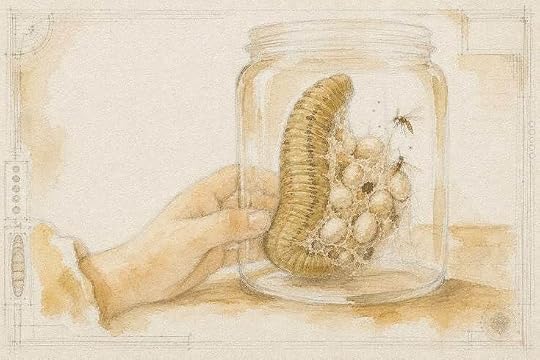
Pencil-Plus-First-Wash Stage – The first wash lets light enter the jar and paper, with the image still suspended between drawing, discovery, and the beginning of color.
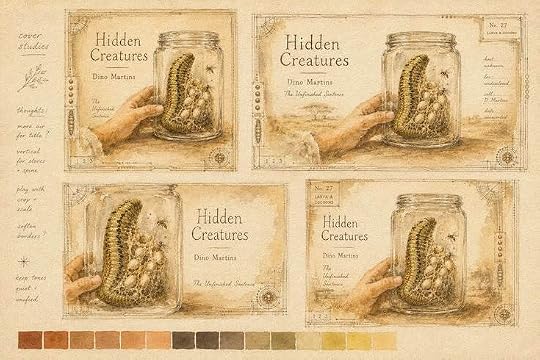
Proposed Alternative Book Cover Study – A speculative cover-like arrangement tests how “The Unfinished Sentence” might operate as an editorial object: title, specimen, border, and signature in one quiet field.
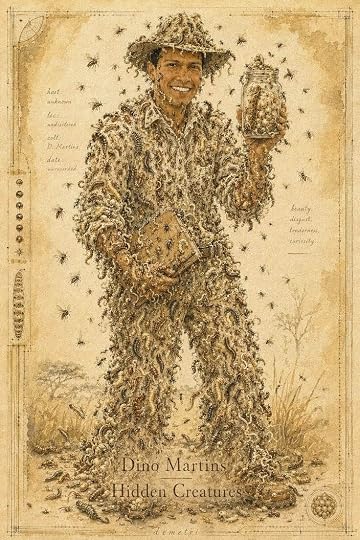
Dino Martins Covered in Hidden Creatures – A playful literary portrait of Dino Martins as living field plate, covered from hat to boots in leeches, bedbugs, wasps, worms, caterpillars, cocoons, and other small lives from “Hidden Creatures.”
All watercolor illustrations by Demetris Papadimitropoulos.
Watercolors are done on 140lb vellum and then scanned into the computer using an Epson scanner. From there, they are finalized in Procreate. All art and opinions are my own.
“Hidden Creatures” does not make parasites beautiful, but it does make contempt feel premature.
By Demetris Papadimitropoulos | June 17th, 2026
“The Unfinished Sentence” – A child’s jarred caterpillar becomes the first lesson of “Hidden Creatures”: beauty, recoil, pale cocoons, and tiny wasps held in the same unfinished act of looking.
Dino J. Martins begins “Hidden Creatures” with an education in looking after recoil. As a boy in Western Kenya, he gathers caterpillars from a pepper tree and tends them with the seriousness children reserve for small lives adults have not yet taught them to dismiss. Most become pupae. One becomes a revelation. Its body ripples with larvae; pale cocoons erupt from its skin; tiny wasps emerge; then even tinier wasps appear among them, parasites of parasites. What might have remained a scene of childhood horror becomes the book’s first discipline: the world is not a smooth skin but a set of bodies inside bodies, appetites inside appetites, lives folded into other lives. The subject is parasites. The test is whether the reader can keep looking after the body has voted to flee.
Even a generous nature writer has to make a harder case when the guest list includes pinworms, hookworms, maggots, mosquitoes, lice, fleas, ticks, botflies, tapeworms, and leeches. Fungi, as in “Entangled Life” by Merlin Sheldrake, arrive with an underground glamour. Microbes, as in “I Contain Multitudes” by Ed Yong, can be made intimate through their invisibility. Parasites, as in “Parasite Rex” by Carl Zimmer, have already had one formidable modern advocate. Martins is dealing with creatures the human imagination has long filed under trespass. His best trick is not making the reader stop saying “ew.” It is making “ew” feel like an unfinished sentence.
Martins arranges the book as an unclean parade, creature by creature, each chapter opening another jar, wound, bed seam, gut, or water trough. There is an introduction and twelve chapters, moving from worms and maggots to mosquitoes, bedbugs, botflies, tapeworms, leeches, and a closing chapter where parasite life opens into climate, travel, water, and warning. The taxonomy soon starts smelling of dung, rainwater, dog fur, and blood. Each chapter has its specimen, its life cycle, its evolutionary sleight of mouthpart. Then memory keeps breaking through the order: the pig, the horse, the dog, the child with the jar, the students peering harder than they expected to.
Early chapters show the habit in full crawl. A school pig named Miss Piggly-Pog leads to worms, dung, soil. Then come bare feet, anemia, sanitation, racialized medical fantasies, and the slow education that parasites travel through bodies, not through the categories bodies invent. A dead elephant in Tsavo becomes a lesson in maggots as heat, labor, competition, cleansing, and return. Martins cuts back the elephant’s skin and discovers not mere rot but industry. His prose does not prettify the horror. It gives the horror a job.
“Industry in the Carcass” – The dead elephant in Tsavo becomes neither spectacle nor horror image, but a broad field of heat, hide, flies, maggots, and hidden labor.
The prose is lush, but its best effects come from the sudden cut between beauty and bite. Martins writes in long, damp, color-rich sentences, then drops into short beats of delight, shock, or comedy. He sees lime-green grass, lemon-gold plains, pale worms, darkening pupae, mosquito larvae breathing at the surface of a puddle, leeches looping toward blood. His diction mixes scientific terminology, childhood awe, local speech, fleshly candor, and verbal overgrowth. He can move from “hyperparasitoids” to a classroom’s “monster caterpillar beast” without embarrassment, because the scientist and the child naturalist are not competing for authority. The child is not decoration; he is the first instrument.
Revulsion, in Martins’s hands, is not argued out of existence. It is given a sequence. First one flinches. Then one looks. Then one learns the route through soil, blood, bedding, water. A hookworm is sanitation, migration, skin, poverty, iron, labor, medicine, and the failure of map-thinking. In a mosquito, water and heat meet blood, Plasmodium, birds, viruses, urban adaptation, climate, and the old insult of being tiny and consequential. A flea is bedding, nests, plague, microscopy, childhood curiosity, and the shared vulnerability of domestic and wild animals.
In the strongest pages, parasites are returned to the traffic of the living without being acquitted. They steal, pierce, burrow, feed, manipulate, sicken, and kill. Yet Martins refuses the tidy human comfort of treating them as biological criminals, as if life were a landlord fantasy and the body had a clear deed. A gut is not sealed off from soil. A bed is not sealed off from travel. A dog is not sealed off from hyraxes, fleas, worms, or grief. The book’s mercy is not innocence. It is the refusal to let disgust do all the judging.
Perhaps the most moving instance comes in the tapeworm chapter, which begins not with human medical anxiety but with Mr Barabara, Martins’s Jack Russell terrier and companion in Laikipia. The chapter is tender, funny, and, eventually, quietly bruising. Barabara kills a hyrax; Martins and students examine the body; its skin and organs contain fleas, ticks, mites, worms, and an astonishing tapeworm. Later Barabara himself hosts a tapeworm, then ages, becomes ill, and dies. When Martins buries him, the parasite too emerges dying. A lesser book would have used this as a grotesque punchline. Martins turns it into a funeral with an uninvited mourner.
A similar risk governs “Parable of the Leech,” the book’s strangest formal gamble. A young shepherd named Emmanuel discovers a leech feeding at his ankle and condemns her as a thief. The leech speaks, explaining her hunger, her young, her smallness, her place among created things. The scene is perilously close to sermon; the pulpit is damp, and the preacher has excellent suction. Yet the chapter matters because it makes explicit what the rest of the book has been doing more quietly. Martins is not asking us to sentimentalize parasites. He is asking whether the imagination can widen without becoming foolish. The leech’s defense grants speech to a creature whose whole relation to us seems to be mouth.
Practical intelligence in “Hidden Creatures” does not arrive as touristic garnish; it arrives with dust on its sandals. During drought in Laikipia, Mandagoi shows how to strain leechy water through a shuka so cattle can drink without swallowing the wrong passengers. In the flea chapter, a boy named Musa and a litter of puppies become a lesson in bedding, eggs, larvae, and shared disease. In the tick chapter, students peer at ornate ticks on hippos with the seriousness usually reserved for jewels. Teaching, for Martins, is not the distribution of information from expert to novice. It is the spread of a useful itch.
“Straining the Wrong Passengers” – Mandagoi’s shuka turns leechy water into a lesson in practical intelligence: cloth, cattle, drought, and danger handled by a knowing hand.
Against that achievement, the method has a cost. The chapters often follow the same path: lush scene, bite or burrow, life-cycle explanation, a history of water, toilets, medicine, or neglect, ecological broadening, ethical turn. The pattern trains the reader by repetition, but it also becomes easy to anticipate. By the middle of the book, one begins to know that the parasite currently making the skin crawl will soon be welcomed into a larger account of shared appetite. That account usually persuades; the pardon sometimes arrives before the itch has finished making its case.
Despite the repetition, Martins’s abundance remains difficult to resist. The problem is not that he lacks material; it is that he has almost too much of it, and too much fondness for every wriggling guest. His sentences can grow greenhouse-humid. Wonder does real work here. It can dissolve disgust. It can also soften anger, grief, and analysis into one glowing wash. Not every worm needs a garland. Not every bite needs to become a benediction. A few plainer, sterner pages would have given the lovelier ones more voltage.
Information in “Hidden Creatures” rarely descends from a clean laboratory shelf. It comes from Kenya, from classrooms and field courses, from animals Martins has cared for, from students he has taught, from dogs he has loved, from guides and herders and veterinarians, from places where parasites are not metaphors but daily terms of life. The reader does not merely receive the life cycle; one often receives the mud, smell, heat, embarrassment, animal breath, and human improvisation around it.
Mosquitoes, for instance, are never just mosquitoes here. They are larvae in puddles, bites in forests, malaria parasites moving through liver and blood, viruses in birds, and warnings about how quickly the world changes when water, heat, travel, and neglect rearrange themselves. Climate, vectors, livestock, sanitation, and frayed public trust enter through the bite marks. Martins does not need to drag relevance in by the antennae. The mosquito does it for him.
Illuminating comparisons help, though they do not quite house the book. “Parasite Rex” by Carl Zimmer remains the nearest shelf-neighbor in subject, though Martins is warmer, more autobiographical, more willing to risk tenderness. “Entangled Life” by Merlin Sheldrake is useful for hidden-world wonder, though fungi do not have to overcome quite the same public-relations problem as botflies. “I Contain Multitudes” by Ed Yong shares the lesson that a body is never singular, but Martins works with beings whose presence feels less like companionship than uninvited tenancy. The neighbors clarify the oddness without domesticating it. Field memoir, biological cabinet, public-health history, animal elegy, classroom comedy, defense brief for the bloodsucking: Martins keeps all of it moving, even when the jar fogs.
The structure does more than shelve specimens; it makes repetition a form of training. Creature by creature, the reader moves from flinch to looking, from looking to explanation, from explanation to a less flattering place among hosts, guests, and meals. Yet the structure also reveals the book’s habit of resolving difficulty into the same ethical shape. By the final third, one may occasionally wish a parasite would remain simply appalling for a page or two longer, allowed to keep its small black hat and villain music before being escorted into the choir.
Rating “Hidden Creatures” at 85/100, which corresponds to 4/5 stars, feels right because its excellence is unmistakable but needs pruning. This is vivid, generous popular natural history, memorable partly because it is not perfectly pruned. Its voice has weather, mud, dogs, classrooms, insect boxes, blood, dung, grief, and laughter in it. It is not reporting from nature’s edge. It is speaking from inside the swarm.
One should not confuse the book’s warmth with softness. Martins can be playful, but he knows that parasites make bodies pay. Hookworms drain iron. Flukes damage livers. Mosquitoes carry death from one body to another with almost insulting elegance. Fleas live in bedding and history. Bedbugs turn sleep into evidence. The book’s mercy toward parasites is therefore not innocence. It is a more demanding kind of judgment, one that insists harm and belonging can occupy the same creature.
Part of the book’s charm is also its dividing line. Readers who want lean exposition may find the prose too leafy, the self too present, the mercy too expansive. Readers who prefer nature writing safely attached to animals with fur, feathers, tusks, or large wet eyes may find the guest list inconsiderate. But those willing to sit still in the discomfort will find a book that changes the order of noticing. It does not ask for love at first bite. It asks for the second look.
Of course, the second look is not always comfortable. The JFK hotel bedbug episode works because it collapses the distance between field adventure and human vanity. The parasite is no longer in savannah grass, rainforest leaf litter, livestock dung, or a crocodile-haunted river. It is in the bed, in the seam, in travel’s little theater of clean sheets and false privacy. Martins pulls back the cover, and the unseen world has checked in before him. It has not paid extra for late checkout.
“False Privacy” – A hotel bed seam interrupts the theater of clean sheets, bringing the parasite out of the field and into the intimate architecture of human comfort.
Underneath its parasite tour, “Hidden Creatures” is about the fantasy of clean borders. Host and guest, harm and usefulness, skin and ground, science and story, revulsion and reverence: Martins does not erase these distinctions, but he makes them porous. The final chapter returns to a gorge, a dog, insects, birds, water, a praying mantis driven into the stream by hidden horsehair worms, and a rhino whose wound becomes a small theater of filarial worms, flies, and a drongo. Nearby, mistletoe draws from trees. It is not allegory imposed on nature. It is appetite, injury, and dependence caught in the same frame.
“Wound, Fly, Drongo” – A rhino’s wound, the flies that gather, the drongo nearby, and the faint branch-life around them close the sequence on appetite, injury, and dependence in one frame.
Long after the life cycles blur, what remains are not lessons but afterimages: the child with the jarred caterpillar; the elephant carcass alive with maggots; the mattress seam with its dreadful congregation of bedbugs; the students admiring ticks as if the hippo had been keeping jewels in unlikely places; Mr Barabara and the tapeworm; the leech pleading its case; the rhino standing in half-light, host to wounds and hungers not entirely its own. Martins’s gift is to make these scenes feel comic, troubling, and strangely tender without sanding off their teeth.
One leaves “Hidden Creatures” not converted into a lover of parasites, exactly. That would be too tidy, and perhaps a little suspicious. The leech remains a leech. The tick remains a tick. The botfly has not become a lifestyle brand, thank mercy. But one does leave with the reflex slightly delayed. Disgust still arrives. It no longer gets the last word merely because it arrived first.
Still, the book finally presses through sight more than thesis. A creature in light, another in shadow; a wound becoming a meal; a meal becoming flight; a tree feeding what feeds from it; the visible world threaded by small hidden hungers. Martins’s victory is not that he makes the parasite beautiful. It is that he makes contempt feel premature. In that pause – itchy, comic, unsettled, alive – the unseen world gets one more chance to appear.
Faint Pencil Underdrawing – The first graphite scaffold maps the jar ellipse, caterpillar body, child’s fingers, cocoon clusters, and plate border before the image learns its atmosphere.
Caterpillar / Wasp Anatomical Study – A closer study of segments, cocoons, and emerging wasps turns the painting’s smallest biological event into its true center of gravity.
Hand and Jar Glass Study – This study works out touch, transparency, and scale, keeping the scene intimate without turning the child into the subject.
Color Swatch Sheet – Cover-derived ochres, taupes, umbers, parchment creams, khakis, clay browns, and black-brown accents establish the restrained natural-history palette for the whole image.
Watercolor Border Study – Hand-ruled graphite and partial wash test a border that feels like field notebook, specimen plate, and fragile container all at once.
Pencil-Plus-First-Wash Stage – The first wash lets light enter the jar and paper, with the image still suspended between drawing, discovery, and the beginning of color.
Proposed Alternative Book Cover Study – A speculative cover-like arrangement tests how “The Unfinished Sentence” might operate as an editorial object: title, specimen, border, and signature in one quiet field.
Dino Martins Covered in Hidden Creatures – A playful literary portrait of Dino Martins as living field plate, covered from hat to boots in leeches, bedbugs, wasps, worms, caterpillars, cocoons, and other small lives from “Hidden Creatures.”
All watercolor illustrations by Demetris Papadimitropoulos.
Watercolors are done on 140lb vellum and then scanned into the computer using an Epson scanner. From there, they are finalized in Procreate. All art and opinions are my own.
August 16, 2026
In Hidden Creatures Dino J. Martins explores the strange, fascinating and often horrifying world of parasites, looking at the ways they have shaped ecosystems, evolution, human history and our understanding of the natural world.
Gosh, I learnt a lot reading this one, even if some of it seemed a bit ick!! Parasites are absolutely fascinating when you get past the whole "ewww, that's inside me" aspect, and there were so many things I had never considered. A surprisingly entertaining way to learn about some very unpleasant creatures.
Gosh, I learnt a lot reading this one, even if some of it seemed a bit ick!! Parasites are absolutely fascinating when you get past the whole "ewww, that's inside me" aspect, and there were so many things I had never considered. A surprisingly entertaining way to learn about some very unpleasant creatures.

Review of advance copy received from NetGalley
Hidden Creatures by Dino Martins is a very highly recommended intriguing and accessible look into the world of parasites. Dr. Martins, an award-winning entomologist, evolutionary biologist, and professor from Kenya, examines real parasites (not that relative who always wants more) in an enthusiastic, understandable, educational, and informative manner. The complete title of the book, Hidden Creatures: Luscious Leeches, Bashful Botflies, and the Wondrous, History-Shaping World of Parasites, makes this quite clear.
Although I felt squeamish and perhaps a bit nauseous at times, I was totally engrossed throughout this informative book. Dr. Martins is a descriptive writer as well as a great teacher who takes delight in sharing his knowledge. Using a conversational tone and in poetic language he shares a plethora of fascinating, detailed information about a wide variety of parasites, their life cycles, treatments for them, as well as the interconnectedness of everything. This isn't simply a book about parasites, it's a detailed, factual book about Dr. Martins' educated, factual, and real life examinations of parasites. This makes all the difference. While reading you are experiencing remotely and at a safe distance his up close observations and interactions.
Chapters are delightfully (and the subject is a joy for Martins to discuss) are titled: 1. Practical Pinworms, Happy Hookworms and Remarkable Roundworms; 2. Marvelous Maggots; 3. Lovable Liver Flukes and Bountiful Bloodworms; 4. Magnificent Mosquitoes and Perfect Plasmodia; 5. Beautiful Bedbugs and Likable Lice; 6. Fabulous Fleas; 7. Mysterious Mites and Titillating Ticks; 8. Bashful Botflies; 9. Terrific Tapeworms; 10. Luscious Leeches; 11. Parable of the Leech; 12. Parasites Rising (And Falling); Acknowledgements and Notes. There are illustrations of various parasites included.
He said more than once while discussing parasites "Life begets death begets life," which is a poignant observation that is clearly exemplified through his elegant, immersive discussions of the various parasites that are a vital part of every ecosystem. A story of one of his experiences observing the activity surrounding an elephants corpse while collecting samples demonstrates this fact. Dr. Martins' book clearly shows the importance of really seeing and paying attention to what is going on around you every day. Also included in the text is a wealth of historical background.
The last chapter was quite interesting and begs for further studies. He discussed how the immune system of humans may be trained through the exposure to parasites and how the increase of allergies may be connected to the decrease of exposure in developed industrial areas. Allergies are rare in rural tropical areas where exposure to parasites is common. Also touched upon was the fact that there are very few new pathogens or parasites. Reports that are quick to claim something is a new foreign agent (ticks, mosquitoes) is a fallacy.
Hidden Creatures is an excellent choice for anyone interested in an accessible account of the world of parasites. I was admittedly simultaneously, fascinated, curious, disgusted, and engaged throughout the entire book. Thanks to Knopf Doubleday for providing me with an advance reader's copy via NetGalley. My review is voluntary and expresses my honest opinion.
http://www.shetreadssoftly.com/2026/0...
Although I felt squeamish and perhaps a bit nauseous at times, I was totally engrossed throughout this informative book. Dr. Martins is a descriptive writer as well as a great teacher who takes delight in sharing his knowledge. Using a conversational tone and in poetic language he shares a plethora of fascinating, detailed information about a wide variety of parasites, their life cycles, treatments for them, as well as the interconnectedness of everything. This isn't simply a book about parasites, it's a detailed, factual book about Dr. Martins' educated, factual, and real life examinations of parasites. This makes all the difference. While reading you are experiencing remotely and at a safe distance his up close observations and interactions.
Chapters are delightfully (and the subject is a joy for Martins to discuss) are titled: 1. Practical Pinworms, Happy Hookworms and Remarkable Roundworms; 2. Marvelous Maggots; 3. Lovable Liver Flukes and Bountiful Bloodworms; 4. Magnificent Mosquitoes and Perfect Plasmodia; 5. Beautiful Bedbugs and Likable Lice; 6. Fabulous Fleas; 7. Mysterious Mites and Titillating Ticks; 8. Bashful Botflies; 9. Terrific Tapeworms; 10. Luscious Leeches; 11. Parable of the Leech; 12. Parasites Rising (And Falling); Acknowledgements and Notes. There are illustrations of various parasites included.
He said more than once while discussing parasites "Life begets death begets life," which is a poignant observation that is clearly exemplified through his elegant, immersive discussions of the various parasites that are a vital part of every ecosystem. A story of one of his experiences observing the activity surrounding an elephants corpse while collecting samples demonstrates this fact. Dr. Martins' book clearly shows the importance of really seeing and paying attention to what is going on around you every day. Also included in the text is a wealth of historical background.
The last chapter was quite interesting and begs for further studies. He discussed how the immune system of humans may be trained through the exposure to parasites and how the increase of allergies may be connected to the decrease of exposure in developed industrial areas. Allergies are rare in rural tropical areas where exposure to parasites is common. Also touched upon was the fact that there are very few new pathogens or parasites. Reports that are quick to claim something is a new foreign agent (ticks, mosquitoes) is a fallacy.
Hidden Creatures is an excellent choice for anyone interested in an accessible account of the world of parasites. I was admittedly simultaneously, fascinated, curious, disgusted, and engaged throughout the entire book. Thanks to Knopf Doubleday for providing me with an advance reader's copy via NetGalley. My review is voluntary and expresses my honest opinion.
http://www.shetreadssoftly.com/2026/0...

Review of advance copy received from NetGalley
I'm not sure if it's possible for book centered around the world of parasites to be both intellectually satisfying and surprisingly poetic in presentation, but those are the two experiences I kept having with "Hidden Creatures: Luscious Leeches, Bashful Botflies, and the Wondrous History-Shaping World of Parasites," a literary adventure put forth by lifelong parasite devotee and wonderdude Dr. Dino J. Martins.
Martins doesn't compromise on the facts here, immersing us in more than we could ever want to know about this world in which he's spent his entire life. However, there's also a remarkably adorable passion that unfolds here that will have you rethinking these misunderstood creatures and very likely wishing you'd stumble across this enthusiastic scientific hero and his ability to both demystify these creatures in a way that's both accessible and endearing.
In addition to leeches, botflies, and parasites (oh my), Dr. Martins introduces us to the tapeworm, a remarkable being that can grow 120 feet in length within the gut of a whale. We learn bunches about the tsetse fly and a whole lot more.
I can't say that "Hidden Creatures" will make you fall in love with parasites, but it sure will give you a deeper appreciation for how these creatures are a vital part of every ecosystem and, in some cases, their nasty reputation is quite undeserved.
Dr. Martins is an award-winning entomologist and biologist from Kenya. He's devoted his life to demystifying these fascinating beings he presents here. By the end, you'll be thankful he does.
I will confess that I occasionally struggled with the tonal rhythms of "Hidden Creatures," Dr. Martins occasionally waxing a little too eloquently. However, it's his enthusiasm that's so infectious and that's what really shines through here while we're being both informed and engaged with his world.
And what an amazing world it is. Dr. Martins takes us around the world with his hosts and collaborators. We learn about places most of us have never been. We learn about animals and parasites most of us have spent a lifetime trying to avoid. I'm not running off to the Amazon anytime soon, but I certainly have enjoyed reading about the adventures of someone who has done so.
With delightful insights and an almost childlike curiosity, Dr. Martins has crafted one of the year's most unique reading adventures. For those who enter this world, Dr. Martins has crafted a literary adventure for those willing to open themselves to an entirely new aspect of history and the world we live in.
Martins doesn't compromise on the facts here, immersing us in more than we could ever want to know about this world in which he's spent his entire life. However, there's also a remarkably adorable passion that unfolds here that will have you rethinking these misunderstood creatures and very likely wishing you'd stumble across this enthusiastic scientific hero and his ability to both demystify these creatures in a way that's both accessible and endearing.
In addition to leeches, botflies, and parasites (oh my), Dr. Martins introduces us to the tapeworm, a remarkable being that can grow 120 feet in length within the gut of a whale. We learn bunches about the tsetse fly and a whole lot more.
I can't say that "Hidden Creatures" will make you fall in love with parasites, but it sure will give you a deeper appreciation for how these creatures are a vital part of every ecosystem and, in some cases, their nasty reputation is quite undeserved.
Dr. Martins is an award-winning entomologist and biologist from Kenya. He's devoted his life to demystifying these fascinating beings he presents here. By the end, you'll be thankful he does.
I will confess that I occasionally struggled with the tonal rhythms of "Hidden Creatures," Dr. Martins occasionally waxing a little too eloquently. However, it's his enthusiasm that's so infectious and that's what really shines through here while we're being both informed and engaged with his world.
And what an amazing world it is. Dr. Martins takes us around the world with his hosts and collaborators. We learn about places most of us have never been. We learn about animals and parasites most of us have spent a lifetime trying to avoid. I'm not running off to the Amazon anytime soon, but I certainly have enjoyed reading about the adventures of someone who has done so.
With delightful insights and an almost childlike curiosity, Dr. Martins has crafted one of the year's most unique reading adventures. For those who enter this world, Dr. Martins has crafted a literary adventure for those willing to open themselves to an entirely new aspect of history and the world we live in.
Review of advance copy received from NetGalley
2026 06 22 Review of Hidden Creatures by Dino J. Martins, William Collins, 2026
. Thanks to NetGalley and to the publishers.
This book delighted, surprised and intrigued me. It will appeal to a wide range of readers, to lovers of nature, of human history and of clear and engaging writing.
The author is not only a parasitologist, entomologist and evolutionary biologist but also an inspiring writer. He provides numerous evocative and descriptive anecdotes, including his account of the richness of life feeding on a dead elephant and his own experience of being fed upon by leeches in Borneo. These often poetically breathtaking accounts transport us to a variety of places.
The book comprises 12 chapters, each dealing with different types of parasites. The chapter headings bemused me somewhat at first: headings like “Marvelous Maggots’ or “Luscious Leeches”. How could these creatures deserve such accolades? By the time we have read each chapter, it is clear that these epithets are justly deserved.
The author describes the life cycles of a variety of different parasites that inhabit an astonishing range of species, including humans, on the planet. Dino Martins, the author, is a respected parasitologist and there is nothing dry about his descriptions of how these animals live, reproduce and are transmitted. I became fascinated by the multitude and variety of these creatures. Hidden creatures, indeed, in that many (but not all) go through all stages of their lives unnoticed by their victims.
The book is wide-ranging. As well as finding out how a dead elephant is returned to the ecosystem, we learn about the evolution of elephants. The impact of parasites on humans is treated in depth, physically, culturally and socially. We learn how they have adversely affected a range of cultures from ancient to modern times and how the problems have been discovered and tackled.
It could truly be said that the history of parasites and parasitology is the history of humanity. I wholeheartedly recommend this book.
This book delighted, surprised and intrigued me. It will appeal to a wide range of readers, to lovers of nature, of human history and of clear and engaging writing.
The author is not only a parasitologist, entomologist and evolutionary biologist but also an inspiring writer. He provides numerous evocative and descriptive anecdotes, including his account of the richness of life feeding on a dead elephant and his own experience of being fed upon by leeches in Borneo. These often poetically breathtaking accounts transport us to a variety of places.
The book comprises 12 chapters, each dealing with different types of parasites. The chapter headings bemused me somewhat at first: headings like “Marvelous Maggots’ or “Luscious Leeches”. How could these creatures deserve such accolades? By the time we have read each chapter, it is clear that these epithets are justly deserved.
The author describes the life cycles of a variety of different parasites that inhabit an astonishing range of species, including humans, on the planet. Dino Martins, the author, is a respected parasitologist and there is nothing dry about his descriptions of how these animals live, reproduce and are transmitted. I became fascinated by the multitude and variety of these creatures. Hidden creatures, indeed, in that many (but not all) go through all stages of their lives unnoticed by their victims.
The book is wide-ranging. As well as finding out how a dead elephant is returned to the ecosystem, we learn about the evolution of elephants. The impact of parasites on humans is treated in depth, physically, culturally and socially. We learn how they have adversely affected a range of cultures from ancient to modern times and how the problems have been discovered and tackled.
It could truly be said that the history of parasites and parasitology is the history of humanity. I wholeheartedly recommend this book.

July 11, 2026
Number one: as a newly budding microbiologist, this book was gold. As someone with a brain that appreciates a greatly written non-fiction book: this book was gold.
It was greatly woven into personal stories, fab nuggets of knowledge and field trip discoveries. It’s a book for every kind of reader (depending on whether you have the stomach for disgustingly cool parasites. It’s not everyone’s cup of tea so readers discretion advised). But I think even the parasite avoidant will develop a new appreciation for these crafty creatures who, like many, are just in the business of living their lives.
Each chapter was dedicated to a different parasite, whether ecto or endo, worm, mite (or my personal favourite tick: I know I’m wierd I have a favourite parasite I love to hate). And it was all so interesting, icky and clever. I also loved the history of some of the parasites included too. They really are a richly woven tapestry.
And who knew, this book would actually introduce a new parasite interest to me - leeches! And I was also prompted to dive into further research and learn more about them (a leech farm in Swansea I was awed by. I didn’t know this practice still survived much in medicine). I’m not far from Swansea, this was an intrigue!!
As someone who specialises in parasites and is currently trying to make a career in this direction, this book was awesome and I thoroughly enjoyed reading it. Kudos to the author! Thank you for sharing your experiences and your enthusiasm and extensive knowledge in this field.
Thank you to the author and publisher for this book on NetGalley in return for my honest thoughts and review.
It was greatly woven into personal stories, fab nuggets of knowledge and field trip discoveries. It’s a book for every kind of reader (depending on whether you have the stomach for disgustingly cool parasites. It’s not everyone’s cup of tea so readers discretion advised). But I think even the parasite avoidant will develop a new appreciation for these crafty creatures who, like many, are just in the business of living their lives.
Each chapter was dedicated to a different parasite, whether ecto or endo, worm, mite (or my personal favourite tick: I know I’m wierd I have a favourite parasite I love to hate). And it was all so interesting, icky and clever. I also loved the history of some of the parasites included too. They really are a richly woven tapestry.
And who knew, this book would actually introduce a new parasite interest to me - leeches! And I was also prompted to dive into further research and learn more about them (a leech farm in Swansea I was awed by. I didn’t know this practice still survived much in medicine). I’m not far from Swansea, this was an intrigue!!
As someone who specialises in parasites and is currently trying to make a career in this direction, this book was awesome and I thoroughly enjoyed reading it. Kudos to the author! Thank you for sharing your experiences and your enthusiasm and extensive knowledge in this field.
Thank you to the author and publisher for this book on NetGalley in return for my honest thoughts and review.

July 7, 2026
At times inducing a squeamish response, Dino J. Martins Hidden Creatures bravely explores the histories and lives of a wide variety of parasites. As a teacher, researcher, academic and traveler, Martins keeps the narrative highly engaging by switching between these different roles and views, making the work both factual engaging and personal.
Hidden Creatures has 12 chapters, most of them focused on at least two different parasites. Martins frequently begins from his own personal experience with the creatures from his youth or fieldwork and teaching. Chapter 2's focus on maggots is visceral in talking through how one would capture samples from their natural feast site, and the titles of all chapters speak to the evolutionary wonder or capabilities of the different parasites. They evolved and changed to fill their current niches and Martins treats them all as marvels.
It is a global journey, that also reflects Martins life experience having been born in Kenya and studied int he United States. His writer biography notes that he is "an award-winning entomologist and evolutionary biologist. A professor at Stony Brook University, he has served as the director of the Turkana Basin Institute in Kenya, founded by Dr. Richard Leaky and previously as the director of the Mpala Research Centre."
Recommended to readers of wonders of the natural world, themed travelogues or the importance of curiosity and exploration.
I received a free digital version of this book via NetGalley thanks to the publisher.
Hidden Creatures has 12 chapters, most of them focused on at least two different parasites. Martins frequently begins from his own personal experience with the creatures from his youth or fieldwork and teaching. Chapter 2's focus on maggots is visceral in talking through how one would capture samples from their natural feast site, and the titles of all chapters speak to the evolutionary wonder or capabilities of the different parasites. They evolved and changed to fill their current niches and Martins treats them all as marvels.
It is a global journey, that also reflects Martins life experience having been born in Kenya and studied int he United States. His writer biography notes that he is "an award-winning entomologist and evolutionary biologist. A professor at Stony Brook University, he has served as the director of the Turkana Basin Institute in Kenya, founded by Dr. Richard Leaky and previously as the director of the Mpala Research Centre."
Recommended to readers of wonders of the natural world, themed travelogues or the importance of curiosity and exploration.
I received a free digital version of this book via NetGalley thanks to the publisher.

Review of advance copy received from NetGalley
At once beautiful and gruesome, this book shines a spotlight on the misunderstood world of parasites. The author’s love of nature is manifest, depicting a leech in the same loving way as a puppy. Dr. Dino’s descriptive prose brings everything vividly to life, which is an asset when speaking about the sunset in the African savanna, but not so great when discussing parasitic infestations. I found the ghastliest parts fascinating; but didn’t love all the animal death. The author says more than once how life begets death begets life, but that part is sad. Being a book about scientists, there is also a bit of animal experimentation, so reader beware. With regards to the content, it’s illuminating how these little creatures have influenced the world so much. The writing is approachable, never too technical, and Dr. Dino tries to make lessons fun. That said, it seemed a little long to me: besides the content, the author adds where he was and with whom and what everyone said (including the original dialogue in the native language and the translation into English). I can see how he was trying to make the book more relatable, but eventually it got a little tiresome. Still, I enjoyed the read.
I chose to read this book and all opinions in this review are my own and completely unbiased. Thank you, NetGalley/Knopf, Pantheon, Vintage, and Anchor.
I chose to read this book and all opinions in this review are my own and completely unbiased. Thank you, NetGalley/Knopf, Pantheon, Vintage, and Anchor.

July 26, 2026
A big Thank you to @aaknopf for sharing with me 𝑯𝑰𝑫𝑫𝑬𝑵 𝑪𝑹𝑬𝑨𝑻𝑼𝑹𝑬𝑺 : 𝑳𝒖𝒔𝒄𝒊𝒐𝒖𝒔 𝑳𝒆𝒆𝒄𝒉𝒆𝒔, 𝑩𝒂𝒔𝒉𝒇𝒖𝒍 𝑩𝒐𝒕𝒇𝒍𝒊𝒆𝒔, 𝒂𝒏𝒅 𝒕𝒉𝒆 𝑾𝒐𝒏𝒅𝒆𝒓𝒐𝒖𝒔, 𝑯𝒊𝒔𝒕𝒐𝒓𝒚-𝑺𝒉𝒂𝒑𝒊𝒏𝒈 𝑾𝒐𝒓𝒍𝒅 𝒐𝒇 𝑷𝒂𝒓𝒂𝒔𝒊𝒕𝒆𝒔 𝒃𝒚 𝑫𝒊𝒏𝒐 𝑴𝒂𝒓𝒕𝒊𝒏𝒔 available now!
When I saw the cover and title, I could not resist asking for this one, and it has been a pure, freakish delight!
Arranged in chapters of creatures, beginning with a tale of a parasitic wasp, and the fascination of the unseen, Martins invites readers into his joy of learning about parasites!
This is a very accessible book, with drawn illustrations, that gives a story to introduce the species being discussed and goes on to give a fascinating mini lesson. It is clear there is an immense joy of the tiny "misunderstood" creatures, and Martin is giving it his all to change the "ick" into a more open sense of wonder. I bounced around from one critter to another, my interest holding throughout.
Honestly, I was glued to the pages, not expecting to be so morbidly fascinated. I can't say I was moved to the level of embracing that the author tried to imbue, but I did thoroughly enjoy the worldwide stories he presents and will be keeping this book for all my curiosity references.
⭐️⭐️⭐️⭐️💫
When I saw the cover and title, I could not resist asking for this one, and it has been a pure, freakish delight!
Arranged in chapters of creatures, beginning with a tale of a parasitic wasp, and the fascination of the unseen, Martins invites readers into his joy of learning about parasites!
This is a very accessible book, with drawn illustrations, that gives a story to introduce the species being discussed and goes on to give a fascinating mini lesson. It is clear there is an immense joy of the tiny "misunderstood" creatures, and Martin is giving it his all to change the "ick" into a more open sense of wonder. I bounced around from one critter to another, my interest holding throughout.
Honestly, I was glued to the pages, not expecting to be so morbidly fascinated. I can't say I was moved to the level of embracing that the author tried to imbue, but I did thoroughly enjoy the worldwide stories he presents and will be keeping this book for all my curiosity references.
⭐️⭐️⭐️⭐️💫
Review of advance copy received from NetGalley
I really enjoyed this book as a foray into the world of parasites. There's a lot of joy and wonder for the natural world captured in the writing style here. The book focuses a lot on Africa, especially Kenya where the writer is based, where parasite-caused diseases are common and devastating. I really liked the perspective that this book offers, and really enjoyed learning about the work of naturalists there. I would note that the style of this book is more akin to nature writing than popular science writing, but the writer's background does mean that all the science present is rigorous. Some bits of the book that I really enjoyed was the history of parasites, how they were discovered, the researchers behind it and also the cultural impact. But the most touching parts were the ones that were deeply human (is that the right adjective, when other animals mourn too?), where the writer grieves the loss of an animal that was important to him.
Thank you to NetGalley and Knopf for the ARC.
Thank you to NetGalley and Knopf for the ARC.

August 6, 2026
Thank you to Alfred A. Knopf for this gifted copy!
As an epidemiologist, I’ve always been fascinated by parasites, especially their public health implications, so this book was right up my alley, and it did not disappoint. Hidden Creatures moves methodically through each type of parasite, and I came away feeling genuinely well-informed rather than just entertained.
One of the biggest surprises for me was learning just how much of the world’s biomass and biodiversity parasites actually make up. It’s a staggering amount, and something I hadn’t fully appreciated even with my background. The book is packed with the kind of facts that stick with you long after you finish reading. I’ve already found myself sharing them with anyone who’ll listen.
Highly recommend for anyone curious about the natural world, public health, or the hidden (pun intended) forces shaping ecosystems we rarely think about.
As an epidemiologist, I’ve always been fascinated by parasites, especially their public health implications, so this book was right up my alley, and it did not disappoint. Hidden Creatures moves methodically through each type of parasite, and I came away feeling genuinely well-informed rather than just entertained.
One of the biggest surprises for me was learning just how much of the world’s biomass and biodiversity parasites actually make up. It’s a staggering amount, and something I hadn’t fully appreciated even with my background. The book is packed with the kind of facts that stick with you long after you finish reading. I’ve already found myself sharing them with anyone who’ll listen.
Highly recommend for anyone curious about the natural world, public health, or the hidden (pun intended) forces shaping ecosystems we rarely think about.

September 21, 2026
Ah, this is exactly my taste of non-fiction: science, written with the adoration of a lover. Look, I actually have very little interest in parasites, seeing them in person pealing out of obstructed bowels is more than enough thanks, but I am a sucker for a good field-memoir. I especially love that the author is African (like, grew-up-in-Africa-African) and that he shares part of his life story, as well as his academic journey. Hidden Creatures is filled with love both for nature and for teaching young mind, and if I were a student, I would attend his classes for sure.
I’ve seen some reviewers call the narration “insufferable” (rude!), but I guess this depends on what you like. For me, Martins’s naturalist way of writing and thinking points towards distinction as a storyteller and an academic, and I find it wonderful. But, sure, if you’re looking for a dry academic work, then maybe this isn’t for you.
I’ve seen some reviewers call the narration “insufferable” (rude!), but I guess this depends on what you like. For me, Martins’s naturalist way of writing and thinking points towards distinction as a storyteller and an academic, and I find it wonderful. But, sure, if you’re looking for a dry academic work, then maybe this isn’t for you.

Review of advance copy received from NetGalley
I received an advance copy of this book from NetGalley. What a lovely book! One might think that with such a topic this would either be graphic and stomach twisting or dry, but, for the most part it is neither. Tha author has a deep and long fascination with his subject and while parts of the book when he recounts scientific history and nomenclature are a little slow, the sections where he moves out into observation are rich with description. Not only will you learn about some of the most important creature affecting animal and human life on earth, but large parts of the book are written as narrative that takes you into the East African savannah and other research areas. I will definitely use sections of this book with my high school students who are learning about parasite life cycles but I would recommend it as vivid nature writing for others also.

July 28, 2026
Fascinating book: one part clear and well written descriptions of a huge number of parasites, highlighting the complexity of the world, which most of us interact with on a very superficial level.
But the other part is a horror story. Who knew how many deadly (or just uncomfortable) diseases we risk everything we leave the house—or go to bed, or wash your face, or do almost anything! Parasites are everywhere, patiently waiting for a chance to hitch a ride on the right host—which could be your beloved pet dog or cat, or YOU!
Whether you find this book illuminating or terrifying (or like me, both), it is an excellent read.
One note: there is a lot of Latin naming, but you can easily get the gist of what he is saying without knowing what all those Patin phrases/names mean. In sum, for a serious science book, this one is very approachable by non-scientists.
But the other part is a horror story. Who knew how many deadly (or just uncomfortable) diseases we risk everything we leave the house—or go to bed, or wash your face, or do almost anything! Parasites are everywhere, patiently waiting for a chance to hitch a ride on the right host—which could be your beloved pet dog or cat, or YOU!
Whether you find this book illuminating or terrifying (or like me, both), it is an excellent read.
One note: there is a lot of Latin naming, but you can easily get the gist of what he is saying without knowing what all those Patin phrases/names mean. In sum, for a serious science book, this one is very approachable by non-scientists.

September 10, 2026
Parasites. Eww, they're nasty!! But I have a little boy's fascination with disgusting things. He had me hooked with the picture of the horrid thing on the cover. I have read other books about parasites, and though this one was decent, it was a little bit too basic for me and did not teach me much that I did not already know. I wanted to learn more about the parasites that manipulate the brains of their hosts. I wanted to learn more about how parasite/host relationships evolved. I wanted to learn more about how parasites have spread and changed over time. All of these things are touched on, but only at the end and not in enough depth to satisfy me. I think that Dino Martins could write a really great parasite book if he just scaled it up a notch for an audience more interested in the details of the science. This one didn't quite get there for me.

Review of advance copy received from Netgalley
Hidden Creatures by Dino J. Martins is a love letter to the most misunderstood of Earth’s creatures. Interspersed with personal anecdotes and historical timelines, Dr. Martins holds your hand as he shows you the beauty he sees in every leech and horsehair worm he comes across.
This book is cozy, poetic, and brimming with kindness and curiosity. Never in my life have I been so eager to image search bugs so that I can see their coloring and patterns.
If you like nature and science documentaries, or just want a hopeful, optimistic read in these trying times, let Dr. Martins paint you a soothing word picture featuring primarily blood-sucking insects.
Thank you Knopf for providing this advance copy for review via NetGalley. All opinions are my own.
This book is cozy, poetic, and brimming with kindness and curiosity. Never in my life have I been so eager to image search bugs so that I can see their coloring and patterns.
If you like nature and science documentaries, or just want a hopeful, optimistic read in these trying times, let Dr. Martins paint you a soothing word picture featuring primarily blood-sucking insects.
Thank you Knopf for providing this advance copy for review via NetGalley. All opinions are my own.

Review of advance copy received from NetGalley
Okay, so I am a curious mind. I am always wondering what is underneath, what's inside, what grows because of death or eats it or needs... and boy oh boy did this book inform me! I had a blast learning all about pinworms, maggots, bloodworms, botflies, tapeworms, leeches, parasites and more! This book is packed full with not only natures undesirables but with the authors stories about how he came to encounter and study each of these, shall I say delightful, little creatures!
The title says it all, Hidden Creatures is a fascinating read and one for the person in your life who is always asking the question, interested in how disease carries, wants to know how nature decomposes and refreshes life and all the "things" in between. I really had a bast with this book.
The title says it all, Hidden Creatures is a fascinating read and one for the person in your life who is always asking the question, interested in how disease carries, wants to know how nature decomposes and refreshes life and all the "things" in between. I really had a bast with this book.

Review of advance copy received from Publisher
This book caught me off guard. It absolutely delivered on the skin crawling facts of various creepy crawly parasites. What I wasn't expecting, was to have those facts delivered in such a poetic, almost beautiful way. The enthusiasm that Martins has for his field shines through in his words. He loves what he does and has such an intense thirst for knowledge about these small creatures who are often the subjects of nightmares. Each scene was set in such a way that I felt almost like I was reading a fiction novel about scientists on location. Not only does he cover the parasites, but also the world around them and how they are interconnected with everything from flora and fauna to humans.
I received this gifted arc from the publisher and all thoughts in this review are my own.
I received this gifted arc from the publisher and all thoughts in this review are my own.

dnf-stalled
August 17, 2026I received this for review, and I actually typically like reading and learning about various creatures and nature. But, pinworms….maggots…I guess I can’t handle reading about them. I gave this one a few chapters and was just too creeped out thinking about various creatures in my intestines, in the intestines of cattle, and crawling around in our dirt, the sand at the beach, and more. I was also dealing with my own unknown bug/tick/spider bite that was causing some health issues, and so reading this book made me freak out even more.
Martin’s research is impeccable, and I think if you like learning about these types of creatures, then by all means, definitely read this book. He is the expert in this area. I guess I just have too much of a weak stomach for this one.
Martin’s research is impeccable, and I think if you like learning about these types of creatures, then by all means, definitely read this book. He is the expert in this area. I guess I just have too much of a weak stomach for this one.

September 24, 2026
Seldom have I come across a work simultaneously so disgustingly skin-crawling and yet written with a sense of wonder and whimsy as this. Martins penned a classic that is a cross between the ethos that modern horror aims at but never achieves and a James Harriot aw-shucks scientific overview of the most revolting creatures we share the earth with. I'm kind of baffled that this didn't get more attention this year - I guess it will fly under the radar of top books where it belongs mainly due to subject matter, but it certainly deserves top placement due to subject matter expertise and writing skill. It even has many touching moments (well, too many touching moments TBH) - I won't forget Mr. Barbara any time soon either. This is definitely All Creatures Small & Nasty.

Review of advance copy received from Publisher
4.5 rounded up. Happy pub day to this gross and lovely book. I really never thought I'd read a book about parasites, let alone actually enjoy it, but Dino Martins really drew me in immediately with his writing, enthusiasm, and ability to make compilated scienced understandable and interesting. I especially loved learning about the historical context of these parasites and the scientists that discovered them. You can tell he is a great teacher, and you get a little taste of being his student as he draws you in to this honestly very gross but fascinating world, I groaned and grimaced too many times to count. This book really shows how we are all connected and the political choices that are affecting the climate bring us all even closer as parasites and pandemics don't care about borders. I read a physical copy of this book, but I bet this will be an excellent audiobook, especially while on a nature walk. I read a lot of this book while sitting outside in my yard and found myself slowing down a bit more to look at the bugs that landed around and on me.
Thank you to the publisher, Knopf, for the advanced reader copy of this book.
Thank you to the publisher, Knopf, for the advanced reader copy of this book.
Displaying 1 - 30 of 56 reviews