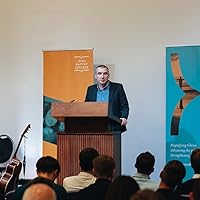
Vern Sheridan Poythress was born in 1946 in Madera, California, where he lived with his parents Ransom H. Poythress and Carola N. Poythress and his older brother Kenneth R. Poythress. After teaching mathematics for a year at Fresno State College (now California State University at Fresno), he became a student at Westminster Theological Seminary, where he earned an M.Div. (1974) and a Th.M. in apologetics (1974). He received an M.Litt. in New Testament from University of Cambridge (1977) and a Th.D. in New Testament from the University of Stellenbosch, Stellenbosch, South Africa (1981).
He has been teaching in New Testament at Westminster Theological Seminary in Philadelphia since 1976. In 1981 he was ordained as a teaching elder in the Reformed Presbyterian Church Evangelical Synod, which has now merged with the Presbyterian Church in America.
More information about his teaching at Westminster can be found at the Westminster Seminary website.
Dr. Poythress studied linguistics and Bible translation at the Summer Institute of Linguistics in Norman Oklahoma in 1971 and 1972, and taught linguistics at the Summer Institute of Linguistics in the summers of 1974, 1975, and 1977. He has published books on Christian philosophy of science, theological method, dispensationalism, biblical law, hermeneutics, Bible translation, and Revelation. A list of publications is found on this website.
Dr. Poythress married his wife Diane in 1983, and they have two children, Ransom and Justin. He has side interests in science fiction, string figures, volleyball, and computers.
The family lived on a farm until he was five years old. When he was nine years old he made a public commitment to Christ and was baptized in Chowchilla First Baptist Church, Chowchilla, California. The family later moved to Fresno, California, and he graduated from Bullard High School in Fresno.
He earned a B.S. in mathematics from California Institute of Technology (1966) and a Ph.D. in mathematics from Harvard University (1970).
A primer on mediatorship from Old Testament to New. Newer believers just beginning to read Scripture to the older, more seasoned Christians will find it useful. Some beautiful observations inside - such as how Esther is actually an image of Christ the Mediator. It is worth your time.
Vern Poythress writes in a very simple style that might trick you into thinking he doesn't have much to say. I may have fallen into that trap in the past. But everyone who knows him says he is a genius, and I don't doubt them. And I believe his refusal to be flashy serves him well in this work (and also commends his personal character).
Poythress' goal seems simple--to walk through the various means that God uses to mediate his presence to his people, whether it be angels or the ark or any number of things. He then shows how these mediators prefigure the threefold office of prophet, priest, and king. At times the work seemed : simply an exposition of that office, though Poythress does bring in other themes as well, such as the point that mediators consistently suffer in Scripture.
I particularly appreciated his care with the many theophanies in the OT (the author has written an entire book on that subject). He never says, "That's Jesus!" Instead he shows how those revelations : foreshadow the Coming One. I find that to be a helpful interpretative move.
The NT portion of the book is surprisingly short. Poythress does not full together the myriad threads he's been spinning throughout the bulk of the work. I guess he is leaving that to the reader. But he does point to Christ while also showing how in his opinion the church serves as a mediator. I have long been unconvinced of the church's role as prophet, priest, and king, but he does make a few good points. I'll have to keep thinking. Among others, that's a sign of a well-written book.
It was interesting to take a tour through the Bible and consider the various ways God has used created things to mediate His authority, power, and presence to the world. I had never really thought about Scripture in quite this way before, and I found the approach intriguing.
Perhaps the most surprising idea for me was the suggestion that the tree of the knowledge of good and evil was intended to teach Adam and Eve discernment and knowledge while keeping them pure—forming in them the ability to resist temptation. Of course, that is not how this mediatorial “living object” functioned in the end.
One question I am left with concerns how broadly the category of “mediator” is applied to people, objects, and angels. Scripture is very clear that Jesus is the one Mediator between God and man. I found myself wondering whether that clarity becomes somewhat less distinct within the scope of this book’s broader thesis. That is the question I am left with.
A fine example of biblical theology at the lay level. There’s a helpful focus on mediation through the offices of prophet, king and priest. Early in the book there are some other mediatorial elements identified which could have been profitably pursued later in the book but sadly weren’t. Overall, useful.