

What do you think?
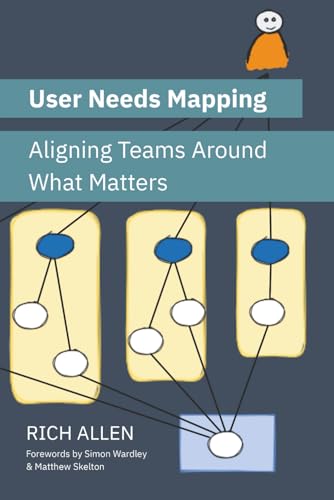
User Needs Mapping: Aligning Teams Around What Matters
Most teams don’t suffer from a lack of effort — they suffer from a lack of alignment. Misaligned goals, unclear boundaries, and a focus on internal priorities over real user needs leads to frustration, delays, and wasted potential.
User Needs Mapping offers a practical, visual method for reconnecting your organisation to the people it’s meant to serve. Whether you're leading a digital transformation, evolving your team structures, or simply trying to reduce friction and focus on what matters most, this book gives you the tools
Expose hidden dependencies and misaligned responsibilities
Identify and articulate genuine user needs — internal or external
Make better decisions about team design, capabilities, and services
Navigate tension between competing wants, needs, and feasibility
Create clarity and purpose for everyone involved
Through real-world case studies and straightforward guidance, User Needs Mapping shows facilitators, leaders, and change agents how to put these ideas into practice. You’ll learn how to make alignment visible, turn complexity into clarity, and enable teams to deliver meaningful outcomes.
If you’re ready to align your teams around what truly matters — and unlock faster, more meaningful flow of value — this book will show you how.
🌟 What the experts “User Needs Mapping is a vital approach for any leader who wants to empower teams to be good stewards of meaningful outcomes...I am confident it will help you and your teams deliver value with less friction and more meaning.”
— Matthew Skelton, Co-author, Team Topologies
“If a Wardley Map gives you the landscape, UNM shows you what has been sitting at the end of your street all along.”
— Simon Wardley, Researcher, explorer of maps, recovering CEO
User Needs Mapping offers a practical, visual method for reconnecting your organisation to the people it’s meant to serve. Whether you're leading a digital transformation, evolving your team structures, or simply trying to reduce friction and focus on what matters most, this book gives you the tools
Expose hidden dependencies and misaligned responsibilities
Identify and articulate genuine user needs — internal or external
Make better decisions about team design, capabilities, and services
Navigate tension between competing wants, needs, and feasibility
Create clarity and purpose for everyone involved
Through real-world case studies and straightforward guidance, User Needs Mapping shows facilitators, leaders, and change agents how to put these ideas into practice. You’ll learn how to make alignment visible, turn complexity into clarity, and enable teams to deliver meaningful outcomes.
If you’re ready to align your teams around what truly matters — and unlock faster, more meaningful flow of value — this book will show you how.
🌟 What the experts “User Needs Mapping is a vital approach for any leader who wants to empower teams to be good stewards of meaningful outcomes...I am confident it will help you and your teams deliver value with less friction and more meaning.”
— Matthew Skelton, Co-author, Team Topologies
“If a Wardley Map gives you the landscape, UNM shows you what has been sitting at the end of your street all along.”
— Simon Wardley, Researcher, explorer of maps, recovering CEO
- GenresManagementLeadership
180 pages, Paperback
Published October 6, 2025
Ratings & Reviews
Friends & Following
Create a free account to discover what your friends think of this book!
Community Reviews
Displaying 1 - 4 of 4 reviews

December 10, 2025
Even if it could be seen as a "remix" of many other tools and practices, I think it has a lot of value, I really enjoyed it :-)
The "part III" is the one I enjoyed the most, with multiple key takeaways which could be applied beyond the "User Needs Mapping".
The "part III" is the one I enjoyed the most, with multiple key takeaways which could be applied beyond the "User Needs Mapping".

November 28, 2025
This book is super-practical. It builds on and combines various ideas into this thing called User Needs Mapping. You don't have to get deep into the academic side to get value from this, you can just do it. I really like the practical examples of how to define needs badly and well as they make it super clear what you're trying to capture. There's lots of ways to apply the different mapping techniques and then make adjustments to your set up to get closer to autonomous cross-functional teams working with high alignment.
August 29, 2026
I recommend thoroughly this book to organisations owners or strategists who look at helping them, by using a typical helicopter view to enable to discover the organisation in a holistic way, user needs mapping covers the full journey from identifying the user, defining the path to reduce friction, improve team alignment and remove complexity. It is simply intriguing to find such a strong overlap between organisations concerns and systems concerns, both seem to share the same symptoms and some that rich seem to excel at creating simple and intuitive methods to reduce cognitive load and deliver more value to the organisation

January 5, 2026
We spend a ridiculous amount of time debating solutions without ever agreeing on the actual user need. Just finished reading the book and it’s shifted how I think about this. The book pushes you to flip that pattern: stay with the problem longer, write outcomes that are agnostic to any solution, and only then talk about how you might solve it. That mindset shift alone feels worth the read!
Displaying 1 - 4 of 4 reviews