From The New York Times bestselling author of a Leaving Isn't the Hardest Thing comes an update of John Steinbeck’s trip in Travels with Charley, a cross-country journey exploring modern America with Lauren Hough’s signature observational wit, searing social commentary, and perspective as someone who knows what it’s like to truly exist on the margins in this country.
Lauren Hough has always been haunted by the road trips she never got to no money, no vacation days, no car capable of making the trip. So, upon finally finding herself in a situation where such a trip might be possible—being a writer may not always pay better than being a bartender or a cable guy, but at least the schedule’s flexible—she leaps at the chance, refurbishing a ramshackle 2001 Dodge van and setting off from Austin, Texas with her Husky mix Woody by her side.
Her influences feel obvious—but a lot has changed about the United States since the 1962 trip John Steinbeck chronicles in Travels with Charley. And Lauren Hough isn’t John Steinbeck—unless the Noble Prize-winning author of The Grapes of Wrath had a secret past as a six-foot-tall lesbian and Air Force vet. But even better as a social lubricant than beer, a dog is the ultimate conversation starter. With Woody as wingman, Lauren chats—at gas stations and restaurants and auto shops and bars—with an incredible cross-section of Americans from all walks of life and every possible political perspective. And as she circumnavigates the country, she documents, with all-too-rare empathy, what it means to be poor, to be marginalized, and to be seen as Other in America.
Part travelogue, part social commentary, and 100% Lauren Hough, Monster of a Land unites her poignant vulnerability, her hilarious narrative voice, and her razor-sharp insights into a journey that will show us how far we’ve come as a country, and how far we still have to go.
LAUREN HOUGH was born in Germany and raised in seven countries and West Texas. She’s been an airman in the U.S. Air Force, a green-aproned barista, a bartender, a livery driver, and, for a time, a cable guy. Her work has appeared in Granta, The Wrath-Bearing Tree, The Guardian, and HuffPost. She lives in Austin with a dog named Teddy.
I might be biased. Well I'm definitely biased. I think Lauren Hough is cool as fuck. I thought that before her first book came out and reading it, I wasn't disappointed. I have been anticipating this new book since she let out that she had a deal. I'm not disappointed. It's everything I love about Hough's voice: Blunt yet poetic, a Bukowski-like rawness but without being a total prick or alcoholic. Sarcastic and funny as hell. Cynical yet not done with us yet - there is a tinge of hope and a deep love for fellow humans that comes through even when she's bitching about how awful we are (I relate to this so hard). If you love dogs, if you love people's stories, if you love 6-foot lesbians who make you laugh... you'll love this book.
I love Lauren Hough's writing - it's so authentic and human - the anti-AI. I was excited to read Monster of a Land, but I did not expect to enjoy it as much as I enjoyed Leaving Isn't the Hardest Thing because Leaving was just so good. But Monster is just as good. The stories and observations are so engaging and so personal, it's like going on a road trip with an old friend. If you love road trips, love dogs, love people or don't really care for people - this book is for you.
Listened to the audiobook. Narration was excellent. I enjoyed this book so much. It felt like listening to an old friend telling you stories and sharing her thoughts. It was a mix of many things. Some great laughs as well. A few things I didn’t especially like though — her detailed (but thankfully short) description of her sexual encounter with a girlfriend, her use of drugs (mostly mushrooms and joints) the episode with the bunny and the fact that she finds it acceptable to eat foie gras. But honestly now I’m to go read her first book.
I love Steinbeck's Travels With Charley, and I love this update on the classic. Hough's Leaving Isn't the Hardest Thing was gorgeous and this follow up didn't disappoint. I will say, if you were one of those folks that hate rated Hough because of her lack of grace on social media after Leaving hit, you prolly won't like this book either. Time as a celebrated author doesn't seem to have filed down her pointy parts and rough edges, thank god. The last beat was a little on the nose for me, but I really loved this one.
Writer Lauren Hough takes readers on a beautiful, bittersweet journey across America at a time when nobody really talks to each other anymore and it seems like everyone in this country is living with profound uncertainty and disconnect. I love a good road trip book and this one did not disappoint. What I love so much about this one is the way the Lauren doesn't perform awe or platitudes so often heard on the road, with packed agendas and Instagram-driven destinations. Instead, she takes us to roadside gas stations, mechanics, emergency vets, hotels, campsites, parks, oceanfronts, and friends' driveways to listen for the stories there.
I love the way Lauren talks about her dog and travel companion, Woody, with deep love and respect, signaled through the tiniest details and subtle shifts in his mood and behaviors, making him a palpable character with just as much to gain or lose on the journey, and as much insight to share, too. I haven't quite come across anything like that!
Finally, I so appreciate the overarching message in this book, woven through the conversations and inner monologues Lauren shares with readers, and that is: take the trip you've been putting off for years; talk to strangers even when you're kind of afraid of the unpredictable nature of humans; face your grief, confusion, restlessness and loneliness with the spirit of a seeker and adventurer, with the disposition to be surprised, and pleased, by the wonders of this world, all the darkness and light we find and make within it, together.
A beautiful read, I hope this book finds its way into many hands, but especially those needing that nudge to get on the road again, open one's heart up again as large as the skies over New Mexico!
Some books pull you forward so fast you barely come up for air. Monster of a Land by Lauren Hough did the opposite for me - it made me want to slow down, breathe, and stay awhile, and I’m so glad I did.
Lauren refurbishes a 2001 Dodge Ram van, loads up her dog, Woody Guthrie, and sets off on a 14,001-mile road trip across America. I loved the stories of the strangers she met along the way, proving once again that everyone has a story worth hearing.
But it was the quiet moments that stayed with me. The stretches of open road and secluded camp sites gave Lauren space to reflect, and somehow those reflections reached into corners of my own memory that I hadn’t visited in decades. More than once I found myself putting the book down, not because I wanted to stop reading, but because I needed a minute to sit with what it stirred up.
And can we talk about the playlists? Whoever says music and books don’t belong together clearly hasn’t read this. Lauren’s taste in music had me smiling almost as much as Woody Guthrie’s company throughout the journey.
This isn’t just a road trip memoir. It’s about the miles we travel, the people who leave fingerprints on our lives, and the memories we carry whether we realize it or not. It’s also a reminder to be kind to one another.
An eloquent, vulnerable, and almost sobering travel narrative. Hough is so fascinating as a narrator: she’s ex-military, openly queer, and grew up in a cult. Her observations of the U.S. are simultaneously hopeful and devastating.
I found Ms. Hough's writing on Substack a few years ago and was impressed by her openness and honesty as she struggled to do her thing well. Her thing is writing, and she is quite successful at doing it well.
Like any good road trip book, this is part travelogue, part memoir and part conversation snippets as she circles the USA.
The problem is that there's not enough of it. Maybe visiting friends and family insulated Ms. Hough from the stated goal of searching for a modern America. Maybe going West first would have encouraged more interaction with strangers; by going East first, the book was 3/4 done in Minnesota, and enthusiasm began to flag.
I enjoyed the encounter with the hunters, as it went against her stereotype of 'right v left '. I wanted more of that. The book would have been helped by more engagement with rural folks in the West.
In my experience with 2 or 3-week road trips lately - one in each of the past 3 years - the last few days have been all about just getting home. As it was for Ms. Hough.
This entire review has been hidden because of spoilers.
I really liked this book even better than her first one. Love her keen observations and social commentary. She is spot on in identifying that what divides Americans is mainly created by the obscenely rich and powerful to keep us fighting each other instead of turning on them. She writes very movingly and often with great humor about her own emotional and mental health struggles. I laughed out loud at some of Woody the dog’s imagined commentary and remarks. He steals the show for sure. I was reminded of “Nickled and Dimed to Death” by Barbara Ehrenreich, one of the finest books I know of about what it’s like to live one paycheck away from disaster. Lauren has lived that life and it shows. Her description of not being able to afford dental care and how people with bad teeth keep their lips closed is truly heartbreaking. I haven’t read Travels with Charley, and I doubt I will now because how could even John Steinbeck rival this road trip memoir?
Wish I could articulate why I enjoy her writing so much. Chuckles, agreement with her rants, what’s next. Great fun and entertaining and thought provoking. Have an autographed copy…guess I really like her stories
Incredible and inspiring road trip story about the reality of traveling the US in the 2020s. Hough’s voice is so authentic, funny, and real that it had me hooked the entire time.
The story examines what it’s like to struggle in the US through anecdotes from the people the author meets, while also providing hope that if we just talk to each other, things could be better.
Thanks to the publisher and NetGalley for letting me review this book. I enjoy reading about those who traverse the land and tell about their adventures along the way. The author goes on a road trip doing the van life with her dog,Woody,along for the ride. She also reminisces about where life has taken her and the interesting people she meets along the way.
Near the end of his life, John Steinbeck published "Travels With Charley: In Search of America," a travelogue featuring his canine companion. In 2026, writer Lauren Hough has published an updated version, complete with her dog, Woody Guthrie. I was not previously familiar with Hough's work, but she has clear-eyed way of depicting people and situations.
This book is the Seinfeld of literature. While on the surface, it purports to be a book about a woman wandering the country with her dog, along the way she finds the tender heart of the country, and more than a few unpalatable political realities of the land we call home.
I'm not afraid to admit it: Woody Guthrie (the dog) is entirely endearing in his literary portrayal. I giggled with delight as Woody surveyed the beds in his hotel room, choosing which mattress would be his with the best test yet invented: by jumping on each one to assess. It reminded me of my own children when they were younger. (And by younger, I mean they were last-week-years-old.) Hough captures the exuberance of her canine companion and preserves it on the page in the best way.
This journey isn't all a love ballad to her native land, though. Hough isn't afraid to call out her fellow Americans, or more often the institutions in which they are entrenched. She does it more poetically than I, calling out a fellow writer for disparaging an entire nationality and their music in one line: "Clearly he's never been punched in the face. [...] It's good for your development, maybe especially if you have asshole tendencies, to experience the immediate but objectively mild consequence of taking a fist" (304). Lauren Hough is not afraid to voice her opinions.
She also voices her vulnerabilities, and takes more than a few punches herself. She is strong enough to admit to prejudging a man she meets at a gas station. After at first criticizing him for embracing the NASCAR ethos with a sticker on his rear window, she later criticizes herself after a brief conversation where she learns that they speak the common language of loss. She wonders aloud "who he'd be if people like me weren't so quick to judge him, if he'd been afforded just a little more time with his wife, a few more vacations, a chance to take some of those trips you always talk about but never take because there's no time and less money" (85). Damn. May we all learn to be as vulnerable as Hough.
If there is a greatest-hits version of this book, let it feature the part where Hough helps her fellow man by offering a ride, reuniting two sisters who had lost one another on their immigration journeys. She mentions how miraculous it is not only that the sisters found each other, but that they found it within themselves to trust, honoring the many helpers on the way. She writes, "How f--ing beautiful could this place be. A place where no one cares why or how; we just see a thing we can do to help someone who needs help, and we do what we can. I think that's something to hold on to" (281-2). I want to bury myself in that prose, hoping it will soften the blow of the next paragraph, where she explains that this enclave would be raided soon afterward, leaving the author and her readers to wonder "if they took the daughter she wouldn't let go of."
Competing for the leading track on the greatest-hits album might be the way she captures the tortured artist's beauty. She writes, "if you want to make a thing your thing, even for a time, maybe to get you through a thing that hurts, maybe just to settle your mind or bring you peace, you have to love it enough to be bad at it, so bad you're an embarrassment to yourself and you feel sorry for doing that to the thing you love. And you have to sit in that and do it again, for a long damn time" (216). I think we have just found the new motto for every guidance counselor in America: Find the work that you love enough to be bad at.
To be fair, I will admit that there were a few tracks that wouldn't make it on my list of songs if I were to, let's say, recommend this book to my 81-year-old mom. But I respect that the book, like the America it captures, doesn't have to be pretty to be important.
Hough takes readers on a wild ride with no B-side. Readers might just find their humility if they're willing to embark on the journey. I have no doubt that this book will also inspire the next great wave of travelers in this country to take that trip, to see that landmark, to find more time just to be, rather than to seek.
Love love love this book. Love this author. This is a love letter to Woody but it's also a call to action to the rest of us. I came away feeling like so much of what is wrong in our country is fixable. We just need to come together to do it.
The Open Road Has Locks In “Monster of a Land,” Lauren Hough Finds Not America, but the Conditions Under Which Americans Can Still Speak By Demetris Papadimitropoulos | June 13th, 2026
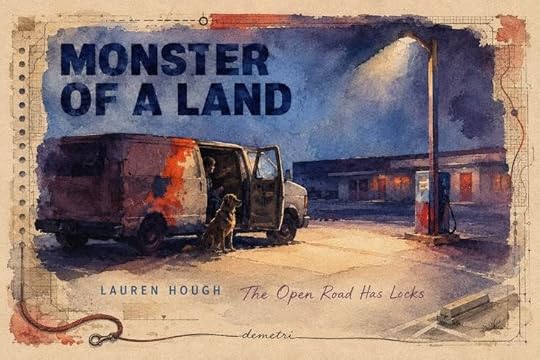
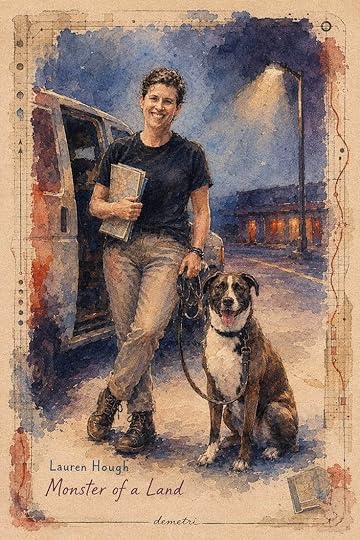
A van, a dog, and a woman held in public light, where “Monster of a Land” begins to trade the fantasy of American mileage for the harder question of who can stop, sleep, speak, and stay.
Driving across America has always tempted writers toward a handsome mistake. Enough odometer, the fantasy goes, and the map will start talking; the right sequence of diners, motels, fields, weather, gas stations, and strangers will coax the land into confession. Lauren Hough’s “Monster of a Land” borrows the old kit – dog, rig, loop, appetite, the ghost of John Steinbeck’s “Travels with Charley” rattling somewhere near the glove box – and treats the form as a suspicious inheritance. Mileage unlocks no national secret here. What matters is smaller and harder: a person at the pump, a dog at her knee, a conversation that does not begin as a fight.
Everything begins with trips not taken. Hough remembers the friend who wanted to see the ocean and died before she could; the cars that would not make it; the jobs that would not allow it; the money that was never there; the life that kept happening while a map stayed theoretical. By the time Hough has returned to Austin, written a memoir, lost her beloved dog Teddy, and adopted Woody Guthrie, a large and not-remotely-as-advertised husky-pit mix, the road is not leisure. It is grief with wheels. A battered 2001 Dodge van, purchased with disastrous optimism and repaired with increasingly comic realism, becomes the vehicle for a late, wary answer to Steinbeck: not a rediscovery of America as a face willing to hold still, but a test of whether conversation can survive somewhere contempt has been made so easy.
Much of the intelligence here lies in how little Hough trusts her own premise. She knows the road-book inheritance too well: the solitary observer, the noble itinerary, the stranger conveniently available to become meaning. She also knows the open road has locks. A queer woman sleeping in a van with weed somewhere in the vehicle, a dog on the floor, a nervous eye for cops, and a long memory of being broke is not crossing the same place as Steinbeck in his truck-camper named Rocinante. Her quarrel with “Travels with Charley” is not simple literary correction, though she can be enjoyably pitiless about Steinbeck’s evasions. Some travelers get to turn the key and feel curious. Others have to calculate the cop, the dog, the parking lot, the weapon in someone else’s truck.
Early in Childress, Texas, the book turns on a gas-station scene. Hough, returning from a “Texas Highways” assignment in Shamrock, meets a queer kid who is joining the military. His nails are painted; his hair has a pink streak; his boyfriend is frightened. He has never seen the ocean. Hough, an Air Force veteran herself, understands the enlistment not as a tidy political proposition but as a poor kid’s exit route from a place that may otherwise keep him. She tells him not to come home on his first leave, but to see the ocean. The scene could have hardened into a lesson on rural America, queerness, recruitment, and class. Instead, it stays stubbornly inconvenient. The kid is neither emblem nor lesson. He is a person trying to get out.
The trip proper begins on March 19, 2023, and eventually covers thirty-seven states, Washington, DC, and 14,001 miles before returning to Austin in June. The itinerary looks tidy only from a distance; up close it is all missed exits, dog needs, bad sleep, helpful strangers, heat, repairs, and machinery with opinions. The book happens where one pays, waits, asks, parks, and hopes not to be moved along. Hough is finding out where she may sleep, where Woody may walk, where the van may sit, and how long a person can remain in public before someone decides she should not.
Rarely has a dog done so much actual work while still being allowed to remain a dog. Woody is companion, scheduling system, leash-shaped passport, and, when necessary, the brake. He accepts treats, refuses bad van architecture, presses himself against Hough’s leg, delights in beaches, worries at strange noises, kills an iguana in front of children, and makes strangers brave enough to approach. If Steinbeck’s Charley sometimes feels like a literary accessory with paws, Woody feels like the creature who edits the itinerary. A chapter cannot simply go where the writer wants. It must answer to the animal in the van: Is he too hot? Is he scared? Has he run? Has the writer mistaken ambition for care?
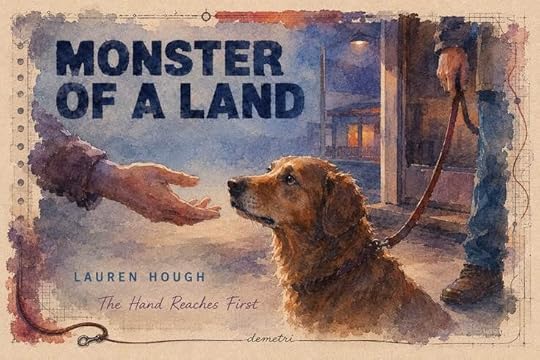
A stranger’s hand moves toward Woody before it reaches Hough, making visible the book’s quietest argument: contact begins through bodies, hesitation, and the dog who softens the air.
It is a funny book, often very funny, but not a light one. Hough’s humor is not garnish; it is holding up the roof. Her sentences move with the momentum of a person telling a story at a table where the drinks are strong and false reverence has been asked to leave. She likes the profane aside, the comic overrun, the quick little detonation of vulgar accuracy. Yet the joke often has a trapdoor. A riff about van-life influencers opens onto housing costs. A story about burying Teddy and accidentally terrifying a pizza delivery guy becomes a thought about what a body is after love has left it. A complaint about bad roads can lead, by a perfectly sensible route, to a place’s indifference to poor people’s time, teeth, cars, and choices.
Prose this voice-driven gives a great deal and asks a great deal. Hough offers speed, intimacy, timing, and a foul-mouthed precision that can be exhilarating. She also repeats herself. The rhythm becomes familiar: she arrives braced, cracks a joke, diagnoses the damage, meets someone who complicates the damage, and leaves the scene a little less sealed off. Often, the encounters earn the turn. Sometimes the people have already beaten the paragraph to the point. Her summaries are rarely wrong, but they can be less surprising than the clerk, mechanic, ranger, veteran, hitchhiker, old neighbor, or kid who has just made the summary unnecessary.
As a stylist, Hough is not interested in shine as proof of seriousness. Her diction is working-life and bodily: oil, fur, teeth, motel air-conditioning, bad brakes, camp toilets, gas-station coffee, cheap food, smoke, sweat. Landscape matters most when it presses on a body or a vehicle. Heat changes the trip. Rain changes the trip. A cop changes the trip. A new noise in the van changes the trip. Every idea has to buy gas, find shade, pay for repairs, coax the dog back inside, and hope the next stranger is not the kind who mistakes vulnerability for opportunity.
Part of the charm, and part of the argument, is that Hough is not nearly as unreachable as her persona sometimes pretends. She can be abrasive, spectacularly impatient, allergic to easy uplift. She is also porous to need. She needs Woody, mechanics, friends, old neighbors, weather reports, dog-friendly patios, motel clerks willing to waive fees, people who know how to fix what she cannot. The DC sections are among the warmest because they make neighborliness look neither quaint nor inspirational. It is repair, food, teasing, local memory, the competence of people who have been useful to one another for years. It is community with grease under its nails.
Again and again, “Monster of a Land” returns to the difference between thumb-scrolled contempt and a person standing close enough to be heard. Hough knows categories can be useful: red-state voters, liberals, cops, veterans, men, tourists, van people, strangers. Categories are sometimes helmets; they can also harden around the head. The book does not ask anyone to abandon judgment, least of all Hough. It asks what happens when judgment has to share space with a voice, a scar, a favor, a badly behaved dog. The answer is not the soft-focus handshake of reconciliation. Sometimes the answer is danger or disgust. Sometimes it is a Canadian mechanic who does not want to be near Woody because he was once mauled by a dog, yet still gets the van moving.
Digression blows through the book like weather. The road gives Hough somewhere to go; memory gives her somewhere to fall through. Air Force years, family, the Children of God, dead dogs, dead friends, old jobs, old cities, old humiliations – all enter the van. The form behaves less like architecture than pressure: visibility changes, old grief returns as suddenly as rain, the middle sags here and there in the upholstery. But the best repetitions gather force. The ocean first belongs to the dead friend who never saw it; later, at Venice Beach, Hough leaves a necklace in the sand and gives that withheld ocean a belated witness. The road has not cured grief. It has given grief a place to stand.
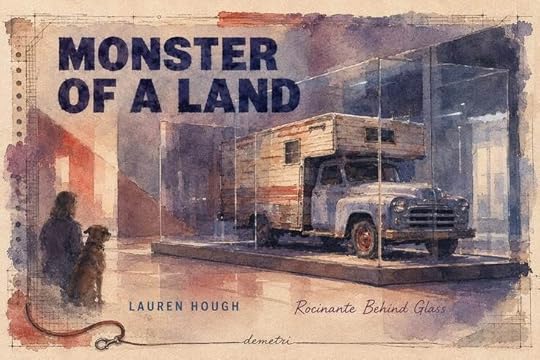
In California, where the Steinbeck frame can no longer stay politely in the rearview mirror, Hough’s argument grows more complicated. At the National Steinbeck Center, Rocinante sits behind plexiglass like a relic from an older license to wander America. Hough can admire the rig and still resist the myth. More important, she begins to reconsider Steinbeck himself, not to absolve him, but to wonder whether shyness shaped the distance between his project and the people he claimed to seek. Her critique of “Travels with Charley” is sharpest when it is not merely corrective, but curious about the human limits behind literary authority. Perhaps one reason Hough can speak to so many strangers is that Woody, with better manners than most writers, speaks first.
Steinbeck’s old road myth sits museum-lit behind plexiglass, admired and resisted, while “Monster of a Land” asks what kind of traveler still receives permission to wander.
Modern pressure gets into the van through bills, heat, enlistment papers, and sleep. Hough writes through housing unaffordability, vehicle living, debt, military recruitment, queer safety, climate unease, immigration, policing, guns, loneliness, and the afterlife of pandemic isolation, but she does not stack issues like cans in a pantry. Her subjects enter through motion. Housing is in the price of the van. The military is in the queer kid at the gas station. Immigration is in a woman and child who need a ride. Loneliness is in the way a dog can become a clock, a bridge, a chaperone, and a reason not to vanish.
If the book overreaches, it does so because Hough sometimes mistakes the force of perception for the need to say everything it implies. She has a superb eye for American meanness in its work clothes: debt, swagger, magical thinking, cruelty marketed as common sense, the worship of freedom by people who cannot afford a dentist. She is also alert to the small mercies that complicate contempt. But there are passages where the verdict arrives after the scene has already done the job. One occasionally wishes she would let a stranger’s line hang in the air, let the dog’s body in the doorway carry the meaning, let silence have the last word before the engine starts again.
That limitation is real, and it belongs to a book that takes this much road seriously. Hough has written a road book that replaces mastery with exposure. She does not possess America by crossing it. She lets the map interrupt her, irritate her, help her, scare her, bore her, feed her, overcharge her, and surprise her. The van is freedom until it breaks; the road is possibility until a trooper searches the vehicle; the stranger is threat until he is lonely, generous, or both. The result is less elegant than alive, less shapely than weathered, and often more moving because its movements are not too clean.
Reaction to the book will likely split along the same seams that give it force. The profanity will delight some and tire others. The dog material will charm one reader and irritate another who came for social argument without quite expecting so many treats, beaches, beds, and canine moods. Some will admire the politics and others will feel cornered by them. Most interestingly, readers sympathetic to the book’s anger may be startled by its turn toward kindness. Coming from a gentler writer, the instruction to go outside, talk to strangers, talk to neighbors, and stop blaming the powerless might curdle into mug wisdom. Coming from Hough, who has spent the book snarling at counterfeit comfort, it feels more like a dare.
Other books haunt this one, but none quite claims it. “Travels with Charley” by John Steinbeck is the necessary ancestor, while “Blue Highways” by William Least Heat-Moon offers a quieter backroad kinship. “Nomadland” by Jessica Bruder shares debt, vehicle living, and precarious arrangements, though Hough is not doing immersive journalism so much as dragging memoir through them. “Wow, No Thank You.” by Samantha Irby comes to mind for comic candor, though Hough’s jokes are more likely to check the oil before the punchline lands. These comparisons mostly clarify what she is not: not a genial guide, not a neutral reporter, not a tourist in her own outrage.
Pacing is the book’s most visible wobble. A road narrative needs accumulation; it also risks becoming a glove compartment full of receipts and a screwdriver no one can identify. Hough’s route includes enough motels, repairs, meals, weather, encounters, beaches, breakdowns, and digressions that the reader occasionally feels the miles as mileage. Yet the unevenness is not emptiness. The weaker stretches are overfull rather than thin, too eager to connect rather than unable to matter. One forgives more sprawl in a book that has actually gone somewhere than in one that has arranged itself beautifully in the driveway.
“Monster of a Land” earns 83/100, or 4/5 stars. The score fits the rattle: very strong, not without loose parts; alive in voice, looser in architecture; more trusting of talk than of silence; occasionally too willing to caption its best scenes. But its strengths are substantial. Hough has taken a familiar American form and made it riskier, poorer, queerer, funnier, angrier, and more exposed. She has written a dog book for readers suspicious of dog books, a road book for readers suspicious of the road, and proof that the trip cannot fit the place into the van.
Under the van repairs, motel rooms, beaches, border crossings, and dog treats runs a plain, severe question: what if talking to one another has become one of the hardest habits to keep alive? Not civility, that exhausted little napkin of a word, and not unity, which too often means the powerful asking the injured to lower their voices. Something humbler and harder. The person at the pump, the hand extended toward the dog, the neighbor who knows which bolt to loosen, the clerk who gives the better rate, the old friend with a driveway, the stranger who warns you not to park on yellow sand.
Late in the journey, Hough’s hope works because it arrives with dirt on it. She does not discover that America is secretly kind. She discovers, more modestly and more persuasively, that people are often kinder than the systems training them to be cruel. That distinction is the book’s hinge. The place remains monstrous: broke, armed, lonely, hot to the touch, and forever repackaging captivity as a freedom upgrade. Yet again and again, someone offers directions, repair, a place to park, a warning, patience. Often, the hand reaches first toward Woody. Hough is wise enough to follow the leash.
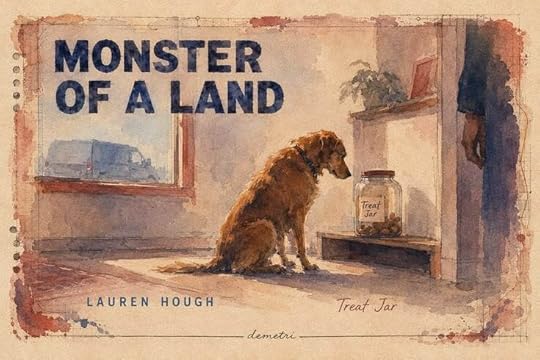
On returning to Austin, after all the miles and weather and repairs, Woody goes straight for the treat jar. No flag, no vista, no revelation – just a dog who has learned that the road can end at home and a writer who has learned that home is not the opposite of motion. The van later dies, as old vans do, in a small comic afterlife that rescues the book from solemnity one last time. Mercifully, no one builds the van a shrine. The book does not need one. It needs the dog, the jar, the laugh, the relief.
After the miles, weather, repairs, and fear, Woody returns to the treat jar – no flag, no vista, no revelation, only appetite, relief, and the small comedy of arrival.
Still, the leash is what lingers after “Monster of a Land.” Hough does not ask us to love America in the abstract, which is often where love curdles into slogan or sale. She asks something less grand and more difficult: open the door, step outside, risk the conversation, let the dog make the first introduction, and see whether the stranger on the other side is already reaching down.
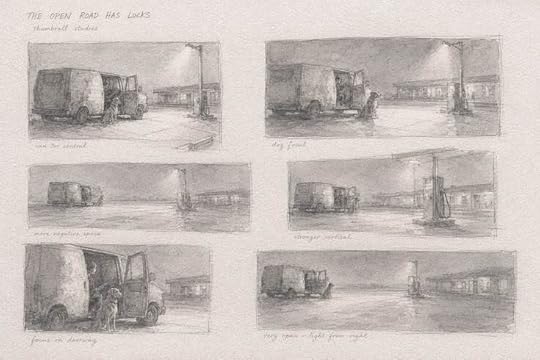
Early thumbnail studies testing how the van, Woody, the light pool, and the empty roadside lot could become one compressed visual argument rather than a literal scene.
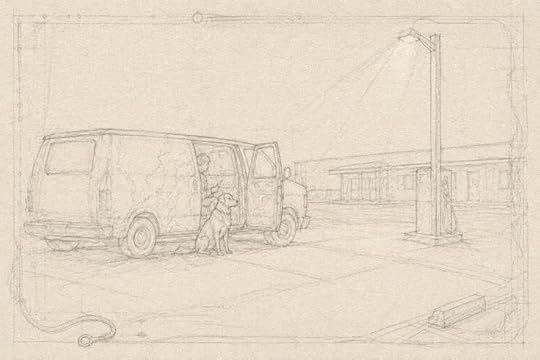
The skeletal map of “The Open Road Has Locks,” with van, dog, door, border, and parking lines still exposed before atmosphere and color begin to decide the image.
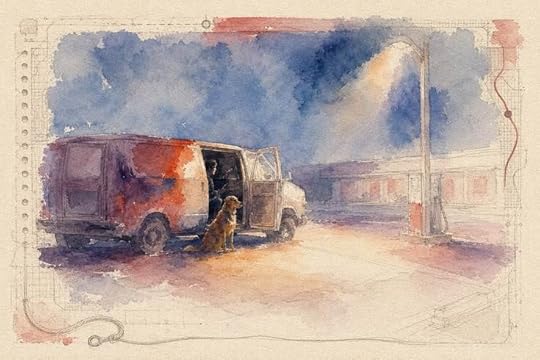
The first wash establishes the image’s emotional weather: cool roadside blue, rust pressure, exposed paper, and a night that has not yet fully closed around the figures.
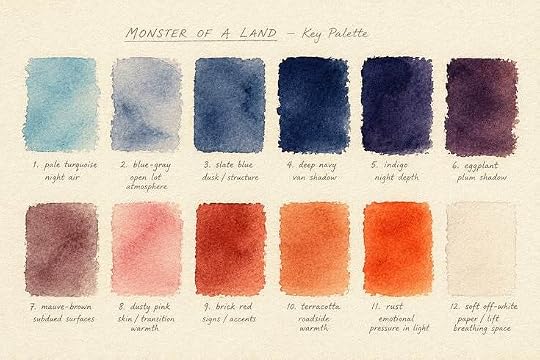
A cover-palette study of indigo, slate, pale turquoise, rust, terracotta, mauve, coral, and paper-white, showing the color logic behind the whole watercolor series.
A border experiment where road atlas, motel receipt, field sketch, and handmade review plate begin to merge into a frame that feels carried rather than decorative.
A literary watercolor portrait inspired by “Monster of a Land,” with Hough, Woody, the van, the map, and the roadside light gathered into one handmade companion image for the review.
All watercolor illustrations by Demetris Papadimitropoulos. Watercolors are done on 140lb vellum and then scanned into the computer using an Epson scanner. From there, they are finalized in Procreate. All art and opinions are my own.
I'm not necessarily drawn to travelogues but I liked Lauren Hough's first book well enough to give this one a try. I listened to the audiobook, which was read by the author and I'm glad I did.
Some of it was funny, some of it sad, some of it uncomfortable to listen to.
There was a couple of paragraphs that caught my attention so much that I had to rewind and listen to them a few times over and then write them down. She sure can write.
I loved this book. Hough is one of my favorite authors because reading her work feels like having beers and conversation with your most interesting and witty friend. She says the book was her version of Travels with Charley so now I want to read that. I also like how she points out so many problems and issues with our current situation while simultaneously finding the good in the majority of the individuals she interacts with.
Not really sure how to explain this book, a road trip book, a dog book, a political statement, a cultural statement. Even though I may not agree with every perspective of the author, she does encapsulate many of the challenges this country faces in a very thought provoking/soul searching way. I thoroughly enjoyed!
Fabulous memoir—an unapologetic lesbian with a foul mouth recreates Steinbeck’s “Travels with Charley” with her full-of-personality dog, Woody Guthrie. Loved it!
Hang on to furniture, unless you’re up for a ride, because I’m about to take you on the one I went on this week. This week I read two books: one by Emma Grede called Start With Yourself. It’s a self help book that everyone in my world, especially my students and clients, is hating on; and the other by Lauren Hough, called Monster of a Land. Anyway I read them both and now I have spiritual, political whiplash and, possibly, an identity crisis. They couldn’t be more different: Emma Grede brought many, many, MANY celebrity brands into being — Good American, Skimms, are you seeing a pattern called Kardashian here? — and hers is a manifesta of what it takes for a poor black Caribbean East End London girl who drops out of school and has nothing, literally nothing, to become a kazillionaire. All my feminist besties and most of my anti-hustle-culture clients hated it. I loved it, because it’s about being an idea monster and a make-shit-happen-from-nothing monster and I read it and thought: my people. Not the ‘my people’ as in what Lauren Hough — I’ll get there in a second — very precisely calls ‘the unf*ckables’ (it’s meaner and more accurate than ‘incels’) but the ‘my people’ as in the ones who just have to do it. Can’t not do it. Probably we have neurochemical imbalances that force us to make the thing, launch the business, work freaking endlessly at rising and jumping class — which is not to say that the ones who don’t jump class didn’t work endlessly. Usually it is just the opposite. Everyone, it seems, is working endlessly. Poor people just do it across 3 jobs for a f fraction of the reward and none of the respect. Having been poor and invisible as a person, individually, but visible as something wrong, categorically, I am desperate not to be poor and invisible/visible again AND desperate to keep all of my students and clients out of that particular hell too. Which is why I also loveloveloved Lauren Hough’s Monster of a Land. I knew I would, I have no chill, I’m obsessed with her writing (laurenhough.substack.comand I read her work the way I read Hemingway: in awe. (Just like I’m not supposed to like Grede, I’m not supposed to like Hemingway either. I do.) And then I reverse-engineer it. Like, how did she do that. I can hear her talking, I can hear her voice, she just summed up that entire asshole’s entire life history in a sentence rather than a full-on sketch, SORCERY. Her writing is so good and so insightful and so taut that it makes me feel like a hot air ballon is rising in my heart (v. good) but also likeI should personally just stop writing anything at all in a paid professional context, including books — no wonder my agent dropped me — and especially emails, and become a plumber instead (v. bad; I am not to be trusted with tools). (I actually wrote something like that today in a text to my loverloverman aka husband who is on a ferry from Vancouver to Victoria moving my 20 year old daughter into her first apartment because I can’t because I’m in Mexico not Canada and when I thanked him for his service he said when you love the cow you love the calf. If that’s not romantic, I don’t know what is.) I digress but not really. Two years ago I drove from Vancouver, Canada to Merida, Mexico via Washington, Oregon, California, Nevada, Arizona, New Mexico, Texas and I was shocked. At the signs. At the cruelty. At the gas station with a lot of red hats with a clerk who straight up refused to serve my black husband. For real. At the burnt out trailer parks and the 40year old RVs and cars people were sleeping in, everywhere. At the poverty. That’s not necessarily what Canadians or non-Americans think about America — poverty — we just think maybe our downstairs neighbour is nuts and notice that American tourists don't say thank you, they say ‘uh huh’; and then we get worried about whether their infection is contagious and spreading to us (it is) and if the zombies the orange menace infected on our side of the border are coming for our healthcare and our social safety net and our immigrants too (they are). So, Monster of a Land: I recognized it. It’s true. It’s real. It’s wrenching. And it is a motherfucking work of art and I loved it. Could not stop reading it, read it in one sitting, the way I used to eat potato chips before I had the surgery that made me skinny. Wildly, though, I also really liked Emma Grede’s book about being an art monster and an idea monster and a make-shit-happen monster — those are my words but she calls herself a monster, too — so maybe you shouldn’t trust anything I say. Maybe I just like monsters.
I read this book as a person who lives with a husband and have traveled with him 7 road trips in America in a campervan. I laughed out loud and enjoyed many paragraphs when Lauren Hough wrote about the dream of living in a campervan or road-tripping in the US. Yeah, 50k-100k USD campervan that nobody talks about when they boast about their beautiful van on YouTube. Yet Lauren decided to go, with her 2001 Dodge Ram that "looked like it might belong to a retiree or a meth cook, and over the next few months would confound every mechanic who agreed to look at it, and not all of them would bother."
But that is not the point of the book. It was just a tiny part of a chapter to start the trip.
And the amazing thing? - Lauren traveled with Woody, her dog buddy, on an American road trip. I love to read about Woody indulging whipping cream cup while Lauren had to buy one more drink in a new bar in New Orleans. It is fun to have a buddy to travel with. And I also notice that it is such a different experience if you travel with a dog. There are places you can't get in if you have a dog, with travelers this must be taken in consideration. I have never had a dog, and this new "dog-eye" view brings a lot of joy to me.
But then, this book brings up so many facets of American lives, there is no unified perception of the US in this book; there are bizarre people, cultural differences when she traveled from town to town, state to state, and there are social frictions happening that Lauren quietly wrote down with rough and honest sketches.
I read this book when I am in the resting state from a trip but I would imagine I will enjoy it so much if I carry it when I am in a road trip. There are places that Lauren went through and I managed to see it, she brings up nuances and respect for lives and people she met on the way.
I was very intrigued to read this because I read Travels with Charley a few years ago in a book club and really struggled both to identify with it and with the fact that it was largely made up. I was curious to see how this sort of story would feel different from a modern, female perspective. I'm so glad I picked it up. Hough is a talented writer, and there were several quotes and sections that moved me. Furthermore, something I love about reading is the pieces of ourselves we find in books and also the opportunities reading gives us to see things from a perspective completely different from our own. I also grew up in the panhandle of Texas, and Lauren's perspective brought up so much nostalgia for me, but she has also had so many unique life experiences, and helped me see things through her eyes in ways I hadn't considered before. Her travels were varied and thoughtful and real, and she even made me reconsider how I feel about Steinbeck, which is quite a feat.
Favorite quotes include: "A dog who survives a book lives forever" and "I wished people would come to Texas, not so we could shoot them, but because it's easy to laugh at someone's misery on the internet, easy to forget they're human beings"
There were only a couple of reasons it didn't get a full five stars. 1.) It's very difficult for road trip books not to drag at all, and there were a couple of times my attention waned. 2.) It was a lot more melancholy than I anticipated, which isn't in any way bad, it just isn't my personal preference. But even to that point, Hough acknowledged this several times in the book and even included this lovely quote from a man she met on her journey, "I hope, and I hope this for your own sake, that you'll find something hopeful to say."
I love Lauren Hough's work. I expected to love this book. It exceeded my expectations.
The focus of this book is the author's road trip with her dog, Woody. As the two travel extensively, Hough considers the world they inhabit. What assumptions do we make about each other? What assumptions are folks making about her and how to they impact her safety? What are Woody's thoughts and experiences as they proceed?
Since I'm more concerned about my dogs' happiness and wellbeing than almost anything or anyone else, I was living for everything tied to Woody in this book. Anyone who spends this much time in close proximity to an animal gets to know them well and vice versa, and I loved watching this relationship develop. Also, this book contains perhaps the best explanation of a Husky of all time. Woody's needs shape the journey as much as Hough's, if not more so, and it's fun to see how the travels and travelers converge.
The social commentary is top notch, as one expects from this author. I was surprised - in a good way - by the hopeful tone and messaging. The closing of this book really worked for me. I read this mostly on Memorial Day, and there's something about the imagery associated with this day that, uh, has changed over time. This book was somehow exactly what I needed: a reminder that people are good, that interpersonal connections can make all the difference, and that dogs are way WAY better than we are.
Someone please make sure the charcuterie guy gets a copy. Oh, and be sure to grab yours. This was a very satisfying read.
*Special thanks to NetGalley and Pantheon for this arc, which I received in exchange for an honest review. The opinions expressed here are my own.
I really wanted to like this book. But I found the entirety of the book to be telling the reader how to perceive a place, rather than really allowing them to experience it and develop their own opinion. There was also a lack of really allowing the reader to truly feel like they could “be” in a place with her — a lack of description about the sights and smells and sounds of a location, which I find to be most of the joy in a roadtrip adventure. I also felt that this was less of a chance to explore the nuances of America, but really just a dog story (which is fine, it’s just not what I expected from “Monster of a Land” and the travelogue / comparison to Travels with Charley). The author also seemed to have some strange flip flopping between being disconnected from the world and wanting to be away from her phone and social media, but then mocking others for not being on their phones, which I found truly odd. I am also not a huge fan of the frequent bashing of different writers (namely Steinbeck). Like another reviewer mentioned, some of the journey seemed fabricated or like she didn’t actually go the route she claimed to pursue (a lot of directional inconsistencies in the South, in particular, and blanket statements that made the south seem all MAGA and psuedo confederate, as if she hadn’t even taken the chance to experience it). Characters also felt flat, and like there could have been a REAL depth to some relationships if she had fleshed them out and allowed the reader to be immersed in the emotions instead of being told the emotions. Overall this sadly fell very flat. I wanted to love it, after really enjoyed her first book. But this really felt like a spent hours and got nothing in return
I've waited a week after reading Lauren Hough's latest book before posting my thoughts, hoping I could come up with the perfect review to do this book justice. I couldn't, so here are some random thoughts about Monster of a Land:
A modern day "Travels with Charley." Hough, along with her rescue dog Woody, take off in a p.o.s. Dodge van conversion to see the country and document her experiences. Her observations of our modern world are stripped down, honest, and frankly beautiful. I loved her encounters with the modern day salt-of-the-earth people: from the gay kid living in the deeply evangelical pocket of Texas who plans on joining the army to escape his hometown, to the kid who's hitchhiking their way to Alaska (oh, and the gift she gives him!), to the woman who needs ride to Bakersfield. I loved her previous book, Leaving isn't the Hardest thing, but this hit my heart. Underneath her raw, gruff, and gritty narrative, beats a heart of gold. Funny, bittersweet, and thought-provoking, I kept a few tissues nearby.
Monster of a Land is now my favorite on-the-road memoir and I'll be putting this into the hands of friends and bookstore customers, knowing they'll be in for a great experience. For those of us who are putting off the trip for "one of these days," read --no -- listen to the audiobook and take that trip.
I was disappointed. I was looking forward to this book as an updated take on Steinbeck's Travels with Charly. Instead, I got a confused narrative about a lesbian driving cross country in a haphazard manner. For example, in writing of driving from Baton Rouge to New Orleans, a city roughly 60 miles southeast of Baton Rouge, she tells of passing through Lafayette at the roughly half-way point on I-10; the only problem is that Lafayette is west of Baton Rouge and not between that city and New Orleans. Equally annoying, she expresses shock at driving into Indiana on the drive from Detroit to Chicago, but there is no way to make that trip unless you drive through Ohio, Kentucky, and all of Illinois with passing through Indiana.
I was also annoyed at her stereotyping of southerners as racist MAGA supporters who wave the Confederate battle flag. As a man born in Alabama who lives in Louisiana after spending my career in the South, I was offended.
Hough describes herself at one point as a lesbian author who writes for lesbians. Clearly, I was not her intended audience.