Kyōka was born Kyōtarō Izumi on November 4, 1873 in the Shitashinmachi section of Kanazawa, Ishikawa, to Seiji Izumi, a chaser and inlayer of metallic ornaments, and Suzu Nakata, daughter of a tsuzumi hand-drum player from Edo and younger sister to lead protagonist of the Noh theater, Kintarō Matsumoto. Because of his family's impovershed circumstances, he attended the tuition-free Hokuriku English-Japanese School, run by Christian missionaries. Even before he entered grade school, young Kintarō's mother introduced him to literature in picture-books interspersed with text called kusazōshi, and his works would later show the influence of this early contact with such visual forms of story-telling. In April 1883, at ten years old, Kyōka lost his mother, who was 29 at the time. It was a great blow to his young mind, and he would attempt to recreate memories of her in works throughout his literary career. At a friend's boarding house in April 1889, Kyōka was deeply impressed by Ozaki Kōyō's "Amorous Confessions of Two Nuns" and decided to pursue a career in literature. That June he took a trip to Toyama Prefecture. At this time he worked as a teacher in private preparatory schools and spent his free time running through yomihon and kusazōshi. In November of that year, however, Kyōka's aspiration to an artistic career drove him to Tokyo, where he intended to enter the tutelage of Kōyō himself. On 19 November 1891, he called on Kōyō in Ushigome(part of present-day Shinjuku) without prior introduction and requested that he be allowed into the school immediately. He was accepted, and from that time began life as a live-in apprentice. Other than a brief trip to Kanazawa in December of the following year, Kyōka spent all of his time in the Ozaki household, proving his value to Kōyō through correcting his manuscripts and household tasks. Kyōka greatly adored his teacher, thinking of him as a teacher of more than literature, a benefactor who nourished his early career before he gained a name for himself. He felt deeply a personal indebtedness to Kōyō, and continued to admire the author throughout his life.
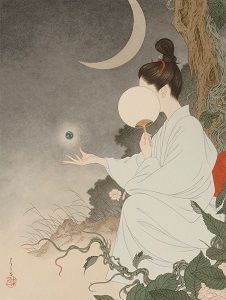
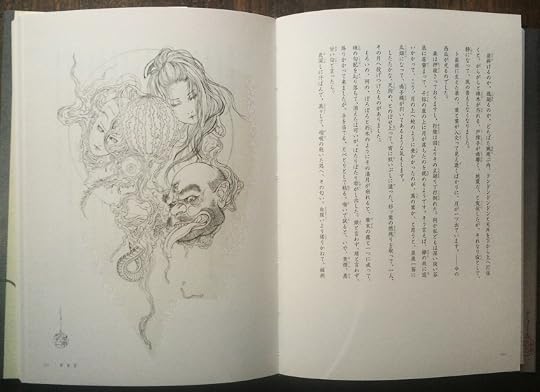
I was looking at this book at the library. Despite having the title, Grass Labyrinth, printed in English, the text is all in Japanese -- except, oddly, the captioning for the plates, with illustrator data in English. I don't really know what it is about, but I think some sort of fantasy, perhaps with supernatural creatures. The illustrations, which are quite lovely, show a mountain (on an island? There is a boat), strange vegetation, a child with an animal face pouring tea, a group with leaves for masks. A young person finds an orb in a pond, which later seems to have strange properties. There is a tough-looking man with a bear on a chain, and a beautiful woman looking sad by moonlight. Later she is murdered, or is it a different flowing-haired lovely? There are snakes and floating eyeballs and horrible creatures. Please let me know if this book is translated.
The tome itself was also a nice production, aside from overly-thin paper that showed though. The dust jacket is a pleasing canvas texture. It has art on the interior flaps instead of text. The front endpaper is a pleasing landscape painting. Black and white drawings are also fit into or ghosted over the text. At the end the black and white illustrations are reproduced as color plates.
A strong 4.5, A daydream profound mystery that can only be written by none but the fantastical genius Kyouka Izumi, a pathos for one’s mother, a longing for love that inspired countless gifted artists… yet still not perfect. But I’d damn well kill for Izumi’s prose and worlds. He’s the greatest master of language and gensou.