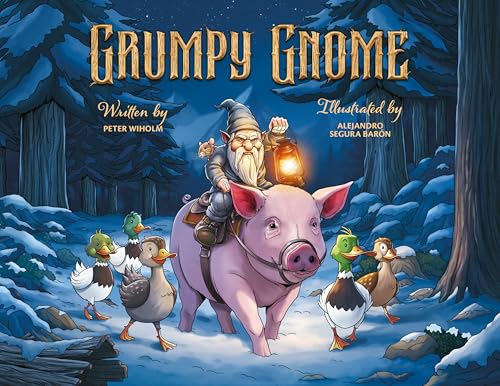
The old gnome was angry with the ducks next door. They had dragged him out of his hundred-year retirement to help a father and daughter in trouble. Why would the gnome care about silly humans, especially ones who had made a big mess at the beloved farm where he used to work? Surely there was nothing about these well-meaning but clumsy people that could soften his prickly mood?
Grumpy Gnome is a humorous, exciting and cozy story about rediscovering joy thought to be long gone, parental love, and the ways of the old world clashing with the new.
In an age where children's literature often leans heavily on fast-paced action or obvious moral lessons, Peter Wiholm's debut picture book arrives like a breath of crisp winter air—refreshing, contemplative, and deeply satisfying. Illustrated with stunning detail by Alejandro Segura Barón, Grumpy Gnome offers young readers and their families something increasingly rare: a story that trusts its audience to find meaning in subtlety while delivering genuine entertainment through wit, warmth, and visual splendor.
A Story That Earns Its Heart
What makes Grumpy Gnome remarkable is how it refuses to take the easy path. This isn't a tale where a cranky protagonist instantly transforms through a single act of kindness or learns an obvious lesson spelled out in capital letters. Instead, Wiholm crafts a narrative that understands how real change happens—gradually, grudgingly, and often despite our best efforts to resist it.
The story centers on a house gnome who has been enjoying retirement for over a century, content in his solitude until a flock of persistently chatty ducks begin reporting disasters at the farm he once tended. The new human occupants, a father and daughter facing their own struggles, have inadvertently created chaos through their well-intentioned but clumsy attempts at farm management. What unfolds is neither a simple tale of rescue nor a predictable journey toward friendship, but rather a nuanced exploration of what it means to find purpose when you thought your useful days were behind you.
Wiholm demonstrates a sophisticated understanding of narrative pacing throughout the book. The disasters escalate organically, each building on the previous one while revealing more about both the gnome's character and the humans he observes from afar. The tension between the gnome's desire to remain uninvolved and his deep connection to the farm creates a compelling emotional throughline that keeps pages turning.
Characters Who Feel Lived-In
The gnome himself is a masterclass in character development for a picture book. At 433 years old—a wonderfully specific age that Wiholm chose deliberately rather than settling for a round number like 300 or 400—he carries the weight of centuries, literally complaining about his foggy eyes, cold fingers, and creaky back. His grumpiness stems from genuine disillusionment. He left his life's work because new inventions made his contributions feel obsolete and because humans stopped believing in his kind altogether.
What Wiholm captures beautifully is that the gnome's perspective on modernization makes sense given who he is and what he's experienced. Rather than imposing a message about technology, the author simply allows his character to have authentic reactions. The gnome's bewildered interpretation of a cell phone as "a freshly baked cookie that needs cooling" and his description of an inflatable Santa as "a crazy, bearded clown in fuzzy, red pyjamas" provide both humor and insight into a worldview shaped by centuries of traditional life.
The father and daughter at the story's heart are equally well-drawn. The father, a delivery driver trying desperately to give his daughter a better life, represents real economic struggles that ground the magical elements in authentic human experience. His willingness to take on farm caretaking work he doesn't fully understand, his transparent vulnerability when apologizing to his daughter about not being able to afford toys—these details create a portrait of modern parenthood that feels genuine and deeply moving.
The daughter's quiet wisdom and unshakeable belief in magic provide beautiful counterweight. Her line "When something magical happens, we should just be very grateful" captures the story's heart in a single breath, suggesting that sometimes wonder deserves acceptance rather than rationalization.
Even the supporting cast of ducks—Ethel, Gary, Brenda, Carlos, and Sven—have distinct personalities that emerge through their interactions. Their persistent quacking of "House Gnome! House Gnome!" becomes both comic refrain and narrative engine, their loud but goofy nature reflecting the birds Wiholm observes in Vancouver that "couldn't care less about our feelings" yet somehow manage to be endearing.
Themes That Resonate Across Generations
What elevates Grumpy Gnome beyond a simple children's tale is its willingness to engage with themes that matter to readers of all ages. The book explores what it means to be seen and valued in ways that speak directly to contemporary anxieties. The gnome's experience of having his work attributed to "blind luck" rather than skill mirrors feelings many adults carry about their own contributions going unrecognized. His hundred-year retirement born of this disappointment creates space for conversations about purpose, dignity, and the need to feel useful.
Parental love weaves through the narrative with particular poignancy. The father's determination to create a better life for his daughter, even when facing repeated setbacks, demonstrates love through action rather than words. The parallel between his efforts and the gnome's reluctant help creates thematic resonance that rewards careful reading.
Wiholm has a particular gift for capturing what he calls "that dynamic between the crusty shell and the warm heart underneath." The gnome's repeated refrain "I suppose I could stay a little bit longer" while secretly becoming more invested exemplifies this perfectly. As the author notes, people who are like this "think they're being very discreet about it" when their internal struggle is obvious to everyone else—a dynamic that is both funny and deeply endearing.
Illustrations That Tell Their Own Story
Alejandro Segura Barón's artwork deserves extended discussion, as it elevates the text to create something truly special. This collaboration between Vancouver-based Wiholm and Barcelona-based Barón represents intercontinental artistry at its finest. According to Wiholm, their communication was remarkably smooth, with mutual respect flowing throughout the creative process.
Wiholm would send extensive instructions for each page, detailing vision, colors, expressions, depth, and perspective. Barón would then create sketches that were "often vastly better than most professional illustrators' finished work," coming up with details and nuances that made Wiholm exclaim "YES!" This collaborative back-and-forth through various stages resulted in work where both creators felt they'd been "pulling in the same direction all along."
The color palette shifts purposefully throughout the book, moving from cool blues during moments of isolation and struggle to warmer golds and ambers when connection emerges. The winter setting, rather than feeling harsh, is imbued with magical possibility. Character expressiveness stands out particularly—the gnome's face conveys decades of experience through subtle details, while even the ducks display personality through body language and positioning.
The decision to show much of the gnome's help from a distance—making readers piece together his involvement—creates visual storytelling that complements the text's restraint. This approach honors Scandinavian folklore traditions where mystical beings maintain separation from the human world, never allowing themselves to be seen directly.
A Deliberately Crafted Journey
The path to publication involved careful creative choices. Wiholm's first draft was written in verse with lines 1 and 3 rhyming, lines 2 and 4 rhyming, but he ultimately abandoned this approach, feeling it made the text "too opaque and gimmicky." The prose version that emerged went through several passes of trimming "unnecessary fat" until reaching its lean, precise final form.
The book spans 40 pages rather than the standard 32—a deliberate choice when the story simply couldn't be compressed further. The illustrations took approximately nine months to complete, a gestation period that felt appropriate for what Wiholm describes as a "labor of love, but still very much labor."
One detail that stands out is the copyright page declaration: "This book was 100% human made. No artificial intelligence (AI) was used." This statement matters deeply to Wiholm, who wants readers to understand the book emerged from "a writer and an illustrator working hard to craft and polish their work" rather than someone lazily feeding prompts into a computer. The human creative output has "something unique and special" that maintains value in an increasingly automated world.
Personal touches add layers of meaning. Wiholm's daughter Evelina contributed the hand-written sign that appears on the book's final page—a detail she "points out to anyone who will listen" with understandable pride. The dedication to her ("Mitt största hjärta och varmaste solsken"—My biggest heart and warmest sunshine) reveals the inspiration behind creating this story, even as Wiholm notes he doesn't write autobiographically. For him, storytelling's wonder comes from imagining worlds and characters different from himself.
Who Will Love This Book
While marketed as a children's picture book, Grumpy Gnome offers rewards for readers across age ranges. Young children will enjoy the adventure elements, the magical premise, and the satisfying resolution. The humor—grumpy characters, persistent ducks, snowy mishaps—provides entertainment that holds attention.
Elementary-aged readers will grasp additional layers: the gnome's character arc, the father-daughter relationship dynamics, and themes about helping others and finding purpose. This age group can also appreciate the detailed illustrations more fully, discovering new elements with each reading.
Adult readers will find surprising depth. The gnome's experience of obsolescence, his struggle with relevance, and his gradual rediscovery of meaning through service offer reflection points that resonate beyond childhood. The story creates natural opportunities for discussions about aging, tradition versus progress, and what we owe to others.
A Debut Worth Celebrating
Grumpy Gnome announces Peter Wiholm as a picture book creator with distinctive voice and genuine insight into what makes stories resonate across generations. His background in articles, short stories, screenplays, reviews, short films, documentaries, music videos, and photographs brings cinematic quality to his prose and understanding of pacing that comes from diverse creative experience.
His partnership with Alejandro Segura Barón (whose previous work includes El Castillo de los Siete Ojos) results in a book where text and image work in true harmony, each enriching the other to create something greater than either could achieve alone. For families seeking books that reward repeated readings, for educators wanting material that sparks meaningful discussion, and for anyone who appreciates craftsmanship in children's literature, this debut offers riches worth discovering.
The book's ending demonstrates particular care in its construction. The wooden figure that the girl discovers in the snow was established on the very first page where the gnome is shown carving it, then shown dropping from his belt during his journey. This careful setup allows for a subtle, confident conclusion that trusts readers to make connections rather than spelling everything out. As Wiholm notes, this approach required establishing not just the figure but also the girl's belief in gnomes through details like the "Trolls and Gnomes" book visible in her bedroom. After all the gnome's grumpiness, the final image of him smiling provides "a joyous payoff" that feels earned rather than imposed.
Like the gnome himself, this book may appear gruff and weathered on the surface, but beneath lies a heart of surprising warmth and wisdom—a testament to what human creativity, collaboration, and careful craftsmanship can achieve.
Grumpy Gnome is brilliant. It’s so luxuriously presented with a robust, glossy cover and equally attractive slip cover that it would make an ideal gift book.
The book size is perfect for sharing with an individual child or in a group situation. The illustrations are wonderful, with a smashing balance between modernity and nostalgia in style. I loved the subdued colour palette that represented the emotions of the story really effectively. It also appealed that there is a single parent and mixed race child so that Grumpy Gnome feels inclusive. In addition, there’s a very good balance of text to image so that young emergent readers are not daunted and more confident ones have enough text to satisfy them. The language is mature so that vocabulary is increased, and it is enhanced by the images that help develop understanding and context.
The Grumpy Gnome himself is inspired. He has lost touch with his old life and is obviously lonely and there’s a very important message in the story that shows children how being kind and helpful towards others actually brings happiness to the person (or gnome) doing so. Consequently, Grumpy Gnome affords the opportunity for adults and children to discuss emotions in a non-threatening environment. Indeed, it felt quite emotional that the little girl seems wiser than her father and her belief in magical things like the gnome gives a sensation of warmth, happiness and hope to readers of any age.
I loved the recalcitrant sheep and the insistent ducks too, because they help bring the narrative to life, adding humour that children will love.
I thought that Grumpy Gnome has all the high quality attributes of traditional tales, containing morals, but within a modern setting so that it slots into the canon of children’s books perfectly without preaching or forcing adult preferences onto children. It’s a lovely story and children will thoroughly enjoy reading it – and what adult doesn’t need a bit of magic in their lives?
Wiholm's Grumpy Gnome represents a thoughtful contribution to contemporary children's literature engaging with Nordic folklore traditions. The narrative adheres to essential tomte/nisse conventions while adapting the house gnome archetype for modern audiences—a balancing act requiring considerable cultural literacy and creative finesse.
The gnome's invisibility to humans throughout the narrative respects the fundamental separation between mundane and mystical realms characteristic of Scandinavian folk belief. Wiholm explicitly acknowledges this in his narrative construction: "Not only is that in keeping with Scandinavian folklore where there's always a separation between the humans and the mystical world, but I also thought it would have broken the sense of wonder" to allow direct confrontation. This artistic choice demonstrates engagement with source material beyond superficial aesthetics.
The house gnome's traditional role as farm guardian who assists deserving humans while remaining unseen finds fresh expression through the father-daughter's genuine efforts despite repeated failures. Their worthiness stems not from perfection but from sincere striving—a nuanced interpretation of the folklore's moral framework regarding deserving recipients of supernatural aid.
Wiholm's exploration of the gnome's retirement due to modernization and erosion of belief addresses tensions between tradition and progress without resorting to simple nostalgia. The gnome's perspective makes internal sense given his cultural context, even as the narrative suggests adaptation's necessity. This complexity elevates the work beyond didacticism.
Barón's visual interpretation draws from European illustrated tradition while maintaining distinctive style. The attic dwelling's details, the wooden carved figure as gift, the winter setting—all echo folkloric motifs while feeling fresh and accessible to contemporary audiences unfamiliar with Nordic traditions.
The work succeeds as both cultural transmission and original creative expression.
Peter Wiholm's debut demonstrates sophisticated understanding of how children process complex emotional narratives. Grumpy Gnome succeeds precisely because it refuses to simplify its protagonist's motivations or rush his character development. The 433-year-old house gnome's century-long retirement stems from legitimate grievances: technological displacement, lack of recognition, and the erosion of belief in his existence. These aren't superficial grumpy traits but psychologically consistent responses to genuine loss.
The narrative structure employs escalating stakes effectively. Each duck visit brings news of worsening disasters, creating natural pacing while revealing the gnome's internal conflict through his reluctant responses. Wiholm's decision to show the gnome's help from a distance—rolling a snowball, arranging a sled, preparing the farmhouse—teaches visual literacy and inference skills. Young readers must piece together the gnome's involvement, actively participating in meaning-making rather than passively receiving information.
The father-daughter relationship grounds the fantasy in authentic emotional territory. The father's economic struggles, his apologies about not affording toys, and his visible vulnerability model healthy parent-child communication while acknowledging real-world hardships many families face. This isn't typical fairy tale territory, and that's precisely its strength.
Alejandro Segura Barón's illustrations function as co-text rather than decoration. The wooden figure appears on the opening page where the gnome carves it, establishing visual continuity that rewards careful observation. The "Trolls and Gnomes" book visible in the daughter's bedroom subtly establishes her belief system, making the ending's recognition scene feel earned rather than convenient.
This book offers rich material for classroom discussions about empathy, intergenerational connection, and how small acts of kindness ripple outward unexpectedly.
There's a particular magic in stories that understand loneliness—not the dramatic kind found in grand adventures, but the quiet sort that settles over you like snow accumulating on windowsills. Grumpy Gnome captures this feeling with such tender precision that I found myself unexpectedly misty-eyed while reading what is ostensibly a children's book.
The gnome sits in his cozy dwelling, surrounded by the life he's built in isolation, and you feel the weight of those hundred years of solitude. When Ethel the duck first appears at his window with her insistent quacking, you understand his irritation—but also sense something deeper stirring beneath his crusty exterior. Peter Wiholm has crafted a character who has convinced himself he prefers isolation because believing otherwise would mean admitting how much he misses having purpose, being needed, mattering to someone.
Alejandro Segura Barón's artwork breathes such life into this world. The winter landscapes could feel cold and forbidding, but instead they shimmer with possibility. The way lantern light glows golden against blue snow, the expressions flickering across the gnome's weathered face, the daughter's quiet joy holding that wooden figure—these images linger long after closing the book.
What moved me most was the gnome watching from afar as the father and daughter ride the sled he prepared, feeling "something he hadn't felt for many, many years"—that warm sensation spreading from his heart. His bewildered attribution of this feeling to eating bad apples is both funny and achingly human. Sometimes we resist joy so thoroughly that when it finally breaks through, we barely recognize it.
This is a story about opening doors we thought we'd closed forever.
You know that special exhaustion when your child demands the same book for the fourteenth consecutive night? Grumpy Gnome is the rare picture book where I found myself not minding. In fact, I started noticing new details each time—a testament to both Peter Wiholm's layered storytelling and Alejandro Segura Barón's incredibly detailed illustrations.
My six-year-old laughed hysterically at the ducks constantly pestering the gnome with their "House Gnome! House Gnome!" chants, while I found myself unexpectedly moved by the father's quiet desperation to provide for his daughter. There's something remarkable about a picture book that works on multiple levels without feeling forced or preachy.
The gnome's confusion about modern technology—thinking a cell phone is a cookie that needs cooling—had us both giggling, but the deeper themes about feeling obsolete and finding renewed purpose struck a chord with me as an adult navigating career transitions. The specificity of the gnome being exactly 433 years old (not a neat 400 or 500) is exactly the kind of detail kids love, giving the fantasy world a believable texture.
What really sets this apart is the ending's subtlety. The gnome never directly reveals himself to the humans, honoring both folklore traditions and the story's sense of wonder. My daughter immediately understood the significance of the wooden figure in the snow—the book had quietly prepared her for this moment through careful visual storytelling. The final image of the gnome actually smiling felt like a reward we'd earned together through the journey, making those fourteen consecutive readings completely worthwhile.
The Grumpy Gnome isn’t happy with his neighbors, the ducks. Well, he’s not really happy with anything. But that’s how he landed in Peter Wiholm’s charming children’s book, Grumpy Gnome. Right now, his nosy duck neighbors are driving him crazy with their quacking and calling for him. They also keep calling him “House Gnome,” which is wrong. He retired from that life a long time ago. He’s no longer a house gnome and has his own home to get ready for the snowstorm he knows is coming. But these noisy ducks just won’t quit!
The ducks are all fired up because someone has moved into the old farmhouse where he used to work. Apparently, they’re also not very bright people, because instead of working to get ready for the storm, they’re putting some silly “glitzy glitter and frilly frills” on the house (according to the ducks). He just wants to be spared the incessant running commentary on the idiotic new neighbors.
But, as these things tend to work, Grumpy Gnome finds himself drawn into saving the neighbors, a father and young daughter, from their own incompetence. As he quietly works to repair a couple of things around the house (always in the background as house gnomes do), he begins to uncover some of the new neighbors’ story. He goes to bed that night thinking he’ll provide a little bit of help to get them on their feet.
But again, the ducks have woken him with their shrill quacking. The father, realizing that he just wasn’t cut out for the job as caretaker for the farm, has packed up his daughter in the car and tried to go back where they came from. But the storm has trapped them in their car. Now they really need help. They are not at all prepared to be out in a blizzard.
The first thing that struck me when I picked up Grumpy Gnome was the absolute beauty of the artwork by illustrator Alejandro Segura Baron. This children’s book has the warm, cozy feel of a perfect hug. These illustrations add brilliantly to the storyline, and often provide more detail for children to find, like that grumpy old gnome working diligently behind the scenes, or the runaway sheep doing– um–sheep(?) things.
The story itself provides both entertainment as well as a lesson in understanding others. Grumpy Gnome has been singularly focused since he retired, and he doesn’t want to get involved with any more silly humans. He’s seen over the years how they’ve become lazy and indifferent to a day’s work. He didn’t know at first about the trouble the father and daughter had: how the father made this sacrifice to provide a better life for his daughter. The grumpy old guy needs to revise his thinking a little bit.
Grumpy Gnome has a delightful outcome for the ducks, the humans, the gnome, and, of course, the sheep. Written for early readers or preschoolers with their parents’ help, this story is a wonderfully cozy bedtime read that children will cherish. The author and staff quite proudly point out that no AI was used in the creation of this book. Old-world delights will mingle with the contemporary as joy is rediscovered when an old house becomes a new home, basking in the glow of familial love.
A little fantasy and a lot of heart make this a magical read with plenty of food for thought.
Grumpy is an old gnome and just wants to be left in peace, but the ducks aren't about to leave him alone when the humans need his help, especially since these humans are about to lose the same farm, which Grumpy spent much of his life taking care of. Of course, Grumpy doesn't need to help, but the ducks are sure he'd be upset if anything horrible happened to the farm. Since the ducks won't leave him alone, he begrudgingly agrees to see what he can do, but the disasters caused by the father and his daughter on the farm seem to be continual. Worse yet, the two humans don't even hold any ill-intentions. They're just naive.
This is a lovely, illustrated book, which holds a bit of fantasy in a more traditional style while snuggling up to a modern day family. The gnome isn't unkind; he simply wants to be left alone. Despite his prickliness, he's never mean but reluctant, and this makes him hesitantly likeable. The gentle fantasy steers clear of magic, leaving the gnome to solve issues with experience, knowledge, and a bit of cleverness. He always stays in the background, keeping a thin separation between the two worlds. Still, his actions are impossible not to notice, and this allows a sense of possibility and what-ifs. And this is enough to create a 'magical' world.
Behind the imaginative aspects of this tale, there's also some wholesome messaging as the gnome has to go beyond his comfort zone to help people, who he doesn't know nor wants anything to do with. It's never preachy but slides into a heart-warming ending, which opens the door to dreams. And this might leave some readers on the lookout for gnomes, too.
This works nicely as a read-aloud or for those readers, who a sure of their words.
The Grumpy Gnome is a beautiful Christmas story and the illustrations are gorgeous.
I love the themes of giving and helping during the holiday season. The Gnome and his animal friends are sweet characters.
At first, the Gnome is grumpy but we soon realize that he has felt pushed aside and not appreciated. When a new family comes to inhabit his prior home, his help is needed once again and he is fulfilled. I love the message that helping others can bring personal fulfillment.