

What do you think?

Should the Waters Take Us: A Novel
An epic literary debut that follows one family across four centuries, from France to Acadia to the bayous of Southern Louisiana—a poignant examination of belonging, place, and how individual, self-interested acts of moral compromise contribute to cycles of injustice and destruction.
In the shifting bayous of coastal Louisiana, on a rapidly disappearing spit of land, generations of Acadians have kept their heads above water. When an offshore rig explodes and unleashes a catastrophic spill, the people of Pelerin Parish face a reckoning that tests the bonds of family and the survival of their way of life.
As the toxic plume of oil advances across the Gulf, Boy Broussard, already living hand-to-mouth off land that isn’t his, finds himself raising a daughter he barely knows. His dying aunt, Rosa Terrebonne, tries to right the misdeeds of the past, yet finds herself thwarted by her husband, Jacot, a retired landman for Big Oil, who refuses to give up his claim to the land where Boy makes his living. Meanwhile the parish priest, Father Fabian, far from his home in the Niger Delta, lends his assistance to Boy’s all-but-motherless daughter, only to be met with suspicion and hostility from the insular community. When a powerful hurricane threatens to turn an already dire situation into a total cataclysm, this sharp-edged cast of characters collides in a thunderclap of resentment and violence. Throughout all of this, Soileau unfolds a sweeping tapestry of loss, resilience, and the fragile miracle of hope.
Should the Waters Take Us reaches across four hundred years of history to illuminate the many epochs and peoples of this storied place. Soileau has crafted an emotionally explosive family saga, as well as a masterful literary crie de coeur about the ways in which moral compromise can eat away at the very fabric of the places we call home.
In the shifting bayous of coastal Louisiana, on a rapidly disappearing spit of land, generations of Acadians have kept their heads above water. When an offshore rig explodes and unleashes a catastrophic spill, the people of Pelerin Parish face a reckoning that tests the bonds of family and the survival of their way of life.
As the toxic plume of oil advances across the Gulf, Boy Broussard, already living hand-to-mouth off land that isn’t his, finds himself raising a daughter he barely knows. His dying aunt, Rosa Terrebonne, tries to right the misdeeds of the past, yet finds herself thwarted by her husband, Jacot, a retired landman for Big Oil, who refuses to give up his claim to the land where Boy makes his living. Meanwhile the parish priest, Father Fabian, far from his home in the Niger Delta, lends his assistance to Boy’s all-but-motherless daughter, only to be met with suspicion and hostility from the insular community. When a powerful hurricane threatens to turn an already dire situation into a total cataclysm, this sharp-edged cast of characters collides in a thunderclap of resentment and violence. Throughout all of this, Soileau unfolds a sweeping tapestry of loss, resilience, and the fragile miracle of hope.
Should the Waters Take Us reaches across four hundred years of history to illuminate the many epochs and peoples of this storied place. Soileau has crafted an emotionally explosive family saga, as well as a masterful literary crie de coeur about the ways in which moral compromise can eat away at the very fabric of the places we call home.
336 pages, Hardcover
First published July 14, 2026
About the author
Stephanie Soileau
7 books83 followersStephanie’s work has appeared in Glimmer Train, Oxford American, Ecotone, Tin House, New Stories from the South, and other journals and anthologies, and has been supported by fellowships from the Wallace Stegner Fellowship Program at Stanford University, the Camargo Foundation, the Vermont Studio Center, the National Endowment for the Arts, and the Fine Arts Work Center in Provincetown. She received an MFA from the Iowa Writers' Workshop and has taught creative writing at the Art Institute of Chicago, Stanford University, and the University of Southern Maine. Originally from Lake Charles, Louisiana, Stephanie now lives in Maine.
Ratings & Reviews
Friends & Following
Create a free account to discover what your friends think of this book!
Community Reviews
Displaying 1 - 30 of 89 reviews

Review of advance copy received from NetGalley
Atmospheric is understating the feeling and tone that this novel emanates. Moving around in time over four centuries it was difficult at first to keep track of the connections of this family, but it didn’t keep me from being moved by the characters managing to live their lives and survive the events around them both natural and man made - the hurricanes, the oil rig explosions, the moral dilemmas they faced at times .
It’s about land ownership and establishing places to call home, about leaving home and making new ones, about family. It’s an immersive read into the bayous of Louisiana, illuminating people I had no real knowledge of - the French Acadians settling in New Orleans area , the forefathers of Cajuns. From the treacherous crossing from France to Acadia to Louisiana in the 1600’s to the members of the Terrebonne family in 2010, I was taken by their tenacity and resilience.
In acknowledgments, not to be missed, the author gives us a sense of what this story meant to her, a grandaughter of Cajuns and her dedication and efforts to tell the story of these people and this place. A well written debut.
I received a copy of this book from Doubleday through NetGalley.
It’s about land ownership and establishing places to call home, about leaving home and making new ones, about family. It’s an immersive read into the bayous of Louisiana, illuminating people I had no real knowledge of - the French Acadians settling in New Orleans area , the forefathers of Cajuns. From the treacherous crossing from France to Acadia to Louisiana in the 1600’s to the members of the Terrebonne family in 2010, I was taken by their tenacity and resilience.
In acknowledgments, not to be missed, the author gives us a sense of what this story meant to her, a grandaughter of Cajuns and her dedication and efforts to tell the story of these people and this place. A well written debut.
I received a copy of this book from Doubleday through NetGalley.

July 27, 2026
I worked in oil & gas for almost two decades and spent 15 of these years at bp. Can't help but figure that this book largely pivoted on the 2010 bp oil spill. Lots of mixed emotions reading this for me. Appreciated seeing this perspective, especially since much of what I remember is from the corporate propaganda shoved down our throats back then. It was an interesting point in psychological examination for me, which I could only do with enough time and space distanced from 2010. It was the second most momentous personal catastrophe for me since 9/11.
I did have a little trouble following the timeline, but it was a good read, and I plan to reread it. There was a line for it at the library. So I've returned it and put another hold on it to reread when it comes back to me. I think I need the reread to help me process my feelings further.
I did have a little trouble following the timeline, but it was a good read, and I plan to reread it. There was a line for it at the library. So I've returned it and put another hold on it to reread when it comes back to me. I think I need the reread to help me process my feelings further.
July 14, 2026
Thank you Doubleday for sending me a free copy!
SHOULD THE WATERS TAKE US has kinda snuck under the radar and I hope more literary fiction fans will check this one out. It’s a strong debut novel that follows generations of a family originating in 1600s France and eventually settling on the Louisiana coast. Hardship is an ongoing theme so be prepared, it’s a rather bleak story.
I connected more with the present day characters which include Boy, a man barely scraping by and the young daughter he has just met who will be staying with him while her mom works on an oil rig. Boy’s aunt, Rosa, is dying and there’s land that her husband, Jacot, refuses to turn over. Other characters include Jamie, an orphan raised by his grandparents, Rosa and Jacot, and Father Fabian a priest from Nigeria who isn’t exactly welcomed into the fold of this Cajun community. While the parts of the story that date back years and years ago provide context it was hard to get into a good reading groove during those portions and I was thankful when it’d return to the current day storyline.
Lots to take away here and room for plenty of perspectives. I viewed it as a sad tale of generations after generations struggling due to circumstances beyond their control and some due to their own making. Maybe others admire this ability to endure and survive time and time again. I give credit to the author for this rich novel that can be examined from so many angles.
SHOULD THE WATERS TAKE US has kinda snuck under the radar and I hope more literary fiction fans will check this one out. It’s a strong debut novel that follows generations of a family originating in 1600s France and eventually settling on the Louisiana coast. Hardship is an ongoing theme so be prepared, it’s a rather bleak story.
I connected more with the present day characters which include Boy, a man barely scraping by and the young daughter he has just met who will be staying with him while her mom works on an oil rig. Boy’s aunt, Rosa, is dying and there’s land that her husband, Jacot, refuses to turn over. Other characters include Jamie, an orphan raised by his grandparents, Rosa and Jacot, and Father Fabian a priest from Nigeria who isn’t exactly welcomed into the fold of this Cajun community. While the parts of the story that date back years and years ago provide context it was hard to get into a good reading groove during those portions and I was thankful when it’d return to the current day storyline.
Lots to take away here and room for plenty of perspectives. I viewed it as a sad tale of generations after generations struggling due to circumstances beyond their control and some due to their own making. Maybe others admire this ability to endure and survive time and time again. I give credit to the author for this rich novel that can be examined from so many angles.

November 26, 2025
I really enjoyed this book and how it takes place over time with different people and shows how the landscape and environment is affected. The characters were very well developed and the writing was fantastic. I loved the moral dilemmas and the family drama and overall the plot was beautiful and brilliant. I received an advance review copy for free, and I am leaving this review voluntarily.

July 14, 2026
Every Family Has an Editor
Stephanie Soileau’s “Should the Waters Take Us” Understands That the Most Persistent Myths Begin as True Stories Missing Their Most Important Paragraph.
By Demetris Papadimitropoulos | July 14th, 2026
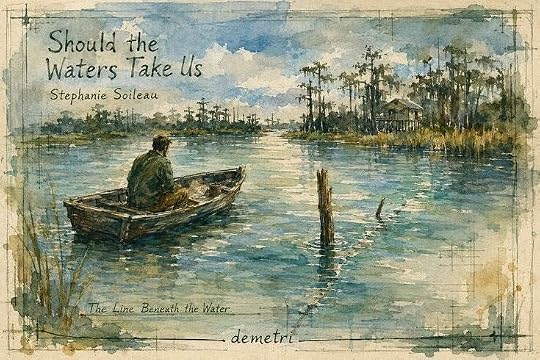
“The Line Beneath the Water” – A solitary figure drifts between deed and memory as the marsh quietly erases the boundary beneath him, rendered in the blue-greens, cypress shadows, and restrained reed-gold accents drawn from the atmosphere of Stephanie Soileau’s “Should the Waters Take Us.”
Disasters do not arrive alone in Stephanie Soileau’s “Should the Waters Take Us.” They drag family legend, mineral leases, unpaid taxes, weather reports, and the convenient conviction that catastrophe ought to know whom to punish. In 1893, Noé Terrebonne, an Acadian fisherman living on a doomed Louisiana barrier island, helps throw barrels containing Chinese and Filipino migrants into the Gulf to avoid inspectors. Later, when a hurricane swallows Cheniere Disparu, he rows repeatedly into lethal water and saves dozens of neighbors. Both acts belong to the same man. Only one becomes inheritance.
Every family myth, Soileau suggests, has an editorial policy. It need not invent a hero. It need only preserve the rescue and lose the bodies beside it. Noé protects his sons by drowning strangers, then protects his neighbors by risking his life. His descendants keep the latter Noé, the one in the rescue boat. The barrels sink out of the family’s usable past, though the sound of them going under travels farther than anyone expects.
More than a century later, Wilford “Boy” Broussard lives by hunting, fishing, trapping, scavenging, and treating most regulations as paper prohibitions drafted by dry-footed strangers. He believes a tract of marsh controlled by his uncle-by-marriage, Jacot Terrebonne, should have descended to him. Boy has ancestral use, local knowledge, a conveniently expandable theory of Indigenous descent, and the confidence of a man who mistakes competence for license. Jacot has deeds. The land keeps sinking beneath both claims.
Entering Boy’s private rulebook is Lee, his twelve-year-old daughter, whom he has scarcely known. Her mother, Mandy, leaves her with him before beginning a rotation on a deepwater drilling rig. The platform explodes. Mandy disappears, oil advances across the Gulf, and Boy begins practicing fatherhood with the breezy confidence of a man accustomed to surviving his own planning. He buys Lee sheets, a bathrobe, maxi-pads, and something resembling a bedroom door. Then he leaves her after dark in a collapsing marsh camp while he steals alligator eggs. His care arrives wearing muddy boots and carrying contraband.
The romance of Boy’s independence does not survive prolonged contact with a child. His knowledge can feed Lee, steer a boat through darkness, and kill a suffering animal quickly. It can also strand her, frighten her, and leave her sitting beside dynamite. She begins to learn the distinction he avoids: knowing how to get out of danger is not the same as keeping another person from it. Beyond Boy’s trailer, Pelerin Parish sorts loss into claims that can be documented and everything that cannot. Jacot grieves his wife, Rosa, while defending both the land and the version of its acquisition he can bear to repeat. Their grandson Jamie treats affection as advance notice of loss. Father Fabian Dakolo recognizes in coastal Louisiana another oil-cut delta, though recognition does not erase the distance between this parish and his Nigerian home.
Rosa’s family land first appears as the object of Boy’s grievance and Jacot’s legal certainty. The novel later returns to 1947, when Jacot is young, poor, ambitious, and useful to oil prospectors who do not know the routes, family names, ridges, or seasonal habits of the marsh. He wants enough money to marry Rosa. He supplies what the outsiders lack. Soon there are maps where there had been understandings, signatures where there had been use, and leases that know nothing of either.
In Jacot’s account, he saves Rosa’s parcel from tax sale and corporate absorption. The account is true and strategically short. Boy performs the same edit more noisily. He knows the marsh intimately, then treats intimacy as permission to trespass, poach, steal, and improvise ancestry when useful. Rosa eventually leaves a handwritten note in her Bible giving him the disputed land, as though one precarious piece of paper might correct another. Even this fails to satisfy him. Being wronged is the one property no deed can take away.
Put Boy inside a long sentence and he can make nearly anything sound reasonable. Soileau lets his explanations gather context, inconvenience, jokes, and emergency exits until the prohibition that began the thought has almost vanished. He revises himself without surrendering a thing. The reader may laugh before noticing what has been excused. His voice is not lovable in the reassuring sense. It is alive, which is more dangerous.
At other moments the language narrows around Jacot’s objects, Jamie’s anticipation of loss, or Fabian’s uneasy mixture of scripture, irritation, and homesickness. The marsh itself never turns gauzy. Oil smells and burns. It coats feathers and remains under sand after the visible cleanup. Houses sag on pilings. Water presses through floorboards. Rusted wellheads rise from flooded acreage like machinery embarrassed to have outlived its owners.
Powerful images sometimes receive one explanation too many. Noé’s barrels, Jacot’s wandering boat, Rosa’s ashes, and the leaking wellhead do not need much help. Soileau occasionally follows them with a sentence that closes the aftershock they opened. Her problem is not thinness. It is abundance refusing to leave the room. A property line running through open water already contains the joke and the injury.
As the hurricane advances in 2010, the novel repeatedly leaves it behind for France, Acadia, colonial Port Royal, earlier Louisiana, and the Niger Delta. The best departures change what we thought we knew. Noé’s rescue can no longer be told without the barrels hovering nearby. Acadian exile remains real, but no longer settles the ethics of later possession. Fabian recognizes Louisiana because he has seen another community live among pipelines and promises. A few journeys into the past arrive after their point has already been made, while Mandy remains offshore and Lee waits for news.
Details sometimes meet their counterparts with suspicious punctuality. Storm answers storm. Attic answers attic. Louisiana faces Nigeria across two damaged deltas. Buried oil meets buried wrongdoing; reconstructed settlements meet reconstructed ancestry. Several pairings bite deeply, especially Jamie and Lee sheltering where Noé’s neighbors once crowded during the 1893 hurricane. Others feel less discovered than positioned, as though the past has been told where to stand before entering the room.
In the present, the people are too troublesome to remain in position. Mandy survives the rig explosion and still turns back toward offshore wages. Jacot’s rise began in poverty, love, flattery, and a young man’s wish to provide, though none of that cleans the title. Fabian understands the damage of oil and the vanity hidden inside moral distance. Boy can be tender, learned, cruel, funny, cowardly, resourceful, and catastrophically certain of himself, sometimes before lunch. Soileau grants motives freely and pardons almost nothing.
Mandy’s paycheck keeps the burning rig inside the family kitchen. So does Boy’s fantasy of the royalties he believes should have been his. Oil is pollution, but it is also rent, mobility, status, and one of the few routes toward a less precarious life. A freshwater diversion may keep crude from one stretch of marsh while killing the oysters on which another household depends. Protection is rarely experienced as protection by everyone standing downstream.
In its Gulf weather, bruised family tenderness, and attention to survival after the official disaster, “Should the Waters Take Us” occasionally recalls Jesmyn Ward’s “Salvage the Bones.” Its nonlinear inheritance of land and environmental debt also brushes against Michael Christie’s “Greenwood,” though Soileau is less interested in formal puzzlework than in the stories families sand smooth through use. Her people know the marsh intimately. Sometimes that knowledge makes them careful. Sometimes it merely furnishes better excuses.
The fire is the portion cameras can hold. The rest arrives as dead oysters, rejected claims, leaking metal, and another shift offshore. The operator leaves; the well does not. A deed remains valid even after its acreage has become open water. Residents are asked why they stay after wages, kinship, poverty, language, and memory have narrowed the practical meaning of departure. Years later, the leak belongs to no decision anyone still wishes to name.
Rosa’s note cannot settle the land dispute, but it records her refusal of Jacot’s version. After her death, he carries her ashes into the bayou, searching for the ridge where their courtship became a marriage. The channels have widened. The ground has shifted. Memory points; the marsh answers with unfamiliar water. His grief needs coordinates. The marsh declines to provide them.
On the eve of the hurricane, Boy dynamites an abandoned wellhead and produces far less justice than noise. Jacot fires toward his boat before realizing Lee is aboard. Boy finally accepts the evacuation order, only to be arrested for having driven Fabian from the road and left him injured in the rain. Consequence arrives just as Boy begins behaving like the father he imagines himself becoming. Belatedness has a bill.
Placed with Jamie in the old Terrebonne house, Lee becomes both heir and hostage to the family’s preferred account. Water climbs the rooms. They retreat to the attic where Noé’s neighbors once sheltered. Jamie tells her about the rescue and leaves out the barrels. For a few minutes, the shortened story steadies her. The dead omitted from it remain dead; in the attic, a frightened girl can breathe. Soileau’s hardest insight may be that an incomplete story can offer shelter even while it preserves the conditions for another forgetting.
Out in the hurricane’s eye, Fabian approaches in a yellow kayak, paddling with one injured arm because Lee called him. Grace, here, has poor equipment and excellent attendance. Mandy later arrives by airboat and reaches for her daughter. Jacot has vanished with Rosa’s ashes. Boy remains answerable to the law and to a child who knows by now that his protection can resemble exposure. The waters keep no ledger.
Until Rosa’s final journey, the book might have ended with those flooded reckonings. Instead it moves backward to 2007. At Lascaux, Rosa reaches toward what she believes is an ancient handprint and learns that the cave is a reproduction. In France, villages do not recognize the surnames she carries as ancestral proof. In Nova Scotia, costumed interpreters in a rebuilt Port Royal welcome her more warmly than the supposed homeland did. Learning that the handprint is copied does not empty her feeling. It adds embarrassment to it, then leaves the feeling there.
Look again at Rosa’s hovering hand and the earlier centuries lose some of their certainty. They have been built across missing records, oral fragments, family appetite, and imaginative inference. Rosa still needs the handprint. Jacot needs the ridge. Boy needs the parcel. None of those needs is counterfeit. None grants sole custody of what has vanished.
One after another, the characters point and say here: the parcel that should be mine, the place where we first loved, the injury that explains what I did, the ancestor who proves I belong. Water crosses the markers before anyone finishes speaking. It carries evidence away. It also carries someone else’s ruin downstream.
Several storms, attics, deltas, and buried secrets meet their counterparts a little too neatly. At 85/100, or 4/5 stars, “Should the Waters Take Us” is strongest when it lets one true story trouble another rather than settle it. The beach may look clean. The tar remains underneath. Under the family story, another story keeps breathing through a reed.
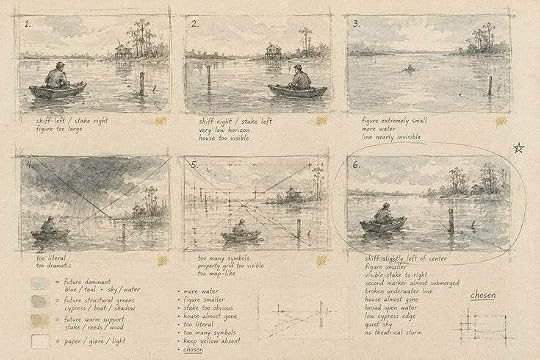
Small studies test the balance among skiff, figure, stake, horizon, and open water, searching for the version in which solitude carries the argument without turning the scene into straightforward illustration.
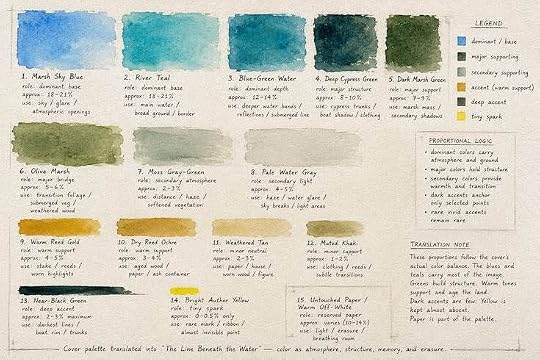
Unequal swatches translate the published cover’s visual hierarchy into paint: blue and teal hold the atmosphere, marsh greens build the structure, ochres warm the edges, and vivid yellow is kept to the smallest possible pulse.
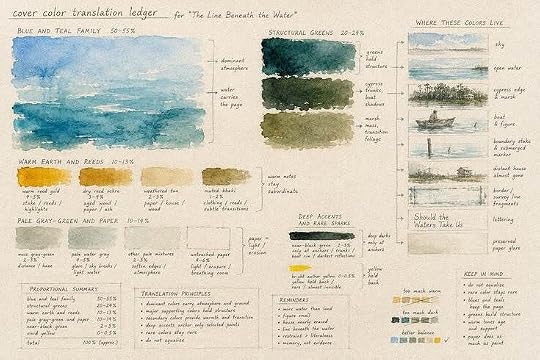
A painter’s ledger maps color to function rather than treating the palette democratically – water carries the page, greens hold its physical structure, warm notes remain subordinate, and the rarest color stays rare.
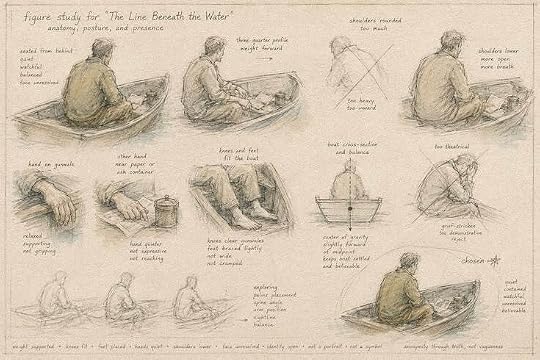
Seated poses, hands, knees, and shifting weight are tested before detail is withheld, ensuring that the final figure can remain anonymous and unfinished without ever becoming anatomically vague.
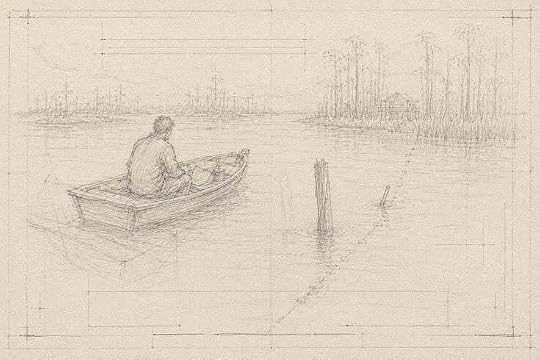
The first full construction fixes the skiff, submerged marker, distant house, and barely visible property line while leaving the paper open enough for water, erosion, and uncertainty to enter later.
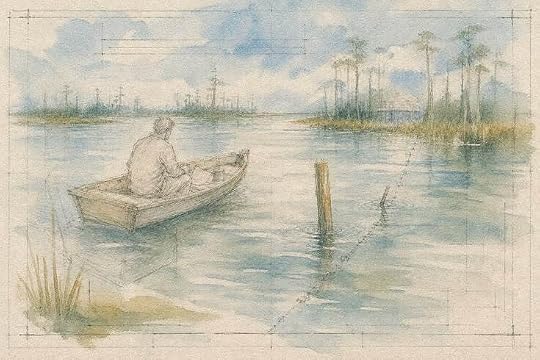
The earliest blue and teal washes establish sky and water before the figure is fully painted, allowing the marsh to become the dominant presence rather than a backdrop arranged around the human subject.
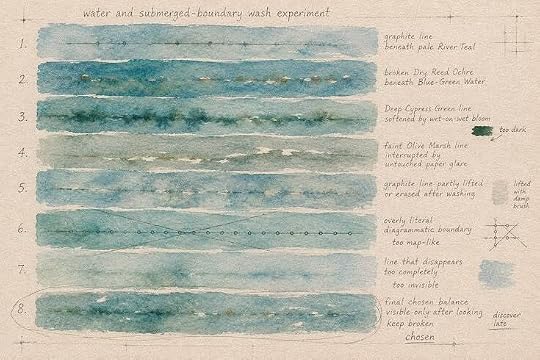
Transparent teal, interrupted graphite, pale glare, and broken ochre are tested until the buried boundary remains discoverable without becoming a diagram – present, unstable, and nearly lost.
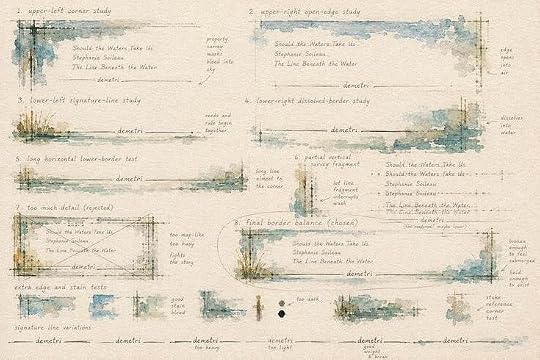
Survey marks, crop lines, dissolved washes, and extended signature rules test a border that behaves like an attempted system of containment – one already being softened and interrupted by water.
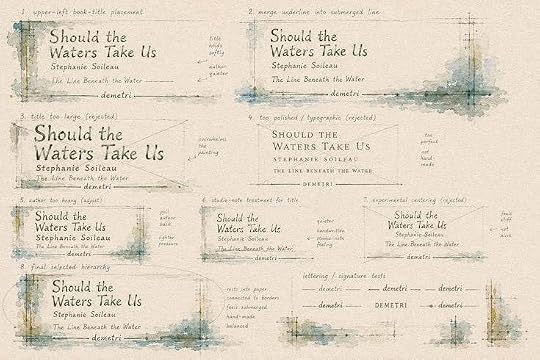
Handwritten titles, graphite guidelines, rejected scales, and the long lower “demetri” rule explore how language can enter the painting as part of its submerged boundary system rather than sit above it as design.
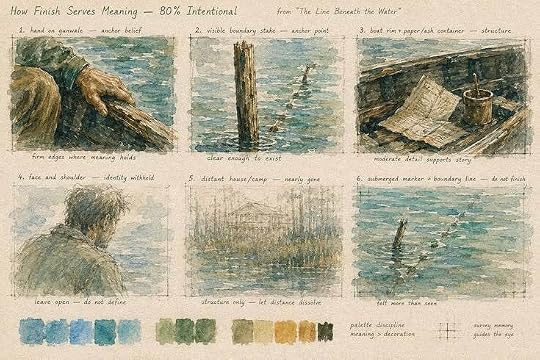
The hand, gunwale, and visible stake receive enough finish to anchor belief, while face, house, and submerged marker remain lighter and provisional, making incompletion part of the image’s meaning rather than a missing last step.
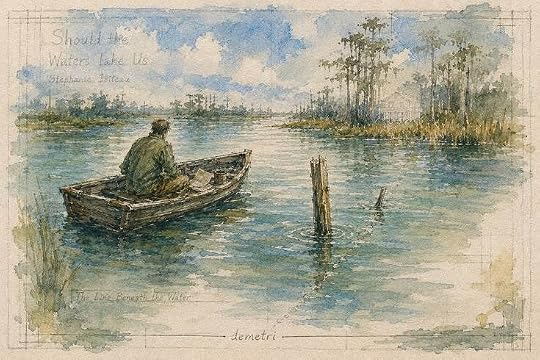
With the main cool masses established and the rare warm notes still restrained, the near-finished plate shows how the final work advances through selective reinforcement instead of painting every passage to equal completion.
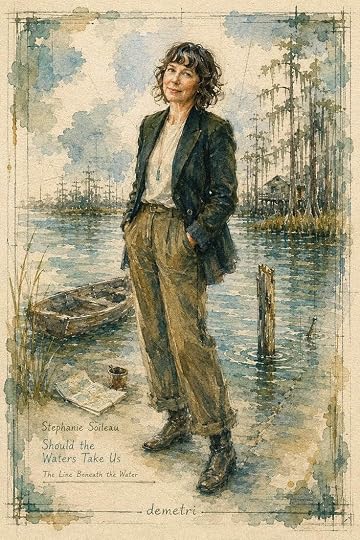
A literary watercolor portrait of Stephanie Soileau places the author inside the marsh world of “Should the Waters Take Us,” where the skiff, disappearing marker, raised house, and cover-drawn palette turn the conventional publicity portrait into an extension of the novel’s unsettled geography.
All watercolor illustrations by Demetris Papadimitropoulos.
Watercolors are done on 140lb vellum and then scanned into the computer using an Epson scanner. From there, they are finalized in Procreate. All art and opinions are my own.
Stephanie Soileau’s “Should the Waters Take Us” Understands That the Most Persistent Myths Begin as True Stories Missing Their Most Important Paragraph.
By Demetris Papadimitropoulos | July 14th, 2026
“The Line Beneath the Water” – A solitary figure drifts between deed and memory as the marsh quietly erases the boundary beneath him, rendered in the blue-greens, cypress shadows, and restrained reed-gold accents drawn from the atmosphere of Stephanie Soileau’s “Should the Waters Take Us.”
Disasters do not arrive alone in Stephanie Soileau’s “Should the Waters Take Us.” They drag family legend, mineral leases, unpaid taxes, weather reports, and the convenient conviction that catastrophe ought to know whom to punish. In 1893, Noé Terrebonne, an Acadian fisherman living on a doomed Louisiana barrier island, helps throw barrels containing Chinese and Filipino migrants into the Gulf to avoid inspectors. Later, when a hurricane swallows Cheniere Disparu, he rows repeatedly into lethal water and saves dozens of neighbors. Both acts belong to the same man. Only one becomes inheritance.
Every family myth, Soileau suggests, has an editorial policy. It need not invent a hero. It need only preserve the rescue and lose the bodies beside it. Noé protects his sons by drowning strangers, then protects his neighbors by risking his life. His descendants keep the latter Noé, the one in the rescue boat. The barrels sink out of the family’s usable past, though the sound of them going under travels farther than anyone expects.
More than a century later, Wilford “Boy” Broussard lives by hunting, fishing, trapping, scavenging, and treating most regulations as paper prohibitions drafted by dry-footed strangers. He believes a tract of marsh controlled by his uncle-by-marriage, Jacot Terrebonne, should have descended to him. Boy has ancestral use, local knowledge, a conveniently expandable theory of Indigenous descent, and the confidence of a man who mistakes competence for license. Jacot has deeds. The land keeps sinking beneath both claims.
Entering Boy’s private rulebook is Lee, his twelve-year-old daughter, whom he has scarcely known. Her mother, Mandy, leaves her with him before beginning a rotation on a deepwater drilling rig. The platform explodes. Mandy disappears, oil advances across the Gulf, and Boy begins practicing fatherhood with the breezy confidence of a man accustomed to surviving his own planning. He buys Lee sheets, a bathrobe, maxi-pads, and something resembling a bedroom door. Then he leaves her after dark in a collapsing marsh camp while he steals alligator eggs. His care arrives wearing muddy boots and carrying contraband.
The romance of Boy’s independence does not survive prolonged contact with a child. His knowledge can feed Lee, steer a boat through darkness, and kill a suffering animal quickly. It can also strand her, frighten her, and leave her sitting beside dynamite. She begins to learn the distinction he avoids: knowing how to get out of danger is not the same as keeping another person from it. Beyond Boy’s trailer, Pelerin Parish sorts loss into claims that can be documented and everything that cannot. Jacot grieves his wife, Rosa, while defending both the land and the version of its acquisition he can bear to repeat. Their grandson Jamie treats affection as advance notice of loss. Father Fabian Dakolo recognizes in coastal Louisiana another oil-cut delta, though recognition does not erase the distance between this parish and his Nigerian home.
Rosa’s family land first appears as the object of Boy’s grievance and Jacot’s legal certainty. The novel later returns to 1947, when Jacot is young, poor, ambitious, and useful to oil prospectors who do not know the routes, family names, ridges, or seasonal habits of the marsh. He wants enough money to marry Rosa. He supplies what the outsiders lack. Soon there are maps where there had been understandings, signatures where there had been use, and leases that know nothing of either.
In Jacot’s account, he saves Rosa’s parcel from tax sale and corporate absorption. The account is true and strategically short. Boy performs the same edit more noisily. He knows the marsh intimately, then treats intimacy as permission to trespass, poach, steal, and improvise ancestry when useful. Rosa eventually leaves a handwritten note in her Bible giving him the disputed land, as though one precarious piece of paper might correct another. Even this fails to satisfy him. Being wronged is the one property no deed can take away.
Put Boy inside a long sentence and he can make nearly anything sound reasonable. Soileau lets his explanations gather context, inconvenience, jokes, and emergency exits until the prohibition that began the thought has almost vanished. He revises himself without surrendering a thing. The reader may laugh before noticing what has been excused. His voice is not lovable in the reassuring sense. It is alive, which is more dangerous.
At other moments the language narrows around Jacot’s objects, Jamie’s anticipation of loss, or Fabian’s uneasy mixture of scripture, irritation, and homesickness. The marsh itself never turns gauzy. Oil smells and burns. It coats feathers and remains under sand after the visible cleanup. Houses sag on pilings. Water presses through floorboards. Rusted wellheads rise from flooded acreage like machinery embarrassed to have outlived its owners.
Powerful images sometimes receive one explanation too many. Noé’s barrels, Jacot’s wandering boat, Rosa’s ashes, and the leaking wellhead do not need much help. Soileau occasionally follows them with a sentence that closes the aftershock they opened. Her problem is not thinness. It is abundance refusing to leave the room. A property line running through open water already contains the joke and the injury.
As the hurricane advances in 2010, the novel repeatedly leaves it behind for France, Acadia, colonial Port Royal, earlier Louisiana, and the Niger Delta. The best departures change what we thought we knew. Noé’s rescue can no longer be told without the barrels hovering nearby. Acadian exile remains real, but no longer settles the ethics of later possession. Fabian recognizes Louisiana because he has seen another community live among pipelines and promises. A few journeys into the past arrive after their point has already been made, while Mandy remains offshore and Lee waits for news.
Details sometimes meet their counterparts with suspicious punctuality. Storm answers storm. Attic answers attic. Louisiana faces Nigeria across two damaged deltas. Buried oil meets buried wrongdoing; reconstructed settlements meet reconstructed ancestry. Several pairings bite deeply, especially Jamie and Lee sheltering where Noé’s neighbors once crowded during the 1893 hurricane. Others feel less discovered than positioned, as though the past has been told where to stand before entering the room.
In the present, the people are too troublesome to remain in position. Mandy survives the rig explosion and still turns back toward offshore wages. Jacot’s rise began in poverty, love, flattery, and a young man’s wish to provide, though none of that cleans the title. Fabian understands the damage of oil and the vanity hidden inside moral distance. Boy can be tender, learned, cruel, funny, cowardly, resourceful, and catastrophically certain of himself, sometimes before lunch. Soileau grants motives freely and pardons almost nothing.
Mandy’s paycheck keeps the burning rig inside the family kitchen. So does Boy’s fantasy of the royalties he believes should have been his. Oil is pollution, but it is also rent, mobility, status, and one of the few routes toward a less precarious life. A freshwater diversion may keep crude from one stretch of marsh while killing the oysters on which another household depends. Protection is rarely experienced as protection by everyone standing downstream.
In its Gulf weather, bruised family tenderness, and attention to survival after the official disaster, “Should the Waters Take Us” occasionally recalls Jesmyn Ward’s “Salvage the Bones.” Its nonlinear inheritance of land and environmental debt also brushes against Michael Christie’s “Greenwood,” though Soileau is less interested in formal puzzlework than in the stories families sand smooth through use. Her people know the marsh intimately. Sometimes that knowledge makes them careful. Sometimes it merely furnishes better excuses.
The fire is the portion cameras can hold. The rest arrives as dead oysters, rejected claims, leaking metal, and another shift offshore. The operator leaves; the well does not. A deed remains valid even after its acreage has become open water. Residents are asked why they stay after wages, kinship, poverty, language, and memory have narrowed the practical meaning of departure. Years later, the leak belongs to no decision anyone still wishes to name.
Rosa’s note cannot settle the land dispute, but it records her refusal of Jacot’s version. After her death, he carries her ashes into the bayou, searching for the ridge where their courtship became a marriage. The channels have widened. The ground has shifted. Memory points; the marsh answers with unfamiliar water. His grief needs coordinates. The marsh declines to provide them.
On the eve of the hurricane, Boy dynamites an abandoned wellhead and produces far less justice than noise. Jacot fires toward his boat before realizing Lee is aboard. Boy finally accepts the evacuation order, only to be arrested for having driven Fabian from the road and left him injured in the rain. Consequence arrives just as Boy begins behaving like the father he imagines himself becoming. Belatedness has a bill.
Placed with Jamie in the old Terrebonne house, Lee becomes both heir and hostage to the family’s preferred account. Water climbs the rooms. They retreat to the attic where Noé’s neighbors once sheltered. Jamie tells her about the rescue and leaves out the barrels. For a few minutes, the shortened story steadies her. The dead omitted from it remain dead; in the attic, a frightened girl can breathe. Soileau’s hardest insight may be that an incomplete story can offer shelter even while it preserves the conditions for another forgetting.
Out in the hurricane’s eye, Fabian approaches in a yellow kayak, paddling with one injured arm because Lee called him. Grace, here, has poor equipment and excellent attendance. Mandy later arrives by airboat and reaches for her daughter. Jacot has vanished with Rosa’s ashes. Boy remains answerable to the law and to a child who knows by now that his protection can resemble exposure. The waters keep no ledger.
Until Rosa’s final journey, the book might have ended with those flooded reckonings. Instead it moves backward to 2007. At Lascaux, Rosa reaches toward what she believes is an ancient handprint and learns that the cave is a reproduction. In France, villages do not recognize the surnames she carries as ancestral proof. In Nova Scotia, costumed interpreters in a rebuilt Port Royal welcome her more warmly than the supposed homeland did. Learning that the handprint is copied does not empty her feeling. It adds embarrassment to it, then leaves the feeling there.
Look again at Rosa’s hovering hand and the earlier centuries lose some of their certainty. They have been built across missing records, oral fragments, family appetite, and imaginative inference. Rosa still needs the handprint. Jacot needs the ridge. Boy needs the parcel. None of those needs is counterfeit. None grants sole custody of what has vanished.
One after another, the characters point and say here: the parcel that should be mine, the place where we first loved, the injury that explains what I did, the ancestor who proves I belong. Water crosses the markers before anyone finishes speaking. It carries evidence away. It also carries someone else’s ruin downstream.
Several storms, attics, deltas, and buried secrets meet their counterparts a little too neatly. At 85/100, or 4/5 stars, “Should the Waters Take Us” is strongest when it lets one true story trouble another rather than settle it. The beach may look clean. The tar remains underneath. Under the family story, another story keeps breathing through a reed.
Small studies test the balance among skiff, figure, stake, horizon, and open water, searching for the version in which solitude carries the argument without turning the scene into straightforward illustration.
Unequal swatches translate the published cover’s visual hierarchy into paint: blue and teal hold the atmosphere, marsh greens build the structure, ochres warm the edges, and vivid yellow is kept to the smallest possible pulse.
A painter’s ledger maps color to function rather than treating the palette democratically – water carries the page, greens hold its physical structure, warm notes remain subordinate, and the rarest color stays rare.
Seated poses, hands, knees, and shifting weight are tested before detail is withheld, ensuring that the final figure can remain anonymous and unfinished without ever becoming anatomically vague.
The first full construction fixes the skiff, submerged marker, distant house, and barely visible property line while leaving the paper open enough for water, erosion, and uncertainty to enter later.
The earliest blue and teal washes establish sky and water before the figure is fully painted, allowing the marsh to become the dominant presence rather than a backdrop arranged around the human subject.
Transparent teal, interrupted graphite, pale glare, and broken ochre are tested until the buried boundary remains discoverable without becoming a diagram – present, unstable, and nearly lost.
Survey marks, crop lines, dissolved washes, and extended signature rules test a border that behaves like an attempted system of containment – one already being softened and interrupted by water.
Handwritten titles, graphite guidelines, rejected scales, and the long lower “demetri” rule explore how language can enter the painting as part of its submerged boundary system rather than sit above it as design.
The hand, gunwale, and visible stake receive enough finish to anchor belief, while face, house, and submerged marker remain lighter and provisional, making incompletion part of the image’s meaning rather than a missing last step.
With the main cool masses established and the rare warm notes still restrained, the near-finished plate shows how the final work advances through selective reinforcement instead of painting every passage to equal completion.
A literary watercolor portrait of Stephanie Soileau places the author inside the marsh world of “Should the Waters Take Us,” where the skiff, disappearing marker, raised house, and cover-drawn palette turn the conventional publicity portrait into an extension of the novel’s unsettled geography.
All watercolor illustrations by Demetris Papadimitropoulos.
Watercolors are done on 140lb vellum and then scanned into the computer using an Epson scanner. From there, they are finalized in Procreate. All art and opinions are my own.

August 26, 2026
As someone raised on the Gulf Coast in Houston who has lived in Louisiana for the past twelve years, this book felt deeply familiar to me. It is such a beautiful homage to the people, culture, history, and plight of South Louisiana without ever romanticizing any of it.
What I loved most is that the land itself feels like the protagonist. People and generations come and go, but the water, marsh, displacement, extraction, poverty, industry, family, and survival remain. The sprawling timelines and characters worked for me precisely because of that. This isn’t really the story of one family or one generation. It’s the story of a place and the people who have tried, over centuries, to belong to it.
And Soileau allows that history to be complicated.
The Acadians are displaced people whose culture survived extraordinary hardship. They are also capable of exploiting people more vulnerable than themselves. Families can remember their heroes while forgetting—or choosing not to remember—the people those heroes harmed. That refusal to flatten anyone into victim, villain, or saint gives the novel so much depth.
The same complexity carries into its treatment of the oil industry. “Oil companies destroyed the Louisiana coast” and “oil has supported generations of Louisiana families” can both be true. Oil is someone’s paycheck, someone’s livelihood, someone’s way of keeping a family afloat. It is also canals cut through wetlands, environmental destruction, corporate power, spills, and disappearing coastline. The book understands that people can recognize what an industry is doing to the place they love and still depend on that industry to survive.
That contradiction feels profoundly Gulf Coast to me.
And perhaps that’s why the environmental loss in this book hit me so hard. The disappearance of coastal Louisiana isn’t some abstract, dystopian possibility. Places have already vanished. Families remember land that is now water. Hurricanes don’t simply destroy homes here; they repeatedly rearrange the geography people understand as home.
Which makes the title, Should the Waters Take Us, devastatingly perfect.
Not if the waters take us.
The novel also left me thinking about what it means to say that land “belongs” to us at all—especially when the land itself is disappearing, and when our claims to it are tangled up in displacement, inheritance, exploitation, survival, and the stories families choose to tell about themselves.
This is a messy, sprawling, deeply human book about a messy, sprawling, deeply human place. It loves South Louisiana enough to neither condemn nor romanticize it.
For me, that’s exactly what made it so good.
What I loved most is that the land itself feels like the protagonist. People and generations come and go, but the water, marsh, displacement, extraction, poverty, industry, family, and survival remain. The sprawling timelines and characters worked for me precisely because of that. This isn’t really the story of one family or one generation. It’s the story of a place and the people who have tried, over centuries, to belong to it.
And Soileau allows that history to be complicated.
The Acadians are displaced people whose culture survived extraordinary hardship. They are also capable of exploiting people more vulnerable than themselves. Families can remember their heroes while forgetting—or choosing not to remember—the people those heroes harmed. That refusal to flatten anyone into victim, villain, or saint gives the novel so much depth.
The same complexity carries into its treatment of the oil industry. “Oil companies destroyed the Louisiana coast” and “oil has supported generations of Louisiana families” can both be true. Oil is someone’s paycheck, someone’s livelihood, someone’s way of keeping a family afloat. It is also canals cut through wetlands, environmental destruction, corporate power, spills, and disappearing coastline. The book understands that people can recognize what an industry is doing to the place they love and still depend on that industry to survive.
That contradiction feels profoundly Gulf Coast to me.
And perhaps that’s why the environmental loss in this book hit me so hard. The disappearance of coastal Louisiana isn’t some abstract, dystopian possibility. Places have already vanished. Families remember land that is now water. Hurricanes don’t simply destroy homes here; they repeatedly rearrange the geography people understand as home.
Which makes the title, Should the Waters Take Us, devastatingly perfect.
Not if the waters take us.
The novel also left me thinking about what it means to say that land “belongs” to us at all—especially when the land itself is disappearing, and when our claims to it are tangled up in displacement, inheritance, exploitation, survival, and the stories families choose to tell about themselves.
This is a messy, sprawling, deeply human book about a messy, sprawling, deeply human place. It loves South Louisiana enough to neither condemn nor romanticize it.
For me, that’s exactly what made it so good.
August 20, 2026
Thanks to Netgalley and Doubleday for the ebook. An epic family history about how one family emigrated to coastal Louisiana. It also tells the modern story of one of those family members surviving working an offshore oil rig that explodes. This rig is spewing oil for months and is now being further spread by a huge hurricane. Within this giant story are the everyday people on the ground who are trying to feed their family, adjusting to life after a matriarch’s death and even a preacher who tries his best, despite his lack of genuine faith. An amazing book.

August 14, 2026
I had high expectations and this novel still blew me away. This book produced such a deep feelings in me I was crying from my chest. The characters in this novel are all so different. A really interesting choice to never write from Lee’s perspective. I will never forgive BP For as long as I am alive. I need to go to Louisiana ASAP!!!
July 21, 2026
Stephanie Soileau has already proven to be a masterful short story writer--her collection Last One Out, Shut Off the Lights revealed her sensitivity and skill at painting small pictures of people on the margins of economic and environmental disaster in coastal Louisiana.
With Should the Waters Take Us, Soileau shows that she can also paint on a larger canvas, to even more devastating effect. This epic novel follows an extended family of Acadian exiles to Louisiana (Cajuns) by focusing the present frame--in the late 2000s--on the coastal erosion and environmental threats of oil spills and hurricanes, juxtaposed with several haunting chapters tracing the ancestors of the current characters as the migrated from France, to New Canada, and ultimately down to the Louisiana they now inhabit.
I don't like to leave plot-oriented reviews, but I will note that, despite the quiet observation of Soileau's prose, the interwoven narrative is as propulsive as any thriller. It IS kind of a thriller, but the outcome hinges not on a crime or dramatic event, but on the people and the place that is under larger existential threat.
Soileau is also a masterful prose stylist. I had to pause and reread many passages just because I was struck by the unexpected turns of phrase the narrator or various characters express. It is high literary fiction at its best: the art never gets in the way of the "story," but they combine to stunning and beautiful effect. One of the best fiction debuts I've read in years.
With Should the Waters Take Us, Soileau shows that she can also paint on a larger canvas, to even more devastating effect. This epic novel follows an extended family of Acadian exiles to Louisiana (Cajuns) by focusing the present frame--in the late 2000s--on the coastal erosion and environmental threats of oil spills and hurricanes, juxtaposed with several haunting chapters tracing the ancestors of the current characters as the migrated from France, to New Canada, and ultimately down to the Louisiana they now inhabit.
I don't like to leave plot-oriented reviews, but I will note that, despite the quiet observation of Soileau's prose, the interwoven narrative is as propulsive as any thriller. It IS kind of a thriller, but the outcome hinges not on a crime or dramatic event, but on the people and the place that is under larger existential threat.
Soileau is also a masterful prose stylist. I had to pause and reread many passages just because I was struck by the unexpected turns of phrase the narrator or various characters express. It is high literary fiction at its best: the art never gets in the way of the "story," but they combine to stunning and beautiful effect. One of the best fiction debuts I've read in years.

Did Not Finish
July 27, 2026I’m very sad to say that I’m DNFing at 68 pages. I have been trying to get into this book for days and I am really struggling. I’m sure the writing is beautiful and lyrical, but it’s not working for me and the storyline isn’t calling to me either :(
Thank you Doubleday for this gifted book!! I truly wish I would’ve worked for me.
Thank you Doubleday for this gifted book!! I truly wish I would’ve worked for me.

August 7, 2026
For a debut novel, this is AMAZING. I give full stars for the sheer complexity, research, and creativity in the storytelling.
Characters: These characters are flawed, painful people who seem so trapped in their choices and way of life in a world where both the forces of God/nature and industry are against them. I sort of hated them and pitied them at the same time (and that's a hard emotion to provoke in readers). From the priest, the kids, the old man watching his wife and his entire life basically die before his eyes, to the way they lost their language, culture, and even their daily bread (in this case, seafood)... it was so heartbreaking. We, as readers, feel all of that with them, through their little vignettes.
Creativity: At first, the seemingly random glimpses of the past felt jarring, as though taking the reader away from the important plot points. But, as the book went on, I grew to appreciate the historical and cultural significance. These little vignettes helped underscore the hidden motives of the original settlers, the many ways that politics and avarice duped them throughout countless generations, and the simple values of family and heritage common to all people in all generations.
Complexity: I'll admit I don't know anything about the gas/oil industry, so this was helpful to see the ecological implications of the issues, and clearly, in such a personal way. I feel much more informed and much more invested in the environmental ramifications of these decisions. I know I'll think about this story for quite a while.
Although I don't think it's a perfect novel. But since it was such a unique and compelling ode to a disappearing culture, I'm giving it five stars in the end.
Characters: These characters are flawed, painful people who seem so trapped in their choices and way of life in a world where both the forces of God/nature and industry are against them. I sort of hated them and pitied them at the same time (and that's a hard emotion to provoke in readers). From the priest, the kids, the old man watching his wife and his entire life basically die before his eyes, to the way they lost their language, culture, and even their daily bread (in this case, seafood)... it was so heartbreaking. We, as readers, feel all of that with them, through their little vignettes.
Creativity: At first, the seemingly random glimpses of the past felt jarring, as though taking the reader away from the important plot points. But, as the book went on, I grew to appreciate the historical and cultural significance. These little vignettes helped underscore the hidden motives of the original settlers, the many ways that politics and avarice duped them throughout countless generations, and the simple values of family and heritage common to all people in all generations.
Complexity: I'll admit I don't know anything about the gas/oil industry, so this was helpful to see the ecological implications of the issues, and clearly, in such a personal way. I feel much more informed and much more invested in the environmental ramifications of these decisions. I know I'll think about this story for quite a while.
Although I don't think it's a perfect novel. But since it was such a unique and compelling ode to a disappearing culture, I'm giving it five stars in the end.

July 25, 2026
"Should the Waters Take Us" is a thoughtful novel about family, inheritance, responsibility, and the far-reaching effects of climate change. Stephanie Soileau skillfully weaves the stories of past generations into the lives of the present-day inhabitants of a Louisiana bayou, centering on the members of the Terrebonne family.
The story follows Wilford ("Boy") Broussard, who fishes, cultivates oysters, and steals alligator eggs on land he does not legally own. Having spent nearly his entire life there, Boy feels a deep connection to the bayou and believes the land is rightfully his. When his young daughter, Lee, comes to live with him, his newfound responsibilities challenge his carefree, laissez-faire lifestyle. Lee's mother, forced to take a job on offshore oil rigs to support her daughter, leaves Lee in Boy's temporary care, forcing him to confront what it truly means to be a parent.
Another central character is Boy's uncle, Jacot, who is grieving the loss of his wife while wrestling with the realization that he played a role in selling out his neighbors to the oil companies that bought up the land and mineral rights. As an offshore oil rig disaster triggers a massive, uncontrollable oil spill, the bayou faces an uncertain future. If the environmental catastrophe weren't enough, Hurricane Norbett barrels toward the Louisiana coast, threatening everything the characters hold dear.
Soileau enriches the novel with a memorable supporting cast, including a Nigerian priest struggling to find his place in an unfamiliar community. Together, these characters create a vivid portrait of a region where family, history, culture, and the environment are deeply intertwined.
This is not an uplifting novel—its themes are heavy, and the outlook is often bleak—but it feels entirely plausible. Readers who enjoy literary fiction rooted in place, with strong environmental themes and complex family dynamics, will find much to appreciate.
Thank you to NetGalley for providing an advance reader copy in exchange for an honest review.
The story follows Wilford ("Boy") Broussard, who fishes, cultivates oysters, and steals alligator eggs on land he does not legally own. Having spent nearly his entire life there, Boy feels a deep connection to the bayou and believes the land is rightfully his. When his young daughter, Lee, comes to live with him, his newfound responsibilities challenge his carefree, laissez-faire lifestyle. Lee's mother, forced to take a job on offshore oil rigs to support her daughter, leaves Lee in Boy's temporary care, forcing him to confront what it truly means to be a parent.
Another central character is Boy's uncle, Jacot, who is grieving the loss of his wife while wrestling with the realization that he played a role in selling out his neighbors to the oil companies that bought up the land and mineral rights. As an offshore oil rig disaster triggers a massive, uncontrollable oil spill, the bayou faces an uncertain future. If the environmental catastrophe weren't enough, Hurricane Norbett barrels toward the Louisiana coast, threatening everything the characters hold dear.
Soileau enriches the novel with a memorable supporting cast, including a Nigerian priest struggling to find his place in an unfamiliar community. Together, these characters create a vivid portrait of a region where family, history, culture, and the environment are deeply intertwined.
This is not an uplifting novel—its themes are heavy, and the outlook is often bleak—but it feels entirely plausible. Readers who enjoy literary fiction rooted in place, with strong environmental themes and complex family dynamics, will find much to appreciate.
Thank you to NetGalley for providing an advance reader copy in exchange for an honest review.

September 15, 2026
So much about Southern Louisiana is woven throughout every paragraph of this book. There are two timelines. The bayou is overtaking the land. Deep in the marshes, families live primitively. The oil companies are relentlessly displacing generations of residents. One day the unfathomable happens. An oil facility in the Gulf explodes. Millions of gallons of oil saturate the Gulf. And on its tail, a hurricane is barreling in. Edited to add: I so appreciate the author bringing the reader inside the heartbreak these people have been through and continue to this very second to endure. This book is REAL.


August 15, 2026
1.5 stars

August 18, 2026
I wanted to like it more but I just lost interest around midpoint and had to really push thru till the end

Did Not Finish
July 17, 2026NO: A book I borrowed from the library to try before I buy (tired buying hundreds books and hating half)
I do not rate these “tested”
books. This is really for me. I will not be buying, reading borrowing this book.
I read first ch or more -first 10-100 pages skim around at times. I read many of my GR friend’s reviews. This is what I did and didn’t like:
Pretty cover.
I was really looking forward to this one but ugh no -what a mess !! I thought I was missing something so goggled the book
ai:”many readers find its style unusual or confusing. The book features a highly unconventional, non-linear structure. Instead of a straightforward narrative, the story jumps frequently across time, geography, and different family members, which can initially make it feel disconnected or hard to follow. The story spans 400 years and jumps between the 17th century and the modern day, sometimes treating chapters like individual short stories…switches point-of-view characters, meaning you have to piece the larger family saga and history together over time…dialogue and descriptions are steeped in Southern Louisiana Acadian (Cajun) culture, which includes a specific regional cadence and vocabulary. YES …the author chose to eliminate traditional quotation marks for dialogue in her novel Should the Waters Take you…
I have no idea what I’m reading this book is too much work. I really hate it when quotation marks are not used. And the jumping all around…ugh pass
I do not rate these “tested”
books. This is really for me. I will not be buying, reading borrowing this book.
I read first ch or more -first 10-100 pages skim around at times. I read many of my GR friend’s reviews. This is what I did and didn’t like:
Pretty cover.
I was really looking forward to this one but ugh no -what a mess !! I thought I was missing something so goggled the book
ai:”many readers find its style unusual or confusing. The book features a highly unconventional, non-linear structure. Instead of a straightforward narrative, the story jumps frequently across time, geography, and different family members, which can initially make it feel disconnected or hard to follow. The story spans 400 years and jumps between the 17th century and the modern day, sometimes treating chapters like individual short stories…switches point-of-view characters, meaning you have to piece the larger family saga and history together over time…dialogue and descriptions are steeped in Southern Louisiana Acadian (Cajun) culture, which includes a specific regional cadence and vocabulary. YES …the author chose to eliminate traditional quotation marks for dialogue in her novel Should the Waters Take you…
I have no idea what I’m reading this book is too much work. I really hate it when quotation marks are not used. And the jumping all around…ugh pass

Review of advance copy received from Netgalley
“a voice for all the gros becs lovers.”
There was no doubt I would connect with this book in so many ways, being from around the exact place of its description. With my ancestors also being part of Le Grand D’erangement, and settling in marshes and bayous all along the coasts of Louisiana in Isle De Jean Charles, later an established part of Terrebonne Parish, this book struck a cord deep, deep within my soul.
In just the first few pages of the book, I knew I was not going to be disappointed with Soileau’s writing. The accuracy, the truth of who was on the lands of my peoples, I was covered in frissons. The voices that Soileau was giving to the culture, the times, the disappearing land, I was already searching out a way to thank her for the words she was putting down.
Starting out with talking about Chenière Disparue, which I knew immediately of what this story was alluding to, made me have another immediate connection. The story of Chenière Caminada and the 2,000 that were buried at sea is one many around here are aware of as its tales are far reaching. I have been fortunate enough to read a written work published in 1981 about the island and its people and to discover something similar talked about in such words is paying reverence in the most beautiful way.
From the way the deep chasms exist between families to the way those same ones seem to disappear when natural disasters come knocking. It is a way of survival, of community, simply, a way of life.
From discussing aspects of land loss, to subtle and not so subtle racism, to the political ineptitudes that keep us in this very position allowing the rich to profit from the land that we have tended century after century, the words within this book echo of the loss that crosses the south. It covers the loss of land, of soul, of life.
If it was not aspects of myself I saw in the characters Soileau created, it was people all around me that I saw within Boy or Rosa or Jamie. The bayou world is rich with personalities abound, but there are certain characteristics that are just perfectly Cajun, perfectly down the bayou that it cannot be replicated unless you know it, unless you live it. Soileau did just that within this book. I cannot stop raving about it. Should the Waters Take Us will be one that sticks with me for a long, long time.
Being down here, you know, I was a stickler for anything that stuck out that wasn’t ringing true to my roots. Stephanie did the best job in making everything so genuine that the only thing that stood out to me was the fact that one of the characters calls a snowball a sno-cone! We don’t do that down here, baby. That’s a snowball and that’s always going to be a snowball. We don’t take ourselves down to the sno-cone stand, we go to the snowball stand and this is a hill I am willing to die on. (My one and only complaint)
Thank you to Net Galley for the advance review of this copy and I am leaving this review completely voluntarily.
There was no doubt I would connect with this book in so many ways, being from around the exact place of its description. With my ancestors also being part of Le Grand D’erangement, and settling in marshes and bayous all along the coasts of Louisiana in Isle De Jean Charles, later an established part of Terrebonne Parish, this book struck a cord deep, deep within my soul.
In just the first few pages of the book, I knew I was not going to be disappointed with Soileau’s writing. The accuracy, the truth of who was on the lands of my peoples, I was covered in frissons. The voices that Soileau was giving to the culture, the times, the disappearing land, I was already searching out a way to thank her for the words she was putting down.
Starting out with talking about Chenière Disparue, which I knew immediately of what this story was alluding to, made me have another immediate connection. The story of Chenière Caminada and the 2,000 that were buried at sea is one many around here are aware of as its tales are far reaching. I have been fortunate enough to read a written work published in 1981 about the island and its people and to discover something similar talked about in such words is paying reverence in the most beautiful way.
From the way the deep chasms exist between families to the way those same ones seem to disappear when natural disasters come knocking. It is a way of survival, of community, simply, a way of life.
From discussing aspects of land loss, to subtle and not so subtle racism, to the political ineptitudes that keep us in this very position allowing the rich to profit from the land that we have tended century after century, the words within this book echo of the loss that crosses the south. It covers the loss of land, of soul, of life.
If it was not aspects of myself I saw in the characters Soileau created, it was people all around me that I saw within Boy or Rosa or Jamie. The bayou world is rich with personalities abound, but there are certain characteristics that are just perfectly Cajun, perfectly down the bayou that it cannot be replicated unless you know it, unless you live it. Soileau did just that within this book. I cannot stop raving about it. Should the Waters Take Us will be one that sticks with me for a long, long time.
Being down here, you know, I was a stickler for anything that stuck out that wasn’t ringing true to my roots. Stephanie did the best job in making everything so genuine that the only thing that stood out to me was the fact that one of the characters calls a snowball a sno-cone! We don’t do that down here, baby. That’s a snowball and that’s always going to be a snowball. We don’t take ourselves down to the sno-cone stand, we go to the snowball stand and this is a hill I am willing to die on. (My one and only complaint)
Thank you to Net Galley for the advance review of this copy and I am leaving this review completely voluntarily.
This entire review has been hidden because of spoilers.

Review of advance copy received from NetGalley
An ambitious, sprawling, and magnificent novel, Should the Waters Take Us by Stephanie Soileau documents the story of an Acadian family and it's peripheral members across three continents and 100 times as many years. Soileau brings the Louisiana coast to life in a setting dripping with character, resilience, and loss. Throughout the novel, many of the characters are faced with moral quandaries and their simple decision in that moment sets off a cascade of downstream effects that oftentimes ripple across the community.
I was very much moved by said community depicted in the novel. I could imagine the dilapidated fishing boats and cottages lost to floods and reclaimed by nature, the families who had lived there for generations and weathered every storm. Further, I appreciated the light that Soileau cast on the many ways that people in the area have been taken advantage of and disenfranchised by the U.S. government and other greedy corporations. As someone not living in an oil-rich area, we hear a lot about the environmental impacts of oil development on the plants and animals in the area, and while this is in the novel too, the human and community impact of oil development was interesting. Soileau approached these depictions in an empathetic and thoughtful way, and brought to life the challenges many individuals face in this region of the United States.
Should the Waters Take Us was a distinctly coastal Louisiana book, the setting as much a character as any human narrator. And perhaps, from my perspective, the most memorable character of all. I read a lot of multi-generational novels spanning large swarths of time, but I really struggled keeping everything straight with this one. I think this was compounded by two factors. First, some of the jumps were a hundred plus years, and without a timeline or map I spent some time trying to connect how this time jump was relevant to the story at first (though usually sorted it by the end of the chapter). Additionally, each chapter, though typically narrated by the titular character (for each chapter was distinguished by the chapter narrator and sometimes the time period) occasionally would jump around between narrators or between settings without warning. The result for me was that I was often confused about who we were meant to be following and did not really develop any real feelings about the characters, except Lee and Fabian, for both of whom my heart broke for different reasons. I still liked the book a lot but think it could have benefited from a family tree right up top that maybe even had the geographic locations drawn in somehow, or a map of the family's migration from France to Acadia to the Louisiana Bayou.
Thank you to Stephanie Soileau, Doubleday Books, and NetGalley for an e-ARC in exchange for an honest review.
I was very much moved by said community depicted in the novel. I could imagine the dilapidated fishing boats and cottages lost to floods and reclaimed by nature, the families who had lived there for generations and weathered every storm. Further, I appreciated the light that Soileau cast on the many ways that people in the area have been taken advantage of and disenfranchised by the U.S. government and other greedy corporations. As someone not living in an oil-rich area, we hear a lot about the environmental impacts of oil development on the plants and animals in the area, and while this is in the novel too, the human and community impact of oil development was interesting. Soileau approached these depictions in an empathetic and thoughtful way, and brought to life the challenges many individuals face in this region of the United States.
Should the Waters Take Us was a distinctly coastal Louisiana book, the setting as much a character as any human narrator. And perhaps, from my perspective, the most memorable character of all. I read a lot of multi-generational novels spanning large swarths of time, but I really struggled keeping everything straight with this one. I think this was compounded by two factors. First, some of the jumps were a hundred plus years, and without a timeline or map I spent some time trying to connect how this time jump was relevant to the story at first (though usually sorted it by the end of the chapter). Additionally, each chapter, though typically narrated by the titular character (for each chapter was distinguished by the chapter narrator and sometimes the time period) occasionally would jump around between narrators or between settings without warning. The result for me was that I was often confused about who we were meant to be following and did not really develop any real feelings about the characters, except Lee and Fabian, for both of whom my heart broke for different reasons. I still liked the book a lot but think it could have benefited from a family tree right up top that maybe even had the geographic locations drawn in somehow, or a map of the family's migration from France to Acadia to the Louisiana Bayou.
Thank you to Stephanie Soileau, Doubleday Books, and NetGalley for an e-ARC in exchange for an honest review.

August 7, 2026
**3.5 rounded up**
This book spoke to me differently than it might to others: I’m a big sucker for setting. And for beautiful writing. Both of which this novel delivered in spades, depositing me in the humid-slick bayous of Southern Louisiana. I’m also in the midst of leading our communities in battling big corporations – replace big oil with big mining, big gas… So the descriptions of the abandoned mining pipes sticking up from the water, the chemicals poured into our oceans to stop the spread of oil spills, really hit home.
I’m living some of this, only not in swampy Louisiana, but in the drought-ridden desert of Arizona, where our air quality and waterways have been polluted by mining for decades. And here we are facing it all over again. Tiny communities coming up against entities with tremendous financial and political power. Those parts really resonated with me: especially the people in the novel who were bamboozled into selling off their property rights.
It's different in the southwest, where ranchers sell off their land to become millionaires, while they put multiple communities in jeopardy and play God with some of the planet’s last riparian ecosystems. So, in that relational way, this book spoke to me.
I wanted a deeper connection with the characters, though. I wanted more of Aunt Rosa, to be honest. She was such a colorful character that I longed for her to be a part of the story on many more pages than those dedicated. My slight dissatisfaction was just not getting quite deep enough into the tender emotions of the characters. Boy was well drawn, and I felt I might have known him best, warts and all. Though, in the end, I judge a book’s quality by its ability to bring me to tears (even near-tears count). But I didn’t quite get there with this book. And I should have. Loved the historical bits, as well.
Even so, I enjoyed learning more about the bayou area and found the parallels to the two geographic locations of Father Fabian (his home in Africa and his new home-that-never-felt-like home in Louisiana) a nice literary touch. While this was eco lit, at its heart, the book was about belonging, fitting in… and family. And the ways corporations play on poverty, making their grand promises. Ones that are never kept.
This book spoke to me differently than it might to others: I’m a big sucker for setting. And for beautiful writing. Both of which this novel delivered in spades, depositing me in the humid-slick bayous of Southern Louisiana. I’m also in the midst of leading our communities in battling big corporations – replace big oil with big mining, big gas… So the descriptions of the abandoned mining pipes sticking up from the water, the chemicals poured into our oceans to stop the spread of oil spills, really hit home.
I’m living some of this, only not in swampy Louisiana, but in the drought-ridden desert of Arizona, where our air quality and waterways have been polluted by mining for decades. And here we are facing it all over again. Tiny communities coming up against entities with tremendous financial and political power. Those parts really resonated with me: especially the people in the novel who were bamboozled into selling off their property rights.
It's different in the southwest, where ranchers sell off their land to become millionaires, while they put multiple communities in jeopardy and play God with some of the planet’s last riparian ecosystems. So, in that relational way, this book spoke to me.
I wanted a deeper connection with the characters, though. I wanted more of Aunt Rosa, to be honest. She was such a colorful character that I longed for her to be a part of the story on many more pages than those dedicated. My slight dissatisfaction was just not getting quite deep enough into the tender emotions of the characters. Boy was well drawn, and I felt I might have known him best, warts and all. Though, in the end, I judge a book’s quality by its ability to bring me to tears (even near-tears count). But I didn’t quite get there with this book. And I should have. Loved the historical bits, as well.
Even so, I enjoyed learning more about the bayou area and found the parallels to the two geographic locations of Father Fabian (his home in Africa and his new home-that-never-felt-like home in Louisiana) a nice literary touch. While this was eco lit, at its heart, the book was about belonging, fitting in… and family. And the ways corporations play on poverty, making their grand promises. Ones that are never kept.

July 18, 2026
Stephanie Soileau’s Should the Waters Take Us is a must-read new novel for anyone interested in climate fiction, hazards of the oil industry, Cajun history and culture, or multi-generational family stories in general.
With segments of the book set in France, Canada, the Eastern U.S., and the majority in Cajun Southern Louisiana, Soileau relates the history of forced Acadian/Cajun migration and eventual voluntary migration to Louisiana in search of free land. Focusing on the intermarried Guidry, Broussard, and Terrebonne families, the author tells much of the story through three generations of Cajun men: Jacot Terrebonne, his nephew Wilford “Boy” Broussard, and his grandson Jamie Terrebonne. However, this is not just a men’s story by any means. Jacot’s wife Rosalie Guidry Terrebonne may die relatively early in the book but gives Jamie, not her husband, a mysterious phone number to call after her death, and, in several ways, continues to play a role to the end of the novel. Lee, the daughter Boy has never known suddenly becomes his responsibility when her mother Mandy takes a job on an off-shore oil rig, communicating daily with her daughter until suddenly she is unable to do so. Holly, teenage Jamie’s best friend, also comes in and out of the story.
Hurricanes and Big Oil affect and sometimes shape family history, and the oil industry connects the one non-Cajun major character to the Cajuns. Father Fabien Dakolo, the local priest, has come to Louisiana from Nigeria, another country impacted by Big Oil. Fabien finds his life repeatedly intersecting with that of the Guidry-Broussard-Terrebonne family as he grapples with his own demons.
With its multiple points of view and non-chronological organization, Should the Waters Take Us slowly unfolds a complex family history filled with plenty of personal issues and dramatic events to keep readers turning pages, wanting to learn more.
Many thanks to NetGalley and Doubleday for an advance reader copy of this captivating novel from Stephanie Soileau, inspired by her Cajun grandparents and bringing Cajun culture and history to life within a context of environmental and ecological challenges.
With segments of the book set in France, Canada, the Eastern U.S., and the majority in Cajun Southern Louisiana, Soileau relates the history of forced Acadian/Cajun migration and eventual voluntary migration to Louisiana in search of free land. Focusing on the intermarried Guidry, Broussard, and Terrebonne families, the author tells much of the story through three generations of Cajun men: Jacot Terrebonne, his nephew Wilford “Boy” Broussard, and his grandson Jamie Terrebonne. However, this is not just a men’s story by any means. Jacot’s wife Rosalie Guidry Terrebonne may die relatively early in the book but gives Jamie, not her husband, a mysterious phone number to call after her death, and, in several ways, continues to play a role to the end of the novel. Lee, the daughter Boy has never known suddenly becomes his responsibility when her mother Mandy takes a job on an off-shore oil rig, communicating daily with her daughter until suddenly she is unable to do so. Holly, teenage Jamie’s best friend, also comes in and out of the story.
Hurricanes and Big Oil affect and sometimes shape family history, and the oil industry connects the one non-Cajun major character to the Cajuns. Father Fabien Dakolo, the local priest, has come to Louisiana from Nigeria, another country impacted by Big Oil. Fabien finds his life repeatedly intersecting with that of the Guidry-Broussard-Terrebonne family as he grapples with his own demons.
With its multiple points of view and non-chronological organization, Should the Waters Take Us slowly unfolds a complex family history filled with plenty of personal issues and dramatic events to keep readers turning pages, wanting to learn more.
Many thanks to NetGalley and Doubleday for an advance reader copy of this captivating novel from Stephanie Soileau, inspired by her Cajun grandparents and bringing Cajun culture and history to life within a context of environmental and ecological challenges.
Review of advance copy received from Netgalley
My attention was first caught by the description, epic saga, when I saw the write up for Stephanie Soileau's debut novel, Should The Waters Take Us being published by Doubleday Books on July 14, 2026. I received an advanced reader's copy of the novel from NetGalley in exchange for an honest review. The word "epic" means to tell the stories of historic people or of a country's history. In Soileau's case, the adventures and deeds being told are of four centuries of people originating in France, then moving to Arcadia, and ending up in Louisianna in the bayous. The waters are paramount in their lives from the first voyage to the new world, to the livelihoods of living and surviving on the bayous for generations.
As in most dynamic tales, the adventures of the people jump from generation to generation, back and forth between eras and history unfolds and is retold to subsequent generations. We are introduced toeach generation learning from the successes and failures of the ancestors and sharing those lessons with their children. Some to be conquered, others to be relived over and over again as the land and the wilds are forever struggling against man and it's progress.
I enjoyed the book. I felt frustration with the characters when the hurricanes came and devastated the land over and over again throughout the centuries. When men took advantage of the poorer people, essentially stepping on the backs of some to rise above them. When children were at the mercy of the parents in the fight to simply survive.
I can't say that this was a book I felt joy to read, but I appreciate the story showing the reader what it means to persevere for the sake of life itself. I will give this book a rating of 4 stars, and invite others to read, , Should The Waters Take Us. It's important to realize that struggle is part of life and seeing others doggedness can motivate us to do likewise.
As in most dynamic tales, the adventures of the people jump from generation to generation, back and forth between eras and history unfolds and is retold to subsequent generations. We are introduced toeach generation learning from the successes and failures of the ancestors and sharing those lessons with their children. Some to be conquered, others to be relived over and over again as the land and the wilds are forever struggling against man and it's progress.
I enjoyed the book. I felt frustration with the characters when the hurricanes came and devastated the land over and over again throughout the centuries. When men took advantage of the poorer people, essentially stepping on the backs of some to rise above them. When children were at the mercy of the parents in the fight to simply survive.
I can't say that this was a book I felt joy to read, but I appreciate the story showing the reader what it means to persevere for the sake of life itself. I will give this book a rating of 4 stars, and invite others to read, , Should The Waters Take Us. It's important to realize that struggle is part of life and seeing others doggedness can motivate us to do likewise.

August 23, 2026
SHOULD THE WATERS TAKE US 🎧
Thanks, @smsoileau, @doubledaybooks, and @PRHAudio, for the review copies. Available now. #PRHAudioPartner
Confession: I was halfway through this one and had set it down. Not because it was bad, just... quiet. Then a member of my Literary Lagniappe Book Club asked me about it, and as I started describing the plot out loud, I got more and more into it, talking myself right back into the book. I went home, picked it back up, and finished it the next day.
This is a multigenerational Acadiana story spanning four centuries and one family, told through interweaving points of view. The kind where a side character in one storyline becomes the anchor of the next. I love that structure. It's like the book is hiding Easter eggs in its own timeline.
Set in a parallel-universe Louisiana where the worst fear during the real 2010 Deepwater Horizon spill actually happens: a hurricane colliding with the blown well before it can be capped. This one will hit differently for anyone who lived through that era on the Gulf Coast. It's character-driven rather than plot-twisty, but the tension builds like real dread.
The audiobook narration by @a.citrus.chaffee is genuinely excellent, especially the accent work.
Not a book for everyone. But if Acadiana, multigenerational family sagas, or literary fiction about place, legacy, and moral compromise are your thing, this could be one of your favorite reads of the year.
Book Club Themes: Can a place become a character in a novel? What do we inherit from the generations before us besides names and stories? How much are we willing to sacrifice for the place we call home? What do we owe the people who come after us?
Food: Oysters, Gulf shrimp, po'boys, and sweet tea.
Have you read this one, or is it on your list? Tell me below.
Thanks, @smsoileau, @doubledaybooks, and @PRHAudio, for the review copies. Available now. #PRHAudioPartner
Confession: I was halfway through this one and had set it down. Not because it was bad, just... quiet. Then a member of my Literary Lagniappe Book Club asked me about it, and as I started describing the plot out loud, I got more and more into it, talking myself right back into the book. I went home, picked it back up, and finished it the next day.
This is a multigenerational Acadiana story spanning four centuries and one family, told through interweaving points of view. The kind where a side character in one storyline becomes the anchor of the next. I love that structure. It's like the book is hiding Easter eggs in its own timeline.
Set in a parallel-universe Louisiana where the worst fear during the real 2010 Deepwater Horizon spill actually happens: a hurricane colliding with the blown well before it can be capped. This one will hit differently for anyone who lived through that era on the Gulf Coast. It's character-driven rather than plot-twisty, but the tension builds like real dread.
The audiobook narration by @a.citrus.chaffee is genuinely excellent, especially the accent work.
Not a book for everyone. But if Acadiana, multigenerational family sagas, or literary fiction about place, legacy, and moral compromise are your thing, this could be one of your favorite reads of the year.
Book Club Themes: Can a place become a character in a novel? What do we inherit from the generations before us besides names and stories? How much are we willing to sacrifice for the place we call home? What do we owe the people who come after us?
Food: Oysters, Gulf shrimp, po'boys, and sweet tea.
Have you read this one, or is it on your list? Tell me below.

Review of advance copy received from NetGalley
This captivating debut novel chronicles the enduring and tumultuous journey of an Acadian/Cajun family over nearly four centuries. It begins in France, tracing their path through the Acadian expulsion to their eventual settlement in Louisiana’s shrinking bayous. Set in the fictional Pelerin Parish, a vanishing wetland, the story follows generations as they fight to preserve their identity amidst a landscape slowly disappearing.
In modern times, an offshore oil rig explosion causes a toxic spill towards the Gulf Coast, heightening personal and communal chaos. At the heart of the story is Boy Broussard, a struggling alligator hunter and squatter, suddenly tasked with raising a daughter he barely knows. Tensions rise when his terminally ill aunt tries to leave him the family land, fiercely contested by her oil industry husband. As a Nigerian priest, simmering family resentments, and an approaching hurricane converge, the narrative reaches a gripping climax of survival, moral reflection, and raw resilience.
The author enriches the tale with vivid historical vignettes that delve into cycles of displacement, adaptation, folklore, and uneasy alliances with industry and nature. Elegantly crafted with vivid characters and a strong sense of place, the novel is both a tribute to Cajun culture and a poignant warning about environmental vulnerability. It offers a powerful meditation on tragedy, hope, and the indomitable human spirit against the waters that sustain and may yet reclaim all.
**I would like to express my gratitude to NetGalley and the publisher for providing me with the opportunity to read this book in exchange for an honest review.
#ARC
#NetGalley
#ShouldTheWatersTakeUs
In modern times, an offshore oil rig explosion causes a toxic spill towards the Gulf Coast, heightening personal and communal chaos. At the heart of the story is Boy Broussard, a struggling alligator hunter and squatter, suddenly tasked with raising a daughter he barely knows. Tensions rise when his terminally ill aunt tries to leave him the family land, fiercely contested by her oil industry husband. As a Nigerian priest, simmering family resentments, and an approaching hurricane converge, the narrative reaches a gripping climax of survival, moral reflection, and raw resilience.
The author enriches the tale with vivid historical vignettes that delve into cycles of displacement, adaptation, folklore, and uneasy alliances with industry and nature. Elegantly crafted with vivid characters and a strong sense of place, the novel is both a tribute to Cajun culture and a poignant warning about environmental vulnerability. It offers a powerful meditation on tragedy, hope, and the indomitable human spirit against the waters that sustain and may yet reclaim all.
**I would like to express my gratitude to NetGalley and the publisher for providing me with the opportunity to read this book in exchange for an honest review.
#ARC
#NetGalley
#ShouldTheWatersTakeUs
August 26, 2026
A thoughtful, deeply Louisiana novel about belonging, environmental loss, family, and the complicated cost of survival.
Stephanie Soileau’s "Should the Waters Take Us" is a multigenerational family epic, but ultimately it is a novel about a land and its people. Through the extended Terrebonne family and the community surrounding them, Soileau creates a moving portrait of coastal Louisiana that simultaneously mourns a disappearing way of life, celebrates the people who inhabit it, and questions the forces contributing to its destruction.
One of the novel’s greatest strengths is its refusal to make environmental destruction morally simple. Oil provides jobs and economic stability while contributing to the destruction of the land and water necessary to sustain the community physically and culturally. Soileau understands the difficult position this creates: dependence upon the industry does not make the community equally responsible for the damage, but neither does it leave them entirely innocent. When a single industry becomes essential to survival, criticism of that industry can begin to sound like criticism of the community itself.
Water carries a similar contradiction throughout the novel. It provides food, work, culture, and identity while constantly threatening the land people call home. This raises a more difficult question about what home actually means when both the physical landscape and the family relationships rooted there are fragile.
Soileau writes this community with affection without idealizing it. Its people can be resilient, joyful, insular, prejudiced, generous, and contradictory. Her strong prose and well-developed characters made them feel less like fictional representations of Louisiana and more like people I have actually met.
Stephanie Soileau’s "Should the Waters Take Us" is a multigenerational family epic, but ultimately it is a novel about a land and its people. Through the extended Terrebonne family and the community surrounding them, Soileau creates a moving portrait of coastal Louisiana that simultaneously mourns a disappearing way of life, celebrates the people who inhabit it, and questions the forces contributing to its destruction.
One of the novel’s greatest strengths is its refusal to make environmental destruction morally simple. Oil provides jobs and economic stability while contributing to the destruction of the land and water necessary to sustain the community physically and culturally. Soileau understands the difficult position this creates: dependence upon the industry does not make the community equally responsible for the damage, but neither does it leave them entirely innocent. When a single industry becomes essential to survival, criticism of that industry can begin to sound like criticism of the community itself.
Water carries a similar contradiction throughout the novel. It provides food, work, culture, and identity while constantly threatening the land people call home. This raises a more difficult question about what home actually means when both the physical landscape and the family relationships rooted there are fragile.
Soileau writes this community with affection without idealizing it. Its people can be resilient, joyful, insular, prejudiced, generous, and contradictory. Her strong prose and well-developed characters made them feel less like fictional representations of Louisiana and more like people I have actually met.

Review of advance copy received from NetGalley
This novel is described as a multi-century literary look at south Louisiana. The novel focuses primarily on living generations of several south Louisiana (Acadian) families. They live in poverty and make their meagre living from what the bayous and Gulf of Mexico produce. There are typical family issues: suddenly becoming the caretaker of your 12 year old child; inheritance questions; PTSD; and depression. There is a rig explosion, an oil spill and a hurricane, all of which are very real threats to south Louisiana. There is also a history of the Cajun people, from France to New France (Canada), to south Louisiana. So - there are quite a number of very different threads woven into this novel.
The author does an excellent job of describing the south Louisiana environment. The reader can visualize the bayous, the wildlife in the bayous and the dense vegetation. The boats and the shacks are also very tangible.
For me the weaknesses of the novel were twofold. First, although the characters were somewhat developed, I never could really feel their hearts or minds. That is, (for me) they were developed factually but not deeply. My second issue is that the novel became preachy. The oil companies were bad and did bad things on many levels. This was pointed out unsubtly many times. While that may be quite true, I generally do not like novels where I am pounded directly about political/social issues. It’s not that I don’t support what this author is saying – I just want room to develop the ideas myself through more subtle storytelling and the thoughts and emotions of the characters.
I thank Net Galley for an early version of this novel.
The author does an excellent job of describing the south Louisiana environment. The reader can visualize the bayous, the wildlife in the bayous and the dense vegetation. The boats and the shacks are also very tangible.
For me the weaknesses of the novel were twofold. First, although the characters were somewhat developed, I never could really feel their hearts or minds. That is, (for me) they were developed factually but not deeply. My second issue is that the novel became preachy. The oil companies were bad and did bad things on many levels. This was pointed out unsubtly many times. While that may be quite true, I generally do not like novels where I am pounded directly about political/social issues. It’s not that I don’t support what this author is saying – I just want room to develop the ideas myself through more subtle storytelling and the thoughts and emotions of the characters.
I thank Net Galley for an early version of this novel.

Review of advance copy received from NetGalley
An epic story of Louisiana told from the perspective of a French Acadian clan who have eked out a living in Pelerin Parish where hurricanes, oil spills, the encroaching Gulf of Mexico and other disasters make life challenging. While a character driven story, the environment is the main character giving meaning and purpose to this hardy group of people.
The novel centers around Boy Boussard, a squatter on land managed by Jacot Terrebonne, his uncle, but owned by Rosalie Terrebonne. Boy makes do by hunting alligators. When Rosalie is dying of cancer, she leaves the land to Boy upsetting Jacot who believes it should be his. The other characters who bring complications to the clan include Boy’s daughter, Lee, and his sullen nephew, Jamie and Father Fabian Dakolo from Nigeria who knows all about oil spills. When Hurricane Nestor arrives the world changes in violence and resentment.
This is a grim story - I’m not sure how these people can could endure a life in this place except for their family being grounded there and their identity etched on the land. I think that was beautifully portrayed in the book. But I found it very hard at times to know where the story was going as the book goes from character to character and then back in time and then to a character - I have no problem reading nonlinear stories but I often felt i was in a short story collection. It got confusing. But the writing is very nice. And the story itself in the whole was a good read.
My thanks to NetGalley and William Morrow for granting me access to this ARC.
The novel centers around Boy Boussard, a squatter on land managed by Jacot Terrebonne, his uncle, but owned by Rosalie Terrebonne. Boy makes do by hunting alligators. When Rosalie is dying of cancer, she leaves the land to Boy upsetting Jacot who believes it should be his. The other characters who bring complications to the clan include Boy’s daughter, Lee, and his sullen nephew, Jamie and Father Fabian Dakolo from Nigeria who knows all about oil spills. When Hurricane Nestor arrives the world changes in violence and resentment.
This is a grim story - I’m not sure how these people can could endure a life in this place except for their family being grounded there and their identity etched on the land. I think that was beautifully portrayed in the book. But I found it very hard at times to know where the story was going as the book goes from character to character and then back in time and then to a character - I have no problem reading nonlinear stories but I often felt i was in a short story collection. It got confusing. But the writing is very nice. And the story itself in the whole was a good read.
My thanks to NetGalley and William Morrow for granting me access to this ARC.

July 21, 2026
𝗪𝗵𝗮𝘁 𝘆𝗼𝘂’𝗹𝗹 𝗳𝗶𝗻𝗱:
Complex Generational Family Drama
History of French Acadian Clans
Atmospheric
Non-chronological Chapters
Bayous of Louisiana
Layered Storytelling
The forces of Nature
The Sanctity of the Land and its People
Soileau casts a broad net with her debut novel. Taking us from France in the 1600s to deep in the Louisiana Bayous of modern day, and making stops in Nigeria and Nova Scotia.
A sense of place, the land, certainly plays a large part in this novel as generations of Acadians have settled in Louisiana, along with many others. Over the years, they have had to try to survive against every imaginable catastrophe, whether a devastating hurricane or an oil spill threatening the environment, as well as human greed and business corruption.
Yet there’s more beneath the surface here. I admit, I got a little off track at times. But this is one of those literary novels where themes run deep: generational grief and hardship, resilience, cultural entanglements, and yes, environmental elements. I know I’ve thought many times, why keep building in a place where waters keep overtaking you?
🎧 I appreciated having the audiobook to share my reading time with. Amy Chaffee’s narration was clear and articulate, which helped me feel more connected to the many characters and timelines. Her accents and vocal tones personalized these characters, making their struggles more relatable and engaging.
Thank you partners | gifted | @doubledaybooks and @prhaudio
Complex Generational Family Drama
History of French Acadian Clans
Atmospheric
Non-chronological Chapters
Bayous of Louisiana
Layered Storytelling
The forces of Nature
The Sanctity of the Land and its People
Soileau casts a broad net with her debut novel. Taking us from France in the 1600s to deep in the Louisiana Bayous of modern day, and making stops in Nigeria and Nova Scotia.
A sense of place, the land, certainly plays a large part in this novel as generations of Acadians have settled in Louisiana, along with many others. Over the years, they have had to try to survive against every imaginable catastrophe, whether a devastating hurricane or an oil spill threatening the environment, as well as human greed and business corruption.
Yet there’s more beneath the surface here. I admit, I got a little off track at times. But this is one of those literary novels where themes run deep: generational grief and hardship, resilience, cultural entanglements, and yes, environmental elements. I know I’ve thought many times, why keep building in a place where waters keep overtaking you?
🎧 I appreciated having the audiobook to share my reading time with. Amy Chaffee’s narration was clear and articulate, which helped me feel more connected to the many characters and timelines. Her accents and vocal tones personalized these characters, making their struggles more relatable and engaging.
Thank you partners | gifted | @doubledaybooks and @prhaudio

August 10, 2026
Should the Waters Take Us (gifted from @doubledaybooks ) is a lyrical debut novel about the Acadians of Louisiana and their struggles to keep their head above water.
Boy Broussard is barely getting by, squatting on land owned by his uncle and surviving through fishing and selling alligator skins. Boy, his uncle, and his nephew make up the core of this novel, along with the Nigerian priest in their parish.
As the Deepwater Horizon oil spill wreaks havoc on Gulf, with real and immediate consequences for the inhabitants of this land, we also see the long lasting effects oil has had. The land that was stolen, the wetlands destroyed, the oil pumps abandoned. It started killing this land (and harming its people) long before Deepwater.
Interspersed are scenes from the past, the history of the Acadians as they’re forcibly removed from one place, tricked out of their land in another, and never given respect.
There’s a lot I admire about this novel. The sense of place, boats crawling along marshy lands and houses set on stilts. The themes of environmental destruction and the displacement of a people. The gorgeous writing. The water that gives and takes.
But for such a character-driven book, none of them were ones I really wanted to spend time with. I empathized with them, felt sorry for them, felt like I learned about their circumstances. The connection, though, was missing. 3.5 stars
Boy Broussard is barely getting by, squatting on land owned by his uncle and surviving through fishing and selling alligator skins. Boy, his uncle, and his nephew make up the core of this novel, along with the Nigerian priest in their parish.
As the Deepwater Horizon oil spill wreaks havoc on Gulf, with real and immediate consequences for the inhabitants of this land, we also see the long lasting effects oil has had. The land that was stolen, the wetlands destroyed, the oil pumps abandoned. It started killing this land (and harming its people) long before Deepwater.
Interspersed are scenes from the past, the history of the Acadians as they’re forcibly removed from one place, tricked out of their land in another, and never given respect.
There’s a lot I admire about this novel. The sense of place, boats crawling along marshy lands and houses set on stilts. The themes of environmental destruction and the displacement of a people. The gorgeous writing. The water that gives and takes.
But for such a character-driven book, none of them were ones I really wanted to spend time with. I empathized with them, felt sorry for them, felt like I learned about their circumstances. The connection, though, was missing. 3.5 stars
Review of advance copy received from Publisher
This excellent novel is both a family saga and look at what climate and oil drilling have done to the delicate bayou country of Pelerin Parish, Louisiana.
Since the families of Pelerin Parish arrived in Louisiana after being forced out of Nova Scotia in the mid-18th century, they've been clinging to the edges of bayous making a living by mostly fishing. But climate change and hurricanes are making it harder and harder to survive, even with homes on higher stilts. Now there's a huge oil spill destroying the fishing lands and another massive hurricane threatening.
Boy Broussard is living hand-to-mouth in a jacked-up trailer on land that doesn't belong to him. His "baby mama" as he calls her, comes to him asking if he will look after their preteen daughter while she takes a job on an offshore rig. Boy can't say no--she has never asked for child support since she has always done better financially. Boy has no idea where his daughter would go to school.
Plus there are generations of simmering resentments and land deeds scrawled on paper scraps. Between that and looming climate destruction, these tough, resilient, stubborn people fight for their homes and survival. Should the Waters Take Us is hard to put down.
Thanks to Doubleday Publishing and NetGalley for a digiral review copy of this novel in exchange for an honest review.
Since the families of Pelerin Parish arrived in Louisiana after being forced out of Nova Scotia in the mid-18th century, they've been clinging to the edges of bayous making a living by mostly fishing. But climate change and hurricanes are making it harder and harder to survive, even with homes on higher stilts. Now there's a huge oil spill destroying the fishing lands and another massive hurricane threatening.
Boy Broussard is living hand-to-mouth in a jacked-up trailer on land that doesn't belong to him. His "baby mama" as he calls her, comes to him asking if he will look after their preteen daughter while she takes a job on an offshore rig. Boy can't say no--she has never asked for child support since she has always done better financially. Boy has no idea where his daughter would go to school.
Plus there are generations of simmering resentments and land deeds scrawled on paper scraps. Between that and looming climate destruction, these tough, resilient, stubborn people fight for their homes and survival. Should the Waters Take Us is hard to put down.
Thanks to Doubleday Publishing and NetGalley for a digiral review copy of this novel in exchange for an honest review.
Displaying 1 - 30 of 89 reviews