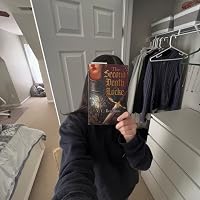
In this lyrical debut, three generations of Palestinian women must put the haunting of their ancestral home to rest, before the secrets of the past drown them all. Our Cut of Salt is a powerful and intimate look at what it means to make a home, to lose it, and to return, only to find it irrevocably changed.
There is something haunting Nuhad’s childhood home in Haifa. Cats avoid its perimeter, strange noises come from within, and residents have mysteriously vanished without a trace. Although Nuhad has not returned to her home since the Nakba in 1948, she always held a place for the house in her heart.
And, in return, the house did the same for her.
After Nuhad passes away, her granddaughter, Marina, is determined to visit her grandmother’s home after a lifetime of being kept in the dark about her culture and family history. Marina's mother, Haifa - named for the city that was lost to their family - reluctantly agrees to her trip, though she knows firsthand that some secrets are better left buried.
But the house is no longer a home. It is a painful, festering wound that infects everything it touches. The more Marina digs into her family’s past, the sicker she becomes. Despite Nuhad’s ghostly warnings, Haifa rushes to help her daughter.
As the three women converge in their ancestral home, they must put the haunting to rest before the secrets of the past drown them all.
Deena Helm (she/her) is a mixed Palestinian-American author, and OUR CUT OF SALT is her debut novel. Her other works can be found in Fikra Magazine and So To Speak. You can find her @deenahlm in most places.
An evocative, devastating, haunting, gothic historical horror from Palestinian-American debut author Deena Helm, told through three generations of Palestinian women, Nuhad, Haifa and Marina, alongside the perspective of a sentient, grieving, murderous house in Haifa. We move between Nuhad's experience of the Nakba in 1948, Haifa's inherited trauma and Haifa's daughter, Marina's attempts to understand the family history.
Of the three perspectives, Nuhad's gripped me the most because her chapters immersed me into the horrors of 1948, when hundreds of thousands of Palestinians were forcibly displaced from their homes, thousands were murdered, some crowd trampled. These parts in particular broke me. Because it really happened. Please check your triggers because Helm does not shy away from the atrocities, including child deaths, and I don't think she should. Because history is horror as is the real life genocidal present.
The house in the city of Haifa, where Nuhad grew up. I viscerally felt its anger and grief right to my bones. The house remembers everything: its family, what happened within its walls. It has become sentient because of its rage and its memory of being violated. As a reader, expect to experience a torrential, emotional stream of consciousness narration style.
And in that way, the house becomes a metaphor for grief, displacement and generational trauma, as well as the city of Haifa itself, a city haunted by the ghosts of its past. The three women’s fragmented relationships reflect that grief, memory and things left unsaid.
I won’t say too much more because I’d rather you experience this one yourself, but yeah. This one hurt. It’s a really good one to pick up if you would like to enlighten yourself more upon the history of Palestine and its people through the lens of historical fiction and gothic horror. I would absolutely encourage everyone to do so if you’re in the right head space. Five stars not because it was a perfect read, but because of the emotional impact.
Our Cut of Salt is not your traditional haunted house horror story. I mean, sure, Nuhad's childhood home has some major issues that it needs to work through, but first and foremost this is a novel about genocide and occupation and displacement and generational trauma. The house is but a product of its environment, and you can't help but feel a bit sorry for it even as it's getting a little … feisty.
And, yeah, this is probably going to be a polarizing book. The author is Palestinian-American, and the book is set in Palestine and is about Palestinians and the Israeli occupation of their homeland. Hardcore Zionists probably aren't going to enjoy this one much, but I think no matter which side of the Israel-Palestine conflict we fall on, all of us can agree that war and death and violence leave their mark on both those who experience them firsthand and on future generations. (And also, apparently, on their sentient houses. Who knew?)
This is a depressing read. It's well-written and thought-provoking and I wholeheartedly recommend it to anyone who wants to learn more about Palestine (particularly the events of 1948), but it's absolutely not a happy story. The ending isn't devoid of hope, however, and the main characters are sympathetic and likeable. It's not particularly scary — the horror here is more of a subtle literary horror — but it's certainly dark and there are some genuinely unsettling moments. It's a slow burn, but it's never boring.
Also, I do think this is the only book I've ever read where some of the sections are narrated from the point of view of a sentient house. It's a novel approach and while it took me a bit to get used to the format, I certainly didn't hate it.
Really, though, this is just one of those books that you have to read to appreciate, and whether you love or hate it isn't going to be influenced by me rambling on for entirely too many paragraphs. If you're interested in the history of Palestine and enjoy literary horror, definitely consider giving this one a read because it really is fantastic.
4.35 stars, rounded down.
Many thanks to NetGalley and Tor Nightfire for providing me with an advance copy of this book to review. Its expected publication date is September 22, 2026.
Our Cut of Salt is a tough one for me to review. is it an important & powerful msg that i think everyone should read? yes. but, i know this will not be for everyone & with how fresh & relevant the content of the story is to what's happening right now, it is not one i can confidently recommend to just anyone. it is quite depressing.
the fact that this is a debut??? & so well written?? kind of blows my mind to be completely honest. i've read a lot of debuts & very few of them have had a clear msg like this or been written this well.
now usually when i pick up a book expecting certain elements based on the synopsis & finish feeling like what's promised was not really delivered, i typically rate accordingly. Our Cut of Salt is different. it's too impactful for me to rate this any lower & while it didn't deliver on a few things, it's still a great story.
i went into this expecting a gothic haunted house story & was left a little underwhelmed in that aspect. yes, there is a "haunted house" but to be honest, it's the weakest part of the entire book. if you're looking for a horror novel with a traditional haunted house where things go bump in the night, look elsewhere or at least tweak your expectations a bit.
the haunted house & supernatural elements are a metaphor. think of it as a physical manifestation of its environment, the violence surrounding it, & generational trauma. it has its own thoughts & feelings, & on paper this is an interesting concept. i did like the parts written from the house's pov. however, these elements in general were lackluster for me. i expected to see a lot more of the haunted house. we get glimpses here & there, but it's not really a main focus or fully "came to life" as some might say until later on in the book.
there's a lot of themes explored here that i think most people will find something to relate to in some way. for me, that's the search for identity & belonging, but i also appreciated the relationships between the women in the family. Nuhad/Haifa definitely felt like a stronger relationship than Haifa/Marina. it felt more developed? but Marina is definitely a character you can root for & connect with. seeing her determination to know her family history was really inspiring. the narrator, Victoria Nassif, did a great job bringing this to life.
i think this is definitely worth a read for anyone who's been curious, angry, or strongly affected by what's happening in Palestine, or anyone who's a fan of literary horror.
i don't typically quote ARCs but this quote really resonated with me;
“The settlers say that the haunted house in Haifa is evil. Rania knows that stealing homes and land, lives and histories, and then erasing them as if they’ve never existed—that is evil.”
Thank you to NetGalley & the publisher for this arc in exchange for an honest review
*The publisher has provided me with an advance readers copy in exchange for an honest review.*
More and more, I find myself convinced that book editors have functionally stopped editing - or at least, they've stopped providing developmental edits, which are the most valuable part of the process. Because there was no reason for this book to be as badly written as it is! There was no reason for the clunky dialogue or bad Instagram poetry or out-of-place happy (?) ending! And yet, here we are. The publisher saw a book with an eyecatching premise, and threw it out onto shelves without doing their due diligence in helping the author develop her skills and sharpen her story so that the final product would be worth reading. The whole thing feels like a first draft, with mixed metaphors, weak adjectives, and characters repeatedly announcing the themes of the book in conversation.
"an anguished fury that is rooted in impotence and helplessness." (p. 83) Impotence and helplessness mean the same thing!
"'Responded to you how? And did Rania elaborate? What are these hauntings?' Haifa says with an urgency that scares Marina." (p. 99) Clunky as hell, and also there should be a comma there. There's no description of how the urgency manifests in her voice, or what Marina's fear feels like. It's just narrating the conversation dispassionately while also expecting the reader to share in the characters' emotions.
"But the Nuhad that Rania grew up with, the one of childhood, had long since disappeared by scarred adulthood." (p. 125) I . . . huh? Was this supposed to read "disappeared INTO scarred adulthood?"
"in the distance, a Zionist flag waved over a home." (p. 138) This is just a bizarre place to deploy passive tense. You're describing the violence of a colonization, the POV character watching everything she knows and loves be ripped away from her by a violent paramilitary force, so why are we distancing the reader from the horror with "a" instead of "the" and "her?" "the Zionist flag waved over her home." See the difference?
"Her heart hurts - not just the flesh, but the chest and the rib cage and the lungs that surround it begin to ache with a heartbreaking pain." (p. 189) why would you use "heartbreaking" here? It's technically an adjective, but it's not a very good one. A burning pain, an excruciating pain, a pain that sends her to her knees - anything stronger than this!
"her mother had to endure so much that it fundamentally changed who she was as a person, even into adulthood." (p. 189) This is reiterated over and over again, always in plain language like this, and it's maddening. Don't tell me, SHOW me! This is a work of art, not an essay!
"The sheer power of the gusts slams [the vase] against the living room pillar. Diamond-glinted shards of ceramic fly in every direction and both Marina and Haifa hold their arms up by their faces instinctively. Small, superficial cuts appear on Haifa's skin, visible only by the faint lines that bead to the surface." (p. 213) Again, why would you use passive voice here? The characters are in a haunted house that's actively combusting in order to keep them from leaving, we need to FEEL the violence of that! The cuts didn't "appear" on Haifa's skin, her skin was cut by the ceramic.
Also: the ending.
All of this - all of it - could have been fixed with a thorough, competent editing job. I get angry in my reviews of bad books sometimes, but I always try to stress that it's not an anger directed at the author, because it is not their fault. And that goes triple for a book like this one, where the author was writing about a personal, painful trauma that is actively playing out in the news right now. Her editors had a responsibility to her to treat her story with care and respect, not half-ass the process so that they could have the book on shelves while people were still talking about Palestine. It's cynical and it's lazy and it really pisses me off.
This is one of the most powerful books that I have read in a long time. Deena Helm takes a subject, the continued genocide of the Palestinian people, that I personally thought I understood fairly well and makes it so real, so personal, so human, it absolutely broke my heart. This is a book that can change minds. And the fact that it is written in the context of a, albeit remarkably unconventional, haunted house story is even more amazing.
The writing here is so excellent, as well, beautiful prose that is incredibly descriptive and poetic. The three main characters and generations of women, Nuhad, Haifa, and Marina, are all such extraordinary and fully created people. I was driven to tears multiple times throughout this book and I think anyone that picks it up will be thinking about it long after they are finished.
Every single time I’ve tried to sit down and write this review, I’ve started crying.
I’m still processing this book. Still trying to find words for everything it stirred up in me. There were so many times I had to stop reading to breathe, to regulate, to let myself feel whatever page I had just ripped open.
And somehow, through all of that grief, I still found myself thinking:
If I could give this book a million stars, I would
There is something so hauntingly beautiful about the way Deena writes about grief, displacement, and inheritance. About the way being forced from home doesn’t end when you leave—it follows you, settles into your bones, and finds its way into the generations after you.
We see that through Nuhad, Haifa, and Marina
Nuhad, the grandmother who survived the first Nakba—the Catastrophe. Haifa, her daughter, carrying the pain of being separated from her homeland and trying to build a future for her own child. And Marina, the next generation, inheriting a history and a longing for a home she was never allowed to truly know for herself.
Three generations. One homeland. Different forms of the same longing. And that is one of the things that made this book hurt so much. Because Palestinian displacement did not end with the Nakba. It was carried forward.
From grandparents to parents to children. From the homes we were forced to leave to the children who grew up hearing stories about them. From one generation's grief into the next generation's longing.
Displacement doesn’t just happen once. It echoes.
The hunger isn’t simply for more. It’s for what was taken. For home. For belonging. For the pieces of ourselves left behind. For a history we were separated from but never stopped carrying.
And then there is the house. God, the house.
Having the house itself as a point of view was one of the most haunting parts of this book for me. You can feel it grieve the family it lost. You can feel its loneliness, its anger, its rage.
But what got me most was that the house doesn't simply mourn. It wants them home. It will do whatever it can to bring its family back to it.
Even with the checkpoints. The soldiers. The barriers between Palestinians and their homes. The countless ways a people can be made to feel like strangers in the places that have always belonged to them.
The house refuses to forget who its family is. It refuses to let them disappear. It becomes a witness to what happened, but also something more: a home that is still reaching for the people who were taken from it.
And I don't think I've ever read a haunted house that felt so deeply ALIVE.
As a Palestinian, there were so many moments where this book stopped feeling like something I was reading and started feeling like something I was recognizing.
Something familiar. Something I already understood somewhere deep in my bones. Because beneath all the horror and grief, there is something else I saw everywhere in this story: Palestinians choosing life.
Choosing love. Choosing family. Choosing to have children. To cook. To laugh. To tell stories. To remember. To build something beautiful even when the world keeps trying to convince you that survival is all you are allowed to want.
That, to me, is one of the most powerful things about Palestinian existence. We have always been more than our suffering. And Our Cut of Salt understands that.
This book is haunting, devastating, beautiful, and deeply rooted in historical reality. It holds grief and rage alongside love and tenderness. It understands that home is not simply a place on a map—it is the people who remember you, the walls that held your life, the stories passed down when you have nowhere else to put them.
And somehow, beneath all of that grief, it is also about survival. About choosing life. About refusing to disappear.
Everyone should read this book. If you support a free Palestine, I think you’ll find so much of our history, grief, longing, rage, and humanity reflected in these pages. And if you want to understand more about Palestine and a reality that is so often erased, Deena has given us such a deeply human way into it.
She gave us an incredible gift: a fictional retelling of a reality Palestinians have lived, inherited, survived, and carried for generations.
I don’t think I’ll ever stop talking about this book. And honestly? I don’t want to.
Ahh!! I've been seeing this one everywhere, so I was thrilled to find the ARC in my inbox!
Premise - Nuhad's childhood home in Haifa is haunted. After Nuhad passes away, daughter, Haifa, and granddaughter, Marina, visit the old house to reconnect with their roots. The secrets of the past fester, and the deeper Marina digs, the sicker she gets.
Basically: a three generation haunted house story, in which grandma is a ghost, Haifa is playing rescuer, and Marina is the truthseeker.
Making the house a perspective character was the most powerful choice in this story, for me. It really drove home the meaning of place, and made the land victim to the violence perpetrated for its ownership. Oof.
I'm not going to say too much, because this book is worth experiencing fresh and new, on your own, but I have no doubt this will be a Big Book. It's incredibly powerful and both timely (Israel-Palestine conflict and the ongoing Palestinian genocide) and timeless (when hasn't man been fighting war over territory?).
I listened to the audiobook, narrated by Victoria Nassif. Nassif did a beautiful job of the narration. I was really curious how the house's sections would read, but those were my favorites to hear aloud! I highly recommend trying the audiobook version, ideally as an immersive read.
Thanks, NetGalley and Macmillan Audio, for the audio ARC in exchange for an honest review.
Wow. Our Cut of Salt is a beautiful gothic horror debut from Deena Helm. The book takes you through the occupation of Palestine through the eyes of 3 generations of women. It was an emotional journey that left me breathless by the end. I don’t know what else to say except…
Free Palestine 🇵🇸🇵🇸🇵🇸
Thank you to NetGalley and Tor Nightfire for the arc!
I absolutely devoured this in one day; I couldn't stop reading. What a debut!
There's nothing I love more than horror novels written by authors of color that really dive deep into the realities of experiencing the world through a racialized body. Add some horror tropes here and there and you have me seated.
If you know me, I'll pretty much read and support anything by Palestinian authors. I was excited for this novel when I first heard about it, and I was even more excited when it lived up to my expectations. Mornings in Jenin is one of my absolute favorite generational sagas, and I'm happy to say that this novel carries echoes of my favorite, but with a slight supernatural/horror twist.
I love it when seemingly inanimate objects (like houses with threatening auras) become important characters in stories. The family home in Haifa is a manifestation of ancestral rage passed down through the matrilineal line. There's so much hurt and grief there that new (Israeli) buyers are either physically or mentally, well, consumed.
There are multiple POVs in this novel and I thought that they were all executed really well. Of course, Nuhad, Haifa, and Marina are the main characters, but I really appreciated both Rania's storyline and the house's perspective. Reading about Haifa from a Palestinian character who still lives there, while also experiencing its colonized past and present from an old, angry house, elevated the story into something more than just an immigrant/refugee generational saga.
I was a little iffy on the ending when I finished the novel (because I'm a huge cynic). But I thought about it and realized that maybe I can stop being a cynic for just one book review.
Anyway, check this out if you love generational sagas, the supernatural, and vengeance against colonizers.
Free Palestine.
Thank you to Tor Nightfire and NetGalley for this arc.
🌊 Colonialism as Horror 🧂 Generational Trauma 🌊 Sentient House 🧂 Multi POV 🌊 Ancestral Rage
Wow. This is going to be a contender for one of my top reads of 2026, guaranteed. A horror story full of rage and culture that is so, so heavy, which managed to fracture my heart into pieces and ultimately suture it back together.
•
A family fractured by secrets that follows three generations of Palestinian women who are left trying to pick up the fragmented pieces and find wholeness, while their ancestral home rages for what it has lost. After Nuhad's death, her granddaughter Marina is determined to visit Haifa and uncover the culture and history of her grandmother's past. Her mother—named Haifa for their homeland—reluctantly allows her to go, setting aside her own pain from her fragmented history. As Marina starts to uncover the past, Nuhad's home in Haifa rages for the family it has lost, and the apparitions of secrets haunt both Marina and Haifa.
•
This book opened up so much discussion for me that I had previously been ignorant of—and this has changed me irrevocably. I was unaware of some of the history here, and the author dives into this so beautifully while also unspooling a story full of rage, full of heartache and representation of Palestinians both living in Palestine and in the diaspora.
Honestly, just read it. I have so many thoughts about this stunning debut (that I can't believe is a debut), and I truly just think that it's a book that everyone should read. The horror isn't so much frightening as it is immense heartache—the rage felt by a culture of people—and the profound sadness of these people who have spent their whole lives waiting to be able to exhale.
This audiobook is narrated by Victoria Nassif, who does a fantastic job of bringing the story to life, with a powerful inflection that represents the rage, grief and heartache poured into this story.
This was a powerful, heavy, yet profoundly insightful book. I can't wait to see it succeed.
Free Palestine. 🇵🇸
•
Thank you to Macmillan Audio for the ALC of this book. All thoughts and feedback contained within this review are my own.
A huge thank you to Macmillan Audio for the gifted copy of this book!
My Thoughts:
OUR CUT OF SALT is the most emotionally devastating book I’ve read this year. Told from the perspective of three generations of Palestinian/Palestinian American women, the story examines the horrors of war, generational trauma, and loss of identity. It’s a haunted house story, but don’t expect a story filled with jump scares or creeping dread. The terrors in this book are the real life terrors that people living in war torn countries face every day.
The house in Haifa was stolen from Nuhad’s family when she was a child, but the family’s pain and trauma remained festering in its walls. After decades of being sold and occupied by strangers, the house has become vengeful, killing anyone who tries to make it their home. When Nuhad’s granddaughter, Marina, sets foot inside her ancestral home, the house is relieved to finally be reunited with its family. It can’t bear to lose them again, so it vows to keep Marina no matter the cost.
While the story stays primarily focused on the family and never dives too deeply into the politics of the war and occupation, these things are still present in the background. There are some scenes in this book that are emotionally difficult to read. The situations are heartbreaking and cruel. I cannot imagine living a life filled with so much fear, and yet, the women in this story face these situations bravely and with love for one another.
I really enjoyed the audio version of this book. The narrator’s voice fit the story well and they did a great job of delivering the emotional beats. I did find the POV shifts a bit jarring, but this was no fault of the narrator. It’s simply the way the book is pieced together and is probably less confusing in the physical book.
If you love a horror book that holds a mirror up to real life and shows it for the monster it really is, this book is for you.
Our Cut of Salt is a powerful debut, a historical-inspired Palestinian Gothic Horror that couldn't be released at a better time, as Deena Helm manages to capture a reality that has been ongoing for almost a century, and that has only worsened since October 2023; a novel composed of grief and horror, and narrates through the eyes of three generations the ongoing genocide on Palestine with a dash of a haunted house.
After Nuhad passes away, her granddaughter Marina has a great desire to go back to her grandmother's childhood house, to learn more about the past of her family and understand more about Nuhad; despite the best reservations of Haifa, her mother, she ends up travelling to Palestine. However, soon and with the help of Nuhad's childhood friend, Raina, she learns about how the house doesn't feel like a house anymore, how it has been haunted since the night Nuhad's family was forced to abandon it during the Nakba; a haunting that incarnates the pain and the grief inflicted by the occupation, and whose consequences can be seen with Marina's eyes.
The use of the haunted house trope as a metaphor to describe the horrors associated with occupation and genocide is on top of the symbolism that makes this such a memorable book; there's nothing supernatural in the haunting, but the consequences of how the Israeli forces have been perpetrating a genocide from the very own moment the two states solution was enacted. It also deserves a mention how salt is associated with cleansing and healing, but also with mourning and the land; an apparent contradiction that shows the cycle that connects grief, memory, and people.
I understand that for some people this might feel like an unsubtle book, as Helm puts much emphasis on reflecting the reality that is still ongoing in Palestine, a genocide that started many years ago and that has only worsened; you can feel how Helm's own familiar stories has been distilled into Our Cut of Salt and its characters. In certain ways, I think it helps humanize those people suffering the occupation, giving faces to those cold numbers that might make it feel as something far or not from our time.
Our Cut of Salt is a powerful debut that takes the opportunity to put the spotlight on an uncomfortable reality that many are trying to hide or even are complicit on it; an example of how Gothic Horror can be used as a vehicle to deliver a powerful message. An absolutely remarkable novel by Deena Helm.
Just another p*lestinian victimization book, you wanna learn about middle east real history? read about islam colonization and how jews were treated in arab countries and in palestine (under British occupation). P*lestinian propaganda, no thank you🙏
Thanks to some earlier reviews, I was able to go into Our Cut of Salt with adequately adjusted expectations and come away from it with a deeper appreciation for what this novel is and what it does.
Before picking up this book, I had no knowledge of the 1948 Nakba, which sent me on an even deeper quest to explore and understand the history of Palestine. To me, this is the novel’s greatest accomplishment: placing the perspective of Palestine and its people at the forefront of a narrative that is so often framed through the perspective of their oppressors. The novel’s questions surrounding individual identity, familial history, and whether it is better to know the atrocities committed against those who came before you—or remain ignorant of them—struck an emotional cord with me that extended well beyond its supernatural elements.
I especially appreciated the symbolism of salt throughout the novel. Its associations with cleansing, healing, weeping, mourning, the sea, the land, and the smallest acts of rebellion and retribution were perfectly suited to such a sorrowful story. There is something beautifully cyclical about the way salt functions throughout the narrative, connecting grief, memory, place, and the people who carry all of them.
The novel is less successful in its execution of the horror elements. I liked the personified family home and apparitions, but they weren’t as strong as I would have liked and became fairly repetitive after the first third of the book. Because of this, it would be advantageous for those who read horror regularly to go in expecting a paranormal historical story rather than a horror-forward haunted house story. It’s also a good choice for readers who primarily enjoy historical fiction and want to dip their toes into the horror genre.
The writing is serviceable for a debut, and I think its accessibility can be view as a strength; Helm doesn’t bury the story beneath overly abstract prose, which feels particularly important given the historical subject matter and the need for its messaging to remain clear. That said, I did find the writing somewhat mechanical as the novel progressed, and I hope to see improvements in flow and depth in Helm’s future releases.
Our Cut of Salt is a book everyone should give a try regardless of genre preferences. It may not have completely worked for me as a horror novel, but I don’t think its importance rests on being a frightening or entertaining read. Its value comes from what it asks us to confront, whose stories we choose to hear, and what happens when buried histories are finally brought to the surface.
Readers who enjoyed This House Will Feed by Maria Tureaud and The Deep by Rivers Solomon are very likely to also enjoy Our Cut of Salt.
Thank you to the publisher for the gifted ARC of this read. All opinions remain my own.
A historical and intimate novel, beautifully composed grief horror, leaving you with an ache in your body on how genocide and human cruelty can and does impact everything.
RTC but WOW. The way Deena Helm explored grief and memory as a haunting, plus the authors note at the end…I’m sitting here with tears pouring down my face in silence and awe.
this story will haunt me forever. chilling, devastating, raw, and impossible to put down. reading this made my heart pound with emotion unlike any other book i’ve ever read. this is an extraordinary work of fiction set against a deeply horrific, very real history. this book deserves to be read by all. the generational grief and emotion deena helm is able to evoke within a couple hundred pages is remarkable. the house pov was transcendent. i felt three generations of oppression, displacement, and homesick melancholy alongside these incredible women (and i’m white 🙄) please take a moment to read this review written by amanie, her review is more poignant, and her pov matters much more 💛
what an honor it is to be truly loved, what an honor it is to be free, what an honor it is to be safe, what an honor is is to be remembered. FREE PALESTINE 🇵🇸 stop genocide, and free all oppressed people. we are not free until we are all free 💛
Our Cut of Salt is an emotional, Gothic, haunted-house tale that follows three generations of Palestinian women. The horror here is present not just in the house in Haifa, but in the streets of the city, due to an occupation by Israeli armed forces over many decades. I enjoyed learning about these women, their history, their relationships, and the generational impacts of trauma. Admittedly, I knew only very general details about Palestinian history prior to reading. So it was nice to be exposed to new information that I could research further to better understand the story.
One critique is that the story got a little muddled for me on audio, and I wish I had spent more time with the physical copy. The amount of timeline and point-of-view switching just got confusing.
Victoria Nassif narrated the audiobook. She does a great job with the various characters, and I would gladly listen to another book narrated by her.
Recommended for readers who like a mix of historical fiction and horror.
Thank you Nightfire for my free ARC of Our Cut of Salt by Deena Helm — out Sept 22!
» READ IF YOU « 🏠 love a house that's haunted by its family's trauma 🧂 want to walk with three women experiencing generational grief 🌊 can handle a book that will likely wreck you before it heals you
» SYNOPSIS « Everyone knows that a certain home in Haifa is haunted. It's been that way since its family was forced to flee and never return in 1948. But the house remembers them, and when Marina travels to Haifa to unbury her family history, it will twist her up in its own grief and she will have to fight her way free.
» REVIEW « Marina is definitely an FMC I can root for. She's bold, determined, and did several things that would have given me, a pretty ballsy bish, pause. The determination she has to learn about her family and their history, no matter how costly, gives the whole book so much forward momentum. I was fully on her side from the start, and watching her gently push past her mother's fear to do what she needed for herself was really moving.
Nuhad's pieces, though, kinda wrecked me. Her POV sections are not at all easy to sit with, but they shouldn't be. Helm isn't interested in softening the horrors or atrocities inflicted on the Palestinian people, which is precisely what we all need. Living through even the tiniest fragment of what that generation carried, in Nuhad's own voice, is absolutely critical to the weight of this story. It's a necessary gutting and whew, it hurt.
The ending, for me, felt so fitting. No spoilers, but we can chat about it when you finish. Our Cut of Salt is a haunted house novel about inheritance, yes, but it's really about what we all try to do to protect the ones we love, even when the truth is what will heal them.
» RATING « 🧂 I'm Restored 🧂
» READ-A-LIKES « • A House With Good Bones by T. Kingfisher • Mongrels by Stephen Graham Jones • Minor Detail by Adania Shibli • Nanny (2022 film)
God this was beautiful and devastating. I’m having a hard time putting words together for a review. What I can say is that this book is going to sit with me for a long time. This needs to be required reading in schools.
Our Cut of Salt follows three generations of Palestinian women—grandmother Nuhad, mother Haifa, and daughter Marina—as they confront a haunted ancestral home and the buried secrets of the 1948 Nakba.
I feel very torn about this book. On the one hand, I really enjoyed learning about the 1948 Nakba conflict and the experiences of Nuhad and her family. Nuhad's story was intense and gut-wrenching. The grief and rage really came through, and I felt like I was right there with her family—being ripped away from their home.
However, I wish this book had been strictly historical fiction, because while I loved the Palestinian perspective and generational trauma aspects, the horror elements were not working for me. The horror parts were weak and clumsily interwoven through the narrative, and the absurdly implausible "happily ever after" ending was a disappointment.
I received an advanced listener copy (ALC) through @netgalley and @MacmillanAudio. Thank you! The audiobook narration was excellent. However, the varied writing style throughout the text sometimes made it difficult to follow.
Some parts of the book were written in a dreamlike, hallucinatory viewpoint, or from the house's perspective, and the writing style of those parts was very lyrical and artistic—almost like spoken word. Maybe it was just the way the narrator read it? The differences were jarring on audio. Additionally, the POVs often changed within the chapters without warning or clear delineation, and without the physical book in front of me, it took a while to orient myself.
Despite these issues, this is an important story to tell, and I did enjoy the book. I would recommend it to anyone who enjoys historical fiction and people who want to read more Palestinian perspectives in literature.
Beautiful and devastating. Heavy but also hopeful. This is an important piece of horror fiction.
Three genrations of Palastinian women grapple with generational trama and the ghost left behind by all that has happened to the previous generations following the Israeli occupation. Haifa the mother never felt like she was enough for her mother, that she never truly new her. Marina (the daughter) longs to go back to her grandmothers ancestral home to witness what was left behind. Nuhad (the grandmother) who has recently passed away never spoke of what she experienced when she and her family as forced from her home. Now her daughter and grand daughter travel back to discover the ghosts passed and present that are buried there.
We need more of this. So few stories like this are told. At least in the US I feel like I never learned about what happened in Palestine after world war 2 and it is such an important piece of history to be aware of. The way this is told is so beautiful and sad but so so well done. I loved the sentient house excerpts that were added and the ending left some room for home amid what feels like a truly hopeless situations. Themes of generational trama, the cyclical nature of history/abuse, and mothers/daughter relationships. While not an easy read I am very glad to have read it.
I read this via audio and found the audio to be well done as well.
Thanks to netgalley and the publisher for access to this audio book. I am writing this reveiw honestly and voluntarily
Our Cut of Salt is a historical horror novel set around three generations of Palestinian women. When Marina decides to return to her grandmother’s home in Haifa, the haunting spectres are everywhere in the salty air.
This is an excellent novel, plain and simple. The characters are beautifully fleshed out. Rania is the woman I instinctively called Mama. Khaled is the boy I laughed with at uni. Hassan is the man who knew I wasn’t Palestinian but still called me ‘ya binti’ within five minutes of meeting me. Palestine is a beautiful, rich tapestry of tatreez and grief and gentleness and laughter and life, and Deena Helm paints as vivid a picture of this paradise buried under bloodshed as an author ever could.
The mystery and horror are interwoven seamlessly with tenderness and history. It is comforting and harrowing all at once to sob at the Nakba and laugh as a father finds a way to call his oppressors “Teezain bilbais.” Helm achieves the seemingly impossible: in pouring salt over the wound, she engulfs the reader in its anguish then soothes it. This novel is far more than a story; it is an atmospheric embrace that leaves its reader soaked in saltwater, and wanting only to sink deeper into it by the end.
Some readers may feel alienated or confused by the Arabic phrases Helm includes. I may be biased, but I found comfort in them; I felt an intimate closeness found only in shared tongues. ‘Baladi’ is not a country or a nation; it is a river of blood in my veins and the dirt on my skin. Every Arabic word warrants the effort of learning its meaning; if it feels discomforting, then you must remember that you are a foreigner on Palestinian pages.
I’ve been calling for a free Palestine since I could say Falasteen. I’ve attended protests, I’ve screamed and wailed at the death of my Palestinian brothers and sisters, and I’ve held them. I’ve seen the crinkle in the eyes of an old woman who knows this pain is not truly mine, and is yet glad to see it shared. I clutch my keffiyeh, gifted by a kind old man with a plate of Knafeh Nabulsiah, and curse the occupation and everyone who has ever defended it. I run my hands over the tatreez on the dress I treasure and wonder if the old woman’s hands bled from the needle. I wonder if they ever stopped bleeding.
There is no excuse for not reading this book. I have wept for Palestine every day of my life, and I will continue to pray for families to return to their olive and lemon trees. I will pray for the day Palestinian children fear fanciful creatures and not bullets and tanks. Everyone should read this book, even if it hurts, even if it’s horrifying. Everyone should taste the salt of its tears. Deena Helm’s debut has unequivocally cemented her as a powerful, scathing, tender voice in literature.
⁀➷ thank you to @tornightfire @libbycollins19 for the physical ARC copy and @deenahlm for writing this masterpiece 🫶
💌 Our Cut of Salt is a beautiful, lyrical debut following three generations of Palestinian women who have to put their haunted house in Haifa, Palestine to rest before it devours more.
💌 my thoughts: the entire time I was reading this, I was wondering “how is this a debut?”. I found myself crying within the first 10 pages due to how devastatingly beautiful the prose was - not to mention how my highlighter and pen was working overtime because of my intense annotating. The plot itself kept me so engaged but that’s not what I loved most about this book. What I loved most was how real and raw these characters were. Their struggles, their actions, and most of all their perseverance.
⁀➷ At the end of the day, Our Cut of Salt is about the effect of war not only on the people directly in the midst, but the generations to come after. To end this review, I wanted to quote one of my favorite lines from the book: “I just want to move freely. It’s not much. But it’s my dream.”
This is haunting in every sense of the word. Yeah there’s ghosts and hungry houses but the horror also comes from how thoroughly and how RECENTLY we’ve failed Palestine over and over again. I loved this book though, and I especially love that family and ends-of-the-earth devotion between mothers and daughters is the beating, bloody heart of this story. A couple things about the ending I don’t necessarily buy but not enough to taint my enjoyment, I need everyone to read this