Jump to ratings and reviews
Rate this book

The Weathering

Rate this book
Award-winning Ukranian author Artem Chapeye's new novel follows a young couple who escape city life to the mountains in Ukraine, only to discover an altered reality upon their return.

After a young couple return from their summer in the Carpathian Mountains in Ukraine, they discover that the world as they once knew it no longer exists. Survivors are forced to adapt to the harsh conditions of their new a place where erosion floats in on a breeze, and ceasing to exist comes with a deceptively joyous capitulation. Overcoming deeply rooted fears, they try to forge another world, uniting with those who continue to fight the darker urges that can emerge when a society must rebuild.

Will the couple be able to survive, make alliances with others, and give birth to a new generation? Will the insidiousness of human nature manifest itself in this new, post-apocalyptic world? Filled with beautifully melancholic and black humor, The Weathering becomes a kind of study of behavior in critical situations when everything that once seemed stable falls apart.

Audible Audio

Published March 24, 2026

Loading...
Loading...

About the author

Artem Chapeye

11 books29 followers

Ratings & Reviews

What do you think?
Rate this book

Friends & Following

Create a free account to discover what your friends think of this book!

Community Reviews

5 stars
7 (11%)
4 stars
24 (38%)
3 stars
22 (35%)
2 stars
9 (14%)
1 star
0 (0%)
Displaying 1 - 17 of 17 reviews
Profile Image for Marcus (Lit_Laugh_Luv).
735 reviews1,505 followers
Review of advance copy received from Publisher
March 21, 2026
[3.5 stars] A quiet dystopian book that conjures up memories of other books like Lord of the Flies, Severance, and Chilco. The premise itself is not particularly unique, but Chapeye manages to create such a haunting, liminal atmosphere with his writing that kept me hooked. There's a foreboding sense of dread that builds throughout the novel, and I enjoyed how little we knew about the apocalypse itself. Like the protagonists, we are left to speculate, but can never get concrete answers on what exactly happened.

While it is certainly less overtly violent or 'flashy' than Lord of the Flies, Chapeye captures similar themes about social hierarchies and the legitimization of power in an isolated society. In The Weathering, the only thing keeping these survivors together is proximity -- there is no common goal among them beyond simply persisting. The emergence of collectivist versus individualist thinking begins to erode what little humanity is left in the survivors, and it leads to social commentary that feels more pertinent than ever as we watch violence unfold globally. It interrogates fundamental questions about humanity: Do we need a common enemy to unite us? Is violence and the regression to savagery inevitable?

There's some levity and dark humour to liven up what is otherwise an incredibly bleak book, and I appreciated the contrast against some of the heavy-hitting passages. I enjoyed the whole book (though I do wish it were a little longer), but especially enjoyed the opening author's note. I won't spoil too much about it, but it helps set the stage for the themes of the book and does an excellent job highlighting the work of translators.

Thank you to Seven Stories Press for the final copy!

Substack | Bookstagram | BookTok | BookTube | Bookshop.org Store | Libro.fm Bonus Offer
Profile Image for Zhou.
154 reviews5 followers
Review of advance copy received from Publisher
April 3, 2026
I DNF'ed this exactly at the halfway mark on page 98 out of 196. This was the exact passage that did it for me:
"The shoreline became more colorful after every night of frost. Many trees held onto their green, but each morning we noticed a new maple that had shaded itself in a hot color, or a new cold-yellow aspen. Or a tall birch that stood out so sharply against the green background that even over a fifty-meter strait, I felt I could pick out every single slender, translucent leaf. The long, winding autumnal shoreline resembled scenery from a Kim Ki-Duk film or something out of a Kawabata novel. A fetish with chinoiserie, Zoia poked fun at me. À la coréenne, I prompted."


Nani...?

Anyway... Dystopian eco-fiction is always a hit or miss for me because the premises are more or less the same. Humans fight each other because of our human nature, everything becomes 'them versus us', and then nature takes over humans... If not plotted carefully, there's often a risk of themes feeling overstated, and unfortunately this fell into that camp for me. Somehow even the political parts about the Truhans (the supposed 'foes' on another island, which the protagonist couple had very little information about) felt forced instead of smoothly woven into the whole story. It wants to be too many things at once and ends up a little scattered all over the place.

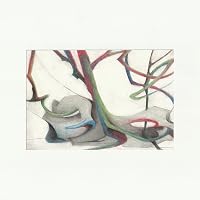
It's not a bad novel per say, just not my cup of tea 😐 Also… I hate the book cover
Profile Image for Andy Weston.
3,462 reviews259 followers
June 14, 2026
Worn down by work and the demands of city life, the narrator and his wife Zoïa head for the tranquility of the Carpathian mountains. On their way up to a basic cabin in their old and barely functioning car, the narrator notes the erosion of rocks and ponders on the equivalent term in Ukranian. He decides on ‘weathering.’

These mountains, in the southwest of Ukraine, I travelled through by bicycle in the summer of 2018, passing through the small town of Yasinia. The first quarter of the book is set here, and Chapeye’s writing excels in the descriptions of this magnificent landscape.

At the cabin, they have no contact with the outside world, which suits them fine, though after a couple of weeks they need supplies and drive to the local village. All they find are empty houses and shops, and it seems an unseen force that is beginning to exert the same effect on them. With some reluctance, they return to the city.
As soon as we had come out of the rain, the same physical sensation came over her too. Empty-headedness, a weakened heart, insides coldly putrefying. Flexible limbs, boneless rubber. Muscles atrophying, the weakening skeleton, the softening mind – all painlessly, which is the most frightening part of it: dissolving imperceptibly into your surroundings, slowly filing down like the moon, and then becoming translucent, and you weather away into thin air.

At first this seems like the sort of post-apocalyptic fiction that we have read before, but it’s not long before it takes a different path, and it’s the specifics emerge.

Back in Kiev the couple find that the weathering effect is lessened when close to water. When they try to return to their apartment on the island of Rusa­nivka, they discover that the island is now run by a community of refugees, and governed like in the post-Soviet era, by corrupt officials.

This short novel was originally published several months before the ongoing Russian invasion of Ukraine, its detail deeply affected by the 2014 war that followed Russia’s annexation of Crimea. Its relevance now though, is unmistaken. Chapeye is currently serving in the Ukrainian army. An end to the fighting cannot come soon enough, and then perhaps the author of this fascinating book can be left to write.

The place was removed from the famous tourist trails. None of the highest peaks for anyone to "conquer" were nearby, only ones of middling height. Far to our left, Petros peak protruded. That's where the hikers go.
The rounded dome of Sheshul was closer. People go there less often. Our location was a few hundred meters lower in altitude, so not as interesting.
And the road leads nowhere, a natural dead end of steep slopes densely forested with spruce, firs, and pine. The old names for the peaks around here didn't even show up on maps until smartphones came about. Web maps still show different names for some of them. Some time ago, I personally named one of the smaller mountains on a hiking app. I checked the route with Vasyl, climbed to the top, marked the place on the app, and gave it a name.
True, when I asked our inside man for the local name, Vasyl answered with uncertainty, jokingly invented a name on the spot, and then added, "Why do we need to name every hilltop anyhow?" So, I'm still unsure whether I climbed and named the right hill.
The highest peak in this area-the round-topped mountain we were traversing up in our Daewoo-has several names, just like Sagarmatha-Everest-Chomolungma, but an unknown, miniature version. To my and Zoïa's delight, we noted the local curiousity of place names ending in -os or -ul. I made a mental note to ask or read up on why that is.
I will probably never find out now.

Profile Image for Cindy.
2,038 reviews51 followers
March 16, 2026
4.5 rounded up. A stressed- and burned-out couple in Ukraine takes time off to recharge at a cabin in the Carpathian Mountains. But while they were gone, “the weathering” happened. Entire towns were swept away in great floods. Those who remain must figure out how to live life with the new reality of food shortages, jobs in distribution replacing jobs in tech, farmers being more respected than former office workers, etc. As we drive our world toward warmer temperatures and wilder weather, events like "the weathering" will become commonplace, upending a society that insists on chasing wealth at the expense of justice, equality, and human rights. What will that kind of conditioning do when we are stripped of security? This novel seeks to shed light on humanity's true nature and what that means for our future.
My thanks to the author, translator, narrator, publisher, @TantorAudio, and #NetGalley for early access to the audiobook of #TheWeathering for review purposes. Publication date: 24 March 2026.
Profile Image for S S.
11 reviews2 followers
September 9, 2026
Rusanivka is an interesting Kyiv neighbourhood. It sits on a triangular artificial island, across the Dnieper from the Lavra monastery. If you’re lucky, your taxi will deliver you there via the Patona bridge, along which your eyes will wander to the Soviet stars on its railings and the hammer and sickle atop each of the four plinths which bookend it. Staring up at the rusting icons of a dead civilisation primes you to receive the island’s architecture: a complete Soviet microrayon with wide boulevards, towering housing blocks (some on concrete legs!), imposing civic buildings, resplendent mosaics and convenient public transport. The district was built from 1961-74 — I visited in 2026, 35 years after those icons on the bridge last had a say in the neighbourhood’s urban planning. It shows. The same district which, objectively, looks and feels slick in postcards from before 1991, is now decaying beyond the main streets. Trash gathers; grass overgrows; a few buildings are visibly subsiding. “Capitalist democracy” knows how to deliver pistachio ice cream to the swanky store I ate at, but not how to replace the light bulbs in the underpass I walked through afterwards.

Chapeye’s novel mostly takes place in this district, after a different kind of collapse. Most of humanity disappears from the Earth after some unexplained apocalyptic event, but a few islands such as this one are unaffected, leaving the unnamed protagonist and his wife to deal with the aftermath. Chapeye uses this dystopia to explore human nature and specifically our political instincts: people are driven by greed and fear; the iron rule of oligarchy always returns; a Leviathan is needed to prevent infighting; without regulation, we mismanage our environment into a tragedy of the commons. All of this is the usual rigamarole for a post-apocalyptic story, but not only does Chapeye says nothing surprising about human nature; he partially blames these fundamentally political issues on the greed of some characters rather than the nature inherent in all men, via the docility of the protagonist and the idealistic barking of his wife. Can I ‘disagree’ with a story? Yes I can.

“In a stable society there is at least the illusion of stable rules. But as soon as a crisis erupts, as soon as rules break, you can see clearly how the tacit social contract is reduced to rule by force, even if, as often happens, it is tied to a flirtation with the weak as a visible legitimization of this monopoly on power: so it was with the Varangians who became the Kyiv princes of old in the nine-hundreds, so it was with the gangsters who became philanthropists in the nineteen-nineties, so it is now with our warriors of the post-apocalypse. If you stir the cesspool, the shit will rise to the top.”

The universe is never developed enough to make it interesting: we simply follow the two main characters as they accept the new reality and have a baby, and we never find out more about the cause of the apocalypse. The setting in Ukraine does differentiate the story, though not enough for it to be worthwhile. Resource rationing, media control, inefficient bureaucracy, and centralisation of power calls back a Soviet mindset in some of the older characters, while the younger characters remain obstinate and angry. There are some reflections on the morality of defending oneself; given the consistent references to the war with Russia, which was at the time of publishing limited to the east of Ukraine, this can be interpreted as Chapeye’s views on either personal or national defence. “Can an unarmed person ever make the right decision when facing someone who is armed?”

Do I mind if a novel is only short and fun, and doesn’t say anything interesting or profound? Yes I do. Stories for me are a kind of engineering and I like to dissect and test them — I can have fun, but only with purpose. (I bet I sound like a knob.) But I take one final issue with Chapeye’s novel, or at least the English translation (I’m not sure which) that makes it unfit even for entertainment. The prose. It is written. Like this. These goofy little fragments dot the text like holes through an otherwise bargain vintage jacket. Why write. Like this? I don’t know whether it’s Gen Z or Twitter or some joke I’m not in on that has possessed modern writing to asssume the staccato of Chinese with none of the punch, and I don’t care to find out. Write. In proper sentences. Ugh.
Profile Image for Renee Godding.
927 reviews1,030 followers
Review of advance copy received from Netgalley
March 16, 2026
Rating: 4/5 stars

"The weathering away of every person is a weathering away inside everyone left behind. Any man’s death diminishes me."

With echoes of The Road and Roadside Picnic, and clear resonance to recent history, The Weathering is a Ukrainian-set dystopian novel that feels timely and timeless at the same time.

The Story:
A young Ukrainian couple spends the summer in a remote cabin in the Carpathian Mountains, to disconnect from the hustle and bustle of everyday life. After months of no-cell-service and only each other to consider, they descend the mountain come autumn to return to their familiar lives. Only to find out that life doesn’t exist anymore.
Unbeknownst to the couple, an unexplained apocalyptic weather-event lead to the disappearance of the majority of humanity, leaving only small groups of survivors behind. The mountain may have sheltered them from the end, but it cannot save them from the aftermath and what’s left of humanity when the surface-layer of polished society has literally weathered away.

What I loved:
The Weathering is the exact type of apocalyptic story that I personally love; quiet, contemplative and with a strong focus op the people who remain, rather than the apocalyptic event itself. Like our protagonists, we have completely missed the apocalypse itself, and are only privy to the aftermath and “what remains”. This perspective brings a very unique feeling of melancholy and alienation to the book, that works wonderfully with the descriptive atmosphere of the setting itself. Artem Chapeye sets up a world that feels foreboding yet serene, desolate yet filled with people ready to fill that power-void, and altogether liminal in its contradictions. The feeling that lives in empty places that – under normal circumstances – should be crowded with people, isn’t an easy one to capture. Yet Chapeye does so brilliantly, and it made for my favourite aspect of the novel.
The story and theme are relatively simple, but no less effective for it. The titular Weathering has a double (or maybe even triple meaning). It’s the name given to the apocalyptic event that started it all, and it’s a descriptor of what’s happened to the people staying behind since. This book is a portrait of what humanity is left with after society and “modern life” have literally weathered away. It’s a theme that many classic have dealt with, but it feels equally fitting against our modern times, and I loved this current take on it.
The book breaks its heavier moments and themes with a lighthearted narrative voice and the occasional wry humor. When it comes to the audio-narration, the narrator leans quite far into this lighthearted tone, which took me a while to get used to. There were a few times where the narrators tone felt more suited to a comedy-book, even if the narrative was quite serious at that moment. It didn’t bother me personally, but I’d recommend you listen to an audio-sample to judge if this style would be something that might take you out of the story.

As a final piece of critique, I have to say that the ending was a little bit underwhelming to me. A little too much felt left open. I don’t have a problem with an open ending in itself, but here it felt like not even the characters arcs were fully resolved, which left me wanting a bit more.


Many thanks to Netgalley and Tantor Media for providing me with an Audio-ARC in exchange for an honest review. All opinions are my own.
Profile Image for Marlienable.
68 reviews5 followers
March 24, 2026
"Any literature speaks of the universal human condition, no matter what language it's in."
This quote from its introduction feels like the perfect entry point into The Weathering, a Ukrainian novel that is very much about a specific place and people, and completely, undeniably universal.

Published today in English translation, The Weathering by Artem Chapeye follows Kolja and Zorya, a millennial couple living the Kyiv rat race, who return from a summer in the Carpathian Mountains to find that 99% of humanity has simply... eroded. Weathered away. They end up sheltering in their old flat, situated on an island that appears to have withstood the catastrophe. What follows is a devastating study of how people form a society, even when society has collapsed.

What makes this novel so compelling is its absurdity. It's literally the end of the world, and people are queuing for food stamps and hosting car races. A janitor nicknamed Uncle Zheroja becomes the de facto ruler of the island. Fear of the survivors on the neighbouring island is stoked almost immediately — barbarians, out to get them — and the main character, who works as Zheroja's speechwriter, is complicit in this. He knows it: "Whenever I could, I sabotaged with silence. I pretended to myself that my task was simply to help people."

I'll admit the speechwriter dynamic made me laugh a little. But the novel earns its darker implications. The fear mongering, the assigned roles, the way hierarchy reassembles itself almost instantly: Chapeye is making an argument about human nature that is both funny and devastating. "We could have sailed between islands, established utopia. We could have caught fish, and sunk any weapons that were not fishing rods."

A word on the translation: Daisy Gibbons does a beautiful job rendering Chapeye's voice in English. the melancholy and the black humour both survive the crossing into the English language well.

If you love post-Soviet literature, speculative fiction with real literary weight, or the particular strangeness of The Master and Margarita, that quality of the bizarre bleeding into the everyday, athis one is for you. In the context of what Ukraine is living through right now, it also carries a weight that is impossible to ignore.
⭐⭐⭐⭐✨

I received an advance audiobook copy via NetGalley in exchange for an honest review. Thank you tantormedia.
Profile Image for Steve Cavill.
95 reviews1 follower
April 5, 2026
The audiobook of The Weathering by Artem Chapeye is a haunting, melancholic piece of near-future speculative fiction that feels both dreamlike and uncomfortably intimate. Set in a near-future Ukraine, the story follows a fractured family — particularly father Otis — as they try to survive a bizarre, sentient fog that slowly erodes everything it touches: buildings, landscapes, memories, and even people’s sense of identity.

Rather than high-stakes action, this is a quiet, slow-burn exploration of grief, love, and what remains of our humanity when the world itself begins to fade away. The characters feel deeply relatable and flawed, making their small, desperate attempts to hold onto each other and their pasts all the more moving amid the bleak, changing landscape.

The narration captures the somber, atmospheric tone beautifully, leaning into the novel’s philosophical and dreamlike quality with quiet intensity and gravity. It suits the introspective prose well, though the pacing can feel sluggish during the longer internal monologues, and some listeners may find the more abstract sections — especially toward the end — a touch drifting.

Overall, this is a beautiful, thoughtful listen for those who enjoy “soft” sci-fi that prioritizes emotional depth and human connection over plot-driven thrills. It leaves a lingering, mournful impression long after the final chapter.
Profile Image for Megan Maradiago.
148 reviews
Review of advance copy received from Netgalley
March 17, 2026
3.5

The Weathering by Artem Chapeye was an early audio listen for me, and it had a quiet, unsettling feel that stuck longer than I expected.

It reminded me a bit of Lord of the Flies, but in a much more subtle, adult way. Instead of chaos hitting all at once, this story slowly strips things back.

We follow a couple who step away from their normal lives for a break, only to find themselves drifting further and further from society. When they return home, everything feels almost… better at first. Slower. Simpler. There’s a sense of reconnecting—with themselves and with nature—that feels really grounding.

But of course, people are still people.
That underlying tension builds in a quiet way, showing how power and control don’t disappear just because the world slows down. They just take different shapes.

What I appreciated most was the tone. It never tries to overwhelm you, but it still leaves you thinking. And while it touches on some heavier ideas, it ends on a note that leans toward hope—this idea that maybe people can choose to take care of each other.

Overall, it was a solid listen. Not loud or dramatic, but thoughtful and a little haunting in its own way
Profile Image for A Mac (on hiatus).
1,899 reviews241 followers
Review of advance copy received from NetGalley
April 13, 2026
I wanted a bit more from the dystopian aspect of the work. It was almost as if that element was more of an afterthought, and the book could have simply been set in a war-ravaged area with survivors left to their own devices. While I was a bit disappointed by this, the author created a powerful atmosphere that added to the heavy feel of the setting.

The author did a good job examining the social aspects: the individual vs. the greater good, who takes control and how, having to contribute to survive, etc. The social commentary was probably the strongest aspect of this one.

This story starts quite slowly, and it does take some time to really get into the main plot of the story. If you like literary fiction dystopian reads, then you may enjoy this one. I listened to the audiobook version, and the narrator did a wonderful job, so I do recommend giving this a listen if you're interested in reading it. My thanks to NetGalley and Tantor Media for allowing me to read this work. All thoughts and opinions expressed in this review are my own.
Profile Image for RebeccaReadsTooMuch 💁‍♀️.
435 reviews4 followers
Review of advance copy received from Netgalley
March 22, 2026
In The Weathering, a man and woman return home from their summer trip in the mountains to find a vastly different world, destroyed and in a new kind of chaos.

Books set in post-apocalyptic settings pretty much always hit home for me. As long as there is some scrap of hope to hold on to. This one was different than most, but we do get that 🙏🏻

The audiobook narrator brought a lot of energy. His voices for the side characters were pretty funny, if not a bit cartoonish for my taste. I’m a fan of dark humor and sarcasm, and this book drew some smirks out of me. That said the humor didn’t always land for me, though I wonder how much my experience was shaped by the delivery.

Overall I am glad I read this. It was thought provoking, and I am appreciative of the lesson and warnings it drives home.

Thank you to Tantor Media for the ALC.
Profile Image for Sandy J.
91 reviews1 follower
Review of advance copy received from Netgalley
March 23, 2026
I would like to thank Netgalley for my ALC in exchange for an unbiased review of this audiobook.

An ordinary escape from the city to the mountains of Ukraine turns into dystopia on a couples return. This book was written pre- Russian invasion, so it’s not the nightmare of occupation, but of “the weathering” that has hit.
Ironically, the couples dreams come true after this event - a better apartment and a pregnancy. I felt a little lost with the geography of the Ukrainian islands, but that’s probably my fault as i didnt stop the book to look this up.
The book is well written, and the characters were realistic and memorable.
The narration in English gave the characters humour and depth.

It is sexually explicitly (trigger warning for those susceptible)
This entire review has been hidden because of spoilers.
Profile Image for Christie Stoneback.
184 reviews2 followers
Review of advance copy received from Netgalley
March 20, 2026
The Weathering explores human nature and how people interact when all sense of normalcy is stripped away. While the premise is intriguing, the execution didn’t quite land for me. It’s hard to say whether that’s due to the writing itself or something that may have been lost in translation.

That said, it’s a quick listen, and the narrator clearly makes an effort to bring emotional depth to the characters.

Thank you to NetGalley, the publisher, the author, and the narrator for the ALC.
99 reviews2 followers
June 9, 2026
Really glad I read this. Set in post-apocalyptic Ukraine about a couple who are funny and love each other a lot.
Profile Image for Paul Fulcher.
Author 2 books2,165 followers
Review of advance copy received from Publisher
April 8, 2026
No one is an island, and if a clod of earth be washed away by the sea, the land will be the less. The weathering away of every person is a weathering away inside everyone left behind.

The Weathering (2026) is Daisy Gibbons translation of Выветривание (2021) by Artem Chapeye, the original date significant in that this was written post Covid and post the 2014 attack by Russia on Ukraine, but before the 2022 invasion.

It is the latest book from the ever-stimulating Asymptote Book Club "dedicated to world literature in translation that partners with top independent publishers on both sides of the Atlantic" - this book from Seven Stories Press.

[which also means this is not, despite the GR algorithm, a review of a pre-publication ARC - books are available from publishers before Mr Bezos gets his mitts, and his large % cut, on them]

The book club's introduction to / review of the book can be found here and an interview with the autohr and translator here.

The first person narrator of the novel and his wife leave Kyiv for a couple of months in a remote hut in the Carpathian Mountains to recharge their mental and physical batteries. Although they don't have much contact with the outside world while they are there, they gradually realise that there is zero signs of life. Journeying down the mountain they encounter a strange sensation that he names 'the weathering'.

She already felt it. As soon as we had come out of the rain, the same physical sensation came over her too. Empty-headedness, a weakened heart, insides coldly putrefying. Flexible limbs, boneless rubber. Muscles atrophying, the weakening skeleton, the softening mind—all painlessly, which is the most frightening part of it: dissolving imperceptibly into your surroundings, slowly filing down like the moon, and then becoming translucent, and you weather away into thin air. And you wish for it. The weathering. Like volcanic rocks on the side of the mountain. A washed away road. Strange rock formations in Utah and Arizona. The weathering pleasantly empties you of consciousness, but your instincts rise up against it, forcing your hairs to stand on end, forcing you to shake yourself out like a dog that has just got out of the water and, instead of lying down and accepting dissolution into gentle nonexistence—Rage against it, flee!

But as they return to the city, they realise (not entirely clearly how they do) that for most people this 'weathering' was a stronger sensation and they did indeed 'accept dissolution into gentle nonexistence', leaving the country (and the wider world) largely depopulated.

Altitude and proximity to water appear to offset the impact of the phenomenon, and returning to the city, they find only the island on the Dnipro are occupied.

Parts of this new existence verge on the idyllic, with Zoïa pointing out that perhaps the planet itself is responsible for the weathering, humanity having outlived it's usefulness:

The shoreline became more colorful after every night of frost. Many trees held onto their green, but each morning we noticed a new maple that had shaded itself in a hot color, or a new cold-yellow aspen. Or a tall birch that stood out so sharply against the green background that even over a fifty-meter strait, I felt I could pick out every single slender, translucent leaf. The long, winding autumnal shoreline resembled scenery from a Kim Ki-Duk film or something out of a Kawabata novel. A fetish with chinoiserie, Zoïa poked fun at me. À la coréenne, I prompted.

But their island, Rusanivka, has regressed into a 'Lord of the Flies' type society, one where control is maintained by designating those on the neighbouring island of Truhano as the enemy. And the narrator, a journalist, is conscripted to help with a propaganda newsletter, only later realising the guilt he bears:

Any man's death diminishes me. The dead three-year-old little boy with his face in the sand weathered away a part of my heart. I had incorrectly understood Lyuba's phrase about stirring the cess-pool. The shit wasn't isolated to Petrovych and his armed cronies, the shit was in everyone. I had written about the wild Truhano-vites. Because Uncle Siroja asked me to. I was just doing my job, correctly performing my assigned tasks. It is also because of me that these islands never tried to unite into a unified archipelago.

A relatively familiar type of story albeit well told. 2.5 stars.
Displaying 1 - 17 of 17 reviews