

What do you think?

La nascita di Frankenstein. Tra scienza, gotico e femminismo: da dove viene la creatura di Mary Shelley
È il 1816, l’anno senza estate. La violenta eruzione del Tambora in Indonesia ha oscurato i cieli fino in Europa e i temporali sono frequenti. Per ingannare il tempo durante una di quelle notti da tregenda, nella svizzera Villa Diodati un gruppo di amici in vacanza decide di raccontarsi storie di mostri e fantasmi. Di quel gruppo fa parte Mary Shelley. È un aneddoto che conosciamo, perché le circostanze da cui scaturirono Victor Frankenstein e la sua Creatura sono ormai nel mito, ma in questa vicenda c’è molto di più. Quello che oggi è un caposaldo del gotico moderno e dell’horror, all’epoca era infatti anche tutt’altro: fantascienza purissima, non proiettata in mondi lontani ma in quello che sembrava poter essere l’immediato futuro... Siamo alla fine del XVIII secolo, Antoine Lavoisier ha posto le basi della chimica moderna con gli studi su idrogeno e ossigeno, Luigi Galvani appende file di rane morte in giardino per investigare gli effetti dei fulmini sui muscoli e le aule di medicina straripano di studenti e curiosi interessati alla dissezione dei cadaveri dei criminali. Tutto sembra in fermento come i nuovi composti sconosciuti che si rimestano in laboratorio. Attraverso la biografia di una donna straordinaria, fra tragedie personali, battaglie politiche e rivoluzioni culturali, Kathryn Harkup ricostruisce la temperie in cui Mary Shelley concepì il suo capolavoro. Un mondo in cui la scienza era spettacolo, magia e ossessione, dove la chimica e la fisiologia si spartivano ancora il campo con l’alchimia, e tra fantastico e fantascientifico il confine era davvero labile. È qui, dove la letteratura combina alchemicamente la storia della medicina e il folklore dei morti viventi, che si compie La nascita di Frankenstein.
352 pages, Paperback
First published February 6, 2018
About the author
Kathryn Harkup
14 books105 followersKathryn Harkup is a chemist and author. Kathryn completed a PhD then a postdoc at the University of York before realising that talking, writing and demonstrating science appealed far more than spending hours slaving over a hot fume-hood. Kathryn went on to run outreach in engineering, computing, physics and maths at the University of Surrey, which involved writing talks on science and engineering topics that would appeal to bored teenagers, and she is now a science communicator delivering talks and workshops on the quirky side of science.
Ratings & Reviews
Friends & Following
Create a free account to discover what your friends think of this book!
Community Reviews
Displaying 1 - 30 of 167 reviews

January 10, 2018
Subtitled, “The Science Behind Mary Shelley’s Frankenstein,” this is a really interesting mix of biography (both of Mary Shelley herself and her novel), combined with a look at the scientific achievements of the time. The early 1800’s were a time of great scientific advances, when science itself was beginning to break into different branches. In fact, the term, ‘scientist,’ was, in itself, new and evolved from the word ‘artist,’ to describe what someone interested in science actually was.
This book is full of such nuggets, wrapped up within Mary Shelley’s life story – from her parents, William Godwin and Mary Wollstonecraft – her early life, with little formal schooling, but her love of reading and the stream of visitors to Godwin’s house to indulge in both business and intellectual conversation, which aroused her interest in various subjects. One of the acolytes who came to see Godwin was, of course, Percy Bysshe Shelley and Godwin’s theories about free love were obviously tested to the extreme when Shelley, already married, informed him that he hoped to form a union with his daughter. The couple eloped, along with Mary’s step sister, Claire (in pursuit of another poet, Byron, and who, Mary would find, was very hard to shake off).
There is the story of the famous evening at Villa Diodati at Lake Geneva, in 1816, ‘the year without summer,’ when heavy rain forced Shelley and his party to stay overnight with Byron. Byron’s proposal that they should each write a ghost story and the results of this. Oddly, neither Byron, nor Shelley, completed the project, but Byron’s ambitious doctor, John William Polidori, who had his own literary ambitions, and Mary, took up the challenge, and two staple figures of the horror genre were born – the vampire and Frankenstein.
Alongside the biography elements of the book and the history of how the novel came to be written, as well as how it was perceived and fared once published, there is also a great deal on the scientific advances of the time. This book will take you from early advances to chemistry, through anatomy rooms, from body snatching to the process of decay. It is not all pleasant, but nor was the subject matter and the ideas behind Mary Shelley’s novel. I found this a very interesting read and thought the author pitched the level just right – this was both interesting and easily understandable, even to someone without any scientific background. I received a copy of this book from the publisher, via NetGalley, for review.
This book is full of such nuggets, wrapped up within Mary Shelley’s life story – from her parents, William Godwin and Mary Wollstonecraft – her early life, with little formal schooling, but her love of reading and the stream of visitors to Godwin’s house to indulge in both business and intellectual conversation, which aroused her interest in various subjects. One of the acolytes who came to see Godwin was, of course, Percy Bysshe Shelley and Godwin’s theories about free love were obviously tested to the extreme when Shelley, already married, informed him that he hoped to form a union with his daughter. The couple eloped, along with Mary’s step sister, Claire (in pursuit of another poet, Byron, and who, Mary would find, was very hard to shake off).
There is the story of the famous evening at Villa Diodati at Lake Geneva, in 1816, ‘the year without summer,’ when heavy rain forced Shelley and his party to stay overnight with Byron. Byron’s proposal that they should each write a ghost story and the results of this. Oddly, neither Byron, nor Shelley, completed the project, but Byron’s ambitious doctor, John William Polidori, who had his own literary ambitions, and Mary, took up the challenge, and two staple figures of the horror genre were born – the vampire and Frankenstein.
Alongside the biography elements of the book and the history of how the novel came to be written, as well as how it was perceived and fared once published, there is also a great deal on the scientific advances of the time. This book will take you from early advances to chemistry, through anatomy rooms, from body snatching to the process of decay. It is not all pleasant, but nor was the subject matter and the ideas behind Mary Shelley’s novel. I found this a very interesting read and thought the author pitched the level just right – this was both interesting and easily understandable, even to someone without any scientific background. I received a copy of this book from the publisher, via NetGalley, for review.
February 16, 2019
4.25
I can sum up my feelings with 5 words.
I. Fucking. Love. Mary. Shelley!
Granted i'm not sure how much someone who isn't interested in Mary Shelley and Frankenstein would enjoy this book, since I seem to be obsessed with Mary Shelley and Frankenstein, I freaking loved it! Mary Shelley dealt with a lot of shit, was a bad-ass, and an amazing woman.
I learned a lot about history, science, and Mary Shelley and was fascinated by all of it. And I am so angry about all the ways her novel has been twisted from it's intention and meaning by films, to which I just want to say this (about Frankenstein)

Edit: lowered to 4.25 from the initial 5 because there is a part that says "The 1818 edition was written with significant input from her husband, but this later edition is all Mary's own and has become the most read and enjoyed."
Yes, the 1831 version is the most read and yes, her husband died in 1822. She initially ignored his edits and suggestions in the initial version, the initial is all her own, but then when he died she couldn't honor her husband in the ways she wanted to (because of her father in law, which is explained more in the book) but she could, and did, use his, initially ignored, edits in the 1831 version. So it was her own choice to do it but the initial 1818 version is all hers, the 1831 version contains his edits.
I know it's one part but until I figured that out (which I had heard before but didn't know much about) I initially read that and felt bad for preferring the original version thinking that was the "wrong" one to prefer so to speak, but I was very confused. Scholars typically prefer the original 1818 version because it's all her own vision, and I had heard that prior but then reading that just confused me.
I do think the rest is solid but that one little part has me questioning. Obviously a lot of time, effort and research went into this book and I hate that one sentence could make me wonder like that, but it does taint it a bit. I did really enjoy this book, and have heard much of what's in here elsewhere so I do think there is plenty of good stuff to be learned from this book. It's just one damn sentence getting on my nerves.
I can sum up my feelings with 5 words.
I. Fucking. Love. Mary. Shelley!
Granted i'm not sure how much someone who isn't interested in Mary Shelley and Frankenstein would enjoy this book, since I seem to be obsessed with Mary Shelley and Frankenstein, I freaking loved it! Mary Shelley dealt with a lot of shit, was a bad-ass, and an amazing woman.
I learned a lot about history, science, and Mary Shelley and was fascinated by all of it. And I am so angry about all the ways her novel has been twisted from it's intention and meaning by films, to which I just want to say this (about Frankenstein)
Edit: lowered to 4.25 from the initial 5 because there is a part that says "The 1818 edition was written with significant input from her husband, but this later edition is all Mary's own and has become the most read and enjoyed."
Yes, the 1831 version is the most read and yes, her husband died in 1822. She initially ignored his edits and suggestions in the initial version, the initial is all her own, but then when he died she couldn't honor her husband in the ways she wanted to (because of her father in law, which is explained more in the book) but she could, and did, use his, initially ignored, edits in the 1831 version. So it was her own choice to do it but the initial 1818 version is all hers, the 1831 version contains his edits.
I know it's one part but until I figured that out (which I had heard before but didn't know much about) I initially read that and felt bad for preferring the original version thinking that was the "wrong" one to prefer so to speak, but I was very confused. Scholars typically prefer the original 1818 version because it's all her own vision, and I had heard that prior but then reading that just confused me.
I do think the rest is solid but that one little part has me questioning. Obviously a lot of time, effort and research went into this book and I hate that one sentence could make me wonder like that, but it does taint it a bit. I did really enjoy this book, and have heard much of what's in here elsewhere so I do think there is plenty of good stuff to be learned from this book. It's just one damn sentence getting on my nerves.

February 1, 2018
When this book is actually released in a couple of days, you will definitely want to read it.
Making the Monster, as the dustjacket blurb says, "explores the scientific background" behind Mary Shelley's masterwork, Frankenstein: Or, Modern Prometheus, first published in 1818 and then again in 1831. The book examines the "science behind the story," but it also pieces together the "political, social and scientific world" in which Mary Shelley grew." The question that the author poses at the outset is this:
"How did a teenager create a work of fiction that has enthralled, inspired and terrified for two centuries?"
which, if you consider it, is a very good question indeed, one providing the framework for what comes next.
After a section on a brief look at the Enlightenment, the author takes us not only into Mary Shelley's life (family, education, contemporaries, her possible inspirations for her work, its creation at the Villa Diodati and the scandals! that followed her and her family), but into the novel itself, both the 1818 edition and the later, revised 1831 edition. All of that makes for fascinating reading, but where this book actually shines is in following Victor Frankenstein as he makes progress in his creation. This part is just plain genius, since alongside Victor in the fictional world, we are taken through the history of science up to that time in the real world, step by step, as the author demonstrates what information was available to a young woman with a well-rounded education and sheds light on the work of scholars or other people who may have influenced Mary Shelley in her writing. She also reveals how Victor's work may have followed or diverted from known science of the time.
Once I started reading Making the Monster it became a book I was reluctant to put down for any reason, which says a lot since "scientifically-minded" is not a description I'd use in describing myself. However, as I said earlier, the way in which the author put this book together made the science completely accessible so that the information is not at all overwhelming. It is also a timely release, since it is now two hundred years since the publication of the original edition of Mary Shelley's Frankenstein, which as a novel has continuously captured people's imagination over the centuries. Anyone at all who has read Shelley's book will love this one which gets behind the science fiction into the science fact.
highly recommended -- and my many, many thanks to the powers that be at Bloomsbury for sending me my copy.
http://www.nonfictionrealstuff.com/20...
Making the Monster, as the dustjacket blurb says, "explores the scientific background" behind Mary Shelley's masterwork, Frankenstein: Or, Modern Prometheus, first published in 1818 and then again in 1831. The book examines the "science behind the story," but it also pieces together the "political, social and scientific world" in which Mary Shelley grew." The question that the author poses at the outset is this:
"How did a teenager create a work of fiction that has enthralled, inspired and terrified for two centuries?"
which, if you consider it, is a very good question indeed, one providing the framework for what comes next.
After a section on a brief look at the Enlightenment, the author takes us not only into Mary Shelley's life (family, education, contemporaries, her possible inspirations for her work, its creation at the Villa Diodati and the scandals! that followed her and her family), but into the novel itself, both the 1818 edition and the later, revised 1831 edition. All of that makes for fascinating reading, but where this book actually shines is in following Victor Frankenstein as he makes progress in his creation. This part is just plain genius, since alongside Victor in the fictional world, we are taken through the history of science up to that time in the real world, step by step, as the author demonstrates what information was available to a young woman with a well-rounded education and sheds light on the work of scholars or other people who may have influenced Mary Shelley in her writing. She also reveals how Victor's work may have followed or diverted from known science of the time.
Once I started reading Making the Monster it became a book I was reluctant to put down for any reason, which says a lot since "scientifically-minded" is not a description I'd use in describing myself. However, as I said earlier, the way in which the author put this book together made the science completely accessible so that the information is not at all overwhelming. It is also a timely release, since it is now two hundred years since the publication of the original edition of Mary Shelley's Frankenstein, which as a novel has continuously captured people's imagination over the centuries. Anyone at all who has read Shelley's book will love this one which gets behind the science fiction into the science fact.
highly recommended -- and my many, many thanks to the powers that be at Bloomsbury for sending me my copy.
http://www.nonfictionrealstuff.com/20...

November 7, 2023
Idealne dopełnienie po wcześniej przeczytanym „Frankensteinie” Mary Shelley i „Buntowniczkach” Charlotte Gordon.
Autorka rozkłada na czynniki pierwsze różne etapy powstawania powieściowego Frankensteina i tego, gdzie w tamtych czasach była w tych kategoriach nauka oraz skąd Mary Shelley mogła czerpać inspiracje do procesu powstawania monstrum. Bardzo ciekawe, choć momentami odpływałam myślami, bo naukowe aspekty zaczęły mi się mieszać. Ale po „Buntowniczkach” świetnie mi ta książka uzupełniła biografię Mary i tego, skąd jej się ten „Frankenstein” wziął i napisał.
Autorka rozkłada na czynniki pierwsze różne etapy powstawania powieściowego Frankensteina i tego, gdzie w tamtych czasach była w tych kategoriach nauka oraz skąd Mary Shelley mogła czerpać inspiracje do procesu powstawania monstrum. Bardzo ciekawe, choć momentami odpływałam myślami, bo naukowe aspekty zaczęły mi się mieszać. Ale po „Buntowniczkach” świetnie mi ta książka uzupełniła biografię Mary i tego, skąd jej się ten „Frankenstein” wziął i napisał.

March 29, 2020
Long before I joined Goodreads I began reading books on Frankenstein. The tragic and triumphant life of Mary Wollstonecraft Godwin Shelley was remarkable by any standards. What does in Making the Monster: The Science behind Mary Shelley’s Frankenstein is graft the science behind the story into the narrative of the life and times of Mary. The book begins with a chronological overview of how the novel came to be written, the famous night when Lord Byron, Percy and Mary Shelley, William Polidori, and Clair Claremont began writing ghost stories outside Geneva. Harkup then provides the science that formed the basis for many of the ideas.
Interestingly, at times she treats the story’s characters as if they weren’t fiction. What Victor would have known, for example. It’s almost as if she is getting lost in her own narrative. Still, as I note elsewhere (Sects and Violence in the Ancient World), there was a lot going on at this time. Evolution was developing as a theory. Medical science was becoming scientific. Chemistry was taking over from alchemy. Electricity was being studied and applied. Attempts to reanimate the dead were undertaken. It was an incredibly rich time to be alive, and Mary Shelley captured it in her fictional tale. The novel made her famous, but not rich.
This is a great book for introducing the curious to what Mary Shelley might have known as she wrote Frankenstein. She went on to write other novels, none of them reaching the level of acclaim as her first. What this subsequent writing does show, however, is that she researched before she wrote. This makes much of the science outlined by Harkup available to Shelley as she wrote her novel. There are many gaps in the story. Human feelings often prevented full disclosure. Still, here we are over two centuries later all familiar with a creature created by a teenage girl on a dark and stormy night. And she managed to bring it to life with science and imagination.
Interestingly, at times she treats the story’s characters as if they weren’t fiction. What Victor would have known, for example. It’s almost as if she is getting lost in her own narrative. Still, as I note elsewhere (Sects and Violence in the Ancient World), there was a lot going on at this time. Evolution was developing as a theory. Medical science was becoming scientific. Chemistry was taking over from alchemy. Electricity was being studied and applied. Attempts to reanimate the dead were undertaken. It was an incredibly rich time to be alive, and Mary Shelley captured it in her fictional tale. The novel made her famous, but not rich.
This is a great book for introducing the curious to what Mary Shelley might have known as she wrote Frankenstein. She went on to write other novels, none of them reaching the level of acclaim as her first. What this subsequent writing does show, however, is that she researched before she wrote. This makes much of the science outlined by Harkup available to Shelley as she wrote her novel. There are many gaps in the story. Human feelings often prevented full disclosure. Still, here we are over two centuries later all familiar with a creature created by a teenage girl on a dark and stormy night. And she managed to bring it to life with science and imagination.

July 21, 2020
Vielleicht sollte man sich auch für das Werk Frankenstein begeistern wenn man an diesem Buch Gefallen finden will. Das ist bei mir leider nur mäßig der Fall. Daher fand ich die Geschichte zur Entstehung dieses Werks auch nicht sonderlich spannend. Auch wenn ich Mary Shelley für ihren doch sehr feministischen Lebensstil, zumindest für die damalige Zeit, Respekt zolle und sie viele Ungerechtigkeiten erfahren musste (dass bspw. ewig angenommen wurde, dass ihr Mann der Autor ist), konnte mich ihre Biographie nicht so recht packen.
Die Abschnitte über die Leichenräuber fand ich schon spannender, allerdings gab es auch einige Themen aus dem medizinischen Bereich die mich nicht interessieren.
Medikamente, Gifte, kurzum Moleküle und deren toxische Wirkungsweisen gehören viel mehr zu meinen Interessen als Geschichte der Medizin. Daher war Harkups vorheriges Buch "A is for Arsenic" auch viel mehr mein Fall als dieses hier. Nichtsdestotrotz ist es hervorragend recherchiert und erklärt, wenn man sich also für die Geschichte der Medizin interessiert und ein Fan von Frankenstein ist, wird man mit diesem Buch bestimmt auch seinen Spaß haben.
Die Abschnitte über die Leichenräuber fand ich schon spannender, allerdings gab es auch einige Themen aus dem medizinischen Bereich die mich nicht interessieren.
Medikamente, Gifte, kurzum Moleküle und deren toxische Wirkungsweisen gehören viel mehr zu meinen Interessen als Geschichte der Medizin. Daher war Harkups vorheriges Buch "A is for Arsenic" auch viel mehr mein Fall als dieses hier. Nichtsdestotrotz ist es hervorragend recherchiert und erklärt, wenn man sich also für die Geschichte der Medizin interessiert und ein Fan von Frankenstein ist, wird man mit diesem Buch bestimmt auch seinen Spaß haben.
March 23, 2018
When I saw another book by Harkup I immediately requested it, as A is for Arsenic made it to my top reads of 2016.
The title is a little misleading as it goes quite a bit in-depth into Shelley's life, as well at a look starting from the Enlightenment era to the beginnings of alchemy and chemistry. The bulk of the book is, of course, the inspiration behind the classic novel of Frankenstein.
I found this to be a very interesting read and thought that Harkup did a great job at making this interesting and easily understandable. However, the beginning of this one was a little slow though-(like it didn't start really until 20% in), to the point where I have been reading this off and on for two months. I was hoping for more Frankenstein and science rather than a complete biography of Shelley and Byron.
I would like to thank Netgalley, Kathryn Harkup and Bloomsbury USA for granting me the opportunity to read and review this wonderful book.
The title is a little misleading as it goes quite a bit in-depth into Shelley's life, as well at a look starting from the Enlightenment era to the beginnings of alchemy and chemistry. The bulk of the book is, of course, the inspiration behind the classic novel of Frankenstein.
I found this to be a very interesting read and thought that Harkup did a great job at making this interesting and easily understandable. However, the beginning of this one was a little slow though-(like it didn't start really until 20% in), to the point where I have been reading this off and on for two months. I was hoping for more Frankenstein and science rather than a complete biography of Shelley and Byron.
I would like to thank Netgalley, Kathryn Harkup and Bloomsbury USA for granting me the opportunity to read and review this wonderful book.

July 3, 2020
Kathryn Harkup weaves the life of the creator of Frankenstein, Mary Shelley, and the science that surrounded the creation of a monster.
Mary Shelley was young when she wrote what would become a classic of literature.
Kathryn writes of Mary Shelley's life but also explains the science that would have been available when the novel was written.
This book definitely gives one a better understanding of so many aspects of electricity and medical advancement, just to name a few areas of science that are discussed.
I would definitely recommend this book to anyone that wanted to take a closer look behind the science of Frankenstein.
Mary Shelley was young when she wrote what would become a classic of literature.
Kathryn writes of Mary Shelley's life but also explains the science that would have been available when the novel was written.
This book definitely gives one a better understanding of so many aspects of electricity and medical advancement, just to name a few areas of science that are discussed.
I would definitely recommend this book to anyone that wanted to take a closer look behind the science of Frankenstein.

February 5, 2018
Whether or not you’ve read or liked Frankenstein, this is an extremely interesting book about Mary Shelley, her life, and the science of her time. I enjoyed the detail Harkup went into and how she was able to make it so informative while keeping it interesting.
I own Harkup’s other novel (A is for Arsenic: The Poisons of Agatha Christie) and it will be moving up on my tbr after reading this.
I own Harkup’s other novel (A is for Arsenic: The Poisons of Agatha Christie) and it will be moving up on my tbr after reading this.

October 24, 2023
Kawał dobrej i bardzo ciekawej książki!
Połączenie biografii o Mary Shally, jej procesu twórczego przy powstawaniu postaci Frankensteina i masa faktów historycznych i naukowych, które pozwalają wyobrazić sobie na jakim poziomie była medycyna! Łącznie z ogromem ciekawostek, które naprawdę były ciekawe! 👀
Ale uwaga - mnóstwo spojlerów do Frankensteina, Cierpień Młodego Wertera i Raju utraconego!
Połączenie biografii o Mary Shally, jej procesu twórczego przy powstawaniu postaci Frankensteina i masa faktów historycznych i naukowych, które pozwalają wyobrazić sobie na jakim poziomie była medycyna! Łącznie z ogromem ciekawostek, które naprawdę były ciekawe! 👀
Ale uwaga - mnóstwo spojlerów do Frankensteina, Cierpień Młodego Wertera i Raju utraconego!

Read
June 10, 2018This year marks the 200 year anniversary of Mary Shelley’s novel ‘Frankenstein’, and with the anniversary came a plethora of titles about the author and the novel in question, as well as a brand new Penguin Black Spine edition of the original 1818 text. Among this multitude of new releases, this one is perhaps the most scientifically leaning, as the title implies: "Making the Monster: The Science Behind Mary Shelley’s Frankenstein". It is written by the author whose first book gave the same treatment to Agatha Christie and her use of poison, in A is for Arsenic. In 'Making the Monster', Kathryn Harkup discusses what influenced Mary Shelley in the writing of the ‘first science fiction novel’; a classic tale of horror and science gone awry, that is so prevalent in adaptations as to make it completely part of the common consciousness.
Full Review: https://weneedhunny.wordpress.com/201...
Full Review: https://weneedhunny.wordpress.com/201...

November 30, 2020
In preparation for my re-read of Frankenstein sometime in the near future, I thought Harkup's overview of Shelley's life and her inspirations would be a good lead-up to the story itself. The first few pages are mainly focused on her upbringing and how it may have influenced her, and the rest of the chapters go into more detail about the developments in science and medicine.
I appreciate how Harkup manages to explain even the most difficult concepts in a way that a layman can understand them. I was a bit worried I'd have to skim some parts, but the journey through alchemy, Enlightenment, body snatching (my favorite topic, ha), scientific experiments, specimen preservation, surgical history etc. went without a hitch. There's a huge amount of meat around the conceptual bones mentioned in the novel, and Making the Monster gives a strong historical and scientifical context to Victor's efforts.
I appreciate how Harkup manages to explain even the most difficult concepts in a way that a layman can understand them. I was a bit worried I'd have to skim some parts, but the journey through alchemy, Enlightenment, body snatching (my favorite topic, ha), scientific experiments, specimen preservation, surgical history etc. went without a hitch. There's a huge amount of meat around the conceptual bones mentioned in the novel, and Making the Monster gives a strong historical and scientifical context to Victor's efforts.
May 19, 2026
kiedy byłam dzieckiem tak wyobrażałam sobie studiowanie i naukę ✨🥲
w końcu jestem zmotywowana żeby przeczytać Frankensteina
w końcu jestem zmotywowana żeby przeczytać Frankensteina
February 6, 2018
A special thank you goes to Netgalley and Bloomsbury Sigma for the eARC of this book. All thoughts and opinions are my own.
This book was a monster. (haha, did you see what I did there??) It took me over a week to read this book and it wasn't even that long, which is unheard of for me. The last time I took that long to read a book, I read Roots which took me a month and was back when I was in high school.
Basically, the premise of this book was conveyed in two fold. First, we have the somewhat biography of Mary Shelley, the author of Frankenstein. It wasn't complete by any means but it gave quite a bit about her life and how the events in her life contributed to Frankenstein. That was my favorite part because I just really love biographies. I knew nothing about Mary Shelley. Just the rumors that she kept her husband's heart in a jar when he died. Which, spoiler alert, actually happened.
The second part was the science behind Frankenstein. This is where the book lost me a little. I appreciate the hard work Kathryn Harkup put into researching the science but it was so dense. Everything was explained and I mean everything. Every single inventor, scientist, chemist, you name it, was given a mini bio and an in depth analysis of their experiments and how they contributed to the science behind Frankenstein. It got to be a bit much after a while. I think I glossed over a lot of it, which is unfortunate because I was generally curious about it. But I just couldn't get my brain to accept what I was reading.
But this book really helped me understand Frankenstein better. Even though, I think Victor was still an idiot, I understood him better. I think this would be a great supplement to have while reading Frankenstein, if you wanted to understand the science. I wish I had read this right after, as I would think my rating and overall likeness of the book would have been higher. I highly recommend this book for those that liked Frankenstein, enjoy learning about science or interesting in learning a little bit about Mary Shelley.
This book was a monster. (haha, did you see what I did there??) It took me over a week to read this book and it wasn't even that long, which is unheard of for me. The last time I took that long to read a book, I read Roots which took me a month and was back when I was in high school.
Basically, the premise of this book was conveyed in two fold. First, we have the somewhat biography of Mary Shelley, the author of Frankenstein. It wasn't complete by any means but it gave quite a bit about her life and how the events in her life contributed to Frankenstein. That was my favorite part because I just really love biographies. I knew nothing about Mary Shelley. Just the rumors that she kept her husband's heart in a jar when he died. Which, spoiler alert, actually happened.
The second part was the science behind Frankenstein. This is where the book lost me a little. I appreciate the hard work Kathryn Harkup put into researching the science but it was so dense. Everything was explained and I mean everything. Every single inventor, scientist, chemist, you name it, was given a mini bio and an in depth analysis of their experiments and how they contributed to the science behind Frankenstein. It got to be a bit much after a while. I think I glossed over a lot of it, which is unfortunate because I was generally curious about it. But I just couldn't get my brain to accept what I was reading.
But this book really helped me understand Frankenstein better. Even though, I think Victor was still an idiot, I understood him better. I think this would be a great supplement to have while reading Frankenstein, if you wanted to understand the science. I wish I had read this right after, as I would think my rating and overall likeness of the book would have been higher. I highly recommend this book for those that liked Frankenstein, enjoy learning about science or interesting in learning a little bit about Mary Shelley.

March 19, 2018
“I succeeded in discovering the cause of generation and life; nay, more, I became myself capable of bestowing animation lifeless matter.”
Making The Monster - The Science Behind Mary Shelley’s Frankenstein by Kathryn Harkup is a fascinating read for fans of the classic story and even those who haven’t read it yet. The book takes us through Mary Shelley’s life prior to her writing her iconic novel. As we know the story of Frankenstein began at a gathering with Lord Byron and other close family and friends. A challenge was given by Lord Byron to write a ghost story and from that night only two were to become successful Frankenstein and Vampyre. The book explores the science of that time and how much it influenced Shelley to mould her story. We learn about natural sciences involving physiology and electricity. Stories are told of Burke and Hare’s grave robbing to provide cadavers to be experimented on and how the studies of the famous surgeon John Hunter were part of her story. We take part on the journey Shelley took to Scotland, Italy, Switzerland and France and learn of her relationships with her family and friends and also the places which she seen and appear in Frankenstein. I read Frankenstein earlier this year and reading this book after it has given me insight into Mary Shelley’s thought and work process while creating her monster. If you love facts about the origins and advancements in natural sciences, the life of Mary Shelley and the infamous story then I highly recommend this read.
Making The Monster - The Science Behind Mary Shelley’s Frankenstein by Kathryn Harkup is a fascinating read for fans of the classic story and even those who haven’t read it yet. The book takes us through Mary Shelley’s life prior to her writing her iconic novel. As we know the story of Frankenstein began at a gathering with Lord Byron and other close family and friends. A challenge was given by Lord Byron to write a ghost story and from that night only two were to become successful Frankenstein and Vampyre. The book explores the science of that time and how much it influenced Shelley to mould her story. We learn about natural sciences involving physiology and electricity. Stories are told of Burke and Hare’s grave robbing to provide cadavers to be experimented on and how the studies of the famous surgeon John Hunter were part of her story. We take part on the journey Shelley took to Scotland, Italy, Switzerland and France and learn of her relationships with her family and friends and also the places which she seen and appear in Frankenstein. I read Frankenstein earlier this year and reading this book after it has given me insight into Mary Shelley’s thought and work process while creating her monster. If you love facts about the origins and advancements in natural sciences, the life of Mary Shelley and the infamous story then I highly recommend this read.

November 3, 2023
3,75/5
Ciekawa lektura - Frankenstein rozłożony na czynniki naukowe i literackie. Dużo o przyczynie powstania dzieła, postępach naukowych XVIII i XIX wieku, historii nauk ścisłych, wpływie powieści na czytelników i świat literacki. Autorka w najdłuższej części książki przedstawia od strony naukowej prawdopodobne teorie powołania do życia potwora. Język nie jest naukowy, więc lektura trafi do większej ilości czytelników, łatwiej jest też zrozumieć wszystkie przedstawione naukowe odkrycia.
Niestety, sporo jest w tej książce błędów językowych - zła odmiana, zjedzone litery, niepotrzebne zaimki.
Ciekawa lektura - Frankenstein rozłożony na czynniki naukowe i literackie. Dużo o przyczynie powstania dzieła, postępach naukowych XVIII i XIX wieku, historii nauk ścisłych, wpływie powieści na czytelników i świat literacki. Autorka w najdłuższej części książki przedstawia od strony naukowej prawdopodobne teorie powołania do życia potwora. Język nie jest naukowy, więc lektura trafi do większej ilości czytelników, łatwiej jest też zrozumieć wszystkie przedstawione naukowe odkrycia.
Niestety, sporo jest w tej książce błędów językowych - zła odmiana, zjedzone litery, niepotrzebne zaimki.

April 18, 2020
I've read and loved the author's previous book A is for Arsenic on Agatha Christie's use of poison and I will certainly pick up more of her work in the future. Here she tackles the science that inspired Mary Shelley's Frankenstein but also Mary Shelley's life, from her parents to her upbringing and afterwards her and her husbands's nomadic lifestyle and financial troubles. The book explores various scientific theories of the time such as Galvanism, an early research on the influences of electricity, and how the idea of bringing a corpse to life by application of electricity came from. There is a lot of rather gory details on dissection and preservation of body parts and historical attempts to graft body parts or transplant organs. There is the story Scottish-born 18th-century surgeon John Hunter a surgeon and anatomist who opened an anatomy school in Covent Garden and how the practice of body snatching has risen to supply the demands of such schools. How preservation of soft tissues was done mostly in spirits at the time, so the Lord Byron's body for example was transported back to England in a barrel filled with alcohol. All in all a fascinating read but not if you are squeamish.
April 11, 2020
3.5 - 4 stars
A very interesting look into the creation of Mary Shelley’s Frankenstein. A lot of it is focused on the people who influenced this book and is quite easy to follow but there is some parts that are much more heavily science based, which could make it a little more hard to follow if you didn’t have some prior understanding to it. It’s explained very well though, less of an issue of actually understanding it and more that it could take you a little while to wrap your head around. Overall though, very interesting.
Also Mary Shelley was a bad ass woman and I don’t think that’s been said enough.
A very interesting look into the creation of Mary Shelley’s Frankenstein. A lot of it is focused on the people who influenced this book and is quite easy to follow but there is some parts that are much more heavily science based, which could make it a little more hard to follow if you didn’t have some prior understanding to it. It’s explained very well though, less of an issue of actually understanding it and more that it could take you a little while to wrap your head around. Overall though, very interesting.
Also Mary Shelley was a bad ass woman and I don’t think that’s been said enough.

June 24, 2022
I very much enjoyed this book but I will admit I struggled with one chapter in particular. So many interesting facts you wouldn’t even think of connected with Mary and her book. Highly recommend if you enjoy this genre.

November 15, 2025
Non so perché sinceramente mi sono approcciata a questo libro. Forse, semplicemente ero intellettualmente svuotata da una lettura precedente e avevo bisogno di un saggio, qualcosa di metodico, preciso, razionale. E in questo libro, che è ben scritto, l’ho trovato.
Moltissimo consigliato se eravate i migliori a giocare all’Allegro Chirurgo o se semplicemente siete ossessionati da Frankenstein e dall’avventurosa vita della sua autrice, Mary Shelley. Troverete ciò che cercate.
Moltissimo consigliato se eravate i migliori a giocare all’Allegro Chirurgo o se semplicemente siete ossessionati da Frankenstein e dall’avventurosa vita della sua autrice, Mary Shelley. Troverete ciò che cercate.
December 14, 2017
Full review at booksonal.blogspot.com
*ARC kindly provided by the publisher and NetGalley in exchange for an honest review!*
✦✦✦✦.5
Like Harkups last novel A is for Arsenic based on Agatha Christie and the poisons she used (link to my review), this book was filled with science.
This book went through lots of aspects including science at that time and to my great interest: things that might've inspired her.
The thing is though, Frankenstein has such a rich history because though it's science fiction, it has some bits that have been regarded as almost fact.
I learned a great deal from this book, and not all of it things I though I might learn, so to say it surprised me is an understatement. Do note that it isn't exactly a bedtime story.
So what did I think?
So as usual, I'll tell things I liked and didn't like, relating to the stars I gave:
+1 | The science. This book was stuffed to the brim with information, just like I hoped!
+1 | The book delved into inspiration: real experiments and interesting facts - also from the future since the publication of Frankenstein, which I though brought a great perspective.
+1 | Not only did it explain experiments and science, Harkup also discussed places and people, again also from later times.
+1 | Mary Shelley's life, family history and connections were presented with fascinating facts told.
+/-0.5 | The writing was gripping, but the pace, since it is scientific, won't be to everyone's liking.
All in all, I can only imagine the work that has been put into this book and I think it is vital to fans of frankenstein or to those whom are just fascinated by science.
Captivating read about science and inspiration, Harkup excelled in portraying the feelings and setting of Frankenstein. I thoroughly enjoyed it and am keenly waiting for what is yet to come!
Read on lovelies,
S
*ARC kindly provided by the publisher and NetGalley in exchange for an honest review!*
✦✦✦✦.5
Like Harkups last novel A is for Arsenic based on Agatha Christie and the poisons she used (link to my review), this book was filled with science.
This book went through lots of aspects including science at that time and to my great interest: things that might've inspired her.
The thing is though, Frankenstein has such a rich history because though it's science fiction, it has some bits that have been regarded as almost fact.
I learned a great deal from this book, and not all of it things I though I might learn, so to say it surprised me is an understatement. Do note that it isn't exactly a bedtime story.
So what did I think?
So as usual, I'll tell things I liked and didn't like, relating to the stars I gave:
+1 | The science. This book was stuffed to the brim with information, just like I hoped!
+1 | The book delved into inspiration: real experiments and interesting facts - also from the future since the publication of Frankenstein, which I though brought a great perspective.
+1 | Not only did it explain experiments and science, Harkup also discussed places and people, again also from later times.
+1 | Mary Shelley's life, family history and connections were presented with fascinating facts told.
+/-0.5 | The writing was gripping, but the pace, since it is scientific, won't be to everyone's liking.
All in all, I can only imagine the work that has been put into this book and I think it is vital to fans of frankenstein or to those whom are just fascinated by science.
Captivating read about science and inspiration, Harkup excelled in portraying the feelings and setting of Frankenstein. I thoroughly enjoyed it and am keenly waiting for what is yet to come!
Read on lovelies,
S

March 16, 2018
I confess, I still haven’t read Frankenstein. It’s on my list – especially after how much I loved Romantic Outlaws about Mary Shelley and her mother Mary Wollstonecraft. But I admit I’ve spent most of the last 18 months reading fluff and I’m not ashamed. In the future though – Frankenstein and Anna Karenina – I’m coming for you! So, back to Mary Shelley, when I received a message about Making the Monster I was completely intrigued. How closely did she follow the science at her time?
I admit I thought this was going to be a light, maybe even silly read. I mean we are talking about building a monster out of corpses. It wasn’t silly at all. Harkup gives both a biography of Mary Shelley (very brief compared to Romantic Outlaws!); and a history of medicine and science at her time. Fascinating and gross and still sometimes a bit dry. I loved how the book followed along with each step of Victor’s creation and what was known, what Mary might have known – down to her relevant correspondence and lectures she could have attended. This could have easily been a silly book, but instead Harkup gave Mary and her creation the respect they deserve.
Also, this was just a really great looking book. The cover details were carried through the chapters with great detail. Now I really really really have to sit down and read Frankenstein. To my book club – get ready, this is going to be my next pick!
Thank you Bloomsbury Sigma for this copy in exchange for an honest opinion.
https://guninactone.wordpress.com/201...
I admit I thought this was going to be a light, maybe even silly read. I mean we are talking about building a monster out of corpses. It wasn’t silly at all. Harkup gives both a biography of Mary Shelley (very brief compared to Romantic Outlaws!); and a history of medicine and science at her time. Fascinating and gross and still sometimes a bit dry. I loved how the book followed along with each step of Victor’s creation and what was known, what Mary might have known – down to her relevant correspondence and lectures she could have attended. This could have easily been a silly book, but instead Harkup gave Mary and her creation the respect they deserve.
Also, this was just a really great looking book. The cover details were carried through the chapters with great detail. Now I really really really have to sit down and read Frankenstein. To my book club – get ready, this is going to be my next pick!
Thank you Bloomsbury Sigma for this copy in exchange for an honest opinion.
https://guninactone.wordpress.com/201...

January 16, 2018
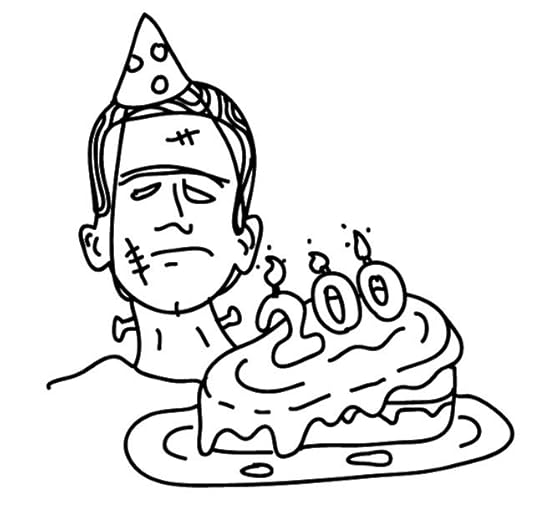
2018 marks the 200th anniversary of Mary Shelley's gothic masterpiece-- Frankenstein; or The Modern Prometheus. Widely recognized as one of the first works of science fiction, this revolutionary novel has truly withstood the test of time (and continues to haunt middle school literary criticism to this day!). Some may already know the broad strokes of how this story came to life: on a dark and stormy night (of course), 18 year old Mary joins her friends in a competitive game to see who can write the best horror story. Inspired by the rational ideals of the Enlightenment and recent advances in electricity research, Mary writes the short story that she will later develop into the novel we know and love.
Making the Monster dives quite bit deeper into the historical context of this work, piecing together not only Mary's biography but those of her family, friends and any intellectual or "natural philosopher" she may have been influenced by. This is interwoven with the upheavals in politics and the sciences leading up to her education and journey away from home. Though the narrative unravels into countless tangents and side-histories, it is well-organized and cohesive. This is a book for anyone who enjoys reading about the history of scientific progress-- the controversies, the blunders, and the experiments that got us where we are today. Whether or not you enjoyed (or even read) Frankenstein, if you appreciate its significance in history and are ready to fall down the rabbit-hole of alchemy, galvanism, and medical experimentation (oh my!), check it out.
// I received this book free from NetGalley in exchange for an honest review.
Making the Monster dives quite bit deeper into the historical context of this work, piecing together not only Mary's biography but those of her family, friends and any intellectual or "natural philosopher" she may have been influenced by. This is interwoven with the upheavals in politics and the sciences leading up to her education and journey away from home. Though the narrative unravels into countless tangents and side-histories, it is well-organized and cohesive. This is a book for anyone who enjoys reading about the history of scientific progress-- the controversies, the blunders, and the experiments that got us where we are today. Whether or not you enjoyed (or even read) Frankenstein, if you appreciate its significance in history and are ready to fall down the rabbit-hole of alchemy, galvanism, and medical experimentation (oh my!), check it out.
// I received this book free from NetGalley in exchange for an honest review.

February 5, 2018
I found Making the Monster to be a really interesting book. It is both a biography of Mary Shelley, as well as an exploration of the scientific achievements of that time. The book also explores Shelley's famous novel, Frankenstein. This book goes into all of these aspects in trying to explain how such a young woman wrote a book in the early 1800's that is still very popular today. Anyone familiar with pop culture knows that this book has not only inspired other books, but television characters, television shows and movies.
The book does explore Shelley's life including her family, education and what might have inspired her writing. Then the author explains Shelley's creation of the fictional character Frankenstein, but also discusses the history of science up until this point. I will say that the pace of this book is a bit slow, especially as it discusses the scientific aspects, but is very interesting since it encompasses so many different aspects. In the back of the book, there is also a very detailed timeline that includes both scientific events and personal events. Also, the cover of the hardcover edition of this book is beautiful. Overall, a very interesting book both about the author and the science of that time.
Thank you to the publisher, Bloomsbury, for sending me a review copy of this book.
The book does explore Shelley's life including her family, education and what might have inspired her writing. Then the author explains Shelley's creation of the fictional character Frankenstein, but also discusses the history of science up until this point. I will say that the pace of this book is a bit slow, especially as it discusses the scientific aspects, but is very interesting since it encompasses so many different aspects. In the back of the book, there is also a very detailed timeline that includes both scientific events and personal events. Also, the cover of the hardcover edition of this book is beautiful. Overall, a very interesting book both about the author and the science of that time.
Thank you to the publisher, Bloomsbury, for sending me a review copy of this book.

January 20, 2018
Kathryn Harkup doesn't seem to have missed much in this thoroughly researched and insightfully arranged work. *Bonus: the Timeline of events appendix is a glorious addition rather than a necessary element to help readers understand the vast amount of information that is packed into the pages, which is not always the case when a book is as dense with dates, names, and scientific exploration.*
"Making the Monster: The Science Behind Mary Shelley's Frankenstein" explores the life of Mary W. G. Shelley and the influence of scientific exploration that exploded during the Enlightenment and the early 19th century on her most famous work of fiction.
Harkup is able to show that while clearly a work of science fiction, even in today's world where new medical advances are continuously being made, Shelley's Frankenstein utilizes many of the early 19th century's experimental science to bring to life a monster character that permeates pop culture in ways that are a far leap from the pages of the original novel. Without losing sight of the central work of fiction and Mary Shelley herself, Harkup uses Mary's biographical information to show that she would have been highly knowledgeable of the scientific exploration happening in Europe during her early life; Harkup is then able to express the numerous ways actual scientific research was addressed and used to horrify Shelley's original readers .
Rather than just connecting Frankenstein's Victor Frankenstein to the scientific world of the time period, Harkup's work (as the subtitle expresses) provides her readers with a fantastic historical overview of the various scientific practitioners and experiments that of the time period through to how they have been used, advanced, or debunked into the twenty-first century.
I will warn that as with any text that explores early scientific methods, at times the visuals can be slightly gruesome, but nothing that can be seen as unnecessary gore. I also found the book to occasionally drift toward repetitiveness, but this was mainly due to the structure of the chapters and the need to discuss the same scientist or biologist in various areas throughout the book. For example, if the chapter was discussing chemistry and a specific person's experiments are examined, that same person may be discussed again in the chapter about electricity with a brief introduction into who the person was each time.
Overall, I enjoyed this book and learned more than I expected. I would recommend this to readers wanting to know more about Shelley (both of them), Frankenstein, and/or those that want to know more about how scientific experimentation and discovery have progressed throughout history (particularly in Western Europe).
Thank you, NetGalley and Bloomsbury publishing for the ARC of Harkup's book in exchange for my honest review.
"Making the Monster: The Science Behind Mary Shelley's Frankenstein" explores the life of Mary W. G. Shelley and the influence of scientific exploration that exploded during the Enlightenment and the early 19th century on her most famous work of fiction.
Harkup is able to show that while clearly a work of science fiction, even in today's world where new medical advances are continuously being made, Shelley's Frankenstein utilizes many of the early 19th century's experimental science to bring to life a monster character that permeates pop culture in ways that are a far leap from the pages of the original novel. Without losing sight of the central work of fiction and Mary Shelley herself, Harkup uses Mary's biographical information to show that she would have been highly knowledgeable of the scientific exploration happening in Europe during her early life; Harkup is then able to express the numerous ways actual scientific research was addressed and used to horrify Shelley's original readers .
Rather than just connecting Frankenstein's Victor Frankenstein to the scientific world of the time period, Harkup's work (as the subtitle expresses) provides her readers with a fantastic historical overview of the various scientific practitioners and experiments that of the time period through to how they have been used, advanced, or debunked into the twenty-first century.
I will warn that as with any text that explores early scientific methods, at times the visuals can be slightly gruesome, but nothing that can be seen as unnecessary gore. I also found the book to occasionally drift toward repetitiveness, but this was mainly due to the structure of the chapters and the need to discuss the same scientist or biologist in various areas throughout the book. For example, if the chapter was discussing chemistry and a specific person's experiments are examined, that same person may be discussed again in the chapter about electricity with a brief introduction into who the person was each time.
Overall, I enjoyed this book and learned more than I expected. I would recommend this to readers wanting to know more about Shelley (both of them), Frankenstein, and/or those that want to know more about how scientific experimentation and discovery have progressed throughout history (particularly in Western Europe).
Thank you, NetGalley and Bloomsbury publishing for the ARC of Harkup's book in exchange for my honest review.

July 23, 2018
2018 is the 200th anniversary of the publication of Mary Wollstonecraft Shelley’s Frankenstein: Or The Modern Prometheus. In the intervening two centuries, Shelley’s novel, originally published anonymously, has become her most famous and well-known work and an international icon. The name Frankenstein has become shorthand for both mad scientists running amok and their monstrous creations (which also tend to run amok!). So, it is fitting that during this bicentennial year, Dr. Kathryn Harkup, a UK based scientist and writer, would investigate the woman behind the novel and the science that impacted and influenced her work in Making The Monster: The Science Behind Mary Shelley's Frankenstein.
In the early 1800s, gothic romances and tales of strange, supernatural occurrences were commonplace. With Frankenstein, Shelley shunned the supernatural and referenced known contemporary scientific theories as the basis for her novel. This set the novel apart because, for contemporary readers, Frankenstein seemed possible. Harkup, a chemist and established science writer in the UK, explores those theories, and how over the centuries, they have fallen by the wayside or been developed into new(er) scientific ideas and disciplines. She also explains, step by step, the various methods and avenues available to Shelley’s Victor Frankenstein for the completion of his “project” through chapters with names like “Preservation,” “Construction,” “Electrification” and “Reanimation.” For example, in the chapter called “Collection,” Harkup addresses the question of how and where Victor would obtain the parts necessary to assemble his creature. She describes the availability of bodies for the burgeoning science of dissection, the schools that secured bodies for study, and the gentlemen from whom they purchased them. She also explores what those gentlemen were paid and how some may have become a bit too anxious while waiting for individuals to be available to fulfill the increasing demand for cadavers. Sometimes creepy, but always informative and entertaining, Harkup provides context and understanding to all of the scientific aspects to Shelley’s novel. She also does an admirable job of providing a biographical sketch of Shelley, her parents, siblings, husband and other influential individuals who played a role in the creation of her masterwork.
Part biography, part literary analysis and part scientific examination of the principles and theories that impacted and influenced Shelley while writing the novel, Making the Monster is a fascinating and compelling exploration of the creation of one of the most important novels of the last two hundred years.
Reviewed by Daryl M., Librarian, West Valley Regional Branch Library,
In the early 1800s, gothic romances and tales of strange, supernatural occurrences were commonplace. With Frankenstein, Shelley shunned the supernatural and referenced known contemporary scientific theories as the basis for her novel. This set the novel apart because, for contemporary readers, Frankenstein seemed possible. Harkup, a chemist and established science writer in the UK, explores those theories, and how over the centuries, they have fallen by the wayside or been developed into new(er) scientific ideas and disciplines. She also explains, step by step, the various methods and avenues available to Shelley’s Victor Frankenstein for the completion of his “project” through chapters with names like “Preservation,” “Construction,” “Electrification” and “Reanimation.” For example, in the chapter called “Collection,” Harkup addresses the question of how and where Victor would obtain the parts necessary to assemble his creature. She describes the availability of bodies for the burgeoning science of dissection, the schools that secured bodies for study, and the gentlemen from whom they purchased them. She also explores what those gentlemen were paid and how some may have become a bit too anxious while waiting for individuals to be available to fulfill the increasing demand for cadavers. Sometimes creepy, but always informative and entertaining, Harkup provides context and understanding to all of the scientific aspects to Shelley’s novel. She also does an admirable job of providing a biographical sketch of Shelley, her parents, siblings, husband and other influential individuals who played a role in the creation of her masterwork.
Part biography, part literary analysis and part scientific examination of the principles and theories that impacted and influenced Shelley while writing the novel, Making the Monster is a fascinating and compelling exploration of the creation of one of the most important novels of the last two hundred years.
Reviewed by Daryl M., Librarian, West Valley Regional Branch Library,
February 16, 2026
This was SO fascinating. Mary Shelley has been one of my 2026 obsessions, and this was exactly the kind of book I was hoping to read. The first half of the book was her early life into young adulthood, which I very much enjoyed and I learned so much. It also went hand-in-hand with historical events that were going on at the time that would have inspired her to write Frankenstein. Her life was, to say the least, tumultuous yet full of passion. Her whirlwind romance with Percy Blysse Shelley was so much and it only lasted a short while. I can’t believe how much happened with them only for it to all end when Mary was 25. Their life was so stereotypically Goth™️, it’s incredible. They were the blueprint. All the people in their life, especially Byron, was such a big influence on them. Were the relationships healthy amongst the famous group? No, but they inspired one another immensely. The fact that Mary wrote Frankenstein before the age of 20, and she had already endured the loss of a child and so much, is just mind-blowing. I just wish I could go back to that night of the ghost story challenge and be invisible, just to see!! I loved learning about all the scientific discoveries and happenings that Mary would have known about that inspired Victor Frankenstein. To understand what Victor would have known and not known was so interesting. This book was very well written and I spent much of my day reading it. I learned so much! So many interesting facts! 5 stars!! ⭐️ 🖤

August 14, 2018
I don't think I realized just how little I knew about Mary Shelley and her husband, Percy Shelley or what was going on around Mary when Frankenstein was being written. Shelley's childhood was chaotic and lacking in any kind of formal education yet she was incredibly curious and well read. What little I knew about Mary Shelley I knew even less about what was going on in scientific world at the time and was very surprised about the number and scope of experiments involving electricity.
This book was fascinating. I had never really thought about putting Frankenstein in historical context and didn't realize just how much that would add to the story. While I found it interesting from the start it took me awhile to get invested in the book. This isn't a nonfiction book that reads like a novel, however, once the book got past Mary's childhood (about 10 - 15%) the pace picked up and I found it a really compelling read.
While this was a really interesting standalone I think it would be even better as companion read to Frankenstein. The book talks quite a bit about influences in the book itself which I think would make Frankenstein a richer and more interesting read. This was a compelling read with an unusual focus and a book that will bring fresh perspective on a classic.
This book was fascinating. I had never really thought about putting Frankenstein in historical context and didn't realize just how much that would add to the story. While I found it interesting from the start it took me awhile to get invested in the book. This isn't a nonfiction book that reads like a novel, however, once the book got past Mary's childhood (about 10 - 15%) the pace picked up and I found it a really compelling read.
While this was a really interesting standalone I think it would be even better as companion read to Frankenstein. The book talks quite a bit about influences in the book itself which I think would make Frankenstein a richer and more interesting read. This was a compelling read with an unusual focus and a book that will bring fresh perspective on a classic.

June 24, 2026
Lettura molto densa eppure scorrevole, scritta (o tradotta?) in modo piacevolissimo tant'è che a volte pare di leggere un testo di gossip, ho adorato i commenti ironici dell'autrice.
Ho amato i dettagli truculenti degli esperimenti scientifici e delle pratiche mediche dell'epoca, e ho capito meglio il terreno illuminista in cui è sorta l'opera di Mary Shelley. Interessanti anche i riferimenti all'immaginario generale del mostro di Frankenstein e agli adattamenti dell'opera, che a volte esulano dalla versione di Mary Shelley ma che sono comunque influenzati dalla cultura del 700 e 800.
Io SCONVOLTA dell'incisione di Goya Caprichos n 50, ANTECEDENTE al libro di Shelley!!!!
Bisogna dire però che alcune connessioni tra scoperte scientifiche e romanzo paiono tirate, non ci sono evidenze che Shelley fosse a conoscenza di molte di queste, e comunque gli esperimenti di Victor Frankenstein non sono così approfonditi e descritti nel romanzo.
Mi sento poi di fare un appunto perché il sottotitolo italiano è fuorviante: qui non si parla di gotico e femminismo, si tratta solo e unicamente di scienza (e va bene anche così! Tutto molto interessante a parte forse la parte sull'elettricità che ho trovato troooooooooppo approfondita)
Mary Shelley comunque, che tosta.
Ho amato i dettagli truculenti degli esperimenti scientifici e delle pratiche mediche dell'epoca, e ho capito meglio il terreno illuminista in cui è sorta l'opera di Mary Shelley. Interessanti anche i riferimenti all'immaginario generale del mostro di Frankenstein e agli adattamenti dell'opera, che a volte esulano dalla versione di Mary Shelley ma che sono comunque influenzati dalla cultura del 700 e 800.
Io SCONVOLTA dell'incisione di Goya Caprichos n 50, ANTECEDENTE al libro di Shelley!!!!
Bisogna dire però che alcune connessioni tra scoperte scientifiche e romanzo paiono tirate, non ci sono evidenze che Shelley fosse a conoscenza di molte di queste, e comunque gli esperimenti di Victor Frankenstein non sono così approfonditi e descritti nel romanzo.
Mi sento poi di fare un appunto perché il sottotitolo italiano è fuorviante: qui non si parla di gotico e femminismo, si tratta solo e unicamente di scienza (e va bene anche così! Tutto molto interessante a parte forse la parte sull'elettricità che ho trovato troooooooooppo approfondita)
Mary Shelley comunque, che tosta.

June 25, 2021
Fascinante y profundo ensayo tanto de la vida de la autora Mary Shelly (que por ella misma ya se merece un libro entero) como de su magnifica obra. Desde luego encantará especialmente a quienes sean admiradores de Frankenstein, pero la descripción que hace del estado del arte de la ciencia de los s. XVIII y XIX fascinará igualmente a todo lector, pues toca todas las facetas que en esa época estaban tan "de moda", alquimia, galvanismo, química, electricidad, fisiología, medicina, ética ... todas ellas ciencias que conformaron al moderno Prometeo, que en aquella época casi se llegó a creer posible su creación. En resumen, un maravilloso ensayo sobre uno de los primeros libros de ciencia ficción
Displaying 1 - 30 of 167 reviews